Most important takeaways…
- Post-master's PMHNP certificates near Newark can be completed in roughly 12 to 18 months, the fastest route available.
- Every accredited program requires a minimum of 500 direct clinical hours regardless of its accelerated format.
- BSN-to-MSN PMHNP tracks typically run 24 to 36 months, even at schools offering year-round scheduling.
- Newark metro PMHNPs earn salaries well above national NP averages, accelerating tuition payback for faster finishers.
Northern New Jersey faces a psychiatric provider shortage that state health agencies have tracked for over a decade, and PMHNPs now fill prescriber gaps that psychiatrists alone cannot cover. For nurses ready to move into this role, several accredited programs within commuting distance of Newark offer completion timelines well under the traditional three-year track, some as short as 18 months for those entering with an existing MSN. If you already hold a graduate degree and want the quickest path, a post-master's PMHNP certificate program may be your best option.
The pages ahead compare ranked programs by speed and cost, break down BSN-to-MSN versus post-master's pathways, and detail clinical placement realities specific to the Newark metro. Licensure steps for 2026 and practical survival tactics round out the picture, because finishing fast means little if the credential does not translate to practice.
Accelerated PMHNP Programs Near Newark, NJ: Ranked by Speed and Value
The programs below were evaluated on a composite of completion speed, net price, graduate earnings, and online or hybrid flexibility, not any single factor. Institution-wide graduation rates and average net prices are included for context, but keep in mind these are university-level figures and may not reflect your individual cost or timeline. Program-level earnings data is not yet available for these PMHNP tracks, so we report institution-wide median earnings where published.
- Completion speed and credit load
- Net price after financial aid
- Institution-wide graduate earnings
- Online and hybrid flexibility
- Clinical hour requirements
- Internal program database
- NCES-IPEDS federal institutional data — nces.ed.gov
- Independent program research
- College Scorecard graduate earnings — collegescorecard.ed.gov

Thomas Edison State University
Thomas Edison State University is a public institution in Trenton built around flexible, career-friendly degree completion. Its PMHNP MSN program is designed specifically for New Jersey RNs, with small cohort sizes of roughly eight students per start and both part-time and full-time pacing options. TESU's public-university tuition structure and low median graduate debt make it a standout value in the state.
- 46 credits with online coursework and in-person clinicals
- Full-time and part-time tracks available
- Four start dates per year (approx. every 16 weeks)
- Small cohorts of about 8 students per start
- One-on-one clinical preceptorships arranged in NJ
- CCNE accredited, prepares for ANCC certification
- In-state tuition approximately $6,838 per year
- Post-master's PMHNP certificate option at 31 credits
Psychiatric Mental Health Nurse Practitioner MSN — Hybrid

Fairleigh Dickinson University
Fairleigh Dickinson University's Madison campus offers a fully online, 43-credit MSN with a Psychiatric-Mental Health Care concentration. The program is designed around working nurses' schedules, combining synchronous and asynchronous coursework with rolling admissions across fall, spring, and summer terms. Most students complete in roughly 2.5 to 3 years, and FDU's clinical network across the North Jersey corridor helps Newark-area students arrange the required 750 hours close to home.
- 43 credits, fully online with sync and async sessions
- 750 required clinical hours, arrangeable locally in NJ
- Rolling admissions with fall, spring, and summer entry
- Part-time pacing, estimated 2.5 to 3 year completion
- 2.8 GPA and active RN licensure required
- Includes psychopharmacology and advanced pharmacology
- Prepares for ANCC PMHNP certification exams
- NursingCAS application with virtual interview option
Psychiatric Mental Health Nurse Practitioner MSN — Online

Seton Hall University
Seton Hall University, a private institution just 10 to 12 miles from Newark in South Orange, delivers a 49-credit online MSN PMHNP program rooted in its CCNE-accredited College of Nursing. The curriculum includes 600 clinical hours and prepares graduates for ANCC certification. With no set log-in times for coursework and proximity to the NYC metro clinical market, the program is built for working nurses who need schedule control while completing a rigorous psychiatric NP education in three to four years.
- 49 credits with fully online, asynchronous coursework
- 600 clinical training hours with regional placements
- 3 to 4 year completion timeline
- CCNE accredited with ANCC certification preparation
- Conditional acceptance available before NCLEX results
- One year of direct patient care required before practicum
- Fall (Aug 1) and spring (Dec 15) application deadlines
- Values-based curriculum with integrated mentorship
MSN Psychiatric-Mental Health Nurse Practitioner — Online

Fairleigh Dickinson University-Metropolitan Campus
Fairleigh Dickinson University's Metropolitan Campus in Teaneck shares the same 43-credit, fully online PMHNP curriculum offered at the Madison campus but sits in the heart of North Jersey's densely populated healthcare corridor. Newark-area students benefit from an extensive local clinical network spanning Essex, Bergen, Hudson, and Passaic counties, which can help secure preceptor sites faster. The average net price at this campus is lower than many private competitors in the region.
- 43 credits, fully online with synchronous components
- 750 clinical hours in North Jersey communities
- Rolling admissions with three annual start terms
- Part-time pacing suited to shift-working nurses
- Psychopharmacology and advanced health assessment courses
- Eligible for ANCC PMHNP certification upon completion
- Average net price around $15,400 (institution-wide)
Psychiatric Mental Health Nurse Practitioner MSN — Online
How Long Does a PMHNP Program Take in New Jersey?
A BSN-prepared nurse eyeing the PMHNP role faces a very different timeline than a colleague who already holds an MSN in another specialty. Understanding which entry point applies to you is the single biggest factor in how quickly you can start practicing psychiatric mental health care.
Three Entry Points, Three Timelines
Most candidates fall into one of three categories:
- BSN-to-MSN PMHNP (2 to 3 years full-time): This is the most common path for bedside RNs. Programs in New Jersey typically range from 39 to 49 credits.3 Felician University's online MSN PMHNP requires 39 credits and can be completed in about 24 months, while Seton Hall University's program runs 49 credits over 24 to 36 months full-time (or up to six years part-time). Thomas Edison State University falls in a similar band at 46 credits and 24 to 36 months.
- Post-master's certificate (often 12 to 18 months): If you already hold an MSN, a certificate program lets you add the PMHNP specialty without repeating core graduate coursework. Thomas Edison State University offers a post-master's PMHNP certificate at 31 credits, with an estimated timeline of 18 to 30 months depending on enrollment pace.3 This is the realistic route for anyone hoping to finish closest to the one-year mark.
- Direct-entry MSN for non-nurses (3 to 4 years): These programs bundle prelicensure nursing coursework with the graduate PMHNP track. They are the longest path by a wide margin and are less common in New Jersey specifically.
Can You Really Finish in One Year?
Let's address this directly: a standalone MSN PMHNP completed in 12 months is virtually nonexistent. The credit loads alone, typically 39 to 49 credits, make a single calendar year impractical even with year-round enrollment. Post-master's certificates are the closest you will get to a one-year finish, and even those usually extend to 18 months once clinical scheduling is factored in. For a broader look at program options and timelines, see our ranking of online MSN PMHNP programs.
What "Accelerated" Actually Means
When a program markets itself as accelerated, it does not necessarily mean fewer total credits. Instead, you will typically encounter a combination of strategies:
- Year-round enrollment with no summer break
- Compressed semesters (seven or eight weeks instead of fifteen)
- Higher per-term credit loads, sometimes 12 to 15 graduate credits in a single semester
These approaches shrink calendar time without reducing rigor. Walsh University's online MSN PMHNP, for example, requires 48 credits and 600 clinical hours yet targets a 24-month completion for full-time students.4
The Clinical Hours Floor
No matter how aggressively a program compresses its didactic coursework, the American Nurses Credentialing Center requires a minimum of 500 supervised clinical hours for PMHNP certification eligibility. Many New Jersey programs exceed that threshold. Seton Hall and Walsh both require 600 hours, Chamberlain University requires 625, and Felician University builds in 750 hours.45 Securing and scheduling those placements takes real calendar time, which is why even the fastest programs rarely dip below 24 months for the full MSN track. Keep this floor in mind as you compare timelines: a program promising speed still has to fit those clinical hours into your schedule alongside coursework.
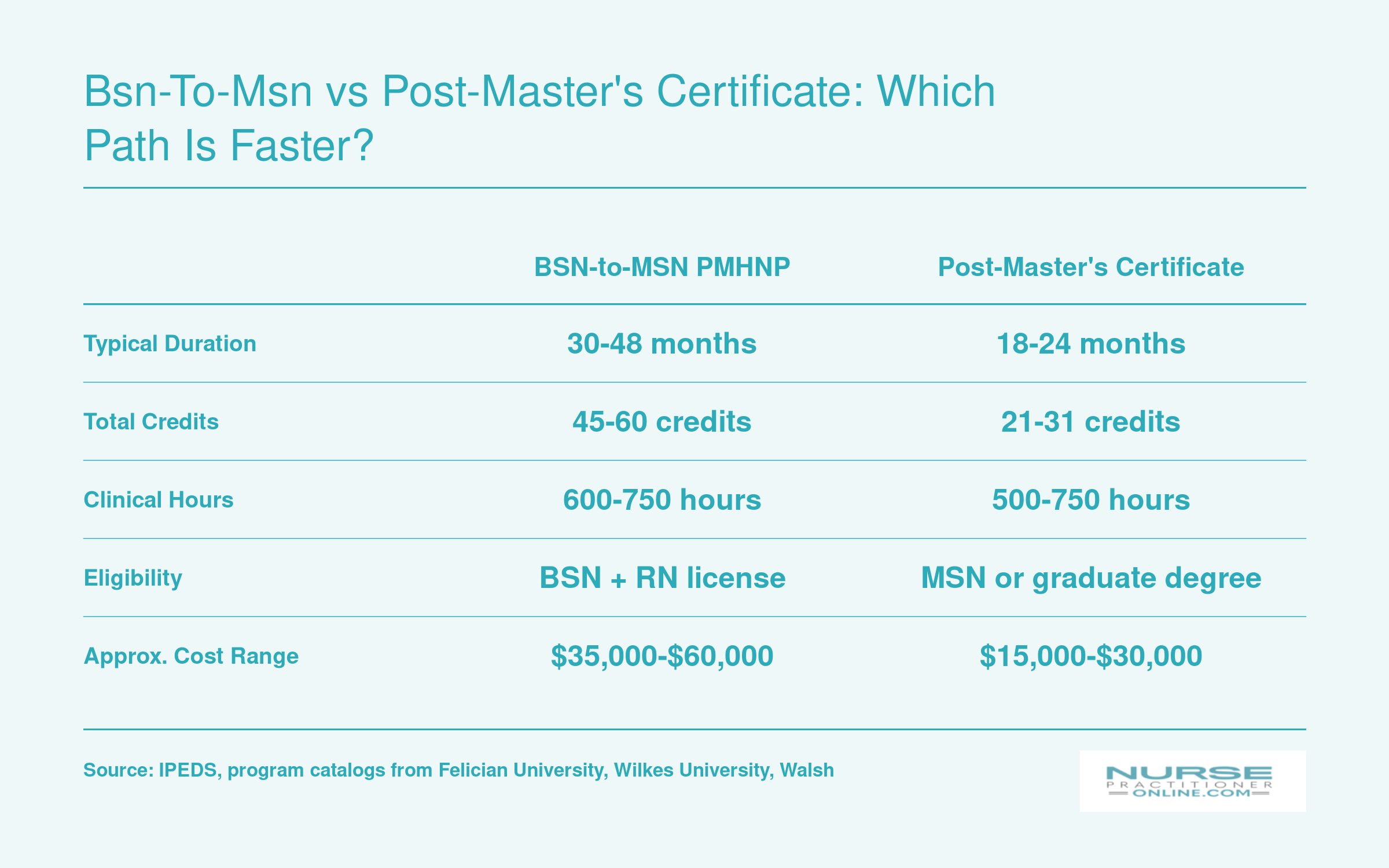
BSN-to-MSN vs Post-Master's Certificate: Which Path Is Faster?
If you already hold an MSN in another nurse practitioner specialty, you can add PMHNP certification without repeating core graduate coursework, saving significant time and money. The post-master's certificate is the fastest route into psychiatric mental health practice, but it requires an existing MSN or related graduate degree. Here is how the two pathways compare across five key attributes.
What Makes an Accelerated PMHNP Program Different?
Choosing an accelerated PMHNP track over a traditional-paced program means trading the comfort of a slower cadence for the urgency of reaching clinical practice sooner. Both paths prepare you for the same board exam and the same scope of practice, but the condensed format compresses coursework, intensifies clinical placement schedules, and demands unwavering discipline. Understanding the structural differences helps you decide whether speed is your best ally or a setup for burnout.
Compressed Semester Schedules and Higher Weekly Course Load
Accelerated programs condense the same credit hours into fewer calendar months. A traditional MSN PMHNP track might spread 45 credits over six to seven semesters, allowing you to juggle part-time clinical work or family responsibilities. An accelerated cohort typically completes those credits in 12 to 18 months, doubling or tripling the weekly workload. Expect to enroll in three or four courses simultaneously and spend 20 to 30 hours per week on didactic work alone. When clinical rotations begin, you'll add another 16 to 24 weekly hours of supervised practice, often scheduled in long weekend or evening blocks to accommodate students balancing a nursing job.
Continuous Enrollment and Limited Breaks
Most accelerated programs run on a year-round calendar with cohorts progressing through a fixed sequence. Summer breaks shrink to two weeks or disappear entirely. This continuous enrollment means no extended downtime between terms to decompress or catch up on readings. The upside is straightforward: you stay immersed in psychiatric nursing content, which helps retain the dense pharmacology and psychotherapeutic frameworks that define PMHNP practice.
Board Pass Rates: Accelerated vs. Traditional Formats
One common question is whether accelerated graduates pass the certification exam at the same rate as their peers in longer programs. National data from 2024 and 2025 show that PMHNP board exam pass rates hover around 82 percent across both the ANCC and AANP certifications, with nearly 9,633 candidates sitting for the ANCC exam and about 1,333 for the AANP version in the most recent reporting periods.12 Neither certifying body publishes pass-rate breakdowns by program length, so comparing accelerated versus traditional cohorts directly is not yet possible from public reports.3
How to Find Program-Specific Pass Rate Data
Because national summaries do not stratify by program duration, you'll need to dig deeper:
- Visit the ANCC official website for annual certification reports; some years include aggregated data by candidate demographics or educational pathway.3
- Contact admissions offices directly at the schools you're considering; many provide recent cohort pass rates in recruitment materials or upon request.
- Check with your state board of nursing, which may collect outcome data from in-state programs for approval or reaccreditation reviews.
- Explore resources from the American Association of Nurse Practitioners (AANP), which occasionally publishes comparative studies on program outcomes and graduate readiness.
Until more granular public data emerges, the best proxy for program quality remains nursing program accreditation status, clinical site partnerships, and testimonials from recent graduates about their exam readiness. For a deeper look at the nurse practitioner licensing process itself, understanding each state's requirements can help you plan your timeline from graduation to practice.
Questions to Ask Yourself
Clinical Placements for PMHNP Students in the Newark Area
Clinical placement is the bridge between didactic coursework and independent practice. For accelerated PMHNP students in New Jersey, the difference between a program that arranges your sites and one that requires you to find your own can mean the difference between finishing on time or pushing graduation back by several months.
Placement Support: Two Models
Some programs guarantee or actively arrange clinical sites for all enrolled students. Felician University's MSN PMHNP program, for example, includes clinical placement support as part of the curriculum. Other programs operate under a self-sourcing model, where students are responsible for identifying and securing preceptors and clinical sites independently. While self-sourcing can offer geographic flexibility and local networking opportunities, it introduces significant risk in accelerated tracks. A single semester delay while hunting for a preceptor can stretch a 12-month program into 18 months and disrupt employment plans. Before you enroll, confirm in writing what level of clinical placement assistance the program provides, especially if you are considering an online program based outside New Jersey. If you're still weighing the enrollment process, our guide on how to enroll in NP school online walks you through each step.
Major Psychiatric Clinical Settings Near Newark
The Newark metro area offers a range of psychiatric settings suitable for PMHNP clinical rotations. Rutgers University Behavioral Health Care (UBHC) operates outpatient clinics and partial hospitalization programs throughout the region. Rutgers DNP PMHNP students rotate through state and county psychiatric hospitals, forensic nurse practitioner facilities, and long-term care settings with behavioral health units. Community mental health centers serving Essex, Hudson, and Bergen counties provide outpatient and crisis intervention placements. The East Orange VA Medical Center maintains both inpatient psychiatric units and outpatient mental health services. Major health systems with dedicated psych units, including RWJBarnabas Health and Saint Barnabas Medical Center, accept advanced practice nursing students for inpatient rotations.
Shortage Areas and Loan Repayment
Many Newark-area zip codes carry federal Health Professional Shortage Area (HPSA) designations for mental health, reflecting the region's unmet demand for psychiatric providers. Practicing in a HPSA may make you eligible for loan repayment programs through the National Health Service Corps or state-funded initiatives. These designations can also improve preceptor availability, as clinical sites in underserved areas often welcome students as part of workforce pipeline strategies.
Seton Hall University's MSN PMHNP program requires 600 clinical hours, and students should expect to complete those hours across multiple settings to gain exposure to diverse patient populations and treatment modalities.
Cost, ROI, and Financial Aid for Accelerated PMHNP Programs
Public university tuition versus private school sticker price can mean a five-figure difference in total cost, yet the fastest program is not always the cheapest one when you measure what really matters: cost per month of study.
Tuition Ranges Near Newark
Among New Jersey PMHNP programs close to the Newark area, published tuition varies widely:
- Thomas Edison State University: Approximately $12,150 for in-state and out-of-state students alike, covering a 46-credit MSN. That figure makes TESU the most affordable option in this group by a significant margin.
- Fairleigh Dickinson University: Roughly $19,000 to $25,600 depending on the campus, for a 43-credit program with 750 clinical hours.
- Seton Hall University: About $37,470 for a 49-credit online MSN, reflecting the school's private university pricing.
When you divide total tuition by the number of months in each program's typical timeline, the cost-per-month picture shifts. A program that costs less overall but stretches to four years may cost you more each month in tuition and delayed earnings than a pricier program you finish in two years. Run that math before you commit.
What Graduates Can Expect to Earn
Program-level earnings data for these specific PMHNP tracks are not yet published, so we have to look at the broader picture. According to the Bureau of Labor Statistics, nurse practitioners in the New York-Newark-Jersey City metro area earned a mean annual wage of roughly $141,000 based on the most recent available data. Psychiatric mental health NPs in high-demand areas of New Jersey may command salaries at or above that figure, though individual earnings depend on setting, experience, and whether you practice in an underserved community.
Even at the highest tuition in this group, a PMHNP working in the Newark metro can reasonably expect to recover the full cost of the degree within the first year or two of practice.
Financial Aid Worth Exploring
New Jersey offers several funding avenues that can soften the blow of an accelerated program's condensed payment schedule:
- NJCLASS Loans: The state's supplemental loan program covers graduate students at competitive interest rates and does not require federal loan limits to be exhausted first.
- HRSA Nurse Corps Loan Repayment: PMHNPs who commit to working in Health Professional Shortage Areas (many of which exist in and around Newark for mental health) can qualify for repayment of up to 85% of qualifying nursing education debt over three years. Given the acute shortage of psychiatric providers in New Jersey, this is one of the most valuable programs available to new PMHNPs.
- Employer tuition reimbursement: Many hospitals and health systems in northern New Jersey offer tuition assistance ranging from $3,000 to $10,000 or more per year. If you are currently working as an RN, check whether your employer's benefit extends to graduate-level education and whether it requires a post-graduation service commitment.
Before you fixate on the sticker price, add up what you will actually pay out of pocket after aid, then weigh that against the salary bump you will see within a year of graduating. For most working nurses in the Newark metro, an accelerated PMHNP program delivers one of the strongest returns on investment in all of advanced practice nursing.
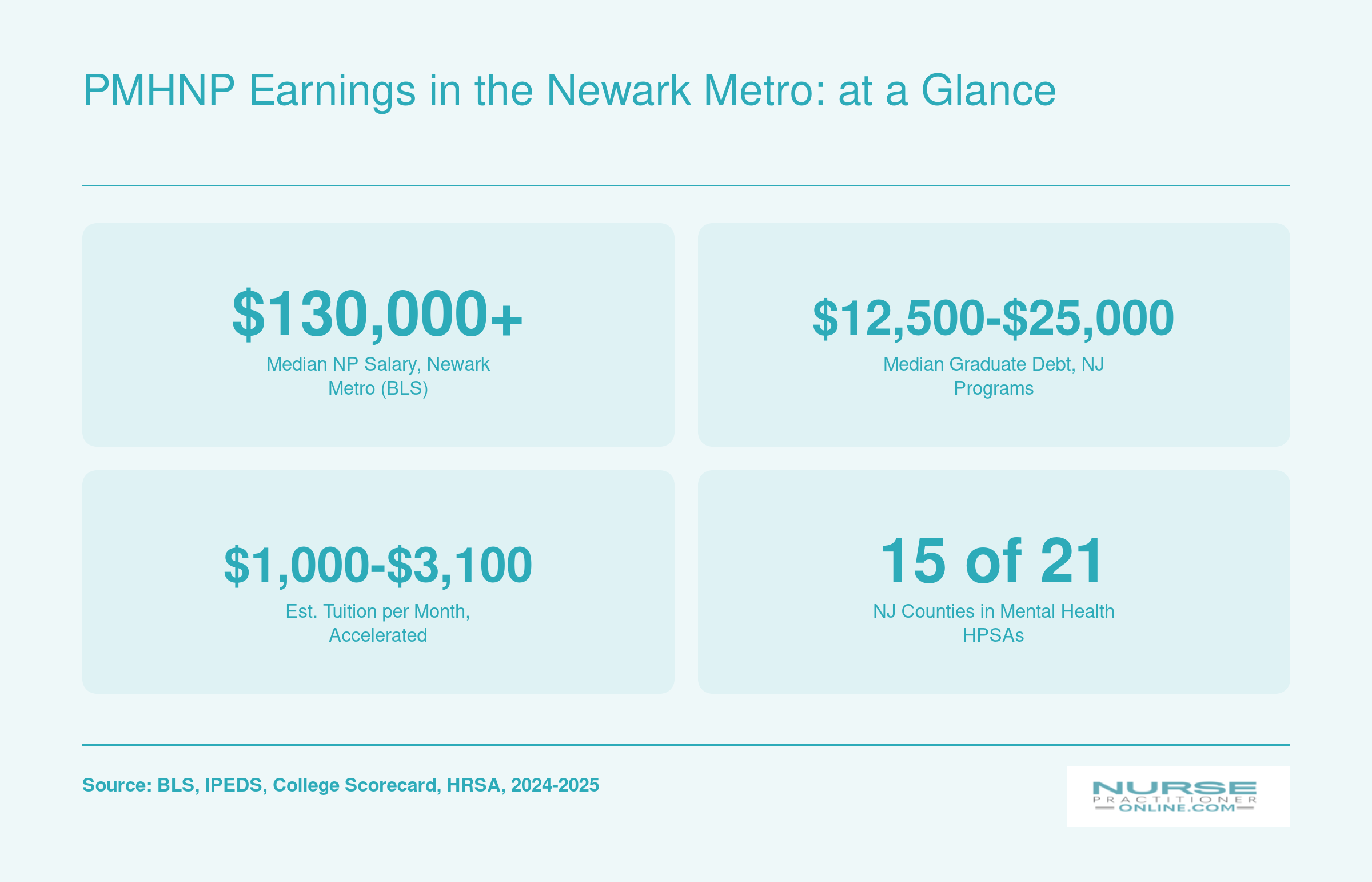
PMHNP Earnings in the Newark Metro: At a Glance
The Newark metro area combines strong NP salaries with acute demand for psychiatric providers, which means accelerated PMHNP graduates can start recouping their investment almost immediately. Finishing faster doesn't just save on tuition months; it moves you into a high-wage role sooner in a market that urgently needs you.
NJ Licensure Steps for New PMHNPs
Once you finish your accelerated program, a few concrete steps stand between you and practicing as a Psychiatric Mental Health Nurse Practitioner in New Jersey. Here is your checklist for 2026.
- Hold an active New Jersey RN licenseYou must have a current, unencumbered registered nurse license in the state before applying for Advanced Practice Nurse (APN) certification.
- Graduate from an accredited PMHNP programYour program must be accredited by either CCNE or ACEN. This is non-negotiable, both the ANCC and the NJ Board of Nursing require it. If a program lacks one of these accreditations, you will not qualify for the national certification exam or state licensure.
- Pass the ANCC PMHNP-BC certification examThe American Nurses Credentialing Center administers the Psychiatric-Mental Health Nurse Practitioner board certification. New Jersey requires national certification for APN licensure, and the PMHNP-BC is the credential specific to this specialty.
- Complete a background checkThe state requires a criminal background check as part of every APN application.
- Secure malpractice insuranceYou must carry professional liability coverage before you begin clinical practice in New Jersey.
- Understand the collaborative agreement requirementNew PMHNPs with fewer than 5,000 APN practice hours must maintain a joint protocol (collaborative agreement) with a collaborating physician or another qualified APN. As of April 2, 2026, New Jersey grants full practice authority once you accumulate 5,000 supervised hours, after that, you can practice independently.
- Know the prescribing rulesNew Jersey requires 14 hours of controlled-substances pharmacology education plus 10 continuing-education hours per biennium. Also note that for Schedule II prescriptions via telehealth, an in-person visit is required for new patients.
- Apply through the NJ Division of Consumer AffairsSubmit your APN application, supporting documents, and fees to the New Jersey Division of Consumer Affairs Board of Nursing. Full requirements are outlined on the Board's APN application page.
Surviving an Accelerated PMHNP Program: Practical Advice
Let's be honest: compressing a PMHNP program into the shortest possible timeline is not a casual commitment. Most accelerated tracks demand 20 to 30 hours of study per week on top of clinical rotations, and that workload lands squarely on shoulders already carrying a nursing career, family obligations, or both. Burnout is a real risk, not a hypothetical one. The good news is that nurses who plan deliberately tend to finish strong. Here are strategies that make the difference.
Lock Down Clinical Sites Early
One of the biggest sources of stress in any NP program is scrambling for clinical placements mid-semester. In an accelerated format you simply do not have a buffer. Start reaching out to psychiatric facilities, community mental health centers, and preceptors the moment you receive your acceptance letter. Programs near the Newark metro often compete for the same clinical slots, so front-loading this task saves you weeks of anxiety later.
Simplify Everything Else
Batch meal prep on weekends. Automate bill payments. Build a household schedule that your family or roommates can follow without your constant input. The goal is to strip away every small decision that drains mental energy during the week. Students who treat logistics like a project plan, rather than something they figure out on the fly, report far less overwhelm.
Use Your Cohort as a Resource
Accelerated programs almost always move students through coursework as a group. Lean into that structure. Form study groups early, share clinical prep notes, and check in on each other. A cohort that communicates well becomes a built-in support network, and it makes dense pharmacology or psychotherapy modules much more manageable.
Talk to Your Employer Before You Enroll
If you plan to keep working, negotiate schedule flexibility before classes begin, not after the first exam. Many healthcare employers are willing to shift you to per diem status or adjust your rotation days when they know you are pursuing an advanced degree. Getting that agreement in writing protects you if management changes mid-program.
Use the Short Timeline as Fuel
When the pace feels relentless, remember the math. Every semester you shave off the traditional timeline is several months of earning a full PMHNP salary sooner. If you are still weighing specialty options, browsing the best online PMHNP programs can help you compare timelines side by side. In the Newark metro, where psychiatric NP compensation is well above the national average, that acceleration translates into real financial momentum.
Ask About Bridge or Recovery Semesters
Many accelerated programs quietly build in a lighter semester, sometimes called a bridge term, that reduces course intensity for a few weeks to prevent attrition. Not every school advertises this. When you are comparing programs, ask admissions directly whether the curriculum includes any pacing relief. A well-designed bridge semester can be the difference between finishing on time and burning out at the halfway mark.
Common Questions About Fast PMHNP Programs in New Jersey
Below are the questions we hear most often from nurses researching accelerated PMHNP options near Newark. Each answer draws on the program details, timelines, and cost data covered earlier in this article.
- Can you finish a PMHNP program in one year?
- A full BSN-to-MSN PMHNP program in one year is extremely rare because of the 500 or more clinical hours required by certification boards. However, post-master's certificate tracks can sometimes be completed in as few as 12 months if you carry a full course load and already hold an MSN. See the BSN-to-MSN vs. post-master's comparison section above for a side-by-side timeline.
- What is the fastest PMHNP program you can complete online?
- Several online programs featured in our ranking can be completed in roughly five to six semesters for BSN-prepared nurses who enroll full time and take courses year round, including summers. The fastest options typically use asynchronous coursework with locally arranged clinical rotations, letting working nurses maintain their schedules. Check the ranked list above for specific program lengths.
- What is the shortest post-master's PMHNP certificate program?
- Post-master's certificate programs are generally the shortest path because they waive core MSN coursework you have already completed. Many of the programs near Newark can be finished in three to four semesters, and a handful offer accelerated tracks as short as 12 months. The infographic earlier in the article compares certificate and full MSN timelines in detail.
- Does choosing a faster PMHNP program affect certification exam pass rates?
- Not necessarily. Accredited programs, whether accelerated or traditional, must meet the same clinical hour and curricular standards set by bodies like CCNE or ACEN. What matters most is the quality of clinical mentorship and your own preparation. Review each program's published ANCC or AANP board pass rates before enrolling, as we discuss in the ranking section.
- Which NJ PMHNP programs arrange clinical placements for students?
- Some New Jersey programs coordinate clinical sites on your behalf, while others expect you to secure your own preceptors. Programs affiliated with large health systems in the Newark metro area often have established placement pipelines. Our clinical placements section above identifies which schools assist with site arrangements and offers tips for finding preceptors independently.
- How much does an accelerated PMHNP program cost in New Jersey?
- Total tuition for accelerated MSN PMHNP programs near Newark generally ranges from roughly $30,000 to over $80,000, depending on the school and whether you qualify for in-state rates. Post-master's certificates tend to cost less because they require fewer credits. The cost, ROI, and financial aid section earlier in this article breaks down tuition benchmarks and funding options.