
Most important takeaways…
- Michigan AGACNP programs require 500 to 750 or more clinical hours in ICUs, ERs, or acute inpatient settings.
- ANCC and AACN each offer a national AGACNP certification, and Michigan accepts both for state licensure.
- Nurse practitioner employment is projected to grow 40 percent from 2023 to 2033 nationwide.
- Michigan still requires collaborative practice agreements for acute care NPs, so full practice authority is not yet available.
Which online AGACNP programs actually accept Michigan nurses, and how do their clinical placement requirements stack up against a full-time hospital schedule? Acute care units across the state, from Detroit's major health systems to regional trauma centers in Grand Rapids and Flint, continue posting openings for ACNPs faster than local programs can produce graduates.
The pool of online-eligible adult-gerontology acute care NP programs serving Michigan is small, typically three institutions, which makes comparing tuition, credit loads, and the 500-to-750-plus required clinical hours straightforward but high-stakes. Getting the clinical logistics wrong can delay graduation by a full semester or more, a costly setback for nurses already balancing night shifts and coursework. If you are also weighing a doctoral pathway, our ranking of online DNP acute care nurse practitioner programs can help you compare options beyond the state level.
Best Online Acute Care Nurse Practitioner Programs for Michigan Nurses, 2026
The following online AGACNP programs were selected from online-delivery-eligible acute care nurse practitioner offerings at Michigan institutions and ordered by a composite quality score that weights online accessibility alongside institutional outcomes. Whether you are eyeing a DNP, an MSN, or a post-master's certificate, each program below offers a distinct pathway into acute care advanced practice while letting you keep working at the bedside.
- Online delivery accessibility
- Institutional graduation outcomes
- Graduate earnings potential
- Clinical placement support
- Program flexibility and format
- NCES-IPEDS federal institutional data — nces.ed.gov
- Internal program database
- Independent program research
- College Scorecard graduate earnings — collegescorecard.ed.gov

University of Michigan
The University of Michigan pairs a highly selective admissions process with deep clinical ties to Michigan Medicine, one of the state's premier academic health systems. Its AGACNP track sits within a DNP framework taught by faculty who actively practice in ICUs and specialty clinics, and the school posts an overall graduation rate of about 93%. Median earnings for graduates across the institution reach roughly $83,600 ten years after enrollment, reflecting the strength of the broader U-M credential.
- Hybrid DNP with first term entirely in the classroom
- Choose from 3-year or 4-year completion plans
- Faculty are practicing clinicians in acute care settings
- Emphasizes diagnostic reasoning and therapeutic interventions
- Clinical rotations leverage Michigan Medicine facilities
- Prepares graduates for national AGACNP board certification
- Designed for RNs with existing acute or critical care experience
DNP Adult-Gerontology Acute Care Nurse Practitioner — Hybrid

Oakland University
Oakland University delivers its AGACNP specialty through a CCNE-accredited MSN program with hybrid and online course formats, making it accessible for nurses across Southeast Michigan and beyond. The program features a competitive, once-a-year fall cohort admission and provides clinical placement assistance in the metro-Detroit region's acute inpatient settings. In-state tuition runs about $21,960 while out-of-state students pay roughly $24,648, keeping the cost gap relatively narrow.
- Hybrid and online course formats for working professionals
- CCNE-accredited with high certification pass rates
- Clinical placement assistance in Southeast Michigan systems
- Experienced NP clinicians serve as program faculty
- Competitive fall-only cohort admission each year
- Prepares for both ANCC and AACN certification exams
- Active Michigan Council of Nurse Practitioners chapter on campus
- BSN with 3.0 GPA and current RN license required
MSN Adult-Gerontological Acute Care Nurse Practitioner — Hybrid

University of Michigan-Flint
The University of Michigan-Flint stands out for offering multiple AGACNP entry points, from an 18-credit post-master's certificate to a full online BSN-to-DNP pathway, all structured around the schedules of working Michigan nurses. Clinicals for the certificate track must be completed in Michigan, and on-campus skills sessions anchor even the fully online options to hands-on practice. In-state tuition starts at roughly $14,473, making UM-Flint one of the more affordable public options in the state.
- 100% online coursework with 540 required clinical hours
- Completable in approximately 3 semesters (18 credits)
- Clinicals must be arranged within Michigan
- Clinical coordinator helps match students to acute care sites
- Requires current NP and RN licenses plus BLS and ACLS
- Application fee may be waived through webinar attendance
- Hybrid format blending online classes and campus sessions
- Concentration prepares for AGACNP national certification
- Emphasizes evidence-based acute and chronic care management
- Optional organizational leadership certificate available
- Pathway to DNP degree for continued advancement
- Requires BSN and active RN license for admission
- Integrated RN-to-DNP pathway totaling 73 credit hours
- Flexible online format with periodic on-campus skills labs
- Full-time and part-time scheduling options available
- Cohort-based structure starting in fall or winter terms
- ICU experience preferred for applicants
- Prepares for Adult-Gerontology Acute Care NP board exam
- Financial aid and scholarships available
- Online format with minimal required campus visits
- Designed for BSN-prepared RNs aiming for doctoral practice
- Focus on acute care for adult and older adult populations
- Flexible part-time and full-time completion plans
- Prepares graduates for national AGACNP board certification
- Financial aid options available to qualifying students
Post-Master's Adult-Gerontology Acute Care NP Certificate — Online
MSN Adult-Gerontology Acute Care Nurse Practitioner — On-Campus
Online RN to DNP with MSN, AGACNP Concentration — Online
Online BSN to DNP with MSN, AGACNP Concentration — Online
Comparing Online AGACNP Programs: Tuition, Credits, and Clinical Requirements
The table below compares three Michigan institutions offering Adult Gerontology Acute Care Nurse Practitioner (AGACNP) programs. Keep in mind that tuition figures reflect institutional rates reported to federal databases and may differ from per-credit graduate nursing tuition. The biggest trade-offs to weigh are cost versus pathway flexibility: UM-Flint offers the most affordable post-master's certificate route for nurses who already hold an MSN, Oakland University provides an MSN-level entry point at a moderate cost, and the University of Michigan (Ann Arbor) offers a DNP pathway with the highest sticker price but strong national reputation. Clinical hour requirements also vary, so confirm current totals with each school's admissions office before applying.
| School | Degree or Pathway | Delivery Format | In-State Tuition (Annual, Institutional) | Out-of-State Tuition (Annual, Institutional) | Estimated Net Price | Credits Required | Clinical Hours | Accreditation |
|---|---|---|---|---|---|---|---|---|
| University of Michigan, Flint | Post-Master's AGACNP Certificate | Online (some clinicals in Michigan) | $14,473 | $21,390 | $7,007 | 18 | 540 | CCNE |
| Oakland University | MSN, AGACNP Concentration | Hybrid (online coursework with on-site components) | $21,960 | $24,648 | $9,120 | Confirm with program | Confirm with program | CCNE |
| University of Michigan, Ann Arbor | DNP, AGACNP Specialty (3 or 4 year plans available) | Hybrid (first term in classroom, then clinical training) | $28,886 | $57,776 | $13,138 | Confirm with program | Confirm with program | CCNE |
Steps to Becoming an Acute Care Nurse Practitioner in Michigan
The path from bedside nurse to acute care nurse practitioner follows a clear sequence. Here is a typical timeline for Michigan nurses, along with the state-specific requirements you should plan for. Michigan's Board of Nursing requires national certification in a population focus that matches your education and intended scope of practice, so each step builds directly on the one before it.
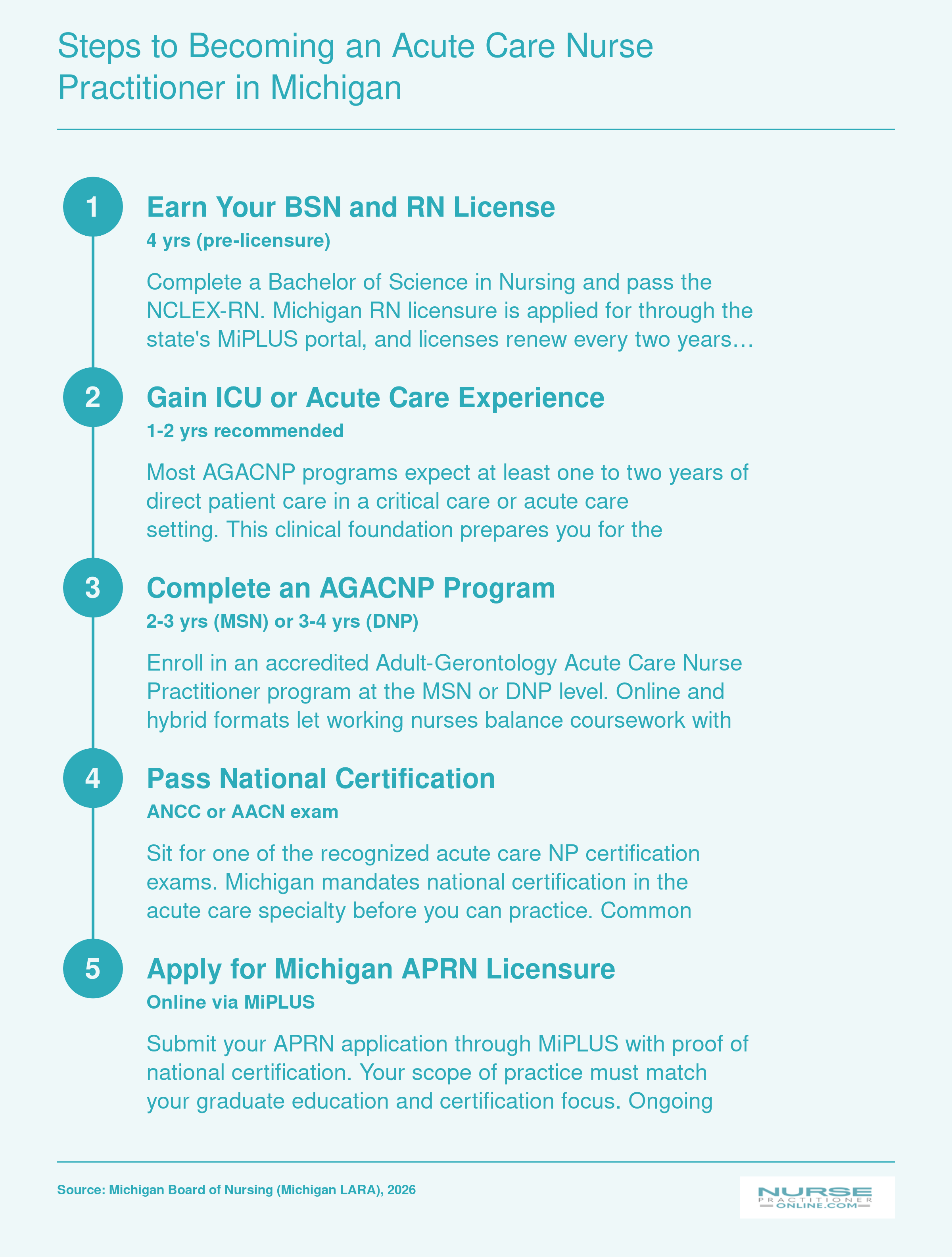
How to Become an Acute Care Nurse Practitioner in Michigan
Michigan's debate over full practice authority for nurse practitioners continues to shape the regulatory landscape, but for now, collaborative agreements remain a requirement for acute care NPs.1 Understanding the pathway from RN to ACNP in this state means unpacking admission expectations, licensure steps, and the practice restrictions you will face upon certification.
Admission Prerequisites: The ICU Experience Question
One of the most common concerns for aspiring acute care NPs is whether ICU or critical care experience is mandatory. In Michigan, no state regulation dictates a specific amount of critical care RN hours, but individual graduate programs set their own standards. Most AGACNP programs in the state list one to two years of recent, full-time experience in an intensive care unit, emergency department, or a similarly high-acuity setting as a preferred qualification. In practice, competitive applicant pools mean that candidates without this background are rarely admitted. Some schools explicitly require ICU experience, while others accept strong emergency department or step-down unit experience, so you should directly confirm each program's policy. If your goal is an online AGACNP program, plan to secure at least a year of critical care nursing before applying to maximize your chances. For a broader look at the role and its requirements, review our acute care nurse practitioner career guide.
Michigan APRN Licensure: A Three-Step Process
Licensure for acute care nurse practitioners in Michigan is managed by the Michigan Department of Licensing and Regulatory Affairs (LARA). The process has three core components:
- Graduate Degree: Complete a master's, post-master's certificate, or DNP from a nationally accredited AGACNP program.
- Active RN License: Hold an unencumbered Michigan registered nurse license or a multistate license from a Nurse Licensure Compact state.
- National Certification: Pass the AGACNP board exam from either the American Nurses Credentialing Center (ANCC) or the American Association of Critical-Care Nurses (AACN).
Once you have these three elements, you submit an application for APRN certification to LARA. The board reviews your education, certification, and background, and upon approval, you receive authority to practice as a nurse practitioner in Michigan. There are no additional state-specific exams for acute care. If you are considering the doctoral route, familiarize yourself with DNP prerequisites early so you can plan accordingly.
Collaborative Practice: Michigan's Regulatory Reality
Michigan is a reduced practice state, meaning NPs cannot practice independently. You must have a written collaborative agreement with a physician that outlines prescriptive authority, patient care scope, and protocols. Controlled substance prescriptive authority is also delegated under this agreement, so you cannot prescribe schedules II through V independently.3 A full practice authority bill (HB 4399) was introduced in 2025 but has not been enacted, leaving the collaborative requirement intact.4 As you plan your career, factor in the need to build and maintain a collaborative relationship. Advocacy groups continue to push for legislative change, but for the immediate future, working within Michigan's collaborative framework is the only option for acute care NPs.5
Questions to Ask Yourself
Online vs. Hybrid ACNP Programs: What Michigan Nurses Should Know
If you're a working RN in Michigan weighing online ACNP programs, the flexibility is real, but so are a few important caveats. Understanding the difference between what happens on screen and what happens in person will help you pick the right program and avoid surprises down the road. Here's a quick breakdown of the biggest advantages and trade-offs.
Pros
- Asynchronous online coursework fits around 12-hour shift schedules, letting you study on your days off or between rotations.
- Michigan is a full NC-SARA member state, so you can enroll in participating out-of-state online ACNP programs without needing separate Michigan authorization.
- Access to programs well beyond Michigan's borders expands your options if in-state seats are limited or a specialty track isn't offered locally.
- Programs at SARA member institutions like Michigan State University and the University of Michigan meet state regulations, giving you a clear path to licensure.
- Online delivery can reduce commute time and related costs, which adds up quickly over a two- to three-year graduate program.
Cons
- No ACNP program is 100% remote: 'fully online' means didactic coursework only, because clinical hours are always completed in person at approved sites.
- Most programs require periodic campus intensives for simulation labs, skills validation, or orientation days, which may involve travel.
- SARA covers institutional authorization but does not override professional licensure rules; your out-of-state program must still meet Michigan Board of Nursing requirements for advanced practice.
- Some out-of-state schools choose not to accept Michigan students due to curriculum or licensure alignment issues, so always verify enrollment eligibility before you apply.
- Clinical placements arranged through out-of-state programs may need separate site-level approvals in Michigan, which can add time to the process.
Clinical Placement Support for Michigan ACNP Students
Securing acute-care clinical rotations is the hardest logistics challenge you'll face in an online AGACNP program, and Michigan's competitive hospital landscape makes it even tougher. Unlike family nurse practitioner students who can often find primary-care preceptors through community health centers or small practices, ACNP students need access to intensive care units, emergency departments, and specialty floors where capacity is limited and credentialing is strict.
How Online Programs Handle Clinical Placement
Online AGACNP programs typically offer one of three models. Some guarantee placement support, meaning clinical coordinators will arrange sites for you, though you may still need to confirm your own preceptors within those sites. Others require full self-placement: you are responsible for identifying, contacting, and securing every preceptor and facility contract. The middle ground is hybrid support, where the program provides a database, facilitates introductions to past preceptors, and steps in only if you've exhausted your own networks. Ask your program directly which model it uses before you enroll. Students who assume they'll receive hands-on help, then discover they're on their own, often scramble or delay graduation. For a broader look at the process, our guide on how to find NP preceptors walks through each model in detail.
Michigan's Acute-Care Clinical Landscape
Michigan is home to several large health systems that commonly accept NP students for precepted placements. Michigan Medicine in Ann Arbor accepts graduate precepted placements1, and the University of Michigan School of Nursing maintains clinical partnerships with nearly every health system in the state, spanning more than 600 sites.2 Corewell Health (formerly Beaumont and Spectrum Health), Henry Ford Health, and other regional systems also credential AGACNP students, though each facility maintains its own approval and onboarding process.
That said, capacity is not unlimited. Hospitals cap the total number of students per unit to protect patient care and staff bandwidth.3 ICU and ED rotations are highly competitive and limited. If you are currently employed in an ICU or emergency department, leverage that relationship early. Nurse managers and advanced practice providers who already know your work are far more likely to support a preceptorship request.
Practical Steps to Secure Preceptors
Start reaching out to potential preceptors six to nine months before your rotation is scheduled to begin. Contact your program's clinical coordinator immediately upon acceptance to understand timelines, credentialing requirements, and any affiliation agreements already in place. Many Michigan hospitals require background checks, drug screens, immunization records, and facility-specific orientations before you can step onto a unit, a process that can take eight to twelve weeks.3
If your employer or personal network doesn't yield a preceptor, consider using national databases such as the ENP Network or ClinicalMatchMe, which connects students with hospital-credentialed AGACNP preceptors.3 NPHub offers a Michigan-specific preceptor-finding resource that lists acute-care NP preceptors.4 Some regions of Michigan participate in a Clinical Preceptor Incentive Pilot Program that offers preceptors up to one thousand dollars per rotation in workforce shortage areas, though availability varies by county and year.
Barriers and Realities
Be prepared for credentialing delays and exclusive affiliation barriers. Some hospitals only accept students from schools with which they hold formal contracts, and students from out-of-state programs may face additional scrutiny.3 Securing acute-care preceptors is harder than primary care, and competition for ICU and ED slots is intense. If you wait until the last minute, you risk postponing your clinical courses or paying for an expensive preceptor-matching service. Plan early, communicate often, and treat every inquiry as a nurse practitioner networking opportunity.
In 2024, U.S. nursing schools turned away more than 80,000 qualified applicants, largely due to faculty shortages and limited clinical training sites. This same shortage of clinical preceptors affects practicing nurses pursuing ACNP degrees, making programs with dedicated placement support especially valuable for Michigan students juggling work and school.
ACNP Salary and Job Outlook in Michigan
Primary-care NP salaries and acute care NP salaries both fall under the same occupational category in federal labor data, which makes comparing them tricky. Keeping that caveat in mind, here is what the numbers actually show for Michigan right now.
What Michigan NPs Earn
According to Michigan's Department of Labor and Economic Opportunity, the state employed roughly 7,900 nurse practitioners in 2024, with a median hourly wage of about $60.40. Annualized, that works out to roughly $125,600 for a full-time schedule, which sits slightly above the national median of $121,610 reported in Bureau of Labor Statistics occupational wage data.2
For broader context, national BLS data shows the NP wage distribution spread from around $87,340 at the 10th percentile to more than $165,240 at the 90th percentile.2 The middle range, roughly the 25th through 75th percentiles, falls between about $103,250 and $135,470 nationally. Michigan's median tracks reasonably close to that midpoint, though regional variation within the state can push individual salaries in either direction.
Where ACNPs Tend to Earn More
ACNPs working in acute care settings generally command a premium over their primary-care counterparts, even though both appear in the same labor statistics. Hospital-based employment, intensive care unit placements, and emergency or specialty surgery environments often carry weekend differentials, night-shift premiums, and incentive pay structures that lift total compensation noticeably above the published median. That structural advantage is one of the clearest financial arguments for pursuing the acute care specialty, and you can explore how it compares to other highest paid nurse practitioner specialties.
Within Michigan, the metropolitan areas most often cited for higher NP compensation include Detroit, Grand Rapids, and Ann Arbor. Ann Arbor is notable given the concentration of academic medical center work tied to University of Michigan Health, where AGACNP-prepared clinicians fill roles in critical care, hospitalist medicine, and complex specialty units.
Program-Level Earnings Data
For the Michigan AGACNP programs featured in this guide, including University of Michigan, Oakland University, and University of Michigan-Flint, graduate-level earnings outcomes are not yet available through the federal College Scorecard. That is not unusual for specialized graduate certificates or post-master's pathways, which often fall below the reporting thresholds. The broader institutional earnings data from those universities reflects all graduates across programs, not AGACNP completers specifically, so drawing direct comparisons would be misleading.
The most reliable earnings signal for AGACNP graduates in Michigan remains the statewide occupational data, paired with realistic conversations with hiring managers in your target specialty and setting. If you are still weighing degree options, our overview of online nurse practitioner programs in Michigan can help you compare pathways side by side.
AGACNP Certification: ANCC vs. AACN Exam Paths
Two national boards certify adult-gerontology acute care nurse practitioners in the United States, and most Michigan graduates will choose between them based on practice setting and program alignment. The American Nurses Credentialing Center offers the AGACNP-BC credential, while the American Association of Critical-Care Nurses offers the ACNPC-AG.2 Both qualify you for APRN licensure through the Michigan Board of Nursing, and both certify the same population focus: acutely and critically ill adult and older adult patients. For a broader comparison of credentialing options across specialties, see our guide to NP certification exams.
Eligibility and Education Requirements
Both exams require a current, unencumbered RN license and graduation from an accredited graduate-level AGACNP program. The ANCC pathway specifies at least 500 supervised clinical hours plus the three APRN core courses (advanced pathophysiology, advanced pharmacology, and advanced health assessment). The AACN pathway requires equivalent graduate-level didactic and supervised clinical work from a nationally accredited program.2 In practice, most Michigan MSN and DNP AGACNP programs are built to meet both sets of eligibility rules, so graduates can choose either exam.
Exam Format, Fees, and Renewal
The ANCC AGACNP-BC exam fee is $395 for non-members, and the AACN ACNPC-AG is $380 for non-members.2 Both exams are computer-based multiple-choice tests delivered through national testing centers, and both certifications are valid for five years before renewal. Renewal for either credential generally requires continuing education hours, ongoing clinical practice, and a renewal fee. The exact category mix differs between the two boards, so check current requirements before your cycle ends.
Which One Should You Choose?
ANCC's AGACNP-BC tends to be the more broadly recognized credential across hospital systems and is often the default choice if you want maximum employer flexibility. AACN's ACNPC-AG carries strong recognition in ICU, step-down, and tertiary critical-care environments, reflecting AACN's critical-care heritage. If you are heading into a Michigan ICU or a large academic medical center's critical-care service, the AACN credential may align more naturally with the unit culture. For broader acute-care roles, hospitalist teams, or rapid-response positions, ANCC is the safer bet. If you already hold an NP credential in another specialty and want to add acute care, consider online post-master's ACNP certificate programs as a streamlined path.
Employment of nurse practitioners is projected to grow 40 percent from 2023 to 2033, much faster than the average for all occupations.
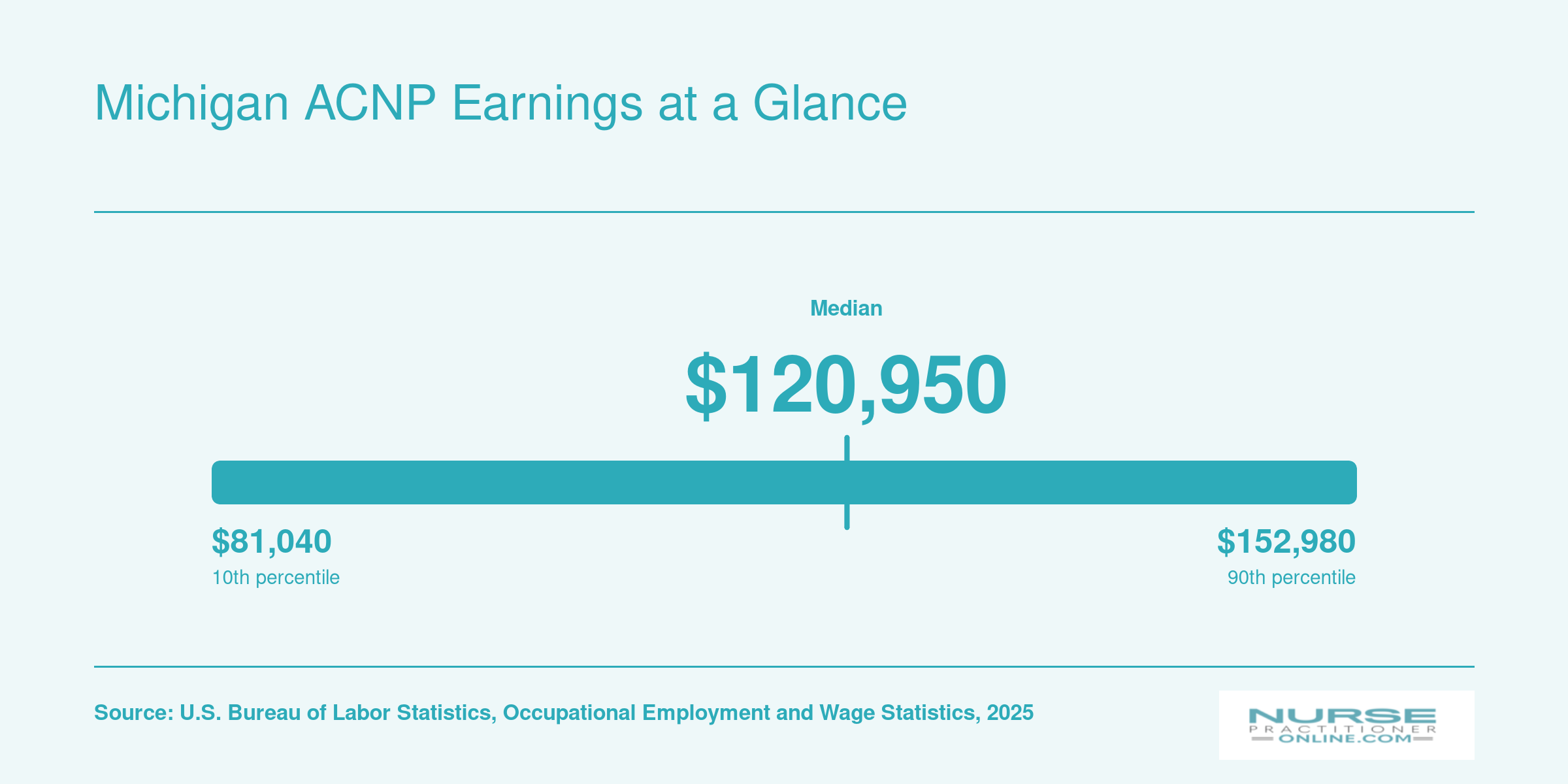
Michigan ACNP Earnings at a Glance
Nurse practitioners in Michigan earn competitive salaries across all experience levels. Because acute care NPs typically work in high-acuity hospital and critical care settings, their pay tends to cluster in the upper percentiles of the overall NP wage distribution. The figures below reflect the full NP salary spread in Michigan, so ACNP graduates can generally expect compensation toward the higher end of this range.