Most important takeaways…
- Hybrid formats dominate the 14 ranked FNP programs near Flint, with 8 hybrid and several fully online options available.
- Flint's median household income of roughly $36,200 makes net price after aid more important than sticker tuition.
- Michigan FNP students can layer employer reimbursement, state scholarships, and federal loan repayment to cut total debt significantly.
- Programs requiring 500 to 720 clinical hours vary widely in preceptor placement support across Genesee County.
What does it actually cost to earn a Family Nurse Practitioner degree if you live near Flint? Annual net prices for the programs serving this region range from roughly $7,000 at University of Michigan-Flint to $32,800 at the highest-priced private option, a spread wide enough to reshape your financial outlook for years after graduation.
Flint-area nurses face a practical challenge: median household incomes here sit well below state averages, yet nearby FNP programs vary dramatically in what students pay after aid. The programs closest to home include hybrid and fully online formats, meaning clinical hour logistics and commute time matter as much as tuition stickers when calculating true cost. Below, we break down net prices, hidden fees, clinical placement support, and financial aid strategies so you can make a confident, well-informed decision.
Affordable FNP Programs for Flint-Area Nurses, 2026 Rankings
These rankings prioritize what matters most to your wallet: net price after financial aid, the generosity of institutional aid packages, and median graduate debt burden. Prestige metrics take a back seat to real affordability for working Michigan nurses. Every program listed is open to Flint-area residents, and several can be completed without relocating.
- Net price after financial aid
- Graduate debt burden
- Financial aid generosity
- Program format and flexibility
- Regional clinical access
- Internal program database
- NCES-IPEDS federal institutional data — nces.ed.gov
- Independent program research
- College Scorecard graduate earnings — collegescorecard.ed.gov

University of Michigan-Flint
Located right in Flint, UM-Flint is the only school on this list with a campus in the city, making it the most convenient choice for local nurses. Its hybrid and online FNP pathways keep in-state graduate tuition around $650 per credit, and small cohorts of roughly 20 students per year mean personalized advising and clinical coordination. The university's net price is the lowest in this ranking, supported by robust financial aid and scholarship options for nursing students.
- Hybrid format with roughly one campus visit per semester
- 53 to 55 MSN credits, then 18 DNP credits to finish
- Full-time and part-time pacing options available
- Early Assurance Admission for eligible BSN students
- CCNE accredited with certification exam eligibility
- Scholarships and financial aid for nursing students
- Fully online format with minimal campus visits
- BSN to DNP pathway with built-in MSN exit point
- Prepares for ANCC or AANP board certification
- No GRE required for admission
- Clinical practicums included in curriculum
- Fall and winter application deadlines available
- Online delivery designed for associate-degree RNs
- Cohort-based curriculum with clinical placement assistance
- Full-time or part-time scheduling flexibility
- 3.5 GPA admission requirement
- Prepares for FNP board certification
- Financial aid and grants offered
DNP with MSN, Family Nurse Practitioner (Hybrid) — Hybrid
BSN to DNP with MSN, Family Nurse Practitioner (Online) — Hybrid
RN to DNP with MSN, Family Nurse Practitioner (Online) — Hybrid

Wayne State University
Wayne State's DNP with FNP specialty is built around Detroit's extensive health care network, including partnerships with Henry Ford Health and Detroit Medical Center. The curriculum emphasizes health equity and care for urban, underserved populations, skills directly transferable to Flint's primary care landscape. With clinical placements arranged by the school and a median graduate debt among the lowest in this ranking, Wayne State delivers strong value for a research university.
- Complete in as little as three years full-time
- Part-time plan designed for working nurses
- Clinical placements arranged by the school
- Prepares for ANCC or AANP certification exams
- Graduate Professional Scholarship and ANEW Grant available
- Integrates health policy, data science, and equity focus
- High certification pass rate reported
- Evidence-based final DNP project required
Doctor of Nursing Practice, Family Nurse Practitioner — On-Campus

Oakland University
Oakland University offers an MSN with an FNP track and a post-master's certificate option, both CCNE-accredited and located about an hour from Flint in Rochester Hills. Admission includes a faculty interview, and the program's holistic patient care focus prepares graduates for primary care across the lifespan. Oakland's median graduate debt of $22,750 is competitive among Michigan publics, and the school admits students in both fall and winter semesters for added scheduling flexibility.
- CCNE accredited with fall and winter start dates
- Prepares for ANCC or AANP national certification
- Clinical primary care experiences across the lifespan
- Faculty interview is part of the admissions process
- Holistic patient care focus throughout curriculum
- Competitive admission with strong advising support
- Gap analysis determines individualized coursework
- Designed for nurses who already hold an MSN
- Prepares for national FNP certification
- Clinical experiences spanning all age groups
- CCNE-accredited nursing school
- Located at Human Health Building in Rochester Hills
Master of Science in Nursing, Family Nurse Practitioner — On-Campus
Post-Master's Graduate Certificate, Family Nurse Practitioner — On-Campus

University of Michigan
The University of Michigan's School of Nursing in Ann Arbor is among the most selective and highest-ranked in the state, and its digital education FNP option now allows nurses across Michigan to enroll without relocating. Students attend just three on-campus days per term, with 2-year and 3-year plans available. While its sticker price is higher, U-M's generous financial aid drives its median graduate debt down to $19,500, the lowest on this list.
- Hybrid format with only three campus days per term
- Both 2-year and 3-year completion plans available
- Digital education option for distance learners statewide
- Prepares for FNP certification across the lifespan
- Clinical sites include community health clinics statewide
- CCNE accredited with capstone requirement
- Online program with brief on-campus sessions each term
- Career paths include family NP, urgent care, community health
- Family-centered health promotion focus
- Both online and residential options available
- Statewide clinical placements, not limited to Ann Arbor
- Full-time and part-time scheduling flexibility
- 4-year dual certification program
- Combines primary care FNP with nurse-midwifery
- Extensive and diverse clinical experiences
- Broadens scope of practice and career flexibility
- Hybrid delivery format with campus sessions
- Covers maternal, newborn, and lifespan care
Primary Care Family Nurse Practitioner (MSN) — Hybrid
Primary Care Family Nurse Practitioner (DNP) — Hybrid
Nurse-Midwifery and Primary Care Family Nurse Practitioner (DNP) — Hybrid

Saginaw Valley State University
Saginaw Valley State University sits roughly 40 miles north of Flint, making it one of the closest options for Flint-area nurses. Its hybrid DNP with FNP concentration features cohort-based learning, a dedicated clinical placement team, and flat tuition that is the same for in-state and out-of-state students. SVSU also offers a unique dual FNP/PMHNP concentration for nurses who want to broaden their scope, and graduates in underserved areas may qualify for loan forgiveness.
- Hybrid format blending online coursework with face-to-face days
- Cohort-based structure builds strong peer relationships
- Dedicated BSN-to-DNP clinical placement team
- Flexible scheduling designed for working nurses
- Loan forgiveness eligibility in underserved Michigan areas
- FNPs can own their own practice in Michigan
- 74 credits required with 1,080 clinical hours
- 91 total credit hours covering both concentrations
- 1,000 supervised clinical practice hours
- BSN-to-DNP pathway available
- Focus on holistic and integrated patient care
- Seven-year window to complete the degree
- DNP scholarly project required
Doctor of Nursing Practice, Primary Care Family Nurse Practitioner (Hybrid) — Hybrid
Doctor of Nursing Practice, Dual FNP and PMHNP (Hybrid) — Hybrid

Northern Michigan University
Northern Michigan University in Marquette uses a low-residency hybrid model that lets students complete clinical hours in their own communities, making geographic distance a non-issue for Flint nurses. The DNP with FNP concentration requires 72 credits and 1,000 clinical hours, and rolling admissions with two start dates per year provide scheduling flexibility. NMU's published tuition is the lowest sticker price in this ranking, though its net price reflects the university's smaller financial aid pool.
- Low-residency model with occasional on-campus visits
- Clinical practicum completed in your home community
- 72 total credit hours with 1,000 clinical hours required
- Rolling admissions on a first-come basis
- Two start dates per year (winter and fall)
- Part-time option accommodates working nurses
- Cohort-based structure for peer support
Doctor of Nursing Practice, Family Nurse Practitioner (Hybrid) — Hybrid

Grand Valley State University
Grand Valley State University's three-year hybrid DNP with FNP emphasis combines online coursework with immersive sessions at the DeVos Center in Grand Rapids. The program stands out for its partnerships with more than 1,700 health care organizations across Michigan, supported by a dedicated clinical placement coordinator, so Flint-area students can often find sites closer to home. Graduates are eligible for national FNP certification after completing 1,000 clinical hours and a DNP Scholarly Project.
- 3-year cohort-based program with fall start
- Hybrid delivery: online plus in-seat sessions in Grand Rapids
- 1,700+ partner health care organizations statewide
- Dedicated clinical placement coordinator on staff
- State-of-the-art Simulation Center for skills practice
- 1,000 clinical hours plus 300 immersion hours
- DNP Scholarly Project capstone required
- CCNE accredited with scholarships available
Doctor of Nursing Practice, Family Nurse Practitioner (Hybrid) — Hybrid

Michigan State University
Michigan State University's hybrid FNP program requires only 15 total on-campus days, making it realistic for Flint nurses who cannot relocate. The program reports over 90% first-time certification pass rates and 95% employment within one year of graduation. MSU arranges clinical rotations through statewide partnerships and supports both synchronous and asynchronous learning, drawing on more than 20 years of online education experience.
- Hybrid format with only 15 campus days total
- Synchronous and asynchronous learning options
- Over 90% first-time FNP certification pass rate
- 95% job placement within one year of graduation
- Statewide clinical rotation partnerships across Michigan
- Full-time and part-time plans available
- Small learning communities with personalized attention
- CCNE accredited with expert community-practice faculty
- 27 total credits at roughly $937 per credit hour
- Minimum 1.5 years to complete
- Requires an MSN degree and current RN license
- Hybrid online and in-person components
- Financial aid and military/veteran resources available
- Leverages MSU's 20+ years of online education
MSN, Family Nurse Practitioner (Hybrid) — Hybrid
Post-Graduate Certificate, Family Nurse Practitioner (Hybrid) — Hybrid

Davenport University
Davenport University offers a fully online MSN with FNP concentration, ideal for Flint nurses who prefer 100% remote coursework paired with in-state clinical placements. The program is CCNE-accredited, provides a 20% tuition discount for Michigan Health and Hospital Association members, and waives the application fee. Davenport's orientation toward adult and working learners makes it a practical fit for mid-career nurses advancing on a budget.
- 100% online delivery with flexible scheduling
- Full-time or part-time pacing options
- 20% tuition discount for MHA members
- Application fee waived for all applicants
- CCNE accredited through 2027
- Clinical placements included with 6:1 student-faculty ratio
- Capstone project required for graduation
- High certification pass rates reported
MSN, Family Nurse Practitioner (Online) — Online

Madonna University
Madonna University in Livonia is a private, mission-driven institution offering FNP pathways at the MSN, DNP, and post-MSN certificate levels. Its smaller class sizes and southeast Michigan clinical partnerships may appeal to Flint nurses willing to commute for a more personalized learning environment. The program is CCNE-accredited and approved by the Michigan Board of Nursing, and faculty assist with clinical placement coordination.
- CCNE accredited and Michigan Board of Nursing approved
- Care across all ages from pediatrics to geriatrics
- Focuses on assessment, diagnosis, and treatment skills
- Smaller cohort size for individualized attention
- Southeast Michigan clinical partnerships available
- Prepares for ANCC or AANP certification
- 74 total credit hours with 600 clinical hours
- BSN-to-DNP pathway with MSN exit option
- Full-time and part-time scheduling available
- Prepares for Family Nurse Practitioner Certification Exam
- Hybrid format blending online and campus sessions
- CCNE accredited program
- Hybrid online and campus format
- 600 direct care clinical hours required
- Prepares for ANCC or AANP certification
- Faculty assist with clinical placements
- Requires MSN degree and current RN license
- Emphasizes evidence-based practice across populations
Family Nurse Practitioner MSN (Campus) — On-Campus
Family Nurse Practitioner Doctor of Nursing Practice (Hybrid) — Hybrid
Family Nurse Practitioner Post-MSN Certificate (Hybrid) — On-Campus
Why Cost Transparency Matters for Nurses in the Flint Area
The median household income in Flint is approximately $36,200, compared to roughly $60,700 across Genesee County as a whole.12 Those figures tell a story that every nurse in this region already lives: stretching a working income to cover graduate tuition is not a minor inconvenience. It is a genuine financial obstacle that makes choosing the right program a high-stakes decision.
The Local Context Behind the Numbers
Genesee County also faces documented healthcare workforce shortages in primary care and family medicine, which is precisely why producing more family nurse practitioners here matters so much. The demand for FNPs in Mid-Michigan is real, and so is the financial pressure on the nurses best positioned to meet it. For RNs working at area hospitals or community health centers, an expensive misstep in program selection can mean years of debt that offset much of the income gain that comes with the NP credential.
Sticker Price Is Not the Full Story
Tuition advertised on a program's website is rarely what you will actually pay. Hidden costs layer on top of the published rate and can add anywhere from $2,000 to more than $5,000 to your total bill before you graduate. Common additions include:
- Clinical placement fees: Some programs charge per-semester fees to coordinate preceptor placements, which can run several hundred dollars each term.
- Technology fees: Online programs frequently add per-credit or per-semester fees for platform access, proctoring software, or simulation tools.
- Malpractice insurance: Many programs require students to carry their own professional liability coverage during clinical rotations.
- Residency travel: Hybrid programs that require brief on-campus intensives mean hotel stays, flights, or long drives that never appear in the tuition table.
Always request a full cost-of-attendance estimate, not just the per-credit-hour rate, before you compare programs side by side.
Net Price Versus Published Tuition
Even when you account for fees, published tuition rates still reflect the cost before financial aid. The number that actually matters is what you will owe after grants, scholarships, and institutional aid are applied. That figure is often described as the net price, and it is an institution-wide average rather than a personal quote. Your actual net price will depend on your income, your employer's tuition benefit, and whether you apply for all available aid. Use published averages as a rough benchmark, not a guarantee.
Out-of-State Programs With Michigan Authorization
Michigan residents are not limited to in-state schools. A number of online NP programs for out-of-state students hold state authorization to enroll Michigan residents, and some carry per-credit tuition rates that compete favorably with public in-state options. State authorization means the program has met Michigan's regulatory requirements for distance education, so your degree carries the same standing as one earned locally. Checking a program's state authorization map before you apply is a simple step that can open up significantly more affordable options without sacrificing credential quality.
FNP Tuition at a Glance: Michigan and Online Programs Compared
The table below compares annual tuition rates and key financial indicators across Michigan schools that offer Family Nurse Practitioner programs. Keep in mind that listed tuition is the sticker price; net price reflects what students actually pay after grants and scholarships. These are institution-level figures, so your graduate program costs may differ. Always confirm current FNP tuition directly with each school's nursing department.
| School | In-State Tuition | Out-of-State Tuition | Average Net Price | Median Graduate Debt | Format | Degree Level |
|---|---|---|---|---|---|---|
| University of Michigan, Flint | $14,473 | $21,390 | $7,007 | $25,000 | Hybrid | MSN / DNP |
| Oakland University | $21,960 | $24,648 | $9,120 | $22,750 | On Campus | MSN |
| Saginaw Valley State University | $18,360 | $18,360 | $10,775 | $25,000 | Hybrid | DNP |
| Andrews University | $29,156 | $29,156 | $12,547 | $26,000 | Online | DNP |
| Wayne State University | $17,960 | $36,542 | $12,766 | $21,250 | On Campus | DNP |
| University of Michigan, Ann Arbor | $28,886 | $57,776 | $13,138 | $19,500 | Hybrid | MSN / DNP |
| Northern Michigan University | $12,196 | $15,652 | $14,085 | $21,474 | Hybrid | DNP |
| University of Detroit Mercy | $22,544 | $22,544 | $15,232 | $23,250 | Hybrid | MSN |
| Grand Valley State University | $20,030 | $20,030 | $16,317 | $24,500 | Hybrid | DNP |
| Davenport University | $20,098 | $20,098 | $17,707 | $26,000 | Online | MSN |
| Madonna University | $18,000 | $18,000 | $17,755 | $23,000 | On Campus | MSN |
| Spring Arbor University | $8,364 | $8,364 | $19,353 | $26,375 | Online | MSN |
| Michigan State University | $21,772 | $41,848 | $19,680 | $23,250 | Hybrid | MSN |
| Concordia University Ann Arbor | $15,870 | $15,870 | $32,811 | $25,750 | Online | MSN |
Online, Hybrid, and On-Campus Formats for Working RNs
Choosing the right program format can make or break your ability to finish an FNP degree while working full time. Among the 14 ranked programs near Flint, the majority use a hybrid model (8 programs), followed by fully online options (4 programs) and traditional on-campus formats (2 programs). Here is how the three formats stack up across the factors that matter most to working nurses.
| Attribute | Fully Online | Hybrid | On-Campus |
|---|---|---|---|
| Flexibility for Full-Time Nurses | Highest: log in on your own schedule, no commute required. Ideal for nurses working 12-hour rotating shifts. | Moderate: coursework is mostly online, but you will travel to campus for periodic intensives (typically one to three days per semester). | Lowest: set class times on campus each week, which can conflict with hospital schedules. |
| Typical Time to Completion (Part-Time) | 3 to 4 years | 3 to 4 years | 3 to 4 years, though scheduling conflicts may extend the timeline |
| Clinical Arrangement Logistics | You typically find or arrange preceptors in your own area, which works well for Flint nurses who can tap Genesee County clinics. | Many hybrid programs, such as Saginaw Valley State and Grand Valley State, have dedicated clinical placement teams that help secure local sites. | Clinical sites are often coordinated through the university and may be clustered near the campus, requiring additional commuting. |
| Peer Networking Opportunities | Virtual discussion boards, video study groups, and online cohorts. Effective, but requires intentional effort. | Strongest blend: you build relationships during on-campus intensives and maintain them online between visits. | Most organic networking through daily face-to-face interaction with classmates and faculty. |
| What On-Campus Intensives Mean for Flint Commuters | None or minimal travel required. | Plan for periodic campus visits. For example, UM-Flint requires one visit per semester (local for Flint nurses), while University of Michigan in Ann Arbor requires roughly three on-campus days per term (about a 60-mile drive each way). Northern Michigan University in Marquette is roughly 350 miles north, so budget for travel and lodging. | Regular commuting to campus is expected. Wayne State in Detroit is about 65 miles from Flint; Oakland University in Rochester Hills is roughly 55 miles. |
| Cost Implications | May save on commuting, parking, and campus fees. Programs like Spring Arbor University and Concordia University Ann Arbor list tuition near $800 per credit. | Moderate added costs for travel and lodging during intensives, but in-state tuition at schools like Saginaw Valley State ($18,360) and UM-Flint ($14,473) can offset those expenses. | Highest ancillary costs from regular commuting, parking permits, and campus fees on top of tuition. |
| Ranked Programs in This Format | Davenport University, Andrews University, Spring Arbor University, Concordia University Ann Arbor | UM-Flint, University of Michigan, Saginaw Valley State, Northern Michigan University, Grand Valley State, Michigan State University, University of Detroit Mercy, Oakland University (note: Oakland lists as campus but uses some hybrid elements) | Wayne State University, Madonna University |
Related Articles
Clinical Placement Support in Genesee County and Mid-Michigan
National family nurse practitioner programs require between 500 and 720 clinical practice hours, a substantial commitment that online and hybrid students must weave into their work schedules. Where you complete those hours, and who helps you find a preceptor, can make or break your timeline.
The Placement Challenge for Online FNP Students
Clinical placement is the hidden hurdle of online FNP education. Some programs rely on a "find your own preceptor" model, which shifts the burden entirely onto the student. Others employ a clinical placement coordinator who secures approved sites on your behalf. This distinction matters enormously for working nurses in Flint, where time and professional networks may be limited. A program that leaves you to cold-call clinics while managing a full-time nursing job can add months of stress and delay graduation.
Clinical Rotation Sites Near Flint
Flint-area nurses have access to several high-volume clinical sites that regularly host FNP students. Major health systems include Hurley Medical Center, McLaren Flint, and Ascension Genesys, all of which offer diverse patient populations and preceptors experienced in training advanced practice nurses. Federally qualified health centers throughout Genesee County also provide placements, often focusing on underserved communities. The key is whether a program already holds agreements with these institutions, saving you from starting negotiations from scratch.
Three Questions to Ask Before Enrolling
Before committing to any program, get clear answers on the clinical placement process:
- Existing preceptor agreements: Does the program have active contracts with clinical sites in Michigan, particularly near Flint? If not, you may need to identify and secure your own preceptor.
- Clinical hour requirement: Confirm the total number of required hours. Programs range from 625 hours (Spring Arbor University, Chamberlain University) to 700 hours (Walsh University), so plan your schedule accordingly.34
- Preceptor fallback support: What happens if a preceptor cancels or falls through mid-rotation? Programs with dedicated placement coordinators will typically reassign you, while self-find models leave you to solve the problem alone.
The Value of a Clinical Placement Coordinator
A dedicated clinical placement coordinator is more than a convenience; it is a career accelerator. These professionals maintain networks of approved sites, handle compliance paperwork, and step in when arrangements fail. For online students balancing jobs and families, that support can mean the difference between finishing in two years versus three. Michigan State University's hybrid FNP track and Walsh University's online MSN-FNP both provide this service, shielding students from the unpredictability of independent preceptor hunting.54
Questions to Ask Yourself
Scholarships, Loan Repayment, and Employer Tuition Benefits for Michigan FNP Students
Paying for an FNP degree rarely comes down to a single funding source. The nurses who finish with the least debt are usually the ones who layer several streams of support, stacking employer reimbursement on top of scholarships and federal aid rather than relying on loans alone.
Federal Programs Worth Knowing First
If you work in Flint or the surrounding Genesee County area, the National Health Service Corps Loan Repayment Program deserves your attention. Flint includes federally designated Health Professional Shortage Areas, which means clinicians who practice there after graduating may qualify for significant loan repayment awards in exchange for a service commitment. The NHSC Scholarship Program supports up to four years of training and requires a minimum two-year service obligation at an approved site.1 The Nurse Corps Scholarship Program operates similarly, also requiring two years of service at a critical shortage facility.2 Neither program is guaranteed, and competition is real, but Flint-area nurses are genuinely well-positioned given the region's shortage designations.
Michigan-Specific Scholarships
Several state-level options are worth bookmarking:
- Michigan Board of Nursing Scholarship Program: Covers tuition, books, fees, and a stipend. Applications are due March 1 each year. Note that this program currently targets pre-licensure, RN-to-BSN, and MSN nursing education pathways, so confirm your MSN program qualifies before applying.
- Michigan Nurses Foundation Scholarship: Awards range from $1,000 to $7,000 depending on the cycle.4
- Michigan Nursing Scholarship: A $4,000 award for qualifying nursing students.5
- Michigan Council of Nurse Practitioners Student Scholarship: Available to MICNP members pursuing NP education.6
- Detroit Black Nurses Association and Michigan NAHN Chapter Scholarships: Each awards $500 to $2,000 and can supplement other funding.5
The Michigan State University workforce scholarships administered through their Center for Rural Health are aimed at students who plan to practice in underserved Michigan communities, which aligns well with Flint-area career paths.
Employer Tuition Reimbursement
This is the funding source most nurses underestimate. Hospital systems including Hurley Medical Center, McLaren Flint, and Ascension Genesys have historically offered tuition reimbursement for employees pursuing advanced degrees, though benefit amounts and eligibility terms change, and you should verify current figures directly with HR. Many hospital employers reimburse between $3,000 and $5,250 per year, which is the IRS tax-exclusion ceiling for employer-provided education benefits. Over a two-to-three-year FNP program, that adds up to real money. If you are already employed at one of these systems, factor reimbursement into your total cost calculation before comparing program sticker prices.
Federal Aid and a Caution on Borrowing
Graduate students can access federal financial aid through FAFSA, including unsubsidized Direct Loans and Graduate PLUS loans. These are legitimate tools, but borrow with your eyes open. FNP salaries in Michigan are strong, yet taking on six figures of debt for a program with lower earning outcomes is a different calculation than borrowing a modest amount for a high-value credential. Use the aid available, lean on scholarships and employer benefits first, and treat loans as a gap-filler rather than a primary strategy.
What FNP Graduates Earn vs. What They Owe: Michigan ROI Snapshot
How quickly can you recoup your investment in an FNP degree? The chart below compares median graduate debt against institutional median earnings for six Michigan programs. For local context, the Bureau of Labor Statistics reports that nurse practitioners in Michigan earn a median annual wage of $129,210, with salaries ranging from about $100,540 at the 25th percentile to $155,490 at the 75th percentile. Nationally, NP employment is projected to grow 35% through 2034, making this one of the strongest returns on investment in healthcare education.
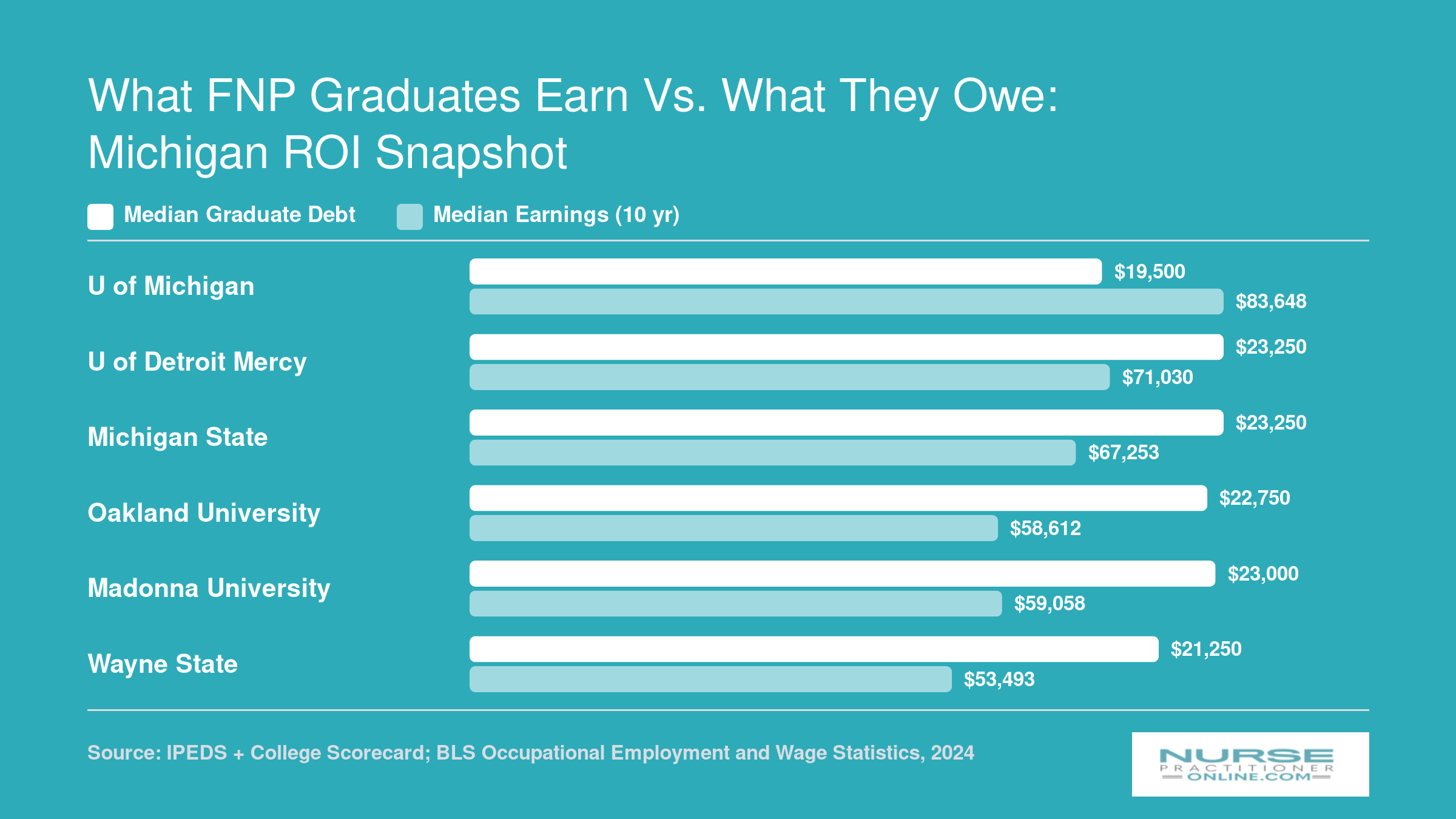
Nurse practitioner jobs are projected to grow 40 percent between 2024 and 2034, nearly ten times faster than the average for all occupations. That extraordinary demand translates into excellent job security and strong return on investment for every dollar you invest in an affordable FNP program today.
How to Pick the Right Affordable FNP Program for Your Situation
Which FNP program gives you the best value for the money you will actually spend, not just the lowest advertised tuition?
That is the question worth asking before you submit a single application. Sticker price and true cost are two very different numbers, and closing that gap requires a structured way of comparing programs side by side.
A Five-Factor Decision Framework
When you have two or three programs on your shortlist, run each one through these five filters before making a decision.
- True total cost: Tuition is just the starting point. Add technology fees, clinical fees, proctoring costs, required residency travel, licensing exam prep, and any per-credit surcharges for out-of-state students. Some programs that look affordable at first glance carry several thousand dollars in extra fees.
- Accreditation: Confirm that the program holds active accreditation from either CCNE or ACEN. This is non-negotiable for licensure eligibility and employer recognition in Michigan.
- Clinical placement support: Ask specifically whether the program helps students in Genesee County and mid-Michigan find and secure clinical sites, or whether you are expected to locate your own preceptors. The answer matters a great deal if you work full time and cannot spend months cold-calling practices.
- Format flexibility: A program may be labeled online but still require weekday synchronous sessions. Map the schedule against your current shifts before you commit.
- Time to completion: A lower per-credit cost sometimes pairs with a longer timeline, which means more semesters of reduced hours and lost income. Factor that into your real-world math.
Compare Apples to Apples
Contact your top two or three programs and request a full itemized cost breakdown, not just a tuition schedule. Ask admissions for the total estimated cost of attendance for a student in your specific situation, including all mandatory fees from first semester through graduation. Put the numbers in a simple spreadsheet so you are comparing the same categories across every program.
Value Is Not the Same as Cheap
The least expensive option on paper may not deliver the best return. A program with strong clinical placement support, a high completion rate, and well-prepared graduates tends to pay for itself faster, even if the tuition is modestly higher than the cheapest alternative. Post-graduation earnings, board pass rates, and how quickly students move into full-time NP roles all belong in your calculation. Nurses who later decide to add a specialty, such as through online post-master's NP certificate programs, will also benefit from a strong foundational FNP education.
Your Concrete Next Step
Reach out to the admissions office at each program on your short list and ask for a personalized financial aid estimate. Many programs will walk you through grants, scholarships, and employer reimbursement options that never appear on the website. That single conversation often changes the ranking order you started with.
More FNP Programs Open to Michigan Residents
In addition to our top-ranked picks, these Michigan schools offer FNP programs worth exploring. Each has unique features, from accelerated RN-to-MSN bridges to doctoral options, and they all accept Michigan residents. Use this directory to broaden your search and find the program that fits your goals and budget.
Southwest Michigan
Andrews University Berrien Springs, MI · Online
- Advanced Practice Registered Nurse DNP (Family Nurse Practitioner)
- Doctor of Nursing Practice DNP (Family Nurse Practitioner)
Mid-Michigan
Spring Arbor University Spring Arbor, MI · Online
- RN to MSN - Family Nurse Practitioner
- Master of Science in Nursing – Family Nurse Practitioner
Southeast Michigan
University of Detroit Mercy Detroit, MI · Hybrid
- Post-Master’s Family Nurse Practitioner Graduate Certificate
- Post-BSN to DNP with MSN exit with a major in FNP
- Family Nurse Practitioner
Concordia University Ann Arbor Ann Arbor, MI · Online
- Post-BSN to DNP (Adult Gerontology Primary Care Nurse Practitioner)
- Post-BSN to DNP (Family Nurse Practitioner)
- MSN - Family Nurse Practitioner (FNP)