Most important takeaways…
- Several Michigan DNP FNP programs offer annual net prices under $20,000 after financial aid is applied.
- Nurse practitioners in the Detroit metro area earn a median annual salary significantly above the registered nurse average.
- Most Michigan DNP FNP programs use a hybrid format, combining online coursework with limited on-campus intensives each term.
- BSN-to-DNP pathways typically require more credit hours and time than MSN-to-DNP tracks, so total cost varies by entry point.
The Detroit-Warren-Dearborn metro area employs roughly 3,850 nurse practitioners, and demand for primary care providers continues to push the Doctor of Nursing Practice (DNP) forward as the terminal practice degree for family nurse practitioners. Net price among ranked programs near Detroit ranges from about $7,000 to over $32,000 per year, a spread that can mean tens of thousands in total cost before you ever see a patient. Since program-level earnings data are still emerging, the financial commitment you make now is a bet on local job growth and your own clinical focus. In this guide, we break down tuition, format options, clinical placement logistics, and return on investment for ten MSN FNP programs accessible to Detroit-area nurses, so you can make a confident, well-informed decision.
Best Affordable DNP FNP Programs Near Detroit, Michigan
Choosing a Doctor of Nursing Practice with a Family Nurse Practitioner concentration is one of the most impactful career moves a working nurse can make, but affordability matters. The programs below serve Michigan nurses and are ordered primarily by net price after financial aid, with institutional graduation rates and program format used as supporting context. All ten schools offer DNP FNP pathways accessible to Detroit-area nurses, though distance from the metro and delivery format vary. Keep in mind that the graduation rates listed reflect institution-wide figures, not rates specific to any single nursing program.
- Net price after financial aid
- Institutional graduation rate
- Program delivery format
- Clinical placement support
- Regional accessibility from Detroit
- NCES-IPEDS federal institutional data — nces.ed.gov
- College Scorecard graduate earnings — collegescorecard.ed.gov
- Independent program research
- Internal program database

University of Michigan-Flint
University of Michigan-Flint pairs one of the lowest net prices in the state with a flexible hybrid DNP that integrates MSN and DNP coursework. Detroit-area nurses benefit from campus visits required only about once per semester, minimizing travel time and cost. The Early Assurance Admission option locks in a seat for qualified BSN students, helping applicants plan finances with confidence. The school has an institution-wide graduation rate of 40.3%, so prospective students should ask the nursing department about its own completion data.
- Integrated MSN and DNP degrees in one pathway
- Hybrid format with campus visits about once per semester
- CCNE accredited with five concentration options
- Early Assurance Admission guarantees a seat
- DNP completion in as little as one year after MSN
- Full-time and part-time plans for working nurses
- Financial aid and nursing scholarships available
DNP with MSN, Family Nurse Practitioner — Hybrid

Wayne State University
Wayne State University sits in the heart of Detroit, giving students immediate access to a diverse urban patient population and clinical partnerships across the metro. The DNP FNP program emphasizes health equity, data-driven care, and policy advocacy, all areas that resonate deeply in a city with significant healthcare disparities. HRSA ANEW grant funding and the Graduate Professional Scholarship can meaningfully lower out-of-pocket costs. The school has an institution-wide graduation rate of 58.4%.
- Complete in as little as three years full time
- Part-time four-year pathway for working nurses
- Clinical placements arranged by the school
- Prepares for ANCC or AANP certification
- HRSA ANEW grant support may reduce tuition costs
- Integrates health policy and data science coursework
- Graduate Professional Scholarship available
- High certification pass rate reported
Doctor of Nursing Practice, Family Nurse Practitioner — On-Campus

Andrews University
Andrews University delivers a fully online DNP FNP that allows Detroit-area nurses to earn a doctoral degree without relocating. The ACEN-accredited program uses both synchronous and asynchronous coursework and offers three tracks to match different educational backgrounds. A cohort model supports steady progress toward completion in three to five years. The university has an institution-wide graduation rate of 71.5% and a 10:1 student-to-faculty ratio.
- Fully online with synchronous and asynchronous delivery
- ACEN accredited with three available tracks
- Cohort-based structure supports timely completion
- Requires 3.25 GPA and current RN license
- Capstone scholarly project and comprehensive exam
- Eligibility for national FNP certification upon graduation
- BSN or MSN entry points accepted
Doctor of Nursing Practice, Family Nurse Practitioner — Online

University of Michigan
The University of Michigan School of Nursing offers a Primary Care FNP DNP in both online and residential formats, with the online option requiring only up to three days on the Ann Arbor campus per term. A reported 100% board certification pass rate for recent cohorts signals strong exam preparation and low risk of costly retakes. The school has an institution-wide graduation rate of 93.2% and an 11:1 student-to-faculty ratio. The sticker price is higher, but robust financial aid brings the net price closer to mid-range options.
- Online and residential format options available
- Up to three on-campus days per term for online students
- 100% board certification pass rate for recent cohorts
- Career paths include FNP, urgent care NP, community health NP
- Three-year and four-year study plans offered
- Family-centered health promotion across the lifespan
- Dual Nurse-Midwifery and FNP track also available
Primary Care Family Nurse Practitioner DNP — Hybrid

Saginaw Valley State University
Saginaw Valley State University's hybrid DNP FNP blends online coursework with face-to-face sessions and is built around a cohort model that fosters peer support. The program highlights loan forgiveness eligibility for graduates who practice in rural or inner-city underserved areas, a meaningful financial incentive for nurses willing to serve high-need communities in and around Detroit. A dedicated clinical placement team helps BSN-to-DNP students secure preceptors. The school has an institution-wide graduation rate of 48.2%.
- Hybrid format designed for working nurses
- Cohort-based progression builds professional community
- Dedicated BSN-to-DNP clinical placement team
- Loan forgiveness eligibility in underserved areas
- FNPs can own their own practice in Michigan
- Fall start with rolling admissions
- Prepares for FNP certification exams
- 91 total credit hours with dual concentration
- 1,000 clinical practice hours required
- Combines family and psychiatric mental health training
- Seven-year time limit for degree completion
- 3.0 GPA minimum and unencumbered RN license
- Focus on holistic and integrated care
Doctor of Nursing Practice, Primary Care Family Nurse Practitioner — Hybrid
Doctor of Nursing Practice, Dual FNP and PMHNP — Hybrid

Northern Michigan University
Northern Michigan University's low-residency hybrid DNP FNP is ideal for Detroit nurses who want an affordable program without relocating to the Upper Peninsula. Students complete 1,000 clinical hours in their own community with an approved preceptor, and on-campus visits to Marquette are only occasional. Rolling admissions with two start dates per year give applicants scheduling flexibility. The school has an institution-wide graduation rate of 52.1%.
- Low-residency hybrid with occasional campus visits
- Clinical practicum completed in your local community
- 72 total credit hours and 1,000 clinical hours required
- Rolling admissions on a first-come basis
- Part-time option accommodates working nurses
- Two start dates per year (winter and fall)
- Cohort-based structure supports peer accountability
Doctor of Nursing Practice, Family Nurse Practitioner — Hybrid

University of Detroit Mercy
University of Detroit Mercy's hybrid Post-BSN to DNP with an FNP major is rooted in Mercy and Jesuit traditions, emphasizing service to medically underserved populations in and around Detroit. The program includes 750 MSN clinical hours plus additional DNP practicum hours, building deep community-health expertise. Graduates practicing in designated shortage areas may qualify for federal loan repayment programs. The school has an institution-wide graduation rate of 67.2% and a 12:1 student-to-faculty ratio.
- 71 total credit hours with MSN exit option
- Hybrid format with rolling admissions each fall
- Emphasis on medically underserved populations
- Prepares for ANCC or AANPCB certification
- Full-time and part-time pathways available
- Three letters of recommendation required
- Work experience required for admission
Post-BSN to DNP with MSN Exit, Family Nurse Practitioner — Hybrid

Grand Valley State University
Grand Valley State University's three-year hybrid DNP FNP program is anchored at the DeVos Center for Interprofessional Health in Grand Rapids and pairs online coursework with immersive in-seat sessions. A dedicated clinical placement coordinator and partnerships with more than 1,700 healthcare organizations across the state can help Detroit-area students find preceptors closer to home. The school has an institution-wide graduation rate of 67% and offers a state-of-the-art Simulation Center.
- Three-year hybrid program with CCNE accreditation
- 1,000 clinical hours plus 300 immersion hours
- Partnerships with 1,700+ healthcare organizations
- Dedicated clinical placement coordinator on staff
- DNP Scholarly Project capstone required
- Fall cohort start fosters supportive learning community
- Financial aid and scholarships available
Doctor of Nursing Practice, Family Nurse Practitioner — Hybrid

Madonna University
Madonna University in Livonia sits in the western Detroit suburbs, offering one of the shortest commutes for metro-area nurses. The 74-credit hybrid DNP FNP program combines online coursework with on-campus intensives and provides both full-time and part-time tracks. Graduates are prepared for ANCC or AANP certification and can pursue careers in primary care, private practice, or administration. The school has an institution-wide graduation rate of 60% and an 11:1 student-to-faculty ratio.
- 74 total credit hours with BSN-to-DNP pathway
- 600 clinical hours across diverse outpatient settings
- Full-time and part-time tracks for flexibility
- Prepares for ANCC or AANP certification
- MSN exit option built into the curriculum
- Hybrid delivery with on-campus intensives
- Curriculum covers health policy and organizational leadership
Family Nurse Practitioner Doctor of Nursing Practice — Hybrid

Concordia University Ann Arbor
Concordia University Ann Arbor offers a primarily online Post-BSN to DNP with a transparent per-credit tuition rate, making total cost easy to calculate upfront. A mandatory four-day on-campus residency is the only required in-person component, and the Ann Arbor location is a manageable drive from Detroit. The program reports above-average national certification results. The school has an institution-wide graduation rate of 47.6%, so applicants should inquire about nursing-specific completion data.
- Online coursework with one four-day on-campus residency
- CCNE accredited with 70 total credit hours
- 1,008 total practicum hours required
- No entrance exam required for admission
- Above-average national FNP certification results
- Three-year or four-year progression plans
- Financial aid and scholarships available
Post-BSN to DNP, Family Nurse Practitioner — Online
DNP FNP Program Cost Comparison: Tuition, Net Price, and Graduate Debt
Understanding the full financial picture is essential before committing to a Doctor of Nursing Practice FNP program. The table below compares annual tuition rates, average net price after financial aid, and median graduate debt across Michigan schools offering DNP FNP pathways. Net price figures reflect institution-wide averages for undergraduate aid recipients and may differ from graduate-level costs, so contact each program directly for DNP-specific estimates.
| School | Annual In-State Tuition | Annual Out-of-State Tuition | Average Net Price | Median Graduate Debt | Median Earnings (10 Years After Entry) |
|---|---|---|---|---|---|
| University of Michigan, Flint | $14,473 | $21,390 | $7,007 | $25,000 | $53,230 |
| Saginaw Valley State University | $18,360 | $18,360 | $10,775 | $25,000 | $51,955 |
| Andrews University | $29,156 | $29,156 | $12,547 | $26,000 | $53,187 |
| Wayne State University | $17,960 | $36,542 | $12,766 | $21,250 | $53,493 |
| University of Michigan, Ann Arbor | $28,886 | $57,776 | $13,138 | $19,500 | $83,648 |
| Northern Michigan University | $12,196 | $15,652 | $14,085 | $21,474 | $47,107 |
| University of Detroit Mercy | $22,544 | $22,544 | $15,232 | $23,250 | $71,030 |
| Grand Valley State University | $20,030 | $20,030 | $16,317 | $24,500 | $56,118 |
| Madonna University | $18,000 | $18,000 | $17,755 | $23,000 | $59,058 |
| Concordia University Ann Arbor | $15,870 | $15,870 | $32,811 | $25,750 | $56,075 |
Questions to Ask Yourself
Online vs. Hybrid DNP FNP Options in Michigan
A hybrid DNP FNP program means most of your coursework happens online, but you still travel to campus a handful of days each term for skills labs, simulations, and orientation. A fully online program shrinks those visits further, sometimes to a single residency week per year. Neither format is truly remote, because both still require hundreds of in-person clinical hours with patients.
How the Ranked Programs Break Down
Among the ten Michigan DNP FNP programs profiled here, the format mix is lopsided:
- Hybrid: Eight programs, including the University of Michigan, University of Detroit Mercy, Madonna University, Grand Valley State, Saginaw Valley State, Northern Michigan, and the University of Michigan-Flint.
- Online: Two programs, Andrews University and Concordia University Ann Arbor.
- Campus-based: One program, Wayne State University, which runs primarily on its Detroit campus.
Hybrid is the dominant model, which is good news for working RNs. It signals that Michigan nursing schools have built their schedules around clinicians who cannot leave their jobs. If you are comparing the broader best online FNP programs landscape nationally, you will find that Michigan's hybrid emphasis is the norm rather than the exception.
What 'Hybrid' Looks Like in Practice
The on-campus footprint varies more than you might expect. Eastern Michigan University, for example, brings students to campus about six days per semester for its Post-BSN to DNP NP track.1 The University of Michigan caps in-person sessions at limited campus visits each term through its web-blended format.2 UM-Flint asks students to visit campus roughly once per semester. Concordia Ann Arbor's online program still requires a mandatory four-day residency. Before you apply, map those dates against your work calendar.
Clinical Hours Are Separate, and They Are Local
No matter how online a program markets itself, you will complete 600 to 1,000 supervised clinical hours in primary care settings. Eastern Michigan University alone requires 750 clinical hours plus 500 practicum hours.1 Programs like Grand Valley State and Wayne State coordinate placements through dedicated clinical teams, while others expect you to help identify preceptors in your own community. Either way, you need to be physically present in Michigan, or close to it, to complete the clinical portion. "Online" describes the lectures, not the patient care.
Graduate Outcomes and Return on Investment
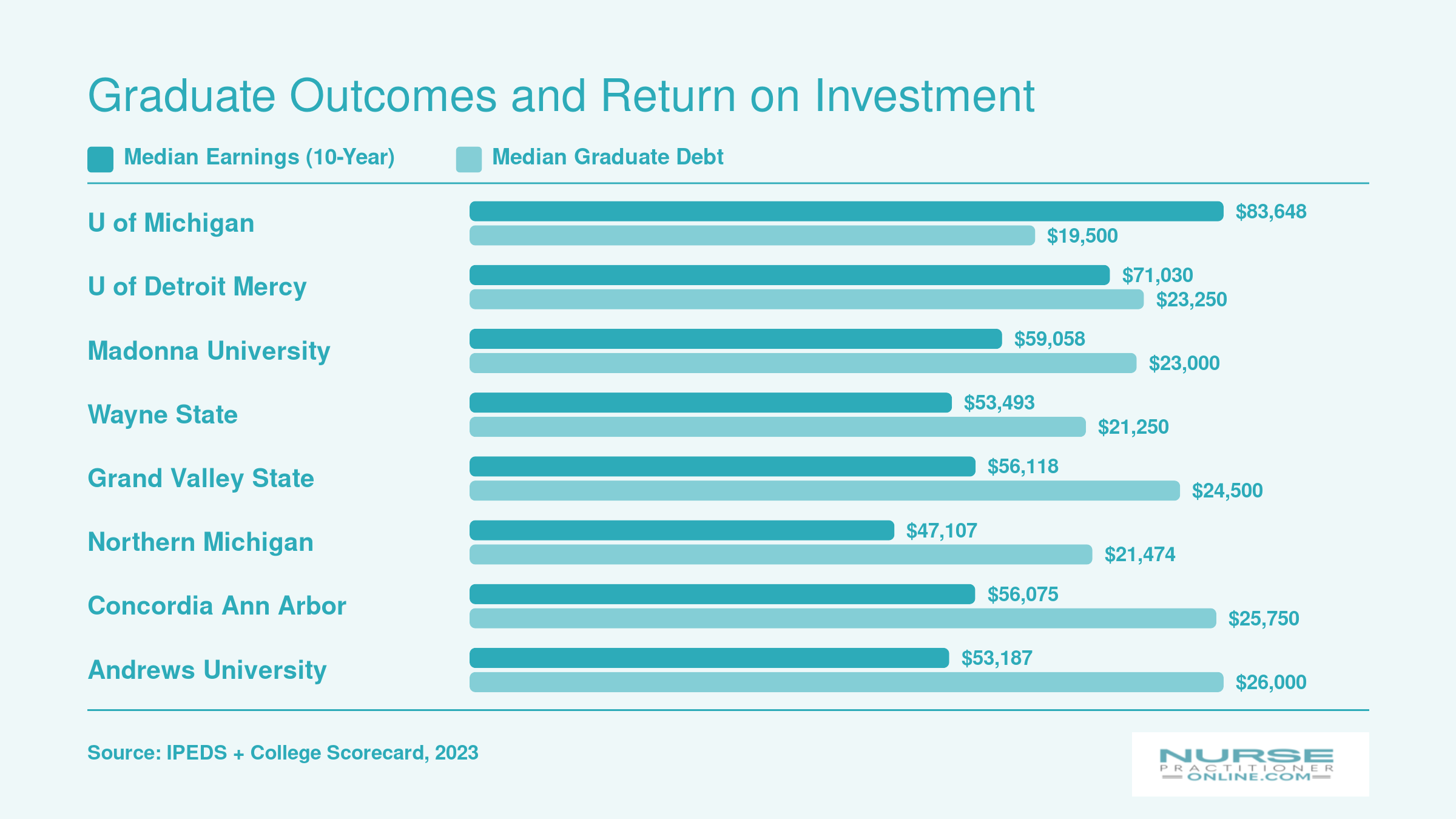
Program-level earnings data at one and four years post-completion are not yet available for these DNP FNP programs, so the chart below uses institution-wide median earnings at ten years alongside median graduate debt. This pairing gives you a useful snapshot of each school's ROI ratio: how many dollars of earnings you can expect for every dollar of debt. The University of Michigan stands out with the strongest return, delivering roughly $4.29 in median earnings for every $1 of debt. The University of Detroit Mercy follows at about $3.05. Schools like Wayne State, Madonna, and Grand Valley cluster in the $2.30-$2.57 range, offering solid value at lower tuition price points. Programs at the bottom of the list, such as Andrews University and Saginaw Valley State, still return more than $2 for every debt dollar, which is a reasonable benchmark for a doctoral investment.
What Nurse Practitioners Earn in the Detroit Metro Area
Understanding local salary data is essential when calculating the return on investment for a DNP FNP program. The Detroit-Warren-Dearborn metro area employs roughly 3,850 nurse practitioners, and their earnings represent a significant jump over registered nurse pay. Below is a comparison of NP salaries across Michigan metro areas, along with RN and related advanced practice wages in Detroit for context.
| Role or Metro Area | Total Employment | 25th Percentile Salary | Median Salary | Mean Salary | 75th Percentile Salary |
|---|---|---|---|---|---|
| Nurse Practitioners, Detroit-Warren-Dearborn | 3,850 | $114,080 | $126,110 | $128,140 | $135,030 |
| Nurse Practitioners, Ann Arbor | 470 | $129,870 | $136,350 | $134,510 | $139,300 |
| Nurse Practitioners, Grand Rapids-Wyoming-Kentwood | 1,010 | $107,450 | $124,480 | $121,320 | $132,340 |
| Nurse Practitioners, Lansing-East Lansing | 250 | $112,150 | $127,790 | $132,910 | $138,440 |
| Nurse Practitioners, Kalamazoo-Portage | 230 | $111,340 | $127,600 | $135,300 | $140,630 |
| Nurse Practitioners, Flint | 340 | $106,270 | $121,630 | $125,340 | $127,450 |
| Nurse Practitioners, Saginaw | 230 | $114,430 | $126,580 | $128,540 | $134,590 |
| Registered Nurses, Detroit-Warren-Dearborn | 44,280 | $81,140 | $88,980 | $92,680 | $101,880 |
| Nurse Anesthetists, Detroit-Warren-Dearborn | 1,590 | $211,530 | $230,450 | $226,560 | N/A |
| Nursing Instructors, Detroit-Warren-Dearborn | 420 | $75,490 | $100,550 | $91,900 | $103,570 |
Clinical Training and Placement in the Detroit Area
How do DNP FNP students secure the clinical hours they need to graduate, and what makes the Detroit area a strong location for primary care training?
Understanding DNP Clinical Hour Requirements
Most Doctor of Nursing Practice Family Nurse Practitioner programs require 1,000 total direct patient care hours before graduation. If you already hold an MSN with completed clinical hours, some programs allow you to apply a portion of those hours toward the DNP requirement. The exact transfer policy varies by school, so you will want to clarify this early in your application process. These clinical experiences must span family practice populations, including pediatric, adult, and geriatric patients, to prepare you for certification as a family nurse practitioner.
Detroit's Healthcare Network as a Clinical Asset
The Detroit metropolitan area offers a dense network of healthcare facilities that can serve as clinical training sites. Major health systems operating in the region include Henry Ford Health, Corewell Health (formerly Beaumont), and Detroit Medical Center. These systems run hospitals, outpatient clinics, urgent care centers, and specialty practices throughout Wayne, Oakland, and Macomb counties. Beyond large systems, the region also hosts federally qualified health centers that provide primary care to underserved communities. FQHCs automatically carry Health Professional Shortage Area designation, making them valuable sites for students seeking robust primary care exposure.1
HPSA Designations and Future Loan Repayment Eligibility
Parts of Detroit and surrounding areas carry primary care HPSA designations, indicating significant provider shortages.2 Completing clinical rotations in HPSA-designated sites not only exposes you to high-need populations but may also position you for federal loan repayment programs after graduation. Programs like the National Health Service Corps offer substantial loan forgiveness in exchange for service commitments in shortage areas. You can verify current HPSA status for specific addresses using the HRSA HPSA Find tool, filtering by discipline, geographic type, and shortage score. It is also worth cross-checking your results against Michigan's designated shortage areas for the most complete picture.
Note that Michigan's shortage designations are under active review: as of January 2026, 48 HPSA designations have been proposed for withdrawal, with replacement applications currently under review and expected withdrawal decisions by July 2026.3 Confirm a site's current status before committing to a clinical placement.
Finding Your Own Preceptor
Most Michigan DNP programs require students to identify and secure their own clinical preceptors rather than providing guaranteed placements.3 This process typically involves researching local clinics and practices, reaching out to certified family nurse practitioners or physicians willing to supervise students, and coordinating with your program to ensure the site meets accreditation standards. Start this process early, ideally six months or more before your clinical semester begins. Building relationships through professional organizations, clinical affiliations from your current nursing role, or networking events can give you a head start. While the state health department and federal resources do not offer direct preceptor matching services, your program's clinical coordinator can often provide guidance and site approval requirements. If you are still weighing the FNP path against other specialties, exploring how to become a nurse practitioner can help you compare the clinical requirements across tracks.
BSN-to-DNP vs. MSN-to-DNP FNP Pathways
The central tradeoff here is time versus total investment: the path you choose will shape not just how long you spend in school, but how much tuition you pay and when you can start practicing as a licensed family nurse practitioner.
Starting from a BSN
If you hold a Bachelor of Science in Nursing and no graduate degree, the BSN-to-DNP FNP pathway takes you from bedside nurse to doctoral-prepared FNP in a single, continuous program. In Michigan, these programs typically run 70 to 80 or more credits and take roughly 36 to 48 months to complete on a full-time schedule, though part-time options can stretch that timeline further.1
A few concrete examples help frame the scope of the commitment:
- Wayne State University: 76 credits total for the BSN-to-DNP FNP track, with up to seven years to finish the degree.1
- Saginaw Valley State University: 71 to 74 credits, paired with 1,020 to 1,080 supervised clinical hours built into the curriculum.2
- University of Michigan-Flint: 70 credits for its BSN-to-DNP FNP option, structured to accommodate working nurses.3
The upside of this route is consolidation. You earn your MSN-level competencies and your DNP in one program, often paying a single per-credit rate throughout rather than funding two separate degrees across two institutions.
Starting from an MSN
Nurses who already hold an MSN, particularly those with a family nurse practitioner concentration, can pursue a post-master's DNP instead. These programs are substantially shorter, typically 35 to 40 credits and 18 to 36 months.1 Wayne State's post-master's DNP track, for instance, requires roughly 38 credits, cutting the credit load nearly in half compared to the BSN entry point.1
The post-master's path makes sense if you earned your MSN FNP credentials, practiced for a few years, and now want the terminal degree for leadership, academic, or advanced clinical roles. With the 2025 DNP deadline having passed, many experienced NPs are weighing this exact move. You skip the foundational FNP coursework you already completed and focus almost entirely on doctoral-level content: quality improvement, evidence-based practice, healthcare policy, and your final DNP project.
Which Path Fits Your Situation
For most working nurses in the Detroit area exploring this decision in 2026, the choice comes down to two questions: Do you already have an MSN? And can you absorb a longer program in exchange for a lower total credit cost per dollar spent?
If you are BSN-prepared, the direct entry route is generally the more efficient long-term investment, even though it demands more time upfront. If you hold an MSN FNP, the post-master's DNP lets you reach the finish line faster with significantly less coursework remaining. If you are drawn to the quickest timeline possible, you may also want to explore fastest nurse practitioner programs as a comparison point. Either way, the programs available in and around Michigan offer enough flexibility that working nurses can realistically complete either pathway without stepping away from their jobs entirely.
Related Articles
Michigan FNP Certification and Licensure Requirements
Passing a national certification exam and securing state licensure are two distinct steps, and understanding the order and timeline for each can help you move from graduation to patient care as quickly as possible.
National FNP Certification
After completing your DNP FNP program, you will need to pass one of two nationally recognized certification exams: the American Academy of Nurse Practitioners (AANP) FNP exam or the American Nurses Credentialing Center (ANCC) Family Nurse Practitioner exam.1 Both are accepted by Michigan's Department of Licensing and Regulatory Affairs (LARA). Most graduates schedule their exam within a few weeks of finishing their program. Results are typically available the same day for the AANP exam or within a few business days for the ANCC exam, so this step does not need to create a long gap in your timeline.
When evaluating programs, ask about FNP certification pass rates. Schools with consistently high first-time pass rates signal strong curriculum alignment with exam content. Some Michigan programs publish these rates on their websites or in accreditation reports, and they are worth reviewing during your decision-making process. For a broader look at the family nurse practitioner role and what the credential unlocks, that context can inform your program choice as well.
Applying for Michigan NP Licensure Through LARA
Once you hold national certification, you apply for nurse practitioner licensure through Michigan's MiPLUS online system.2 You must already hold an active Michigan registered nurse license.1 The application requires official transcripts from your DNP program, primary source verification of your national certification sent directly from the certifying body, and a background check.3 Programs accredited by CCNE or ACEN satisfy Michigan's educational requirements.3
Processing times can vary, but many applicants report receiving their NP license within four to eight weeks of submitting a complete application. Planning ahead by gathering transcripts and requesting certification verification promptly can shorten this window.
Practice Authority and Prescriptive Privileges
As of 2025 and into 2026, Michigan remains a reduced-practice state.4 This means you are required to maintain a collaborative agreement with a physician in order to practice. Legislation to grant nurse practitioners full practice authority has been introduced in the Michigan legislature but has not been enacted.4 You can review the current landscape across all states in our guide to nurse practitioner practice authority by state, which is an area worth watching as passage would eliminate the collaborative agreement requirement and expand your autonomy.
For controlled substance prescriptive authority, you will need to apply for a DEA registration after obtaining your state license. Your collaborative agreement will outline the scope of your prescribing privileges until any legislative changes take effect.
Keeping Your License Current
Michigan NP licenses renew every two years, with a deadline of March 31.5 You must complete at least 25 hours of continuing education per renewal cycle.5 Specific requirements include at least 2 hours in pain management and 2 hours in implicit bias training. There is also a one-time 2-hour human trafficking training requirement that was established in 2022.6 Note that Michigan caps CE credit at 12 hours per day, so you cannot compress all your education into a single weekend.5
From Graduation to Seeing Patients
Realistically, most DNP FNP graduates in Michigan move from program completion to practicing with patients in roughly two to four months. That timeline includes scheduling and passing your certification exam, submitting your LARA application, and securing a collaborative agreement with a physician. Starting the application process before you officially graduate, where possible, and having your documents ready to submit can compress the timeline toward the shorter end. Employers in the Detroit metro area are often familiar with this process and may assist new hires in establishing collaborative agreements, which can further smooth the transition into clinical practice.
Frequently Asked Questions About DNP FNP Programs Near Detroit
Choosing a Doctor of Nursing Practice Family Nurse Practitioner program is a big decision, especially when you are balancing shifts, family, and finances. Below are answers to the questions Detroit-area nurses ask most often about DNP FNP programs in Michigan.
- How much does a DNP FNP program cost in Michigan?
- Costs vary widely depending on the school and your residency status. Among Michigan programs, published per-year tuition ranges from roughly $14,000 to $29,000 for in-state students. For example, University of Michigan-Flint lists annual tuition near $14,473 for Michigan residents, while the University of Michigan in Ann Arbor runs about $28,886 per year. Total program cost also depends on whether you enter from a BSN or an MSN, since credit requirements differ significantly.
- What is the cheapest DNP FNP program in Michigan?
- Based on published tuition figures, University of Michigan-Flint is one of the most affordable options for Michigan residents, with annual in-state tuition around $14,473. Saginaw Valley State University is another budget-friendly choice, listing tuition near $18,360 per year for both in-state and out-of-state students. Financial aid, scholarships, and employer tuition benefits can further reduce your out-of-pocket costs at either school.
- How long does it take to complete a DNP FNP program?
- Timeline depends on your entry point. A BSN-to-DNP pathway typically takes 36 to 48 months of full-time study and requires 65 to 95 credits. If you already hold an MSN, the MSN-to-DNP route is shorter, generally 12 to 24 months and 33 to 43 credits. Part-time schedules designed for working nurses can extend these timelines, so check each program for flexible pacing options.
- What is the difference between an MSN FNP and a DNP FNP?
- Both credentials qualify you to practice as a family nurse practitioner in Michigan, and the scope of practice is the same for clinical roles. The DNP is a terminal practice doctorate that adds deeper training in evidence-based practice, leadership, health policy, and systems improvement. While clinical salaries are comparable, the DNP can open doors to academic faculty positions, executive leadership roles, and organizational influence that an MSN alone may not.
- Are there fully online DNP FNP programs in Michigan?
- Several Michigan schools offer programs with significant online coursework, though most require some in-person component for clinical training or occasional campus visits. Andrews University, for example, offers an online format with synchronous and asynchronous options. University of Michigan-Flint and the University of Michigan in Ann Arbor use hybrid models with online courses plus brief on-campus sessions roughly once per semester or a few days per term.
- What are the clinical hour requirements for a DNP FNP program?
- DNP FNP students must complete a minimum of 1,000 supervised clinical hours as set by the AACN. If you are entering an MSN-to-DNP pathway and already logged clinical hours during your master's program, you may need to complete approximately 500 additional hours. Some Michigan programs, including Wayne State University and Saginaw Valley State University, offer clinical placement support to help you secure sites in the Detroit metro area.
- What is the FNP certification exam pass rate for Michigan programs?
- Michigan DNP FNP programs generally report strong certification exam pass rates, ranging from 90% to 100% in recent years. Pass rates are reported on a school-by-school basis, so it is worth checking each program's most recent outcomes. Programs such as Wayne State University highlight their high certification pass rates, and asking admissions for the latest figures is always a smart step before you apply.