
Most important takeaways…
- Fewer than 1% of nursing faculty hold FAAN distinction.
- UCF now has 15 FAAN faculty, most in Florida.
- FAAN faculty led national telehealth NP education standards.
When comparing nurse practitioner programs, many applicants focus on tuition and pass rates. Yet a program’s true educational depth often reveals itself in faculty honors: specifically, the American Academy of Nursing (AAN) Fellowship. Only a fraction of nursing educators earn the FAAN credential, and their presence signals a commitment to advancing clinical practice and education.
In 2026, the University of Central Florida led Florida universities with four new AAN Fellows, including Jacqueline LaManna, whose telehealth education frameworks and diabetes care standards have shaped NP curricula nationally. Such concentrated expertise directly influences what and how students learn.
Programs that invest in FAAN faculty tend to embed cutting-edge clinical evidence and leadership training into everyday coursework, giving graduates an edge in practice.
What Is the American Academy of Nursing Fellowship?
The Fellow of the American Academy of Nursing (FAAN) is the most prestigious professional recognition in nursing,1 awarded to nurse leaders whose careers demonstrate exceptional and sustained contributions to the field. Earning the FAAN credential is not like completing a degree program; it signals that a nurse has been recognized by peers as a transformative force in practice, education, research, or policy. Few nurses ever receive this honor, which places FAAN fellows in an elite category of influence and expertise.
A Rigorous, Peer-Reviewed Selection Process
The path to becoming a FAAN is demanding. Candidates must be sponsored by two current fellows2 and submit a comprehensive portfolio of their accomplishments through a secure application platform.3 The Fellow Selection Committee and International Subcommittee conduct a thorough peer review,2 evaluating whether the candidate’s work has had a substantive, sustained, and outstanding impact beyond routine job duties. Applicants must demonstrate national or international reach, or scalable regional impact that advances the nursing profession.4 The process ensures that only those who have truly made a difference are inducted.
Global Reach and Annual Induction
The American Academy of Nursing induction ceremony is a highlight of the nursing calendar. In October 2026, the newest fellows will be formally recognized in Washington, D.C., joining a global community of over 3,600 fellows.5 This international network includes famous nursing leaders from practice, academia, research, and policy who collaborate to address health care challenges. The sheer number of fellows worldwide, combined with the selectivity of the process, reinforces the FAAN credential as a universal mark of excellence.
Why FAAN Matters for NP Education
For prospective nurse practitioner students, the presence of FAAN faculty in a program is a powerful quality indicator. These fellows often lead curriculum development, publish foundational research, and serve on national committees that shape clinical guidelines, directly enriching the classroom experience. When you see a program director or faculty member with the FAAN designation, you are looking at someone whose peers have validated their leadership and lasting contributions, placing them among the most respected nurse practitioner visionaries in the field. It is a shorthand for the kind of mentorship and evidence-based training you can expect from that institution.
According to the American Academy of Nursing, fewer than 1 percent of nursing faculty across the U.S. are Fellows of the Academy (FAAN). This exceptionally selective honor signifies leadership, innovation, and lasting impact on nursing education and practice.
Why Faculty Recognitions Are a Hidden Quality Signal
Faculty recognitions like the American Academy of Nursing (AAN) Fellowship operate as a powerful but often overlooked indicator of program quality. While accreditation and board pass rates dominate the conversation, the distinction of FAAN or FAANP fellowship credentials among faculty signals a level of peer-reviewed achievement that directly benefits students.
Spotting the Signal on Faculty Profiles
Start by searching nursing school websites for faculty profiles that highlight FAAN or FAANP designations. These aren't ceremonial titles; they represent invitation-only recognition for sustained, measurable contributions to practice, education, research, or advocacy. For example, the FAANP fellowship requires current NP certification and at least two years of membership, with selection based on demonstrated impact.1 When you see multiple faculty members with these honors, it suggests a program that attracts and retains leaders who shape the profession.
Linking Recognition to Student Success
The connection to student outcomes is more concrete than you might think. National first-time NP certification pass rates hover around 81, 83%,2 but programs with exceptionally strong faculty mentorship and rigor see much higher numbers. An integrative review of health professions education found that key predictors of exam success include faculty-to-student ratio, mentoring quality, and direct patient care clinical hours, which are statistically significant factors.3 In one striking comparison, NP programs with near-perfect pass rates showed odds of 100% pass rates eight times higher when faculty credentials and clinical hour thresholds aligned.4 Even achieving an 80% pass rate standard5 was associated with four to five times greater odds under these conditions.4 These aren't coincidences; they reflect the instructional depth that recognized faculty bring to curriculum development, test-item writing, and student preparation.
External Data That Validates Quality
To ground these observations in hard data, cross-reference your findings with public sources. The Bureau of Labor Statistics (BLS.gov) offers state-level nursing employment projections and wage data, helping you gauge if a program's outcomes match regional demand. Reports from the American Association of Colleges of Nursing (AACN) and National League for Nursing (NLN) analyze faculty qualifications and program results. Even U.S. News & World Report rankings incorporate faculty credentials, like FAAN status, into their scoring models, so a program with recognized faculty often climbs in rankings over time. For instance, one nurse anesthesia pathway saw its rank leap from 65 to 29 after strengthening faculty scholarship and clinical mentorship, illustrating how recognition translates to measurable improvement.
Faculty honors aren't just ego boosters; they're a proxy for the mentorship, curriculum quality, and networking opportunities that define your educational experience. When you evaluate NP programs, let these hidden signals guide you toward a choice backed by proven excellence.
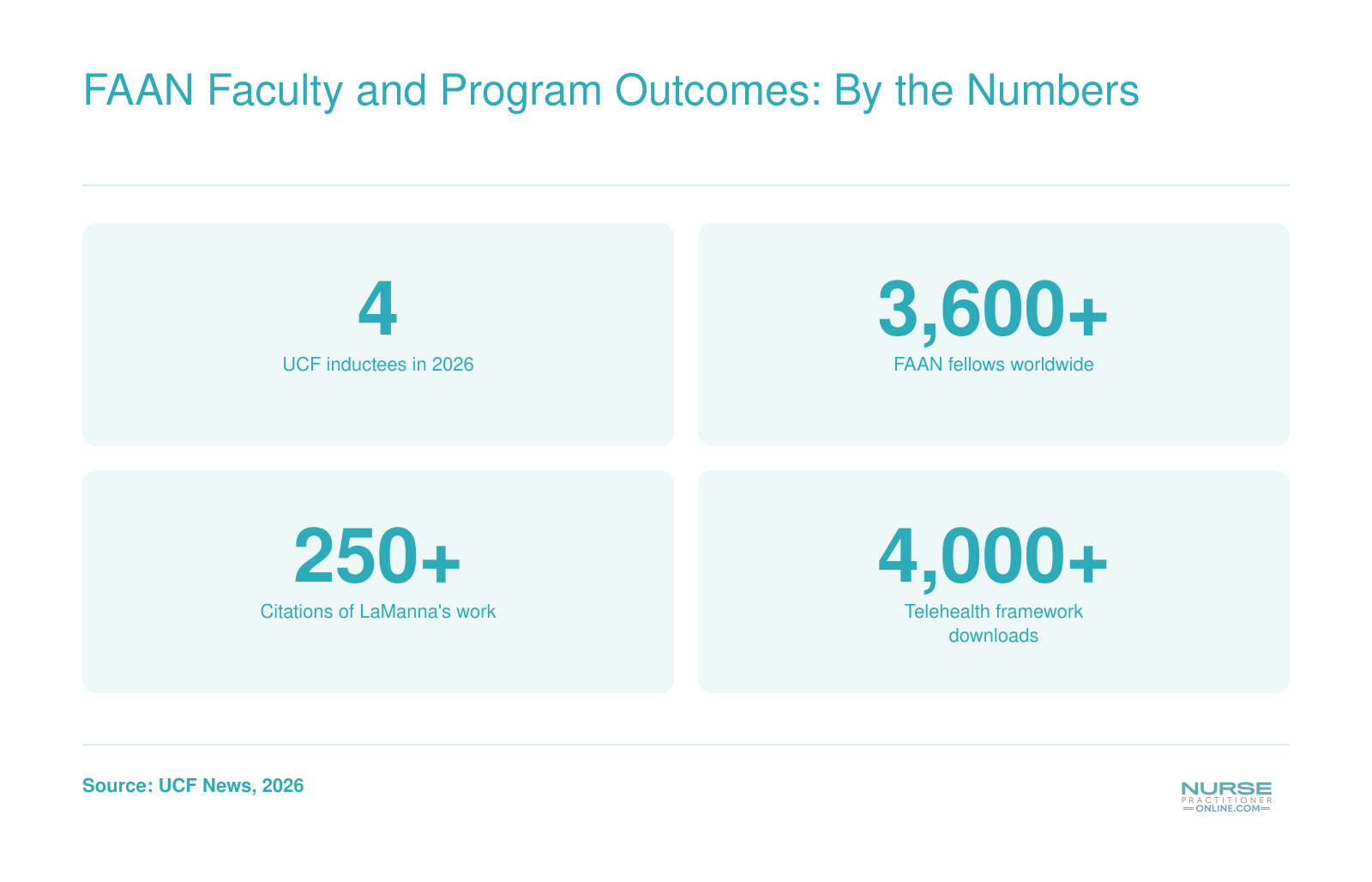
FAAN Faculty and Program Outcomes: By the Numbers
The 2026 class of American Academy of Nursing Fellows highlights the caliber of faculty shaping NP education. These numbers underscore the reach and influence of FAAN-recognized faculty and their contributions to curriculum and practice.
How AAN Fellows Shape Curriculum and Student Success: The UCF Example
The University of Central Florida now holds 15 faculty members with the prestigious FAAN designation, the most among Florida universities after its dominant 2026 class of four new Fellows. This concentration of recognized expertise isn't just a badge: it directly shapes the nurse practitioner curriculum and student experience.
A Faculty Fellow Driving Curriculum Change
Dr. Jacqueline LaManna, a 2026 FAAN inductee, exemplifies this impact. As a Family Nurse Practitioner and director of the Adult-Gerontology Primary Care Nurse Practitioner program at UCF, her scholarly work reaches deep into the classroom. She co-authored guidelines now embedded in the American Diabetes Association Standards of Care in Diabetes,1 standards that nurse practitioner students study and apply during nurse practitioner clinical rotations. With over 250 citations, her research on diabetes self-management forms the backbone of case studies and evidence-based practice assignments.
Telehealth Standards That Reshape NP Training
LaManna also helped build national telehealth education frameworks for NP graduate students1, resources accessed more than 4,000 times nationally. UCF integrated these frameworks into its own curriculum, ensuring students graduate prepared for virtual care delivery long before the pandemic made it mainstream. Graduates enter practice with telehealth competencies many programs still lack.
A Faculty Benchmark for Program Quality
UCF’s 15 FAAN faculty members set a high bar, but the 2026 class alone, with the most inductees in the state, signals a continued commitment to hiring and developing faculty whose work drives clinical standards. When a program’s instructors are the ones writing the guidelines that shape national NP practice, students get a future-ready education , a factor worth considering when evaluating FNP programs.
Questions to Ask Yourself
Other Professional Fellowships That Signal Program Excellence
Nurse practitioner education increasingly rewards programs whose faculty demonstrate distinction through nationally recognized fellowships. While the American Academy of Nursing (FAAN) fellowship is widely recognized, several other prestigious designations signal teaching expertise, clinical leadership, or research impact. Understanding these credentials helps you evaluate programs where faculty are actively shaping the profession.
Common Faculty Fellowships to Look For
- FAANP (Fellow of the American Association of Nurse Practitioners): This honor recognizes NP leaders who have made outstanding contributions to clinical practice, research, education, or policy. FAANP fellows often shape national NP practice standards and mentor the next generation.
- ANEF (Academy of Nursing Education Fellow): Granted by the National League for Nursing, this designation highlights educators who have innovated teaching methods, advanced curricular design, or contributed to the science of nursing education. It is a strong indicator of a program's commitment to pedagogical excellence.
- Sigma Theta Tau International (STTI) Fellow: Also known as the International Nurse Researcher Hall of Fame or Virginia Henderson Fellow within Sigma, these recognitions honor significant research contributions. Faculty with STTI honors often bring a global perspective and robust research mentorship to their students.
- Additional Recognitions: Some faculty may hold fellowships from specialty organizations, such as the Gerontological Advanced Practice Nurses Association or the National Association of Pediatric Nurse Practitioners. These signal depth in a particular patient population.
How to Verify Fellow Credentials
Start by visiting the official websites of these professional associations. Many publish public directories of current fellows, searchable by name or institution. For example, the AANP maintains an online fellow directory, and the NLN provides a roster of ANEF inductees. While not every association updates these in real time, they offer a credible starting point. You can also scan faculty profile pages on NP program websites: look for acronyms like FAANP, ANEF, or FAAN in the faculty's credentials string. This manual comparison across a few target programs gives a sense of the concentration of recognized faculty, an essential part of evaluating programs.
For broader trends, labor market resources like the Bureau of Labor Statistics (BLS) can provide context on the growth of nursing educator roles, though they do not break down fellowship attainment. If you need institution-level counts, contacting the associations directly or emailing program admissions offices with specific questions can yield more precise information. Remember that a single fellowship is not a guarantee of program quality, but a pattern of multiple recognized faculty often reflects a culture of excellence that directly benefits your education.
How to Research Faculty Credentials Before Applying to an NP Program
Evaluating faculty credentials before you apply to NP school is one of the most direct ways to gauge the quality of your education. Start by exploring what’s publicly available and then verify the details to ensure a program’s faculty are truly leaders in the field.
Start with the Faculty Directory
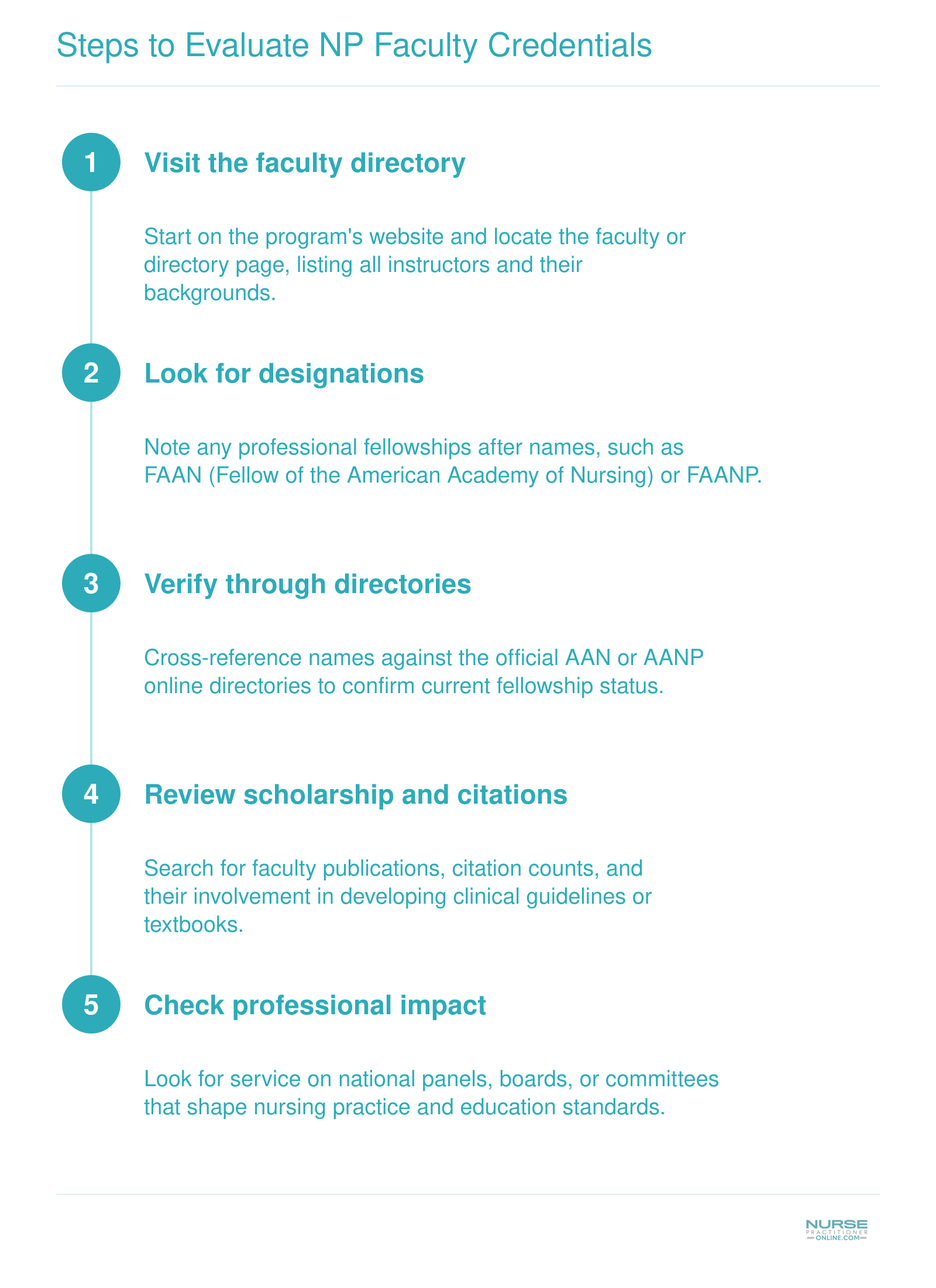
Visit the program’s website and locate its faculty or directory page. Look for post-nominal initials after professors’ names: FAAN (Fellow of the American Academy of Nursing), FAANP (Fellow of the American Association of Nurse Practitioners), or a PhD in nursing. Sparse profiles that omit degrees, certifications, or licensure details aren’t just a red flag: they’re one of the mistakes to avoid when enrolling in an MSN program.2 Solid programs proudly display their faculty’s credentials because they signal deep expertise.
Verify FAAN and FAANP Status
Don’t just take the website at face value. Use the American Academy of Nursing’s public online directory to confirm FAAN status. Similarly, the AANP Fellow directory lets you verify FAANP credentials.1 Finding a faculty member listed in these national registries tells you they’ve met rigorous standards for scholarship and leadership, and that the program attracts and retains top-tier educators.
Examine Research Impact
Search for faculty publications on PubMed or Google Scholar. Look for articles that are frequently cited, especially those that shape clinical guidelines. For instance, a professor whose work appears in the American Diabetes Association’s Standards of Care is directly influencing real-world practice. High citation counts and publication in major journals indicate a faculty member’s research is respected and relevant.
Look for Leadership Beyond Academia
Check whether faculty hold leadership roles in professional organizations or serve on guideline-writing panels. Involvement with groups like the American Diabetes Association, the American Telemedicine Association, or state boards of nursing shows that their knowledge extends beyond the classroom and into policy, which enriches your learning.
Your Faculty Credentials Checklist
Use these steps as a mental checklist when comparing programs:
- Credentials on profiles: Do faculty bios clearly list NP licensure, board certification, and advanced degrees?
- Fellowship verification: Are any FAAN or FAANP designations confirmed by the official directories?
- Research presence: Does a quick PubMed search reveal meaningful scholarship with a track record of citations?
- Practice influence: Are faculty named in national guidelines or leadership roles that affect patient care?
A program whose faculty check all these boxes is one that invests in quality, the same quality you’d look for in a rigorous MSN FNP program evaluation.
Steps to Evaluate NP Faculty Credentials
Beyond Faculty Honors: Complementary Quality Indicators
How can I evaluate the overall strength of a nurse practitioner program beyond faculty credentials and recognitions? While fellowships like the American Academy of Nursing signal individual expertise, they are just one lens. A truly robust assessment layers in accreditation status, standardized outcome metrics, and clinical training quality.
Accreditation Standards and Faculty Qualifications
Nursing accreditation bodies such as the Commission on Collegiate Nursing Education (CCNE) set rigorous expectations. Since January 2025, CCNE has required that at least 80% of a program’s graduates secure employment within their field, up from 70%.1 Faculty must hold active RN licenses, and those teaching at the graduate level need a doctoral degree.2 For advanced practice tracks, instructors who oversee clinical courses are expected to possess national certification in the same population focus or equivalent clinical expertise.1 Professional recognitions like FAAN, though not explicitly mandated, strengthen a program’s profile during accreditation reviews by demonstrating faculty influence and leadership.
Standardized Quality Indicators from NONPF and AANP
National organizations outline clear benchmarks for NP education quality:
- Board pass rates: First-time np certification exam pass rates are a critical metric; a program consistently falling below the national average warrants scrutiny.
- Clinical placement quality: Students should complete at least 500 nurse practitioner clinical hours for master’s-level NP tracks and 1,000 practice hours for DNP programs, with placements arranged and vetted by the school.1
- Graduation and employment rates: Look for on-time completion percentages and post-graduation employment rates that meet or exceed the CCNE threshold.
- Faculty-student ratios: A ratio around 1:8 in clinical settings is considered optimal for individualized learning.1
Putting It All Together: Holistic Program Evaluation
Cross-reference faculty honors with these outcome metrics. A program with multiple FAAN holders but subpar board pass rates or weak clinical placement support raises a red flag. Conversely, a school with solid metrics and a growing number of recognized faculty often excels on both fronts. Top-ranked NP programs typically perform well across all these measures, signaling a balanced commitment to instruction and student success.
Frequently Asked Questions About NP Faculty Recognition
When evaluating NP programs, faculty fellowships often raise questions. These answers, grounded in nursing education evidence, help you understand the role of recognitions like AAN and AANP fellowships in program quality.
- How many AAN fellows should a high-quality NP program have?
- There is no set minimum, but programs with multiple AAN fellows often indicate a strong culture of scholarship and leadership. Even one fellow can bring depth, as their recognition reflects sustained, outstanding contributions to nursing practice, education, or policy. Look for a cluster of fellows as a sign of a robust academic environment.
- Are online NP programs with AAN faculty as rigorous as on-campus programs?
- Yes, when the online program holds CCNE or ACEN accreditation5 and demonstrates strong board pass rates and employment outcomes. Faculty fellowships add scholarly depth, but the delivery mode does not determine rigor. When comparing online vs on-campus NP programs, accreditation, curricular standards, and student outcomes are the primary indicators of respect and quality.
- How can I verify if a program’s faculty fellowship claims are accurate?
- Check the official fellows directory on the American Academy of Nursing or AANP Fellows directory website. These directories list all current fellows and are searchable by name. Because fellowships are based on substantive, sustained impact, independent verification confirms that the program’s claims align with official recognition.
- Is faculty fellowship status a vanity metric or a real quality indicator?
- It is a real but supporting indicator. Primary quality measures include accreditation, board pass rates, employment outcomes, and faculty productivity.4 Fellowship status signals a faculty member’s contributions to practice, education, advocacy, or research, adding value to the learning environment, but it should be considered alongside these other metrics.
- Do faculty fellowships matter more in certain NP specializations?
- They are valuable across all areas, but if your career goals align with a fellow’s expertise (e.g., diabetes care, telehealth), you may gain richer mentorship and specialized curriculum insights. Always research faculty scholarly work in your desired specialty to see how their fellowships connect to what you will learn.
- What backgrounds do FAAN faculty typically have?
- FAAN fellows are recognized for outstanding contributions in at least two areas: practice, education, advocacy, or research, per the American Academy of Nursing Fellowship program. They often lead clinical innovations, publish influential work cited in national guidelines, and develop educational frameworks. This breadth of expertise enriches the NP curriculum with real-world policy and evidence-based practice insights.
- Can an early-career NP program with fewer fellows still be strong?
- Yes. Faculty fellowships enhance a program, but newer programs can still deliver excellent education through experienced, though not yet nationally recognized, faculty. Evaluate accreditation, board pass rates, clinical placement support, and student satisfaction. These outcomes matter more than the count of fellows, especially for emerging programs.