Most important takeaways…
- Hiring managers form impressions within five minutes, and your lighting, background, and camera setup influence that judgment significantly.
- Proactively discussing specific telehealth platforms and remote triage protocols differentiates you from most NP candidates.
- NP employment is projected to grow 46 percent from 2023 to 2033, intensifying competition for top positions.
- A timely, personalized follow-up after the interview signals the communication skills and attention to detail employers want.
Across health systems in 2026, virtual interviews have become the default first screen for nurse practitioner candidates, including roles that are entirely on-site. That shift creates a practical gap: strong clinical preparation and a polished resume are no longer enough to carry you through the process.
Virtual interviews test a different skill set. Hiring managers read your professionalism through camera framing, ambient noise, and eye contact on a flat screen before you deliver a single clinical answer. Candidates who treat a video call like a relaxed phone screen consistently underperform relative to their actual qualifications.
The tension here is real. NPs with excellent bedside skills and years of experience often struggle on camera precisely because those skills do not automatically translate to the virtual format. Employers staffing roles that may never involve telehealth are still evaluating how you show up digitally, which makes on-camera competency a baseline hiring criterion rather than a specialty credential.
Why Virtual Interviews Are Now Standard for NP Hiring
What percentage of nurse practitioner interviews are now conducted virtually? Industry hiring reports from 2026 point to virtual interviewing as a core part of how health systems screen advanced practice candidates, though exact percentages vary by employer and region.1 The pattern is clear even without a single national figure: video is no longer reserved for telehealth roles. It is the default first touchpoint for almost any NP opening.
A Bigger Candidate Pool Means Camera Skills Count
The Bureau of Labor Statistics counts roughly 307,000 nurse practitioners working nationally, with projected growth of about 46% from 2023 to 2033 and roughly 135,000 net new jobs over that decade.2 That makes NPs the third fastest-growing occupation in the country. High-demand states are moving even faster: Arizona is projecting a 71.1% growth rate, California 58.6% with around 2,500 annual openings, and Florida 58.5% with about 2,190 openings.3
More openings does not mean less competition. Strong roles, especially in academic medical centers, well-funded primary care groups, and specialty practices, still draw dozens of qualified applicants. When recruiters are sorting through that volume, your first impression usually happens through a webcam, not a handshake.
Virtual Screens Apply Even to Bedside and Clinic Roles
Even NP positions that are entirely in-person (hospitalist work, surgical first-assist, urgent care) typically begin with a virtual recruiter screen. Many employers then move to a virtual panel interview before flying or driving candidates in for a final on-site visit. Recruiters favor this format because it reduces time-to-hire and eliminates the scheduling gridlock of coordinating multiple clinicians in one room.1
Expect Multiple Virtual Rounds
For most NP openings in 2026, plan on a three-stage process: a 20- to 30-minute recruiter screen, a longer clinical or panel interview with the hiring manager and peer NPs or physicians, and a final conversation with leadership or a department director. Each round has a different audience and a different bar. Treating any of them as casual is the fastest way to get cut.
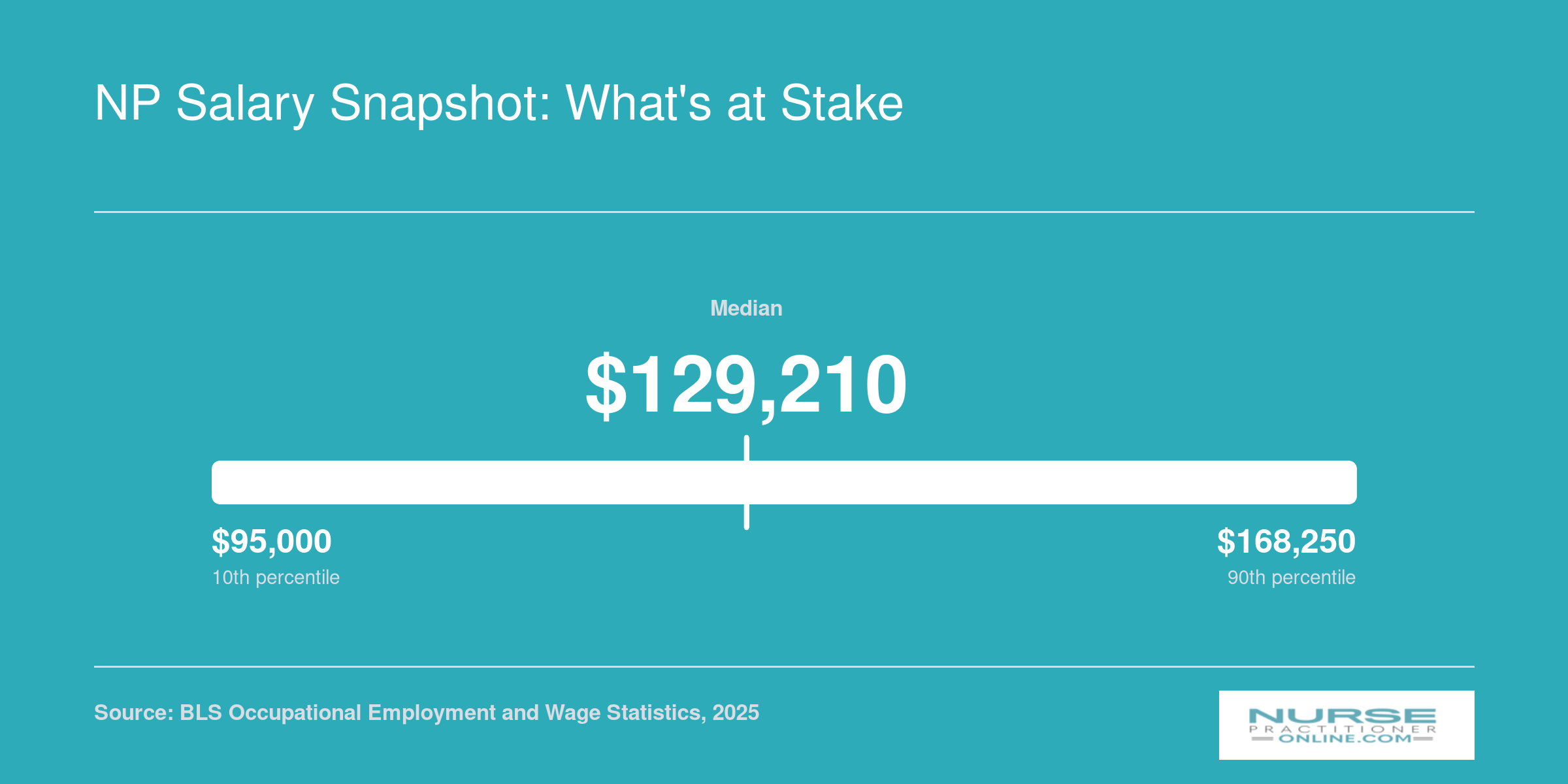
NP Salary Snapshot: What's at Stake
With over 307,000 nurse practitioners employed nationwide, the earning potential in this field is significant. Acing your virtual interview is the gateway to tapping into these competitive salaries, so preparation is more than a formality.
Set up Your Space Like a Pro: Tech, Lighting, and Background
A 2024 SHRM survey found that 67% of hiring managers form an impression of a candidate within the first five minutes of a virtual interview, and a surprising share of that judgment hinges on production quality rather than what you say. For nurse practitioners interviewing for telehealth-heavy roles, your setup is also an unofficial competency demo: if you cannot run a stable video call from your home office, the hiring panel will quietly wonder how you will manage a virtual visit with a patient.
Your NP-Tailored Setup Checklist
- Camera position: Raise your laptop or webcam to eye level using books or a stand. Looking down into the camera distorts your face and reads as disengaged.
- Lighting: Use a ring light or sit facing a window. Light should come from in front of you, never behind. Backlighting turns you into a silhouette.
- Background: Choose a neutral, uncluttered wall or a tidy bookshelf. Remove anything clinical from view: no stethoscopes hanging on hooks, no patient education handouts, no prescription pads, no badges with identifiable facility names. HIPAA-adjacent visuals make panels nervous.
- Attire: Wear a solid, professional top in a mid-tone color. Navy, burgundy, forest green, and charcoal photograph cleanly. Avoid fine stripes, herringbone, and tight checks, which create moiré patterns on camera.
Audio and Platform Prep
Audio quality matters more than video quality. Invest in a wired headset or a quality external USB microphone, because laptop mics pick up keyboard clicks, HVAC noise, and room echo. There are a number of helpful nurse practitioner tools that can streamline your tech prep, but the basics are straightforward: at least 24 hours before the interview, log into the actual platform the employer is using (Zoom, Microsoft Teams, Webex, or Doxy.me) and run a test call. Update the app, grant camera and microphone permissions, and silence every notification: email, Slack, iMessage, and your phone.
Run a Dry Run
Schedule a 15-minute mock call with a fellow NP, a mentor, or a friend the day before. Ask them to evaluate three things: how you are framed in the shot (head and shoulders, with a little headroom), whether your voice sounds clear and full, and whether your connection holds steady. Run a speed test and aim for at least 25 Mbps upload. If your home connection is borderline, plug into ethernet rather than relying on Wi-Fi, and ask other household members to stay off streaming services during the interview window.
Questions to Ask Yourself
Master On-Camera Body Language and Eye Contact
Hiring managers evaluate your bedside manner through a webcam the same way patients will judge your telehealth presence: through your eyes, your posture, and the warmth you project on a flat screen. Strong clinical credentials get you the interview; on-camera presence gets you the offer.
Train Your Eyes on the Lens, Not the Face
Look at the camera, not at the interviewer's image on your screen. This feels unnatural at first, but it is the only way to create the perception of eye contact. A practical trick: place a small sticky note arrow next to your webcam as a reminder, or shrink the video window and drag it directly under the camera lens. Practice this for short stretches before interview day so it stops feeling forced.
Sit, Frame, and Gesture Deliberately
Frame yourself from mid-chest up, with roughly a hand's width of space above your head. Sit slightly forward, shoulders square to the camera, feet planted. Keep gestures inside the frame and slower than you would in person, because video compresses motion and fast hand movement reads as anxious. A relaxed smile at the open and close of each answer signals the same approachability patients respond to in a virtual visit.
Build the Skill With Real Resources
You do not have to guess at what hiring managers want. A few places to find vetted guidance:
- Professional associations: The American Association of Nurse Practitioners (AANP) and the American Medical Association (AMA) publish guidance on professional presentation and virtual communication.
- University career services: NP program career offices and alumni networks often share free videos, mock interview tools, and body language checklists, even for graduates of other schools.
- LinkedIn: Follow verified healthcare recruiters and NP hiring managers who post specific, current advice on what works and what sinks candidates.
- BLS.gov: The Bureau of Labor Statistics outlines general interview best practices and links out to professional organizations with deeper job-hunting guides.
If the interview process is also sparking thoughts about your next career move, exploring non-clinical nurse practitioner jobs can help you refine how you position your experience on camera. Record a two-minute practice answer, watch it back once, and adjust. That single habit closes the gap between knowing these tips and showing them.
How to Demonstrate Telehealth Competency in Your Answers
Hiring managers evaluating NP candidates in 2026 expect familiarity with at least one major telehealth platform and at least one major EHR system, and they begin assessing your tech fluency from the moment the interview starts.1 That means every answer you give is a chance to show, not just tell, that you can deliver high-quality care through a screen.
Weave Platform Knowledge Into Every Behavioral Answer
You do not need to wait for a direct telehealth question to showcase your skills. Proactively name the tools you have used inside your STAR-method stories.2 Instead of saying "I triaged a patient with chest pain," try something like: "When I triaged that patient remotely using our Epic telehealth module, I relied on the integrated video assessment and real-time documentation workflow to capture vitals the patient reported from their home blood pressure cuff." Dropping specific platforms (Epic, Athenahealth, Doxy.me, Teladoc, or others you have genuinely used) signals that you understand the technology stack rather than speaking about telehealth in the abstract.
Interviewers also listen for how you handled platform-specific workflows: scheduling, e-prescribing, asynchronous messaging, and charting while maintaining eye contact with the patient on camera. If you have navigated any of these, say so naturally within your stories.
Build a Go-To STAR Answer That Covers Multiple Competencies
A single well-constructed response can demonstrate EHR proficiency, remote triage decision-making, and virtual patient communication all at once. Here is a sample framework you can adapt:
- Situation: A 62-year-old patient with a history of COPD contacted the telehealth clinic reporting worsening shortness of breath and a new productive cough.
- Task: You needed to determine whether the patient could be managed remotely or required an in-person escalation, all while documenting in real time.
- Action: You used targeted open-ended questions and guided the patient through a self-assessment (respiratory rate count, description of sputum color, pulse oximetry reading from their home device). You verbalized your clinical reasoning aloud, noting specific red flags such as oxygen saturation below 92 percent and increased work of breathing, and you documented findings directly in the EHR during the visit to maintain accuracy.2 You also reassured the patient with clear, jargon-free language to preserve rapport through the screen.
- Result: You identified criteria warranting same-day in-person evaluation, coordinated a warm handoff to the patient's pulmonologist via the platform's referral workflow, and followed up virtually the next day.
This type of answer checks several boxes interviewers care about: independent clinical decision-making without on-site support, explicit verbalization of red flags and escalation logic, HIPAA-compliant documentation habits, and strong "webside manner," which hiring managers consider a critical competency.1
Leverage Clinical Rotation Experiences if You Are a New Grad
If you recently completed an NP program, your telehealth nurse practitioner clinical rotations are powerful material. Describe specific patient encounters rather than generalities. Talk about the platform you trained on, the remote assessment techniques your preceptor taught you (such as guided self-palpation or camera-angle coaching for skin assessments), and how you adapted your communication style for a virtual visit. Employers understand you may have limited independent practice hours, but they want to hear that you engaged meaningfully with the technology and can articulate your clinical reasoning.
Show You Can Maintain Diagnostic Accuracy Without Hands-On Assessment
One of the biggest concerns employers raise is whether an NP can uphold diagnostic rigor when a physical exam is not possible. Address this directly in your answers by explaining how you compensate: using validated screening tools, guiding patients through self-assessment maneuvers, leveraging remote monitoring device data, and knowing exactly when a virtual visit should convert to an in-person referral.1 Demonstrating that you have a clear mental framework for these decisions, and that you can communicate it to a patient calmly and clearly, sets you apart from candidates who treat telehealth as simply "a phone call with video." If you want to sharpen your approach to those tense clinical conversations, our guide on dealing with difficult patients offers strategies that translate well to virtual encounters.
Common Virtual Interview Questions for Nurse Practitioners
Behavioral questions versus clinical scenario questions require different preparation strategies, and virtual NP interviews typically feature both.1 Understanding what interviewers are really evaluating helps you structure answers that demonstrate both your clinical expertise and your telehealth readiness.
Clinical Scenario Questions
Expect interviewers to present common telehealth complaints and ask you to walk through your entire approach. A typical question might be: "Walk me through how you would evaluate and manage a patient presenting with URI symptoms via video only."2
Your answer should follow a logical flow: clarify the chief complaint, gather a focused history, conduct a virtual physical exam using patient self-assessment techniques, develop a differential diagnosis, create a treatment plan, and explain your documentation approach. Interviewers evaluate your clinical reasoning, ability to generate appropriate differentials, and judgment about when to escalate care.2
Another clinical scenario to prepare for involves telehealth triage decisions. You may be asked how you decide when a telehealth visit is not appropriate and when to transition a patient to in-person or emergency care. Demonstrate your knowledge of red flags, your clinical triage framework, how you guide patients through the transition, and your follow-up protocols.
Operational and Workflow Questions
High-volume virtual clinics present unique challenges, and interviewers want to know you can handle the pace without compromising quality.1 When asked about managing high-volume virtual schedules, discuss your approach to pre-visit planning, visit structure optimization, triage protocols, technology tools that increase efficiency, quality safeguards you build into your workflow, and how you handle unexpected interruptions.
Technology proficiency questions are standard. Be ready to describe your experience with various EHR systems and telehealth platforms, how you maximize efficiency within these tools, and your troubleshooting protocols when technology fails mid-visit. Interviewers assess whether you can maintain visit continuity and patient safety when screens freeze or connections drop.
Collaboration and Communication Questions
Virtual care models require intentional collaboration strategies. When asked how you work with collaborating physicians and interdisciplinary teams in a predominantly virtual model, address your understanding of scope of practice, communication protocols you use for physician consultation, escalation procedures, how you coordinate with specialists and care managers, and your approach to navigating clinical disagreements professionally.2
Patient engagement questions assess your ability to build therapeutic relationships through a screen. Interviewers may ask how you build rapport and ensure understanding when you have never met the patient in person. Cover your approach to first impressions, how you manage the virtual environment to minimize distractions, agenda-setting techniques, teach-back methods to confirm understanding, and cultural sensitivity considerations.
Behavioral and Quality Improvement Questions
STAR-format questions appear frequently. You might be asked to describe a time you managed a high-risk or complex patient primarily via telehealth. Structure your response around the situation, your specific task, actions you took, results achieved, and what you learned from the experience.2
Data-driven practice questions are increasingly common. Be prepared to explain how you have used telehealth data and EHR tools to improve care quality or outcomes in your patient panel. Discuss specific metrics you tracked, EHR features you leveraged, interventions you implemented, outcomes you achieved, and how you approach continuous improvement.
Regulatory and Crisis Management Questions
Demonstrate awareness of telehealth regulations and billing for nurse practitioners. Interviewers may ask about your understanding of current rules for NPs in their specific setting. Cover scope of practice variations, billing basics for telehealth visits, compliance protocols, and privacy considerations.
Finally, prepare for crisis management scenarios. A common question asks you to describe a time technology or connectivity failed during a critical virtual visit and how you handled it.1 This assesses your problem-solving under pressure, commitment to patient safety, professionalism, and ability to implement system improvements afterward.
Smart Questions NPs Should Ask the Interviewer
Asking thoughtful questions during a virtual interview demonstrates preparation, genuine interest, and professional maturity. Hiring managers consistently report that candidates who ask targeted, setting-specific questions stand out from those who only focus on compensation or time off. The questions you ask also help you evaluate whether the position aligns with your clinical goals and lifestyle needs.
Clinical Workflow Questions
Understanding day-to-day operations helps you picture yourself in the role and signals you are thinking critically about fit.
- Patient volume: What is the average daily patient load, and how does this vary between telehealth and in-person visits?
- Telehealth ratio: What percentage of patient encounters are conducted via telehealth, and what platform do you use?
- Panel structure: Will I manage my own patient panel, or do NPs share patients across the team?
Asking about telehealth workflows shows you are forward-thinking and prepared for modern care delivery.2 Employers increasingly value candidates who approach virtual care as a core skill rather than an afterthought.
Collaboration and Team Structure
How you work with physicians and other providers shapes job satisfaction and professional growth.
- Supervision model: How is collaboration between NPs and physicians structured here, and what does the typical oversight process look like?
- Team composition: Who else is on the care team, and how do we communicate throughout the day?
These questions reveal whether the practice supports autonomous NP practice or requires heavy supervision, helping you assess alignment with your nurse practitioner scope of practice expectations.
Compensation and Logistics
While you should avoid leading with pay-related questions early in the conversation, clarifying compensation structure is appropriate once rapport is established.3
- Productivity expectations: Is compensation salary-based, RVU-driven, or a hybrid model, and what productivity benchmarks should I expect?
- Malpractice coverage: Does the practice provide malpractice insurance, and is it occurrence-based or claims-made?
Onboarding and Mentorship
Hiring managers say too few candidates ask about professional development, yet these questions leave a lasting positive impression.
- Orientation process: What does onboarding look like for new NPs, and is there a structured mentorship program?
- Continuing education: How does the practice support ongoing learning, such as CME funding or conference attendance?
Avoid Generic Questions
Steer clear of questions you could answer with a quick visit to the organization's website. Asking about basic location, patient population, or services offered suggests you skipped your homework. Instead, tailor your questions to the specific setting and patient population described in the job posting. Demonstrating genuine curiosity about how the practice operates day-to-day leaves interviewers confident you will be an engaged, invested team member.
Troubleshooting Tech Issues Mid-Interview
Tech failures during a virtual interview feel catastrophic in the moment, but they do not have to derail your chances. How you respond to a dropped connection or a frozen screen often tells a hiring manager more about you than a polished answer ever could.
Treat It as a Clinical Scenario
Hiring managers who work in telehealth know that technology fails. What they are watching for is whether you stay calm, communicate clearly, and recover quickly. Those are exactly the skills you need when a telehealth visit cuts out mid-appointment with a patient. A graceful recovery during your interview is, in effect, a live demonstration of clinical composure under pressure. Treat every glitch as an opportunity to show that skill in real time.
Scripts That Keep You Steady
Having a few ready-made phrases means you never scramble for words when things go sideways.
- Audio drop: "I apologize, my audio cut out for a moment. Could you repeat that last part?"
- Video freeze: "It looks like my video may have frozen. I am going to switch to my phone as a backup and rejoin in just a moment."
- Platform crash: "I am going to reconnect immediately. Please expect a call or email from me within the next 60 seconds."
These scripts are short, professional, and solution-focused. Rehearse them before interview day so they come out naturally rather than panicked.
Build Your Backup System
Preparation is what makes those scripts possible. Before the interview, set up a small safety net:
- Backup device: Install the interview platform on your phone and keep it charged, with the link or meeting ID ready to go.
- Mobile hotspot: If your home Wi-Fi drops, a hotspot on your phone buys you an immediate reconnection.
- Printed materials: Keep a hard copy of your resume and any notes nearby so a screen blackout does not leave you fumbling.
- Contact info on hand: Save the interviewer's direct email and phone number somewhere you can reach without logging into anything.
Set the Stage at the Start
Do not wait for something to go wrong. At the very beginning of the interview, say something simple: "I have a backup plan ready in case we run into any tech issues." That one sentence reframes any future glitch as evidence of preparation rather than carelessness. Interviewers notice, and it signals the kind of proactive thinking that translates directly to strong patient care.
The Bureau of Labor Statistics projects 46 percent job growth for nurse practitioners from 2023 to 2033, making it one of the fastest growing occupations in healthcare. With this surge in demand, mastering virtual interview skills positions you to compete effectively for these expanding opportunities.
After the Interview: Follow-Up That Sets You Apart
The interview ends, you close your laptop, and the real differentiating move begins. Most candidates send a generic thank-you note or nothing at all. A thoughtful, timely follow-up signals the same attention to detail and communication skills that interviewers hope to see in a clinical leader.
Send a Personalized Thank-You Within Hours
Aim to send your thank-you email within two to four hours of the interview. That window keeps you fresh in the hiring team's mind and shows genuine initiative. The note should be brief, but it needs at least one specific reference to something that actually came up in the conversation. If the medical director mentioned a telehealth triage workflow they are piloting, name it. If a panelist shared a clinical philosophy around patient autonomy, echo it back. A line like "Our conversation reinforced my enthusiasm for integrating remote triage into the care model your team is building" does far more than a boilerplate thank-you ever could.
Panel Interviews Deserve Individual Notes
If you interviewed with multiple people, send a separate, personalized message to each one rather than a single group email. Each note can share a similar structure, but pull in something specific to what that individual said or asked. If you only have one contact address, reach out to your recruiter and ask for the other panelists' emails. Most recruiters are happy to provide them, and the ask itself signals professionalism.
Reinforce a Key Competency
Beyond gratitude, use one sentence to restate why you are a strong fit. Connect it directly to something discussed, whether that is your telehealth experience, your diagnostic approach, or your comfort managing asynchronous patient communication. If you referenced nurse practitioner workflow improvement strategies during the interview, circle back to that example briefly. Keep it concise. The goal is a confident reminder, not a second cover letter.
Following Up When You Have Not Heard Back
If the interviewer gave you a timeline and that window passes without word, one polite follow-up email is entirely appropriate. Express continued interest, ask if there is any additional information you can provide, and leave it there. Repeated calls or messages can undermine the positive impression you worked hard to build throughout the process.
Frequently Asked Questions About Virtual NP Interviews
Below are answers to the most common questions working nurses ask when preparing for a virtual nurse practitioner interview. Each response is designed to be actionable so you can walk into your next video call with confidence.
- How do I prepare for a virtual nurse practitioner interview?
- Start at least a week ahead by researching the employer, reviewing the job description, and mapping your clinical experience to their needs. Test your webcam, microphone, and internet connection on the same platform the interview will use. Practice answering questions on camera with a colleague or record yourself so you can refine your delivery, posture, and pacing before the real conversation.
- What should I wear to a virtual nursing interview?
- Dress in full professional attire from head to toe, not just from the waist up. A solid colored top in a muted tone works well on camera and avoids distracting patterns. Make sure your clothing is wrinkle free and fits comfortably while seated. Dressing completely helps you stay in a professional mindset even if only your upper half is visible.
- How can I demonstrate telehealth skills during a virtual NP interview?
- Treat the interview itself as a telehealth encounter. Maintain steady eye contact by looking at the camera, speak clearly, and use active listening cues like brief verbal acknowledgments. Reference specific telehealth platforms you have used, describe how you conduct remote assessments, and share examples of patient outcomes you achieved through virtual care to show real world competency.
- What questions are commonly asked in a nurse practitioner interview?
- Expect clinical scenario questions, behavioral prompts like "Tell me about a time you managed a difficult patient interaction," and role specific inquiries about your approach to collaborative practice. Interviewers often ask about your experience with electronic health records, your comfort level with autonomous decision making, and how you stay current with evidence based guidelines in your specialty area.
- How do I handle technical difficulties during a virtual interview?
- Prepare a backup plan before the call: have the interviewer's phone number ready, keep a mobile hotspot available, and close unnecessary applications to free up bandwidth. If video freezes or audio cuts out, calmly acknowledge the issue, suggest switching to a phone call if needed, and rejoin without apologizing excessively. Demonstrating composure under pressure reflects the same steadiness expected in clinical practice.
- What questions should a nurse practitioner ask during a job interview?
- Ask about the patient panel size, typical daily schedule, and the support staff structure. Inquire how the organization approaches telehealth visits and whether they provide training on their virtual care platform. Questions about mentorship, continuing education support, and the credentialing timeline show genuine interest in long term fit and signal that you are evaluating the role as thoughtfully as the employer is evaluating you.