Most important takeaways…
- State boards, not federal rules, set NP preceptor experience and certification standards.
- FNP students need preceptors practicing across the family lifespan.
- Confirm malpractice coverage for student supervision before signing any affiliation agreement.
Nurse practitioner enrollment has outpaced clinical clinical placement capacity for years: national NP programs graduate roughly 40,000 new practitioners annually, and nearly every one of them needs 500 to 700 supervised clinical hours signed off by a practicing preceptor. Programs are competing for a shrinking pool of qualified supervisors, while many working NPs assume the role requires extra certification or a faculty appointment.
An NP preceptor is simply a licensed, practicing nurse practitioner who supervises and evaluates a student during required clinical rotations, no teaching degree necessary.
The real barriers are procedural: licensure verification, malpractice coverage, an affiliation agreement between your site and the school, and state-specific rules that shift depending on where you practice.
What Is an NP Preceptor (And Why Become One)?
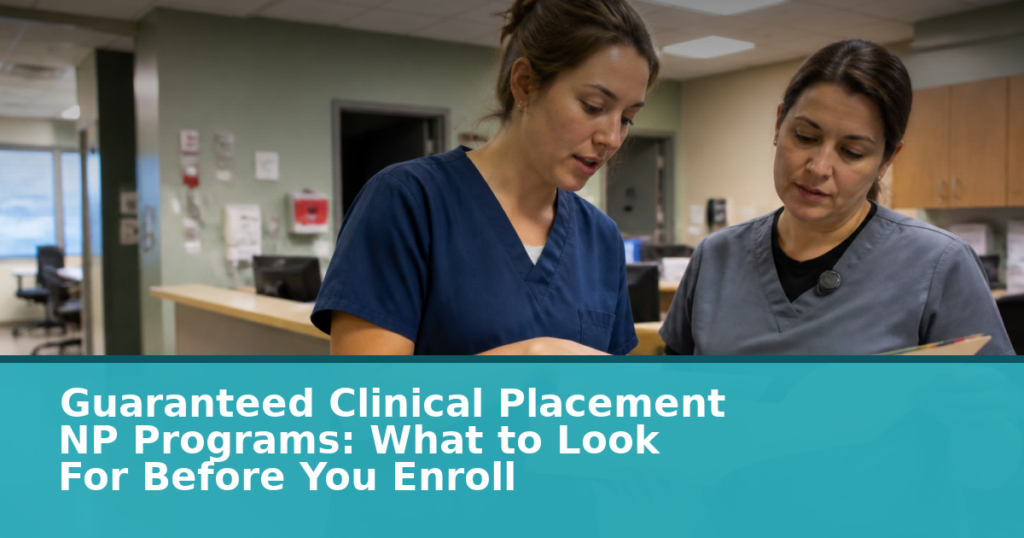
An NP preceptor is a practicing nurse practitioner who supervises, teaches, and evaluates NP students during their required clinical rotations. You work alongside students in your practice setting, guide them through patient encounters, and confirm they are building the clinical judgment and skills their program requires, the practical work of hosting a nurse practitioner student.
What the Role Actually Involves
Precepting is more than letting a student shadow you. You typically review patient cases before or after visits, model clinical reasoning, observe the student performing exams and histories, and provide feedback on documentation and treatment plans. Many programs also ask preceptors to complete midterm and final evaluations that document the student's progress toward specific competencies.
Why Experienced NPs Choose to Precept
The practical benefits are real and varied:
- CE credits: Some state boards and national certifying bodies accept precepting hours toward continuing education requirements.
- Tuition discounts: Partner schools may offer reduced tuition or fee waivers for preceptors who pursue additional graduate coursework.
- Professional recognition: Many universities list preceptors in program materials, newsletters, or faculty affiliate directories, a visible form of NP Preceptor Recognition.
- Mentorship satisfaction: Helping a colleague transition from RN to NP can be one of the most rewarding parts of an advanced practice career.
Precepting as a Career Accelerator
Serving as a preceptor also strengthens your resume for future faculty, clinical coordinator, or leadership roles, key nurse practitioner advancement opportunities. It shows you can teach, evaluate clinical performance, and manage the onboarding side of advanced practice education. For NPs considering a move into academic or administrative positions, precepting is often one of the most direct ways to build that experience.
A Critical Shortage of Clinical Sites
Programs actively recruit preceptors because securing clinical placements is one of the biggest barriers NP students face. Many schools maintain waitlists or match preceptors across specialties, especially in primary care and rural areas. By saying yes to a student, you help relieve that bottleneck and shape the next generation of nurse practitioners.
Core NP Preceptor Requirements: Licensure, Certification & Experience
Requirements vary by school and state, but nearly every nursing program screens for the same core credentials before approving you as a preceptor. Work through this checklist before you reach out to a program, having documentation ready shortens approval from weeks to days.
- Active, unencumbered NP licenseYou need a current advanced practice registered nurse license in the state where the student will complete clinical hours, with no disciplinary action or restrictions on file.
- National board certification in good standingCertification through ANCC or AANP (or the appropriate body for your population focus) must be current. Programs typically ask for a copy of your certification card and expiration date.
- One to two years of independent clinical practiceMost programs require at least one year of practice as a licensed NP, and some prefer two. The reasoning is practical: you need enough autonomy in your own role to model decision-making rather than still be building it.
- Current malpractice and liability coverageCoverage must be active before the student's first clinical day. Verify with your carrier that supervising students falls within your policy's scope.
- Signed affiliation agreementA contract between your practice site and the sponsoring nursing program that defines liability, scheduling, and responsibilities. Your practice administrator usually signs, not you, build in lead time.
- Preceptor orientation or training moduleSchools generally require a short onboarding covering evaluation forms, clinical hour logging, and student competency expectations. Many are completed online in an hour or two.
NP Preceptor Requirements by State
State boards of nursing set the actual preceptor rules, and there is no single national standard for how many years of experience count, which certifications are recognized, or how many students a preceptor may supervise. That means your eligibility can shift as soon as you cross a state line, even when your national certification stays the same.
The 1 to 2 Year Experience Baseline
Across the reviewed guidance, one to two years of clinical or practice experience is the most commonly named eligibility benchmark, but it is not a uniform requirement. Texas requires at least two years for an experienced nurse providing direct supervision, with the preceptor immediately available on site.1 Washington sets a lower floor of one year and also requires employment at an approved practice site.2 Tennessee asks for at least one year in the advanced practice area relevant to the student's clinical focus.3 Missouri draws a distinction by preparation: one year for master's-prepared preceptors, with two to five years for non-master's-prepared preceptors who hold ANCC or AANP certification.4 California does not state a specific minimum number of years in the cited approval text, although it still requires an active, valid license and current clinical competence.5 Kentucky's cited regulation likewise does not state a minimum number of years.6
Ratio Rules Are Local
Student-to-preceptor ratios are set by each state board and are not federally regulated or evidence based, a patchwork that reflects the broader NP Program Capacity Shortage. Kentucky caps the ratio at 2 students to 1 preceptor.6 Missouri uses a 1 to 1 ratio for practicum courses.4 Tennessee specifies 1 to 1 when the preceptor is seeing their own patients.3 Texas addresses supervision more than a numeric cap, requiring direct, on-site availability rather than a fixed student count.1 The National Advisory Council on Nurse Education and Practice describes ratio policies as state-determined rather than evidence based.7 If you plan to precept across state lines, check both the state where you hold your license and the state where the clinical experience occurs.
Certification Recognition Varies
State language also differs on certification. Missouri explicitly recognizes ANCC or AANP certification for non-master's-prepared preceptors.4 Tennessee requires current national certification in the population-focused or specialty area but does not limit recognition to ANCC or AANP.3 California frames the requirement around an active license in the relevant jurisdiction rather than a specific certification body.5 Some boards, such as Kentucky and California, focus more on licensure and competence than on naming a certifying body. In practice, your certification may qualify you in most states, but the board's exact wording determines whether it must be ANCC, AANP, or another nationally recognized credential, so check ANCC vs AANP certification before you assume eligibility.
Before agreeing to your first student, confirm the experience floor, ratio cap, and certification language with the board of nursing in the state where the clinical hours will occur. Program coordinators often know the current requirements, but your state board is the final authority.
FNP-Specific Requirements and Population-Focus Matching
Family nurse practitioner students face a specific matching rule that trips up a lot of nurses hunting for their first rotation: your preceptor's practice population should mirror your program's population focus. For FNPs, that means family or individual care across the lifespan. The rule comes from the National Task Force on Quality Nurse Practitioner Education (NTF Standards, 6th edition, 2022)1 and is reinforced by CCNE accreditation guidance.2
What AANP and ANCC Expect
Both AANP and ANCC certify FNPs through population-focus-specific NP certification exams, which is why the preceptor-matching rule exists in the first place: you cannot sit for the FNP exam without NP clinical rotations that actually prepared you for family practice. ANCC endorses the NTF standard of 750 direct patient care hours for population-focused NP graduates,1 while its own certification eligibility floor is 500 faculty-supervised clinical hours.3 Starting January 1, 2026, ANCC candidates must also apply for certification within five years of degree conferral, so timing your rotations matters.3
The Majority Rule and Cross-Population Precepting
CCNE and NTF guidance is pragmatic: the majority of your clinical hours should be with a preceptor whose practice matches your population focus, and over the course of the program you must have experiences with an APRN preceptor, preferably an NP with expertise in family practice.12 Programs typically run indirect faculty supervision at roughly a 1:8 ratio.2
Can a physician precept you? Yes, on a case-by-case basis, when the program, accreditor, and site all agree the physician's scope aligns with the rotation's learning objectives. A family medicine physician often qualifies for an FNP rotation. But a physician alone does not satisfy the population-focus rule for all your hours: an APRN preceptor is still expected somewhere in the program.1
Physician assistants are setting-dependent. Neither AANP, ANCC, CCNE, nor NTF identifies PAs as a required or preferred preceptor category for FNP students, so acceptance varies by school. Always confirm with your NP clinical placement office before you sign anything.
Malpractice Insurance and Liability Coverage for Preceptors
Four parties can absorb liability during a student encounter: the student, the preceptor, the clinical site, and the school. Knowing which policy answers when a claim lands is the difference between a covered incident and an out-of-pocket nightmare.
Who Covers Whom
The student's malpractice coverage almost always flows from the university or program, either through institutional coverage or a student-purchased policy required at enrollment. That coverage protects the student, not you as the supervising preceptor. Programs like Pacific Lutheran University state this explicitly: the school insures the student and clinical faculty, but the preceptor in the preceptor role is not covered.
Your own protection comes from one of two sources:
- Employer policy: Only applies if precepting falls within your scope of employment and your employer has formally approved student supervision at the site. Moonlighting arrangements or side gigs are unlikely to be covered.
- Personal NP policy: Many carriers require an explicit rider or endorsement for student oversight. Precepting without disclosing it to your carrier can void the policy and lead to a denied claim.
Call your carrier before you sign anything. Ask specifically whether student supervision is included and get the answer in writing.
Documentation Schools Require
Before an affiliation agreement is finalized, most programs ask for proof of active licensure, certification, and current malpractice coverage with stated policy limits. The affiliation agreement itself should spell out which party carries primary coverage, minimum limits, and the scope of supervised activities. Read it carefully, and confirm your policy meets or exceeds the minimums listed.
If you are leaving a position soon or your policy is claims-made rather than occurrence-based, ask about tail coverage. Claims from a student encounter can surface months or years later, and malpractice tail coverage by state rules determine whether a lapsed claims-made policy will respond.
Telehealth Precepting Changes the Calculus
Telehealth supervision is not automatically covered by policies written for in-person practice. There is no universal rule here, which is exactly the problem, and Telehealth for Nurse Practitioners coverage varies by state and payer. Two steps are non-negotiable:
- The affiliation agreement must expressly recognize telehealth as an approved clinical setting for the rotation.
- Your malpractice carrier (and your employer's, if relevant) must confirm in writing that virtual student supervision is within policy scope.
Skip either step and you may be supervising without a safety net.
Preceptor Training and Onboarding Steps
Onboarding looks different at every school, but the sequence is remarkably consistent: prove you are eligible, complete the paperwork and training, wait for university approval, then take your first student. Budget a few hours up front for the administrative work and training module, then plan your ongoing time around the rotation length the school sets.

Related Articles
The real return on precepting isn't the stipend, it's the influence you have on shaping a confident, competent colleague before they ever see their first patient alone.
Precepting solo versus precepting through a formal program partnership: either way, the path into an NP student-preceptor relationship is the same. Confirm your license and certification are current, meet the experience threshold your target school requires, verify your malpractice policy covers educational supervision, and complete the school's preceptor training and affiliation agreement.
Your concrete next step: call or email the office that coordinates local clinical placements at a nearby NP program. Introduce yourself, share your credentials and specialty, and ask what they need to start the approval process. One conversation turns months of wondering into a signed agreement and your first student.