
Most important takeaways…
- NP benefits packages commonly add $20,000 to $50,000 on top of base salary, making total compensation the true benchmark.
- Non-compete clauses, malpractice tail coverage, and termination terms can quietly erode your income or limit career mobility for years.
- A four-step negotiation process (research, quantify your value, counter in writing, finalize with legal review) keeps talks professional and productive.
- Healthcare contract attorneys charge $300 to $2,500 for a flat-fee review, a small cost relative to a multi-year agreement.
Nurse practitioner contract negotiation is the process of reviewing, benchmarking, and countering the terms of a job offer before you sign. Most NPs skip it entirely. Studies consistently show that the majority of professionals accept their first offer without a counteroffer, and in a field where base salaries range from roughly $95,000 to over $130,000 depending on specialty and geography, that silence can cost $10,000 to $30,000 or more over the life of a single contract.
The tension is real: you worked hard to earn your certification, you may need income quickly, and pushing back on an employer feels risky. But the math favors preparation over speed. A structured approach, moving from salary benchmarking to revenue calculation to clause review to the actual conversation, replaces anxiety with data. Employers expect negotiation. The ones who do not are worth scrutinizing closely.
Why NP Contract Negotiation Matters More Than You Think
Accepting the first offer versus countering it: those two paths can look nearly identical in the moment, but they lead to very different careers. The gap between a nurse practitioner who negotiates and one who does not is rarely dramatic at signing. Over time, though, it becomes impossible to ignore.
The Compounding Cost of Silence
Consider a starting salary difference of just $7,000 per year. That figure alone feels manageable, even minor, when you are eager to launch your NP career. But annual raises are almost always calculated as a percentage of base pay, which means a lower starting point locks in a lower ceiling at every subsequent review. Factor in employer retirement contributions tied to salary, and the lifetime cost of that single unchallenged offer can easily reach six figures across a 20-year career. Negotiation is not about being greedy. It is about protecting a financial trajectory that compounds in your favor from day one.
The Confidence Barrier Is Real, and It Is Beatable
New graduate NPs are especially vulnerable to a particular mindset: gratitude. After years of school, clinical hours, and board prep, receiving an offer feels like relief, and relief has a way of silencing the part of your brain that asks whether the offer is fair. Many new NPs worry that pushing back will make them look difficult, or worse, cost them the position entirely.
Here is what hiring managers actually know that candidates often do not: negotiation is expected. Budgets built for NP hiring almost always include a buffer precisely because employers anticipate that qualified candidates will ask for more. Accepting the first number without any discussion can actually signal inexperience rather than good faith.
You Are Not an Employee. You Are a Revenue Source.
This is the distinction that changes everything. Registered nurses are employed as a staffing expense. Nurse practitioners are hired as providers who generate billable revenue directly. A productive primary care nurse practitioner, for example, can generate hundreds of thousands of dollars in annual revenue for a practice. That reality shifts your leverage considerably.
When you negotiate as an NP, you are not asking for a favor. You are discussing the terms under which a revenue-generating professional will join an organization. Framing it that way, even privately in your own thinking, helps you approach the conversation with the confidence it deserves. Employers understand this calculus. You should too.
NP Salary Benchmarks by Specialty, State, and Setting
Knowing what other nurse practitioners earn in your specialty, state, and practice setting gives you concrete leverage at the negotiating table. The figures below draw on federal wage data and the CompHealth Nurse Practitioner Salary Report 2025. Keep in mind that specialty-level salary breakdowns (for example, psychiatric-mental health NPs versus family practice NPs) are not consistently reported across all sources, so the setting and state comparisons here offer the most reliable benchmarks. Use these numbers as a starting range, then adjust for your specialty credentials, patient panel size, and local cost of living.
| Setting or State | Mean Annual Salary | Median Annual Salary | 25th Percentile | 75th Percentile |
|---|---|---|---|---|
| Hospital Inpatient (national) | $189,000 | N/A | N/A | N/A |
| Hospital Outpatient (national) | $149,000 | N/A | N/A | N/A |
| Other Clinical Settings (national) | $143,000 | N/A | N/A | N/A |
| Non-Hospital Urgent Care / Medical Offices (national) | $132,000 | N/A | N/A | N/A |
| Community / Public Health (national) | $124,000 | N/A | N/A | N/A |
| California | $173,190 | $166,610 | $140,260 | $205,400 |
| New York | $148,410 | $145,390 | $128,190 | $164,670 |
| New Jersey | $140,470 | $149,620 | $126,030 | $162,250 |
| Oregon | $148,030 | $144,600 | $129,840 | $163,240 |
| Washington | $143,620 | $140,220 | $125,890 | $161,730 |
| Massachusetts | $145,140 | $138,890 | $125,590 | $160,310 |
| Connecticut | $141,140 | $138,960 | $125,910 | $159,680 |
| Alaska | $142,340 | $145,450 | $104,000 | $165,510 |
| Texas | $130,930 | $129,880 | $110,570 | $143,860 |
| Florida | $128,340 | $129,010 | $109,670 | $143,670 |
| Illinois | $128,880 | $128,620 | $111,450 | $138,420 |
| Minnesota | $128,120 | $128,570 | $103,250 | $139,590 |
| Colorado | $127,610 | $129,750 | $110,300 | $139,440 |
| Indiana | $126,520 | $128,280 | $111,210 | $134,840 |
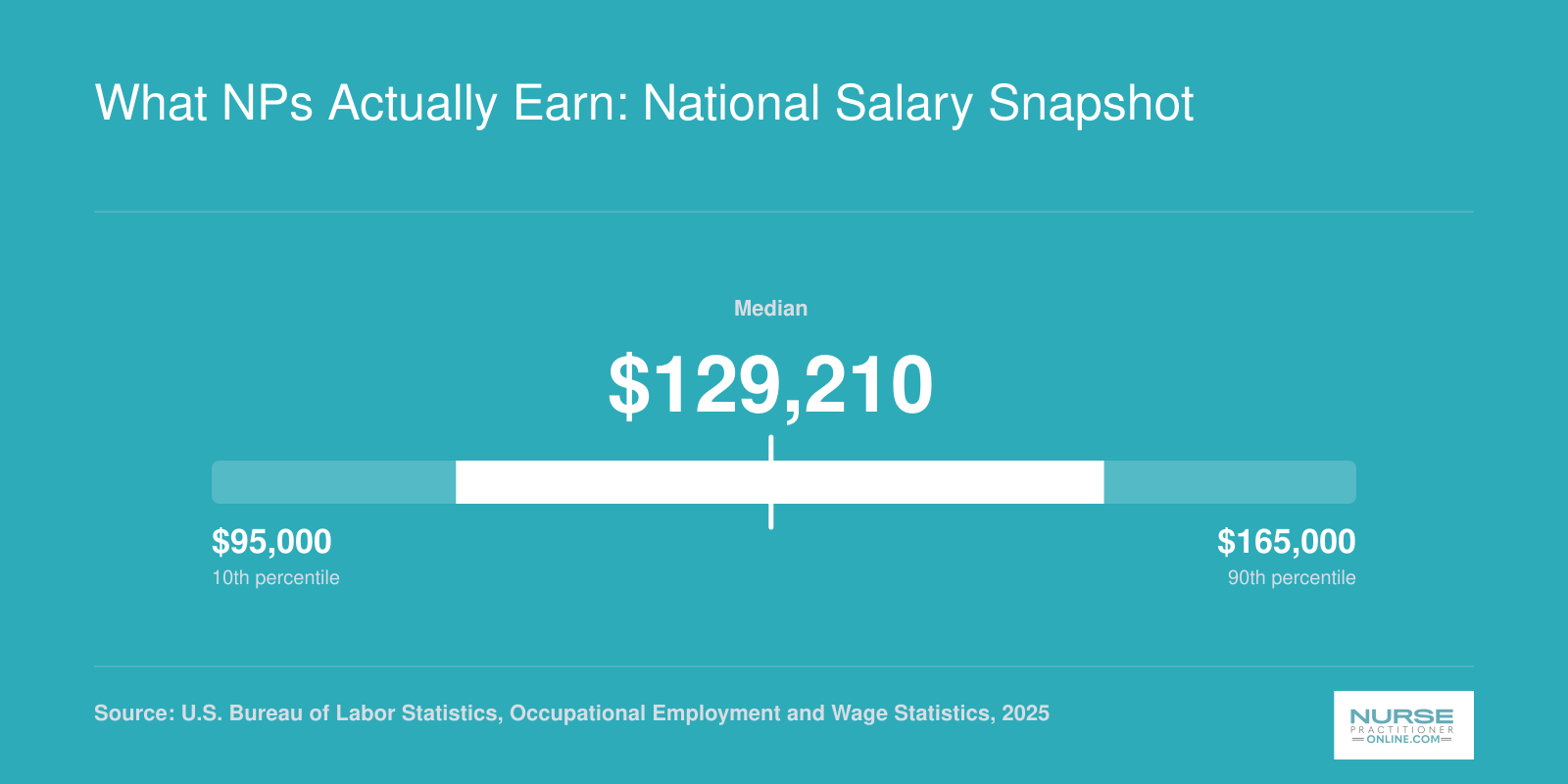
What NPs Actually Earn: National Salary Snapshot
Before you evaluate any offer, you need to know where it falls on the national pay spectrum. With over 307,000 nurse practitioners employed across the country, demand is strong, and compensation reflects it. If your offer lands below the 25th percentile, treat it as a red flag worth discussing. Between the 25th percentile and the median is negotiable territory. An offer above the 75th percentile signals a strong package.
How to Calculate Your Revenue Value to a Practice
Family nurse practitioners typically generate between 2,800 and 4,000 work relative value units annually, with each unit reimbursed at rates ranging from $25 to $45 depending on the practice's payer mix and geographic location.1 Understanding how to quantify your revenue contribution gives you concrete data to support your salary request and demonstrates that you understand the business side of healthcare.
The Patient Volume Revenue Model
The simplest calculation follows a straightforward formula: multiply your daily patient volume by the average reimbursement per visit, then multiply by your working days per year. For example, if you see 20 patients per day at an average reimbursement of $120 per visit and work 240 days annually, you generate approximately $576,000 in gross revenue. After accounting for typical outpatient practice overhead of 55 to 70 percent, the practice nets between $230,000 and $288,000.2 This framework makes a $120,000 base salary clearly justifiable, leaving room for the practice to cover your benefits, malpractice coverage, and administrative costs while maintaining profitability.
Payer mix significantly affects this calculation. A practice with predominantly Medicaid patients may see average reimbursements closer to $80 to $90 per visit, while one with commercial insurance contracts often collects $140 to $160 per encounter. Ask about the practice's typical payer breakdown during your interview to refine your revenue estimate. Brushing up on primary care billing and coding fundamentals can also help you speak the practice's language during these conversations.
Understanding RVU-Based Compensation
Many practices, particularly hospital-employed positions and larger group practices, use work relative value units as a productivity metric. RVU targets vary by specialty. Family practice nurse practitioners typically aim for 2,800 to 4,000 units annually, while acute care nurse practitioners often target 3,000 to 4,500 units and psychiatric-mental health NPs work toward 2,400 to 3,600 units.3 Per-unit compensation rates also differ: family practice rates range from $25 to $45, acute care from $30 to $50, and psychiatric-mental health from $35 to $60.1
A concrete example: if your contract offers a base salary of $110,000 with a bonus structure paying $35 per unit above a 3,200-unit threshold, and you produce 3,800 units in your first year, you earn an additional $21,000 in productivity bonuses (600 units × $35), bringing your total compensation to $131,000.4
Presenting Your Value Without Overstepping
When discussing these calculations during negotiation, frame your analysis as understanding the practice's business model rather than demanding a specific revenue share. You might say, "Based on the patient volume you've described and typical reimbursement rates in this market, I estimate I would generate approximately $500,000 in annual revenue. Given standard overhead costs, I believe a compensation package in the range of $125,000 to $135,000 reflects both my productivity and the practice's needs." This approach shows financial literacy and collaborative thinking rather than entitlement, positioning you as a partner in the practice's success.
Key Contract Clauses Every NP Must Review Before Signing
Your contract is more than a salary figure. Several clauses can quietly erode your income, limit your career mobility, or expose you to financial liability. Here are the provisions that deserve a careful second look.
Non-Compete Clauses
Non-compete language typically restricts where and when you can practice after leaving a job. For NPs, durations often fall between 6 and 12 months, with geographic radii that vary sharply by setting: 3 to 5 miles in dense urban markets, 5 to 15 miles in suburban areas, and up to 25 to 50 miles in rural regions.1 Enforceability is not uniform. Six states broadly ban employee non-competes: California, Minnesota, Montana, North Dakota, Oklahoma, and Wyoming.2 Additionally, Indiana, Montana, Utah, and Wyoming have enacted healthcare-specific bans that directly affect NPs.3 A federal non-compete ban from the FTC was vacated in August 2024 and its appeal dismissed in September 2025, so no nationwide protection exists.2 Before signing, verify your state's stance and ask whether the radius and duration are reasonably tailored to the practice's legitimate business interests. If you are weighing short-term assignments as an alternative, understanding the difference between locum tenens NP contracts and permanent NP jobs can help you evaluate non-compete exposure across employment models.
Malpractice and Tail Coverage
This is the single most overlooked contract clause. If your employer provides a claims-made malpractice policy, coverage extends only while the policy is active. Once you leave, any lawsuit filed against you for care rendered during your employment falls on you unless tail coverage is in place. Tail coverage typically costs 1.5 to 2 times the annual premium, often $3,000 to $8,000 for NPs. Your contract must explicitly state who pays for tail coverage upon termination. If the contract is silent, assume the cost is yours. Negotiate for the employer to cover tail, especially if the departure is not for cause. Occurrence-based policies do not require tail, but they are rare in employment settings; confirm which type you have.
Termination Provisions
Without-cause termination clauses allow either party to end the agreement with 30 to 90 days' notice. A short notice period may sound convenient, but it can leave you scrambling to find new employment and potentially without income or benefits quickly. Push for at least 60 to 90 days. For with-cause termination, look for a cure period: a defined window, often 15 to 30 days, during which you can fix the alleged breach before the contract is terminated. Without one, a minor paperwork issue could lead to immediate job loss.
Moonlighting and Outside Employment
Many NP contracts silently prohibit any outside clinical work. Even if you have no immediate plans, this can block future telehealth, teaching, or per-diem shifts that boost your income and skills. Restrictions on moonlighting can also affect your ability to pursue highest paying NP jobs in specialties that reward supplemental practice hours. Ask for a written carve-out that permits non-competing professional activities, specifying examples like weekend urgent care or nursing faculty roles. Get it in writing before you sign.
Mandatory Arbitration and Dispute Resolution
Arbitration clauses require you to resolve employment disputes privately, often in a venue and under rules favorable to the employer. You lose the right to a jury trial and public record. If arbitration is unavoidable, push for mediation as a first step and insist that the arbitration venue be in your local county, not across the country. These small modifications can level the playing field significantly.
Related Articles
W-2 vs 1099 vs per Diem: How Employment Type Changes Your Contract
Your employment classification determines not only how you get paid but also your tax burden, benefits eligibility, malpractice coverage, and negotiating leverage. Understanding the trade-offs between W-2 employee, 1099 independent contractor, and per diem status will help you evaluate the true value of any offer.
W-2 Employee: Predictability and Benefits
As a W-2 employee, your employer withholds federal and state income tax along with your share of FICA (Social Security and Medicare), and pays the employer portion as well.1 You are eligible for employer-sponsored health insurance, dental, vision, retirement contributions, paid time off, continuing education allowances, workers' compensation coverage, and unemployment benefits. Your employer typically provides malpractice insurance, either occurrence-based or claims-made with tail coverage. The trade-off is less flexibility: your employer sets your schedule, hours, and clinical protocols, and you generally cannot accept outside contracts without permission. Hourly rates for W-2 primary care outpatient NPs typically range from $55 to $75 per hour in 2026.2
1099 Independent Contractor: Higher Pay, Higher Responsibility
Independent contractors earn 10 to 30 percent more per hour than W-2 employees, with primary care NPs often seeing $72 to $85 per hour or higher.2 You gain schedule flexibility and can accept multiple contracts simultaneously. However, you are responsible for both the employee and employer shares of self-employment tax (approximately 15.3 percent on net earnings), must make quarterly estimated tax payments, and receive no employer benefits.2 You will need to purchase your own health insurance, fund your own retirement, and in many cases secure your own malpractice coverage, though some locums agencies provide claims-made policies. You also forfeit workers' compensation and unemployment protections. If you are weighing locum tenens arrangements specifically, be sure to review the locum tenens pros and cons before committing to a 1099 contract.
Per Diem: Maximum Flexibility, Variable Benefits
Per diem arrangements offer day-to-day scheduling flexibility. You can pick up or drop shifts based on your availability and the facility's staffing needs, though some employers require a minimum monthly commitment. Per diem NPs typically earn $5 to $15 per hour above base W-2 rates.1 If classified as W-2 per diem, you may receive limited benefits such as health insurance if you meet minimum hours worked, but you usually forfeit paid time off and full retirement matching. Malpractice coverage is generally provided by the facility. If classified as 1099 per diem, you face the same tax and benefit challenges as a full independent contractor.
IRS Misclassification Risk
The IRS closely scrutinizes 1099 relationships in healthcare.3 If you work regular ongoing shifts, your employer controls your schedule or clinical protocols, or you maintain an exclusive relationship with one practice, you may be misclassified as an independent contractor when you should legally be a W-2 employee. Misclassification can result in penalties and back taxes for both you and the employer. If a practice offers you a 1099 contract but expects you to work set hours with limited autonomy, consult a contract attorney or tax professional before signing.
Negotiating Beyond Salary: Benefits That Add $20K–$50K in Total Value
Total compensation is your base salary plus every quantifiable benefit your employer agrees to fund on your behalf: paid time off, continuing education dollars, retirement contributions, signing bonuses, loan repayment, malpractice coverage, and schedule flexibility. Most NPs anchor on the salary number and stop negotiating there, leaving an estimated $20,000 to $50,000 of yearly value on the table. The trick is to translate every perk into dollars so two offers can sit side by side on the same scale.
Benchmarks Worth Knowing
Recent industry surveys give us reasonable anchor points for 2025 and 2026 negotiations. Average total NP compensation sits near $144,500, with typical ranges of $130,000 to $145,000 depending on specialty and setting.12 Use these to benchmark individual line items:
- PTO: 20 to 30 days is standard for experienced NPs; new grads often start at 15 to 20. Hospital systems are the hardest to move on this.
- CME allowance: About 85% of organizations offer one, with a median around $2,500 per year.3 $3,000 to $5,000 plus 3 to 5 CME days is a reasonable ask in outpatient and specialty roles.
- Signing bonus: The average is roughly $12,900.4 New grads typically see $5,000 to $15,000; rural and underserved settings can push past $30,000.
- Student loan repayment: Roughly 78% of organizations offer some form, ranging from $10,000 to $50,000 over a contract term.3 Federal NHSC programs can stack on top.
- Retirement match: 3% to 6% of salary is typical. This is one of the harder items to negotiate because it is usually set at the organizational level.
- Call and flexibility: Call pay commonly runs $50 to $150 per shift or per call. Telehealth days, four-day workweeks, and guaranteed patient caps are increasingly on the table, especially post-pandemic.
Assigning a Dollar Value to Each Item
Convert benefits to a daily rate so you can compare offers cleanly. At a $120,000 salary working roughly 230 clinical days, one day is worth about $520. So five extra PTO days equals roughly $2,600. A 4% retirement match on $130,000 is $5,200 per year. A $4,000 CME allowance plus four CME days adds about $6,000 in real value. Compensation varies significantly by NP specialties by salary, so make sure your benchmarks reflect the right clinical niche.
What Moves and What Does Not
CME budgets, signing bonuses, start dates, and license and DEA reimbursement are the easiest wins, since they come out of discretionary or recruiting budgets. PTO inside large hospital systems, retirement match percentages, and health insurance tiers are typically fixed by HR policy. Spend your negotiating capital where the answer is most likely to be yes.
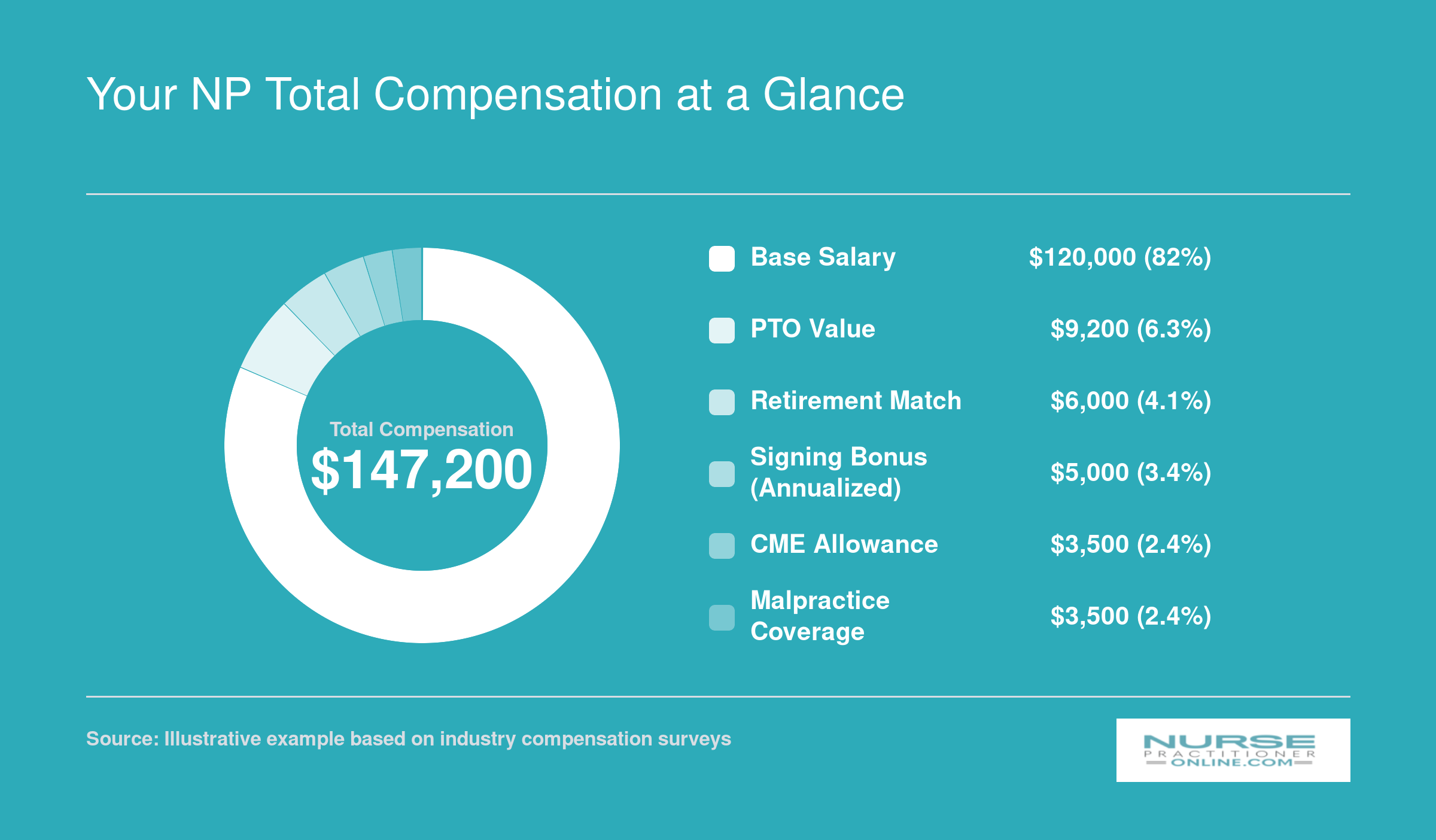
Your NP Total Compensation at a Glance
When you sit down to evaluate a job offer, base salary is only part of the story. A typical nurse practitioner earning $120,000 in base pay actually receives closer to $160,000 in total compensation once you factor in retirement contributions, paid time off, continuing education funds, and other negotiable benefits. Understanding this breakdown gives you real leverage: even a modest improvement in one or two benefit categories can add thousands to your overall package.
The Four-Step NP Contract Negotiation Process
What is the actual step-by-step process for negotiating a nurse practitioner contract without damaging the relationship or leaving money on the table? Most NPs feel confident in the exam room but uncertain at the negotiating table. A clear, repeatable framework changes that.
Step 1: Research Before You React
Before you open any conversation, do your homework. Pull current salary data from the Bureau of Labor Statistics and the AANP compensation survey for your specialty, state, and practice setting. Note the median and the upper range, because you want to know where a strong offer sits versus a weak one.
At the same time, identify your top three non-salary priorities. Maybe that is malpractice tail coverage, a flexible schedule, or a CME allowance. Ranking these in advance keeps you from scrambling when the employer says salary is fixed. Then read the contract line by line, flagging every clause that concerns you before any conversation takes place.
Step 2: Build Your Case
Prepare a one-page value summary that pulls together three things: your revenue generation estimate for the practice, your credentials and clinical background, and the market data you gathered in Step 1. Keep it concise and factual.
Then rehearse your ask out loud. Practice with a mentor, a trusted colleague, or even record yourself. Hearing your own words helps you find the spots where you hedge or apologize unnecessarily. Go in sounding like someone who expects a professional conversation, because that is exactly what this is. If you want to sharpen your communication skills more broadly, our guide on dealing with difficult patients offers techniques that translate well to any high-stakes dialogue.
Step 3: Have the Conversation
Open by expressing genuine enthusiasm for the role. Then pivot to your data-backed requests. Use specific, grounded language rather than vague asks.
A script that works well in practice: "I am really excited about this opportunity and the direction of the practice. Based on AANP compensation data, the median for this specialty in this market is around $X. I would like to discuss aligning my offer closer to that figure. Can we talk through what is possible?"
If the employer pushes back on base salary, do not fold and do not argue. Pivot calmly: "I understand salary flexibility may be limited right now. Can we look at the CME allowance, schedule structure, or the tail coverage provision instead?" Negotiating on multiple dimensions almost always produces a better total outcome than fighting over a single number.
Step 4: Get Everything in Writing
Verbal agreements disappear. Every point you discuss and agree on verbally must appear in the final written contract before you sign.
After receiving a revised offer, request 48 to 72 hours to review it carefully. Do not let excitement push you into signing same-day. Have an attorney experienced in healthcare contracts, or at minimum a seasoned NP colleague, review the final version.
Once you sign, send a brief follow-up email summarizing what was agreed. A simple template:
"Dear [Name], Thank you for the revised offer. I want to confirm the terms we discussed: a base salary of $[X], tail coverage paid by the practice, a CME allowance of $[X] annually, and a schedule of [Y]. Please let me know if I have captured anything incorrectly. I look forward to joining the team."
This email creates a clear record and gives both sides a chance to catch any misunderstanding before your first day.
New Grad Vs. Experienced NP: How Negotiation Strategy Differs
The central tension every nurse practitioner faces at the negotiation table boils down to leverage: new graduates worry they have none, while experienced NPs sometimes underestimate just how much they carry. Understanding where you fall on this spectrum shapes every ask you make, from base salary to long-term career trajectory.
New Graduates: Less Leverage Does Not Mean No Leverage
If you are a newly certified NP, it is easy to feel so relieved about landing an offer that you accept the first number on the table. Resist that impulse. Employers expect some negotiation, and new grads who approach the conversation professionally can typically secure a bump of 3 to 8 percent above the initial offer. That translates to several thousand dollars annually, compounding over the life of your career.
Beyond base pay, new grads have room to negotiate items that cost the employer relatively little but benefit you enormously:
- Signing bonus: Even $3,000 to $10,000 upfront can offset relocation or licensing costs.
- Student loan repayment assistance: Some employers contribute a set amount monthly or annually toward your loans.
- Structured salary increases: Request a written review at 6 or 12 months with a defined raise tied to productivity benchmarks.
- Protected mentorship time: Negotiating dedicated training hours with a collaborating physician builds your clinical confidence and makes you more productive faster.
One critical warning: do not accept a below-market offer simply out of gratitude for being hired. Gratitude is appropriate, but your compensation should reflect the market value of the role, not the employer's assumption that new grads will take whatever they can get.
Experienced NPs: Your Leverage Has Shifted Dramatically
Once you have three or more years of practice under your belt, the negotiation dynamic flips. You bring tangible, measurable assets to the table, and employers know it. Experienced NPs should expect to negotiate 8 to 15 percent above an initial offer depending on specialty and local market conditions.
Your strongest bargaining chips include:
- Patient panel portability: If patients follow you from one practice to another, that revenue stream gives you significant leverage.
- Productivity metrics: Documented RVU generation, patient satisfaction scores, and panel size speak louder than any talking point.
- Specialty certifications: Board certifications in high-demand areas like psychiatric mental health, acute care, or dermatology command premium compensation.
With this kind of track record, your asks should go beyond salary. Push for productivity-based bonuses, a leadership or clinical director title, profit-sharing arrangements, or a defined partnership track with equity potential. These elements can add tens of thousands of dollars in long-term value.
Addressing the Biggest New-Grad Fear
Almost every new graduate worries about the same question: will they rescind my offer if I try to negotiate? In practice, this almost never happens. A reasonable, professional counteroffer is a standard part of the hiring process in healthcare. Employers budget for it.
If an employer does pull an offer simply because you asked a thoughtful question about compensation or benefits, that reaction tells you something important about the organization's culture. A practice that punishes professional advocacy during hiring is unlikely to support your growth once you are on staff, and that kind of environment can accelerate nurse practitioner burnout. Consider it a red flag that saved you from a difficult work environment.
Whether you are fresh out of your program or a seasoned clinician weighing your next move, the core principle is the same: know your worth, prepare your case with data, and ask with confidence. The worst realistic outcome is that they say no to a particular request, and the conversation continues.
When to Walk Away, and When to Hire a Contract Attorney
Healthcare attorneys who specialize in provider contracts typically charge between $300 and $600 per hour for negotiation support, with flat-fee contract reviews ranging from $300 to $2,500 depending on complexity.1 That investment protects you against multi-year agreements worth hundreds of thousands of dollars, making it one of the most cost-effective career decisions you can make as a nurse practitioner.
Non-Negotiable Red Flags That Justify Walking Away
Some contract terms signal fundamental problems that negotiation cannot fix. Walk away immediately if the offer includes a salary more than 15 percent below market benchmarks with no productivity bonus path to close that gap. Similarly, a restrictive non-compete clause in a single-employer market effectively traps you in one practice or forces relocation if the relationship sours. If an employer refuses to put verbal promises in writing, you have learned everything you need to know about their trustworthiness. Finally, any contract that fails to provide employer-paid malpractice coverage shifts catastrophic financial risk entirely onto your shoulders.
Walking away from a bad contract is always cheaper than litigating one later or suffering through years of underpayment and restrictive terms. The short-term discomfort of continuing your job search pales in comparison to the long-term financial and professional damage a predatory contract can inflict.
When Legal Review Is Clearly Worth the Investment
Hiring a healthcare contract attorney makes sense in several specific situations. If you are reviewing your first NP contract ever, you lack the pattern recognition that experienced practitioners develop over multiple negotiations. Any contract containing a non-compete clause warrants legal review, since these provisions vary widely in enforceability across states and can profoundly limit your future mobility. Independent contractor (1099) classification raises complex tax, liability, and benefit questions that general-practice attorneys may not fully understand. Contracts with vague termination language leave you vulnerable to sudden job loss without recourse. Finally, any offer over $150,000 annually involves contract terms that will significantly affect your lifetime earnings, making the cost of review trivial compared to the financial stakes.
Basic flat-fee contract reviews typically cost between $150 and $350, while standard or issue-specific reviews range from $450 to $3,000.1 Hourly negotiation support runs $100 to $750 per hour, depending on the attorney's experience and geographic market.1 This is a one-time investment against a multi-year earning commitment, often amortizing to less than one percent of your first-year compensation.
What NP-Specific Attorneys Catch That General Lawyers Miss
Healthcare attorneys who regularly work with nurse practitioners focus on issues that general contract lawyers may overlook. They scrutinize incident-to billing provisions that determine whether you can bill independently or only under physician supervision, directly affecting your productivity bonus potential. In restricted-practice states, they review collaborative agreement requirements to ensure the terms are legally compliant and professionally sustainable. Understanding nurse practitioner practice authority by state is essential context here, because what your contract can legally require depends heavily on your state's regulatory framework. They decode RVU bonus calculation methodology to verify that the formula is both transparent and achievable. They also examine tail coverage triggers to clarify who pays for extended malpractice protection when you leave the practice.
Budget-Friendly Alternatives for Contract Review
If attorney fees stretch your budget, explore resources through NP professional organizations first. The American Association of Nurse Practitioners (AANP) and many state NP associations offer contract review resources, template checklists, and attorney referral lists at discounted member rates. Some organizations provide basic contract consultations as part of membership benefits, helping you identify which issues warrant full legal review and which you can negotiate independently. Services like MyContractRx offer flat-rate pricing starting at $499 for a standard review and $1,499 for a premium review, giving you predictable costs without hourly billing surprises.2
Frequently Asked Questions About NP Contract Negotiation
Contract negotiation can feel overwhelming, especially if it is your first time reviewing offer letters and legal clauses. Below are answers to the questions nurse practitioners ask most often. For deeper context on any topic, follow the references to related sections throughout this article.
- How much can you realistically negotiate an NP salary?
- Most nurse practitioners can negotiate a salary increase of 5% to 15% above the initial offer, depending on specialty, geographic demand, and experience level. In high-demand fields like psychiatric mental health or acute care, the range may be even wider. Use the specialty and state benchmarks earlier in this article to anchor your counteroffer in real market data rather than guesswork.
- What is a non-compete clause in an NP contract, and are they enforceable?
- A non-compete clause restricts where and when you can practice after leaving an employer, typically within a defined radius and time frame. Enforceability varies significantly by state: some states ban or heavily limit them, while others uphold reasonable restrictions. Review the key contract clauses section above for guidance on what to watch for and how to negotiate narrower terms before signing.
- Should a new graduate nurse practitioner hire a lawyer to review their first contract?
- Yes. A healthcare contract attorney typically charges a few hundred dollars for a review, and that investment can save you thousands in unfavorable terms. New graduates are especially vulnerable to overlooking restrictive non-competes, unclear termination language, or missing malpractice protections. The section on when to hire a contract attorney explains how to find an attorney experienced with NP agreements.
- What benefits should nurse practitioners negotiate besides salary?
- Benefits that meaningfully boost total compensation include CME allowances, student loan repayment assistance, signing bonuses, paid time off, retirement matching, and schedule flexibility. As outlined in the section on negotiating beyond salary, these extras can add $20,000 to $50,000 in annual value. Always evaluate the full package, not just the base pay number.
- What is malpractice tail coverage and why does it matter for NPs?
- Tail coverage extends your claims-made malpractice insurance to cover incidents that occurred during your employment but are reported after you leave. Without it, you could face personal liability for past patient encounters. This protection can cost thousands of dollars, so clarify in your contract who pays for it. The key contract clauses section above walks through how to address this before you sign.
- Can you negotiate an NP contract after you have already accepted?
- It is possible but more difficult. If you discover unfavorable terms after accepting, approach the conversation professionally and focus on specific clauses rather than reopening the entire agreement. Employers are often willing to revisit items like scheduling, CME funding, or non-compete scope. The four-step negotiation process section provides a framework you can adapt even after an initial acceptance.