
Most important takeaways…
- Wisconsin AGACNP salaries commonly reach six figures, with Milwaukee metro NPs averaging over $120,000 annually per BLS data.
- Wisconsin Act 17 takes effect September 2025, modernizing APRN licensure and streamlining the path to AGACNP practice.
- Online and hybrid AGACNP programs both lead to the same credential, but clinical hours must be completed in acute care hospitals.
- NP employment is projected to grow 46 percent nationally through 2033, making AGACNP one of the fastest expanding specialties.
For Wisconsin nurses pursuing AGACNP certification, the real fork in the road is between a handful of in-state hybrid programs and a broader set of fully online degrees that rely on remote didactic coursework paired with local acute-care clinical placements. That practical choice shapes everything from tuition to preceptor logistics.
Demand for adult-gerontology acute care nurse practitioners inside the state's hospital systems is running well ahead of local graduate supply. ICU teams, trauma services, and hospitalist groups across Milwaukee, Madison, and Green Bay increasingly depend on AGACNPs to manage complex inpatient caseloads.
Yet only a few Wisconsin universities offer the specialty at the MSN, DNP, or post-master's certificate level. That gap pushes many nurses toward accredited acute care nurse practitioner programs online that let them keep working in their home hospitals while completing clinical hours in Wisconsin acute-care settings.
Best Online AGACNP Programs for Wisconsin Students (2026 Rankings)
This ranking prioritizes online accessibility alongside institutional quality signals such as graduation rates, graduate debt outcomes, median earnings, and whether the program offers remote or hybrid delivery. Rather than relying on a single metric, the list uses a composite approach so you can compare programs across the dimensions that matter most to working nurses. Because program-specific graduation and earnings data are not yet available for these AGACNP tracks, institution-wide figures serve as a proxy, and you should weigh them as one piece of a larger picture.
- Institutional graduation rate
- Graduate debt outcomes
- Median alumni earnings
- Online or hybrid delivery format
- Overall quality composite score
- College Scorecard graduate earnings — collegescorecard.ed.gov
- Internal program database
- Independent program research
- NCES-IPEDS federal institutional data — nces.ed.gov

University of Wisconsin-Milwaukee
The University of Wisconsin-Milwaukee is the state's largest public research university and one of the few Wisconsin institutions offering AGACNP preparation at multiple credential levels. Its College of Nursing houses a post-graduate certificate, a BS-to-DNP pathway, and a post-master's DNP option, all built around Wisconsin's acute care workforce needs. A Wisconsin RN license is required by program start, and clinical placements are designed to be completed at hospitals and health systems throughout the state.
- 21-credit post-graduate certificate for MSN or DNP holders
- Designed for completion in approximately one year
- Prepares for ANCC AGACNP-BC or AACN ACNPC-AG certification
- Three theory courses paired with three clinical practicums
- Requires current unencumbered Wisconsin RN license
- Minimum 2.75 undergraduate GPA for admission
- Prior acute care nursing experience preferred
- 65-credit hybrid DNP with full-time and part-time options
- Includes 460 required clinical hours in acute care settings
- Fall and spring start dates available each year
- Implementation science and systems leadership in the DNP core
- DNP project culminates in an oral defense
- Holistic admissions with interview by faculty committee
- Seven-year completion limit for post-baccalaureate entrants
- 65-credit hybrid pathway for BSN-prepared nurses
- One year of RN experience required at admission
- Covers advanced pathophysiology, pharmacology, and assessment
- Progressive acute care management sequence (three courses)
- Capstone project required alongside clinical training
- Financial aid and flexible scheduling for working nurses
Adult-Gerontology Acute Care NP, Graduate Certificate — Online
Adult-Gerontology Acute Care NP, DNP — Online
BS-to-DNP, AGACNP Concentration — On-Campus

Viterbo University
Viterbo University in La Crosse offers a tightly structured post-BSN-to-DNP track with an AGACNP concentration. With a 10-to-1 student-to-faculty ratio and a higher institution-wide graduation rate than many regional peers, Viterbo provides a more personalized learning environment. The hybrid model keeps on-campus commitments to roughly one day per week, and clinical practicums can be arranged in the student's own community, a notable advantage for nurses outside the Milwaukee metro area.
- 74-credit hybrid curriculum spanning about 3.5 years
- On-campus sessions limited to one day per week
- Clinical practicums arranged in the student's community
- Prepares for ANCC AGACNP-BC or AACN ACNPC-AG certification
- 10-to-1 student-to-faculty ratio for individualized support
- Financial aid available for qualifying students
- Blends online coursework with hands-on acute care training
- Covers advanced health assessment and acute care management
Post-BSN to DNP, AGACNP Concentration — On-Campus
How to Choose an AGACNP Program From Wisconsin
The APRN Consensus Model finished what started years earlier: the standalone ACNP and PCNP credentials are gone, and every prospective acute care NP now chooses between adult-gerontology focused certifications tied to a specific population scope.1 That structural shift means your program choice in Wisconsin needs to align with three decisions: certification path, accreditation, and degree level.
Pick Your Certification Path First
Two bodies certify AGACNPs, and both are accepted for Wisconsin APRN licensure:
- AACN ACNPC-AG: Offered by the American Association of Critical-Care Nurses Certification Corporation. Launched in January 2013, this exam replaced the original ACNP credential and is the choice many critical care nurses gravitate toward.2 The "ACNP" inside ACNPC-AG is part of a longer credential name, not the retired standalone credential.
- ANCC AGACNP-BC: Offered by the American Nurses Credentialing Center. Functionally equivalent for licensure and hospital privileging.
Both require graduation from an AGACNP track whose educational preparation matches the role and population you plan to practice in.1
Confirm Accreditation and Wisconsin Authorization
Look for programmatic accreditation from CCNE or ACEN. Without it, your degree will not qualify you to sit for either certification exam. For online programs based outside Wisconsin, also confirm the school holds state authorization to enroll Wisconsin residents and to place students in Wisconsin clinical sites. SARA membership covers most of this, but clinical placement authorization is a separate question worth asking admissions directly.
Match the Degree to Your Timeline
- MSN-AGACNP: Fastest route to practice, typically 5 to 7 semesters for BSN-prepared nurses. Meets certification eligibility for both ACNPC-AG and AGACNP-BC. You can compare options across the country in our guide to acute care nurse practitioner programs online.
- DNP-AGACNP: Terminal practice doctorate, 3 to 4 years full-time. Same certification eligibility, with added scholarship and systems coursework.
- Post-Master's AGACNP Certificate: Designed for NPs already certified in another population (often FNP or AGPCNP) who want to add acute care scope. Under the current consensus rules, currently certified ACNPs and PCNPs may renew their existing credentials, but anyone newly entering acute care practice must complete a post-graduate certificate aligned to the AGACNP role.2 Browse nationwide options in our list of online post-master's ACNP certificate programs.
Do Not Confuse AGACNP With AGPCNP
This is the single biggest mistake applicants make. AGACNP prepares you for hospital-based acute, critical, and complex care across adolescents through older adults: ICUs, step-down units, hospitalist teams, rapid response, surgical services. AGPCNP prepares you for primary care in clinics and long-term care. The curricula, clinical hours, and certification exams are different. For a deeper comparison, see our breakdown of acute care NP vs primary care NP differences. If your goal is the ICU or a procedural service line, AGACNP is the only path.
Questions to Ask Yourself
AGACNP Tuition and Cost Comparison for Wisconsin Nurses
The table below compares tuition and institutional cost data for Wisconsin schools offering AGACNP programs in 2026. Keep in mind that the net price figures shown are institution-wide averages for all students and do not reflect your individual financial aid package, employer tuition benefits, or scholarship awards. Your actual out-of-pocket cost may be significantly lower (or higher) depending on your personal circumstances. Program-level earnings and debt data are not yet available for these specific AGACNP tracks, but we have included median graduate debt at the institutional level so you can gauge typical borrowing patterns among students at each school.
| School | Degree Level | Format | In-State Tuition (per year) | Out-of-State Tuition (per year) | Institutional Net Price (avg.) | Median Graduate Debt |
|---|---|---|---|---|---|---|
| University of Wisconsin, Milwaukee | Post-Master's Certificate (21 credits) | Online | $12,728 | $26,159 | $15,014 | $23,000 |
| Viterbo University | DNP (74 credits, 3.5 years) | Hybrid | $9,888 | $9,888 | $21,260 | $25,000 |
Explore other Wisconsin related topics
Related Articles
Clinical Placement Logistics for AGACNP Students in Wisconsin
AGACNP clinical hours have to happen inside the walls of an acute care hospital, not a primary care clinic, and that single requirement shapes every logistical decision Wisconsin students face. You need supervised time in medical and surgical ICUs, step-down units, emergency departments, and ideally a Level I or Level II trauma center. A family practice office, an urgent care, or a community health clinic will not satisfy your program's acute care competencies, no matter how willing the preceptor is. For a broader look at what these rotations involve, see our guide to nurse practitioner student clinical rotations.
Where Wisconsin Students Typically Rotate
Four large systems handle most of the AGACNP clinical volume in the state. Froedtert and the Medical College of Wisconsin in Milwaukee anchor the southeastern region and run an Advanced Practice Provider fellowship in inpatient adult critical care, signaling an established pipeline for acute care NPs.1 UW Health serves as the clinical partner for UW-Madison's AGACNP DNP and post-master's certificate programs.2 Advocate Aurora Health covers much of eastern Wisconsin, and Marshfield Clinic Health System reaches the central and northern parts of the state. All four routinely accept NP students, but acceptance is heavily weighted toward partner schools and Wisconsin-based accredited programs.3
Before you set foot on a unit, expect to clear an affiliation agreement between your school and the hospital, hold an unencumbered Wisconsin RN license, carry malpractice insurance, and complete onboarding: immunizations, TB screening, background check, and drug testing.4 Your program must hold CCNE or ACEN accreditation for the agreement to move forward.
Preceptor-Secured vs. Self-Placement Programs
This distinction matters more for AGACNP students than for primary care NP students. In a preceptor-secured model, your school's clinical coordinator places you with an intensivist, hospitalist, or acute care NP at an affiliated site. In a self-placement model, you find an NP preceptor on your own and your school approves them. Acute care preceptors are scarcer, busier, and harder to cold-call than primary care providers, so self-placement can stall progress by a semester or more.
If you enroll in an out-of-state online AGACNP program, the school must hold NC-SARA authorization or Wisconsin-specific approval to operate here, and you will almost certainly be responsible for securing your own Wisconsin clinical sites.4 Without an existing hospital relationship, that lift is real. Before you commit to an out-of-state online program, ask the admissions office point-blank whether they have active affiliation agreements with Wisconsin hospitals or whether you will be building them yourself.
AGACNP Salary in Wisconsin by Metro Area
The table below draws on the latest Bureau of Labor Statistics data for nurse practitioners across Wisconsin metro areas. Keep in mind that BLS figures cover all NP specialties, not AGACNP roles specifically. That said, acute care nurse practitioners who work in hospital, ICU, and critical care settings often earn at or above the overall NP median because of the high acuity and demand in those environments. Madison leads the state in both median pay and the 75th percentile, while Milwaukee offers by far the largest NP workforce, giving AGACNP job seekers the widest range of acute care openings.
| Metro Area | Total NP Employment | 25th Percentile Salary | Median Salary | 75th Percentile Salary | Mean Salary |
|---|---|---|---|---|---|
| Milwaukee, Waukesha | 1,940 | $114,070 | $129,760 | $133,480 | $130,020 |
| Madison | 460 | $124,820 | $134,200 | $154,300 | $137,750 |
| Appleton | 140 | $118,050 | $130,000 | $140,720 | $132,720 |
| Janesville, Beloit | 90 | $117,640 | $131,040 | $139,990 | $133,590 |
| Kenosha | 110 | $119,630 | $128,270 | $140,650 | $135,820 |
| Racine, Mount Pleasant | 100 | $115,010 | $128,050 | $134,730 | $130,290 |
| Eau Claire | 160 | $118,040 | $127,770 | $145,600 | $130,000 |
| Wausau | 150 | $108,760 | $127,370 | $139,430 | $128,120 |
| Oshkosh, Neenah | 160 | $113,140 | $126,580 | $134,590 | $126,550 |
| Green Bay | 270 | $109,110 | $125,000 | $133,070 | $125,360 |
AGACNP Earnings and ROI Analysis for Wisconsin Graduates
Investing in an AGACNP program means weighing real tuition costs against a realistic timeline for earning them back. The good news for Wisconsin nurses is that the numbers tell a compelling story, provided you choose a program aligned with acute care hospital hiring.
What Wisconsin NPs Actually Earn
Wisconsin's nurse practitioner workforce sits at roughly 4,950 employed NPs statewide. The median annual wage runs just under $128,600, with the middle range of earners falling between approximately $117,600 and $137,200.1 NPs who land at the top of the market, typically in specialized acute or critical care roles, can reach into the $160,000 range.2 That top-end figure reflects the premium hospitals place on NPs who can manage complex, acutely ill patients, which is precisely the population AGACNP graduates are trained to serve.
Nationally, the NP wage structure mirrors Wisconsin closely: a 25th-percentile wage around $110,000, a median near $130,000, a 75th-percentile around $150,000, and a 90th-percentile approaching $180,000.3 Wisconsin tracks the national median tightly, meaning graduates are not accepting a geographic pay penalty by staying in state. For a broader look at which specializations command the strongest compensation, see our breakdown of highest paid nurse practitioner specialties.
Highest-Paying Practice Settings for AGACNPs in Wisconsin
Not all practice settings pay equally, and AGACNP training positions you for the ones that pay most. Short-term acute care hospitals are consistently the top-paying employment setting for NPs in Wisconsin, followed closely by critical access hospitals, which are common throughout the state's rural regions.2 Within those institutions, the specialty units that carry the strongest compensation tend to be:
- Surgical ICU and trauma services: High acuity, 24-hour coverage demands, and specialized skill sets drive premium pay.
- Cardiac care and cardiac surgery step-down: A growing area in major Wisconsin health systems, with demonstrated salary premiums.
- Hospitalist and rapid-response teams: Volume-based productivity models in these roles can push total compensation well above base salary.
Building a Payoff Timeline
Program-level earnings data for specific Wisconsin AGACNP programs are not yet widely published at the granularity needed for a school-by-school comparison, so the timeline below uses conservative statewide figures.
A registered nurse earning around $86,000 annually (roughly Wisconsin's RN median) who completes an AGACNP program and enters practice at the statewide NP median of $128,600 gains approximately $42,000 per year in additional gross income.1 If total program costs, including tuition plus fees before employer reimbursement, fall in the $30,000 to $60,000 range common among online AGACNP offerings, the break-even point on that investment lands somewhere between nine months and eighteen months of post-graduation practice. Nurses who negotiate sign-on bonuses or work for systems with tuition reimbursement can compress that timeline further.
The practical takeaway: even at the conservative end of the salary range, an AGACNP credential in Wisconsin pays for itself within the first two years of practice, and the compounding lifetime earnings advantage grows substantially from there.
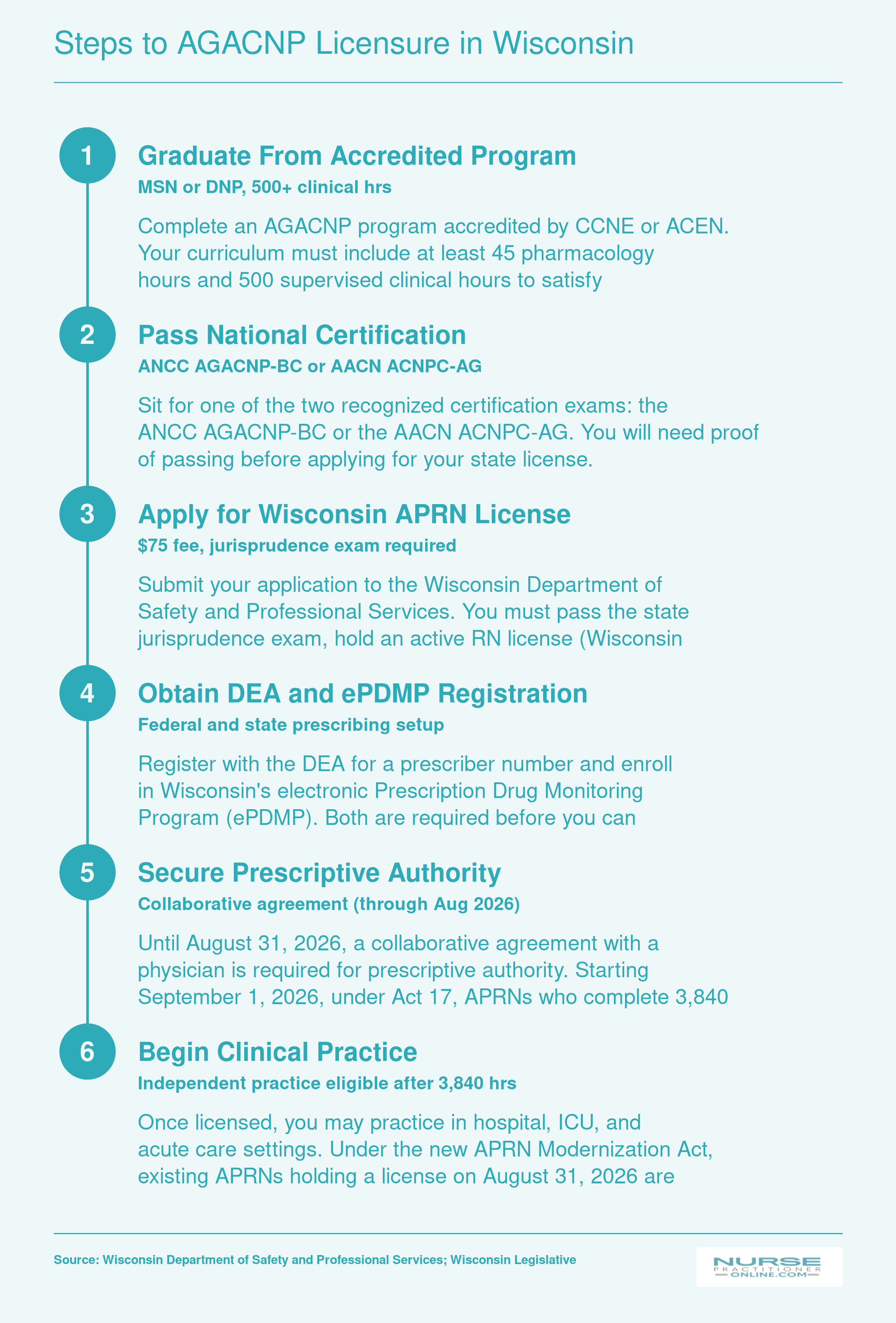
Steps to AGACNP Licensure in Wisconsin
Getting from graduation to full AGACNP practice in Wisconsin involves a clear sequence of applications and credentials. Here is the pathway as of 2026, including key changes under the APRN Modernization Act (2025 Wisconsin Act 17), which takes effect September 1, 2026.
Online vs. Hybrid AGACNP Programs: What Wisconsin Students Should Expect
Wisconsin nurses pursuing an AGACNP degree typically choose between two delivery formats: fully online or hybrid. Both can lead to the same credential, but each has trade-offs worth weighing against your schedule, location, and learning style. Here is a practical breakdown to help you decide which format fits your life as a working RN.
Pros
- Fully online AGACNP programs offer maximum schedule flexibility, letting you keep full-time hospital shifts while completing asynchronous coursework on your own time.
- Online format eliminates the need to relocate, opening access to nationally ranked AGACNP programs well beyond Wisconsin's borders.
- Hybrid programs typically provide structured clinical placement support, reducing the burden of finding your own preceptors in competitive metro areas.
- On-campus simulation intensives in hybrid formats give you hands-on procedural practice (central lines, ventilator management) that virtual simulations cannot fully replicate.
- Hybrid cohorts build a strong peer network through regular in-person weekends, which many graduates say improves accountability and long-term professional connections.
Cons
- Fully online students are often responsible for securing their own clinical preceptors, a process that can be especially challenging in saturated markets like Milwaukee or Madison.
- Online learners may encounter state-authorization barriers if a program's institution lacks approval to operate in Wisconsin, so always verify before enrolling.
- Reduced in-person interaction in online programs can limit spontaneous peer collaboration and mentorship opportunities with faculty.
- Hybrid programs require periodic travel to campus for intensive weekends, adding lodging, transportation, and time-off costs that hit rural Wisconsin nurses hardest.
- Fewer hybrid AGACNP options are physically accessible from northern or western Wisconsin, narrowing your choices compared to the broader online marketplace.
The U.S. Bureau of Labor Statistics projects nurse practitioners will see 46 percent job growth between 2023 and 2033, making it one of the fastest-growing occupations in the country. For AGACNP-prepared nurses focused on acute and critical care, that national surge translates into strong hiring momentum at Wisconsin health systems.
Frequently Asked Questions About AGACNP Programs in Wisconsin
Choosing an AGACNP program is a big decision, especially when you are balancing clinical shifts and family life. Below are the questions Wisconsin nurses ask most often about program length, cost, credentials, and online options.
- How much do AGACNPs make in Wisconsin?
- According to Bureau of Labor Statistics data for nurse practitioners in Wisconsin, median annual salaries typically fall in the range of $105,000 to $120,000, with higher earnings in metro areas such as Milwaukee and Madison. Actual pay varies by employer, specialty unit, years of experience, and whether you hold additional critical care credentials.
- How long does it take to become an AGACNP in Wisconsin?
- Timeline depends on your starting degree. A BSN-to-MSN AGACNP track usually takes about two to three years of full-time study, while a BSN-to-DNP pathway may take three to four years. Post-master's certificate programs are shorter, often running two to four semesters (roughly 29 to 30 credits), making them the fastest route for nurses who already hold an MSN.
- What is the difference between AGACNP and AGPCNP?
- AGACNP (Adult-Gerontology Acute Care NP) focuses on managing complex, acute, and critical conditions in hospital settings for patients from adolescence through older adulthood. AGPCNP (Adult-Gerontology Primary Care NP) centers on wellness, chronic disease management, and preventive care in outpatient clinics. The two tracks have different certification exams, clinical hour requirements, and scope of practice expectations.
- Can you complete an AGACNP program online from Wisconsin?
- Yes. Several accredited schools offer online AGACNP programs that accept Wisconsin residents. Didactic coursework is delivered online, while clinical hours are completed at approved acute care sites within Wisconsin. Programs from institutions such as West Coast University, the University of Memphis, and UTHealth Houston are among those available to out-of-state students in an online or hybrid format.
- What certifications do AGACNPs need in Wisconsin?
- Wisconsin requires national board certification to practice as an NP. AGACNPs earn either the ACNPC-AG credential through the American Association of Critical-Care Nurses (AACN) or the AGACNP-BC credential through the American Nurses Credentialing Center (ANCC). Current BLS and ACLS certifications are also required by most employers and many programs.
- Are there post-master's AGACNP certificate programs available to Wisconsin nurses?
- Yes. Multiple accredited universities offer post-master's AGACNP certificate programs online, so Wisconsin nurses with an existing MSN can add the acute care specialty without repeating core graduate coursework. These certificates typically range from 29 to 30 credits and include supervised clinical hours at acute care facilities in your area.
- Do AGACNP programs in Wisconsin require ICU experience for admission?
- Most programs require at least one to two years of acute care or critical care RN experience. For example, some programs ask for a minimum of one year, while others set the bar at two years. All applicants need an active, unencumbered RN license, a BSN (or MSN for certificate tracks), a minimum GPA of 3.0, a completed statistics course, and a cleared background check.