
Most important takeaways…
- Texas offers AGACNP programs at MSN, DNP, and Post-Master's Certificate levels from schools like UT Health San Antonio and Texas Tech.
- Clinical hours range from 500 to over 1,080 depending on degree pathway and institution.
- AGACNP graduates from top Texas programs report median earnings above $100,000 within ten years of entry.
- The ANCC AGACNP-BC exam posted an 83% pass rate in 2024, while the AACN ACNPC-AG exam recorded 75%.
Primary care NP roles dominate outpatient settings, but the AGACNP credential prepares you for the fast-moving acute care environments of Texas ICUs, emergency departments, and hospitalist services. With Texas hospital systems expanding critical care capacity, demand for Adult-Gerontology Acute Care Nurse Practitioners has outpaced the supply of qualified applicants in major trauma centers and specialty units. For a broader view of accredited options nationwide, see our guide to acute care nurse practitioner programs.
The online and hybrid AGACNP programs in this ranking span MSN, DNP, and post-master's certificate pathways, each with different cost structures and clinical hour requirements that reflect what each program expects you to arrange yourself. For working nurses already staffing night shifts in a Fort Worth ICU or a South Texas step-down unit, the path from bedside to board certification hinges on finding a program whose clinical placement model aligns with your location and schedule.
Top Online AGACNP Programs in Texas for 2026
The following programs are eligible for online delivery and ranked using a quality composite that weights online accessibility alongside academic outcomes, institutional strength, and program-level features. Whether you are a bedside nurse in a rural West Texas ICU or a DFW trauma nurse ready for an advanced practice role, these ten Texas schools offer AGACNP pathways you can complete while continuing to work. Program-level earnings data are not yet available for most of these programs, so institution-wide median earnings and graduation rates are included as contextual quality signals.
- Online and hybrid accessibility
- Institutional academic outcomes
- Tuition and affordability indicators
- Clinical placement flexibility
- Faculty ratio and student support
- Internal program database
- Independent program research
- NCES-IPEDS federal institutional data — nces.ed.gov
- College Scorecard graduate earnings — collegescorecard.ed.gov

The University of Texas at El Paso
UTEP offers both an MSN and a post-master's certificate in AGACNP, giving nurses two entry points depending on their current credentials. The MSN track is a 49-credit hybrid program with as few as three campus visits over seven semesters, while the post-master's certificate runs 28 to 40 credits entirely online. As a Hispanic-Serving Institution on the U.S./Mexico border, UTEP is uniquely positioned to prepare AGACNPs for medically underserved communities in West Texas and beyond.
- Hybrid format with online didactics and limited campus visits
- 49 credit hours over seven semesters
- 720 clinical clock hours in acute care settings
- BSN with 3.0 GPA and valid RN license required
- Critical care experience required for admission
- Certification eligibility through ANCC or AACN
- Resident tuition approximately $552 per credit hour
- Curriculum aligned with AACN Essentials and APRN Consensus Model
- Fully online program delivery
- 28 to 40 credit hours depending on prior coursework
- 630 to 775 clinical practicum hours
- Requires a Master's in Nursing degree
- Current RN or NP license needed for admission
- Professional purpose statement and resume required
- Two applicant categories: with or without existing APRN recognition
Adult Gerontology Acute Care Nurse Practitioner MSN — Online
Adult Gerontology Acute Care Nurse Practitioner Post-Master's Certificate — Online

Texas Tech University Health Sciences Center
Texas Tech University Health Sciences Center offers a 36-credit post-graduate AGACNP certificate through its CCNE-accredited School of Nursing. The hybrid format blends online coursework with occasional visits to the Lubbock campus, and the school's regional sites in Amarillo, Abilene, and the Permian Basin extend access for nurses across West Texas. A 7:1 student-to-faculty ratio signals strong mentorship, and applicants need at least one year of ICU, ER, or flight nursing experience.
- Hybrid format with occasional Lubbock campus visits
- 36 semester credit hours
- Requires MSN degree with 3.0 GPA minimum
- Unencumbered RN license and ACLS or PALS certification needed
- One year ICU, ER, or flight nursing experience required
- Holistic admissions review considers leadership and work experience
- CCNE accredited and prepares for national certification exams
- Financial aid and scholarship options available
Post-Graduate Adult-Gerontology Acute Care Nurse Practitioner Certificate — Hybrid

The University of Texas at Tyler
UT Tyler's AGACNP post-master's certificate is a two-year, 30-credit hybrid program with 750 clinical hours designed for MSN-prepared nurses in East Texas and surrounding areas. The school's close relationships with regional health systems mean clinical placements are often arranged in the student's own Texas community. The institution-wide graduation rate is about 54%, providing a general quality benchmark for the university.
- Hybrid format blending online coursework with clinical hours
- 30 total credit hours over two years
- 750 clinical practicum hours
- MSN degree, RN licensure, and 3.0 GPA required
- One year of RN experience and statistics prerequisite
- Advanced pathophysiology, pharmacotherapeutics, and health assessment prerequisites
- $50 application fee, waived for UT Tyler alumni
- Conditional admission and transfer credits available
Adult Gerontology Acute Care Nurse Practitioner Certificate — Hybrid

The University of Texas at Arlington
UT Arlington operates one of the largest online graduate nursing enrollments in Texas, and its fully online MSN in AGACNP is built for working nurses statewide who cannot relocate. Full-time and part-time scheduling options let you pace your studies, and the school's broad NP specialty menu means you can add credentials later without switching institutions. Graduates are eligible for Texas Board of Nursing APRN recognition and national certification.
- Fully online didactic delivery
- Full-time and part-time scheduling options
- Prepares for ANCC or AACN national certification
- Texas Board of Nursing APRN recognition eligible
- Focus on complex illness management and health restoration
- Graduate nursing specialty with adult and gerontology population focus
- Part of Texas's broadest NP specialty menu at one institution
- Tuition guarantee supports predictable cost planning
Adult Gerontology Acute Care Nurse Practitioner MSN — Online

The University of Texas Health Science Center at Houston
UTHealth Houston's Cizik School of Nursing offers a BSN-to-DNP track with an AGACNP concentration, providing a direct doctoral pathway for bedside nurses. The 79-credit, 10-semester hybrid program features clinical experiences at the Texas Medical Center, one of the world's largest academic medical complexes. Rankings highlight UTHealth Houston for offering among the lowest tuition of comparable hybrid AGACNP programs in Texas, and enrollment coaches help students navigate the journey from application through graduation.
- Flexible hybrid curriculum with online coursework
- 79 total credit hours over 10 semesters
- Full-time and part-time options with spring and fall starts
- Clinical experience at Texas Medical Center hospitals
- CCNE accredited program
- Prepares for AGACNP national certification exam (ANCC or AACN)
- Hands-on lab and simulation components
- Dedicated enrollment coaches and financial aid available
BSN-to-DNP Adult Gerontology Acute Care Nurse Practitioner — Hybrid

The University of Texas Medical Branch at Galveston
UTMB offers the widest AGACNP degree spread in Texas, with an MSN, a BSN-to-DNP, and a post-MSN certificate all available in a hybrid format. Campus visits are limited to two or three days per semester, and clinical practicums are arranged in the student's geographic area within Texas. Small cohort sizes and leadership immersion opportunities distinguish the Galveston school, and the institution-wide median earnings ten years after enrollment are among the highest on this list.
- Hybrid format with 7 semesters part-time
- 14 courses covering advanced pathophysiology and pharmacology
- BSN with 3.0 GPA and active RN license required
- One year acute care experience and BLS/ACLS certification needed
- Small class sizes with experienced faculty support
- Prepares for ANCC or AACN certification
- CCNE accredited with holistic admissions review
- Online flexible curriculum over 12 semesters
- 1,020 clinical practice hours
- Minimum 3.0 GPA and one year nursing experience required
- Advanced clinical specialty training with nationally recognized faculty
- Focus on healthcare transformation and evidence-based practice
- Hybrid online and campus format starting each spring
- 540 total clinical hours across three courses
- Requires MSN degree, current RN license, and APRN authorization
- Covers geriatric syndromes, episodic illness, and complex critical care
- FNP-to-AGACNP and AGPC-to-AGACNP pathways available
- One reference letter and resume required for admission
Adult-Gerontology Acute Care Nurse Practitioner MSN — Hybrid
BSN-to-DNP Adult Gerontology Acute Care Nurse Practitioner — Hybrid
Adult-Gerontology Acute Care Nurse Practitioner Post-MSN Certificate — Hybrid

Texas Woman's University
TWU's 27-credit post-master's AGACNP certificate is delivered fully online and is limited exclusively to Texas residents, with all clinical experiences completed within the state. That deliberate in-state focus makes TWU a strong fit for RNs planning long-term careers serving adult and older-adult Texans. In-state tuition is among the most affordable on this list, and the curriculum covers advanced health assessment, pathophysiology, and pharmacology alongside acute care clinical practicums.
- Fully online program format
- 27 semester credit hours
- One year critical care experience required
- Master's degree in nursing needed for admission
- Pharmacology prerequisite must be within six years
- Clinical practicum components in acute and inpatient settings
- Texas residents only, all clinicals completed in state
- Prepares for APRN certification with teamwork and decision-making focus
Post-Master's Certificate in Adult-Gerontology Acute Care Nurse Practitioner — Online

The University of Texas Health Science Center at San Antonio
UT Health San Antonio's hybrid Post-BSN to DNP with an AGACNP concentration is a 76-credit program completable in as few as 32 months full-time, with three-year and four-year plans for working nurses. The curriculum emphasizes interprofessional collaboration, and clinical hours accumulate across ICU, ER, and acute care preceptorships. No GRE or MAT is required for admission, removing a common barrier for Texas RNs pursuing doctoral-level AGACNP training. In-state annual tuition starts at approximately $4,648.
- Hybrid format with online and on-campus learning
- 76 total credit hours, completable in 32 months full-time
- 1,080 clinical hours in ICU, ER, and acute care settings
- Three-year and four-year study plans for working nurses
- No GRE or MAT required for admission
- 3.0 GPA minimum and BSN with RN licensure required
- DNP project resulting in scholarly paper and presentation
- Curriculum based on AACN Essentials with five concentration options
Post-BSN to DNP Adult Gerontology Acute Care Nurse Practitioner — Hybrid

Baylor University
Baylor's online DNP in AGACNP is a 75-credit, cohort-based program pairing online coursework with periodic on-campus immersions in Waco. Clinical placement support is built into the program, a differentiator for students who would otherwise have to find their own preceptors. Baylor holds a U.S. News & World Report nursing school ranking and is noted as one of the top-ranked nursing schools in Texas. The trade-off is cost: annual tuition is $43,578 regardless of residency, substantially higher than public alternatives.
- Online coursework with periodic on-campus immersions
- 75 total credit hours in a cohort-based structure
- 1,125 practicum hours with clinical placement support
- No GRE or MAT required, 3.0 GPA minimum
- Three letters of recommendation required
- CCNE accredited with nationally recognized faculty
- 15-week courses offered three terms per year
- Dedicated student success advisor throughout the program
DNP Adult-Gerontology Acute Care Nurse Practitioner — Online

Texas Christian University
TCU's hybrid DNP in AGACNP combines online coursework with just three on-campus intensives in Fort Worth, preparing nurses for advanced roles in academic medical centers, critical care units, and specialty practices. Faculty are active practitioners and researchers, and the program emphasizes leadership development through community partnerships and the TCU alumni network. The institution-wide graduation rate of about 86% is the highest among schools on this list, reflecting strong institutional support. Tuition is $38,658 per year regardless of residency.
- Hybrid format with online coursework and three on-campus sessions
- Prepares for practice with chronically, acutely, and critically ill adults
- Interactive online learning platform
- Leadership development through regional partnerships
- Faculty are active practitioners and researchers
- Practice settings include academic medical centers and critical care
- Distinguished TCU alumni network for career advancement
DNP Adult-Gerontology Acute Care Nurse Practitioner — Hybrid
What Texas AGACNP Programs Actually Cost: Tuition & Net Price Compared
The table below compares annual tuition rates and institution-wide average net prices for Texas schools offering AGACNP programs in 2026. A few things to keep in mind as you read it. In-state tuition applies to Texas residents at public universities, while private schools charge a flat rate regardless of where you live. The net price column reflects the average annual cost across all students at that institution after grants and scholarships, so treat it as a ballpark rather than a personalized quote. Median graduate debt shows what the typical graduate borrower owes at completion across all programs at that school; program-level debt figures for AGACNP specifically are not yet available. Public universities generally offer the most affordable path, while private institutions carry higher sticker prices but may offset costs through institutional aid.
| School | Type | Degree Level | In-State Tuition | Out-of-State Tuition | Avg. Net Price (Institution-Wide) | Median Graduate Debt |
|---|---|---|---|---|---|---|
| UT El Paso | Public | Post-Master's Certificate | $7,166 | $16,621 | $9,403 | $18,000 |
| Texas Woman's University | Public | Post-Master's Certificate | $8,520 | $15,900 | $11,963 | $19,218 |
| UT Tyler | Public | Post-Master's Certificate | $8,480 | $17,264 | $13,323 | $17,137 |
| UT Arlington | Public | MSN | $11,249 | $26,073 | $13,951 | $17,527 |
| Texas Tech University | Public | DNP (BSN to DNP) | $9,518 | $17,918 | $19,070 | $21,500 |
| West Coast University, Dallas | Private | MSN | $16,441 | $16,441 | $25,992 | $32,946 |
| Texas Christian University | Private | DNP | $38,658 | $38,658 | $36,660 | $21,500 |
| Baylor University | Private | DNP | $43,578 | $43,578 | $41,104 | $23,000 |
Questions to Ask Yourself
Online vs. Hybrid AGACNP Formats: What 'Online' Really Means in Texas
If you have ever clicked on a program labeled "100% online" only to discover it requires multiple campus visits, you are not alone. The phrase "online" in AGACNP education almost always comes with fine print, and understanding the real time commitments before you apply can save you from scheduling headaches down the road.
Why Most AGACNP Programs Are Actually Hybrid
AGACNP curricula prepare you to manage acutely ill patients in high-stakes hospital settings, so programs build in hands-on skill intensives that cannot be replicated through a screen alone. Procedures like central line insertion simulation, ventilator management scenarios, and advanced physical assessment labs typically require you to be present in a skills lab. What schools mean by "online" is that didactic coursework (lectures, readings, and exams) is delivered through a learning management system, while a handful of required on-campus immersion days supplement the virtual content. For a broader look at the trade-offs, our comparison of online vs on-campus NP programs breaks down the key differences.
The length and frequency of these immersions vary more than you might expect. Chamberlain University, for example, requires two-day on-campus immersions1, while Rockhurst University schedules three-day sessions supplemented by virtual immersion days.2 West Coast University structures its requirement as two on-campus weekends.3 The difference between two days and three days per visit might seem small, but for a working nurse juggling 12-hour shifts and family life, it matters.
How to Investigate a Program's True Format
Program websites do not always spell out immersion logistics on the main admissions page. Here is where to look and what to ask:
- Program curriculum pages: Drill past the marketing overview and look for a semester-by-semester course plan. Immersion or "intensive" requirements are often noted beside specific clinical courses.
- Admissions FAQ or student handbook: Many schools post downloadable handbooks that detail attendance policies, travel expectations, and whether virtual alternatives exist for any on-campus days.
- Direct outreach: Contact the program coordinator or admissions counselor and ask exactly how many on-campus days are required across the entire degree, where they take place, and whether any can be completed virtually.
- State authorization: If you are considering a school based outside Texas, confirm it is authorized to offer clinical education in your state. Rockhurst, for instance, limits enrollment to approved states.2 The school's admissions office and your state board of nursing are both good starting points.
Authoritative Sources to Cross-Check
Beyond individual school websites, professional associations such as the American Association of Critical-Care Nurses (AACN) and the American Association of Nurse Practitioners (AANP) maintain directories and accreditation information that can help you verify whether a program meets current national standards. Our guide to acute care nurse practitioner programs online collects accredited options across the country if you want to compare Texas offerings against the national landscape. For salary context that might influence your choice of degree level, BLS.gov publishes occupation-specific wage data you can filter by state and metro area. These resources give you an independent baseline so you are not relying solely on a school's promotional materials.
Bottom Line for Texas Nurses
Treat "online" as a starting point, not a final answer. Before you commit tuition dollars, map out every required travel day across your entire program timeline, factor in flight or hotel costs if the campus is outside your city, and confirm the schedule works with your current employer. A program that is transparent about its immersion requirements up front is usually one that respects your time throughout the rest of the curriculum, too.
Clinical Placement Requirements for Online AGACNP Students in Texas
UT Health San Antonio requires 1,080 hours of supervised clinical practice in its BSN-to-DNP AGACNP program, reflecting the high-acuity training needed for adult-gerontology acute care certification.1 Across Texas online AGACNP programs, clinical hour requirements typically range from 500 to 750+ hours for post-Master's certificate pathways and 700 to 1,100+ hours for entry-to-practice DNP tracks. These hours ensure graduates are prepared for the AACN ACNPC-AG or ANCC AGACNP-BC certification exams and the demands of ICU, emergency department, and inpatient acute care roles.
Clinical Hour Benchmarks and Placement Models
Most Texas AGACNP programs follow the student-initiated, faculty-approved model. UT Health San Antonio, for example, requires students to identify preceptors and clinical sites, subject to faculty review and affiliation agreements.2 This approach offers flexibility for working nurses who already have professional networks in their home metro or region, but it also places the burden of site-securing squarely on the student. Some programs provide preceptor databases, letter templates, and dedicated clinical coordinators to assist, while others offer minimal guidance beyond approval forms. If you are new to this process, our guide on how to find NP preceptors walks through each step in detail. Before enrolling, ask admissions representatives how many students secured placements within their first semester, what percentage of placements were self-sourced, and whether the program maintains a current roster of willing preceptors in your region.
Acute Care Rotation Specialties
AGACNP clinical training spans multiple high-acuity settings. UT Health San Antonio students rotate through ICUs (medical, surgical, cardiac, neuro), step-down units, hospitalist and inpatient medicine services, emergency and trauma departments, and specialty acute units such as pulmonary, cardiac care, and transplant.3 This breadth ensures you can assess, diagnose, and manage acute and critical illness across the adult lifespan. Expect to complete at least one rotation in a critical care environment and another in an emergency or rapid-response setting; certification exams and employer expectations assume competence in both. For a broader look at what rotations involve, see our overview of nurse practitioner student clinical rotations.
Geographic Flexibility and Texas-Only Site Restrictions
Most Texas online AGACNP programs allow clinical rotations in your home state or region, provided the site meets program accreditation standards and holds an active affiliation agreement. If you live and work outside Texas, confirm early that your program will approve out-of-state placements and that it maintains agreements in your area. Some programs limit clinical sites to Texas, particularly for DNP capstone projects, which can complicate logistics for non-resident students. Students pursuing online DNP programs in Texas should pay special attention to these geographic policies.
Evaluating Preceptor Support: Questions to Ask
When comparing programs, ask how many clinical coordinators support AGACNP students, what the coordinator-to-student ratio is, and how quickly students receive placement approval. Red flags include programs that provide only a generic preceptor request form with no follow-up, lack of preceptor orientation materials, or admission staff unable to name recent placement locations. Strong programs offer onboarding for preceptors, stipend or honorarium structures, and dedicated troubleshooting for students who encounter site refusals or schedule conflicts.
MSN vs. DNP vs. Post-Master's Certificate: Which AGACNP Pathway Fits You
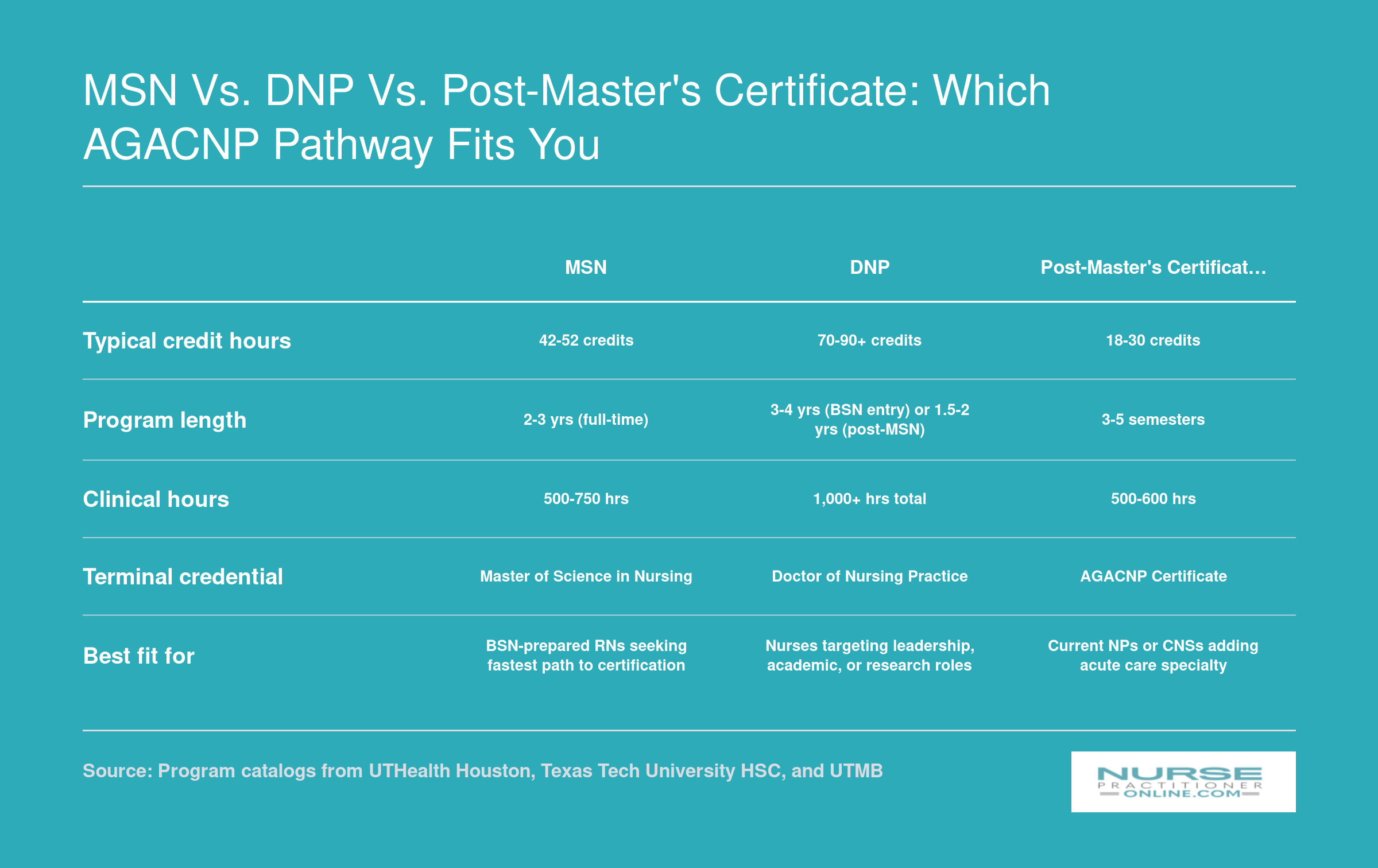
Texas nursing schools offer three main routes to AGACNP certification: the MSN, the DNP (via BSN-to-DNP or MSN-to-DNP tracks), and the Post-Master's Certificate for nurses who already hold an advanced degree. Credit hours, clinical requirements, and timelines vary by school, so the ranges below reflect typical figures from major Texas programs such as UTHealth Houston, Texas Tech, and UTMB. Contact each program's admissions advisor for the most current catalog details.
Explore other Texas related topics
Related Articles
Admission Requirements & Entry Pathways for Texas AGACNP Programs
Texas AGACNP programs share a core set of admission criteria, though a few requirements shift from school to school. Here's what you can expect to pull together before you apply.
- BSN from an accredited programEvery Texas AGACNP program requires a Bachelor of Science in Nursing earned from a CCNE- or ACEN-accredited institution. Most set a minimum cumulative GPA of 3.0, at UT Health San Antonio, for example, both the post-master's certificate and BSN-to-DNP tracks require a 3.0 or higher.
- Unencumbered RN licenseYou'll need an active, unrestricted registered nurse license. Texas programs typically accept a Texas RN license or a compact-state license with multistate privileges, and your license must be in good standing at the time of application and throughout enrollment.
- Acute care clinical experienceBecause AGACNP practice centers on critically ill adults and older adults, programs look for bedside experience in high-acuity settings such as the ICU, ED, or step-down units. Most schools ask for at least one to two years of recent acute care experience, though exact minimums vary.
- Prerequisite courseworkExpect to complete foundational graduate-level courses, advanced health assessment, pathophysiology, and pharmacology, before or early in the program. At UT Health San Antonio, prerequisite courses must be completed with a grade of B or better. Some schools also require an undergraduate statistics course.
- Certifications: BLS, ACLS, and sometimes CCRNCurrent BLS and ACLS certifications are standard requirements; UT Health San Antonio, for instance, lists both as mandatory. A few programs prefer or require Critical Care Registered Nurse (CCRN) certification, so check each school's admissions page carefully.
- GRE policyGRE requirements vary across Texas schools. UT Health San Antonio does not require the GRE, and several other programs have followed suit. Others may still request scores or offer conditional waivers based on GPA, so confirm the latest policy before you apply.
- Professional references and other materialsPlan on submitting two to three professional references, ideally from nurse managers or clinical mentors who can speak to your acute care competence. Most programs also require a personal statement, a current résumé, and an interview or goal-setting essay.
- BSN-to-DNP direct entry pathwayIf you'd rather earn the terminal practice doctorate without stopping at the MSN, certain Texas schools offer a BSN-to-DNP track in the AGACNP concentration. This streamlined route typically takes three to four years of full-time study and rolls the master's-level content into the doctoral curriculum, saving you time and often money compared with completing both degrees separately.
AGACNP Certification Pass Rates and Board Exam Prep in Texas
The ANCC AGACNP-BC exam recorded an 83% pass rate in 2024, while the AACN ACNPC-AG exam posted a 75% pass rate the same year, making exam choice and preparation strategy critical decisions for Texas AGACNP graduates.1 Both certifications qualify you to practice as an adult-gerontology acute care nurse practitioner, but the exams differ in approach, content weighting, and the populations they emphasize.
Two Pathways to AGACNP Certification
The American Nurses Credentialing Center (ANCC) offers the AGACNP-BC exam, a 175-question test (150 scored, 25 pretest) administered over 210 minutes.2 The American Association of Critical-Care Nurses (AACN) administers the ACNPC-AG exam, also 175 questions with the same time limit and structure.3 Both exams align with the 2025 APRN Consensus Model and cover assessment, diagnosis, and management of adolescent through older adult patients in acute and critical care settings.4 The AACN exam tends to weight critical care and intensive care scenarios more heavily, while the ANCC exam balances acute care across a broader range of hospital settings, including step-down units, emergency departments, and surgical services.
Eligibility for both exams requires graduation from an accredited AGACNP program (MSN, DNP, or post-master's certificate). Nurses exploring the post-master's route can review online post-master's ACNP certificate programs to compare options across the country. Most Texas programs prepare students for both exams, though some curricula align more closely with one certifying body. Ask admissions or faculty which exam their graduates typically choose and whether the program offers targeted board review.
The 2025 Consensus Model Change
The 2025 APRN Consensus Model retired the legacy Adult Acute Care Nurse Practitioner (ACNP) and Pediatric Critical Care Nurse Practitioner (PCNP) credentials. Current students entering AGACNP programs in 2026 will sit for either the AGACNP-BC or ACNPC-AG exam upon graduation. If you hold a legacy ACNP credential, you may continue to practice under that certification, but recertification pathways now require transitioning to the AGACNP credential. The change does not affect your scope of practice, only the formal designation and continuing education requirements.
Evaluating Program Board Prep Support
Pass rates published by individual Texas schools vary, and not all programs make program-level data publicly available on accreditation or outcomes pages. When comparing programs, ask for first-time pass rates over the past three years, not just overall or eventual pass rates. Strong board prep support includes live or recorded review courses, access to question banks (such as APEA or Hollier), timed practice exams, and one-on-one tutoring for students who score below benchmark on diagnostic tests. Transparency around pass rates signals confidence in curriculum rigor and clinical preparation. If a program declines to share recent data, consider that a yellow flag.
AGACNP Salary and Job Outlook in Texas by Metro Area
The table below shows nurse practitioner salary data across major Texas metro areas, based on the most recent Bureau of Labor Statistics figures. Keep in mind that BLS reports combine all NP specialties into one category. AGACNPs who work in hospital, ICU, and acute care settings often earn above these medians, particularly at large academic medical centers and Level I trauma centers where demand for acute care expertise is highest. The national median salary for nurse practitioners is approximately $126,260, and as you can see, most major Texas metros meet or exceed that figure. For context, the Texas statewide median for nurse practitioners sits near $127,000, making the state competitive on a national level. AGACNPs in high acuity environments such as critical care units, emergency departments, and surgical services may command premiums of 5% to 15% above general NP pay, especially when shift differentials and specialty bonuses are factored in.
| Metro Area | Total NP Employment | 25th Percentile Salary | Median Salary | 75th Percentile Salary |
|---|---|---|---|---|
| Dallas, Fort Worth, Arlington | 5,300 | $114,990 | $131,910 | $154,240 |
| Houston, Pasadena, The Woodlands | 4,680 | $118,610 | $133,140 | $143,760 |
| Austin, Round Rock, San Marcos | 2,570 | $119,670 | $132,530 | $156,000 |
| San Antonio, New Braunfels | 1,830 | $109,170 | $125,530 | $136,090 |
| El Paso | 560 | $109,230 | $126,120 | $140,650 |
Texas APRN Licensure & Prescriptive Authority: What AGACNP Graduates Need to Know
Completing your AGACNP program is one milestone; practicing independently in Texas requires navigating a separate licensure process that differs significantly from full practice authority states. Understanding these requirements before graduation helps you transition into practice without delays.
The Texas Board of Nursing APRN Application Process
Texas handles APRN licensure through an online application system that requires several components working in sequence.1 You will need to submit an education verification form completed by your program director, official transcripts showing completion of your graduate degree, and verification of national certification. The Texas Board of Nursing accepts either the AACN ACNPC-AG or ANCC AGACNP-BC credential for AGACNP licensure.
Application fees run $100 for APRN licensure without prescriptive authority or $150 if you apply for prescriptive authority simultaneously.1 Most AGACNP graduates pursue prescriptive authority immediately since acute care practice typically requires medication management. Your program must include at least 500 clinical hours and 400 practice hours, with separate core courses covering pharmacology, pathophysiology, and advanced health assessment.
Understanding Texas's Restricted Practice Environment
Texas operates under a restricted practice model, meaning AGACNPs cannot practice independently without physician involvement.2 You must establish a collaborative practice agreement with a delegating physician before seeing patients. Day to day, this means a physician reviews and co-signs certain orders, maintains availability for consultation, and shares responsibility for your clinical decisions.
For AGACNPs working in hospital settings, this arrangement often feels less restrictive since physician collaborators are typically on-site. However, the requirement does limit where and how you can structure your practice compared to states with full practice authority. You can track pending legislative changes and compare regulations through our nurse practitioner scope of practice guide.
2025 Consensus Model Alignment and Certification Timelines
The 2025 consensus model changes retired the legacy ACNP and PCNP credentials, which means new graduates must obtain population-focused certification matching their educational preparation. Texas now requires APRN titles to align with consensus model role and population designations, reinforcing the importance of choosing a program that prepares you specifically for adult-gerontology acute care practice.1
One notable timeline change affects ANCC certification candidates: as of January 2026, you have five years from your graduation date to pass the certification exam.3 This provides flexibility if you encounter delays but creates urgency to complete testing within that window.
Ongoing Requirements and Legislative Landscape
Once licensed, Texas AGACNPs must complete 20 contact hours of continuing education per renewal cycle to maintain their credentials.1 Legislative efforts to expand practice authority in Texas have surfaced repeatedly but have not yet succeeded in changing the supervisory requirement. Staying informed through professional organizations helps you track any pending bills that could affect your scope of practice.
Frequently Asked Questions About AGACNP Programs in Texas
Below are answers to the questions prospective AGACNP students ask most often. Because program details change, we recommend verifying specifics directly with each school's admissions office or program advisor before making any enrollment decisions.
- What is the difference between ACNP and AGACNP?
- The legacy ACNP (Acute Care Nurse Practitioner) credential was retired under the 2025 APRN Consensus Model. It has been replaced by the AGACNP (Adult-Gerontology Acute Care Nurse Practitioner) designation, which explicitly defines the population focus as adolescents through older adults in acute and critical care settings. For a detailed comparison of the legacy and current designations, review the Texas Board of Nursing's advanced practice rules and individual school program pages, as curriculum differences can vary between institutions.
- How long does it take to complete an online AGACNP program in Texas?
- Timelines depend on the degree pathway you choose and whether you attend full time or part time. MSN AGACNP programs typically range from about two to three years, while DNP AGACNP programs may take three to four years. Post-master's certificate options are generally shorter, often one to two years. Clinical hour requirements also affect total program length. Because these ranges vary by school, consult the BLS.gov occupational outlook resources for general context, then verify exact timelines with each program's advisor.
- What are the clinical hour requirements for AGACNP programs in Texas?
- Clinical practicum hours differ by degree level and institution. MSN programs commonly require around 500 to 700 direct patient care hours in acute and critical care settings, while DNP programs may require 1,000 or more total practice hours. Some schools count prior APRN clinical experience toward DNP requirements. Always confirm exact hour totals with your program of interest, because requirements can shift with accreditation updates.
- Can you complete an AGACNP program fully online in Texas?
- Most Texas AGACNP programs deliver didactic coursework online, but nearly all include a hybrid component. This may take the form of on-campus intensive weekends, simulation lab days, or scheduled clinical residency blocks. Truly 100 percent online completion (with no campus visits) is uncommon for this specialty because of hands-on skill validation requirements. Review each school's distance learning page carefully and contact admissions to clarify exactly what in-person commitments are expected.
- Can out-of-state students enroll in a Texas online AGACNP program?
- Policies differ by institution. Some Texas schools accept students from any state, while others limit enrollment to residents of states covered by the State Authorization Reciprocity Agreement (SARA) or specific interstate compacts. Clinical placement logistics can also complicate out-of-state enrollment, since you will need preceptors and sites approved by the program. Check each school's admissions page for residency requirements, and call the admissions office directly if the information is not clearly posted.
- What certification exams do AGACNP graduates take?
- AGACNP graduates sit for one of two national board exams: the AACN ACNPC-AG (offered by the American Association of Critical-Care Nurses) or the ANCC AGACNP-BC (offered by the American Nurses Credentialing Center). Both credentials qualify you for APRN licensure in Texas. Your program's curriculum may align more closely with one exam, so ask your program director which certification their coursework prepares you for and review each exam's eligibility requirements early in your studies.
Texas by Specialty
- AGNP Programs in Texas
- DNP NP Programs in Texas
- FNP Programs in Texas
- PMHNP Programs in Texas
- PNP Programs in Texas
- Best Nurse Practitioner Options in Dallas, TX
- Best Nurse Practitioner Options in San Antonio, TX
- Best Nurse Practitioner Programs in Austin, TX
- Best Nurse Practitioner Programs in Fort Worth, TX
- Best Nurse Practitioner Programs in Houston, TX
- Best Nurse Practitioner Programs in Laredo, TX
- Best Nurse Practitioner Programs in Lubbock, TX