
Most important takeaways…
- Hawaii NPs earn a median salary of $130,940 per year, well above the national average for the profession.
- Securing clinical preceptors across the islands is the biggest logistical challenge Hawaii NP students face.
- Most Hawaii nurses rely on online or hybrid programs from mainland schools due to limited local options.
- The full licensing process from BSN to independent NP practice typically takes about three to four years.
Only two universities in Hawaii currently offer nurse practitioner pathways at the master's or doctoral level, and seat counts at both fill quickly each cycle. That bottleneck pushes most island-based RNs toward online MSN and DNP programs delivered by mainland schools, where coursework runs asynchronously and clinical hours can be completed locally with an approved preceptor.
The trade-offs are real: out-of-state tuition, time-zone gaps with East Coast cohorts, and the work of securing preceptors across Oahu, Maui, the Big Island, or Kauai. The payoff is one of the most NP-friendly regulatory environments in the country. Hawaii grants full practice authority, letting licensed NPs assess, diagnose, and prescribe independently without a physician collaboration agreement. If you're an RN weighing this move, understanding the key steps from RN to NP will help you map out a realistic timeline.
Hawaii's NP Education Landscape: What Prospective Students Should Know
Brick-and-mortar programs versus online pathways: for aspiring nurse practitioners in Hawaii, this choice often makes or breaks the pursuit of an advanced practice degree. The state's geographic isolation and limited number of local graduate nursing programs mean that most Hawaii-based nurses must look beyond the islands to find NP education that fits their schedules and career goals.
Limited Local Options Drive Online Learning
Hawaii has only a handful of in-state institutions offering nurse practitioner programs, with the University of Hawaii at Manoa serving as the primary option for those seeking face-to-face instruction. This scarcity creates a genuine challenge for working nurses, particularly those on neighbor islands like Maui, Kauai, or the Big Island who would face significant travel burdens to attend classes in Honolulu. Online and hybrid programs from accredited mainland universities have become essential pathways, allowing Hawaii nurses to earn their credentials while continuing to work and live in their communities.
Demographic Realities Shaping Workforce Demand
Hawaii's population is aging rapidly, with residents 65 and older representing a growing share of the state's demographics.1 Rural and neighbor-island communities face particular challenges accessing primary care, with some areas experiencing pronounced provider shortages. These realities translate into strong demand for nurse practitioners in rural healthcare, especially those trained in primary care and gerontology. Healthcare systems across the islands are actively recruiting NPs to serve aging residents in settings ranging from community health centers to long-term care facilities.
FNP vs. AGNP: Which Track Fits Hawaii's Needs?
When selecting a specialty track, Hawaii nurses should understand the difference between FNP and AGNP pathways. FNP programs prepare graduates to provide primary care across the lifespan, from pediatrics through geriatrics, making them versatile choices for community clinics serving diverse patient populations. AGNP programs focus specifically on adults and older adults, aligning closely with Hawaii's demographic trends and the growing need for gerontology-focused providers. Both tracks offer strong career prospects in the state, though your choice should reflect the patient populations you most want to serve.
Full Practice Authority: A Career Advantage
Hawaii grants full practice authority to Advanced Practice Registered Nurses, meaning nurse practitioners can evaluate patients, diagnose conditions, and prescribe medications independently without physician oversight. This regulatory environment positions Hawaii-based NPs to practice at the top of their license from day one, whether opening an independent practice, serving rural communities, or working within larger healthcare systems. For nurses weighing career destinations, Hawaii's practice authority status represents a meaningful advantage compared to states with more restrictive supervision requirements.
Top Online Nurse Practitioner Programs for Hawaii Students, Ranked
Hawaii-based nurses pursuing NP careers have a small but strong set of programs to consider, and several are accessible through online or hybrid delivery. The rankings below use a composite quality score that weighs online delivery availability alongside graduation rates, net price, and post-graduation earnings rather than relying on any single metric. Because Hawaii has a limited number of in-state NP programs, many students also explore nationally accredited online options; the three schools listed here are the Hawaii-based institutions that currently offer NP-level pathways.
- Online delivery availability
- Institutional graduation rates
- Net price after financial aid
- Post-graduation earnings data
- Program breadth and accreditation
- NCES-IPEDS federal institutional data — nces.ed.gov
- College Scorecard graduate earnings — collegescorecard.ed.gov
- Internal program database
- Independent program research

University of Hawaii at Manoa
UH Manoa's School of Nursing and Dental Hygiene offers DNP programs with concentrations in Family NP, Adult-Gerontology Primary Care NP, and Psychiatric Mental Health NP, all delivered in a hybrid format with school-coordinated clinical placements. Its curriculum is built around culturally responsive care and service to rural and underserved populations across Hawaii and the Pacific, making it uniquely positioned for nurses planning to practice in the islands. Median earnings for graduates ten years out reach approximately $57,624, and in-state tuition of roughly $16,502 combined with a net price near $15,664 keeps costs relatively manageable for a doctoral program.
- Hybrid DNP with fall-only cohort admission
- School-coordinated clinical placements statewide
- Emphasis on culturally responsive primary care
- DNP Scholarly Project addressing real-world health challenges
- Interprofessional collaboration woven into coursework
- Full-time enrollment with cohort-based structure
- Financial aid available for qualifying students
- Full-time, 3-year cohort model with 74 credits
- 810 supervised clinical hours included
- Advanced psychotherapy and medication management training
- Focus on care for vulnerable populations
- Hybrid delivery combining online and on-campus learning
- Prepares graduates for PMHNP certification
- Hybrid DNP with six concentration options available
- Cohort-based format starting each fall
- Clinical placements in rural and underserved settings
- Interprofessional care collaboration emphasis
- DNP Scholarly Project on real-world health challenges
- Culturally responsive care focus across the lifespan
Doctor of Nursing Practice, Family Nurse Practitioner — Hybrid
Doctor of Nursing Practice, Psychiatric Mental Health Nurse Practitioner — Hybrid
Doctor of Nursing Practice, Adult-Gerontology Primary Care Nurse Practitioner — Hybrid

University of Hawaii at Hilo
UH Hilo's DNP with a Family Nurse Practitioner concentration stands out for its deep focus on transcultural nursing, social justice, and the health needs of rural Hawaii communities. The program prepares graduates for FNP certification and careers as primary care providers, nurse leaders, or faculty. With in-state tuition around $12,230 and a net price near $11,856, it is the most affordable in-state option, though its institution-wide graduation rate of about 48% is worth noting (that figure reflects the entire university, not the nursing program specifically).
- Hybrid DNP emphasizing transcultural nursing competency
- Prepares graduates for national FNP certification exam
- Strong focus on rural population health and health disparities
- Evidence-based practice and social justice integrated throughout
- Leadership training in organizational and health systems
- Interprofessional collaboration built into clinical experiences
- Lowest net price among Hawaii's in-state NP programs
Doctor of Nursing Practice, Family Nurse Practitioner — Hybrid

Chaminade University of Honolulu
Chaminade University of Honolulu, a private Marianist institution, offers both BSN-to-DNP pathways and post-doctoral certificates in Family NP, Pediatric NP, and Psychiatric Mental Health NP. Programs are delivered in a hybrid format with coursework largely online and a mandatory annual on-campus immersion in Honolulu, scheduled for August 2026. Tuition runs about $26,880 regardless of residency, with a net price near $28,856. The school's CCNE-accredited programs emphasize culturally informed, person-centered care.
- CCNE-accredited DNP with 68 total credit hours
- Completable in 2 to 3 years via cohort model
- Online coursework plus annual Honolulu immersion
- Up to 9 transfer credits accepted
- BSN-to-MSN-to-DNP pathway available
- Fall start with June 1 application deadline
- No GRE required for admission
- 69-credit DNP with lifespan PMHNP focus
- Medication management and psychotherapy training
- $32,500 HRSA stipend may be available
- BSN-to-DNP pathway offered for entry-level applicants
- Cohort-based with one fall start per year
- Emphasis on care for vulnerable populations
- Family-centered pediatric care across development stages
- Online delivery with yearly on-campus immersions
- Expert faculty mentors and scholarly project component
- No GRE required and no minimum GPA threshold
- CCNE accredited with culturally informed curriculum
- Hands-on clinical and experiential learning integrated
- 12-month, 18-credit hybrid certificate program
- 630 clinical hours in primary care settings
- Designed for APRNs who already hold a doctorate
- Prepares graduates for FNP national certification
- Annual on-campus immersion in Honolulu required
- Integrates evidence-based and culturally responsive practices
- 12-month certificate covering birth through adolescence
- 18 credit hours with 630 clinical hours
- Hybrid format with online coursework and immersion
- Requires current APRN license and national board certification
- Focused on pediatric health promotion and acute care management
- CCNE accredited with fall-term start
- 12-month hybrid certificate at 18 credit hours
- 560 clinical hours in psychiatric mental health settings
- Covers psychopharmacology across the lifespan
- Designed for doctorally prepared APRNs
- Annual on-campus immersion session required
- Prepares graduates for PMHNP national certification
Doctor of Nursing Practice, Family Nurse Practitioner — Hybrid
Doctor of Nursing Practice, Psychiatric Mental Health Nurse Practitioner — Hybrid
Doctor of Nursing Practice, Pediatric Nurse Practitioner — Hybrid
Post-Doctoral Family Nurse Practitioner Certificate — Hybrid
Post-Doctoral Pediatric Nurse Practitioner Certificate — Hybrid
Post-Doctoral Psychiatric Mental Health Nurse Practitioner Certificate — Hybrid
Questions to Ask Yourself
Most Affordable NP Programs Available to Hawaii Residents
Tuition is a major consideration when choosing a nurse practitioner program, especially given Hawaii's higher cost of living. The table below compares the three Hawaii institutions offering NP pathways, sorted by estimated net price. Keep in mind that the net price shown is an institution-wide average based on federal data and reflects aid received by all undergraduate students; your actual graduate-level costs will vary based on your financial aid package, residency status, and enrollment intensity. Beyond tuition, Hawaii nurses have meaningful options to offset costs. Federal student loans cover most NP programs, and the National Health Service Corps (NHSC) Loan Repayment Program offers up to $50,000 for a two-year commitment at an approved site in a Health Professional Shortage Area, with family, adult, pediatric, psychiatric/mental health, gerontological, and women's health NP specialties all eligible. Hawaii also runs its own State Loan Repayment Program (HSLRP), administered through the University of Hawaii AHEC, for primary care and behavioral health providers serving in designated shortage areas. Given Hawaii's sizable military community, eligible students should also explore VA education benefits and military tuition assistance, which can substantially reduce out-of-pocket costs at any of these schools.
| School | Format | In-State Tuition | Out-of-State Tuition | Avg. Net Price (Institution-Wide) | Median Graduate Debt |
|---|---|---|---|---|---|
| University of Hawaii at Hilo | Hybrid | $12,230 | $27,062 | $11,856 | $20,500 |
| University of Hawaii at Manoa | Hybrid | $16,502 | $34,550 | $15,664 | $18,500 |
| Chaminade University of Honolulu | Hybrid | $26,880 | $26,880 | $28,856 | $23,250 |
Accelerated & Fastest NP Pathways for Hawaii Students
For working nurses eager to advance their careers without spending years in school, accelerated pathways offer a faster route to NP licensure. Understanding your options and the trade-offs involved helps you choose the timeline that fits your life.
Main Accelerated Pathway Options
Hawaii students can pursue three primary accelerated tracks. The BSN-to-DNP pathway bundles MSN-level NP coursework into a doctoral program, skipping the separate master's degree. Hawaii Pacific University offers a BSN-to-DNP FNP program that spans 48 months and includes 1,000 clinical hours. The University of Hawaii at Manoa's GEPN (Graduate Entry Program in Nursing) DNP-FNP track also runs 48 months and requires 126 credits, serving as a comprehensive entry-level doctoral pathway. For a deeper look at typical doctoral timelines, see our guide on how long a DNP program takes.
Accelerated MSN-FNP programs compress traditional timelines into 20 to 30 months. Hawaii Pacific University's online MSN-FNP completes in 24 months with 46 credits and 624 clinical hours, preparing graduates for both ANCC FNP-BC and AANP FNP-C certification exams. Their MSN AGACNP program finishes in 28 months with 46 credits and 600 clinical hours.
Part-time-to-full-time flexibility allows you to adjust pace semester by semester, though full-time enrollment consistently shortens overall completion time compared to extended part-time tracks.
Realistic Timelines and Trade-Offs
Standard MSN-FNP programs typically require two to three years of full-time study. Accelerated tracks condense this to under two years, but expect heavier course loads and year-round enrollment with minimal breaks. You'll balance didactic work, clinical placements, and often a full-time nursing job. If you're wondering whether the workload is manageable, our article on how hard nurse practitioner school is provides honest perspective.
Clinical Hours: The Fixed Bottleneck
Clinical requirements remain non-negotiable regardless of didactic pace. National certification boards require at least 500 clinical hours for FNP and AGNP credentials, and many programs exceed this minimum. Hawaii Pacific's programs range from 600 to 1,000 hours depending on degree level. These hours must be completed in real time alongside preceptors, meaning no amount of accelerated coursework can compress the hands-on training period. This fixed bottleneck is the most important timeline factor to plan around when evaluating accelerated options.
Online vs. Hybrid NP Programs: Key Differences for Island-Based Students
Choosing between a fully online and a hybrid NP program is a big decision, especially when you live on an island chain where travel to a campus can mean booking a flight. Both formats have genuine strengths, and both still require you to complete in-person clinical rotations, so "online" never means zero face-to-face time. Here is a practical breakdown to help you weigh your options.
Pros
- Fully online programs let you stay on a neighbor island without relocating, saving thousands in housing and travel costs.
- Flexible asynchronous coursework fits around 12-hour nursing shifts, making it realistic to keep earning while you learn.
- Hawaii participates in NC-SARA, which opens the door to accredited mainland programs with competitive tuition rates.
- Online formats give you access to a wider pool of specialty tracks that may not be available locally.
- Hybrid intensives build hands-on clinical skills during short campus residencies, reinforcing what you study online.
- In-person cohort weekends create strong peer networks and professional relationships that last well beyond graduation.
- Local faculty mentorship in hybrid programs often leads to stronger clinical placement connections across the islands.
- Some Hawaii employers view hybrid graduates favorably because of their documented in-person training hours.
Cons
- Online students must still secure precepted clinical sites in Hawaii, which can be competitive on smaller islands.
- Without structured campus time, online learners may feel isolated and need to be proactive about building peer support.
- Not every mainland online program is authorized to enroll Hawaii residents, so always verify NC-SARA participation and any state-specific restrictions before applying.
- Hybrid programs typically require periodic travel to a campus, adding flight and lodging expenses for neighbor island students.
- Hybrid schedules with set intensive dates can conflict with hospital shift rotations, requiring advance planning with your employer.
- Time zone differences with mainland online programs can make live sessions inconvenient, sometimes falling during work hours in Hawaii.
Related Articles
Completing Clinical Rotations Across the Hawaiian Islands
Finding a quality preceptor in a state with limited healthcare infrastructure and thousands of miles of ocean between clinical sites remains the single biggest logistical challenge Hawaii NP students face. Understanding how placements work before you enroll can save months of frustration and unexpected costs down the road.
Why Clinical Placement Is So Competitive in Hawaii
Hawaii's healthcare system is concentrated on Oahu, where the majority of large hospital networks operate. Facilities such as Queen's Health Systems, Straub Medical Center, Kaiser Permanente Hawaii, and Tripler Army Medical Center all host NP students, but slots fill quickly because multiple nursing programs compete for the same preceptors. On Maui, the Big Island, and Kauai, community health centers and smaller clinics provide primary care rotation opportunities, yet specialty placements in areas like acute care or psychiatry are far more scarce. Students based on neighbor islands should expect that some rotations, particularly specialty ones, will require temporary relocation or commuting to Oahu, adding housing, airfare, and time costs to the program budget. For a deeper look at what rotations involve, our guide to nurse practitioner clinical rotations covers the student role, required hours, and what to expect.
How Online Programs Handle Placements
Not every online NP program approaches clinical coordination the same way, and this is a question worth asking before you submit an application. Some programs offer dedicated placement coordination teams that reach out to facilities on your behalf. Others place the full responsibility on you to find a clinical preceptor independently. A few options can help bridge the gap:
- National matching services: Platforms like Clinical Match Me let students submit a request and receive offers from preceptors, giving you flexibility in choosing a site that fits your schedule and location.1
- Retail clinic rotations: CVS MinuteClinic accepts Family Nurse Practitioner students who have completed at least one semester of graduate NP coursework. Applications are online only and follow strict seasonal deadlines (Spring: Aug 1-14, Summer: Dec 1-14, Fall: Apr 1-14), so planning ahead is essential.2
- State preceptorship programs: The Hawaii Preceptorship Program through a primary care clinic accepts students for adult primary care and outpatient geriatric care rotations, though specialties such as women's health and pediatrics are not available through this pathway.3
Tips for Neighbor-Island Students
If you live on Maui, Kauai, or the Big Island, start building relationships with local clinic providers early, ideally during your first semester. Many preceptors agree to host students they already know professionally. Budget for at least one or two rotations on Oahu, and ask your program whether they have existing affiliation agreements with Hawaii facilities. A program that already holds contracts with island health systems can shave weeks off the placement process compared to one that requires you to negotiate agreements from scratch.
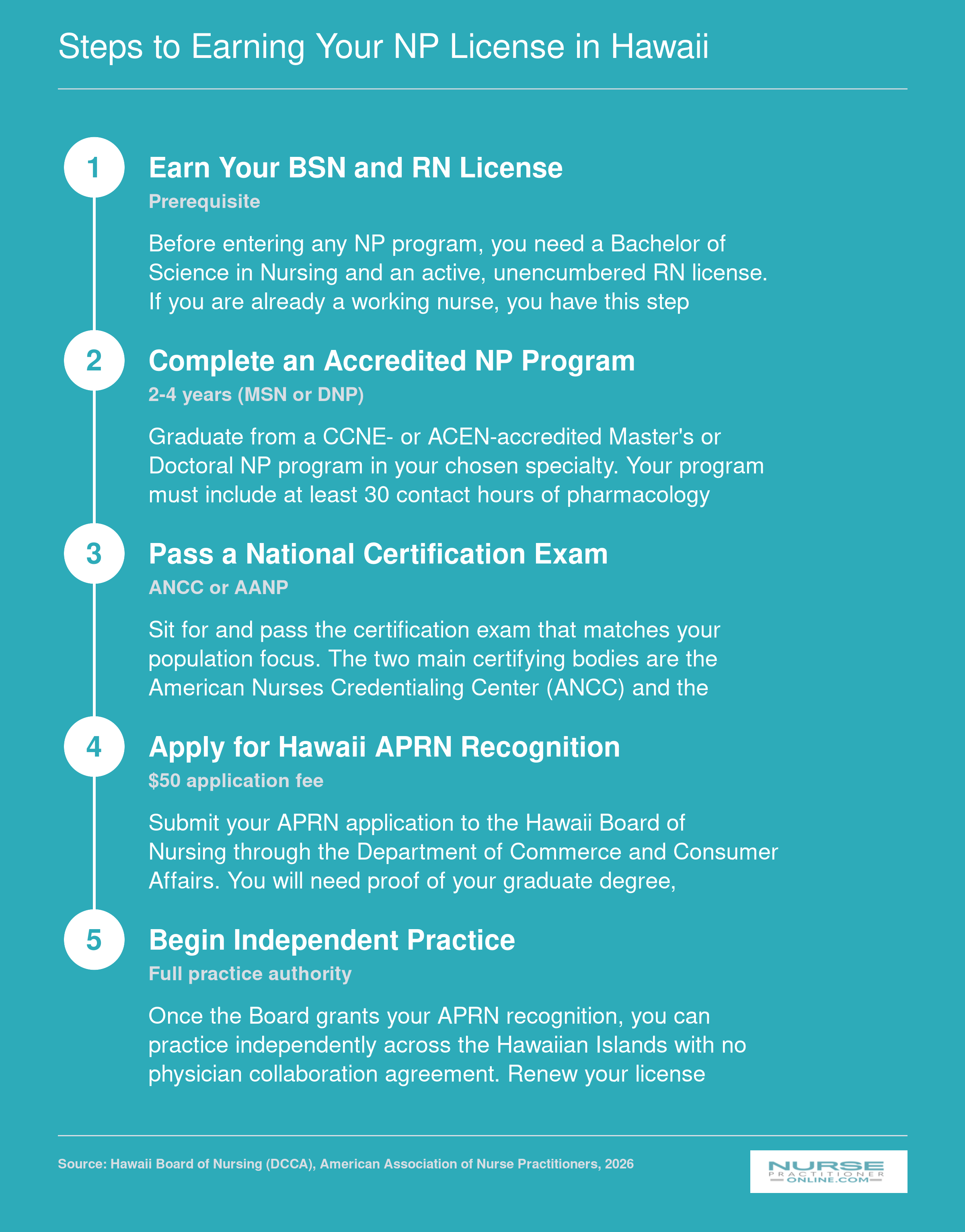
Steps to Earning Your NP License in Hawaii
Hawaii is one of the states that grants nurse practitioners full practice authority, meaning you can diagnose, treat, and prescribe independently with no collaborative agreement with a physician required. From BSN to independent practice, the entire journey typically takes about 2 to 4 years depending on whether you choose an MSN or DNP track.
What Nurse Practitioners Earn in Hawaii
Hawaii's nurse practitioners enjoy strong earning potential, though the state's high cost of living does offset some of the nominal salary advantage. With a median annual salary of $130,940, NPs in Hawaii earn well above the national NP median of roughly $126,260 and significantly more than Hawaii's median household income (approximately $94,800). About 470 NPs are currently employed statewide, a figure that underscores both the demand for advanced practice nurses and the room for workforce growth across the islands.
| Occupation | Total Employment in Hawaii | Median Annual Salary | 25th Percentile Salary | 75th Percentile Salary | Mean Annual Salary |
|---|---|---|---|---|---|
| Nurse Practitioners | 470 | $130,940 | $121,410 | $158,100 | $135,020 |
| Registered Nurses | 13,100 | $136,320 | $103,480 | $139,310 | $123,720 |
| Medical and Health Services Managers | 2,590 | $140,750 | $108,840 | $167,540 | $154,160 |
| Nursing Instructors (Postsecondary) | 370 | $102,180 | $82,380 | $109,370 | $97,820 |
NP Program Questions Hawaii Students Ask Most
Hawaii-based nurses considering an NP career often share the same set of practical concerns, from logistics of online learning across the Pacific to licensing details. Here are the questions we hear most, answered with the facts you need to move forward.
- Can I complete a nurse practitioner degree entirely online from Hawaii?
- Most of your coursework can be completed online through nationally accredited programs that accept Hawaii residents. However, every NP program requires hands-on clinical rotations, so you will need to arrange supervised patient-care hours at approved sites in Hawaii. Several online FNP programs explicitly support Hawaii-based students with clinical placement coordination, though availability can vary by island.
- How long does it take to go from BSN to nurse practitioner in Hawaii?
- A typical BSN-to-MSN pathway takes about two to three years of full-time study. Accelerated tracks and BSN-to-DNP programs range from roughly two years (intensive) to four years (part-time). Your timeline depends on course load, clinical scheduling, and whether you choose a master's or doctoral degree. Part-time options are popular among working nurses balancing hospital shifts.
- Do nurse practitioners in Hawaii have full practice authority?
- Yes. Hawaii grants nurse practitioners full practice authority, meaning APRNs can evaluate patients, diagnose conditions, order tests, and prescribe medications, including controlled substances, without a collaborative agreement with a physician. This independent scope of practice makes Hawaii one of the more favorable states for NP autonomy and can expand your career options across rural and underserved communities on all islands.
- What is the difference between an FNP and an AGNP program?
- A Family Nurse Practitioner (FNP) program prepares you to treat patients across the entire lifespan, from pediatrics through geriatrics. An Adult-Gerontology Nurse Practitioner (AGNP) program focuses specifically on adolescent, adult, and older adult populations. Both require a minimum of 500 faculty-supervised clinical hours for national certification. Your choice depends on the patient population you want to serve after graduation.
- What are the clinical hour requirements for NP programs?
- Both ANCC and AANP require a minimum of 500 faculty-supervised clinical hours for initial FNP or AGNP certification. Many programs exceed this floor, requiring 600 to 750 hours depending on the curriculum and specialty track. These hours must be completed at approved clinical sites under qualified preceptors. For Hawaii students in online programs, arranging placements on your home island early is strongly recommended.
- How much do NPs earn in Hawaii compared to the national average?
- Nurse practitioners in Hawaii typically earn above the national average, reflecting the state's higher cost of living and strong demand for primary care providers. While exact figures shift year to year, Hawaii NP salaries generally range well above six figures annually. The state's ongoing provider shortage, especially on neighbor islands, continues to support competitive compensation and signing incentives for newly certified NPs.