Most important takeaways…
- Georgia WHNPs work in settings ranging from large health systems like Emory and Wellstar to rural maternity care deserts spanning over 60 counties.
- NCC certification and a graduate degree in women's health are required before applying for Georgia WHNP licensure.
- The BLS projects nurse practitioner employment to grow by 40 percent nationally through 2032, fueling strong Georgia demand.
- Atlanta area NPs earn the highest metro salaries in the state, though rural roles often include federal loan repayment incentives.
Where are women's health nurse practitioner jobs actually hiring in Georgia right now? That question has a more varied answer than most nurses expect. Demand is strong across the state, but the job market splits sharply between Atlanta's large academic medical centers and the rural community health centers that serve the roughly 60 counties classified as maternity care deserts.
Georgia's healthcare expansion has accelerated hiring pressure for WHNPs specifically. Ob-gyn practices, Federally Qualified Health Centers, and integrated women's health clinics all compete for a credential that remains relatively rare: the Women's Health Care Nurse Practitioner (WHNP-BC) certified through the National Certification Corporation. If you are still exploring this specialty path, our women's health nurse practitioner career guide covers the full scope of practice and credentialing requirements.
That credential scarcity gives qualified candidates real negotiating leverage, but it also means the job search requires knowing which employers actually understand the WHNP scope of practice versus those posting loosely written listings that could suit any NP specialty.
What Does a Women's Health Nurse Practitioner Actually Do?
Women's health nurse practitioners hold national certification through the National Certification Corporation (NCC) and are trained to deliver both primary and specialty care focused exclusively on women across the lifespan, from adolescence through menopause and beyond. If you are exploring WHNP jobs in Georgia, understanding this focused scope of practice is essential before you apply.
Core Clinical Responsibilities
Day to day, a WHNP manages a wide range of services that revolve around reproductive and gynecological health:
- Contraception counseling: Evaluating options from oral contraceptives to IUDs and implants, then prescribing and, in some settings, placing devices.
- Well-woman and GYN exams: Performing annual pap smears, breast exams, and pelvic assessments.
- Prenatal and postpartum care: Managing uncomplicated pregnancies through routine prenatal visits and guiding patients through postpartum recovery, including breastfeeding support and mood screening.
- Menopause management: Addressing vasomotor symptoms, bone density concerns, and hormone therapy decisions.
- STI screening and treatment: Ordering labs, interpreting results, and initiating treatment plans.
- Complex GYN conditions: Evaluating abnormal uterine bleeding, endometriosis, polycystic ovary syndrome, and pelvic pain.
One distinction that trips up many nurses early in their career research: WHNPs do not typically manage labor and delivery. That falls under the certified nurse midwife (CNM) scope. WHNPs focus on the outpatient management that happens before, between, and after pregnancies, along with the full spectrum of gynecological care.
Where WHNPs Work in Georgia
Georgia's WHNP job market spans a variety of clinical environments. Private OB/GYN practices remain the most common employer, particularly across the Atlanta metro area and in mid-sized cities like Augusta and Savannah. Hospital-based women's centers hire WHNPs for outpatient clinic roles tied to larger health systems such as Emory Healthcare, Wellstar, and Piedmont. Title X-funded community health clinics, which serve underinsured populations, also recruit WHNPs to deliver contraceptive services and preventive screenings, especially in rural parts of the state. Fertility clinics represent a smaller but growing niche, where WHNPs assist with initial evaluations and monitoring cycles.
Schedule and Lifestyle
One of the biggest draws of women's health NP jobs is the schedule. Most WHNP roles operate on a weekday outpatient model, running Monday through Friday during standard clinic hours. On-call responsibilities are limited compared to inpatient or emergency settings, and weekend shifts are uncommon. For working nurses weighing career advancement against family commitments or personal well-being, this predictability is a significant benefit. It is one reason many experienced RNs pursuing an online WHNP program cite lifestyle as a primary motivator alongside clinical interest. For a deeper look at how WHNPs shape patient outcomes and community health, see the essential role of women's health nurse practitioners.
Understanding exactly what a WHNP does, and does not do, helps you target the right job postings and prepare for interviews with confidence. The women's health nurse practitioner job description centers on outpatient, relationship-driven care that rewards clinical depth without the unpredictability of acute settings.
Frequently Asked Questions About WHNP Careers in Georgia
Whether you are weighing certification options or wondering how the job market looks across Georgia, these common questions can help you plan your next move. Each answer draws on current certification requirements and workforce trends so you can make informed decisions.
- Can an NP work in women's health without WHNP certification?
- Technically, a family nurse practitioner (FNP) can provide some women's health services, but the scope is more limited. In Georgia, employers hiring specifically for gynecologic or reproductive health roles typically prefer or require the WHNP-BC credential issued by the National Certification Corporation. Earning the WHNP-BC demonstrates specialized training in areas like contraceptive management, menopause care, and gynecologic screening that go well beyond a generalist NP curriculum.
- What is the difference between a WHNP and a CNM?
- Both focus on women's health, but their scopes differ. A Women's Health Nurse Practitioner (WHNP) specializes in gynecologic, reproductive, and primary care for women across the lifespan, while a Certified Nurse Midwife (CNM) centers on pregnancy, labor, delivery, and postpartum care. In Georgia, CNMs manage births in hospitals and birth centers, whereas WHNPs typically practice in OB/GYN clinics, women's health centers, and specialty practices without delivering babies.
- Are women's health nurse practitioners in demand in Georgia?
- Demand appears strong and growing. Georgia's expanding population, particularly in metro Atlanta and surrounding suburbs, is driving the need for specialized women's health providers. Rural areas of the state also face significant gaps in gynecologic care, creating additional opportunities. While statewide workforce data specific to WHNPs is limited, job board trends suggest a steady increase in postings for women's health NP roles across both urban and underserved Georgia communities.
- How do you become a WHNP in Georgia?
- You will need to complete a graduate program (MSN, DNP, or post-master's certificate from an accredited WHNP track), hold an active and unencumbered RN or APRN license, and pass the NCC WHNP-BC exam. The exam includes 175 questions and must be completed within 180 minutes. You have up to eight years after graduating to sit for the exam, and recertification is required every three years with 45 continuing education credits per cycle.
WHNP Job Outlook and Demand Across Georgia
Georgia is one of the strongest job markets in the country for women's health nurse practitioners, and the national data backs that up.
A Growth Rate That Stands Apart
The Bureau of Labor Statistics projects nurse practitioners will grow by 40 percent between 2024 and 2034, adding roughly 128,400 positions nationwide. That makes NPs one of the fastest-growing occupations in the entire U.S. economy, far outpacing the 3.1 percent average for all occupations and the 8.4 percent rate for healthcare broadly. With a national unemployment rate hovering around 0.6 percent for the field, qualified NPs are essentially moving directly from graduation into employment.3 Georgia tracks closely with that national momentum, driven by a combination of population growth, persistent provider shortages, and evolving healthcare policy.
What Is Driving Demand in Georgia Specifically
Several forces are converging to make Georgia a particularly urgent market for WHNPs:
- Maternal health deserts: Dozens of rural Georgia counties have no OB-GYN providers within a reasonable driving distance. WHNPs are increasingly filling that gap in community health centers, federally qualified health centers, and critical access clinics.
- Medicaid coverage expansion: Georgia expanded Medicaid access in phases starting in 2023. More insured patients means higher patient volumes at women's health clinics, which translates directly into open WHNP positions.
- Metro population growth: Atlanta continues to rank among the fastest-growing metro areas in the Southeast. Savannah and Augusta are also expanding rapidly, fueling demand for reproductive health, prenatal care, and gynecological services across all age groups.
Urban Concentration vs. Rural Shortages
The distribution of WHNP job postings across Georgia is uneven. The Atlanta metro area generates the highest volume of open positions by a wide margin, with large health systems, private OB-GYN practices, and multispecialty groups posting regularly. However, rural and semi-rural counties often present a more urgent need. Many of those communities offer federal or state loan repayment incentives for advanced practice providers willing to commit to underserved areas, which can meaningfully offset student debt for new graduates. If you are still weighing your specialty options, our guide to women's health nurse practitioner careers covers the full scope of practice and credentialing pathway.
Telehealth as an Emerging Channel
A newer trend worth watching: some Georgia employers are now advertising hybrid WHNP roles that blend in-person clinical days with telehealth visits. Follow-up contraception counseling, postpartum check-ins, and hormone therapy management are among the services shifting toward virtual formats. If you are open to a hybrid schedule, that flexibility may expand your options well beyond the county where you live. For nurses still exploring program options, the best online WHNP programs can prepare you for these evolving roles without requiring you to leave your current position.
Average WHNP Salary in Georgia by Metro Area
The table below shows nurse practitioner salaries across Georgia's major metro areas. These figures reflect all NP specialties reported by the Bureau of Labor Statistics; WHNP-specific salaries may vary depending on practice setting, experience, and employer. The Atlanta metro area leads in both total employment and compensation, while smaller markets like Augusta, Savannah, and Macon offer competitive pay with a potentially lower cost of living.
| Metro Area | Total NPs Employed | 25th Percentile | Median Salary | Mean Salary | 75th Percentile |
|---|---|---|---|---|---|
| Atlanta, Sandy Springs, Roswell | 6,280 | $115,690 | $128,640 | $129,710 | $140,140 |
| Gainesville | 350 | $108,190 | $127,100 | $126,820 | $134,480 |
| Athens, Clarke County | 280 | $104,580 | $123,250 | $121,320 | $135,200 |
| Columbus | 410 | $103,230 | $118,680 | $122,130 | $131,090 |
| Augusta, Richmond County | 500 | $100,640 | $110,410 | $115,250 | $125,250 |
| Macon, Bibb County | 360 | $107,400 | $109,170 | $115,900 | $126,410 |
| Dalton | 170 | $105,640 | $114,130 | $113,970 | $125,000 |
| Savannah | 300 | $101,920 | $112,000 | $115,500 | $127,130 |
| Albany | 110 | $101,560 | $111,350 | $114,730 | $127,670 |
| Rome | 110 | $97,120 | $105,500 | $111,430 | $127,640 |
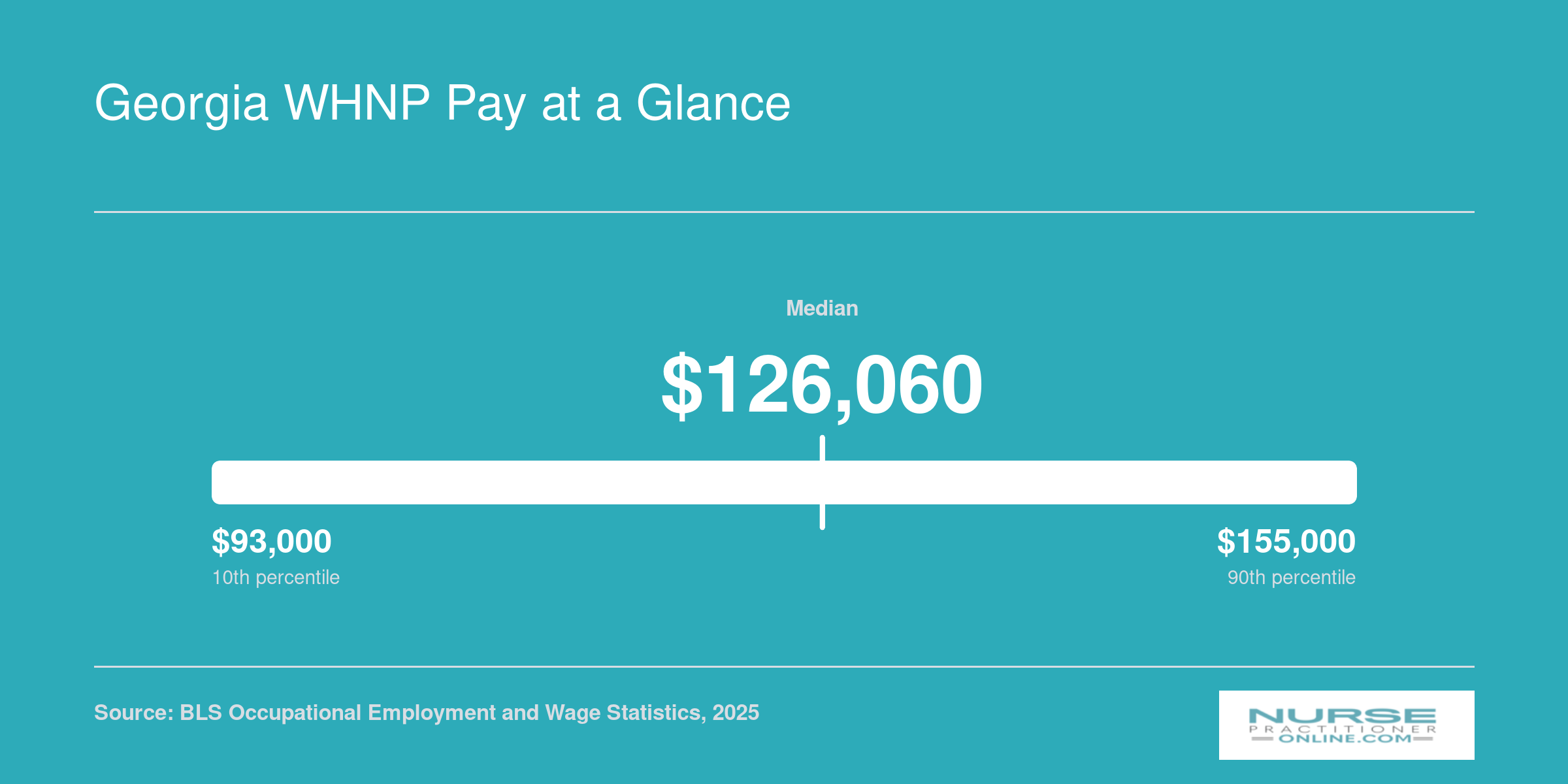
Georgia WHNP Pay at a Glance
Nurse practitioner salaries in Georgia span a wide range depending on experience, setting, and specialty focus. The figures below show how NP compensation in the state compares at different points in the pay distribution. The national median NP salary of $126,260 sits just above Georgia's median of $126,060, meaning Georgia WHNPs earn right in line with their peers nationwide.
Top Employers and Work Settings for WHNPs in Georgia
Which Georgia health systems are hiring women's health nurse practitioners, and what work settings offer the best combination of pay, autonomy, and benefits?
Major Health Systems Recruiting WHNPs
Several of Georgia's largest healthcare employers actively recruit WHNPs in 2025 and 2026. Emory Healthcare and Wellstar Health System, both based in metro Atlanta, frequently post positions in their women's health services. Piedmont Healthcare and Grady Health System also advertise WHNP roles, with Grady serving a high-volume, urban safety-net population. Augusta University Health, located in Georgia's second-largest metro area, is another consistent source of openings. These large systems often provide robust support structures, including dedicated APP leadership, structured orientation, and opportunities to precept students. If you're still exploring the path to this specialty, the women's health nurse practitioner career guide covers the education and certification steps in detail.
Work Settings: From Private Practice to Public Health
Setting shapes your day-to-day experience more than almost any other variable. A private OB/GYN group offers high autonomy and predictable office hours, with the chance to build long-term patient relationships. Hospital-based women's centers bring higher-acuity cases, rotating shifts, and extensive interdisciplinary collaboration, often along with higher base pay and comprehensive benefits. Community or Title X clinics serve underserved populations and may qualify you for state or federal loan repayment programs, making them a powerful option if reducing debt is a priority. Each path rewards a different temperament, so think about whether you thrive in fast-paced, team-driven environments or prefer a calmer, relationship-focused practice.
Typical Benefits Packages
Large Georgia health systems compete aggressively for advanced practice nurses, and benefits reflect that. You can generally expect a package that includes medical, dental, and vision coverage; retirement plan matching; paid time off; and short- and long-term disability. Northeast Georgia Health System, for example, lists day-one health insurance eligibility, a retirement match, malpractice coverage, CME allowance and paid CME days, certification reimbursement, tuition reimbursement, and an employee assistance program.1 Similar offerings are common at Emory, Wellstar, and Piedmont. Always verify whether your employer covers your state license renewal and DEA registration, as these expenses add up.
Niche Opportunities in Metro Atlanta
While general OB/GYN remains the largest employer, fertility clinics and women's oncology centers represent a growing niche for WHNPs in the Atlanta area. These settings require deeper subspecialty knowledge but can offer more predictable schedules, cutting-edge treatment involvement, and competitive compensation. If you're open to a narrower clinical focus, monitoring job boards at organizations like the Atlanta Center for Reproductive Medicine or the Winship Cancer Institute can surface roles that rarely appear on general posting sites.
Questions to Ask Yourself
How to Become a WHNP in Georgia: Licensure and Certification
Becoming a women's health nurse practitioner in Georgia requires you to complete a specific sequence of education, national certification, and state licensure steps that typically span three to four years beyond your initial RN license. The pathway is straightforward once you understand the distinct roles of your graduate program, your national certifying body, and the Georgia Board of Nursing, but each gate has its own requirements and timeline.
Educational Requirements: BSN Through Graduate Degree
You must begin with an active RN license and a Bachelor of Science in Nursing. From there, you enroll in a Master of Science in Nursing or Doctor of Nursing Practice program that includes an accredited women's health nurse practitioner concentration. The program must include advanced pharmacology coursework, clinical rotations focused on women's reproductive health and primary care, and sufficient clinical hours to qualify for national certification. Georgia law requires a master's or higher degree in nursing for all APRN applicants. After graduation, you apply to sit for the National Certification Corporation's WHNP-BC exam. Only candidates who have completed an accredited WHNP program are eligible to test, so confirm your school holds programmatic accreditation before you commit.
National Certification: The WHNP-BC Exam
The NCC WHNP-BC examination is a computer-based test covering women's health across the lifespan, from adolescence through post-menopause. Once you pass, your certification is valid for three years. Recertification requires either retaking the exam or completing a portfolio of continuing education and practice hours. The Georgia Board of Nursing recognizes NCC WHNP-BC certification as one of the approved national credentials for APRN licensure. For a broader look at the process across specialties, see our nurse practitioner licensing guide.
Georgia APRN Licensure and Collaborative Practice
Once certified, you apply for your APRN license through the Georgia Board of Nursing. Georgia operates under a restricted-practice model, which means you cannot practice independently. You must secure a nurse-physician protocol agreement before you begin seeing patients. This written document outlines your scope of practice, prescribing privileges, and quality-assurance procedures, and it must be signed by a Georgia-licensed physician. The protocol requirement has remained in place through 2026, despite legislative discussions in recent sessions.
If you took a break from clinical practice, Georgia requires either 500 hours of practice within the past four years or completion of 40 hours of classroom study and 160 hours of supervised practice to reactivate your license. Your APRN license renews every two years.
Prescriptive Authority in Georgia
Georgia grants WHNPs prescriptive authority under delegation through your nurse-physician protocol agreement. You may prescribe Schedule III, IV, and V controlled substances, as well as legend drugs, but you cannot independently prescribe Schedule II medications. Prescriptive authority carries an additional application fee of $150, though government employees may qualify for a waiver. Your protocol must explicitly spell out your prescribing privileges and any drug-class limitations your collaborating physician sets.
WHNP vs. CNM vs. FNP: Which Credential Fits Your Career Goals?
Catching babies versus caring for women across the lifespan: that single distinction often decides which credential fits you best. All three roles show up in Georgia women's health job postings, but they are not interchangeable, and choosing the wrong one can lock you out of the work you actually want to do.1
WHNP-BC: The Gynecology and Reproductive Care Specialist
The Women's Health Nurse Practitioner, certified through the National Certification Corporation, focuses exclusively on gynecologic, reproductive, prenatal, and postpartum care for adolescent through older adult women.2 WHNPs do not manage intrapartum labor or attend births.3 You will find them in OB/GYN clinics, women's health centers, and fertility practices across Atlanta, Savannah, and Augusta. If you want depth in colposcopy, contraception, menopause management, and well-woman care without taking call for deliveries, this is your lane.
CNM: The Birth Attendant
Certified Nurse-Midwives, credentialed by the American Midwifery Certification Board, lead labor management and perform vaginal deliveries.2 Their scope covers childbearing-age women and newborns, with well-woman and family planning care folded in. Georgia hospital L&D units, freestanding birth centers, and collaborative OB practices hire CNMs specifically for intrapartum work. If attending births is non-negotiable for you, only the CNM credential gets you there.
FNP-BC: The Primary Care Generalist
Family Nurse Practitioners, certified through ANCC or AANP, treat patients of all ages and genders in primary care, family practice, and community health settings.2 FNPs handle basic women's health (Pap smears, contraception counseling, routine prenatal co-management) but are not trained as birth attendants. If you are still weighing your options, learning how to become a nurse practitioner can help you map out the educational timeline for any of these tracks. Choose FNP if you want broad primary care flexibility with women's health as one piece of a larger practice.
Tips for Landing Your First WHNP Job in Georgia
Your strongest job lead as a new WHNP graduate is probably already in your phone contacts. Georgia employers routinely hire directly from their own preceptor pipelines, so the clinical rotation site where you trained is often the fastest path to a signed offer letter. If you are still completing your online WHNP programs, treat every rotation day as a working interview and build genuine relationships with the staff and providers around you.
Craft a Resume That Speaks Georgia's Language
Hiring managers in Georgia's major health systems want to see specifics, not generic bullet points. Tailor your resume to highlight total women's health clinical hours, competencies in colposcopy or IUD insertion, and proficiency with Epic, which dominates electronic health records across Georgia's largest employers. If you are bilingual, especially in Spanish, Korean, or Vietnamese, feature that skill prominently. Georgia's growing immigrant communities create real demand for providers who can deliver culturally competent care without an interpreter.
Build Your Network Before You Need It
Professional connections open doors that job boards cannot. Consider joining the National Association of Nurse Practitioners in Women's Health for access to mentorship, continuing education, and a national job board tailored to your specialty. Closer to home, the Georgia APRN Alliance hosts events that connect new graduates with practice owners, clinic directors, and legislative advocates. Showing up consistently at these gatherings signals commitment and keeps your name circulating among decision-makers.
Consider Starting Rural
If you are flexible about location, rural and underserved communities across Georgia offer a compelling fast track into practice. These settings often have urgent staffing needs, which means shorter hiring timelines and, in many cases, greater clinical autonomy from day one. An added financial incentive: practicing in a Health Professional Shortage Area can qualify you for National Health Service Corps loan repayment of up to $50,000. For a new graduate carrying student debt, that benefit alone can reshape your financial trajectory while giving you invaluable hands-on experience.
- Polish your clinical log: Quantify your women's health hours and procedures performed so recruiters see your readiness at a glance.
- Leverage your preceptor network: Ask for introductions, references, and honest feedback before you graduate.
- Join NPWH and the Georgia APRN Alliance: Attend at least one event per quarter to stay visible.
- Target underserved areas: Rural openings often come with faster offers, broader scope, and loan repayment eligibility.