
Most important takeaways…
- Georgia AGNP programs near Atlanta range widely in net price, making aid-adjusted cost a more reliable comparison than published tuition.
- Most ranked programs offer online or hybrid formats that let working RNs complete coursework without leaving their current positions.
- Atlanta-area adult-gerontology nurse practitioners earned a median annual wage above $121,000 as of the latest federal data.
- Georgia requires a physician protocol agreement for APRN practice, so choosing a CCNE or ACEN accredited program ensures board certification eligibility.
Georgia's population aged 65 and older is projected to grow by more than 30 percent over the next decade, driving sustained demand for adult-gerontology nurse practitioners across the Atlanta metro and beyond. For working RNs considering an MSN, tuition remains a genuine barrier: published rates for AGNP programs in the region range from under $20,000 to well over $60,000, with net price varying even more dramatically after grants and employer reimbursement.
Affordability, though, is only part of the equation. Format flexibility, clinical placement logistics, and Georgia's collaborative practice requirements all shape whether a program fits your life. The rankings, cost comparisons, and licensure details ahead are built around those realities.
Best Affordable MSN Adult-Gerontology NP Programs Near Atlanta (2026 Rankings)
Finding an affordable MSN Adult-Gerontology Nurse Practitioner program near Atlanta means weighing tuition against clinical quality, format flexibility, and your ability to keep working while you study. The programs below serve Georgia RNs at very different price points and in different formats. Georgia State University stands out as the most budget-friendly option for in-state residents at roughly $398 per credit hour, while Emory commands a premium but pairs it with 750-plus clinical hours across Atlanta's top health systems. Both South University options deliver fully online coursework at a flat national rate of $660 per credit hour. All graduation rates listed below are institution-wide figures, not specific to the AGNP track.
- In-state and out-of-state tuition
- Net price after financial aid
- Graduation and retention rates
- Program format and flexibility
- Clinical training depth
- NCES-IPEDS federal institutional data — nces.ed.gov
- College Scorecard graduate earnings — collegescorecard.ed.gov
- Independent program research
- Internal program database

Georgia State University
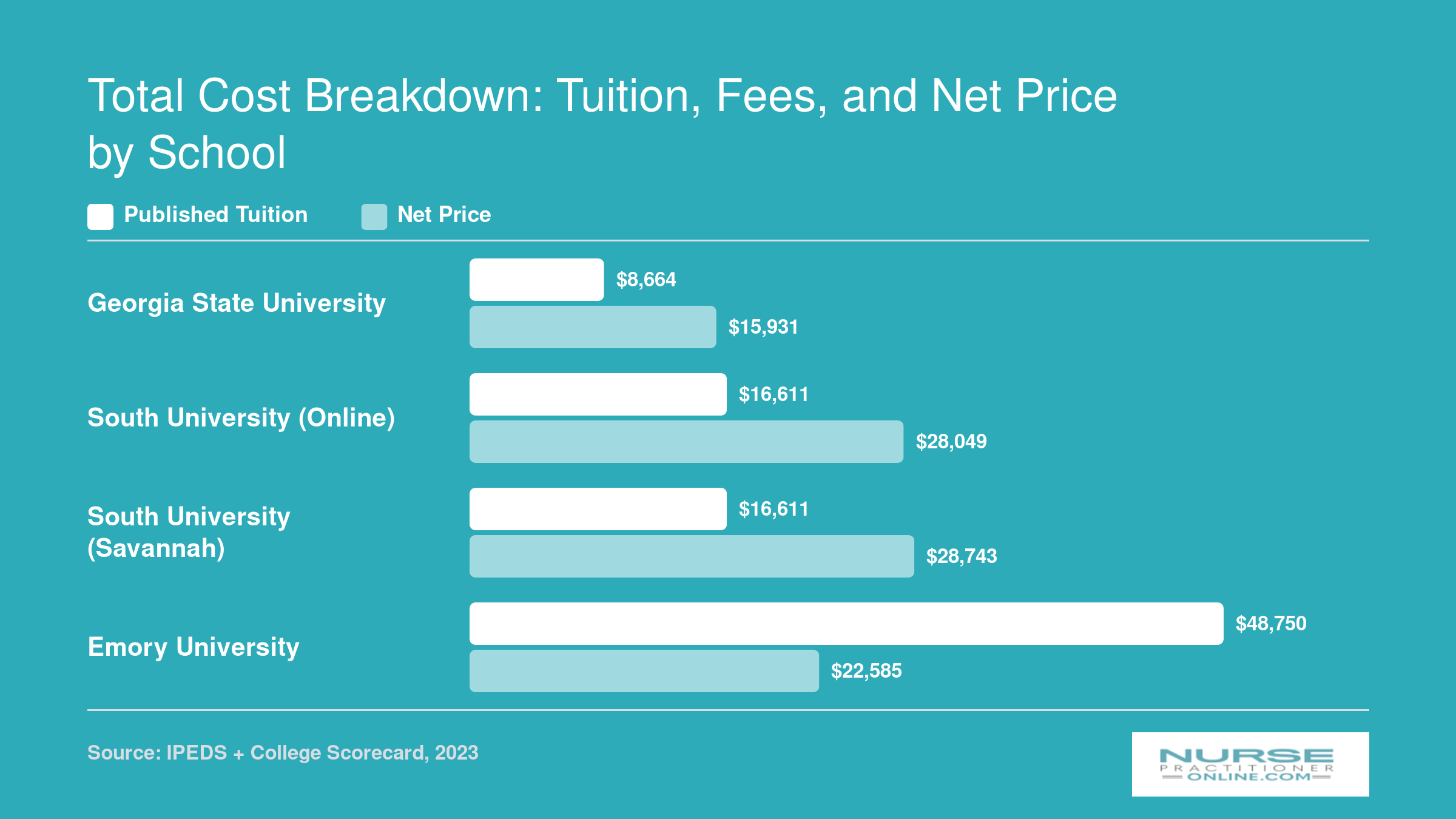
Georgia State University is a large public research university in downtown Atlanta and one of the most affordable paths to an AGNP credential for Georgia residents. Its Byrdine F. Lewis College of Nursing is a designated member of the National Hartford Center of Gerontological Nursing Excellence, signaling deep institutional commitment to geriatric care. With in-state tuition of $8,664 per year and a net price of roughly $15,931, GSU consistently ranks among the lowest-cost AGNP options in the state.
- CCNE-accredited 48-credit-hour curriculum
- Approximately $398 per credit hour for in-state students
- Full-time and part-time scheduling for working nurses
- Prepares graduates for both ANCC and AANP certification exams
- Gerontological nursing focus with Hartford Center membership
- Interprofessional collaboration coursework included
- Clinical hours completed in real-world ambulatory settings
Adult-Gerontology Primary Care Nurse Practitioner MSN — On-Campus

South University-Savannah
South University's Savannah campus offers a CCNE-accredited online MSN in Adult-Gerontology Primary Care that Georgia RNs can complete without relocating. The program emphasizes evidence-based practice, clinical judgment, and care for elderly and vulnerable populations. Its small student-to-faculty ratio of 9:1 can translate into more individualized mentoring during coursework and practicum planning.
- CCNE-accredited and aligned with NONPF competencies
- Fully online format with required clinical practicum
- Flat tuition rate of $16,611 per year regardless of residency
- Focus on health promotion and disease prevention in older adults
- Prepares graduates for national NP certification exams
- Emphasizes leadership, critical thinking, and clinical judgment
- Small 9:1 student-to-faculty ratio
Master of Science in Nursing with a Specialization in Adult-Gerontology Primary Care Nurse Practitioner — Online

South University-Savannah Online
South University's dedicated online division mirrors the Savannah campus AGNP curriculum but operates as a separate institution with its own enrollment and support structure. Coursework is delivered entirely online at $660 per credit hour with no in-state discount, making it geography-neutral for nurses anywhere in the country. The 56-credit-hour program covers advanced pathophysiology, pharmacology, and supervised practicums that students typically arrange near their home.
- CCNE-accredited, 56-credit-hour online program
- Tuition set at $660 per credit hour, same for all students
- Includes supervised practicum with locally arranged placements
- Meets NONPF core competencies for primary care NP practice
- Covers advanced pathophysiology and holistic patient care
- Mobile-friendly classroom platform for on-the-go study
- Prepares graduates for national AGNP certification
Master of Science in Nursing, Adult-Gerontology Primary Care Nurse Practitioner — Online

Emory University
Emory University is a top-tier private research university in Atlanta with a hospital system that feeds directly into its clinical training pipeline. The hybrid AGNP program requires 750-plus clinical practice hours spread across diverse metropolitan Atlanta health settings, giving students exceptional hands-on exposure. Published tuition is $48,750, but Emory's generous financial aid brings the average net price to around $22,585, and the institution posts a 91.1% graduation rate and a 10:1 student-to-faculty ratio.
- Hybrid format: online coursework with on-site clinical intensives
- 49-credit, four-semester plan with full-time or part-time options
- 750-plus clinical hours across Emory Healthcare partner sites
- Dual MSN/MPH degree pathway available
- Prepares graduates for ANCC and AANP certification
- 10:1 student-to-faculty ratio for close mentorship
- Comprehensive chronic disease management curriculum
- DNP advancement option for those pursuing doctoral study
Adult-Gerontology Primary Care Nurse Practitioner MSN — Hybrid
How We Ranked These AGPCNP Programs
Our rankings are built for working nurses who need to balance educational quality with a realistic budget. Affordability isn't just about the lowest sticker price: it's about what you actually pay after financial aid. That's why we prioritized net price and the availability of aid when evaluating these programs.
The Weighting Behind the List
We placed the heaviest emphasis on net price, the estimated cost after grants and scholarships, because it's the number that hits your bank account. Schools with strong institutional aid or lower tuition relative to their sector performed better. This approach ensures the list surfaces programs where your total out-of-pocket cost is most manageable. If you're curious how these figures compare nationally, our guide to the most affordable nurse practitioner programs offers broader context.
Where the Data Comes From
To build these rankings, we pulled from publicly available federal data sources: the U.S. Department of Education's College Scorecard (which tracks institution-level and, where available, program-level outcomes) and the Integrated Postsecondary Education Data System (IPEDS) for tuition and fee figures. These are the same resources financial aid officers and researchers use to compare colleges.
Understanding the Numbers: Net Price and Graduation Rates
A critical caveat: the net price we reference is a sector-conditional institutional average, a blended figure across all students at that school. Your personal cost will shift based on your own financial aid package, transfer credits, and enrollment intensity. Use these averages as a benchmark, not a guarantee.
Similarly, the graduation rates shown are institution-wide metrics. They don't isolate adult-gerontology NP completions, but they serve as a reasonable proxy for the overall support and retention environment you'd enter. A school that helps students finish, regardless of major, tends to have systems in place that benefit nursing graduate students too.
By focusing on these practical metrics, we aimed to cut through brochure language and help you zero in on programs that blend affordability with credible outcomes.
Total Cost Breakdown: Tuition, Fees, and Net Price by School
When comparing AGNP programs, sticker price (published tuition) can be misleading. Net price, the amount students actually pay after grants and scholarships are applied, is a far more useful budgeting figure. The grouped bars below show published in-state tuition alongside net price for each ranked school. Keep in mind that per-credit costs vary by program and require direct confirmation with each school, since published totals reflect institutional averages rather than program-specific breakdowns. Always request a program-specific cost sheet before making your final decision.
Questions to Ask Yourself
Online, Hybrid, and On-Campus Format Options
Choosing the right delivery format can make or break your ability to juggle coursework, clinical hours, and a nursing career. Here is how the AGNP programs in our rankings stack up across format, flexibility, and cost. Keep in mind that every AGNP program requires in-person clinical hours, regardless of how didactic coursework is delivered, so no program is entirely remote from start to finish.
| Feature | Online (South University, Chamberlain, UT Arlington) | Hybrid (Emory University, Mercer University) | On-Campus (Georgia State University) |
|---|---|---|---|
| Coursework Delivery | 100% online lectures, discussions, and assignments; log in on your schedule | Online coursework combined with periodic in-person lab or seminar days | Traditional face-to-face classes at the Atlanta campus |
| Schedule Flexibility | Highest flexibility; ideal for nurses working full-time or rotating shifts | Moderate flexibility; plan around required on-site sessions (Mercer requires in-person labs; Emory offers full-time and part-time pacing) | Least flexible; class times are fixed, though full-time and part-time tracks are available |
| Clinical Requirements | In-person clinical practicum required in your local area; placement assistance varies by school (Chamberlain offers placement support; UT Arlington support may vary for Georgia residents) | In-person clinicals required; Mercer mandates a minimum of 780 practice hours, Emory requires 750 or more hours with multiple placement sites | In-person clinicals arranged through metro Atlanta partner sites |
| Networking and Faculty Access | Virtual office hours, discussion boards, and peer collaboration; less spontaneous face time with faculty | Strong mix of online peer interaction plus in-person mentoring during lab or immersion days | Daily interaction with faculty and classmates; access to on-campus simulation labs and study groups |
| Georgia Resident Eligibility | South University is Georgia based and open to residents; Chamberlain and UT Arlington accept Georgia applicants (verify current state authorization before enrolling) | Both are Georgia institutions; in-state residents are fully eligible | Georgia residents benefit from in-state tuition of roughly $8,664 per year |
| Approximate Annual Tuition | South University: approximately $16,611 per year (flat rate regardless of residency); Chamberlain and UT Arlington rates vary, so request a current quote | Emory: approximately $48,750 per year; Mercer: contact admissions for current AGNP rates | In-state: approximately $8,664 per year; out-of-state: approximately $25,116 per year |
| Best Suited For | Working RNs who need maximum scheduling freedom and live outside metro Atlanta | Nurses near Atlanta who want online convenience but value hands-on lab experiences and in-person mentorship | Atlanta area nurses who prefer a structured classroom setting and easy access to campus resources |
Clinical Placement Requirements and Local Sites
Where will you complete your required clinical hours, and who finds your preceptor?
For aspiring adult-gerontology nurse practitioners near Atlanta, clinical placements are a cornerstone of your MSN education. You'll need hands-on experience in primary care settings that serve adult and geriatric populations. Understanding the requirements, local site options, and how placements are arranged can save you time and stress before you even start your program.
What Clinical Hours Are Required for AGNP Programs?
Most AGNP programs require at least 600 hours of direct patient care, in line with national standards from organizations like the American Association of Colleges of Nursing and the National Organization of Nurse Practitioner Faculties. These hours are typically spread across multiple semesters and focus on managing chronic and acute conditions in adults and older adults. You'll work under the supervision of a licensed preceptor, often a nurse practitioner or physician, to build your clinical reasoning and procedural skills. If you're comparing options, our overview of adult gerontology nurse practitioner programs covers the full landscape of accredited offerings.
Major Atlanta Health Systems That Host NP Rotations
Atlanta is home to several world-class health systems that routinely open their doors to NP students. These clinical sites offer diverse patient populations and advanced practice environments:
- Emory Healthcare: A major academic medical center deeply integrated with NP training.3
- Grady Health System: The largest safety-net hospital in Georgia, providing rich exposure to complex, underserved patients.2
- Piedmont Healthcare: A large, multi-facility network with numerous primary care and specialty clinics.
- WellStar Health System: A community-based system with extensive adult and geriatric services.3
- Northside Hospital: Known for its clinical excellence, Northside processes student placements through the ACEMAPP platform and requires a resume, background check, drug screen, and internal application.4
These institutions often require affiliation agreements between the health system and your school. For example, Grady Health System mandates an active affiliation agreement before you can rotate there.2
Placement Support: School-Arranged vs. Self-Sourced
How you secure your clinical site varies dramatically by program. Some schools, like Emory School of Nursing, centrally arrange all clinical placements within a 75-mile radius.3 Emory's clinical coordination team matches you with a preceptor at an approved facility, and you are prohibited from self-placing at Emory Healthcare, WellStar, Northside, Children's Healthcare, MedLink, Peachtree Immediate Care, or Winship Cancer Institute.3
In contrast, many online or hybrid programs require you to identify and secure your own preceptor. While this offers flexibility to train close to home, it places the administrative burden squarely on you. Our guide on how online NP students arrange clinicals in their local area walks through practical strategies for navigating this process. You'll need to reach out to local practices, negotiate supervisory arrangements, and ensure the site meets your program's requirements.
Confirm Placement Policies Before You Enroll
Before you commit to any program, ask directly: "Does the school arrange my clinical placements, or am I responsible for finding a preceptor?" This is especially critical for online AGNP programs, where you might be studying from a distance. Clarify what geographic limitations exist, whether the school has existing contracts with Atlanta-area systems, and what support you'll receive if a placement falls through. A little investigation now can make the difference between a smooth clinical journey and a last-minute scramble.
Related Articles
Admissions Requirements for Working RNs in Georgia
If you're a working RN thinking about applying to an AGNP program near Atlanta, the good news is that most admissions checklists are straightforward. Here's what you can generally expect to gather before hitting "submit."
- Active, Unencumbered RN LicenseYou'll need a current RN license in Georgia or through a Nurse Licensure Compact state with no disciplinary actions. Emory University, for example, explicitly requires an unencumbered RN license in Georgia or a multistate compact license.
- BSN from an Accredited InstitutionA Bachelor of Science in Nursing from a regionally accredited school is standard. Emory specifies that the BSN must come from a CCNE- or NLNAC-accredited program. Most programs look for a cumulative GPA of 3.0 or higher, though exact minimums can vary by school.
- Prerequisite CourseworkSome programs require specific undergraduate courses before you begin graduate-level work. Georgia State University, for instance, lists undergraduate health assessment, pathophysiology, pharmacology, and statistics as prerequisites for its MSN Adult-Gerontology Primary Care NP program.
- Clinical RN ExperienceMany AGNP programs prefer or require one to two years of direct patient care experience as a registered nurse. The exact requirement varies, so check each program's current admissions page for specifics.
- Application MaterialsPlan to submit official transcripts from all post-secondary institutions, a professional resume or CV, a personal goal statement, and two to three letters of recommendation. An application fee is also typical. Emory's application package, for example, includes all of these components.
- GRE Scores (Often Waived)While some programs historically required Graduate Record Examination scores, many AGNP programs near Atlanta have waived this requirement in recent years. Always verify the current GRE policy directly with your target program, as policies can change from one admissions cycle to the next.
AGNP Salary and Job Outlook in Georgia
How much do AGNPs make in Georgia? Adult-gerontology nurse practitioners in Georgia earned a median annual wage of $121,980 as of May 2023, according to the Bureau of Labor Statistics.1 In the Atlanta-Sandy Springs-Roswell metropolitan area specifically, the median sits slightly lower at $121,650.2 These figures represent all nurse practitioners in the state, including both primary care and acute care specialists across various clinical settings.
Understanding the Wage Range
While the median gives you a midpoint, your actual earnings will depend on experience, employer type, and clinical focus. Entry-level nurse practitioners in Georgia (10th percentile) earned around $98,540, while the most experienced practitioners (90th percentile) brought in $164,340.1 In the Atlanta metro, the range spans from $93,010 at the 10th percentile to $157,220 at the 90th.2 The 25th to 75th percentile bracket, where most mid-career NPs fall, ranges from $108,570 to $136,700 statewide.
Program-completer earnings data for specific AGNP programs near Atlanta are not yet available, as most institutions in our rankings do not publish post-graduation wage outcomes for individual degree programs. When that data becomes public, it will offer a clearer picture of what recent graduates from these particular schools are earning in their first years of practice.
Primary Care vs. Acute Care: Subspecialty Differences
The AGPCNP (Adult-Gerontology Primary Care Nurse Practitioner) and AGACNP (Adult-Gerontology Acute Care Nurse Practitioner) credentials lead to distinct roles. Primary care AGNPs typically work in outpatient clinics, family practices, geriatric wellness centers, and community health settings, managing chronic conditions and providing preventive care. Acute care AGNPs practice in hospitals, intensive care units, emergency departments, and specialty inpatient services, handling critically ill or rapidly changing patients. If you're still weighing which track fits your goals, our guide to acute care nurse practitioner online programs covers the key differences in depth.
Salary differences between these two tracks can be significant. Acute care roles often command higher wages due to the complexity of patient acuity, shift differentials, and hospital-based compensation structures. Primary care positions may offer better work-life balance, more predictable schedules, and opportunities for longitudinal patient relationships, though base salaries may be slightly lower.
Employment Volume and Job Growth
Georgia employed 11,040 nurse practitioners as of May 2023, with 6,910 of those positions concentrated in the Atlanta metro area.2 Nationally, the Bureau of Labor Statistics projects nurse practitioner employment to grow 38 to 40 percent between 2022 and 2032, far faster than the average for all occupations.3 This surge reflects expanding access to primary care, an aging population with complex chronic disease needs, and growing acceptance of NPs as independent providers in many states. For nurses entering an AGNP program today, the job market outlook remains exceptionally strong through the end of the decade.
How to Become an Adult-Gerontology Nurse Practitioner in Georgia
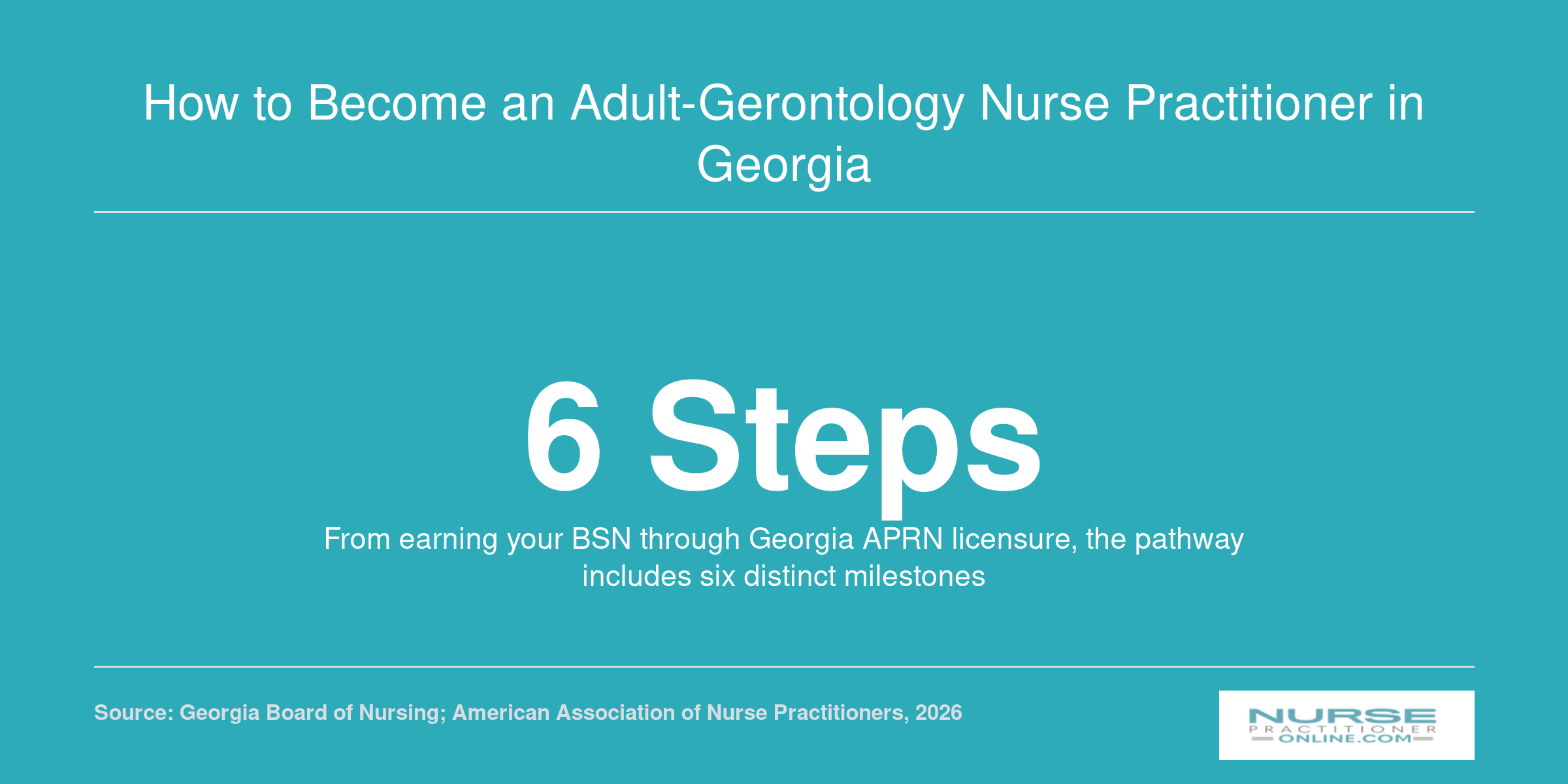
Georgia has a clearly defined pathway from bedside RN to licensed APRN, but the state's regulatory framework includes a few requirements that set it apart. Unlike full-practice-authority states, Georgia requires a written protocol agreement with a Georgia-licensed physician before you can practice as a nurse practitioner. Prescriptive authority is issued separately by the Georgia Composite Medical Board, not the Board of Nursing, and covers only Schedule III through V controlled substances, so you will also need your own DEA registration. Below is the step-by-step sequence, along with the key Georgia-specific details every aspiring AGPCNP should know.
Frequently Asked Questions About AGNP Programs Near Atlanta
Choosing an adult-gerontology nurse practitioner program is a big decision, especially when you are balancing work, family, and finances. Below are answers to the questions we hear most often from working RNs in the Atlanta area who are exploring AGNP programs.
- How much do AGNPs make in Georgia?
- Adult-gerontology nurse practitioners in Georgia earn competitive salaries that reflect the state's growing demand for advanced practice providers. Compensation varies by setting, with hospital-based AGNPs often earning more than those in outpatient clinics. The Atlanta metro area tends to offer higher pay than rural parts of the state due to cost of living and patient volume. Check the latest Bureau of Labor Statistics data for current Georgia figures.
- What is the difference between AGPCNP and AGACNP programs?
- AGPCNP (Adult-Gerontology Primary Care Nurse Practitioner) programs prepare you to manage chronic conditions and provide preventive care in outpatient settings. AGACNP (Adult-Gerontology Acute Care Nurse Practitioner) programs focus on managing complex, acute, and critical illnesses in hospital or emergency environments. Both require similar credit hours and clinical hours, but the clinical focus and patient populations differ significantly. Your career goals should guide which track you choose.
- Are there online AGNP programs that accept Georgia residents?
- Yes. Multiple CCNE- and ACEN-accredited universities offer fully online or hybrid MSN AGNP programs open to Georgia residents. These programs typically require you to complete 500 to 700 or more clinical hours at approved sites, which can often be arranged in the Atlanta metro area. Online formats are especially popular among working nurses because coursework can be completed on your own schedule.
- What accreditation should an AGNP program have?
- Look for programs accredited by either CCNE (Commission on Collegiate Nursing Education) or ACEN (Accreditation Commission for Education in Nursing). Both are equally accepted when you apply to sit for ANCC or AANP board certification exams. CCNE focuses on baccalaureate and higher nursing degrees, while ACEN accredits all levels of nursing education. Either accreditation confirms the program meets national quality standards.
- How long does it take to complete an MSN AGNP program?
- Most MSN AGNP programs require 40 to 50 credit hours and take about 24 to 36 months for full-time students. If you continue working while enrolled part time, expect a timeline of roughly 36 to 60 months. Clinical requirements of 500 to 700 or more hours are built into that timeline. Many online programs offer flexible pacing so you can adjust your course load each semester.
- How do I become an adult-gerontology nurse practitioner in Georgia?
- Start by earning your BSN and obtaining an active RN license. Then enroll in a CCNE- or ACEN-accredited MSN AGNP program, completing all required coursework and clinical hours. After graduation, pass a national certification exam through ANCC or AANP. Finally, apply for Advanced Practice Registered Nurse licensure through the Georgia Board of Nursing. The entire process from BSN to certified AGNP typically takes two to five years depending on your enrollment pace.