
Most important takeaways…
- Atlanta FNP tuition ranges from about $4,600 per year at public schools to nearly $48,750 at Emory University.
- Emory delivers the strongest earnings to debt ratio among ranked Greater Atlanta programs.
- Most graduates move from commencement to seeing patients within two to four months after certification and state licensure.
- Atlanta metro NP job growth is outpacing the national average, boosting salary leverage for new graduates.
Online MSN-FNP tracks built for working RNs and traditional campus-based programs anchor the two ends of the Atlanta market, and the gap between them shapes cost, pace, and clinical placement support. Greater Atlanta houses major academic medical centers, including Emory Healthcare, Piedmont, Grady, and Northside, all hiring family nurse practitioners as primary care demand climbs across north Georgia.
Prospective students weigh real tradeoffs: in-state public tuition near $4,600 to $8,300 per year against private rates above $48,000, two-year full-time schedules against three-year part-time tracks, and self-sourced preceptors against placement-assisted models. Georgia's NP scope remains restricted, requiring a collaborating physician, which influences where graduates ultimately practice and how employers structure FNP roles.
Best FNP Programs in Greater Atlanta: Rankings & Comparison
These rankings weight graduate earnings, debt load, and institutional completion metrics rather than subjective reputation. Program-level earnings data is not yet available for these FNP programs, so we rely on institution-wide median earnings and debt figures alongside format flexibility, clinical training depth, and relevance to the Atlanta metro area. Whether you are looking for a research-intensive hybrid experience in the heart of the city or a fully online option you can complete from your couch in Cobb County, this list covers the full range of Georgia FNP pathways accessible to Greater Atlanta nurses.
- Graduate earnings and debt load
- Institutional graduation and retention
- Program format and flexibility
- Clinical training depth
- Atlanta metro relevance
- NCES-IPEDS federal institutional data — nces.ed.gov
- College Scorecard graduate earnings — collegescorecard.ed.gov
- Independent program research
- Internal program database

Emory University
Emory University pairs a 91% institution-wide graduation rate with one of the highest median earnings figures among Georgia schools, anchored by deep clinical partnerships across Atlanta's major health systems. Its hybrid FNP program offers access to 40-plus community-based clinical sites, and the university's Midtown Atlanta location places students at the center of the state's largest healthcare market. Emory's small 10:1 student-to-faculty ratio supports close mentorship throughout the 49-credit curriculum.
- 49 credit hours with part-time study available
- Hybrid format: online coursework plus on-site clinicals
- Over 600 supervised clinical hours required
- 40+ community-based clinical sites in metro Atlanta
- Four-semester full-time completion option
- Nationally certified faculty across all specialties
- Fall semester start with certification exam prep
- Post-RN to DNP pathway also available
Family Nurse Practitioner (FNP) — Hybrid

Kennesaw State University
Kennesaw State University sits in the northern Atlanta suburbs and delivers a hybrid FNP program specifically designed for working RNs, requiring only one weekend on campus per month. KSU maintains established preceptor relationships across north Georgia and the greater metro, easing clinical placement for students who want to stay close to home. At roughly $6,700 in-state tuition, it offers strong value relative to its 52% graduation rate and $57,552 median institutional earnings.
- 44 credit hours, no GRE required
- Hybrid delivery with max one campus weekend monthly
- 5 semesters full-time or 8 semesters part-time
- Up to 9 transfer credits accepted
- In-state tuition approximately $6,702 per year
- Established north Georgia preceptor network
- Georgia RN licensure and one year RN experience required
- Priority application deadline December 15
Master of Science in Nursing, Family Nurse Practitioner — Hybrid

Clayton State University
Clayton State University in Morrow sits on the south side of metro Atlanta, giving students direct access to major health systems including Grady, Piedmont, and Wellstar for clinical rotations. Its 47-credit hybrid FNP curriculum emphasizes culturally competent care for diverse populations, reflecting the demographics of south metro Atlanta. Clinical hours must be completed in Georgia, which effectively channels placements into the surrounding metro area. Each student is paired with a dedicated advisor to balance work and coursework.
- 47 credit hours with 585 required clinical hours
- Hybrid format blending online and in-person learning
- In-state tuition approximately $6,493 per year
- Clinical placements restricted to Georgia sites
- Prepares graduates for both ANCC and AANPCB exams
- 3.0 GPA minimum and Georgia RN license required
- Statement of purpose and two recommendation letters
- Advisor assigned to each student for ongoing support
Master of Science in Nursing, Family Nurse Practitioner — Hybrid

Georgia Southwestern State University
Georgia Southwestern State University delivers its fully online FNP through the Georgia On My Line portal, making it accessible to Atlanta-area nurses without ever leaving the metro. The 44-credit program boasts a reported 100% FNP certification exam pass rate and can be completed in 22 months at full-time pace. At roughly $4,626 in-state tuition per year, GSW is one of the most affordable public FNP options in the state, though its institution-wide graduation rate of 41% is lower than some peers.
- 44 credit hours, fully online via Georgia On My Line
- 780 clinical hours arranged near student's location
- 22-month full-time completion timeline
- In-state tuition approximately $4,626 per year
- 100% reported FNP certification exam pass rate
- CCNE accredited with two admission cycles per year
- BSN and one year of RN experience required
- Full-time and part-time study plans available
Master of Science in Nursing, Family Nurse Practitioner — Online

University of North Georgia
The University of North Georgia in Dahlonega serves nurses in the northern exurbs of the Atlanta metro with a hybrid FNP program that reports 100% certification pass and job placement rates. The 46-credit curriculum includes 750 clinical hours and offers either a two-year or three-year completion track, giving working nurses meaningful scheduling control. UNG's net price of approximately $9,823 and median graduate debt of $17,750 place it among the more cost-efficient options in the state.
- 46 credit hours with 750 required clinical hours
- Hybrid format with summer-start cohort
- Two-year or three-year completion plans
- In-state tuition approximately $5,416 per year
- 100% reported certification pass and job placement
- Georgia RN license and 1 to 2 years experience required
- Application deadline February 28 with $40 fee
- Scholarship opportunities available
Master of Science in Nursing, Family Nurse Practitioner — Hybrid

Albany State University
Albany State University is a historically Black university offering an affordable, fully online FNP program that serves nurses across Georgia, including the Atlanta metro. The 44-credit MSN prepares graduates for AANP or ANCC certification and offers fall, spring, or summer entry, giving applicants unusual flexibility in timing. Institution-wide metrics show a 31% graduation rate and $40,674 median earnings, though the program's low tuition (approximately $5,008 in-state) and mission-driven focus on underserved communities make it a meaningful option for nurses committed to health equity.
- 44 credit hours with clinical practicum included
- Fully online with fall, spring, or summer start terms
- In-state tuition approximately $5,008 per year
- Prepares for both AANP and ANCC certification exams
- 3.0 GPA minimum and BSN required
- Full-time or part-time study plans available
- Scholarly project and comprehensive exam required
- HBCU with a mission focus on underserved communities
MSN, Family Nursing Practitioner — Online

Columbus State University
Columbus State University offers a 100% online, asynchronous FNP program that lets Atlanta nurses complete all didactic coursework without commuting to the Columbus campus. Its 44-credit curriculum includes 765 clinical hours that can be completed in the student's local community, and full-time students can finish in about two years. The program is CCNE accredited and positions itself among Georgia's top FNP options, though its institution-wide graduation rate (42%) and median earnings ($44,544) trail several metro peers.
- 44 credit hours, fully asynchronous online
- 765 clinical hours completed in student's home area
- Two-year full-time completion timeline
- In-state tuition approximately $8,268 per year
- CCNE accredited, no campus commute required
- 3.0 GPA and unencumbered RN license required
- Three letters of recommendation needed
- No thesis or capstone project required
Family Nurse Practitioner (MSN) — Online

South University-Savannah
South University's Savannah campus offers an online MSN with an FNP specialization that recruits nationally rather than targeting the Atlanta market specifically. The 62-credit program includes 750 clinical hours that students arrange in their own communities, which can include metro Atlanta. However, a 9% institution-wide graduation rate and median earnings of $34,421 place it well below public Georgia peers on outcome metrics, while its estimated net price of roughly $28,743 is the highest on this list.
- 62 credit hours at $660 per credit hour
- 750 clinical hours with in-person requirements
- Fully online coursework via Brightspace platform
- BSN with 2.5 GPA and active RN license required
- CCNE accredited, meets NONPF competencies
- Covers adult, pediatric, and women's health practicums
- 9:1 student-to-faculty ratio on Savannah campus
- Prepares for national FNP certification exams
Master of Science in Nursing, Family Nurse Practitioner — Online

South University-Savannah Online
South University's dedicated online division mirrors the Savannah campus FNP program in curriculum, tuition, and clinical requirements, but operates with a 30:1 student-to-faculty ratio and a 7% institution-wide graduation rate. The 62-credit program covers the same lifespan primary-care content and 750 clinical hours, with students arranging placements in their home region. At a net price near $28,000, it is among the costliest options relative to reported institutional outcomes.
- 62 credit hours at $660 per credit hour
- 750 clinical hours arranged in student's community
- Fully online via Brightspace with Pulse mobile app
- BSN with 2.5 GPA and active RN license required
- CCNE accredited with NONPF competency alignment
- Four practicum courses across lifespan specialties
- 30:1 student-to-faculty ratio
- Prepares for national FNP certification exams
Master of Science in Nursing, Family Nurse Practitioner (Online) — Online
How We Evaluated Atlanta-Area FNP Programs
Nurse practitioner education has expanded faster than any other graduate health profession in the past decade, which means prospective FNP students now face dozens of Atlanta-area options with wildly different price tags, completion rates, and post-graduation outcomes. We built this ranking to cut through that noise with numbers, not impressions. If you are also weighing programs outside Georgia, our national list of best online FNP programs uses the same methodology.
What Drives the Rankings
Every program on this list is scored against measurable federal data, not editorial preference or school reputation. The inputs are straightforward:
- Graduate earnings: Median earnings of program alumni as reported in the U.S. Department of Education's College Scorecard.
- Median graduate debt: The typical loan balance students carry at graduation.
- Institutional graduation rate: The share of degree-seeking students who finish.
- Return on investment: A ratio comparing post-graduation earnings against total cost of attendance.
No subjective category, no brand bonus, no alphabetical shortcut.
Where the Data Has Limits
We want you to read this list with clear eyes. Graduation rates published by the federal government are institution-wide, covering every undergraduate and graduate program at a school, so they describe the university's overall completion culture rather than the FNP track specifically. Net price figures are similarly averaged across all enrolled students, which means your actual MSN cost will depend on your residency, employer tuition benefits, and credit load.
We also catalog whether a program runs online, on campus, or in a hybrid format, but we do not weight format in the score. Whether a Wednesday-night Zoom class fits your shift schedule better than a Decatur classroom is a personal calculation, not a quality marker.
How This Differs From Other Lists
Many competing FNP roundups list schools alphabetically or by name recognition, with no disclosed criteria. We disclose ours so you can decide whether our priorities match yours and adjust accordingly.
Questions to Ask Yourself
Cost and ROI: What Atlanta FNP Graduates Pay vs. What They Earn
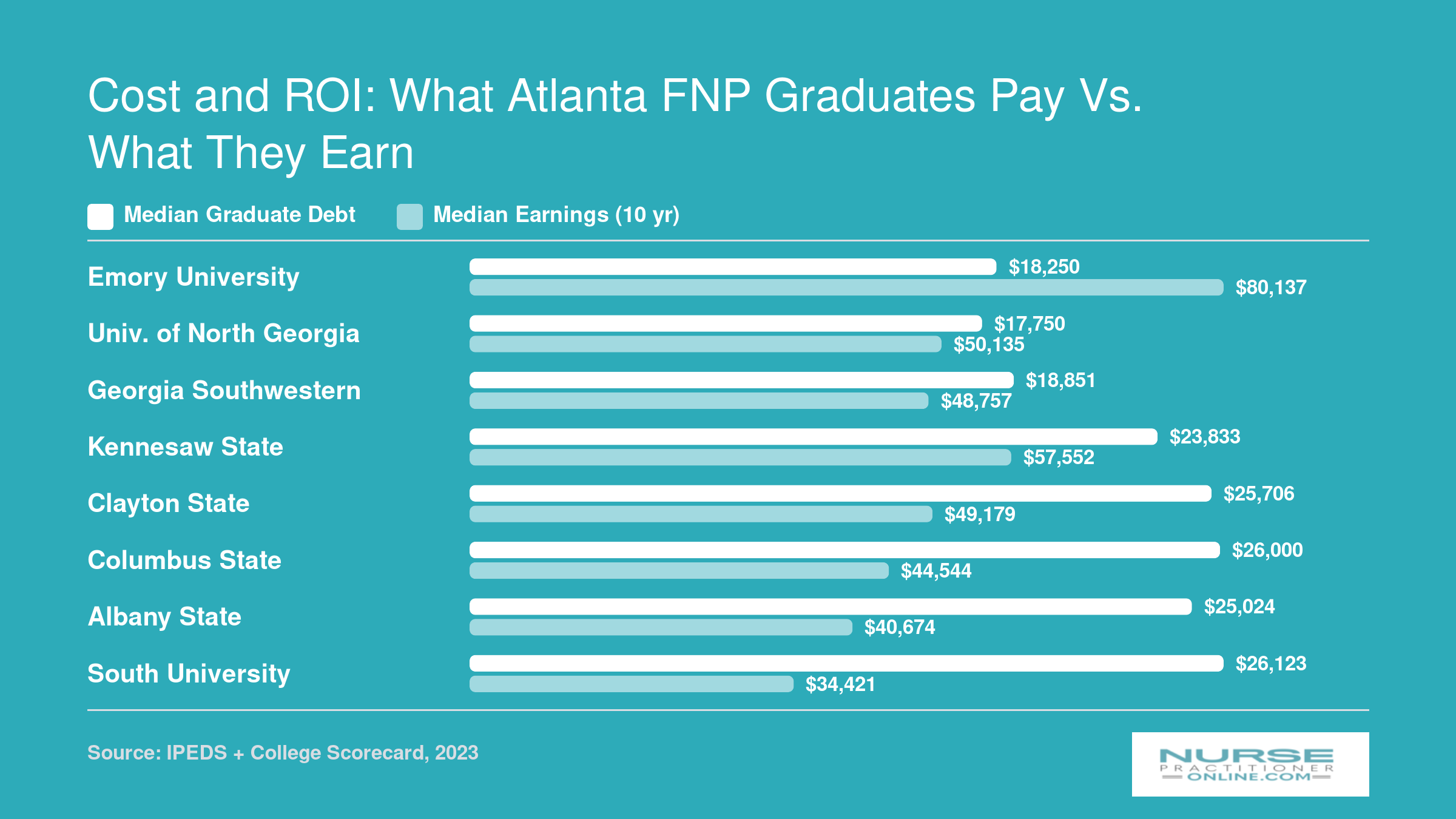
The spread between median graduate debt and institutional earnings tells you a lot about long-term value. Emory University stands out with the highest earnings-to-debt ratio among these Georgia programs, largely thanks to lower median graduate debt paired with strong post-completion earnings. Program-level earnings specific to FNP completers are not yet available for these schools, so the figures below reflect institution-wide outcomes reported through the College Scorecard, not job-posting averages.
Tuition, Debt, and Financial Aid for Georgia FNP Students
In-state graduate tuition at Georgia's public FNP programs runs roughly $4,600 to $8,300 per year, while private and out-of-state options climb sharply: Emory University lists graduate tuition near $48,750 annually, and South University-Savannah sits around $16,600. That spread (close to a 10x difference between the cheapest in-state seat and the priciest private one) is the single biggest cost lever you control before applying.
Tuition and Debt at a Glance
Among ranked Georgia programs, median debt at graduation clusters in a tighter band than tuition might suggest, generally in the high teens to mid-$20,000s. Georgia Southwestern and the University of North Georgia report some of the lower debt medians (roughly $17,750 to $18,900), while Clayton State, Columbus State, and South University graduates carry closer to $25,000 to $26,000. Emory's debt median is also near $18,250, partly because many of its FNP students are working nurses with employer support.
Keep in mind that published net price figures are institution-wide averages across all graduate and undergraduate aid recipients. Your actual cost depends on your aid package, Georgia residency status, whether you enroll full-time or part-time, and how many credits you transfer in.
Georgia-Specific Aid Worth Pursuing
- NHSC Loan Repayment Program: Up to $50,000 for a two-year full-time commitment at an NHSC-approved site in a Health Professional Shortage Area.1 Nurse practitioners are eligible, and the Atlanta metro contains multiple designated shortage zones (use HRSA's HPSA Find tool to confirm a site).2
- NHSC Rural Community LRP and Substance Use Disorder Workforce LRP: Separate tracks with higher award ceilings for rural sites and SUD-focused practice.1
- Georgia Board of Health Care Workforce: Offers APRN loan repayment for licensed Georgia NPs who commit two to four years in rural or HPSA-designated communities.3
- Employer tuition partnerships: Emory Healthcare, Wellstar Health System, and Piedmont Healthcare each offer tuition reimbursement for employees pursuing graduate nursing degrees, typically in the $3,000 to $5,250 annual range (the IRS tax-free education benefit ceiling).
Compare Total Cost, Not Sticker Price
When you build a side-by-side comparison, add clinical travel, lab fees, certification exam costs, background checks, and required immunizations to tuition. A program with low per-credit tuition but mandatory on-campus intensives across the state can quietly cost more than a fully online option a few hundred dollars higher per credit. If you are still weighing how the application process works for online programs, our guide on how to enroll in NP school online walks through each step.
Online, Hybrid, or In-Person: Which FNP Format Fits Your Life?
The format you choose determines not just how you learn but whether you can realistically balance your current job, family, and school for the next two to three years. Atlanta-area programs offer all three formats, and while each prepares you for the exact same national certification exam and scope of practice, the week-to-week experience differs in ways that matter deeply to working nurses.
Schedule Flexibility
Fully online programs deliver didactic coursework asynchronously, letting you watch lectures, complete readings, and submit assignments on your own timeline. This structure fits nurses working irregular shifts, night rotations, or weekend schedules. Hybrid programs blend online coursework with periodic campus skills labs or immersions, typically scheduled on weekends or during concentrated week-long sessions. In-person programs follow a traditional cohort-based model with fixed class meeting times, usually during business hours, which may require you to reduce work hours or switch to part-time.
Clinical Coordination and Campus Residencies
This is where confusion arises: almost every FNP program, regardless of didactic format, requires 500 to 700 supervised clinical hours completed in person at healthcare sites. "Online" does not mean entirely remote. The difference lies in who secures those placements. Some online programs expect you to arrange your own preceptors and clinical sites near your home or workplace, a process that can take weeks and involves cold-calling practices and negotiating agreements. Other programs, particularly hybrids and in-person options, coordinate placements for you or maintain established networks of clinical partners. Hybrid programs may also require short campus residencies for physical assessment labs, simulation training, or pharmacology practicums, typically one to three visits per semester.
Peer Networking and Who Each Format Suits Best
In-person programs build the strongest on-campus peer networks through daily interaction, study groups, and shared clinical rotations. Hybrid programs offer a middle ground, with periodic face-to-face sessions that foster relationships while preserving schedule flexibility. Fully online programs rely on virtual discussion boards and video collaboration, which works well for self-directed learners but requires more intentional effort to build professional connections. Employers do not differentiate among formats when hiring; median salaries for FNP graduates hover around $133,000 annually regardless of program type.2 Among the ranked Atlanta-area programs, several offer hybrid tracks, and enrollment across all formats has been increasing as demand for flexible advanced-practice nursing education grows.3
Clinical Training Opportunities Across the Atlanta Metro
The shift toward competency-based education means clinical rotations are no longer just about logging hours. They are about supervised, high-quality patient encounters that mirror real-world primary care. Atlanta's dense health care landscape offers a rich training ground, but the experience you get depends heavily on how your program structures its clinical placements.
Major Health System Partners
Atlanta is home to several nationally recognized health systems that routinely serve as rotation sites for family nurse practitioner students. Emory Healthcare, Grady Health System, Piedmont Healthcare, Northside Hospital, and WellStar Health System all provide clinical training environments spanning urban, suburban, and safety-net settings. These rotations expose you to everything from complex chronic disease management at Grady's nationally known diabetes clinic to well-child visits in Piedmont's suburban practices.
Two Placement Models: Program-Arranged vs. Self-Secured
The most consequential difference among Atlanta FNP programs is how they handle clinical placements. Some programs take full responsibility for securing preceptors and sites, often through long-standing contracts with the systems above. Others require you to find your own preceptor, a task that can add months to your timeline in a competitive metro area where every nursing school is chasing the same clinicians. Before you enroll, understand exactly what "placement support" means: is it a guarantee or just a list of names? This one variable often determines whether you graduate on time or get stuck waiting.
Additional Opportunities: FQHCs and VA Facilities
Beyond the big hospitals, Atlanta has a high concentration of federally qualified health centers and Veterans Affairs clinics that welcome FNP students. The Atlanta VA Health Care System accepts FNP learners for primary care rotations and partners with nearby university programs, including Emory University and Georgia State University.12 Georgia State's partnership is specifically designed to nurture novice nurse practitioners equipped to provide confident, high-quality clinical care.2 For new graduates, the VA offers structured NP residency programs in primary care, geriatric nurse practitioner programs, and PMHNP tracks, providing a pathway to master clinical confidence in a supported environment.1 FQHCs add another layer of community-based training, ideal for those planning to work with underserved populations.
What to Ask Before Enrolling
Direct your questions to the clinical placement coordinator, not just the admissions counselor. Find out the average time to secure a first rotation, whether there are geographic restrictions on where you can train, and what happens if a preceptor falls through. The gap between "we'll help you" and a guaranteed, ready-to-start placement is where many students lose semesters and tuition dollars.
Related Articles
What It Takes to Get Accepted: Admissions Requirements for Atlanta FNP Programs
Most Atlanta-area FNP programs share a core set of admissions expectations, though the details can vary enough to trip you up if you don't verify each school's requirements individually. Use this checklist as your starting framework, then confirm specifics with every program on your shortlist.
- Active, unencumbered RN licenseEvery program requires a current RN license. Most expect a Georgia RN license or proof that you've applied for one. Emory, Kennesaw State, and Georgia State all list this as a firm prerequisite.
- BSN from an accredited institutionA Bachelor of Science in Nursing from a regionally accredited school with programmatic nursing accreditation is the standard baseline. Look for programs accredited by CCNE or ACEN, these are your quality filters and often matter for financial aid eligibility and future certification.
- Minimum GPAA cumulative GPA of 3.0 is the most common threshold, Kennesaw State uses this benchmark. Georgia State sets a slightly lower minimum at 2.75, though a stronger GPA will make your application more competitive at any school.
- Clinical nursing experiencePlan on at least one to two years of direct patient care as a registered nurse. Kennesaw State requires a minimum of one year, while Georgia State looks for one to two years of clinical RN experience. Programs weigh this heavily because your bedside background directly informs your readiness for the advanced practice role.
- Letters of recommendationMost programs ask for two or three professional references, typically from nursing supervisors, faculty, or colleagues who can speak to your clinical competence and readiness for graduate study.
- Goal or personal statementExpect to write a focused essay explaining your motivation for pursuing the FNP role, your career goals, and why you're a strong fit for that particular program. Tailor each statement, admissions committees can spot a generic copy-paste.
- GRE scores, verify per programThis is one of the biggest variables. Kennesaw State and Georgia State do not currently require the GRE, and many programs across the region have waived it in recent years. Others may still ask for scores. Always check each program's latest admissions page, since GRE policies can change from cycle to cycle.
- Accreditation checkBefore you invest time in an application, confirm the program holds CCNE or ACEN accreditation. This isn't just a quality signal, it affects whether your degree qualifies you for national certification and state licensure as a nurse practitioner.
From Graduation to Practice: Georgia FNP Licensure and Certification
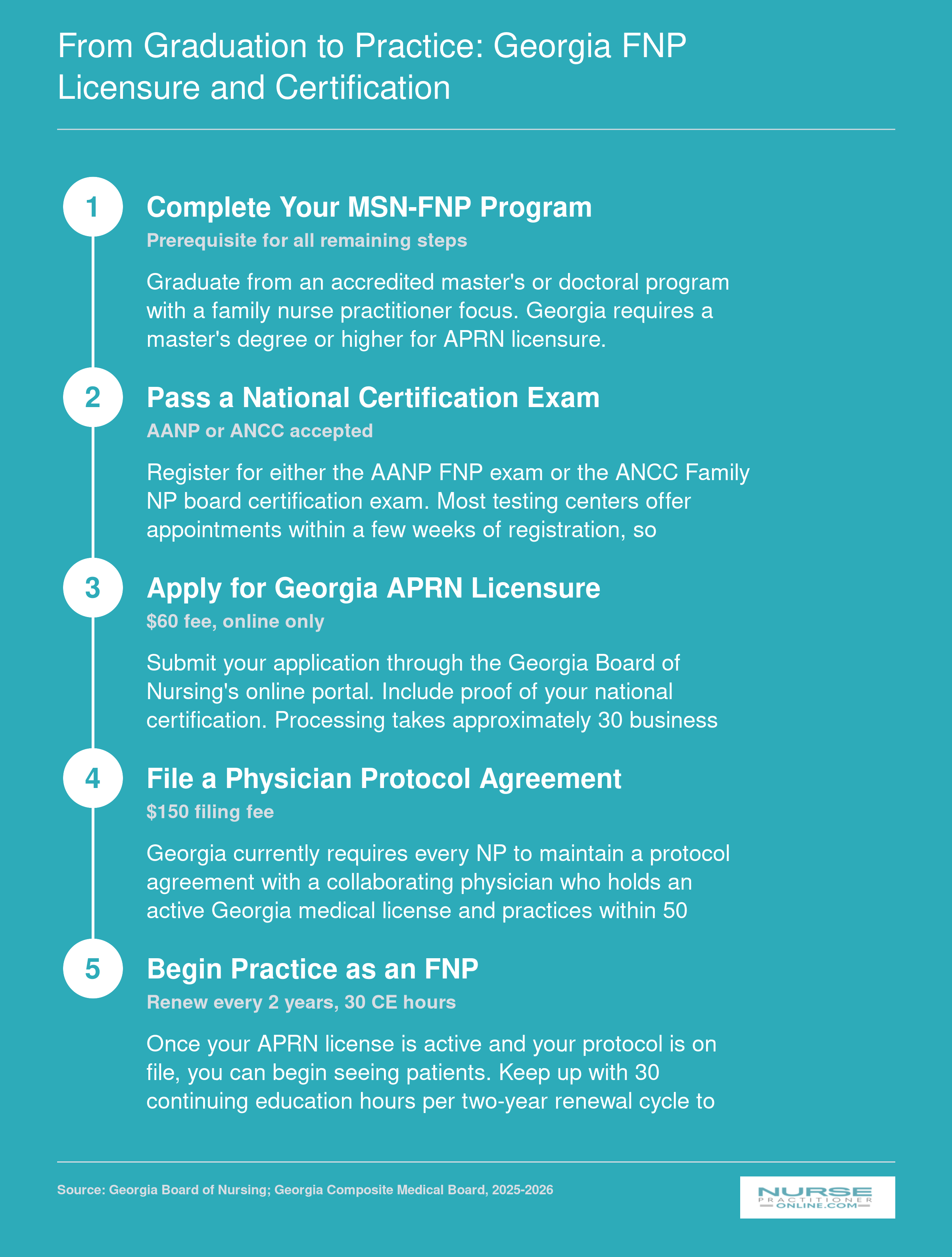
Most new FNP graduates can move from commencement to seeing patients in roughly two to four months, but the timeline depends on how quickly you schedule your certification exam and how fast the Georgia Board of Nursing processes your application (currently about 30 business days). All applications are submitted online through the state's Licensing Gateway portal, so there is no paper option. Planning each step in advance helps you avoid gaps between graduation and your first paycheck.
What Family Nurse Practitioners Earn in the Atlanta Area
Salaries for family nurse practitioners in the Atlanta metro area are competitive with national figures and represent a significant jump over registered nurse pay. The table below draws on the most recent Bureau of Labor Statistics wage data to show how NP compensation in the Atlanta-Sandy Springs-Roswell MSA stacks up against the national picture. Keep in mind that newly minted FNP graduates typically earn less in their first year or two of practice; program-level earnings data shortly after graduation generally reflect that ramp-up period rather than long-term NP compensation. As you gain experience, specialty certifications, and negotiate within Atlanta's large healthcare market, your earning potential moves toward the higher percentiles shown here.
| Wage Benchmark | Atlanta MSA | National |
|---|---|---|
| 25th Percentile | $115,690 | $109,940 |
| Median (50th Percentile) | $128,640 | $129,210 |
| Mean (Average) | $129,710 | N/A |
| 75th Percentile | $140,140 | $149,570 |
| 90th Percentile | N/A | $169,950 |
| 10th Percentile | N/A | $97,960 |
| Atlanta RN Median (for comparison) | $96,370 | N/A |
| Estimated NP Employment in Area | 6,280 | N/A |
FNP Career Outlook and Growth in Atlanta
The career outlook for family nurse practitioners refers to how many new FNP jobs are expected over the next decade, where those jobs will sit (which employers, which care settings), and what that demand means for your salary leverage and job security. For Atlanta-area nurses weighing an MSN, this is the data that tells you whether the investment pays off.
National Demand Sets the Floor
The Bureau of Labor Statistics projects nurse practitioner employment to grow 40% nationally between 2024 and 2034, adding roughly 128,000 to 135,000 new jobs. That makes NP the fastest-growing healthcare occupation and the third fastest-growing occupation overall in the U.S. economy.2 Atlanta sits squarely in the path of that growth: the metro is one of the Southeast's busiest healthcare hubs, with Emory, Piedmont, Wellstar, Northside, and Grady continuing to expand outpatient footprints across the suburbs.
Where Atlanta FNPs Actually Work
Nationally, about 48% of NPs work in physician offices, 22% in hospitals, and 9% in outpatient care centers.3 In Atlanta, the practical mix for family nurse practitioners skews toward:
- Primary care practices and family medicine groups
- Urgent care chains (a fast-growing employer across metro Atlanta)
- Hospital-affiliated outpatient clinics and ambulatory networks
- Federally Qualified Health Centers serving underserved zip codes
- Retail health clinics inside pharmacies and grocery chains
Is It Worth It?
Short answer: yes, for most working RNs in Georgia. With Georgia NPs earning a median around $126,060, 40% projected job growth, and most in-state MSN-FNP programs landing between $25,000 and $55,000 in total tuition, the payback window is typically two to four years.
One wildcard worth watching: Georgia still requires a collaborative agreement with a physician. If the state moves toward full practice authority, as roughly half the country already has, autonomy and earning ceilings for Atlanta FNPs will climb further.