
Most important takeaways…
- Several ranked programs near Augusta carry an average net price under $10,000 per year after grants and scholarships.
- All 15 programs in the ranking use online or hybrid formats, so Augusta nurses never need to relocate for coursework.
- Augusta-area FNP job demand is fueled by large hospital systems, the VA Medical Center, and surrounding rural counties.
- Federal loan repayment programs and Georgia workforce incentives can dramatically offset total FNP program costs.
Family nurse practitioners in the Augusta metro earn a median salary near $112,000, enough to comfortably support a household while working in one of Georgia's most accessible advanced-practice markets. But the path to that job hinges on choosing an FNP program that balances cost, clinical placement logistics, and credential quality, three variables that do not always move in the same direction. Among ranked programs, average net price ranges from roughly $8,400 at Clayton State to $28,700 at South University-Savannah Online, a spread wide enough to determine whether you finish school with manageable debt or a six-figure burden.
Programs near Augusta include options from Georgia Southern, Augusta University, Valdosta State, and Albany State, among others. Most use hybrid or fully online formats, requiring little to no weekly commuting yet still demanding 500 to 780 supervised clinical hours completed near your home base.
This breakdown covers ranked programs by net cost, tuition comparisons across Georgia, clinical hour requirements and preceptor logistics, regional salary data, program-level earnings outcomes, Georgia licensure steps, and financial aid pathways that can cut total borrowing by tens of thousands of dollars.
Best Affordable FNP Programs Near Augusta, Georgia
Finding an affordable Family Nurse Practitioner program that fits your schedule and keeps you close to Augusta takes real homework. The programs below are ranked with a heavy emphasis on financial accessibility, including net price after aid, student debt outcomes, and aid availability, so working nurses in the CSRA can identify where their tuition dollars stretch furthest. Graduation rates listed are institution-wide figures, not specific to FNP cohorts, so treat them as a general signal of institutional quality rather than a direct measure of your program.
- Net price after financial aid
- Median graduate debt levels
- Institutional graduation and retention
- Program format and flexibility
- Regional clinical accessibility
- NCES-IPEDS federal institutional data — nces.ed.gov
- College Scorecard graduate earnings — collegescorecard.ed.gov
- Internal program database
- Independent program research

Clayton State University
Clayton State University pairs one of the lowest net prices in Georgia with a hybrid MSN program built around culturally competent, family-focused care. The 47-credit-hour FNP concentration requires 585 clinical hours restricted to Georgia, giving Augusta-area nurses a structured path to national certification. With nearly 78% of undergraduates receiving Pell Grants, the institution has deep experience helping students navigate financial aid.
- 47 credit hours with 585 required clinical hours
- Hybrid format with clinical sites limited to Georgia
- Prepares for both ANCC and AANPCB certification exams
- Minimum 3.0 GPA and Georgia RN license required
- Dedicated advisor assigned to every student
- Emphasis on care across pediatric, adult, and geriatric populations
Master of Science in Nursing, Family Nurse Practitioner — Hybrid

University of North Georgia
The University of North Georgia delivers the lowest per-credit-hour FNP tuition in the state, roughly $293 per credit hour plus fees. Its 46-credit MSN program boasts a reported 100% certification pass rate and 100% job placement rate. A flexible three-year track lets nurses take one course at a time while continuing full-time employment, making the weekly commute to Dahlonega more manageable even from the Augusta region.
- 46 credit hours and 750 clinical hours required
- Two-year or three-year completion tracks available
- Summer-start cohort with February 28 application deadline
- 100% reported certification pass rate and job placement
- Scholarship opportunities available for qualified applicants
- BSN with 3.0 GPA and 1 to 2 years clinical experience recommended
Master of Science in Nursing, Family Nurse Practitioner — Hybrid

Georgia Southwestern State University
Georgia Southwestern State University offers a fully online, CCNE-accredited MSN FNP that can be completed in just 22 months. Its 44-credit curriculum requires 780 clinical hours, with placements arranged near each student's home, a real advantage for Augusta-area nurses who want to stay in local health systems while earning their degree. The program also reports a 100% FNP certification exam pass rate.
- 44 credit hours with 780 required clinical hours
- Fully online through Georgia On My Line platform
- 22-month completion for full-time students
- CCNE accredited with 100% exam pass rate
- Two admissions cycles per year, fall/summer and spring
- Clinical sites arranged near the student's location
Master of Science in Nursing, Family Nurse Practitioner — Online

Valdosta State University
Valdosta State University stands out with a BSN-to-DNP pathway that includes an MSN opt-out after seven semesters, giving students the flexibility to earn an MSN FNP first and return for the doctorate later. The 81-credit hybrid program features weekend campus meetings and online doctoral coursework, with over 1,200 clinical hours spread across a 41-county South Georgia service area. Augusta-based students should note that the clinical footprint generally covers South Georgia, so plan accordingly.
- 81 total credit hours with 1,215 clinical hours
- CCNE accredited hybrid format, 4 to 5 weekend meetings per semester
- MSN opt-out option available after seven semesters
- Cohort-based structure starting each fall
- Clinical experiences across a 41-county service area
- DNP project team includes chair, second reader, and content expert
BSN to DNP, Family Nurse Practitioner — Hybrid

Albany State University
Albany State University, a historically Black university, offers one of Georgia's most competitively priced MSN FNP programs at roughly $300 per credit hour, even for non-residents. The fully online 44-credit program provides fall, spring, and summer entry points, a level of scheduling flexibility many competitors do not match. Graduates are prepared for both AANP and ANCC certification exams.
- 44 credit hours with clinical practicum included
- Fully online delivery accessible from Augusta
- Full-time or part-time study plans available
- Fall, spring, or summer start terms offered
- Prepares for AANP and ANCC certification exams
- Scholarly project and comprehensive exam required
MSN, Family Nurse Practitioner — On-Campus

Augusta University
Augusta University is the only academic health center in the CSRA and the most geographically convenient option for Augusta-area nurses. It offers both a Post-Master's FNP Certificate for APRNs looking to add a specialty and a DNP with an FNP concentration. Clinical rotations can be completed in Georgia or South Carolina, which is ideal for nurses living in Augusta, North Augusta, or Aiken. The DNP program highlights a median FNP salary of $127,976 and includes interactive web-based classes with a residency requirement in the local region.
- Hybrid format combining online coursework with clinical experiences
- Clinical placements in Georgia or South Carolina
- Gap analysis customizes coursework for each APRN
- Part-time study options available
- Prepares for national FNP certification exams
- Focus on lifespan care including pediatrics and geriatrics
- CCNE accredited with four concentration options
- Interactive web-based classes with hybrid delivery
- Residency required in Georgia or South Carolina
- Financial aid and scholarships available
- Application deadline of June 15, 2026
- Region's only academic health center for clinical training
Post-Graduate Certificate, Family Nurse Practitioner — Hybrid
Doctor of Nursing Practice, Family Nurse Practitioner — Hybrid

Columbus State University
Columbus State University's MSN FNP is a 100% online, asynchronous program that eliminates commuting entirely. Its 44-credit curriculum includes 765 clinical hours that students can complete in their own communities, making it a practical choice for Augusta nurses who cannot travel regularly. The program can be finished in as few as two years of full-time study and is accredited by the Commission on Collegiate Nursing Education.
- 44 credit hours with 765 clinical hours
- 100% online asynchronous format, no campus visits
- Complete clinical hours in your own area
- Two-year completion available for full-time students
- CCNE accredited program
- 3.0 GPA minimum and three recommendation letters required
Family Nurse Practitioner, MSN — Online

Georgia Southern University
Georgia Southern University offers two FNP pathways: a 19-credit Post-MSN Certificate for nurses who already hold a master's degree and an 80-credit BSN-to-DNP with a rural and underserved community focus. Both programs feature online or hybrid delivery with fall-only admission. The rural emphasis aligns well with counties surrounding Augusta and the Georgia-South Carolina border.
- 19 credit hours, fully online delivery
- Fall admission only with March 1 deadline
- Current APRN certification required for entry
- Focus on rural and underserved communities
- Pharmacology course within five years required
- Credits may transfer toward a DNP program
- CCNE accredited, 80 total credit hours
- Synchronous and asynchronous online options
- Fall cohort start with cohort-based structure
- Scholarships and grants available
- Students secure their own clinical preceptors
- GRE required for admission
Post-MSN Certificate, Family Nurse Practitioner — Online
Post-BSN to DNP, Family Nurse Practitioner — Hybrid

Kennesaw State University
Kennesaw State University's hybrid MSN FNP is the second most affordable in-state option in Georgia at roughly $296 per credit hour. The 44-credit program requires no GRE and allows up to nine transfer credits, which can shorten your timeline. On-campus attendance is limited to a maximum of one weekend per month, a manageable schedule even for nurses traveling from the Augusta area.
- 44 credit hours, no GRE required
- Hybrid format with maximum one campus weekend monthly
- Five-semester full-time or eight-semester part-time plans
- Up to 9 transfer credits accepted
- One year of RN experience and Georgia licensure required
- Priority application deadline December 15
Master of Science in Nursing, Family Nurse Practitioner — Hybrid

Georgia College & State University
Georgia College & State University's fully online Post-Master's FNP Certificate is designed for MSN-prepared nurses who want to add family practice to their credentials. Non-board-certified APRNs complete up to 32 credit hours, while already certified APRNs may need as few as 11 credit hours through an individualized study plan. The CCNE-accredited program keeps costs proportional to what each nurse actually needs.
- Fully online format with minimal campus visits
- Up to 32 credit hours for non-board-certified APRNs
- As few as 11 credit hours for certified APRNs
- Individualized study plans developed with coordinator
- CCNE accredited and prepares for AANPCERT/ANCC exams
- Completion in up to two years
Post-Master's Certificate, Family Nurse Practitioner — On-Campus

Brenau University
Brenau University's Post-Graduate FNP Certificate is a hybrid option for MSN graduates who want to pivot into family practice. The 26-credit program spans four part-time semesters and includes 624 clinical hours. Courses are delivered online with monthly Saturday sessions at the Norcross campus. At $824 per credit hour, it is pricier than public school alternatives, but its small 11-to-1 student-faculty ratio offers more personalized instruction.
- 26 credit hours over four part-time semesters
- 624 clinical hours included
- Hybrid format with monthly Saturday classes at Norcross campus
- $824 per credit hour tuition
- Taught by active practitioner instructors
- Prepares for FNP certification exams
Family Nurse Practitioner Post-Graduate Certificate — Hybrid

South University-Savannah
South University's Savannah campus offers an MSN FNP that requires 62 credit hours and 750 clinical hours. The CCNE-accredited program admits students with a BSN and a 2.5 GPA, one of the lower admission thresholds in the state. However, the institution's very low graduation rate (9.1% institution-wide) and higher net price warrant careful consideration before committing.
- 62 total credits at $660 per credit hour
- 750 clinical hours with in-person components
- CCNE accredited, meets NONPF core competencies
- BSN with 2.5 GPA and active RN license required
- Covers adult, pediatric, women's health, and primary care practicums
- Online delivery through Brightspace platform
Master of Science in Nursing, Family Nurse Practitioner — Online

South University-Savannah Online
South University's online division mirrors its Savannah campus FNP program with the same 62-credit, $660-per-credit-hour structure and CCNE accreditation. Coursework is fully online with required in-person clinical components. Prospective students should weigh the convenience of a fully online format against the institution's low overall graduation rate and higher net price compared to Georgia's public universities.
- 62 credits with online coursework and in-person clinicals
- $660 per credit hour, 750 clinical hours required
- BSN with 2.5 GPA required for admission
- CCNE accredited program aligned with NONPF competencies
- Four practicum courses covering lifespan care
- Mobile access available through Pulse App
Master of Science in Nursing, Family Nurse Practitioner (Online) — Online

Mercer University
Mercer University's BSN-to-DNP FNP is a hybrid program from the Georgia Baptist College of Nursing that blends synchronous online classes with in-person learning. With four specialty tracks and a 69.6% institution-wide graduation rate, Mercer appeals to nurses aiming for a doctoral degree in a supportive, private-university environment. The higher net price reflects a private institution, but robust financial aid helps offset sticker costs.
- Hybrid format with synchronous online and in-person components
- Four specialty track options available
- Prepares for ANCC or AANP FNP certification
- Offered through Georgia Baptist College of Nursing
- Financial aid available to qualified students
- Focus on primary care across the lifespan
BSN to DNP, Family Nurse Practitioner — On-Campus

Emory University
Emory University brings a nationally ranked nursing school and over 40 community-based clinical sites to its FNP offerings. The MSN FNP requires 49 credit hours with more than 600 clinical hours, and a Post-BSN DNP pathway is also available. Emory's 91.1% institution-wide graduation rate and 10-to-1 student-faculty ratio signal institutional strength. Its high sticker price drops significantly after aid, with a median graduate debt of $18,250, but the net price remains higher than most public alternatives on this list.
- 49 credit hours with over 600 clinical hours
- Hybrid format with fall semester start
- 40+ community-based clinical sites
- Part-time study option available
- Nationally certified faculty
- Specialty rotation opportunities included
- Hybrid program completable in approximately 2.5 years
- Clinical rotations in top health systems
- BSN and active RN license required
- Financial aid and scholarships available
- Online coursework with Atlanta intensives
- Leadership and evidence-based practice emphasis
Family Nurse Practitioner, MSN — Hybrid
Post-BSN DNP, Family Nurse Practitioner — Hybrid
Frequently Asked Questions About FNP Programs Near Augusta
Choosing an FNP program is a big decision, especially when you are balancing a nursing career, family, and finances. Below are the questions Augusta-area nurses ask most often, answered with the latest program and labor-market data available in 2026.
- What are the cheapest FNP programs near Augusta, Georgia?
- Several University System of Georgia schools offer in-state graduate tuition well under $7,000 per year. Georgia Southwestern State University, Clayton State University, Albany State University, and the University of North Georgia all list annual in-state graduate tuition between roughly $5,000 and $6,500. Because most of these programs are online or hybrid, Augusta-area nurses can enroll without relocating, keeping total costs low even when a school is a few hours away.
- How much is NP school in Georgia?
- At public universities, expect roughly $5,000 to $9,200 per year in tuition and fees for in-state students. Total program cost depends on credit hours, which typically range from 40 to 47 for an MSN-FNP. Private options like Mercer University or Emory University charge significantly more, with per-year tuition exceeding $14,000 and $48,000 respectively. Always confirm current rates directly with the school, since fees can change each academic year.
- How long does it take to become a family nurse practitioner in Georgia?
- Most MSN-FNP programs in Georgia require about two years of full-time study, or roughly five to six consecutive semesters. Part-time tracks at schools like Kennesaw State University stretch to about eight semesters. BSN-to-DNP pathways, such as Valdosta State University's 10-semester program, take closer to three and a half years. Factor in time for certification exams and state licensure after graduation, which typically adds a few additional months.
- Can you complete an FNP program online while working full-time?
- Yes. Many Georgia FNP programs are designed for working nurses. Schools such as Georgia Southwestern State University, Columbus State University, and Albany State University offer fully online coursework with asynchronous classes you can complete on your own schedule. Keep in mind that every program still requires several hundred hours of in-person clinical rotations, typically 585 to 780 hours, so you will need some flexibility in your work schedule during clinical semesters.
- What are the admission requirements for FNP programs in Georgia?
- Most programs require a BSN from an accredited institution, an active and unencumbered Georgia RN license, and at least one year of clinical nursing experience. The standard minimum GPA is 3.0, although Georgia College & State University accepts applicants with a GPA as low as 2.75. You will generally need two to three letters of recommendation, a professional resume, and a statement of purpose. Many Georgia programs no longer require the GRE, including Kennesaw State University.
- What is the average FNP salary in Augusta, Georgia?
- Family nurse practitioners in the Augusta metro area typically earn competitive salaries that reflect the region's growing demand for primary care providers. While exact averages fluctuate, FNP salaries in mid-sized Georgia metros generally fall within the range reported by the Bureau of Labor Statistics for nurse practitioners statewide. Your actual pay will depend on practice setting, specialty focus, years of experience, and whether you negotiate for benefits like loan repayment assistance.
- Do Georgia FNP programs help you find clinical preceptors?
- Policies vary. Some programs, such as Georgia Southwestern State University, actively help place students at clinical sites near their home communities. Others expect you to identify and secure your own preceptors, with faculty approval. Augusta-area nurses may have an advantage because of the concentration of healthcare facilities, including Augusta University Medical Center and several large primary care networks. Always ask about preceptor support before you apply.
- Are there HBCU options for FNP students near Augusta?
- Yes. Albany State University, a historically Black university in Albany, Georgia, offers an online MSN-FNP program with 44 credit hours and multiple start terms each year. The program requires a 3.0 GPA and a BSN, and it prepares graduates for both the AANP and ANCC certification exams. Because the program is delivered online, Augusta-area nurses can complete their coursework from home while arranging clinical rotations locally.
FNP Tuition and Total Cost Compared Across Georgia Programs
The table below compares annual tuition, average net price, and median graduate debt across Georgia programs offering FNP pathways. The "Average Net Price" column reflects an institution-wide average cost of attendance after grants and scholarships have been applied. It is not a guaranteed quote for a specific graduate program, but it gives you a useful baseline for comparing affordability. Median graduate debt shows how much a typical graduate borrows overall. Notice the spread: the lowest median debt on this list is $17,750, while the highest reaches $27,000, a difference of more than $9,000. Public universities generally offer the lowest in-state tuition rates, while private institutions charge one flat rate regardless of residency, which can actually benefit out-of-state students in some cases.
| School | Type | In-State Tuition | Out-of-State Tuition | Avg. Net Price (After Aid) | Median Graduate Debt |
|---|---|---|---|---|---|
| Georgia Southwestern State University | Public | $4,626 | $15,534 | $12,019 | $18,851 |
| Albany State University | Public | $5,008 | $15,880 | $11,898 | $25,024 |
| University of North Georgia | Public | $5,416 | $18,484 | $9,823 | $17,750 |
| Valdosta State University | Public | $6,316 | $18,934 | $10,945 | $24,779 |
| Clayton State University | Public | $6,493 | $12,779 | $8,365 | $25,706 |
| Georgia Southern University | Public | $6,646 | $22,414 | $15,267 | $23,250 |
| Kennesaw State University | Public | $6,702 | $21,390 | $15,048 | $23,833 |
| Augusta University | Public | $6,992 | $21,060 | $13,787 | $20,500 |
| Columbus State University | Public | $8,268 | $10,140 | $13,115 | $26,000 |
| Georgia College & State University | Public | $8,376 | $27,530 | $20,686 | $22,250 |
| Mercer University | Private | $14,971 | $14,971 | $23,847 | $24,199 |
| Brenau University | Private | $15,840 | $15,840 | $18,924 | $27,000 |
| South University, Savannah Online | Private | $16,611 | $16,611 | $28,049 | $26,123 |
| Emory University | Private | $48,750 | $48,750 | $22,585 | $18,250 |
Related Articles
Questions to Ask Yourself
Online, Hybrid, and In-Person FNP Options for Augusta-Area Nurses
Among the 15 ranked FNP programs near Augusta, Georgia, seven use a hybrid format (combining online coursework with scheduled on-campus sessions), while eight are fully online. No program in this group is delivered entirely on campus. Even if you choose a fully online option, remember that every FNP program requires in-person clinical hours, so your proximity to clinical partners in the Augusta metro area still matters. Public hybrid and online programs tend to carry the lowest net prices, with several falling under $13,000 per year.
| Dimension | Fully Online Programs (8 of 15) | Hybrid Programs (7 of 15) |
|---|---|---|
| Flexibility for working RNs | Maximum scheduling freedom. Lectures, discussions, and assignments are typically asynchronous, so you can study around 12-hour shifts. | Mostly online coursework with periodic on-campus days (often one weekend per month or a few intensive weekends per semester). Requires some advance scheduling around work. |
| Clinical hour logistics | You arrange clinical rotations near your home. Programs such as Georgia Southwestern State University and Columbus State University let students complete hours in their own community, which is ideal if you already work in the Augusta area. | Clinical placements may be coordinated through the school's partner network. Augusta University, for example, offers clinical experiences across Georgia and South Carolina. Valdosta State's hybrid BSN to DNP uses a 41-county service area. |
| Typical in-state tuition range | Public options range from roughly $4,626 (Georgia Southwestern) to $8,376 (Georgia College and State University). Private options such as South University run about $16,611. | Public options range from roughly $5,416 (University of North Georgia) to $6,992 (Augusta University). Private options include Brenau University at $15,840 and Emory University at $48,750. |
| Lowest net price examples | Georgia Southwestern at $12,019 and Albany State at $11,898 are among the most affordable fully online choices for Georgia residents. | Clayton State University posts the lowest net price in the entire ranked list at $8,365, followed by University of North Georgia at $9,823. |
| Peer interaction and networking | Interaction happens through discussion boards, virtual study groups, and video conferencing. Cohort models at schools like Columbus State help build community despite the distance. | Scheduled campus visits create face-to-face time with classmates and faculty. Kennesaw State's monthly Saturday sessions and Emory's in-person intensives foster stronger peer relationships. |
| Student-to-faculty ratio range | Ranges from 16:1 (Columbus State) to 30:1 (South University, Savannah Online). Smaller ratios generally mean more individualized mentoring. | Ranges from 10:1 (Emory) to 20:1 (Clayton State). Overall, hybrid programs in this group tend to offer slightly lower ratios. |
| Best fit for Augusta-area nurses | Great if you want total geographic independence for didactic work and can self-arrange local clinical sites through Augusta-area health systems. | Ideal if you value hands-on campus experiences and want built-in clinical partnerships. Augusta University's hybrid program is the only option physically located in the city. |
Clinical Hours, Preceptor Support, and Augusta-Area Placements
Every accredited FNP program requires you to complete direct patient care hours in real clinical settings, supervised by experienced practitioners. For most programs, that means logging between 500 and 750 hours across primary-care settings like family medicine clinics, urgent care, pediatrics, and community health centers.1 These hours are not theoretical exercises; they are your classroom, where you learn to diagnose, prescribe, manage chronic conditions, and develop clinical judgment. If you work full-time in Augusta and plan to pursue an online family nurse practitioner program, understanding how clinical placement works in your region is one of the most consequential decisions you will make.
Standard Clinical Hour Requirements
The Commission on Collegiate Nursing Education (CCNE) mandates a minimum of 500 supervised clinical hours for FNP programs, and the American Nurses Credentialing Center (ANCC) requires the same for certification eligibility.23 Most programs exceed that floor, assigning between 540 and 750 hours spread across four or five clinical courses. Some programs cap the hours you can log in urgent-care settings to ensure breadth of exposure.4 Doctor of Nursing Practice (DNP) pathways require 1,000 total post-baccalaureate practice hours, which includes your master's-level clinical time if you entered with an MSN.1 It is also worth noting that ACEN-accredited programs do not prescribe a fixed clinical hour count; instead, they require programs to ensure clinical experiences meet learning outcomes and scope of practice expectations.5 The takeaway for Augusta-based students: clinical hours are non-negotiable, non-waivable, and consume evenings, weekends, and days off over 12 to 24 months.
The Preceptor Challenge in the Augusta Metro
Some online FNP programs arrange clinical placements for you through established preceptor networks; others place the responsibility entirely on the student. That distinction matters enormously in the Central Savannah River Area (CSRA). If your program requires you to find your own preceptors, you will need to identify qualified nurse practitioners or physicians willing to supervise, then negotiate site agreements, liability coverage, and scheduling. Start outreach at least six months before your first clinical course begins. Augusta's clinical landscape offers strong options: AU Health and Augusta University Medical Center anchor the city's academic medicine infrastructure, Charlie Norwood VA Medical Center serves veterans and accepts students through established partnerships, and University Hospital provides acute and specialty care. Community health centers across Richmond and Columbia counties also host FNP students and often serve underserved populations, which broadens your clinical exposure.
Practical Tips for Securing Placements
- Leverage employer relationships: If you currently work at AU Health, University Hospital, or a CSRA clinic, ask your manager or nursing leadership whether the organization hosts NP students and how to initiate the preceptor request.
- Check the program's regional network: Before enrolling, ask admissions whether the school maintains active preceptor agreements in the Augusta metro. Programs with established CSRA partnerships save you months of cold outreach.
- Start early and cast a wide net: Preceptors book up quickly, especially in popular rotations like family medicine. Begin contacting sites nine to twelve months in advance, and be prepared to drive to nearby counties if Augusta placements fill.
- Understand contract lead times: Most health systems require legal review of affiliation agreements, a process that can take 60 to 90 days. Factor that lag into your timeline.
This is a key differentiator that many rankings and listicles skip entirely. Working nurses cannot afford to enroll, pay tuition, and then discover that securing Augusta-area preceptors is impossible or requires a year-long wait. Clarify placement support before you apply, and treat clinical logistics as a core selection criterion alongside cost and curriculum.
FNP Salary and Job Demand in the Augusta Metro Area
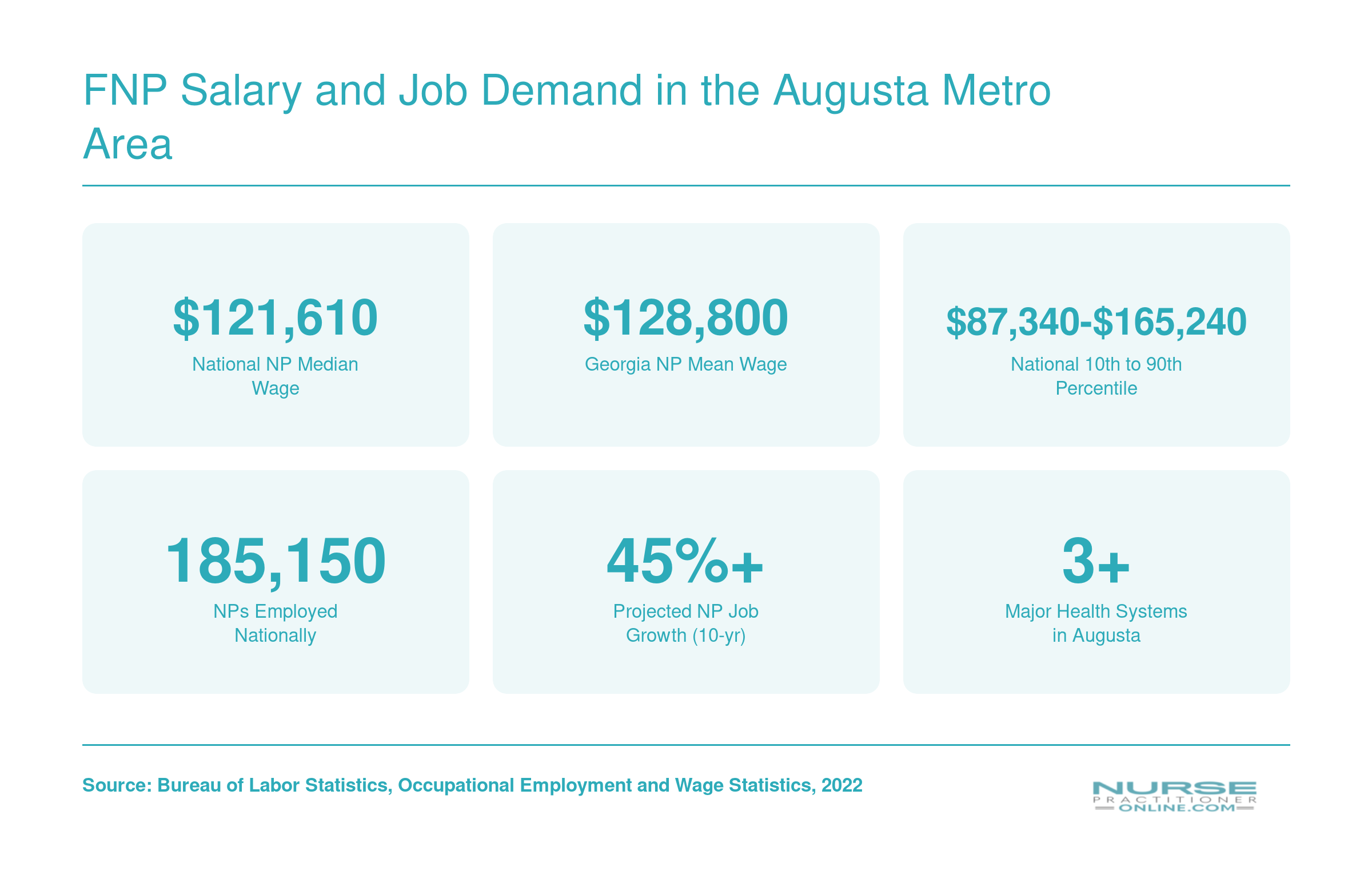
Augusta serves as a major regional healthcare hub, anchored by large hospital systems, the Charlie Norwood VA Medical Center, and a network of clinics extending into surrounding rural and underserved counties. These factors fuel strong demand for family nurse practitioners. Nationally, BLS projects NP employment to grow much faster than average over the coming decade, and Augusta-area nurses are well positioned to benefit from that trend as local providers compete for primary care talent.
What FNP Graduates Actually Earn: Program-Level Outcomes
The most honest measure of an FNP program's worth isn't its sticker price; it's what graduates actually earn after completing it. While broad metro-level salary figures give a bird's-eye view of the Augusta labor market, they can't tell you whether a specific school's alumni land jobs that pay well or leave them struggling with debt.
Beyond the BLS Averages: Real Graduate Earnings
The Bureau of Labor Statistics reports that nurse practitioners in the Augusta metro area earn a median annual wage of $119,100, a solid figure that reflects the entire profession locally. But that number blends together graduates from every program, years of experience, and practice settings. What you really need to know is: do graduates from the affordable program you're eyeing actually break into that earning bracket quickly? Program-level earnings data, when available through sources like the U.S. Department of Education's College Scorecard, show median earnings one year and four years after program completion. These figures cut through the noise and reveal which schools consistently launch well-compensated FNPs.
Data Availability: What's Reported and What's Not
Unfortunately, not every program will have reportable earnings figures. Federal privacy rules suppress earnings data when cohorts are too small or when too few graduates enter the workforce directly. As of 2026, many of the family nurse practitioner programs near Augusta do not publish program-specific earnings outcomes, either because their graduate numbers fall below reporting thresholds or because the data has not yet been released. This is common for smaller, affordable public universities and private colleges alike. When the numbers are available, you'll typically see a median that rivals or surpasses the metro average within a year of graduating. In the absence of published data, treat the absence as a cue to ask hard questions during admissions: What do your recent graduates earn? How does the school track employment?
Connecting Debt to Earnings: The ROI Lens
Salary alone is only half the picture. A program that costs $30,000 but puts graduates into jobs paying $105,000 after one year is a smarter bet than one charging $60,000 for the same starting pay. This is where median federal student loan debt at graduation becomes critical. By comparing median debt (for those who borrowed) to first-year earnings, you can ballpark a program's return on investment. A rule of thumb: look for debt-to-earnings ratios well below one-to-one. In other words, your total grad school debt should be less than your first-year salary. Even without precise program-level data, you can estimate by pairing a school's reported net price with average FNP starting salaries for the region. Affordable programs in Georgia's public university system often see graduates earning strong salaries quickly, keeping that ratio favorable. If you're still exploring which best online FNP programs align with your budget, comparing debt-to-earnings ratios across schools is one of the most effective filters.
What to Do When Data Is Thin
If the program you're considering doesn't have published earnings outcomes, lean on alternative signals: talk to alumni, ask about preceptor placement quality, and check whether graduates pass the national certification exam at high rates. Strong clinical preparation and a network of respected preceptors in the Augusta area often translate into competitive job offers. Meanwhile, monitor the College Scorecard, as new earnings data for graduate programs is gradually being added, and programs that haven't reported in the past may have figures by the time you enroll in NP school online.
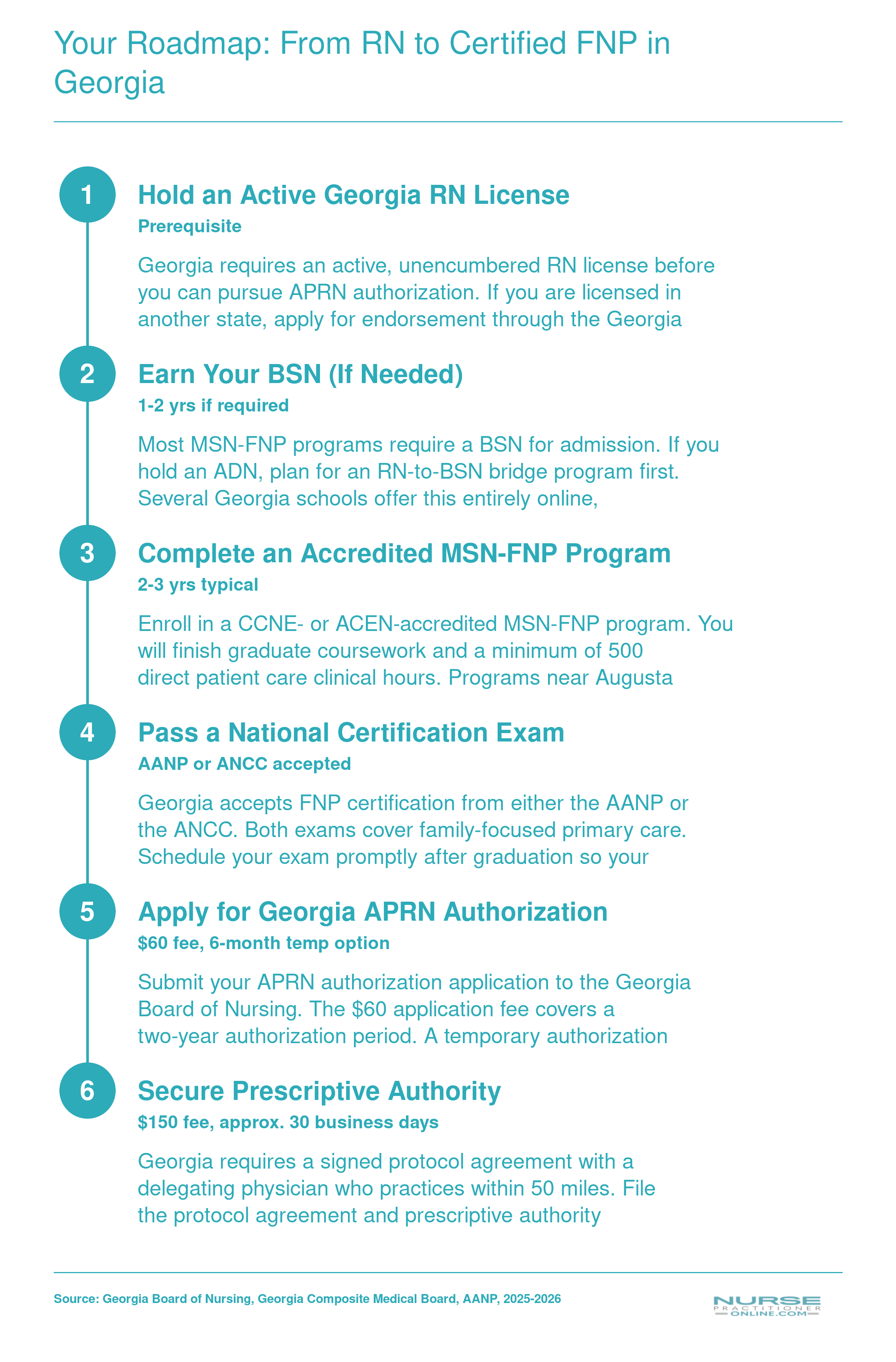
Your Roadmap: From RN to Certified FNP in Georgia
Becoming a certified Family Nurse Practitioner in Georgia follows a clear sequence, but each step has Georgia-specific details you need to know. Most nurses complete the journey in roughly two to four years, depending on whether a BSN is already in hand. Here is your step-by-step path, including timeline estimates and the state requirements that set Georgia apart.
Financial Aid, Scholarships, and Loan Repayment for Georgia FNP Students
The cost of an FNP program can feel like the biggest barrier to career advancement, yet the financial picture changes dramatically once you factor in federal loan repayment programs, state workforce incentives, and targeted nursing scholarships. Knowing where to look, and when to apply, can turn a daunting tuition bill into a manageable investment.
National Health Service Corps Loan Repayment
The National Health Service Corps (NHSC) offers loan repayment awards to primary care providers, including family nurse practitioners, who commit to working in federally designated Health Professional Shortage Areas (HPSAs). Parts of Augusta-Richmond County and surrounding rural communities in east Georgia carry HPSA designations, which means practicing in certain clinics or health systems after graduation could qualify you for up to $50,000 in loan repayment over an initial two-year service commitment, with opportunities to extend. Because HPSA designations are updated periodically, check the official NHSC website for the most current map of eligible sites in and around Augusta before you commit to a specific employer.
Georgia Physician and Advanced Practice Provider Loan Repayment Program
The Georgia Board of Health Care Workforce administers state-level loan repayment programs aimed at keeping providers in underserved areas. The Georgia Physician and Advanced Practice Provider Loan Repayment Program has historically included nurse practitioners among its eligible applicants. Award amounts and application windows vary by funding cycle, so visit the Board's website directly for upcoming deadlines and current eligibility criteria. If you plan to practice in a rural or medically underserved community near Augusta, this program is worth watching closely.
HRSA Nurse Corps Scholarship
The Health Resources and Services Administration (HRSA) funds the Nurse Corps Scholarship Program, which covers tuition, fees, and a monthly living stipend in exchange for a post-graduation service obligation at a Critical Shortage Facility. Application details for the upcoming cycle typically post in early spring. You can sign up for email alerts on the HRSA website so you do not miss the window. This is one of the more generous federal options and is specifically designed for nursing students. For a broader look at repayment pathways, see our guide to student loan forgiveness options for nurse practitioners.
Local and Institutional Opportunities
Beyond federal and state programs, individual schools often have their own pots of money that go underutilized. Contact the financial aid offices at Augusta University, Georgia Southern University, and any other program you are considering. Ask specifically about graduate nursing scholarships, graduate assistantships, and employer tuition reimbursement partnerships with local health systems like AU Health or Piedmont Augusta.
Professional organizations are another often overlooked resource. The Georgia Nurses Association and the Georgia Association of Nurse Practitioners periodically offer scholarships or can point you toward regional foundations that fund advanced nursing education.
Practical Steps to Maximize Aid
- File the FAFSA early: Federal loan and grant eligibility starts here, and some institutional awards are first-come, first-served.
- Ask your employer: Many hospitals and health systems in the Augusta metro area offer tuition assistance or loan repayment as a retention benefit for nurses pursuing NP degrees.
- Layer multiple sources: Federal loan repayment, a state program, and an institutional scholarship are not mutually exclusive in most cases. Read the fine print on service obligations to confirm compatibility.
- Set calendar reminders: Application windows for NHSC, HRSA Nurse Corps, and the Georgia Board of Health Care Workforce programs open and close on fixed schedules. Missing a deadline means waiting an entire year.
Taking a few hours to research and apply for these programs can save you tens of thousands of dollars, making even the most competitive FNP program near Augusta far more affordable than the sticker price suggests.