
Most important takeaways…
- Florida offers AGACNP programs at MSN, DNP, and post-master's certificate levels across both public and private universities.
- Most Florida AGACNP programs deliver didactic coursework fully online, with clinical hours completed at acute care sites statewide.
- The 2025 Consensus Model retired legacy ACNP credentials, so new graduates must earn the AGACNP-BC or ACNPC-AG certification.
- National first-time pass rates for the two AGACNP certification exams ranged from 83% to 91% in 2023.
Florida operates 10 Level I and Level II trauma centers and ranks second nationally in residents aged 65 and older, a combination that has hospital systems from Jacksonville to Miami competing for Adult-Gerontology Acute Care Nurse Practitioners. ICU staffing shortages widened after 2023, and AGACNPs now fill roles once held exclusively by physicians on rapid response teams, surgical step-down units, and cardiology services.
The rankings that follow cover online-eligible AGACNP programs across Florida at three entry points: MSN for BSN-prepared nurses, DNP for those pursuing the terminal degree, and AGACNP post-master's certificates for practicing NPs adding the acute care population focus.
Tuition spreads from roughly $24,000 at public universities to over $90,000 at private institutions, and clinical placement support varies sharply between schools, a gap that often matters more than sticker price.
Florida's Best Online AGACNP Programs for 2026: Full Rankings
These online and hybrid AGACNP programs in Florida are ranked using a quality composite that weighs institutional outcomes, affordability, and program strength rather than any single metric. Every program listed prepares you for national certification through the ANCC AGACNP-BC or AACN ACNPC-AG credential. Program-level earnings data is not yet available for these AGACNP tracks, so we report institution-wide figures where they exist to help you gauge overall return on investment.
- Institution-wide graduation and retention
- Tuition and median graduate debt
- Graduate earning outcomes
- Program delivery and clinical structure
- Accreditation and certification eligibility
- NCES-IPEDS federal institutional data — nces.ed.gov
- College Scorecard graduate earnings — collegescorecard.ed.gov
- Internal program database
- Independent program research

University of Florida
The University of Florida is one of the largest AGACNP providers in the state, offering a hybrid DNP track through its College of Nursing in Gainesville. With a 91.1% institution-wide graduation rate, competitive in-state tuition, and a median graduate debt of just $15,000, UF delivers an especially strong value proposition for Florida residents pursuing acute care careers in ICUs, emergency departments, and inpatient units.
- Hybrid DNP with online coursework and Florida-based clinicals
- Full-time and part-time scheduling options available
- Requires minimum one year of critical care RN experience
- Prepares for both ANCC AGACNP-BC and AACN ACNPC-AG exams
- Individualized clinical placements at high-acuity inpatient sites
- Travel may be required for clinical rotations
- Emphasis on stabilization, evidence-based practice, and collaborative care
- In-state tuition approximately $12,737 per year
BSN to DNP Adult-Gerontology Acute Care Nurse Practitioner — Hybrid

Florida State University
Florida State University stands out for offering AGACNP education at three credential levels: a BSN-to-DNP pathway, a post-master's DNP, and a fully online 22-credit post-master's certificate. The hybrid DNP runs at roughly $444 per credit with synchronous and asynchronous sessions plus just four required on-campus days. FSU's 85.6% institution-wide graduation rate and $18,000 median graduate debt make it a well-rounded option for nurses at different career stages.
- Hybrid format with synchronous and asynchronous coursework
- BSN-to-DNP and post-master's DNP entry routes available
- Approximately $444 per credit hour for in-state students
- Only four on-campus day sessions required
- Capstone project required for completion
- Recommends 1 to 2 years of acute care RN experience
- Eligible for both ANCC AGACNP-BC and AACN ACNPC-AG certification
- Fall start with application deadline of May 1, 2026
- Fully online delivery with synchronous components
- 22 credit hours focused on complex illness management
- CCNE-accredited through the College of Nursing
- Prepares for diagnosis and treatment of critically ill adults
- Includes simulation exercises and clinical rotations
- Designed for nurses already holding an MSN or DNP
DNP Adult-Gerontology Acute Care Nurse Practitioner — Hybrid
Post-Master's Graduate Certificate in AGACNP — On-Campus

University of South Florida
The University of South Florida in Tampa offers a BS-to-DNP with an Adult-Gerontology Acute Care concentration through a hybrid model that pairs online coursework with hands-on clinical experiences. USF is frequently cited as one of the top-ranked nursing programs in Florida and carries an institution-wide graduation rate of 76.8%. In-state tuition near $10,428 and a median graduate debt of roughly $17,988 keep costs manageable for working nurses in the Tampa Bay area and beyond.
- Hybrid format blending online courses with clinical rotations
- Part-time and full-time scheduling tailored at admission
- Focuses on acute, critical, and chronic illness management
- Prepares for ANCC AGACNP-BC or AACN ACNPC-AG certification
- Financial aid and scholarships may be available
- In-state tuition approximately $10,428 per year
- Covers care for adults and older adults across acuity levels
- Course sequences detailed in the Graduate Catalog
BS-DNP Adult-Gerontology Acute Care Concentration — Hybrid

University of Central Florida
The University of Central Florida in Orlando offers a hybrid 23-credit post-master's certificate in AGACNP, making it a focused option for nurses who already hold an MSN or DNP and want to add an acute care specialty. UCF's in-state tuition of about $8,872 is among the lowest on this list, and the institution reports a 78% graduation rate and $18,190 median graduate debt. The curriculum emphasizes evidence-based practice, diagnostic reasoning, and leadership across acute care settings.
- Hybrid delivery: 23 credit hours beyond MSN or DNP
- Requires current national APRN certification for admission
- Includes clinical hours for hands-on skill development
- Prepares graduates for Florida state ARNP licensure
- Emphasizes evidence-based practice and leadership skills
- Covers disease prevention through critical care management
- Flexible curriculum designed for working professionals
Post-Master's Graduate Certificate in Adult-Gerontology Acute Care Nurse Practitioner — Hybrid

Miami Regional University
Miami Regional University offers a compact 12-month post-master's certificate in AGACNP that packs 30 credits and 810 clinical hours into a hybrid format. The program requires on-campus skills sessions during the first semester and expects students to hold a current RN license, ACLS and BLS certifications, and Florida or SARA-state residency. With an 84.5% institution-wide graduation rate, MRU is a focused private option for South Florida nurses ready for an intensive clinical experience.
- Completed in 12 months with 30 semester credits
- 810 total clinical hours with preceptorship throughout
- Hybrid format: primarily online with on-campus skills sessions
- Three-day simulation weekend included in curriculum
- MSN degree and current RN license required for admission
- ACLS and BLS certification must be current at enrollment
- Florida residency or SARA member state residency required
- Faculty can assign preceptors if students need placement help
Adult-Gerontology Acute Care Post-Master's Certificate — Hybrid

Nova Southeastern University
Nova Southeastern University in Fort Lauderdale provides AGACNP education at all three levels: a 45-credit MSN, a 75-credit BSN-to-DNP, and a 24-credit postgraduate certificate. The hybrid programs incorporate on-site intensives at the Palm Beach campus. NSU's private tuition is higher (approximately $24,830 per year), but CCNE accreditation, a dedicated faculty adviser model, and flexible start dates twice per year give working nurses scheduling room. Median graduate debt at NSU is $24,250.
- CCNE-accredited 45-credit MSN completed in six semesters
- Full-time and part-time options with fall or winter starts
- Capstone project required for degree completion
- Optional live Zoom sessions and on-campus intensives
- Bridge option available for non-BSN students
- Dedicated faculty adviser throughout the program
- Financial aid and scholarships available
- 75 total credits with hybrid online and face-to-face delivery
- 1,000 total clinical hours across the program
- Advanced acute care specialization with leadership focus
- Prepares for ANCC AGACNP-BC or AACN ACNPC-AG certification
- Designed for BSN-prepared nurses entering doctoral study
- Financial aid options available to manage costs
- 24-credit hybrid certificate over four semesters
- On-site clinical component at Palm Beach campus
- Requires MSN degree, 3.0 GPA, and Florida RN licensure
- Minimum 12 months of clinical experience for admission
- Residence within 225 miles of campus required
- 170 practicum hours plus 225 clinical hours
- Prepares for national AGACNP certification exams
M.S.N. Nurse Practitioner in Adult-Gerontology Acute Care — Hybrid
BSN to DNP Adult-Gerontology Acute Care Nurse Practitioner — Hybrid
Postgraduate Certificate in Adult-Gerontology Acute Care Nurse Practitioner — Hybrid

Barry University
Barry University in Miami pairs its AGACNP offerings with a notably small 7:1 student-to-faculty ratio, meaning you get unusually personalized attention during both the post-master's certificate and the 12-semester BSN-to-DNP pathway. A 30% tuition scholarship is highlighted for the DNP track. Barry's institution-wide graduation rate is 37.9%, which is lower than the other schools on this list, so prospective students should weigh the strong individual support against broader institutional metrics. Median graduate debt is $26,997.
- Hybrid format with personalized curriculum plans
- Requires MSN degree and 3.3 minimum GPA
- Current nursing license and national certification needed
- Focuses on acute, chronic, and critical conditions in adults
- CCNE accredited with high certification pass rates reported
- Small class sizes with individualized faculty advising
- Competitive tuition with scholarships and financial aid
- CCNE-accredited 12-semester hybrid doctoral program
- 1,000 total clinical hours required for completion
- 30% tuition scholarship highlighted for DNP students
- Part-time scheduling available for working nurses
- Prepares for ANCC AGACNP-BC certification and Florida ARNP licensure
- Graduate assistantships available to offset costs
- Technology-enhanced format with small cohort sizes
Post-Master's Certificate in Adult-Gerontology Acute Care Nurse Practitioner — Hybrid
BSN to DNP Adult-Gerontology Acute Care Nurse Practitioner — Hybrid
How We Ranked These Florida AGACNP Programs
A ranking is only as useful as the methodology behind it, so here is exactly how we evaluated Adult-Gerontology Acute Care Nurse Practitioner programs across Florida for 2026.
Our Composite Scoring Approach
We built each school's score by layering an online-delivery boost on top of baseline quality factors. The baseline draws from institution-level graduation rates, program-level earnings outcomes, median student debt, net price, and completions volume. Programs offering robust online or hybrid formats received additional points because flexible delivery matters enormously to working nurses juggling shifts, families, and clinical hours.
Data came from the U.S. Department of Education's College Scorecard for program-level outcomes, IPEDS for institutional metrics, and direct verification of each school's current delivery format. We cross-checked program websites and admissions offices to confirm whether courses run fully online, hybrid, or on-campus. If you are weighing degree levels, our overview of best online MSN nurse practitioner programs covers how MSN and DNP tracks compare nationally.
What This Ranking Does Not Measure
Numbers tell part of the story, not all of it. Our composite scoring does not capture clinical placement quality, faculty credentials, board exam pass rates, or student satisfaction surveys. Those factors matter deeply, and we discuss them qualitatively in other sections of this article. If a program excels at securing hospital-based clinical rotations or boasts exceptional AGACNP-BC or ACNPC-AG certification pass rates, you will find that context elsewhere on the page rather than baked into the numerical ranking.
A Note on Graduation Rates
The institution-wide graduation rate reflects the entire university, not the AGACNP cohort specifically. A large state university might report a lower overall rate while its graduate nursing program performs exceptionally well. Keep that caveat in mind as you compare schools. Program-specific retention and completion data, when available, appear in individual school profiles rather than the composite score.
Side-by-Side AGACNP Program Comparison Table
The table below compares verified AGACNP program details from Florida schools based on 2025-2026 catalog data. Because credit hours, clinical requirements, and program length can shift year to year, we recommend confirming the latest figures directly with each school's admissions office or academic advisor. For programs where specific data points have not yet been published or independently verified, those cells are marked accordingly. You can also cross-reference clinical hour guidelines with the American Association of Critical-Care Nurses (AACN), but always treat each institution's posted requirements as the final word.
| School | Degree / Track | Total Credits | Clinical Hours | Typical Length |
|---|---|---|---|---|
| University of South Florida | MSN | 57 | Contact program for current requirement | Contact program for current timeline |
| Florida State University | DNP | 72 | 1,080 | Contact program for current timeline |
| Florida State University | Post-Master's DNP | 36 | 420 | Contact program for current timeline |
| Florida State University | Post-Master's Certificate | 22 | 780 | Contact program for current timeline |
Explore other Florida related topics
Related Articles
Questions to Ask Yourself
Online, Hybrid, or On-Campus: AGACNP Format Options in Florida
Fully online versus hybrid: that's the format choice facing working nurses who want to advance into the AGACNP role while maintaining their current clinical job. The good news is that most Florida AGACNP programs deliver didactic coursework entirely online. The reality check: clinical hours and high-fidelity simulation always require in-person attendance, whether on campus or at an approved partner site.
Can You Complete an AGACNP Program Fully Online?
Not quite. When a Florida school markets an AGACNP program as "online," they mean the didactic coursework (pathophysiology, pharmacology, advanced health assessment) is delivered asynchronously or via live webinar. You'll watch lectures, complete modules, and submit assignments from home. But every accredited AGACNP program requires hands-on simulation and in-person clinical rotations. You cannot learn acute ventilator management or central-line placement solely through a screen.
Florida State University's DNP AGACNP track, for example, is advertised as "primarily online" but requires four on-campus visits during the program, each lasting a full day, for simulation workshops and skills validation.1 Similarly, Nova Southeastern University's MSN AGACNP uses a hybrid model with three on-campus intensives over the course of study, each running two to four days and covering critical procedures in the university's simulation labs.2
Weekend Intensives and Week-Long Immersions
Florida programs vary in how they structure these in-person requirements. West Coast University schedules two weekend intensives for its MSN AGACNP students, minimizing time away from work.3 University of Central Florida's DNP AGACNP brings students to campus twice per year for two-day sessions, plus one simulation workshop per semester.4 This pattern, short, concentrated bursts rather than weekly on-campus classes, makes it feasible for full-time nurses across Florida (and sometimes out of state) to participate. If you're curious how other states handle similar scheduling challenges, you can compare AGACNP programs in Texas for a broader perspective.
Clinical Placements: Local or Restricted?
Clinical rotations typically happen near your home or workplace, not on the university's main campus. University of Central Florida restricts clinical placements to its Central Florida service area, while University of Florida limits AGACNP clinical sites to Florida only.5 Most programs expect you to arrange practicums within a reasonable commute of your residence, in acute-care hospitals, ICUs, or specialty units that meet AGACNP competency standards. If you live in a rural county with limited Level II or III trauma centers, clinical placement may require travel or relocation for a semester. Clarify geographic flexibility with admissions before you apply.
AGACNP Clinical Placements in Florida: Hours, Sites, and Support
Clinical hours are the backbone of your AGACNP education. You'll spend hundreds of hours under preceptor supervision in acute care settings, translating classroom knowledge into bedside skills with ICU patients, emergency department admissions, and critically ill adults. Florida's AGACNP programs require anywhere from 500 to 1,000-plus clinical hours depending on degree level, and how you secure those placements (and where you complete them) varies widely from school to school.
How Many Clinical Hours Florida AGACNP Programs Require
Most MSN-level AGACNP programs in Florida mandate 500 to 600 clinical hours. Nova Southeastern University's MSN track requires a minimum of 510 hours1, while West Coast University's MSN AGACNP curriculum includes 540 hours.2 DNP pathways demand significantly more: the University of Central Florida's AGACNP DNP program requires 1,080 clinical hours3, and Herzing University's MSN-to-DNP bridge adds 945 hours on top of your prior master's-level clinical work.4 If you're entering a post-master's DNP program, expect the school to verify your previous clinical hours before setting your new requirement. Florida State University, for instance, requires proof of prior clinical hours for students transitioning into its DNP AGACNP track.5 You can explore additional online DNP nurse practitioner programs Florida offers to compare clinical hour requirements across schools.
Who Finds Your Clinical Site: Program-Assisted vs Self-Placement
Some Florida programs actively arrange your nurse practitioner clinical rotations; others leave the search to you. UCF's AGACNP DNP program assigns placements within its clinical service area, covering Orange, Seminole, Volusia, Lake, Brevard, Osceola, Flagler, northern Indian River, and Marion counties, and coordinates with regional hospital systems.3 That structure removes the burden of cold-calling preceptors from your plate. Other schools provide partial support (databases of approved sites, letters of introduction, preceptor training) but expect you to initiate contact and secure your own preceptor agreements. A handful of Florida programs have formal partnerships with large hospital systems such as AdventHealth, HCA Florida, and Baptist Health, which can streamline placement in ICUs, emergency departments, and step-down units.
Acute Care Site Requirements and the Florida Preceptor Squeeze
AGACNP clinicals must occur in acute care environments where patients are hospitalized and acutely ill: intensive care units, emergency departments, cardiac step-down units, surgical floors, or specialty inpatient services. Primary care offices and outpatient clinics do not satisfy AGACNP clinical criteria. That focus on acute care creates a bottleneck. Florida's high density of NP programs (MSN, DNP, FNP, AGACNP, and specialty tracks) all compete for a finite pool of willing acute care preceptors. Many hospitals limit the number of students per unit, and preceptors in high-demand ICUs often have waiting lists. Starting your preceptor search early, ideally a semester ahead, and maintaining flexibility about shift times and geographic location will improve your chances of securing the acute care slots you need to graduate.
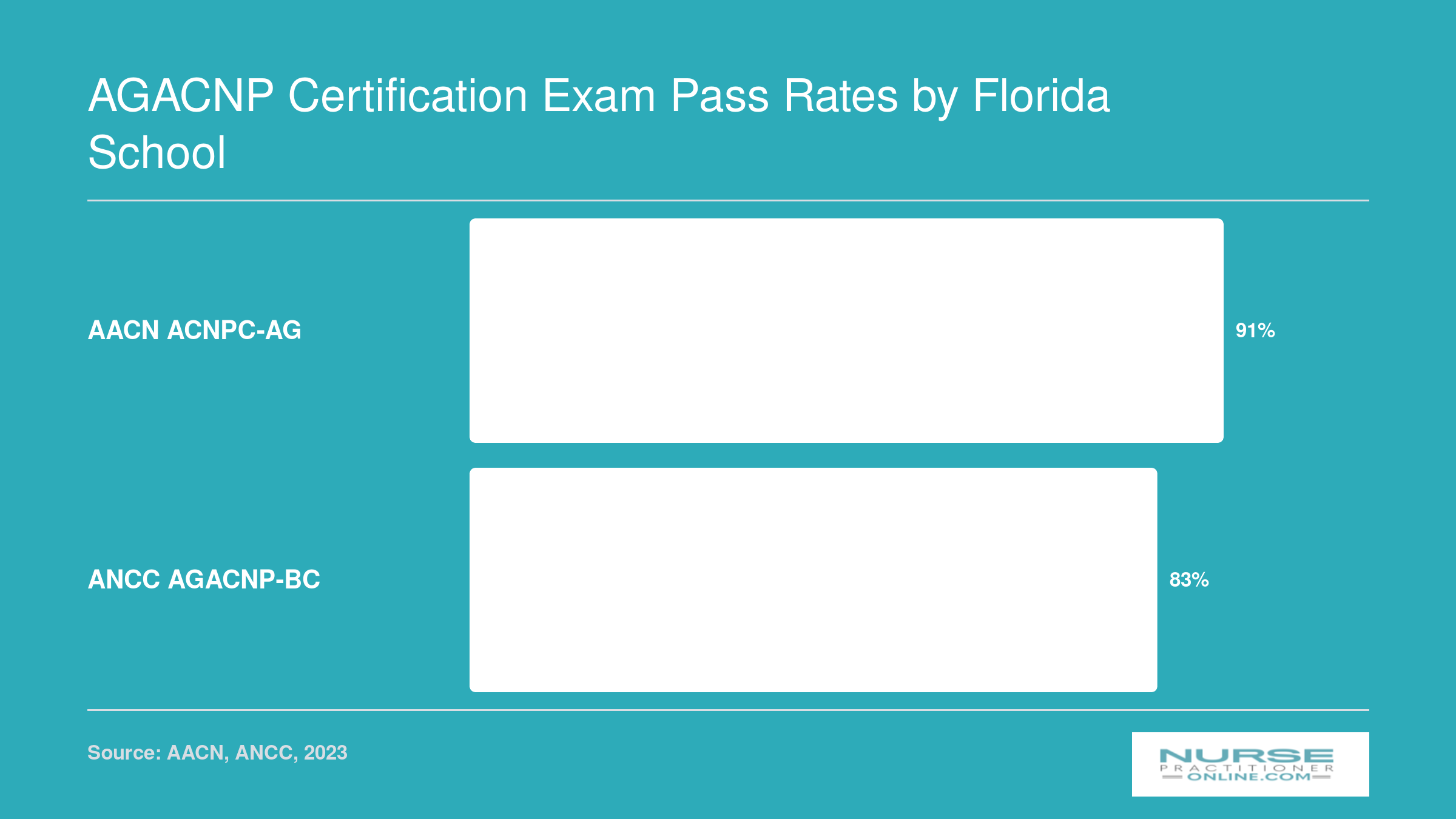
AGACNP Certification Exam Pass Rates by Florida School
Two national certifying bodies credential AGACNPs. The AACN offers the ACNPC-AG exam, which posted a 91% national first-time pass rate in 2023. The ANCC offers the AGACNP-BC exam, which had an 83% national first-time pass rate that same year. Most Florida acute care employers accept either credential, though many hospital systems in the state show a slight preference for the AACN ACNPC-AG because of its deeper critical care focus. Not all Florida AGACNP programs publicly report school-level pass rates, so the chart below uses the most recent national averages as a benchmark. If a program you are considering does not publish its own pass rate data, ask the admissions team directly for first-time and aggregate rates before you commit.
AGACNP Tuition and ROI in Florida
Florida AGACNP programs span a wide cost range, but even the priciest options can pay for themselves within a year or two of practice in most metro areas across the state.
Public vs. Private Tuition Spread
Among the ranked programs, in-state tuition for public universities sits roughly between $8,800 and $12,700 for the full AGACNP sequence, while out-of-state rates climb to around $21,000 to $30,100. Private institutions charge a flat rate regardless of residency, and totals run from approximately $19,600 at Barry University up to about $24,800 at Nova Southeastern University. DNP tracks at public schools like the University of Florida and the University of South Florida carry higher total credit loads than post-master's certificates, so expect DNP tuition to land at the upper end of the public range even at in-state rates. If you are comparing online DNP acute care nurse practitioner programs nationally, Florida's public options remain very competitive. Post-master's certificates at Florida State University and the University of Central Florida require only 22 to 23 credits, keeping costs meaningfully lower.
What Can You Expect to Earn?
Program-level earnings data are not yet available for most Florida AGACNP programs, so the best proxy comes from Bureau of Labor Statistics wage figures for nurse practitioners across the state's major metros.1 As of the most recent BLS data:
- Tampa-St. Petersburg: median annual wage of $128,120, with the 90th percentile reaching $158,710
- Miami-Fort Lauderdale: median of $123,000, up to $154,000 at the top
- Orlando-Kissimmee: median of $123,000, ceiling near $150,000
- Jacksonville: median of $121,000, top earners around $147,000
Even entry-level NP wages in each metro (10th percentile) fall between $94,000 and $99,400, which dwarfs the total tuition of any ranked public program. For context, the national median for nurse practitioners is $121,610, so Florida's major metros all meet or exceed the national benchmark.2
MSN vs. DNP: Is the Extra Investment Worth It?
The honest answer is nuanced. DNP graduates do not consistently command higher starting salaries than their MSN-prepared peers in bedside acute care roles. Where the DNP pays off is in leadership-track positions, hospital system appointments, and academic faculty roles that increasingly require a practice doctorate. If you plan to stay at the bedside as an AGACNP for the foreseeable future, an MSN or post-master's certificate gets you to the same certification exams (ANCC AGACNP-BC or AACN ACNPC-AG) at a fraction of the cost. If you see yourself moving into executive practice or education, investing the additional credits now can save you from returning later. Exploring highest paid nurse practitioner specialties can also help you weigh the long-term earnings potential of acute care versus other tracks.
Cost of Living Changes the Math
A $121,000 salary in Jacksonville stretches considerably further than $123,000 in Miami, where housing and insurance costs run significantly higher. When you factor in tuition at a South Florida private school versus a public program in Gainesville or Tampa, the gap widens further. Before committing, run the numbers on your target city. A lower-paying metro with affordable living and a low-tuition program may deliver better real-world ROI than a flashy salary in an expensive market.
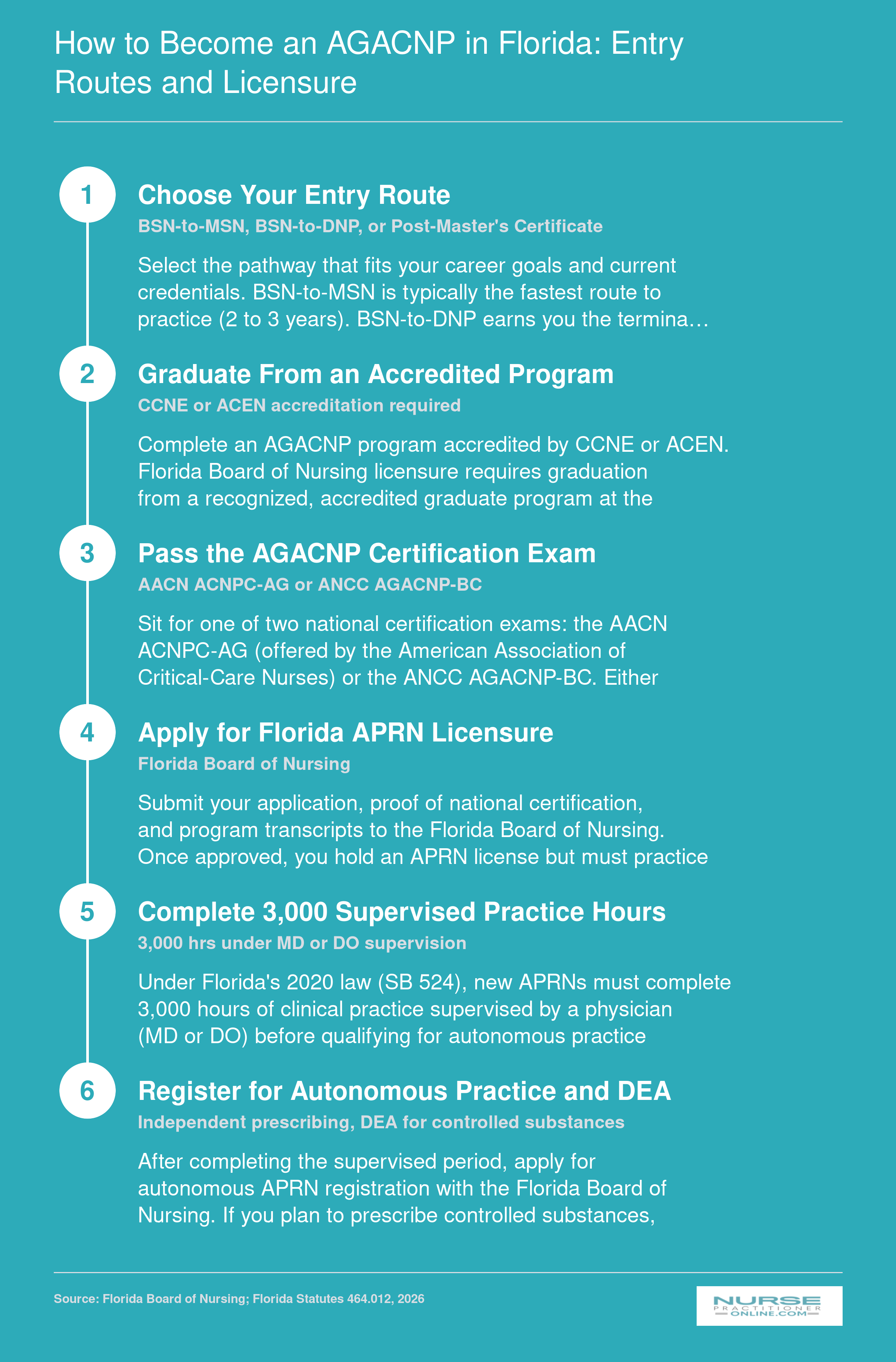
How to Become an AGACNP in Florida: Entry Routes and Licensure
There are three entry routes to becoming an Adult-Gerontology Acute Care Nurse Practitioner in Florida: BSN-to-MSN (the fastest path to practice), BSN-to-DNP (earning the terminal degree), or a post-master's certificate for NPs who already hold a master's and want to add AGACNP scope. Keep in mind that AGACNP is not the same as AGNP (Adult-Gerontology Primary Care NP). AGACNPs practice in hospital and acute care settings with adolescent through older adult patients, while AGNPs focus on outpatient primary care. The two carry different certification exams and are not interchangeable.
Frequently Asked Questions About Florida AGACNP Programs
Below are the questions we hear most from working nurses considering an Adult-Gerontology Acute Care NP (AGACNP) track in Florida. Where possible, answers reference specific data and sections elsewhere in this article so you can dig deeper.
- What is the difference between AGACNP and AGNP programs?
- AGACNP programs prepare you to manage acutely and critically ill patients, from adolescents through older adults, in hospital and ICU settings. AGNP (Adult-Gerontology Primary Care NP) programs focus on outpatient, preventive, and chronic disease management. The patient populations overlap in age range, but the care settings, clinical hours, and certification exams are entirely different. Choose AGACNP if your goal is acute or critical care practice.
- How many clinical hours do AGACNP programs in Florida require?
- Most Florida AGACNP programs require a minimum of 500 direct patient care clinical hours at the MSN level, though DNP tracks often exceed 1,000 total practice hours. Exact requirements vary by school. See the clinical placements section above for details on how individual programs handle site procurement, preceptor matching, and intensive on-campus simulation days.
- Can you complete an AGACNP program fully online in Florida?
- Didactic coursework is available fully online at several Florida schools, but every AGACNP program includes in-person clinical rotations and, in many cases, periodic on-campus immersion or simulation days. The format section earlier in this article breaks down which programs lean more heavily on hybrid delivery versus primarily online models so you can find the best fit for your schedule.
- What is the AGACNP salary in Florida?
- Salaries for AGACNPs in Florida vary by employer, specialty, and region. According to recent Bureau of Labor Statistics data, nurse practitioners in Florida earn a median annual wage in the range of roughly $110,000 to $120,000, with acute care and critical care specialists often commanding the higher end. Hospital systems in major metros like Miami, Tampa, and Jacksonville tend to offer the most competitive packages.
- How much do AGACNP programs cost in Florida?
- Total tuition for a Florida AGACNP program ranges widely. Public university MSN tracks may run approximately $20,000 to $35,000 for in-state students, while private or DNP programs can exceed $60,000. The tuition and ROI section above compares estimated costs across the ranked schools and discusses financial aid options, employer tuition reimbursement, and long-term return on investment.
- What are the requirements to become an AGACNP in Florida?
- You need an unencumbered RN license, a BSN (for MSN entry) or MSN (for DNP or post-master's entry), and completion of an accredited AGACNP program. After graduating, you must pass a national certification exam and apply for APRN licensure through the Florida Board of Nursing. The licensure infographic earlier in this article maps every step from application through independent practice.
- Are there AGACNP post-master's certificate programs in Florida?
- Yes. Several Florida schools offer post-master's certificate options for nurses who already hold an MSN or DNP in another specialty and want to add the AGACNP credential. These programs are shorter than a full degree track, typically requiring 18 to 30 credit hours plus clinical rotations. Check the full rankings section for schools that specifically list a post-master's AGACNP pathway.
- Which certification exam should I take: AACN ACNPC-AG or ANCC AGACNP-BC?
- Both the AACN ACNPC-AG and the ANCC AGACNP-BC are nationally recognized and accepted by the Florida Board of Nursing for APRN licensure. The AACN exam is administered by the American Association of Critical-Care Nurses and is popular among ICU-focused nurses. The ANCC exam is offered through the American Nurses Credentialing Center. Your program may recommend one over the other, so check with your school's academic advisor before registering.
Florida by Specialty
- AGNP Programs in Florida
- DNP NP Programs in Florida
- FNP Programs in Florida
- PMHNP Programs in Florida
- PNP Programs in Florida
- Best Nurse Practitioner Options in Lakeland, FL
- Best Nurse Practitioner Options in Sarasota, FL
- Best Nurse Practitioner Programs in Fort Lauderdale
- Best Nurse Practitioner Programs in Fort Myers, FL
- Best Nurse Practitioner Programs in Miami, FL
- Best Nurse Practitioner Programs in Orlando, FL
- Best Nurse Practitioner Programs in Tampa, FL