Most important takeaways…
- Colorado currently has two schools offering AGACNP tracks at the MSN, DNP, and post-master's certificate levels.
- Most Colorado AGACNP programs use a hybrid format combining online coursework with on-campus intensives and clinical rotations.
- Colorado grants AGACNPs full practice authority with no collaborative agreement or transition period required.
- Denver-area nurse practitioners earn a median salary above $120,000, making program tuition a strong long-term investment.
Colorado's hospital systems, from UCHealth's Level I trauma centers to Denver Health's ICUs and HCA's inpatient specialty units, need nurse practitioners trained specifically for acutely ill patients spanning adolescence through older adulthood. That is the AGACNP role: rapid assessment, ventilator management, central line placement, and co-management with intensivists and hospitalists, not primary care.
The in-state pipeline is narrow. Only a handful of Colorado universities currently offer AGACNP tracks, and most run hybrid formats that blend online coursework with on-campus intensives. Out-of-state acute care nurse practitioner programs online accept Colorado residents, but clinical placement rules and the 2025 APRN consensus model updates have tightened how acute care hours can be logged.
Best AGACNP Programs in Colorado for 2026
This list spotlights Colorado-based Adult-Gerontology Acute Care Nurse Practitioner (AGACNP) programs that offer online or hybrid delivery, ranked by a composite quality score that weighs online accessibility alongside institutional outcomes such as graduation rates, student support ratios, and post-graduation earnings. The goal is not simply to surface the cheapest option or the highest-earning graduates, but to give working nurses a balanced picture of program quality, flexibility, and value. Because only a small number of Colorado schools currently offer a dedicated AGACNP track, the list is concise; we include every program we could verify as active for 2025-2026 admissions rather than padding with tangentially related options.
- Online and hybrid accessibility
- Institutional graduation and retention rates
- Student-to-faculty ratio
- Graduate earnings and debt profile
- Clinical placement support
- NCES-IPEDS federal institutional data — nces.ed.gov
- College Scorecard graduate earnings — collegescorecard.ed.gov
- Independent program research
- Internal program database

University of Colorado Denver/Anschutz Medical Campus
CU Anschutz anchors Colorado's AGACNP landscape with both a DNP pathway and a post-graduate certificate, all housed within its CCNE-accredited College of Nursing on a campus that doubles as a major academic medical center. Denver-metro students benefit from school-arranged clinical placements at top hospitals across the state, removing a common pain point in NP education. Eligible western-state residents pay in-state equivalent tuition, widening access for nurses in neighboring states. The institution-wide graduation rate sits at about 46%, though that figure reflects the full undergraduate and graduate student body and should not be read as specific to the AGACNP tracks.
- Hybrid format with most coursework delivered online
- 1,170 total clinical hours in acute and critical care settings
- School arranges clinical placements for Denver-metro students
- Eligible western-state residents pay in-state tuition rates
- Ranked 33rd nationally among DNP programs
- Fall 2027 applications open August 15, 2026
- Prepares graduates for AACN ACNPC-AG or ANCC AGACNP-BC certification
- CCNE-accredited certificate completable in about 12 months
- 360 required clinical hours for experienced NPs adding AGACNP scope
- Hybrid, mostly online delivery designed for working nurse practitioners
- Spring 2027 start term currently listed for new applicants
- Ideal for MSN- or DNP-prepared NPs seeking acute care role change
- Colorado and eligible western-state resident tuition benefits apply
Adult Gerontology Acute Care Nurse Practitioner, DNP — Hybrid
Adult Gerontology Acute Care Nurse Practitioner, Post-Graduate Certificate — Hybrid

University of Northern Colorado
The University of Northern Colorado offers a hybrid MSN with an AGACNP concentration that appeals to nurses who want a master's-level entry point rather than committing immediately to a DNP. A flat per-credit tuition rate of $734 applies to all students regardless of residency, simplifying cost planning for out-of-state applicants. UNC also advertises a post-bachelor's DNP pathway for nurses aiming at the terminal practice degree. The institution-wide graduation rate is approximately 51%, and median graduate debt across all programs hovers near $20,470, both institution-level figures rather than AGACNP-specific numbers.
- Hybrid online format blending distance coursework with on-site intensives
- Flat $734 per credit hour regardless of residency status
- Specialized AGACNP concentration within the MSN degree
- No additional mandatory student fees beyond tuition
- Post-bachelor's DNP pathway available for those pursuing terminal degree
- Prepares graduates for AACN ACNPC-AG or ANCC AGACNP-BC board exams
- 14:1 student-to-faculty ratio at the institutional level
Nursing M.S., Adult Gerontology Acute Care Nurse Practitioner Concentration — Hybrid
Colorado AGACNP Tuition and Cost Comparison
Understanding the full cost picture is essential before committing to an AGACNP program. Below is a side-by-side look at the two Colorado schools currently offering Adult-Gerontology Acute Care Nurse Practitioner tracks. Keep in mind that graduate nursing tuition often differs from the university-wide figures shown here, so contact each program directly for the most current per-credit rates and fees.
| Category | University of Colorado Denver / Anschutz Medical Campus (DNP) | University of Northern Colorado (MSN) |
|---|---|---|
| In-State Tuition (annual, university-wide) | $9,298 | $15,376 |
| Out-of-State Tuition (annual, university-wide) | $27,154 | $26,446 |
| Average Net Price (after aid) | $11,900 | $17,760 |
| Median Graduate Debt at Graduation | $20,500 | $20,470 |
| Program Format | Hybrid | Hybrid |
| Degree Level | Doctorate (DNP) | Master's (MSN) |
| Total Required Clinical Hours | 1,170 | Contact program for details |
| Student-to-Faculty Ratio | 17:1 | 14:1 |
| Pell Grant Recipients (university-wide) | 60.4% | 55% |
| Notable Tuition Detail | Ranked #33 nationally; in-state rate significantly lower than out-of-state | Flat rate of roughly $734 per credit; no additional student fees reported |
Questions to Ask Yourself
Online vs. Hybrid: What AGACNP Program Formats Look Like in Colorado
Most Colorado-based AGACNP programs follow a hybrid format: online didactic coursework paired with periodic on-campus intensives and hands-on clinical rotations. This setup works well for many working RNs, but it is not the only path. If you need a fully online didactic experience, several out-of-state NC-SARA approved programs, such as Georgetown University, Vanderbilt University, and the University of South Alabama, may accept Colorado residents. Colorado is a SARA member state, which broadens your options. Always verify current enrollment eligibility directly with each school's admissions office, as state-specific restrictions can change.
Pros
- Hybrid formats let working RNs complete lectures and coursework online, then attend focused campus intensives for simulation and skills labs.
- In-state programs like the University of Colorado Anschutz connect you to established clinical networks across Colorado's major health systems.
- On-campus intensives provide valuable face-to-face faculty mentorship, hands-on practice with acute care procedures, and peer networking.
- Your AGACNP credential (ACNPC-AG or AGACNP-BC) is nationally recognized, so graduating from a Colorado program does not limit where you can practice.
- Out-of-state NC-SARA approved programs such as Georgetown or Vanderbilt offer fully online didactics for nurses who cannot attend local intensives.
Cons
- Campus intensives at in-state programs require periodic travel, which adds costs for lodging, meals, and time away from work.
- Fully online AGACNP options based in Colorado are limited; most programs require at least some in-person attendance.
- Coordinating clinical rotation schedules around intensive weekends can be challenging, especially for nurses juggling shift work.
- Out-of-state online programs may not assist with Colorado-based clinical placements, leaving you to find your own preceptors locally.
- Some NC-SARA approved schools have state restriction lists that may limit or exclude Colorado residents, so confirm eligibility before applying.
AGACNP Admission Requirements at Colorado Schools
Colorado AGACNP programs share a common set of admission standards, though specific prerequisites and deadlines vary. Here is what you should have ready before you apply.
- Minimum GPAA cumulative GPA of 3.0 on a 4.0 scale from your BSN program is the standard threshold. At CSU Pueblo, prerequisite courses such as statistics, microbiology, and chemistry must be completed with a grade of C or better (C-minus does not qualify).
- Active, Unencumbered RN LicenseYou will need a current, unrestricted RN license in Colorado or a compact state. Programs verify licensure status before admission and again before clinical placements begin.
- Acute Care Clinical ExperienceExpect to document at least one to two years of hands-on RN experience in an acute care environment, think ICU, emergency department, step-down unit, or similar high-acuity setting. CSU Pueblo requires a minimum of one year. Your resume should clearly detail the type and duration of this experience.
- Prerequisite CourseworkIf your BSN did not include graduate-level statistics or a health assessment course, you may need to complete them before starting. CSU Pueblo also lists microbiology and chemistry among its prerequisites. Check each program's specific list early so you can fill any gaps.
- Application ComponentsPrepare a polished personal statement explaining your interest in acute care practice, two to three professional references (ideally from clinical supervisors), and a detailed resume highlighting your bedside experience. CU Anschutz uses NursingCAS for applications, with the 2026–2027 cycle opening August 6, 2026, and the Fall 2027 cohort deadline set for January 15, 2027.
- Standardized TestingGood news for test-averse applicants: CSU Pueblo does not require the GRE or any other standardized exam. Policies vary by school, so confirm requirements with each program you are considering.
Clinical Hours and Preceptor Placement Across Colorado AGACNP Programs
How many clinical hours do Colorado AGACNP programs require, and do they help you find a preceptor? The answer varies by degree level and school, but all options prepare you for high-acuity practice in acute and critical care settings.
Clinical Hour Requirements by Program
The University of Colorado Anschutz MSN AGACNP track requires 675 direct clinical hours.1 For nurses pursuing the BSN-to-DNP pathway at Anschutz, the total climbs to 1,170 hours, reflecting the expanded scope of doctoral education.2
Colorado State University Pueblo launched its AGACNP programs with a new curriculum in fall 2024. The MSN track now requires 780 clinical hours (up from 585 hours for earlier cohorts). The BSN-to-DNP at CSU Pueblo includes 780 clinical hours plus 1,320 total practicum hours, offering substantial hands-on experience.3
The University of Northern Colorado's BSN-to-DNP AGACNP concentration does not publicly state its clinical hour total, so prospective students should contact the program directly for the most current information.4
Preceptor Placement Support
Finding a qualified preceptor can be a major hurdle for working nurses. The University of Colorado Anschutz arranges preceptors for students located in the Denver metro area, easing the burden of self-placement.1 CSU Pueblo and UNC typically expect students to identify their own preceptors, though both programs offer guidance, site selection criteria, and support from clinical placement coordinators.
If you attend a program that does not guarantee placement, start networking early. Reach out to former colleagues, join state NP associations, and leverage connections from your RN work to secure a preceptor in your desired specialty. If you are also weighing other nurse practitioner programs in Colorado, comparing preceptor support policies across specialties can help narrow your decision.
Common Clinical Sites in Colorado
AGACNP students in Colorado often rotate through major hospital systems that serve diverse patient populations. Common sites include: - UCHealth facilities across the Front Range, including University of Colorado Hospital in Aurora, a Level I trauma center. - SCL Health/Intermountain hospitals, such as Saint Joseph Hospital in Denver. - Denver Health, the safety-net system for the metro area, with a high-volume emergency department and ICU. - Children's Hospital Colorado for pediatric-focused acute care experiences (when appropriate to the gerontology span). - The VA Eastern Colorado Health Care System, providing exposure to veteran-specific acute and critical conditions.
These partnerships give AGACNP students exposure to multisystem organ failure, advanced cardiac life support, invasive monitoring, and complex discharge planning across adolescent, adult, and older adult populations.
AGACNP Salary and ROI in Colorado
The tension is real: you are weighing two to three years of tuition, clinical hours, and lost leisure against a long-term leap in earning power and professional autonomy. For Colorado nurses, the math often tilts sharply in favor of the acute care NP route.
How Much Do AGACNPs Make in Colorado?
State-level data for nurse practitioners gives us a solid floor. The mean annual wage for NPs in Colorado is $121,990.1 National compensation surveys consistently show acute care NPs earning a 7, 12% premium over primary care counterparts, which translates to roughly $8,000, $15,000 more per year.2 That premium puts Colorado AGACNPs well above the national NP median of $121,610.3 In Colorado's competitive hospital markets, experienced AGACNPs in ICU, trauma, or hospitalist services can push earnings into the $140,000, $150,000 range, especially when factoring in overtime, on-call pay, and weekend differentials. Nationally, acute care NPs are consistently among the highest paid nurse practitioner specialties.
Metro vs. Rural Salary Variation
Where you practice matters as much as what you practice. The Denver-Aurora-Lakewood metro area, home to large health systems like UCHealth, HealthONE, and SCL Health, tends to offer the highest salaries, with top-percentile NPs reporting compensation above the state mean. Colorado Springs, with a lower cost of living, still provides robust opportunities at major centers like UCHealth Memorial, though average salaries may sit 5, 10% below Denver. Rural Colorado facilities frequently use enhanced pay packages (signing bonuses, student loan repayment, and higher base rates) to attract AGACNPs. A critical-access hospital on the Eastern Plains might offer a total compensation package that rivals a Denver base salary once incentives are included.
AGACNP ROI: Salary Uplift Over RN Baseline
To make the return on investment concrete, start with the experienced RN baseline. Colorado registered nurses earn a median of roughly $96,520 per year. Moving into an AGACNP role raises that figure by approximately $25,000, $33,000 annually, depending on setting. Even assuming a moderate student debt load (many Colorado MSN and DNP NP programs Colorado range from $25,000 to $60,000 in total tuition), the break-even point often arrives within two to three years of practice. When you pair that with the long-term NP earnings trajectory, where the national mean total compensation including bonuses and incentives was $144,509 in 2025, the financial case is clear.4 For most working nurses, the temporary squeeze of tuition payments is outweighed by the permanent uplift in earning power and career flexibility that an AGACNP credential unlocks.
AGACNP Salary by Metro Area in Colorado
Salaries for nurse practitioners vary across Colorado's metro areas, and understanding these differences can help you weigh the return on investment of an AGACNP program. The figures below reflect all nurse practitioner specialties in each area. AGACNPs working in acute and critical care settings may earn at or above these medians, especially in high-acuity hospital systems. Data is drawn from the most recent Bureau of Labor Statistics reporting period.
| Metro Area | Total NP Employment | Median Annual Salary | 25th Percentile | 75th Percentile |
|---|---|---|---|---|
| Boulder, CO | 260 | $134,670 | $114,290 | $145,570 |
| Denver, Aurora, Centennial, CO | 2,190 | $130,630 | $118,030 | $139,620 |
| Fort Collins, Loveland, CO | 270 | $129,830 | $112,270 | $138,980 |
| Colorado Springs, CO | 470 | $125,770 | $108,190 | $138,210 |
| Pueblo, CO | 170 | $125,370 | $102,000 | $141,390 |
| Grand Junction, CO | 140 | $121,130 | $97,460 | $137,200 |
| Greeley, CO | 130 | $115,820 | $76,590 | $135,330 |
How to Become an AGACNP in Colorado: Licensure Steps
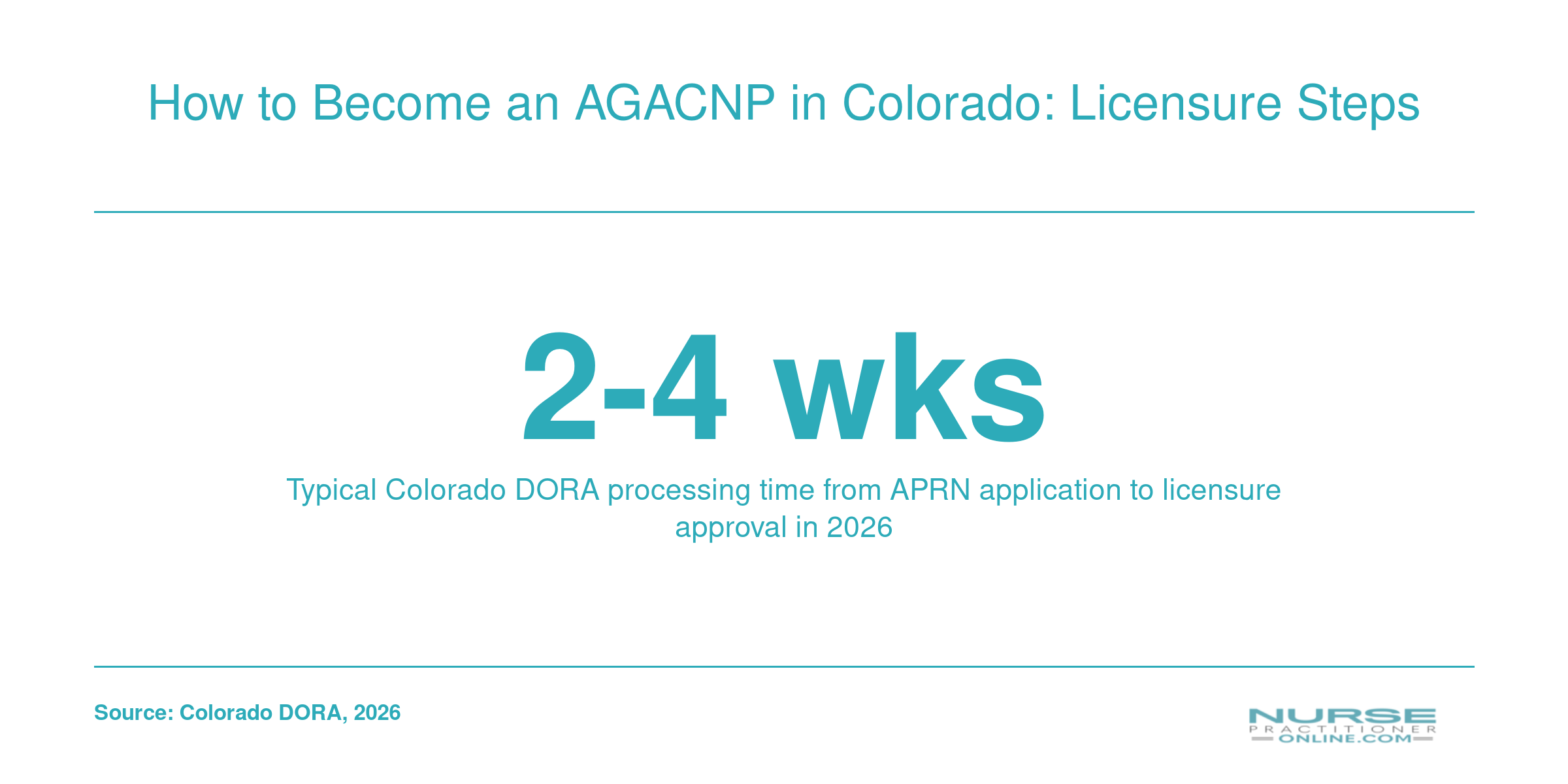
Colorado is a full practice authority state, which means AGACNPs can practice independently without a collaborative agreement once fully licensed. There is no transition-to-practice period required. After graduating from an accredited AGACNP program, you can move through the licensure process in as few as two to four weeks. Note that the 2025 AACN consensus model retired the legacy ACNP and PCNP credentials, so new graduates must sit for one of the AGACNP-specific national certification exams: the AACN ACNPC-AG or the ANCC AGACNP-BC. Here are the five steps from program completion to independent practice: (1) Complete your AGACNP program (MSN, DNP, or post-master's certificate). (2) Pass a national certification exam, either the AACN ACNPC-AG or the ANCC AGACNP-BC. (3) Apply for APRN licensure through the Colorado DORA online portal ($132 application fee; a background check is required). (4) Apply separately for prescriptive authority ($264 fee), bringing total initial costs to roughly $390 to $415. (5) Begin independent AGACNP practice in Colorado. Your license renews every two years by September 30, and you will need at least two hours of substance use training at renewal.
AGACNP vs. AGPCNP in Colorado: Choosing the Right Track
If you are a nurse weighing specialty options, the distinction between the Adult-Gerontology Acute Care NP (AGACNP) and the Adult-Gerontology Primary Care NP (AGPCNP) comes down to one core question: where do you want to spend your days, and what kind of patient problems do you want to solve?
Both credentials require an MSN or DNP, and both Colorado programs reviewed for this guide carry CCNE accreditation. The University of Colorado Anschutz reported a 100% first-time pass rate for both tracks in 2026, so certification success is strong on either path. The real differences live in clinical focus and work setting.
Acute Care: High-Acuity, Hospital-Based Practice
AGACNPs specialize in episodic, rapidly changing conditions.2 Think ICUs, step-down units, hospitalist services, and interventional radiology suites. Your patients are acutely ill or medically unstable, often moving through complex, life-threatening presentations that require fast assessment and intervention. If you thrive in that environment and already work acute or critical care as an RN, the AGACNP track is almost certainly the better fit.
Because the scope is tied to the inpatient and specialty setting, AGACNP graduates are hired primarily by hospital systems and large specialty practices. Employers in Colorado's urban centers, including major academic medical centers along the Front Range, recruit specifically for this credential when staffing ICU and hospitalist teams. A general primary care NP credential will not satisfy those postings, regardless of clinical experience.
Primary Care: Continuity Across the Lifespan
The AGPCNP track is built around comprehensive, ongoing care. Outpatient clinics, internal medicine offices, community health centers, and long-term care facilities are the primary practice settings. Patient acuity is generally lower at any single visit, but the work involves managing chronic disease over years, coordinating prevention, and building longitudinal relationships.
Colorado's rural communities and Federally Qualified Health Centers often seek primary care NPs, and the AGPCNP credential aligns well with those roles.
How to Choose
Ask yourself which clinical environment energizes you rather than drains you. If you are still exploring how these tracks compare to the broader AGNP vs. FNP landscape, that context can help sharpen your decision. A few guiding questions:
- Current RN role: Do you already work in acute or critical care? AGACNP clinical hours build on that foundation.
- Career goals: Hospital employment, procedural work, or specialty consult roles point toward AGACNP. Clinic-based or community practice points toward AGPCNP.
- Geography: Rural Colorado positions lean primary care. Denver and Boulder metro hospital systems actively recruit AGACNPs.
- Scope of practice: Colorado state rules mirror the national consensus model, so the credential you earn will define where you can practice independently.
Neither track is superior. They serve genuinely different patients in genuinely different systems. Choose the one that matches where you already want to be.
Frequently Asked Questions About AGACNP Programs in Colorado
Below are answers to the most common questions nurses ask when exploring Adult-Gerontology Acute Care Nurse Practitioner (AGACNP) programs in Colorado. If you need personalized guidance, nursepractitioneronline.com offers additional resources to help you compare programs and plan your next steps.
- How much do AGACNPs make in Colorado?
- AGACNP salaries in Colorado vary by metro area and setting, but acute care nurse practitioners in the state generally earn between roughly $110,000 and $140,000 per year. Higher compensation is common in ICU, emergency, and specialty hospital roles. Experience, certification (ACNPC-AG or AGACNP-BC), and employer type all influence where you land in that range.
- Which Colorado schools offer AGACNP programs?
- As of 2026, the University of Colorado College of Nursing is the primary institution offering a dedicated AGACNP track at both the MSN and DNP levels. Some nurses also pursue hybrid or online AGACNP programs from accredited out-of-state universities that accept Colorado clinical placements. Always confirm the program holds CCNE or ACEN accreditation.
- What are the clinical hour requirements for AGACNP programs in Colorado?
- Most AGACNP programs require a minimum of 500 direct patient care clinical hours for the MSN and roughly 1,000 or more total hours for the DNP, depending on whether the program is post-baccalaureate or post-master's entry. Clinical rotations focus on acute and critical care settings such as ICUs, emergency departments, and specialty inpatient units.
- What is the difference between AGACNP and AGPCNP?
- The AGACNP prepares you to manage acutely and critically ill adolescent through older adult patients in hospital settings. The AGPCNP (Adult-Gerontology Primary Care NP) focuses on outpatient, preventive, and chronic disease management. The populations overlap in age range, but the care settings and patient acuity differ significantly.
- How long does it take to complete an AGACNP program in Colorado?
- Full-time MSN AGACNP programs typically take about two to three years, while BSN-to-DNP tracks run three to four years. Part-time students should expect to add one to two additional years. Post-master's certificate pathways are shorter, often completing in three to five semesters depending on course load.
- Can existing NPs earn a post-master's AGACNP certificate in Colorado?
- Yes. If you already hold an MSN or DNP and a different NP certification, a post-master's certificate lets you add the AGACNP specialty without repeating a full degree. These programs focus on acute care coursework and clinical hours, and they can often be completed in as few as three semesters of part-time study.
- Are part-time and accelerated pacing options available for Colorado AGACNP programs?
- Most Colorado AGACNP tracks offer part-time schedules designed for working nurses, with evening or weekend online coursework. Accelerated full-time options exist as well, though they require a heavier course load each semester. Check with each program to confirm which pacing plans are currently available for your desired entry point.
- Does Colorado grant AGACNPs full practice authority?
- Yes. Colorado is a full practice authority state, meaning AGACNPs can evaluate, diagnose, order tests, and prescribe medications, including controlled substances, without a collaborative agreement after completing a transition-to-practice period. This makes the state especially attractive for nurse practitioners seeking autonomous practice.