
Most important takeaways…
- Arkansas NP salaries range from roughly $95,000 to over $120,000 depending on metro area.
- In-state tuition at the most affordable public programs can fall below $15,000 for the full degree.
- Full-time BSN-to-MSN tracks at some Arkansas schools can be completed in as few as five semesters.
- Rural and HPSA practice unlocks NURSE Corps loan repayment, stacking savings on top of low tuition.
Roughly 60 of Arkansas's 75 counties qualify as Health Professional Shortage Areas, and nurse practitioners are increasingly filling those gaps in primary care, psychiatry, and women's health. For working nurses weighing a return to school, the state's six accredited NP programs range from under $10,000 in total tuition at public universities to accelerated BSN-to-DNP tracks that compress the timeline to under three years. If tuition is your biggest concern, it helps to compare Arkansas options against the most affordable nurse practitioner programs nationally.
Certification pass rates, clinical placement support, and financial aid eligibility vary more than most prospective students expect. Programs that look similar on paper differ sharply in whether they help secure preceptors, how they structure hybrid intensives, and what NURSE Corps or nurse practitioner loan repayment programs their graduates can access.
Top Online NP Programs in Arkansas for 2026
We evaluated Arkansas's online-accessible nurse practitioner programs using a composite that weighs online delivery flexibility, institutional graduation rates, graduate earnings outcomes, and affordability. The six schools below represent the strongest options for working nurses who want to advance to NP practice without relocating, whether you are pursuing an MSN, a DNP, or a post-master's certificate.
- Online delivery flexibility
- Institutional graduation rates
- Graduate earnings outcomes
- Tuition and affordability
- Program breadth and accreditation
- NCES-IPEDS federal institutional data — nces.ed.gov
- Internal program database
- Independent program research
- College Scorecard graduate earnings — collegescorecard.ed.gov

University of Central Arkansas
The University of Central Arkansas anchors NP education in the state with both a post-master's FNP certificate and a BSN-to-DNP pathway, all delivered in a hybrid format that pairs online coursework with guided clinical experiences. In-state tuition starts at roughly $7,446 per year, making it one of the more budget-friendly public options. The institution-wide graduation rate sits at about 54%, while median earnings for graduates across all programs reach approximately $45,938 ten years after enrollment. UCA's individualized study plans and CCNE accreditation give students a tailored, quality-assured path to national FNP certification.
- Hybrid format: online classes plus clinical experiences
- Minimum 12 credit hours with individualized study plans
- Requires master's degree in nursing and active RN license
- Minimum 3.0 graduate GPA for admission
- CCNE-accredited and prepares for national FNP certification
- Background check and health documentation required
- Hybrid delivery with online and campus components
- 11-semester part-time schedule
- FNP concentration with evidence-based practice focus
- Requires approximately 15 hours weekly per course
- Leadership and health policy coursework included
- Prepares graduates for FNP certification exam
Post-Master's Certificate in Family Nurse Practitioner — Hybrid
Post-BSN to DNP, Family Nurse Practitioner — Hybrid

University of Arkansas
The University of Arkansas in Fayetteville delivers its DNP and post-master's FNP options almost entirely online, with minimal campus visits, making it especially practical for nurses across rural Arkansas. At $594 per credit for the DNP and roughly $12,470 annual in-state tuition, it balances research-university resources with public-school pricing. A standout is the dual DNP-Executive MBA option for nurses eyeing leadership in health systems. The institution-wide graduation rate of about 71% and median ten-year earnings of roughly $58,191 reflect strong overall outcomes. Multiple NP concentrations, including Adult-Gerontology Acute Care, give students room to specialize without changing schools.
- Fully online delivery for working professionals
- Designed for master's-level APRN nurses adding FNP specialty
- Covers primary care across the lifespan, including pediatrics
- Emphasis on rural health and evidence-based practice
- Scholarships and financial aid available
- Prepares for national board certification
- Online coursework with minimal campus visits
- Two entry paths: BSN-to-DNP or MSN-to-DNP
- $594 per credit for in-state students
- Eligible for national FNP certification upon completion
- Dual DNP-MBA degree option available
- GRE-exempt admission for BSN holders with 3.0 GPA
- Fully online format with work-life balance flexibility
- Coursework in both chronic and acute illness management
- Prepares for ICU, ER, and specialty acute care settings
- Rural health content integrated throughout curriculum
- Capstone DNP project focused on patient outcomes
- Financial aid and scholarships available
Post-Master's Graduate Certificate in Family Nurse Practitioner — Online
Doctor of Nursing Practice, Family Nurse Practitioner — Online
Doctor of Nursing Practice, Adult-Gerontology Acute Care — Online

Arkansas State University
Arkansas State University offers one of the fastest MSN-FNP tracks in the state: 41.5 credit hours completable in as few as 24 months at just $380 per credit, totaling roughly $15,770. All didactic coursework is 100% online, and the ACEN-accredited program features multiple start dates each year, letting working nurses begin when it fits their schedule. A-State also extends its online catalog to PMHNP and Adult-Gerontology Acute Care at both the master's and certificate levels. In-state annual tuition is approximately $7,322, and institutional median earnings ten years out are about $42,617.
- 100% online coursework with 750 clinical hours
- $15,770 total program tuition at $380 per credit
- Completable in as few as 24 months
- ACEN-accredited with multiple annual start dates
- Prepares for both ANCC and AANP certification exams
- Requires BSN, 3.25 GPA, and 1,500 RN practice hours
- 100% online coursework over 26 months
- 47.5 credit hours at $23,750 total tuition
- ACEN-accredited, lifespan mental health focus
- Prepares for ANCC PMHNP certification
- Clinicals arranged near student's home
- Designed for working nurses in underserved areas
- Fully online, 16-month completion
- $8,170 total tuition for 21.5 credit hours
- ACEN-accredited with required practicums
- Prepares for ANCC and AACN exams
- Pay-by-the-course tuition model
- Requires MSN degree and 3.25 GPA
- Online delivery over 18 months
- 27.5 credit hours at $14,025 total tuition
- ACEN-accredited, covers lifespan mental healthcare
- Prepares for ANCC PMHNP certification
- Individualized faculty support included
- Focus on trauma, recovery, and underserved populations
Master of Science in Nursing, Family Nurse Practitioner — Online
Master of Science in Nursing, Psychiatric Mental Health Nurse Practitioner — Online
Post-Master's Certificate, Adult Gerontology Acute Care Nurse Practitioner — Online
Post-Master's Certificate, Psychiatric Mental Health Nurse Practitioner — Online

University of Arkansas for Medical Sciences
As Arkansas's academic health center, UAMS offers the broadest NP specialty menu in the state, spanning FNP, PMHNP, Adult-Gerontology (both primary and acute care), and pediatric tracks at the DNP and post-master's certificate levels. Its hybrid format pairs online didactics with clinical rotations embedded in the UAMS Health system and affiliated sites statewide. In-state tuition is approximately $12,460 per year, and the institution's median ten-year earnings of roughly $73,827 are the highest among Arkansas NP schools, reflecting the strength of its health sciences focus. UAMS is the go-to choice for nurses who want deep clinical immersion and access to multiple NP specializations without leaving the state.
- Hybrid format with advanced clinical placements
- Comprehensive patient lifecycle care training
- Diagnostic and disease management skill building
- Prepares for APRN licensure and national certification
- Practice-ready preparation across diverse healthcare settings
- Strong UAMS Health clinical network across Arkansas
- Hybrid delivery covering the full lifespan
- Includes therapy and medication management training
- National PMHNP certification preparation
- BSN-to-DNP pathway available (3 to 4 years)
- Fall-only admissions cycle
- Financial assistance and scholarships offered
- Hybrid format with advanced clinical reasoning focus
- Complex patient management across the adult lifespan
- Evidence-based intervention approach
- Leadership and healthcare transformation coursework
- Diagnostic skills training integrated throughout
- Aligned with UAMS statewide clinical network
- Approximately 18-month completion timeline
- Prepares for national PNP certification
- Dual primary and acute care certification option available
- Advanced practice licensure eligibility upon completion
- Interprofessional team approach to pediatric care
- Hybrid format with flexible clinical settings
Doctor of Nursing Practice, Family Nurse Practitioner — Hybrid
Doctor of Nursing Practice, Psychiatric Mental Health Nurse Practitioner — Hybrid
Doctor of Nursing Practice, Adult-Gerontology Acute Care — Hybrid
Post-Master's Certificate, Acute Care Pediatric Nurse Practitioner — Hybrid

Harding University
Harding University stands out as one of the few Arkansas schools still offering an MSN-level FNP, giving nurses a shorter path to practice compared with BSN-to-DNP programs. The hybrid program requires 45 credit hours with 750 clinical hours, and it can be completed in five semesters full-time or eight part-time. Harding reports a 100% certification pass rate and 100% employment rate for recent graduates. Total program tuition is approximately $48,650 at $950 per credit. As a private institution, tuition is the same regardless of residency, but federal financial aid is available. The program integrates Christian values into its clinical training philosophy.
- Hybrid format with three on-campus intensives
- 45 credit hours plus 750 clinical practicum hours
- $48,650 total tuition at $950 per credit
- Completable in five semesters full-time
- 100% certification pass rate and employment rate
- Federal financial aid and scholarships available
- Starts fall, spring, or summer terms
- Up to 32 credit hours for post-master's students
- Hybrid format with three on-campus intensives
- Prepares for national FNP certification
- $950 per credit with pay-as-you-go option
- 100% certification pass rate reported
- Application through NursingCAS portal
Master of Science in Nursing, Family Nurse Practitioner — Hybrid
Post-Graduate Certificate in Family Nurse Practitioner — Hybrid

Henderson State University
Henderson State University in Arkadelphia provides a budget-friendly online MSN-FNP option especially convenient for nurses in southern and southwestern Arkansas. In-state tuition is roughly $7,497 per year, and the program requires 45 credit hours with 540 practicum hours. Coursework is delivered online with just a single two-day on-campus session in the first semester. Applicants need a BSN, an unencumbered RN license, and at least 2,000 hours of RN work experience. The institution-wide graduation rate of about 37% is lower than peers, so prospective students should ask about graduate-level retention and completion specifically.
- Primarily online with one two-day campus session
- 45 credit hours plus 540 practicum hours
- In-state tuition approximately $7,497 per year
- Requires BSN and 2,000+ RN work hours
- Prepares for Family Nurse Practitioner board certification
- Unencumbered RN license required for admission
MSN Family Nurse Practitioner — Online
Arkansas NP Programs FAQ: Licensure, Pass Rates, and Costs
Choosing a nurse practitioner program is a big decision, and Arkansas has its own set of rules, timelines, and costs to consider. Below are answers to the questions working nurses ask most often when exploring NP education in the state.
- What are the requirements to become a nurse practitioner in Arkansas?
- You need an active Arkansas RN license, a graduate degree (MSN or DNP) from an accredited NP program, and national certification through the AANP or ANCC in your population focus. After that, you apply to the Arkansas State Board of Nursing for APRN licensure. You must also hold a collaborative practice agreement with a physician before you can practice, unless you later qualify for full independent practice.
- Does Arkansas grant full practice authority to nurse practitioners?
- Arkansas is classified as a reduced practice state, but Act 412 (2021) created a pathway to full independent practice. After completing 6,240 supervised hours under a collaborative practice agreement with prescriptive authority, NPs can apply to the Full Independent Practice Credentialing Committee, which reviews applications quarterly. Recent legislation in 2025 also expanded APRN authority to delegate certain tasks, certify durable medical equipment needs, and sign death certificates in hospital settings.
- Which Arkansas NP program has the best FNP certification exam pass rate?
- Exact pass rates shift each testing cycle, but programs at the University of Arkansas for Medical Sciences (UAMS) and Arkansas State University consistently report first-time FNP certification exam pass rates above the national average. The University of Central Arkansas and Harding University also post strong results. Always request the most recent AANP or ANCC pass rate data directly from any program you are evaluating.
- Can you complete a nurse practitioner degree entirely online in Arkansas?
- Most Arkansas NP programs deliver didactic coursework online, which is ideal for working nurses. However, every accredited program requires hands-on clinical hours, typically 500 to over 1,000, completed in person with approved preceptors. So while the classroom portion can be 100% online, expect to arrange local or regional clinical placements. Several programs offer preceptor placement support to ease that process.
- How much do NP programs in Arkansas cost on average?
- Total tuition for MSN-level NP programs in Arkansas generally ranges from roughly $20,000 to $45,000, depending on the school and residency status. DNP programs tend to run higher because of additional credit hours. In-state tuition at public universities such as UAMS and Arkansas State falls on the lower end of that range. Financial aid, employer tuition reimbursement, and federal loan programs can significantly reduce out-of-pocket costs.
- What is the typical salary range for nurse practitioners in Arkansas by metro area?
- Salaries vary by specialty and location, but NPs in Arkansas generally earn between approximately $95,000 and $125,000 per year. Metropolitan areas such as Little Rock and Fayetteville tend to offer higher compensation, while rural regions may pair slightly lower base pay with loan repayment incentives or signing bonuses. The salary discussion later in this article breaks down earnings by specific metro area.
- How long does it typically take to finish an NP program in Arkansas if you already have a BSN?
- BSN-to-MSN programs in Arkansas usually take two to three years of full-time study, including clinical rotations. Part-time tracks extend that to three or four years, which many working nurses prefer. Accelerated BSN-to-DNP options can be completed in roughly three to four years. Some programs offer year-round scheduling or intensive clinical blocks that shorten the timeline further. We cover the fastest pathways in detail in a later section of this guide.
NP Demand, Salaries, and Career Outlook Across Arkansas
Arkansas is one of the most underserved states in the country for primary care, and that gap is exactly what makes nurse practitioner careers here so compelling right now.
What NPs Earn in Arkansas
The mean annual wage for nurse practitioners in Arkansas sits at roughly $116,030.1 The 75th percentile reaches $129,050, meaning experienced NPs in the right settings can earn well above the statewide middle. For context, the national median for NPs is somewhat higher, which reflects both the higher cost of living in many other states and the concentration of high-paying urban markets elsewhere. You can compare compensation across the country with a breakdown of nurse practitioner salary by state and specialty. Even so, Arkansas NP salaries represent a substantial step up from registered nurse pay in the state, where the median hovers around $77,130.
A Growth Rate That Stands Out
Arkansas is projecting a 61.3% increase in NP positions between 2022 and 2032, translating to roughly 1,840 new jobs over that decade and an estimated 360 openings every year.1 That growth rate outpaces the national projection of about 46% over a comparable period. Nationally, NP ranks among the three fastest-growing occupations, and Arkansas is running ahead of even that pace.
The driver is straightforward: access. Approximately 80 million Americans live in areas designated as primary care shortage zones, and rural Arkansas counties make up a disproportionate share of that burden. Arkansas consistently ranks among the states with most need for nurse practitioners, which is why so many NP programs here emphasize family practice and primary care preparation. Graduates are not just filling positions; they are often the primary provider for entire communities.
Scope of Practice and What It Means for You
One practical consideration for Arkansas NPs is scope of practice. Arkansas currently operates under a reduced practice model, meaning nurse practitioners must maintain a collaborative agreement with a physician to prescribe and practice at full clinical capacity.1 This is different from full practice authority states, where NPs can open independent practices and set their own terms without a supervising agreement.
Reduced practice authority does not eliminate opportunity, but it does shape how careers develop here. Many Arkansas NPs work within hospital systems, federally qualified health centers, and rural health clinics where collaborative agreements are built into the employment structure. If independent practice is a long-term goal, it is worth factoring into your plan, either by staying updated on potential legislative changes in the state or building experience that positions you well if the landscape shifts.
What Nurse Practitioners Earn Across Arkansas Metro Areas
Salaries for nurse practitioners in Arkansas vary meaningfully by metro area, and understanding those differences can help you weigh program location, clinical placement sites, and long-term career plans. The table below draws on Bureau of Labor Statistics data and compares NP earnings to registered nurse pay in the same market, so you can see the concrete financial return of advancing your degree. Notably, the Fayetteville corridor leads the state in NP compensation, while smaller markets like Hot Springs offer a lower median but may come with reduced cost of living and strong demand for primary care providers.
| Metro Area | NP Employment | NP Median Salary | NP 25th Percentile | NP 75th Percentile | RN Median Salary in Same Area |
|---|---|---|---|---|---|
| Fayetteville, Springdale, Rogers | 530 | $126,860 | $108,800 | $141,760 | $82,170 |
| Jonesboro | 260 | $114,250 | $104,210 | $131,850 | $78,730 |
| Little Rock, North Little Rock, Conway | 1,140 | $113,660 | $101,110 | $129,430 | $79,830 |
| Fort Smith | 270 | $111,910 | $102,040 | $128,470 | $77,000 |
| Hot Springs | 170 | $104,720 | $101,600 | $123,920 | $76,930 |
Questions to Ask Yourself
Most Affordable NP Programs in Arkansas
Tuition is a major factor when choosing an NP program, and Arkansas offers several public universities where in-state rates keep costs manageable. The table below ranks the most affordable options by in-state tuition, with delivery format and institution-wide graduation rate included for context. Beyond sticker price, working nurses should explore financial aid pathways such as the NURSE Corps Scholarship Program (a federal award requiring a two-year service commitment), the Arkansas Graduate Nursing Education Student Loan and Scholarship administered through UAMS, and the Faith A. Fields Nursing Scholarship Loan, which offers up to $5,000 per semester (up to $20,000 total) as a forgivable loan. Arkansas State University opens its College of Nursing scholarships each October 1 with a February 1 deadline, and the Arkansas Nursing Foundation accepts applications through June 1 annually. NPs who plan to practice in rural or underserved communities may also qualify for state loan repayment programs and AHEC workforce incentives that can significantly reduce long-term education costs.
| School | City | In-State Tuition | Format | Graduation Rate |
|---|---|---|---|---|
| Arkansas State University | Jonesboro | $7,322 | Online | 55.4% |
| University of Central Arkansas | Conway | $7,446 | Hybrid | 53.5% |
| Henderson State University | Arkadelphia | $7,497 | Online | 37.3% |
| University of Arkansas | Fayetteville | $12,470 | Online | 70.5% |
| Harding University | Searcy | $14,572 | Hybrid | 68.8% |
Accelerated and Fastest NP Pathways in Arkansas
How quickly can you move from BSN to nurse practitioner in Arkansas, and which programs actually offer a faster track?
The answer depends on the pathway you choose, the school's curriculum design, and whether you enroll full time or part time. Arkansas has a small but focused set of NP programs, and each structures its accelerated and standard options differently. For a broader look at fast-track options nationwide, our guide to accelerated nurse practitioner programs is a helpful benchmark. Because timelines and credit requirements can shift from one catalog year to the next, the steps below will help you find the most current, accurate information.
Start With Each School's Official Program Page
Before you commit to any timeline assumptions, visit the nursing program pages for schools like the University of Arkansas for Medical Sciences (UAMS), Arkansas State University, the University of Central Arkansas, and Harding University. Look specifically for:
- BSN-to-DNP tracks: These combine the master's and doctoral levels into a single pathway, often ranging from roughly 70 to 90 credit hours depending on the specialty. Full-time students may complete the program in three to four years.
- MSN-FNP options: A traditional MSN with a family nurse practitioner concentration typically requires around 45 to 50 credit hours and can be finished in two to three years, with some schools offering full-time schedules that compress the timeline.
- Part-time flexibility: Most Arkansas programs allow part-time enrollment so you can keep working. Part-time tracks usually add one to two additional years compared to full-time plans.
Credit hour counts and semester maps are usually published on each program's admissions or curriculum page. If you cannot find a specific detail, that is a signal to reach out directly.
Contact Admissions for the Latest Details
Program structures change more often than websites get updated. Call or email each school's nursing admissions office to confirm current start dates, the number of clinical hours required, and whether any accelerated cohorts are planned. Ask specifically about summer enrollment options, which can shave a semester off your total time. If securing preceptors is a concern, our guide on how to find NP preceptors walks you through the process step by step.
Verify Accreditation and State Requirements
Speed matters, but only if the program meets the right standards. Check the Commission on Collegiate Nursing Education (CCNE) directory to confirm that any program you are considering holds current accreditation. For a deeper explanation of what to look for, see our nursing accreditation guide. Then review the Arkansas State Board of Nursing website for state-specific licensure prerequisites, including required supervised clinical hours and APRN application steps.
Use Professional Associations as a Resource
The American Association of Nurse Practitioners (AANP) maintains general guidance on NP education timelines and can help you benchmark what "accelerated" actually looks like nationwide. Comparing Arkansas options against national norms gives you a realistic sense of whether a program's pace is genuinely fast or simply marketed that way.
The fastest path is the one that matches your life, not just the one with the fewest semesters on paper. Gather specifics from official sources, ask pointed questions, and confirm accreditation before you enroll.
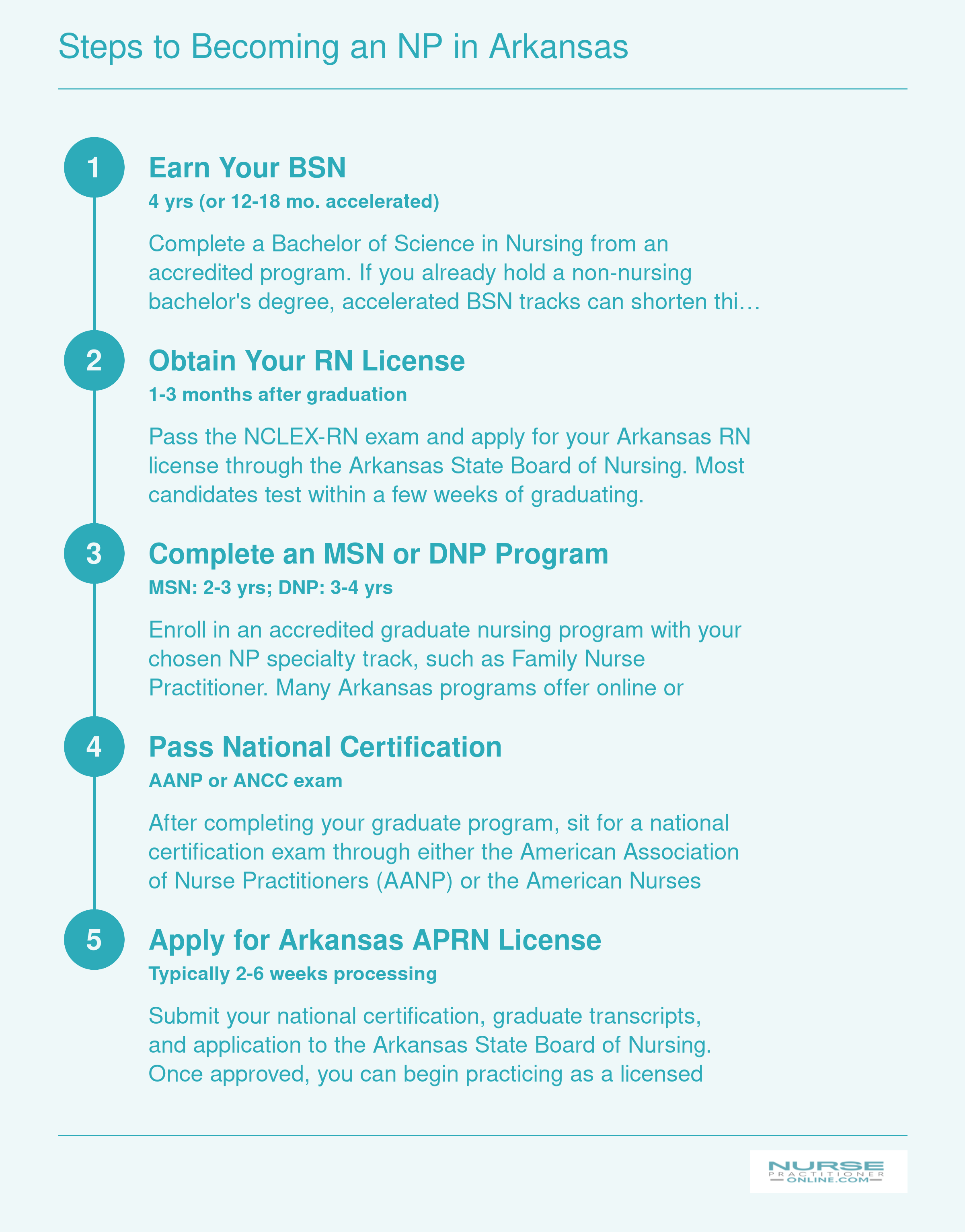
Steps to Becoming an NP in Arkansas
Arkansas requires national board certification before the state will issue an Advanced Practice Registered Nurse (APRN) license. The pathway below outlines each milestone from your BSN through independent practice, along with approximate timelines to help you plan ahead.
Online, Hybrid, or Campus: Comparing NP Program Formats in Arkansas
Most nurse practitioner programs in Arkansas are hybrid by design, combining online didactic coursework with required on-campus intensives or in-person clinical rotations. Even programs listed as fully online still require hands-on clinical hours, so understanding the real tradeoffs between formats helps you plan your schedule and budget before committing.
Pros
- Flexible online coursework lets working RNs keep full-time or part-time positions while progressing through the program.
- Hybrid and online formats open the door to a broader selection of programs, including options outside your immediate area.
- Self-paced lecture modules and recorded content let you study during off-shifts, making it easier to balance family and career.
- Programs like those at the University of Arkansas for Medical Sciences and Arkansas State University deliver most didactic content online, reducing commute time.
Cons
- Clinical placements still require in-person hours, and some programs expect students to identify and arrange their own preceptor sites.
- Less face-to-face faculty interaction can make it harder to build mentoring relationships or get immediate feedback on complex clinical questions.
- On-campus intensives, often required once or twice per semester, may involve travel costs and time off work for nurses who live far from the host campus.
- Self-discipline is essential because online coursework demands consistent time management without the structure of a set classroom schedule.
Clinical Placements and Preceptor Support at Arkansas NP Programs
Securing quality clinical placements ranks among the most pressing concerns for prospective NP students, and Arkansas programs vary significantly in how much support they provide. Before committing to any program, ask directly whether the school arranges your clinical sites or expects you to find preceptors independently.
How Arkansas Programs Handle Clinical Placements
The state's flagship program at the University of Arkansas for Medical Sciences offers a program-assisted model that eases the preceptor search considerably. UAMS maintains contracts with hospitals and healthcare organizations statewide, and students can access clinical rotations through UAMS Regional Centers distributed across Arkansas. This infrastructure proves especially valuable for students in underserved areas who might otherwise struggle to locate qualified preceptors nearby.
Arkansas State University, Harding University, and the University of Central Arkansas take a different approach. These programs operate on a student-led model with faculty approval, meaning you identify potential preceptors and submit them for vetting. Faculty review credentials and site suitability, but the initial legwork falls on your shoulders. Students who already work in healthcare settings or have strong professional networks often navigate this process smoothly, while those new to an area may need extra time to build connections.
Clinical Hour Requirements
Most FNP programs in Arkansas require a minimum of 500 clinical hours, aligning with national accreditation standards. These hours typically distribute across multiple semesters, starting with foundational assessments and progressing toward independent patient management. If you're unfamiliar with how nurse practitioner clinical rotations are structured, expect to spend your final semesters logging more intensive clinical weeks as you transition toward practice-ready competency.
Rural and Urban Clinical Opportunities
Arkansas's geography creates both challenges and opportunities for clinical training. Rural clinics throughout the state offer rich primary care exposure with diverse patient populations and hands-on experiences that urban settings sometimes cannot match. However, rural placements may require significant travel, and students should budget for gas and lodging when rotations fall outside their immediate area.
Urban sites in Little Rock, Fayetteville, and Jonesboro provide access to larger health systems and specialty consultations, though competition for these placements can be intense. Many students find that a combination of rural and urban rotations strengthens their clinical reasoning and prepares them for the varied practice environments common across Arkansas.
Selecting an NP Program That Fits Your Career and Life
Choosing between a program with rock-bottom tuition and one that offers built-in board prep, or between a fast-track timeline and the part-time flexibility you need as a working nurse, is rarely straightforward. The right NP program is the one that balances cost, quality, and schedule in a way that actually works for your life today and your career five years from now.
Accreditation: The Non-Negotiable Starting Point
Before comparing anything else, confirm that a program holds either CCNE (Commission on Collegiate Nursing Education) or ACEN (Accreditation Commission for Education in Nursing) accreditation. This is not a prestige distinction; it is a gatekeeping requirement. Both AANP and ANCC require graduation from an accredited program to sit for certification exams, and the Arkansas State Board of Nursing ties APRN licensure to that same credential. A program without CCNE or ACEN accreditation, no matter how affordable or convenient, cannot lead to licensure in Arkansas.
Certification Pass Rates as a Quality Signal
Once accreditation is confirmed, look at how well graduates actually perform on certification exams. UAMS, for example, reported an overall FNP certification pass rate of 87% for academic year 2023.1 That figure provides a useful benchmark, though it is worth noting that not all programs break out first-time pass rates or specify whether graduates sat for the AANP or ANCC exam.1 When a school publishes only an overall rate, ask admissions directly for first-time numbers, since retake attempts can inflate the total. Programs at Arkansas State, University of Central Arkansas, and Harding each report outcomes through their accreditation bodies as well, so request those reports during your research.
Weighing the Financial Return
Tuition across Arkansas NP programs varies widely. In-state graduate tuition at the University of Central Arkansas starts around $7,446 for a post-master's FNP certificate, while UAMS lists roughly $12,460 in-state for a similar credential, and the University of Arkansas in Fayetteville falls in a comparable range at about $12,470 in-state. If you already hold an MSN and are considering a post-master's FNP certificate program, these lower-credit options can keep total costs well below a full degree. Median graduate debt at UAMS sits near $14,000 at the institutional level, which is relatively modest compared to national averages. Program-level earnings data shortly after completion are not yet available for most Arkansas NP tracks, but institutional data for UAMS shows median earnings around $73,800 a decade after enrollment across all programs. For NP graduates specifically, salaries in Arkansas tend to exceed state medians for registered nurses by a significant margin, making even the higher-tuition options potentially strong investments. Still, treat these figures as directional rather than guaranteed, since individual outcomes depend on specialty, location, and practice setting.
Board Prep Integration and Part-Time Options
Some Arkansas programs fold AANP or ANCC board review courses directly into their curriculum or final semester, while others leave exam preparation entirely to you. That difference can mean hundreds of dollars in extra review-course fees and dozens of self-directed study hours. Ask each program explicitly whether board prep is included, and if so, which exam it targets.
Part-time enrollment is equally important to investigate early. If you are weighing online vs on-campus NP programs, understand that clinical hour requirements stay the same regardless of format or pace. A part-time plan stretches coursework over more semesters while keeping clinical rotations intensive, so make sure the schedule truly fits your shift commitments before enrolling.
Your Decision Checklist
As you narrow your options, run each program through these practical filters:
- Accreditation status: Confirm current CCNE or ACEN accreditation, not just a pending application.
- Certification pass rates: Ask for first-time pass rate data, not only overall rates.
- Preceptor support: Determine whether the program places you with preceptors or expects you to find your own clinical sites.
- Flexibility: Check whether part-time, evening, or weekend options are available and how clinical scheduling accommodates working nurses.
- Board prep: Find out if a certification review course is embedded in tuition or an out-of-pocket add-on.
- Total cost: Add tuition, fees, clinical-related travel, and any required on-campus residency days for a true picture of what you will spend.
No single program in Arkansas checks every box perfectly for every nurse. The goal is not perfection but clarity: know what each program offers, what it costs, and what it expects of you before you commit.