Most important takeaways…
- Post-MSN DNP pathways can be completed in as few as two years, roughly half the time of BSN-to-DNP tracks.
- Two Arizona universities offer DNP pediatric nurse practitioner programs with hybrid formats suited to working Tucson nurses.
- Nurse practitioners in the Tucson metro area earn competitive wages, with Bureau of Labor Statistics data confirming strong regional demand.
- Early clinical placement coordination in Tucson is critical because preceptor delays can add several months to your DNP timeline.
Pediatric nurse practitioner shortages across Southern Arizona have intensified as primary care clinics and specialty practices compete for DNP-prepared clinicians who can lead care teams and shape policy. For Tucson nurses ready to move into this advanced role, accelerated pathways now compress what once took five years into timelines as short as two, depending on your starting credential.
The gap between a BSN-to-DNP track and a post-MSN completion program can mean a difference of 40 or more credit hours and two extra years of study. That choice, along with tuition costs ranging from roughly $23,000 to over $70,000 and the reality of securing pediatric clinical placements in a competitive metro area, shapes which program fits your situation. If you are still weighing a faster route to advanced practice more broadly, our roundup of fastest nurse practitioner programs offers a useful starting point. Arizona's NP wage market rewards doctoral preparation, but the path you take to get there matters as much as the destination.
Best Fastest DNP Pediatric Nurse Practitioner Programs Near Tucson
For Tucson-area nurses ready to advance into pediatric practice at the doctoral level, two Arizona universities stand out for combining a respected DNP curriculum with formats flexible enough for working professionals. Below, we highlight each program's strengths, cost profile, and timeline so you can weigh which path fits your schedule, budget, and clinical goals. Graduation rates listed are institution-wide figures reported to the federal government and do not reflect program-specific completion.
- Estimated total program cost
- Completion timeline flexibility
- Clinical hour requirements
- Hybrid and online accessibility
- Regional relevance for Tucson nurses
- NCES-IPEDS federal institutional data — nces.ed.gov
- College Scorecard graduate earnings — collegescorecard.ed.gov
- Independent program research
- Internal program database

University of Arizona
Located right in Tucson, the University of Arizona offers the most geographically convenient DNP pathway for local nurses. Its hybrid Pediatric Nurse Practitioner specialty blends online didactic coursework with just three on-campus intensives, and the program can be completed in as few as 2.5 years on a full-time track. With an average cohort of about 10 students, you get close faculty mentorship, and the college coordinates clinical placements on your behalf, a major time-saver when you are juggling shifts and family life.
- Hybrid format with only 3 on-campus intensives
- 65 total credit hours required
- 720 clinical hours included in curriculum
- Full-time completion in approximately 2.5 years
- Part-time study option available for working RNs
- Clinical placements coordinated by the program
- Dual DNP/PhD pathway offered for research-minded students
- Prepares graduates for pediatric primary care NP certification
Pediatric Nurse Practitioner, DNP — Hybrid

Arizona State University
Arizona State University's Edson College of Nursing delivers a DNP with two distinct pediatric concentrations: Acute Care PNP and Primary Care PNP. Both run in a hybrid format that pairs online coursework with periodic campus visits in downtown Phoenix, roughly 90 minutes from Tucson. Clinical rotations include placements in underserved urban and rural communities, giving graduates exposure to diverse patient populations. No entrance exam is required, and the program's practicum hours exceed national minimums set by the AACN.
- 85 total credit hours required
- 1,170 clinical hours, exceeding AACN minimums
- 600 hours of direct patient care with a preceptor
- Hybrid format with scheduled on-campus visits
- No entrance exam required for admission
- Clinical rotations in underserved communities
- Prepares for national acute care PNP certification
- Capstone doctoral project required
- Hybrid delivery with periodic campus sessions
- Focus on pediatric primary care across the lifespan
- Prepares graduates for pediatric NP certification
- Financial aid available for qualifying students
- Requires current, unencumbered RN license
- Fall start term each academic year
Advanced Nursing Practice (Acute Care Pediatric Nurse Practitioner), DNP — Hybrid
Advanced Nursing Practice (Pediatric Nurse Practitioner), DNP — Hybrid
How Long Does a Fast-Track DNP-PNP Program Take?
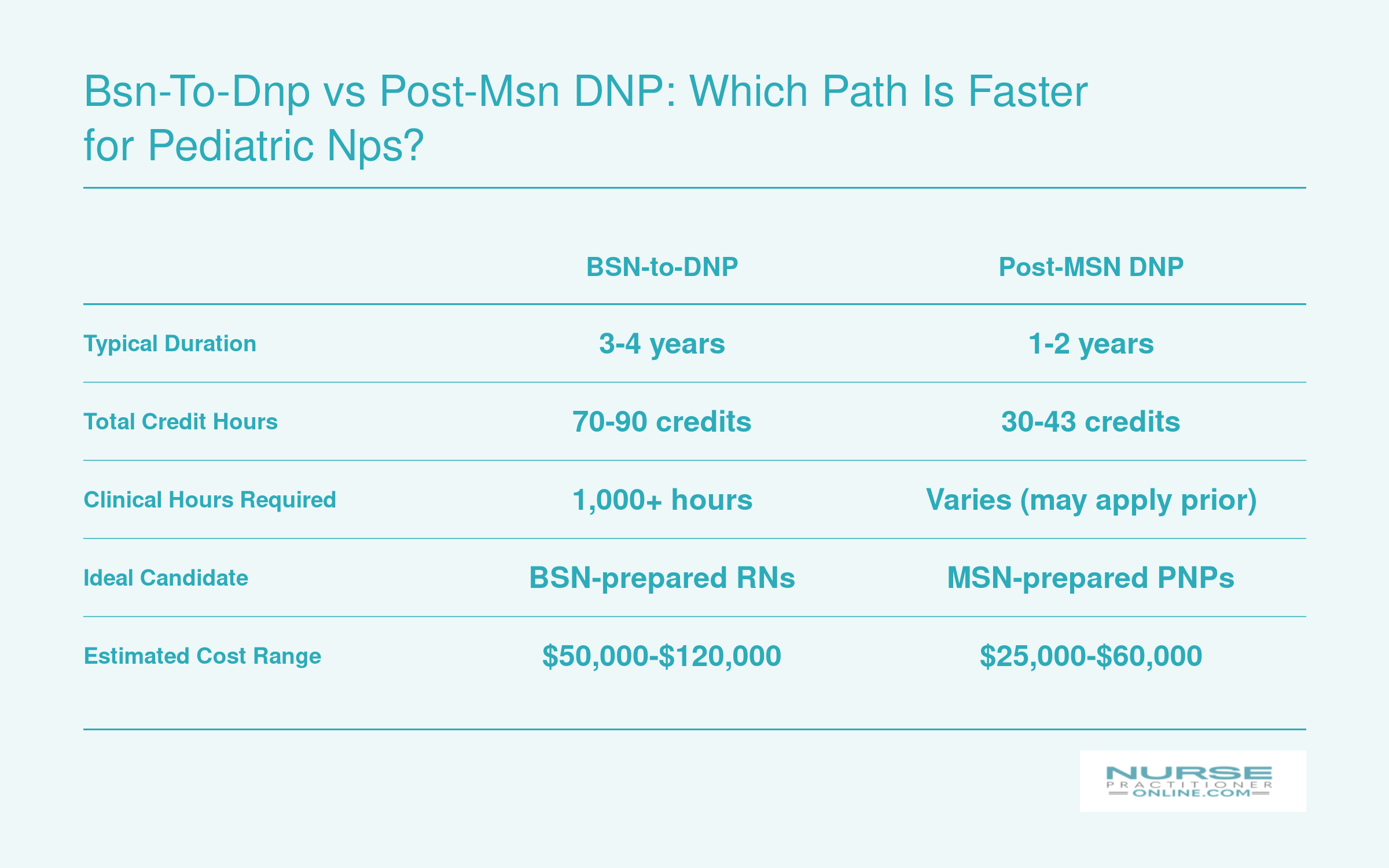
A nurse entering with a BSN faces a very different runway than one entering with an MSN already in hand. BSN-to-DNP pediatric tracks typically run three to four years of full-time study (roughly 70 to 90 credits), while post-MSN DNP completion paths usually wrap in 1.5 to 2 years and 30 to 40 credits. The gap reflects how much foundational NP coursework and clinical training you still need before layering on doctoral-level work. If you are weighing the MSN route first, our guide to MSN pediatric nurse practitioner programs can help you compare options.
What Actually Makes a Program "Fast-Track"
Speed in a DNP-PNP program rarely comes from cutting content. It comes from how the calendar and clinicals are organized. Look for these structural features:
- Year-round enrollment: Accelerated DNP-PNP programs run through summer terms instead of pausing, shaving months off the back end.3
- Intensive clinical immersions: Block scheduling of pediatric rotations lets you bank required hours faster than spreading them across many low-intensity semesters.
- Streamlined scholarly project: A DNP project replaces the traditional dissertation, and well-designed programs integrate project milestones into existing courses rather than treating it as a separate hurdle.
- Transfer of prior clinical hours: For post-MSN students, programs that accept eligible MSN or APRN practice hours toward the DNP requirement can meaningfully shorten the path.3
Clinical Hour Requirements You Cannot Skip
The AACN sets a minimum of 500 post-baccalaureate practice hours for the DNP.1 However, online DNP pediatric nurse practitioner programs almost universally exceed that threshold. A national study of postbaccalaureate-to-DNP NP programs found an average of about 791 supervised direct patient care hours plus roughly 170 indirect hours, which lines up with the widely cited 1,000-hour benchmark most PNP tracks build toward.2 No accelerated schedule changes that floor. A faster program compresses the calendar; it does not reduce the hours at the bedside.
Arizona-Accessible Timelines
With the caveat that program structures shift year to year, the general landscape near Tucson looks like this: the University of Arizona's BSN-to-DNP pediatric pathway is typically a three- to four-year commitment, ASU's post-MSN DNP completion option commonly runs three to five semesters, and national online programs (such as Spring Arbor University's DNP) advertise post-master's completion in roughly two years.4 Confirm current credit loads and start dates directly with each program before you plan around them.
BSN-to-DNP vs Post-MSN DNP: Which Path Is Faster for Pediatric NPs?
Choosing between a BSN-to-DNP and a post-MSN DNP pathway depends largely on where you are in your career. If you already hold an MSN with a pediatric nurse practitioner focus, the post-MSN route is the fastest way to earn your doctorate, often finishing in under two years. On the other hand, BSN-to-DNP programs bundle your master's-level coursework and doctoral work into one streamlined plan, which can be more cost-effective over time since you avoid paying for two separate degrees.
Questions to Ask Yourself
Online, Hybrid, and On-Campus DNP-PNP Formats Compared
Which DNP-PNP format gives you the flexibility to keep working full-time while completing your pediatric doctorate?
For Tucson nurses weighing doctorate programs, understanding the practical differences between online, hybrid, and on-campus formats can make or break your ability to balance work, family, and school. Each model offers distinct tradeoffs in scheduling flexibility, campus visit requirements, and clinical placement support.
Online DNP-PNP Programs: Maximum Flexibility, Minimal Campus Time
Fully online programs like Walden University's DNP-PNP track deliver coursework asynchronously with no routine campus visits.1 Most national online programs require one to three short academic residencies or intensives over the entire program, typically two to four days per event.2 These residencies focus on skills labs, simulation, and doctoral seminars that benefit from in-person collaboration.
For working nurses, online formats offer the greatest scheduling control. You complete coursework on your own timeline, attend live virtual sessions in the evenings or weekends, and arrange clinical placements locally. The tradeoff: you assume primary responsibility for securing preceptors and sites, though most programs provide placement support and regional coordinator assistance. If you are still exploring how the application process works, our guide on how to enroll in NP school online walks you through each step.
Hybrid Programs: Periodic Campus Immersions with Online Coursework
Arizona's two DNP-PNP programs both use hybrid models. The University of Arizona requires on-campus intensives such as RISE (Research Immersion and Scholarly Engagement) and CSI (Clinical Scholarship Immersion), which bring cohorts to campus for focused doctoral work.3 Arizona State University's DNP-PNP program expects students to visit campus two to three times per semester, a schedule that may require periodic travel to Phoenix from Tucson.4
Hybrid formats blend asynchronous online learning with structured on-campus experiences. These periodic visits foster faculty mentorship and peer collaboration, but they demand advance scheduling and travel logistics. For Tucson nurses, Phoenix is a manageable two-hour round trip, yet repeated visits can add childcare, lodging, or time-off complications.
Choosing the Right Format for Your Work Schedule
Working nurses with inflexible shift schedules or family responsibilities often find fully online programs easiest to sustain. Hybrid models work well if your employer supports periodic professional development days and you value face-to-face faculty interaction. Traditional on-campus DNP-PNP programs are uncommon at the doctoral level and rarely viable for working professionals.
When comparing formats, ask each program for a detailed academic calendar showing all required campus days over the full program timeline. Budget travel time, lodging costs, and backup childcare before committing to a hybrid model.
Tuition and Cost Comparison for Arizona DNP-PNP Programs
Tuition for a DNP Pediatric Nurse Practitioner program is the per-credit-hour rate charged for graduate nursing coursework, plus any nursing-specific differential fees, technology charges, clinical placement fees, and required books or assessment tools. In Arizona, the two main in-state options near Tucson are the University of Arizona College of Nursing and Arizona State University's Edson College of Nursing and Health Innovation. The only reliable way to confirm current numbers is to go directly to each school.
Go Straight to the Source
Both programs publish their graduate per-credit-hour rates on official tuition pages, and those rates do change year over year. Visit the University of Arizona College of Nursing website and the ASU Edson College website, then look for a "Tuition and Fees" or "Cost of Attendance" page. Pay close attention to nursing program differential fees, which are added on top of the base graduate rate, and to one-time costs like clinical compliance tracking, background checks, and standardized testing.
Ask About Online and Out-of-State Rates
If you are considering a primarily online or hybrid pathway, ask the admissions office whether out-of-state online students qualify for a reduced or in-state-equivalent rate. Some Arizona programs offer this for distance learners, but the policy varies by program track and enrollment status. Do not assume the published in-state or out-of-state number is what you will actually pay until an admissions counselor confirms it for your specific pathway. You can browse best online nurse practitioner programs to compare how other schools handle distance-learner pricing.
Compare Cost Against Earning Potential
Once you have real numbers, weigh them against realistic post-graduation earnings. The Bureau of Labor Statistics at BLS.gov publishes occupational wage data for nurse practitioners, and the American Association of Nurse Practitioners (AANP) publishes compensation surveys with pediatric specialty breakdowns. Comparing total program cost to expected NP salary gives you a rough payback timeline and helps you decide whether a higher-priced program is worth it.
Get a Personalized Estimate
Finally, contact each school's financial aid office directly. Ask for a personalized cost estimate that includes tuition, differential fees, books, malpractice insurance, clinical site fees, and travel for residencies or intensives. If you already hold a master's degree and want to explore a shorter credential path, consider a pediatric nurse practitioner post master's certificate as a potentially lower-cost alternative. A side-by-side estimate from both schools, in writing, is the only fair comparison.
Pediatric Clinical Placement Options in the Tucson Area
Securing a pediatric clinical site through your nursing program or finding your own preceptor represents one of the most consequential decisions in your DNP journey. The path you take directly affects your timeline, stress level, and ultimately your readiness to practice.
Major Pediatric Clinical Sites in Tucson
Tucson offers several high-quality pediatric training environments, though each comes with distinct access considerations:
- Banner Children's at Diamond Children's Medical Center: This University of Arizona-affiliated facility provides the most comprehensive pediatric services in the region. Rotation spots are limited and highly competitive, with UA-affiliated students receiving priority placement.1
- Tucson Medical Center: This community hospital operates inpatient pediatric, emergency pediatrics, and neonatal intensive care units. Preceptor supply runs smaller than student demand, making early outreach essential.1
- El Rio Health: As a Federally Qualified Health Center, El Rio trains family and pediatric NP students in a community-focused setting. Capacity is limited to roughly one student per term per provider due to workload constraints.1
- UA-affiliated pediatric clinics: Faculty practice clinics and community partners require active clinical affiliation agreements with UA Health Sciences and Banner.1
Program-Arranged vs. Self-Secured Placements
Whether your program arranges clinical placements or expects you to find your own preceptors varies significantly and deserves careful investigation before enrollment. Arizona-based NP programs typically use a centralized, capacity-based rotation model with limited class sizes.2 This approach generally works in students' favor, though it means cohorts remain small.
Online and out-of-state programs typically require students to secure their own Tucson-area preceptors. This can prove extremely difficult. Non-UA students face the greatest challenges, as major sites prioritize UA medical students, residents, fellows, and in-house nursing learners over external NP students.1 Every site requires formal affiliation agreements, onboarding, background checks, and EMR training before clinical hours can begin. If you are still comparing online PNP programs, pay close attention to how each school handles clinical placement support.
Planning Your Placement Strategy
Experts recommend beginning preceptor outreach six to twelve months ahead of your planned clinical rotation.1 Starting early gives you time to navigate institutional requirements and establish backup options if your first-choice sites lack capacity.
Tucson's designation as home to Hispanic-Serving Institutions and its significant underserved population create meaningful opportunities for DNP scholarly projects. FQHCs like El Rio and community health centers welcome quality improvement initiatives addressing pediatric health disparities, though clinical rotation capacity remains separate from project collaboration. For nurses weighing a broader range of DNP nursing education online options, understanding local clinical placement dynamics is essential before committing to any program.
Career Outlook and Salary for DNP-Prepared Pediatric NPs in Arizona
Advancing from an RN to a DNP-prepared pediatric nurse practitioner delivers a significant salary boost, and practicing in the Tucson metro area puts you in one of Arizona's stronger NP wage markets. According to Bureau of Labor Statistics data, nurse practitioners in Tucson earn a median annual salary of $132,230, which actually edges above the Phoenix metro median of $134,630 when you factor in the lower cost of living. Arizona grants full practice authority to nurse practitioners with no transition-to-practice requirement, meaning a PNP who earns CPNP-PC or CPNP-AC certification through the PNCB (or an accepted ANCC credential) and completes the APRN application with the Arizona Board of Nursing can practice and prescribe independently from day one. That autonomy opens the door to higher-paying roles in private pediatric clinics, urgent care settings, and leadership positions that reward a doctoral credential. Program-level earnings data specific to DNP pediatric NP graduates are not yet available for the programs near Tucson, but the BLS figures below offer a reliable benchmark for what you can expect across practice settings.
| Role and Metro Area | Total Employment | 25th Percentile Salary | Median Salary | 75th Percentile Salary | Mean Salary |
|---|---|---|---|---|---|
| Nurse Practitioners, Tucson AZ | 680 | $118,320 | $132,230 | $156,560 | $136,530 |
| Nurse Practitioners, Phoenix AZ | 5,970 | $115,290 | $134,630 | $151,670 | $132,670 |
| Nurse Practitioners, Prescott Valley AZ | 170 | $122,360 | $126,970 | $137,600 | $133,200 |
| Nurse Practitioners, Sierra Vista AZ | 70 | $118,260 | $124,470 | $158,040 | $133,020 |
| Nurse Practitioners, Yuma AZ | 110 | $108,710 | $126,430 | $151,010 | $129,530 |
| Registered Nurses, Tucson AZ | 9,390 | $77,700 | $95,960 | $100,560 | $91,890 |
How to Choose the Right DNP-PNP Program Near Tucson
The national first-time pass rate for the Certified Pediatric Nurse Practitioner, Primary Care exam was 80.69% in 2024, and 69.57% for the Acute Care credential.1 Those numbers matter because the program you choose will directly shape where you land relative to those benchmarks.
Start with Accreditation
CCNE (Commission on Collegiate Nursing Education) accreditation is not optional. The PNCB and ANCC both require graduates to have completed a program accredited by a recognized body, and most certification pathways specifically recognize CCNE. Some online DNP programs carry regional institutional accreditation without holding CCNE program-level accreditation, which can leave you ineligible to sit for the certification exam. Verify CCNE status on the CCNE website directly before you apply anywhere.
Ask About Certification Pass Rates Directly
Neither the University of Arizona nor Arizona State University publishes program-specific PNP certification pass rates openly. That is not unusual. Many programs do not. However, it means you need to ask the question yourself during an admissions conversation. Request the program's first-time pass rate for the PNCB or ANCC pediatric certification exam for the past two to three graduating cohorts. A program confident in its outcomes will answer. One that deflects or changes the subject tells you something too.
For context, national data from 2022 showed that roughly 63% of acute care PNP programs achieved pass rates of 80% or higher, while about 24% fell below 70%.2 Knowing where a program sits relative to those figures is worth the uncomfortable phone call. If you are also weighing an online DNP acute care nurse practitioner programs track, these benchmarks are equally important to verify.
Evaluate Clinical and Mentoring Support
For Tucson-area nurses, preceptor access is one of the most practical concerns. Ask programs whether they help secure clinical placements or leave that entirely to you. A program that offers placement assistance or maintains relationships with pediatric practices and children's hospitals in southern Arizona removes a significant scheduling burden.
DNP project mentoring matters just as much. Ask how many faculty advisors are assigned per student, what the typical project completion timeline looks like, and whether students have finished on time in recent cohorts.
Factor in Scheduling and Total Cost
Beyond tuition, calculate fees, technology costs, and any required on-campus intensives before committing. A hybrid program with two required campus visits per semester may cost less in tuition but more in total time and travel for a working nurse in Tucson.
A practical checklist before you decide:
- Accreditation: Confirm active CCNE accreditation at the program level, not just institutional accreditation.
- Pass rates: Ask directly for cohort-specific PNCB and ANCC results.
- Clinical support: Clarify whether the program assists with preceptor placement in the Tucson region.
- Schedule fit: Map out every required on-campus requirement against your current shift schedule.
- Alumni access: Contact a recent graduate through LinkedIn or the program's alumni network. Honest feedback on preceptor support and project mentoring is rarely captured in brochures.
Taking an hour to work through these questions before you apply saves months of frustration after enrollment.
Frequently Asked Questions About DNP-PNP Programs Near Tucson
Choosing the right DNP pediatric nurse practitioner program is a big decision, and you probably have questions about timelines, costs, and career outcomes. Below are answers to the most common questions working nurses ask when exploring DNP-PNP options near Tucson, Arizona.
- What is the fastest DNP program for pediatric nurse practitioners near Tucson?
- For nurses who already hold an MSN with a pediatric NP specialization, post-master's DNP programs can often be completed in as few as two to three semesters of full-time study, or roughly 12 to 18 months. The University of Arizona's College of Nursing offers one of the closest options. BSN-to-DNP pathways typically take three to four years but combine the master's and doctoral coursework into a single streamlined track.
- How much does a DNP pediatric nurse practitioner program cost in Arizona?
- Costs vary depending on the school and your residency status. In-state tuition at Arizona's public universities generally ranges from roughly $800 to $1,100 per credit hour for graduate nursing programs. A post-master's DNP of approximately 30 to 40 credits may total $25,000 to $45,000, while a full BSN-to-DNP track with 70 or more credits will cost considerably more. Always confirm current rates with each program's admissions office.
- Are there online DNP pediatric NP programs that accept Arizona clinical hours?
- Yes. Several nationally accredited online and hybrid DNP programs allow students to complete clinical practicum hours locally in the Tucson metro area. Schools such as Rush University, the University of South Alabama, and others maintain partnerships or permit students to arrange precepted placements at Arizona pediatric sites. Confirm with each program that they can support clinical coordination in your area before you enroll.
- What is the salary for a DNP-prepared pediatric nurse practitioner in Tucson?
- According to the most recent Bureau of Labor Statistics data, nurse practitioners in Arizona earn a median annual salary in the range of $120,000 to $130,000. DNP-prepared pediatric NPs may command salaries at the higher end of that range, particularly in specialty clinics, hospital systems, or leadership roles. Tucson's lower cost of living compared to Phoenix can also stretch your earnings further.
- What is the difference between a BSN-to-DNP and a post-MSN DNP for pediatric NPs?
- A BSN-to-DNP pathway is designed for registered nurses who hold a bachelor's degree and want to earn their doctoral degree without completing a standalone master's first. This route typically takes three to four years and includes both specialty clinical training and a DNP scholarly project. A post-MSN DNP is shorter (often 12 to 24 months) and is built for nurses who already have a master's degree and want to add doctoral-level expertise.
- Does Arizona grant full practice authority to pediatric nurse practitioners?
- Not entirely. Arizona allows nurse practitioners to practice independently after completing a transition-to-practice period. Once you have accumulated the required supervised clinical hours (currently a minimum of 720 hours under a physician or experienced NP mentor), you can apply for full practice authority. This makes Arizona one of the more NP-friendly states, giving pediatric NPs the ability to diagnose, prescribe, and manage patient care on their own.