Most important takeaways…
- The fastest BSN-to-PMHNP path near Phoenix takes roughly three years, including earning your MSN and obtaining Arizona APRN licensure.
- Grand Canyon University's PMHNP program requires only a 2.8 GPA, lower than the 3.0 minimum many competitors set.
- Arizona PMHNPs earn above the national nurse practitioner median, boosted by a severe statewide mental health provider shortage.
- Federal and state loan repayment programs in Arizona HPSA areas can cover a significant portion of PMHNP tuition costs.
Arizona ranks among the bottom five states for mental health provider-to-population ratios, and psychiatric-mental health nurse practitioners now fill more than 40 percent of new behavioral health prescriber roles statewide. The shortage is acute in Maricopa County, where wait times for a new psychiatric appointment regularly stretch past eight weeks.
For working RNs near Phoenix, the central tension is calendar time, not academic rigor. The fastest BSN-to-PMHNP track takes about 29 months of coursework and clinical hours, but independent practice in Arizona requires full APRN licensure and national certification, which together add three to six months beyond graduation. Online programs dominate the landscape, but clinical placement support varies dramatically and can extend your timeline by a full semester if you're left to secure preceptors on your own.
Most Arizona PMHNPs see a positive return on tuition within two years of entering practice, driven by base salaries that begin around $115,000 and often exceed $130,000 in rural and underserved settings where loan repayment incentives apply.
Best MSN PMHNP Programs Near Phoenix at a Glance
When we say "near Phoenix," we mean two things: schools physically in the metro area and online-friendly programs based elsewhere in Arizona that welcome Phoenix-area students for clinical placements. All three programs below accept Arizona residents, and two are headquartered right in Phoenix. Program-level earnings data is not yet available for these PMHNP tracks, so we include institution-wide median earnings and graduation rates as broader context. Keep in mind that institution-wide graduation rates reflect the full undergraduate and graduate student body, not PMHNP students specifically.
- Program relevance to Phoenix area
- Clinical placement accessibility
- Tuition and net price
- Institutional graduation and retention rates
- Program format and flexibility
- College Scorecard graduate earnings — collegescorecard.ed.gov
- Independent program research
- NCES-IPEDS federal institutional data — nces.ed.gov
- Internal program database

Grand Canyon University
Grand Canyon University sits in the heart of Phoenix, giving local students the easiest access to on-campus immersion experiences and a well-established network of regional behavioral health clinical sites. The online MSN with a PMHNP emphasis requires 53 credits and 750 clinical hours, and GCU's clinical placement team works with Phoenix-area hospitals and community mental health organizations to help students secure preceptors without the delays common at fully national programs. The institution-wide graduation rate is about 43.5%, and its median earnings ten years after enrollment are approximately $42,186, though neither figure is specific to graduate nursing students.
- Online format with on-campus immersion at the Phoenix campus
- 53 total credits required at $750 per credit
- 750 clinical hours with regional placement assistance
- Covers advanced pharmacology, health assessment, and diagnostic reasoning
- Integrates evidence-based practice and interprofessional collaboration
- Prepares graduates for ANCC PMHNP certification
- Accredited by the Higher Learning Commission since 1968
- Requires active BSN and unencumbered RN license for admission
MSN: Psychiatric Mental Health Nurse Practitioner Emphasis — Online

University of Phoenix-Arizona
University of Phoenix, also headquartered in the Phoenix metro, delivers its MSN/PMHNP entirely online with a required five-day campus residency that local students can attend without travel costs. The 52-credit program focuses on neuropsychiatric care, psychopharmacology, and addiction services across all age groups. A notable feature for speed: RNs who hold a non-nursing bachelor's degree can enter a bridge pathway of three upper-division courses and move directly into the PMHNP track, bypassing the need for a full BSN. The institution-wide graduation rate is roughly 20.8%, with median earnings ten years after enrollment around $37,752; as with the other schools listed here, those numbers encompass all students, not just PMHNP graduates.
- Online delivery with a five-day Phoenix campus residency
- 52 credits required at $540 per credit plus fees
- Nursing Bridge Program available for non-BSN bachelor's holders
- Covers neuropsychiatric assessment, diagnosis, and treatment
- Includes psychotherapy interventions and pharmacologic management
- Prepares graduates for the ANCC PMHNP certification exam
- CCNE-accredited program with multiple start dates per year
- No application fee, no GMAT, and no essay required
Master of Science in Nursing/Psychiatric Mental Health Nurse Practitioner — Online

Northern Arizona University
Northern Arizona University is based in Flagstaff but delivers its PMHNP concentration through a hybrid model with online coursework and clinical placements arranged in students' home communities, including the Phoenix metro. As a public university, NAU offers Arizona residents notably lower tuition, with an in-state rate of about $13,023 per year. Its curriculum emphasizes culturally responsive care and service to rural and underserved Arizona populations, making it a strong fit for nurses who plan to work across the state. The institution-wide graduation rate is approximately 61.3%, the highest among these three schools, and median earnings ten years after enrollment are roughly $54,384.
- Hybrid format with online didactics and community-based clinicals
- CCNE-accredited with expert faculty mentorship
- Culturally responsive care focus, including tribal and border populations
- Arizona resident tuition significantly lower than private alternatives
- Clinical placements can be arranged in the Phoenix metro area
- Prepares students for advanced practice mental health roles
- Part of the NAU College of Nursing graduate program
Nursing, Advanced Practice MSN: Psychiatric Mental Health Nurse Practitioner — Hybrid
How Long Does It Take to Become a PMHNP in Arizona?
The shortest honest answer depends on where you're starting: a BSN-prepared RN typically needs about three years to reach independent PMHNP practice in Arizona, while an MSN-prepared NP in another specialty can add the credential in roughly one to two years through a post-master's certificate. The path you take, and how aggressively you sequence it, shapes everything from cost to clinical scheduling.
The Full BSN to Practicing PMHNP Timeline
For a working RN with a BSN, the standard sequence runs through four stages:
- MSN PMHNP coursework and clinicals: Programs serving Phoenix-area students cluster in the 29 to 30 month range for full-time enrollment. Spring Arbor's online BSN-to-MSN PMHNP runs 29 months with 50 credits and 500 clinical hours.1 Chamberlain's online MSN PMHNP runs 30 months.2 The University of Arizona's DNP PMHNP runs 30 months full-time with 720 clinical hours.3
- Graduation to ANCC certification exam: Most graduates sit for the PMHNP-BC exam within 1 to 3 months of finishing coursework, once transcripts and program verification clear.
- Arizona APRN licensure: The Arizona State Board of Nursing typically processes APRN applications in 4 to 8 weeks once ANCC certification is in hand.
- Onboarding into practice: Plan another month or two for credentialing with employers and payers.
Add it up and a focused full-time student can reasonably go from BSN to billable PMHNP practice in about 33 to 36 months.
Full-Time vs Part-Time vs Post-Master's Pathways
Part-time enrollment stretches the academic portion. The University of Arizona's part-time DNP PMHNP track runs 42 months instead of 30, a common pattern for nurses keeping a full clinical workload.3 Expect most part-time BSN-to-MSN routes to land in the 3 to 4 year range.
If you already hold an MSN, best online post-master's PMHNP certificate programs compress the timeline dramatically. Spring Arbor's PMHNP certificate runs 18 to 24 months.1 Wright State's PMHNP concentration runs 12 to 24 months depending on prior coursework.4 The University of Arizona offers a 12-month DNP-FNP to PMHNP certificate for its own graduates.3
The Fastest Realistic Route
The quickest way to become a psychiatric nurse practitioner in Arizona is a post-master's certificate for an existing NP, putting you roughly 12 to 15 months from enrollment to licensure. Starting from a BSN, the shortest credible path is an accelerated MSN psychiatric NP program with year-round enrollment, putting you in practice in about 33 months. Either way, budget time for nurse practitioner licensing and credentialing after you finish coursework.
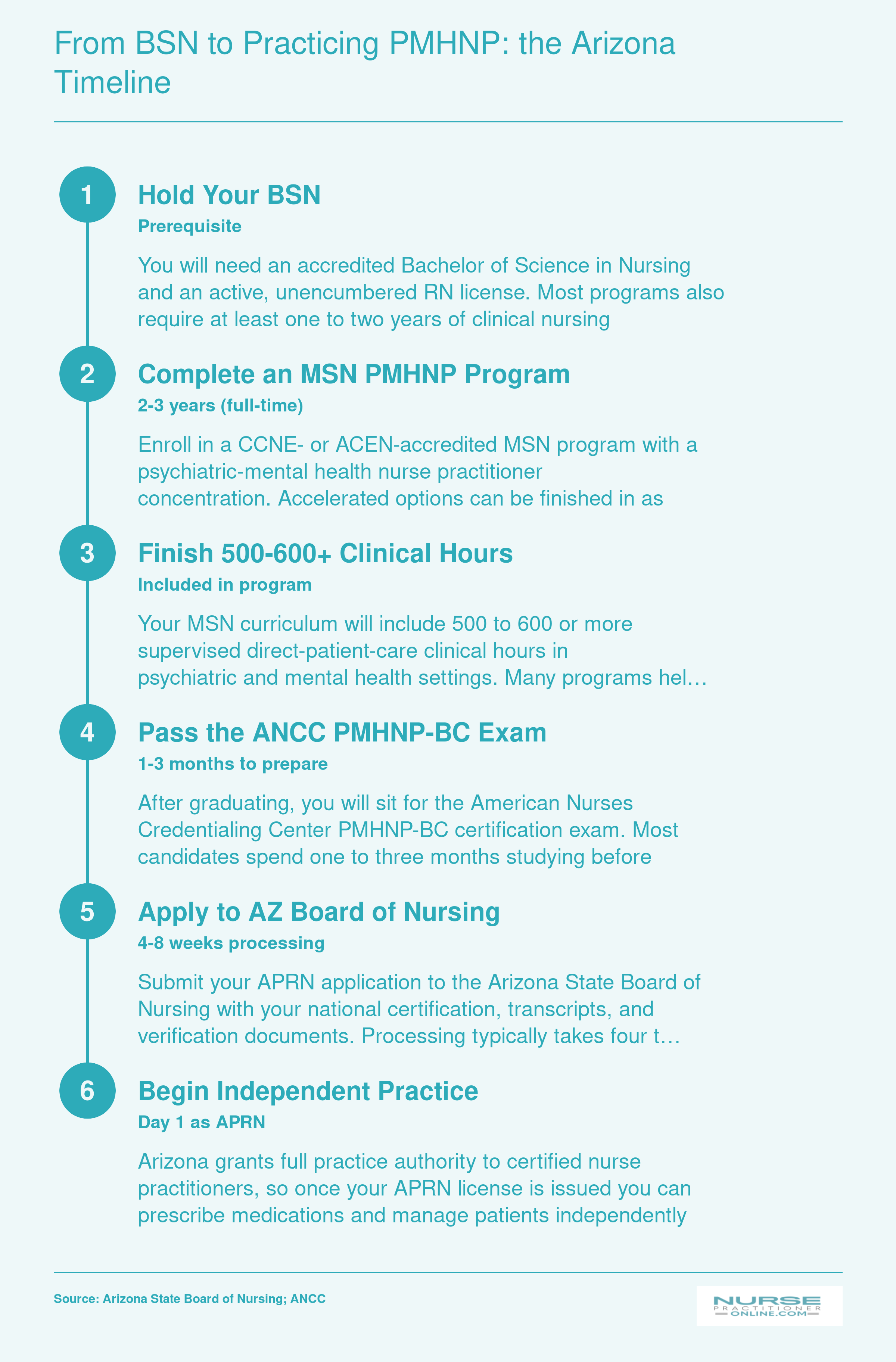
From BSN to Practicing PMHNP: The Arizona Timeline
Wondering how long the journey from BSN to practicing psychiatric-mental health nurse practitioner actually takes in Arizona? Here is the credentialing ladder with realistic timeframes at each stage.
Total Program Costs and ROI Breakdown
Spending money to make more money is the central tension every working nurse weighs when evaluating a PMHNP program. Tuition is the headline number, but the real cost of attendance stretches well beyond credit hours. Understanding the full picture helps you compare programs honestly and plan your finances before you enroll.
Tuition Anchors for Phoenix-Area Programs
Across the programs reviewed for this article, tuition ranges considerably depending on school type and residency status. Northern Arizona University's hybrid MSN program carries in-state tuition of roughly $13,000 per year at the institution level, making it one of the more affordable options for Arizona residents. Grand Canyon University's fully online PMHNP program is priced at $750 per credit for 53 credits, putting total tuition in the neighborhood of $39,750. University of Phoenix charges approximately $540 per credit for a 52-credit program, landing around $28,000 in tuition. These figures give you a workable range: roughly $26,000 to $40,000 in tuition alone, depending on the school and your residency status.
The Hidden Costs That Add Up
Tuition is only the starting point. When you build a realistic budget, add in the following:
- Technology fees: Many programs charge $300 to $500 per term. Walden University, for example, lists approximately $349 per term in additional fees, which can add $1,400 or more over a two-year program.1
- Clinical placement and preceptor-finding services: Some programs facilitate placement at no extra charge; others offer optional third-party matching services ranging from $500 to $1,500.
- Liability and malpractice insurance: Student coverage typically runs $30 to $100 per year, but you may carry your own policy for broader protection.
- Background checks and drug screening: Expect $100 to $200 at enrollment and potentially again at clinical sites.
- On-site intensives or residencies: Travel, lodging, and meals for a multi-day campus residency can run $500 to $1,500 depending on distance and duration.
- ANCC certification exam: The Psychiatric-Mental Health Nurse Practitioner board exam fee is currently around $395 for ANA members and $495 for non-members.
Adding these supplementary costs to tuition, a realistic total cost of attendance for a Phoenix-area PMHNP program falls in the range of $29,000 to $45,000, with program structure and individual choices moving you toward either end.
Connecting Cost to Return
Program-level earnings data for these specific PMHNP concentrations is not yet available through federal reporting channels, so treat published figures cautiously rather than as guarantees. What is well-documented at the broader occupational level: nurse practitioners in Arizona earn a median annual salary in the range of $115,000 to $125,000, with psychiatric NPs often commanding a premium given the statewide shortage of mental health providers.
Median graduate debt figures vary by school. University of Phoenix students carry a notably higher median debt load than NAU graduates, which matters when you are projecting monthly loan payments against a new PMHNP salary. A rough rule of thumb: if your total debt at graduation stays below one year's expected salary, the investment is generally considered manageable by financial planning standards. If you are comparing costs across a wider set of schools, our guide to the best online PMHNP programs offers detailed tuition and fee breakdowns for nationally ranked options.
The bottom line is that even at the higher end of this cost range, a PMHNP credential typically delivers a meaningful salary increase over a registered nurse baseline within the first year or two of practice, making the investment worthwhile for most nurses who complete the program and enter the workforce in a full-time capacity.
Clinical Placements and Preceptor Support in the Phoenix Area
Clinical placements are the supervised, real-world hours you spend assessing and treating patients under a licensed preceptor, and they are the single biggest variable in how quickly you earn your PMHNP degree.
The two paths: guaranteed placement versus self-sourcing
Many online PMHNP programs distinguish themselves by whether they offer a preceptor guarantee or require you to self-source. A guaranteed placement program typically assigns a coordinator who finds and vets a preceptor for you, often within a specific geographic radius. In practice, true guarantees are rare. Even when a program promises assistance, coordinator effectiveness tends to be limited, and you may face waitlists, limited site options, or the expectation that you will help identify leads.1 Programs without a guarantee place all the responsibility on your shoulders: you must network, cold-call clinics, and often pay for a matching service out of pocket. This distinction directly affects your stress level and your graduation timeline. If you are still comparing online MSN PMHNP programs, pay close attention to each school's placement support language before committing.
Why the Phoenix area is especially competitive
The Phoenix metro is home to multiple PMHNP programs, and they all compete for a finite pool of psychiatric preceptors.2 Community mental health centers, private practices, and major health systems like Banner Health, Valleywise Health, and the Phoenix VA have limited capacity and often give first priority to students from affiliated state universities, employees, or longstanding contracts.1 Nationally, there is a well-documented shortage of PMHNP preceptors, and Phoenix mirrors that trend exactly.1 It is not unusual for students to spend three to six months searching for a clinical slot, especially if they are limited to Maricopa County. Many resort to paid preceptor matching services or expand their search to rural Arizona, where demand is lower.2
How to navigate this landscape with practical strategies
Start networking as early as possible, ideally before you even enroll. Join the Arizona Nurses Association, attend local psychiatric nursing conferences, and connect with practicing PMHNPs on professional platforms. If you currently work in a healthcare setting, ask your employer about tuition support or internal placement pathways; employees at systems like Banner or Valleywise sometimes receive placement preference. Be willing to commute or consider a rural rotation outside Maricopa County. Rural sites often have fewer competing students and can lead to unique learning experiences. Finally, ask programs point-blank how many students in the last cohort found a preceptor within 30 days of their requested start date, and what happens if you cannot secure one. That transparency will tell you more than any marketing claim.
Why placement speed dictates your timeline
Arizona PMHNP programs require between 500 and 600+ direct patient care clinical hours, split across three or more semesters. Each semester you spend hunting for a preceptor adds months to your timeline and delays your eligibility for the ANCC certification exam. Even in a "fastest" format, a single placement gap can push graduation back by a year. The speed of your program is irrelevant if you cannot start your clinicals on schedule. Treat the clinical placement plan as your make-or-break factor when comparing programs.
Related Articles
PMHNP Salary and Job Outlook in Arizona
Psychiatric-mental health nurse practitioners in Arizona earn significantly above the national median for nurse practitioners, and the specialty commands a premium driven by an acute statewide shortage of mental health providers.
National Baseline for Nurse Practitioner Wages
Nationwide, nurse practitioners (BLS SOC 29-1171) earned a median annual wage of $121,610 as of May 2022, according to the Bureau of Labor Statistics.1 The 25th percentile stood at $103,250, while the 75th percentile reached $135,470. These figures represent all nurse practitioner specialties combined; psychiatric-mental health is not separately tracked by BLS occupational codes, but industry surveys consistently show PMHNPs earning at or above the 75th percentile for the profession.
How Much Does a PMHNP Make in Phoenix, AZ?
In the Phoenix-Mesa-Chandler metropolitan area, nurse practitioners typically earn between $110,000 and $145,000 annually depending on experience, setting, and subspecialty. PMHNPs in the region often see starting offers in the $125,000 to $140,000 range, with experienced practitioners exceeding $160,000 in high-demand areas. Many employers in Phoenix add signing bonuses ranging from $5,000 to $15,000 to attract candidates quickly.
Why Psychiatric NPs Command a Premium
Arizona faces a severe shortage of mental health providers. Large portions of the state carry federal Health Professional Shortage Area (HPSA) designations for mental health, particularly in rural counties and underserved urban neighborhoods. This shortage directly impacts PMHNP compensation: employers compete for a limited pool of qualified providers, driving salaries upward and supporting generous benefit packages, loan repayment assistance, and schedule flexibility.
Job Growth and Long-Term Outlook
The demand for psychiatric nurse practitioners continues to outpace supply. Arizona's population growth, coupled with expanding Medicaid coverage for behavioral health and rising awareness of mental health needs, has created robust job security. Many PMHNPs work in private practice, community mental health centers, integrated care models within primary care nurse practitioner settings, telehealth companies, and hospital psychiatric units. Each setting offers distinct salary structures, but all reflect the state's urgent need for mental health prescribers.
For nurses considering the PMHNP track near Phoenix, the financial return on a master's degree is strong and accelerating. The combination of competitive base salaries, shortage-driven incentives, and diverse practice opportunities makes the specialty one of the most financially rewarding advanced practice roles in Arizona's nursing landscape.
PMHNPs typically earn above this NP median
Admission Requirements and Selectivity for Phoenix-Area PMHNP Programs
Grand Canyon University sets its MSN Psychiatric Mental Health Nurse Practitioner program minimum GPA at 2.8, which is notably more accessible than the 3.0 floor many competing programs require.1 That single detail matters a great deal if you finished your BSN several years ago and your transcript reflects a difficult season.
Core Requirements Across the Board
Most Phoenix-area PMHNP programs share a short list of non-negotiable requirements. You will need:
- Active RN license: An unencumbered, current license in the state where you practice (or compact eligibility).
- BSN degree: From a regionally or nationally accredited institution. Associate-degree RNs typically need to complete an RN-to-BSN before applying.
- Clinical experience: Programs most commonly ask for one to two years of post-licensure RN experience. Psychiatric or behavioral health experience is frequently preferred, though not always required for admission.
- Prerequisite coursework: Statistics, health assessment, and pathophysiology appear on many programs' checklists. If you completed these during your BSN, you are usually covered, but verify with each school before applying.
What GCU Specifically Requires
For GCU's MSN PMHNP program, the published list is straightforward. You need an accredited BSN, a minimum 2.8 GPA, an active unencumbered RN license, and at least two years of RN work experience.2 The application also calls for a current CV and a letter of intent.2 GCU offers multiple start dates throughout the year rather than a single annual cohort deadline, which gives working nurses real scheduling flexibility. Formal application deadlines and cohort acceptance rates are not publicly listed, so reaching out to an enrollment advisor early in your planning is the practical move. If you need a refresher on the enrollment process, our guide on how to enroll in NP school online walks through each step.
Selectivity and Timing
Because demand for psychiatric NPs continues to outpace supply, PMHNP programs in Arizona have grown more competitive over the past few years. Rolling or multiple-start admissions (like GCU's model) reduce the pressure of missing one annual window, but do not mistake that flexibility for low selectivity. Strong applications typically include relevant psych or med-surg experience, a focused letter of intent, and a GPA that clears the program floor with some margin. Applying as soon as your materials are ready, rather than waiting for a specific semester cycle, gives you the best chance of securing a seat in your preferred start term.
Questions to Ask Yourself
Accreditation, ANCC Certification, and Arizona APRN Licensure
What accreditation do I need from my PMHNP program to sit for the ANCC board exam and practice independently in Arizona?
This question sits at the intersection of educational choices and career viability. Choosing a program without proper accreditation can derail your entire certification pathway, while understanding Arizona's practice environment helps you appreciate what awaits after graduation.
Why CCNE or ACEN Accreditation Is Non-Negotiable
The American Nurses Credentialing Center requires that PMHNP-BC exam candidates graduate from a program accredited by either the Commission on Collegiate Nursing Education or the Accreditation Commission for Education in Nursing.1 This is not a preference or recommendation. It is an eligibility requirement with no exceptions.
All programs serving the Phoenix area that appear in quality rankings maintain current CCNE or ACEN accreditation. Grand Canyon University's MSN-PMHNP program holds CCNE accreditation, as do the other regional and online options available to Arizona nurses. Before enrolling anywhere, verify current accreditation status directly through CCNE's or ACEN's public databases, since accreditation can lapse or change during your enrollment period. Our nursing accreditation guide walks you through the differences between CCNE and ACEN so you can evaluate programs with confidence.
ANCC PMHNP-BC Exam Pass Rates
The national pass rate for the ANCC PMHNP-BC exam currently stands at approximately 82 percent, which represents a notable decline from historical rates that ranged between 88 and 91 percent in earlier years.2 This drop reflects the exam's evolving rigor and the expanding candidate pool.
Unfortunately, program-specific pass rates are not publicly reported by ANCC or consistently disclosed by individual schools.3 Grand Canyon University does not publish its PMHNP board pass rate data, and this opacity extends across most programs nationally. When evaluating schools, ask admissions representatives directly for internal pass rate data, though be aware that reporting standards vary and some programs may decline to share these figures.
Arizona's Full Practice Authority Advantage
Arizona grants nurse practitioners full practice authority, placing it among the most NP-friendly states in the country.1 For PMHNPs, this means:
- Independent practice: You can evaluate, diagnose, and treat patients without physician supervision or collaborative agreements.
- Full prescriptive authority: Arizona permits NPs to prescribe all medications independently, including Schedule II controlled substances commonly used in psychiatric care.
- No transitional period: Unlike many states that require supervised practice hours before independent practice, Arizona imposes no such transitional requirement as of 2026.
- DEA registration: You will need your own DEA number for controlled substance prescribing, which you can obtain upon receiving your Arizona APRN license.
This regulatory environment means new PMHNPs can establish independent practices or join healthcare organizations with full autonomy from day one of licensure. If you are considering advancing beyond the MSN, DNP PMHNP programs can open doors to leadership and academic roles while building on the clinical foundation you establish here.
Recent Legislative Landscape
Arizona's APRN scope of practice laws have remained stable through 2025 and into 2026, with no significant legislative changes restricting or expanding current authority. The state continues to support full practice authority, and no pending bills as of mid-2026 threaten the independent practice rights PMHNPs currently enjoy. This stability makes Arizona an attractive long-term practice destination for psychiatric nurse practitioners seeking professional autonomy.
Scholarships, Loan Repayment, and Arizona HPSA Programs for PMHNPs
The real question is not whether you can afford a PMHNP program, but how much of the bill someone else will pay if you commit to serving where the need is greatest. Arizona's mental health workforce shortage is severe enough that most of the state qualifies for federal loan repayment, which can shift the financial math substantially in your favor. For a broader look at available programs, our guide to student loan forgiveness options for nurse practitioners covers every major federal pathway.
NHSC Loan Repayment in Arizona Mental Health HPSAs
The National Health Service Corps Loan Repayment Program is the largest single source of debt relief for PMHNPs.1 In exchange for a two-year full-time commitment (40 hours per week, at least 45 weeks per year) at an approved site in a Mental Health Health Professional Shortage Area, PMHNPs can receive up to $50,000 at sites scoring 14 or higher on the HPSA index, or $30,000 at lower-scored sites.2 Half-time service (20 hours per week) is available at a reduced award of $25,000. After the initial contract, you can extend in one-year continuation contracts for additional repayment.1
Eligible sites include Federally Qualified Health Centers, Community Mental Health Centers, Rural Health Clinics, Indian Health Service and tribal facilities, and correctional or public hospital outpatient settings.3 The vast majority of Arizona counties carry at least partial Mental Health HPSA designation, so finding a qualifying employer in or around Phoenix, Tucson, Flagstaff, or the rural reservations is realistic for new graduates.
Nurse Corps, State, and Institutional Options
The HRSA Nurse Corps Loan Repayment Program covers APRNs at Critical Shortage Facilities in HPSAs, and the Nurse Corps Scholarship Program pays tuition and fees for current MSN, DNP, or post-master's PMHNP students who commit to post-graduation service.4 Arizona also participates in the NHSC State Loan Repayment Program, which sets its own service terms (minimum two years) and site list.5
Beyond federal dollars, look at employer tuition reimbursement from Banner Health, HonorHealth, Dignity Health, and Mayo Clinic Arizona, plus PMHNP-specific scholarships from the American Association of Nurse Practitioners, the American Psychiatric Nurses Association, and program-level merit and diversity awards offered by ASU, GCU, and Northern Arizona University.
Frequently Asked Questions About PMHNP Programs Near Phoenix
Below are answers to the questions nurses ask most often when researching psychiatric mental health nurse practitioner programs in the Phoenix metro area. Each answer draws on the program details, costs, and career data covered earlier in this article.
- How long is the University of Phoenix PMHNP program?
- The University of Phoenix does not currently offer a standalone PMHNP specialty track. Nurses in the Phoenix area often consider programs at Grand Canyon University, the University of Arizona, or nationally accredited online options instead. Program lengths for MSN PMHNP tracks in the region typically range from about two to three years of full time study, depending on prior coursework and clinical hour requirements.
- How long does it take to become a PMHNP in Arizona?
- Starting from a BSN, most nurses can complete an MSN PMHNP program in roughly two to three years. After graduation, you will need to pass the ANCC Psychiatric Mental Health Nurse Practitioner board certification exam and apply for Arizona APRN licensure through the Arizona State Board of Nursing. From enrollment to first day of practice, the full timeline is commonly 2.5 to 3.5 years.
- What is the fastest way to become a psychiatric nurse practitioner?
- The quickest path is enrolling in an accelerated or year round MSN PMHNP program that allows continuous coursework without semester breaks. Some online programs designed for working nurses can be completed in as few as five to six semesters. Choosing a school that provides dedicated preceptor placement support also helps avoid delays in logging the 500 or more required clinical hours.
- How much does a PMHNP make in Phoenix, AZ?
- Psychiatric mental health nurse practitioners in the Phoenix metropolitan area earn a median annual salary that generally falls between approximately $130,000 and $155,000, depending on practice setting, experience, and whether the role is in outpatient, inpatient, or telehealth. Demand for behavioral health providers across Arizona continues to push compensation upward, especially in underserved and rural communities surrounding Phoenix.
- Are clinical placements guaranteed for PMHNP programs near Phoenix?
- Policies vary by school. Some programs, such as certain national online universities, require students to secure their own preceptors, while others offer dedicated clinical placement coordinators who match students with Phoenix area psychiatric sites. Before enrolling, confirm whether your program guarantees placement support, because finding qualified PMHNP preceptors on your own can add months to your timeline.
- What are the admission requirements for GCU's PMHNP program?
- Grand Canyon University's MSN PMHNP track generally requires an unencumbered RN license, a BSN from a regionally accredited institution, a minimum cumulative GPA (typically around 3.0), and at least one year of clinical nursing experience. Applicants also submit a professional resume, goal statement, and official transcripts. Specific prerequisites may be updated each cycle, so check GCU's admissions page for the latest 2026 requirements.
- Does Arizona grant full practice authority to PMHNPs?
- Arizona is a full practice authority state, meaning PMHNPs can evaluate, diagnose, and prescribe (including controlled substances) without a collaborative agreement with a physician after meeting initial transition to practice requirements. This regulatory environment makes the state especially attractive for new PMHNP graduates who want to open independent practices or work in underserved communities without the added step of securing physician oversight.