Most important takeaways…
- ASU and the University of Arizona both offer hybrid or online DNP pathways leading to PMHNP certification near Tempe.
- The University of Arizona's ANEW Scholarship awards up to $25,000 to qualifying PMHNP students.
- Phoenix metro PMHNPs earn well above the national median NP salary, reflecting strong demand in designated shortage areas.
- The PMHNP-BC certification exam had a national first-time pass rate of 82% in 2025, making program quality critical.
Arizona's Maricopa County added more than 200 psychiatric NP job postings in 2025 alone, reflecting a statewide shortage that shows no sign of easing. For working nurses in the Tempe area ready to move into this high-demand specialty, the real obstacle is often cost: graduate tuition for PMHNP programs can range from roughly $30,000 to well over $80,000, depending on the school and degree level.
That spread makes program selection a financial decision as much as an academic one. Net price after aid, clinical placement logistics, and format flexibility all shape the true cost of earning your certification. Whether you pursue an MSN to DNP PMHNP program or a post-master's certificate, median PMHNP salaries in metro Phoenix run well above the national average for registered nurses, so the return on a carefully chosen program remains strong.
Best Budget-Friendly PMHNP Programs Near Tempe, Arizona, Ranked
If you're a working nurse in the Tempe area looking to specialize in psychiatric mental health, cost matters. We ranked these Arizona-based PMHNP programs primarily by net price so you can compare real affordability alongside program quality. Every school listed below is accessible to Tempe residents through online, hybrid, or commutable formats, and each prepares graduates for national PMHNP certification.
- Net price and tuition affordability
- Institution-level graduation rate
- Program format and flexibility
- Grant and scholarship availability
- Clinical placement relevance
- NCES-IPEDS federal institutional data — nces.ed.gov
- College Scorecard graduate earnings — collegescorecard.ed.gov
- Internal program database
- Independent program research

Arizona State University
ASU is the hometown choice for Tempe-area nurses, with its DNP PMHNP program headquartered at the Downtown Phoenix campus, just minutes away. The hybrid digital-immersion model blends online coursework with intensive on-campus experiences and local clinical rotations, letting you keep working while you earn your doctorate. ASU pairs competitive public-university tuition with strong grant and financial aid options, including military-friendly policies. Faculty are practicing clinicians who bring real-world psychiatric expertise into every course.
- Hybrid format with in-person immersions near Tempe
- 85 total credit hours with 1,125 practicum hours
- No entrance exam required, 3.0 GPA minimum
- Rotations in underserved Arizona communities
- Prepares for national PMHNP certification exam
- Financial aid and military tuition benefits available
- Practicing faculty teach all specialty courses
- Fall start with flexible scheduling for working RNs
Doctor of Nursing Practice, Psychiatric Mental Health Nurse Practitioner — Hybrid

University of Phoenix-Arizona
University of Phoenix delivers a fully online MSN PMHNP designed for busy nurses who need maximum schedule flexibility. The 52-credit program costs $540 per credit and includes just a five-day campus residency, making it one of the most convenient options for Tempe-area RNs. A built-in bridge pathway lets nurses without a BSN work through one institution from start to finish, potentially saving time and money on transfer credits. The curriculum is CCNE-accredited and covers neuropsychiatric assessment, psychopharmacology, and psychotherapy across the lifespan.
- Fully online with one five-day campus residency
- 52 credits at $540 per credit, no application fee
- CCNE-accredited, prepares for ANCC certification
- Bridge pathway for RNs without a BSN
- No GMAT, GRE, or entrance essay required
- Transfer credits and employer tuition benefits accepted
- Covers psychopharmacology and lifespan mental health
- 24/7 student support with experienced faculty
Master of Science in Nursing, Psychiatric Mental Health Nurse Practitioner — Online

Northern Arizona University
NAU offers both a hybrid Master of Science with a PMHNP concentration and a post-master's Graduate Certificate for nurses who already hold an MSN. Both pathways are CCNE-accredited and emphasize culturally responsive care, with particular strength in serving rural, Indigenous, and underserved communities. The institution-wide graduation rate sits at about 61%, and the average net price of roughly $14,158 makes NAU one of the most affordable public options in the state. In-state tuition runs approximately $13,023, while out-of-state students pay around $19,306.
- Hybrid format with online courses and clinical training
- CCNE-accredited with expert faculty mentorship
- Culturally responsive care and Indigenous health focus
- Two specialty track options within the MSN
- Prepares graduates for advanced practice certification
- Designed for working nurses with flexible scheduling
- Post-master's certificate for already credentialed APRNs
- Online delivery with clinical training components
- Requires master's degree in nursing and active RN license
- State-of-the-art simulation labs for skills practice
- Focus on mental health care across the lifespan
- Accredited by CCNE, affordable public tuition
Master of Science in Nursing, Psychiatric Mental Health Nurse Practitioner — Hybrid
Graduate Certificate, Psychiatric Mental Health Nurse Practitioner — Hybrid

University of Arizona
The University of Arizona brings strong research infrastructure and notable grant funding to its PMHNP offerings. Students in the DNP pathway may qualify for up to $25,000 through the HRSA ANEW grant or up to $32,500 through the BHWET grant when completing clinical rotations in Arizona, a significant cost offset for Tempe-area nurses. The online Graduate Certificate is a focused 30-credit, four-semester option for nurses who already hold an MSN. With an institution-wide graduation rate of about 68% and a net price near $16,674, U of A balances affordability with the resources of a top-tier research university.
- Hybrid format: online courses plus Tucson campus intensives
- 70 credit hours with 720 clinical hours
- $1,053 per credit, full-time and part-time options
- Up to $32,500 in HRSA grant funding for Arizona clinicals
- Ranked among the top 20 DNP programs nationally
- Prepares for PMHNP career and prescriptive authority
- Designed for RNs with a BSN or MSN
- Average cohort size of about 30 students
- Online format with select campus experiences in Tucson
- 30 credits at $1,053 per credit over four semesters
- Part-time schedule built for working registered nurses
- 765 clinical practicum hours required
- Covers advanced psychiatric theories across the lifespan
- Prepares graduates for PMHNP national board certification
Doctor of Nursing Practice, Psychiatric Mental Health Nurse Practitioner — Online
Graduate Certificate, Psychiatric Mental Health Nurse Practitioner — Online

Grand Canyon University
Grand Canyon University rounds out the Phoenix-metro options with a fully online MSN featuring a PMHNP emphasis. The 53-credit program includes 750 clinical hours, on-campus immersion experiences, and a curriculum that integrates evidence-based practice with a Christian worldview. GCU's net price of roughly $22,472 is higher than the public universities on this list, so it suits students who value its faith-based learning community and the convenience of a Phoenix-based private institution. The institution-wide graduation rate is approximately 44%.
- Online format with on-campus immersion experiences
- 53 credits including 750 clinical hours
- Tuition of $750 per credit
- Requires BSN and active RN license for admission
- Integrates Christian principles with evidence-based care
- Covers advanced pharmacology and diagnostic reasoning
- Interprofessional collaboration and cultural competence focus
- Accredited by HLC since 1968
MSN, Psychiatric Mental Health Nurse Practitioner Emphasis — Online
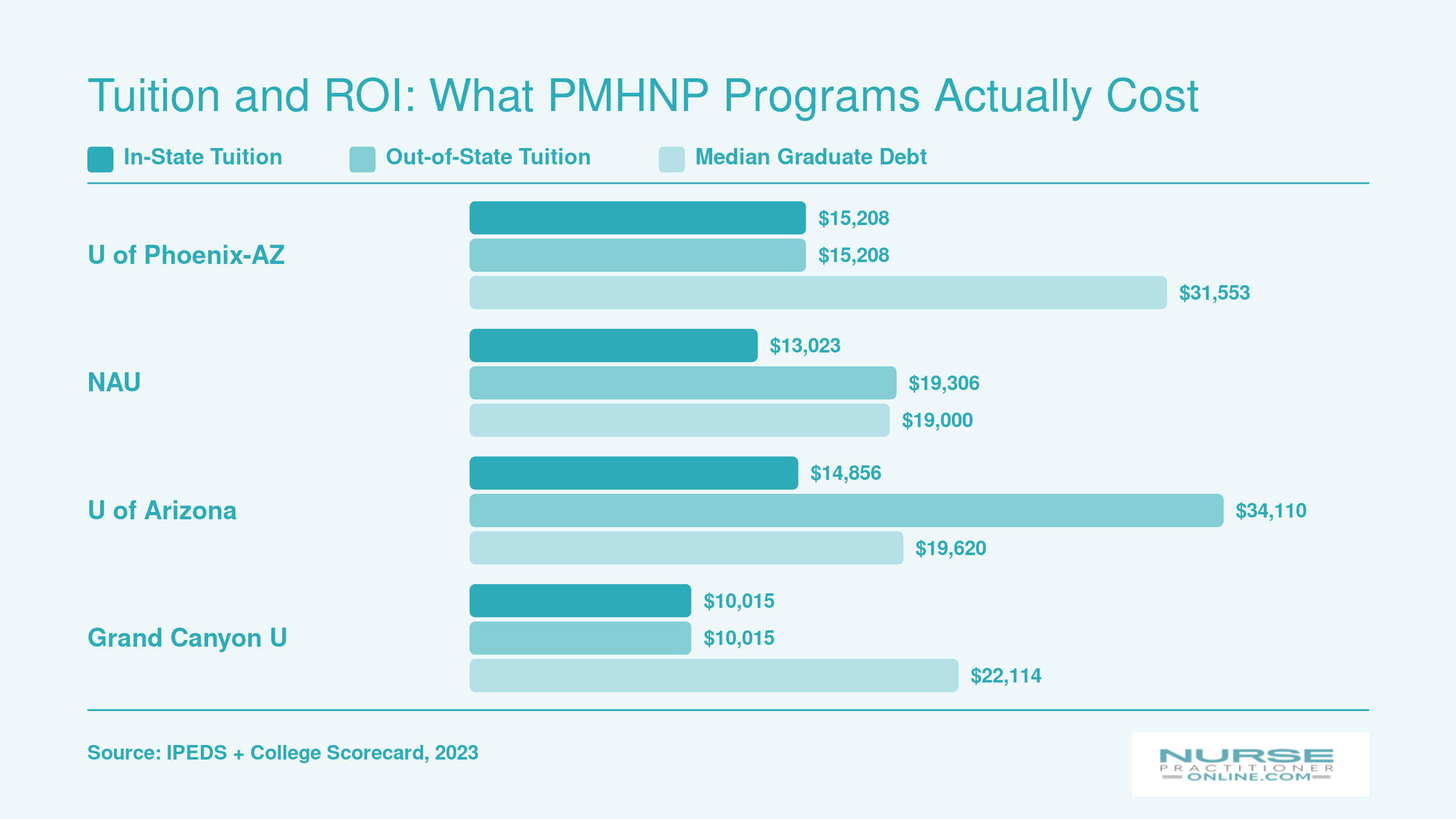
Tuition and ROI: What PMHNP Programs Actually Cost
Tuition varies widely among Arizona PMHNP programs, and so does the debt you may carry at graduation. The net price figures below are institution-wide averages after financial aid, not a per-student guarantee. Program-level earnings and debt data are not yet available for these PMHNP tracks, so use the school-wide median graduate debt as a rough benchmark when weighing your return on investment.
ASU vs University of Arizona: PMHNP Program Breakdown
If you're weighing your options between Arizona's two flagship universities for a PMHNP pathway, this side-by-side comparison should help clarify what each program offers. Both ASU and the University of Arizona deliver hybrid or online DNP programs that prepare you for ANCC certification, but they differ meaningfully in credit requirements, cost structure, and format. Keep in mind that both universities also offer post-master's graduate certificate options for nurses who already hold an MSN.
| Feature | Arizona State University (ASU) | University of Arizona (UA) |
|---|---|---|
| DNP PMHNP Degree | Advanced Nursing Practice (PMHNP) DNP | DNP, Psychiatric Mental Health Nurse Practitioner Specialty |
| Total Credits (DNP) | 85 credits | 64 to 70 credits |
| Clinical Hours (DNP) | Approximately 1,125 hours | Approximately 765 hours (certificate track); DNP clinical hours may vary |
| Program Format | Hybrid: online coursework with in-person immersion days | Hybrid: primarily online with select campus experiences |
| Typical Program Length | Roughly 3 to 4 years (full-time or part-time options) | Varies; certificate track runs about 4 semesters part-time |
| Graduate Certificate Option | Yes, 28-credit PMHNP post-master's certificate | Yes, 30-credit PMHNP post-master's certificate at roughly $1,053 per credit |
| Minimum GPA for Admission | 3.0 cumulative GPA | Generally 3.0 GPA; check current requirements |
| Entrance Exam | No entrance exam required | No GRE required for most applicants |
| Letters of Recommendation | Minimum 3 letters | Required (number may vary by cycle) |
| Start Date | Fall start | Not offered every cycle; verify availability before applying |
| ANCC Certification Prep | Prepares graduates for the national PMHNP certification exam | Prepares graduates for the national PMHNP certification exam |
| ANCC Pass Rates | Not publicly confirmed at this time; contact ASU for the latest data | Not publicly confirmed at this time; contact UA for the latest data |
| Location | Scottsdale/Tempe metro (local to Tempe nurses) | Main campus in Tucson; online delivery reduces travel needs |
Questions to Ask Yourself
Online and Hybrid PMHNP Options for Tempe-Area Nurses
Fully online coursework from your living room versus hybrid programs that bring you to campus a few times a year: both paths can lead to the same PMHNP certification, but the day-to-day experience is very different. Understanding the format of each program helps you protect your work schedule, plan ahead for travel, and avoid surprises once classes start.
Three Formats You Will See
PMHNP programs generally fall into three delivery categories, and the programs ranked for the Tempe area span all of them.
- Fully online: Coursework is delivered entirely through a learning management system. University of Phoenix, Maryville University, Walden University, Western Governors University (WGU), Grand Canyon University, and the University of Arizona graduate certificate all use this model for didactic content.1 Some are asynchronous, letting you watch lectures and complete assignments on your own timeline, while others schedule live virtual sessions one or two evenings a week.
- Hybrid with on-campus intensives: Arizona State University's DNP with a PMHNP focus and Northern Arizona University's graduate certificate both require periodic in-person immersion days.3 Expect roughly two to four campus visits per year for simulation labs, skills check-offs, or orientation sessions. ASU holds immersions in the Phoenix metro, which is convenient if you live near Tempe.
- Traditional campus-based: Less common for working nurses, but some local programs still require weekly on-site attendance. None of the top-ranked programs in this guide rely exclusively on that model.
Keep in mind that "online" does not mean zero travel. University of Phoenix, for instance, includes a five-day campus residency even though the rest of its MSN PMHNP coursework is online.1
Out-of-State Programs That Welcome Arizona Residents
Several nationally recognized online MSN PMHNP programs accept Arizona residents and charge a flat-rate tuition regardless of where you live. Maryville University and Walden University both use a flat tuition model, so you pay the same rate as students in any other state. WGU charges a flat term-based rate, making costs predictable each semester.4 UTEP's online PMHNP program also enrolls Arizona residents, though it uses a differential tuition structure, so verify exact out-of-state costs before committing.
Before enrolling in any out-of-state program, confirm that the school holds state authorization to operate in Arizona and that your clinical hours will be accepted by the Arizona State Board of Nursing. Our guide on how to enroll in NP school online walks you through those verification steps.
Synchronous vs. Asynchronous Coursework
Asynchronous programs give you the most scheduling flexibility, which matters if you are juggling 12-hour hospital shifts. WGU's competency-based model is entirely self-paced within each term.4 Grand Canyon University and Maryville offer a mix: recorded lectures you can review anytime, paired with weekly discussion boards and periodic live sessions. If real-time interaction with faculty is important to your learning style, look for programs that list synchronous seminar hours in their course schedule.
How Clinicals Work Locally
Regardless of where your program is based, clinical rotations happen near you. Online students in the Phoenix-Tempe metro typically arrange precepted hours at behavioral health clinics, community mental health centers, or hospital psychiatry units throughout Maricopa County. Some programs, such as ASU's PMHNP graduate certificate (which requires 585 clinical hours), provide clinical placement coordinators who help match you with local sites.3 Others expect you to secure your own preceptor, so ask about placement support before you apply.
On the technology side, most programs require a reliable broadband connection, a webcam for proctored exams or live sessions, and access to electronic health record simulation platforms. A laptop that can run telehealth software smoothly is also a practical investment, since many PMHNP clinical experiences now incorporate telepsychiatry.
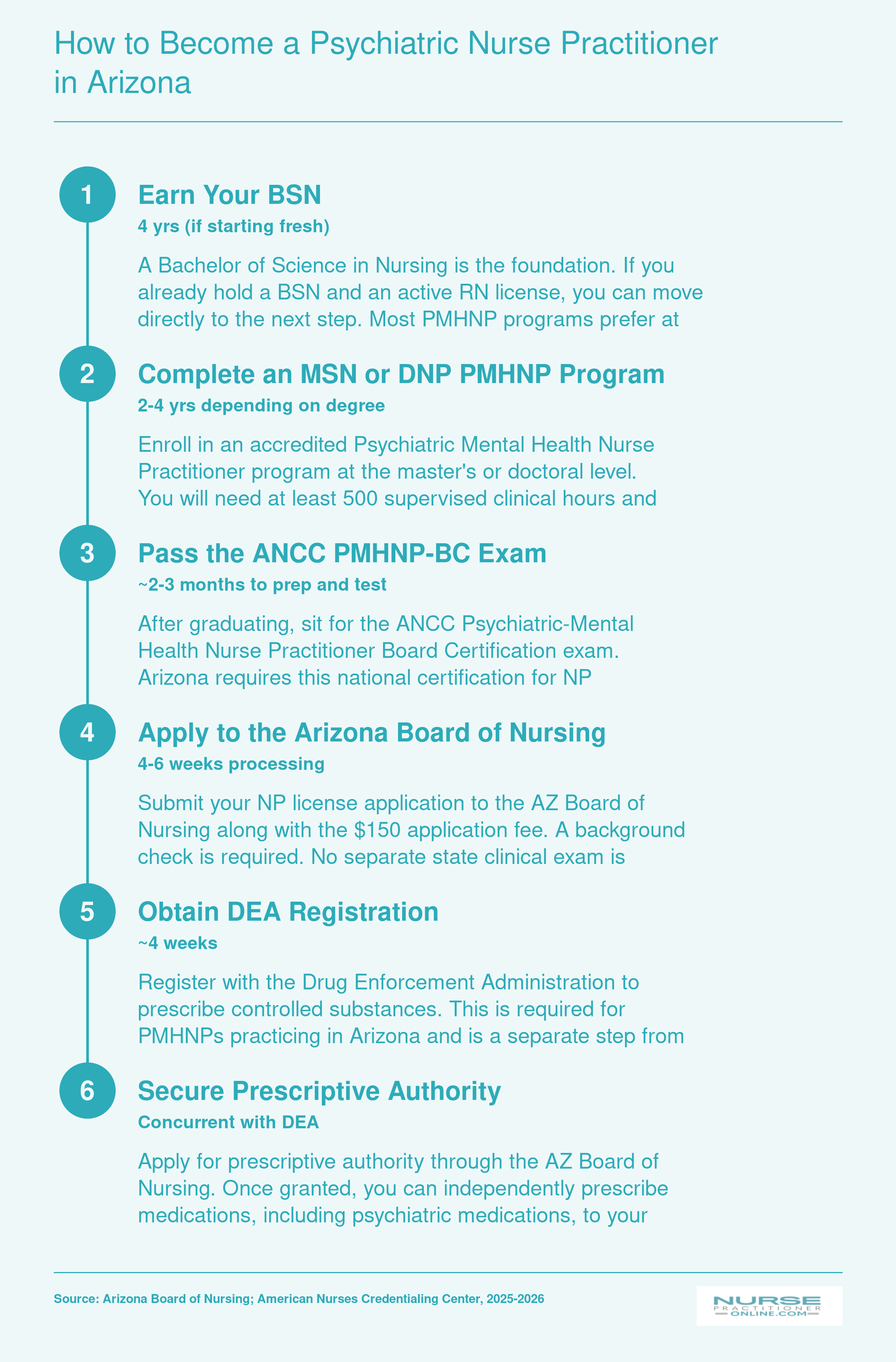
How to Become a Psychiatric Nurse Practitioner in Arizona
The path from BSN to fully licensed PMHNP in Arizona is straightforward, but each stage has its own timeline and requirements. Arizona does not require a separate state exam. Instead, the Arizona Board of Nursing accepts national certification from the ANCC as proof of competency. Here is what the full journey looks like.
Clinical Placement Support in the Phoenix-Tempe Metro
How hard is it to find psychiatric clinical placements for PMHNP students in the Phoenix area? The answer depends heavily on which program you choose and where you live. Psychiatric clinical placements are one of the biggest bottlenecks in PMHNP education nationwide, and Arizona is no exception. Site scarcity, preceptor availability, and intense competition among the growing number of NP programs create real friction for students trying to complete the 500 to 750 clinical hours required for PMHNP certification.1
School-Arranged vs Self-Placement: What It Means for You
The single most important question to ask any PMHNP program is whether they arrange clinical placements or require you to find your own. University of Arizona's DNP PMHNP program arranges placements for all students, which removes a major burden but may require some travel depending on where sites are located.2 Arizona State University offers a hybrid model: if you live in Maricopa County (which includes Tempe, Phoenix, Mesa, and Scottsdale), ASU arranges your clinical placements locally. If you live outside Maricopa County, you are responsible for self-placement, and ASU does not guarantee support.3 University of Phoenix requires all students to secure their own clinical sites and preceptors.1
For working nurses in Tempe, this distinction matters enormously. Self-placement means you will spend significant time cold-calling psychiatric practices, reaching out to former colleagues, and navigating preceptor credentialing paperwork while juggling your current job. If you want a detailed look at strategies for lining up rotations, our guide on how online NP students arrange clinicals in their local area walks through the process step by step. School-arranged placements mean the program does that legwork, though you may have less control over site selection and scheduling.
Phoenix Metro Advantages: More Sites, More Options
Tempe-area students benefit from the concentration of psychiatric and behavioral health facilities in the greater Phoenix metro. Major sites include Banner Health's behavioral health units, Valleywise Health (formerly Maricopa Integrated Health System), the Phoenix VA Health Care System, and numerous community mental health centers.2 This density gives you a relative advantage over students in rural Arizona, where psychiatric preceptors are scarce and driving distances can be prohibitive.
Practical Tips for Securing Placements
Even if your program arranges placements, you should start networking early. Attend Arizona Nurses Association (AZNA) events and join local nurse practitioner organizations to meet practicing PMHNPs who may serve as preceptors or refer you to colleagues. Introduce yourself to psychiatric providers at your current workplace or clinical rotations. Ask your program if telehealth-integrated clinical hours are allowed, as some accredited programs now permit a portion of psychiatric assessments and follow-ups to be conducted via telehealth under supervision. If you are still comparing schools nationally, our ranked list of best online PMHNP programs can help you weigh clinical placement support across a wider field. The earlier you begin building relationships, the smoother your clinical placement process will be.
PMHNP Salary and Career Outlook in Greater Phoenix
Earnings for psychiatric mental health nurse practitioners in the Phoenix area reflect a strong return on your educational investment, even though official metro-level data on NP pay is limited. The Bureau of Labor Statistics reported a national median annual wage of $121,610 for all nurse practitioners in 2024, with the middle 50% earning between $103,250 and $135,470.1 Top earners exceeded $165,240. While BLS does not publish separate figures for psychiatric NPs or for the Phoenix-Mesa-Chandler metro area specifically, many compensation surveys indicate that PMHNPs earn 10% to 15% above general NP rates due to specialized behavioral health demand.2
What Your Student Debt Might Look Like
A practical way to gauge value is to compare typical student debt to expected salary. For the Arizona-based PMHNP programs we reviewed, median graduate debt held by the typical student ranges from about $19,000 to $22,000, with some online options carrying slightly higher balances. Against a national NP median of over $121,000, the debt-to-income ratio appears manageable, likely below 20% for most Arizona graduates. Keep in mind that program-level earnings statistics are not yet available, so this uses broad NP salary data as a benchmark. Your actual starting pay will depend on practice setting, experience, and local market conditions, but the overall picture suggests a solid financial path. If you are still weighing program options, our guide to best online PMHNP programs can help you compare costs and outcomes side by side.
Strong Demand for Psychiatric NPs in Arizona
Several factors make Greater Phoenix a hotspot for mental health practitioners. Arizona faces a well-documented behavioral health workforce shortage, especially in rural and underserved communities that often rely on telehealth connections to urban hubs like Tempe or downtown Phoenix. Proposition 204 continues to channel dedicated behavioral health funding into the state, expanding service capacity and creating jobs. Telepsychiatry roles have grown rapidly, letting PMHNPs work from home while serving patients statewide. These demand drivers mean new graduates typically have multiple employment options across hospitals, outpatient clinics, private practices, and virtual care platforms, with steady upward pressure on compensation. For nurses exploring other nurse practitioner specialties, the same workforce dynamics are pushing salaries higher across the board in Arizona.
According to the American Nurses Credentialing Center, the national first-time pass rate for the PMHNP-BC certification exam was 82% in 2025. That means choosing a rigorous, well-supported program really does matter when it comes to clearing this high-stakes milestone on your path to practice.
Frequently Asked Questions About PMHNP Programs Near Tempe
Choosing a PMHNP program is a big decision, especially when you are balancing a nursing career and a budget. Below are answers to the questions Tempe-area nurses ask most often about cost, format, timeline, and career outlook.
- How much does ASU's PMHNP program cost in total?
- Arizona State University offers a hybrid DNP with a PMHNP concentration that requires 85 total credit hours. Published per-credit tuition is roughly $10,843 per year for both in-state and out-of-state students. Because total cost depends on how many semesters you need and any fee changes, you should confirm the latest per-credit rate directly with ASU's Edson College of Nursing and Health Innovation before applying.
- What is the cheapest psychiatric nurse practitioner program available to Arizona residents?
- For Arizona residents already holding an MSN, Northern Arizona University's PMHNP graduate certificate is one of the most affordable paths, with in-state tuition listed around $13,023 per year. University of Phoenix also advertises $540 per credit for its 52-credit MSN-PMHNP track (approximately $28,080 total). Compare net price after financial aid, because scholarships can shift the real cost considerably.
- Can you complete a PMHNP program entirely online while living in Tempe?
- Several programs are designed for remote learners. The University of Arizona and Grand Canyon University both offer online PMHNP tracks, though each requires brief on-campus immersion days. University of Phoenix's MSN-PMHNP includes a five-day residency. ASU's DNP is hybrid, combining online coursework with periodic in-person sessions in the Phoenix metro. All programs still require local clinical rotations.
- How long does it take to become a psychiatric nurse practitioner in Arizona?
- Timeline varies by entry point. BSN-to-DNP programs at ASU typically take about three to four years of full-time study (85 credits plus 1,125 clinical hours). An MSN-to-PMHNP certificate at Northern Arizona University or the University of Arizona can be completed in roughly four semesters of part-time work. After graduation, you must pass the ANCC PMHNP certification exam before applying for Arizona licensure.
- How much do psychiatric nurse practitioners earn in the Phoenix-Tempe area?
- Psychiatric nurse practitioners in the greater Phoenix-Tempe metro consistently rank among the higher-paid advanced practice providers in Arizona. While program-level earnings data for specific schools are not yet published, industry salary surveys and Bureau of Labor Statistics figures place the median annual wage for nurse practitioners in the Phoenix metro above $120,000, with PMHNP specialists often earning at or above that range due to strong demand.
- What are the ANCC PMHNP certification pass rates for Arizona schools?
- Schools report certification pass rates at different intervals, and not all Arizona programs have published current ANCC PMHNP exam data. When evaluating a program, ask the admissions office directly for their most recent first-time pass rate. CCNE-accredited programs such as those at ASU, NAU, and the University of Arizona generally maintain strong board outcomes, but you should verify the numbers before enrolling.
- Does Arizona require a collaborative agreement for PMHNPs to practice independently?
- No. Arizona grants full practice authority to nurse practitioners, including PMHNPs. That means you can evaluate, diagnose, treat, and prescribe independently without a collaborative agreement with a physician. The Arizona State Board of Nursing is the sole regulatory body overseeing NP practice. This makes Arizona one of the more favorable states for PMHNPs who want autonomous practice right after certification.