Most important takeaways…
- Only two accredited universities in Florida currently offer dedicated pediatric NP or DNP tracks.
- Full-time BSN-to-DNP pediatric programs typically require about three years across eight to nine semesters.
- HRSA scholarships can cover full tuition, while state and pediatric-specific awards fill remaining gaps.
- Roughly 4 in 5 first-time test takers passed the PNP Primary Care certification exam in 2024.
Fewer than five Florida universities currently offer a DNP track specifically focused on pediatric primary or acute care, even as the state's under-18 population climbs past 4.5 million. That gap creates real competition for seats and forces many working nurses to weigh out-of-state online programs against the handful of local options.
Entry points vary widely. Some programs admit BSN-prepared nurses directly into a three-year DNP pathway, while others require an existing MSN or post-master's NP certificate. Clinical hour requirements, preceptor support, and total tuition can differ by tens of thousands of dollars between institutions. For nurses balancing shifts and family responsibilities, understanding those variables early shapes both timeline and cost. If you are also exploring broader online DNP NP programs in Florida, the comparison can help you weigh pediatric-specific tracks against more general options.
Florida's Top-Ranked Pediatric Nurse Practitioner DNP Programs
We evaluated Florida's pediatric NP tracks on affordability, institutional graduation benchmarks, and online accessibility to help working nurses find the program that fits their goals. Because pediatric NP options in the state are limited, every accredited pathway matters. Below you will find a closer look at the two universities currently offering dedicated pediatric nurse practitioner tracks in Florida, along with the distinct program pathways available at each.
- Graduate tuition affordability
- Institutional graduation benchmarks
- Online and hybrid accessibility
- Clinical placement flexibility
- Program credential options
- NCES-IPEDS federal institutional data — nces.ed.gov
- Independent program research
- Internal program database
- College Scorecard graduate earnings — collegescorecard.ed.gov

Florida International University
Florida International University stands out as the most online-friendly pediatric NP option in the state, offering both a post-graduate certificate and a BSN-to-DNP pathway entirely online. Located in Miami, FIU gives students proximity to robust pediatric clinical networks, including partners affiliated with Nicklaus Children's Hospital. With in-state graduate tuition around $11,334 and an institution-wide graduation rate of roughly 74%, FIU combines affordability with flexibility for nurses who need to keep working while advancing.
- 32 credit hours required for completion
- Fully online program format
- Pediatric Primary Care concentration
- Requires an MSN from a CCNE or ACEN accredited program
- Leads to national certification eligibility through PNCB
- Clinical placements may be arranged outside Florida
- Fall admission with a March 1 application deadline
- Direct BSN-to-DNP pathway with pediatric focus
- Fully online coursework with flexible clinical site options
- Application submitted through NursingCAS
- Prepares graduates for national pediatric NP certification
- Four specialty concentration tracks available
- Focus on pediatric primary care across the lifespan of childhood
- Students arrange their own clinical placements
Post-Graduate Nurse Practitioner Certificate in Pediatric Primary Care — Online
Post-BSN to DNP, Pediatric Primary Care Nurse Practitioner — Online

University of South Florida
The University of South Florida in Tampa offers structured, on-campus pediatric NP tracks at both the MSN and BSN-to-DNP levels. USF's curriculum emphasizes family-centered care from infancy through adolescence, with both lock-step and new-graduate program plans to accommodate different career stages. In-state graduate tuition sits near $10,428, and the university posts a strong institution-wide graduation rate of about 77%. Students complete a comprehensive examination and graduate prepared for PNCB certification.
- 57 total credit hours of coursework and clinical practice
- Prepares graduates for Pediatric Primary Care NP Certification (PNCB)
- Comprehensive examination required for completion
- Lock-step program plan keeps cohorts on a predictable timeline
- New-graduate program plan available for recent BSN grads
- Curriculum covers health promotion, disease prevention, and restoration
- Care delivered within a family-centered framework
- Direct BSN-to-DNP pathway with pediatric health concentration
- Flexible part-time and full-time scheduling options
- Ambulatory care practice focus for outpatient pediatric settings
- Prepares graduates for PNCB national certification
- Comprehensive pediatric health training across developmental stages
- On-campus format with clinical rotations in Florida
MSN in Pediatric Primary Care Nurse Practitioner — On-Campus
BSN to DNP, Pediatric Primary Care Nurse Practitioner — On-Campus
What Do Florida Pediatric DNP Programs Actually Cost?
Tuition sticker prices only tell part of the story. The table below compares published annual tuition rates and institution-wide average net prices (after financial aid) for the two Florida schools currently offering pediatric NP pathways. Keep in mind that the net price figure reflects an institution-wide average for undergraduates receiving aid, not a guaranteed cost specific to the pediatric NP or DNP track. Your actual out-of-pocket expense will depend on your residency status, credit load, and the aid package you receive.
| School | Annual In-State Tuition | Annual Out-of-State Tuition | Avg. Net Price After Aid | Program Format | Credits Required |
|---|---|---|---|---|---|
| Florida International University | $11,334 | $24,439 | $9,288 | Online (Post-Graduate Certificate) | 32 |
| University of South Florida | $10,428 | $21,126 | $9,812 | On-Campus (Master's) | 57 |
Online, Hybrid, or On-Campus: Which PNP Format Fits Your Life?
One of the most common questions working RNs ask is: do online pediatric NP programs in Florida require on-campus time? The short answer is that it depends on the program. Florida's pediatric NP and DNP tracks range from fully online formats to hybrid models that blend distance coursework with periodic in-person requirements. Below is a practical comparison across the dimensions that matter most when you are juggling shifts, family, and graduate school.
| Dimension | Fully Online | Hybrid | Traditional On-Campus |
|---|---|---|---|
| Scheduling flexibility for working RNs | Highest. Asynchronous lectures let you study between shifts or on days off. Ideal if your hospital schedule rotates. | Moderate. Most didactic content is online, but you will need to block time for scheduled campus visits, often a few weekends or intensive days per semester. | Lowest. Fixed weekly class times at the university typically require a predictable weekday schedule. |
| Synchronous vs. asynchronous coursework | Primarily asynchronous, though some programs add live virtual sessions for clinical case discussions. Florida International University's pediatric primary care track, for example, uses an online format. | Asynchronous online modules combined with required synchronous, in-person intensives. Both the University of Florida and the University of South Florida structure their pediatric DNP programs this way. | Predominantly synchronous, face-to-face lectures and labs held on a set weekly calendar. |
| Required campus or in-person time | None or very limited. Some programs may require a brief orientation or proctored exams, but day-to-day coursework is remote. | Yes. Expect campus intensives that can range from a handful of days to several weekends per term. Verify each school's exact schedule, as requirements can change year to year. | Full on-campus attendance throughout the program, typically two to four days per week depending on the semester. |
| Peer and faculty interaction quality | Virtual discussion boards, video conferences, and group projects. Relationship-building is possible but takes more intentional effort. | A blend of online collaboration and concentrated face-to-face cohort time during intensives, which many students find strengthens professional networks. | Daily in-person contact with classmates and faculty, offering the richest spontaneous collaboration but the least geographic flexibility. |
| Best fit for which RN | Nurses with unpredictable schedules, those living far from a university campus, or RNs outside Florida who can arrange local clinical placements. | Nurses who want the convenience of online learning but value periodic hands-on campus experiences and cohort bonding. | Nurses who live near the university, can reduce work hours, and prefer a fully structured classroom environment. |
How Clinical Placements Work for Online PNP Students in Florida
Clinical placements represent the most consequential logistical decision you will make when choosing an online pediatric nurse practitioner program. Unlike coursework, which adapts easily to remote delivery, hands-on pediatric clinical training hours demand face-to-face time with patients, preceptors, and often specialized facilities that serve children with acute or chronic conditions.
Total Clinical Hour Requirements and Semester Breakdown
Most Florida-based DNP programs require between 1,000 and 1,200 total clinical hours, distributed across four to five semesters of concentrated practicum courses.1 MSN pathways typically mandate 500 to 600 hours over two to three semesters.2 Expect to dedicate 12 to 16 hours per week during active clinical semesters, with intensity rising in final capstone rotations. Programs often split hours between primary care pediatric settings (well-child visits, developmental screening, immunizations) and acute care environments (emergency departments, pediatric intensive care units, specialty clinics). University of Florida's hybrid PNP program, for example, structures practicum courses across seven semesters for BSN-to-DNP students, gradually increasing weekly site commitments as competencies build.1
Preceptor Sourcing: School Support vs. Self-Placement
How your program handles preceptor placement will shape your entire experience. University of Florida restricts clinical sites to Florida and leverages affiliations with UF Health Shands Children's Hospital, easing placement for students near Gainesville.1 University of South Florida draws on Tampa Bay clinical networks, including Johns Hopkins All Children's Hospital, and assigns a dedicated clinical coordinator to match students with preceptors.3 University of Miami partners with Holtz Children's Hospital at Jackson Memorial but limits placements to South Florida, narrowing options for students in northern or Panhandle regions.3 Florida International University similarly concentrates placements in the Miami area.3
Many programs adopt a hybrid model: the school provides a curated list of affiliated sites and backup placement assistance, but students bear primary responsibility for contacting potential preceptors, submitting site agreements, and coordinating schedules. This approach works well for motivated nurses with existing pediatric employer relationships but can delay graduation for those without established networks.
Pediatric Site Availability and Geographic Considerations
Pediatric-specific clinical sites are less abundant than adult primary care practices, particularly in rural and mid-sized markets. Metro hubs like Miami, Tampa, Orlando, and Jacksonville host children's hospitals, pediatric specialty clinics, and large group practices that regularly accept NP students. Smaller communities may require travel to regional centers or creative arrangements with local pediatricians who see lower patient volumes. Students in the Panhandle or rural Southwest Florida often drive 60 to 90 minutes each way for clinical days or relocate temporarily near major facilities. If you are comparing online PNP programs nationally, keep in mind that geographic placement constraints vary widely from school to school.
Why Clinical Placement Should Drive Your Program Choice
A program's clinical placement infrastructure matters more than tuition, curriculum design, or brand prestige if you cannot secure quality pediatric sites. Before enrolling, ask admissions staff for recent placement statistics: What percentage of students complete all clinical hours on time? How many students defer graduation due to site shortages? Which hospital systems accept students from this program? If the school cannot answer these questions with data, consider that a red flag. Clinical delays cost time, tuition dollars, and lost NP salary, making robust placement support one of the highest-value services a program can offer.
Questions to Ask Yourself
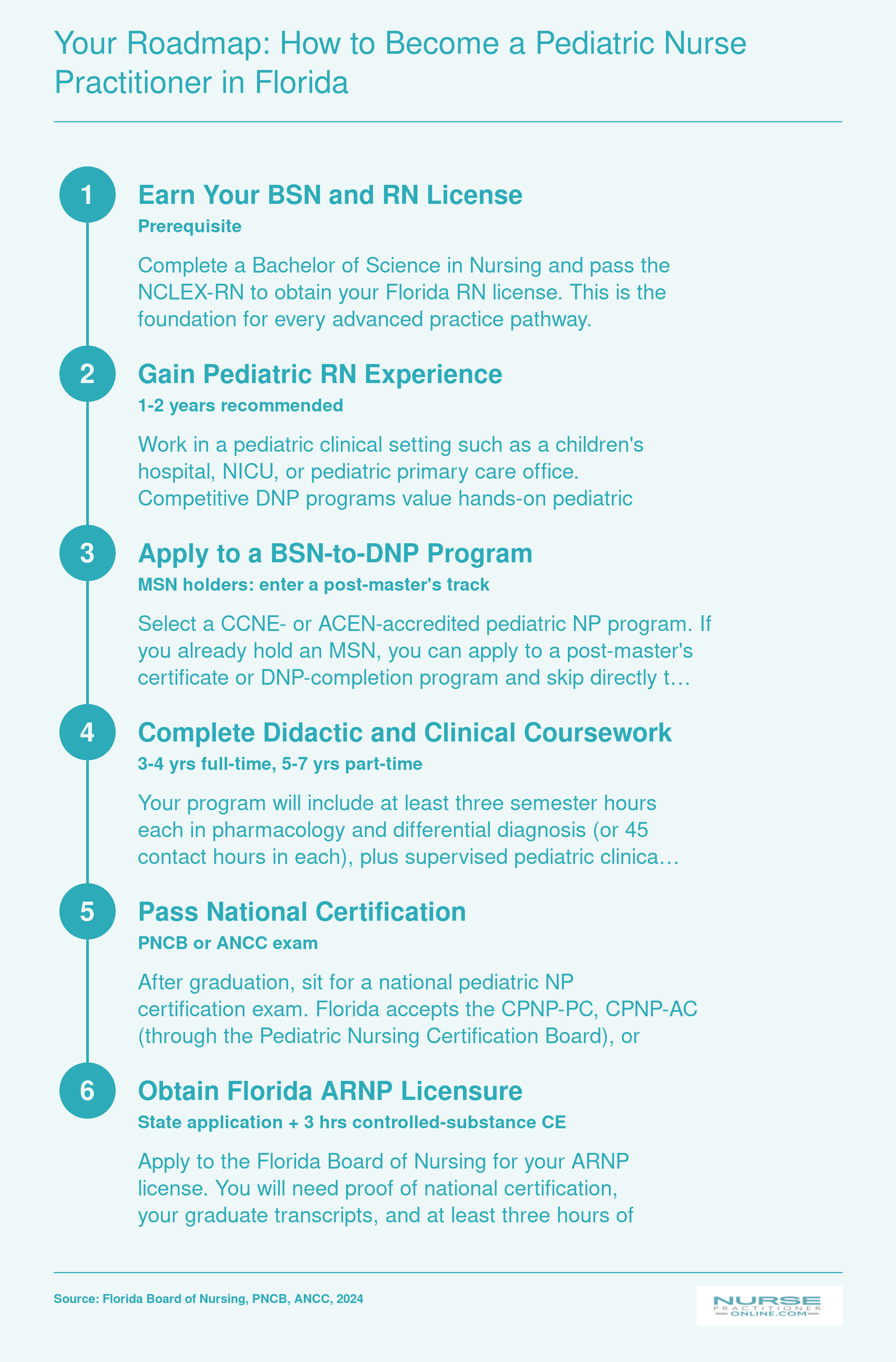
Your Roadmap: How to Become a Pediatric Nurse Practitioner in Florida
Whether you are starting with a BSN or already hold an MSN, the path to practicing as a pediatric nurse practitioner in Florida follows a clear sequence. Full-time BSN-to-DNP programs typically take about three years (around eight to nine semesters), while part-time tracks can stretch to five or even seven years. Nurses who already hold an MSN can enter a shorter post-master's certificate or DNP-completion track and rejoin the pathway at step four.
Pediatric NP Earnings and Job Growth in Florida
The honest tradeoff for pediatric NPs in Florida is this: you will likely earn slightly less than peers in adult or acute care specialties, but you gain access to one of the fastest-growing pediatric care markets in the country. Knowing the numbers helps you weigh whether the specialty pays off for your situation.
What Florida Nurse Practitioners Actually Earn
The Bureau of Labor Statistics puts the median annual wage for nurse practitioners in Florida at $129,010 as of 2024, almost identical to the national median of $129,210. The middle 80% of Florida NPs earn between roughly $100,540 and $155,490 per year, or about $62 an hour at the median.
Pediatric NPs typically land in the lower-to-middle band of that range. Pediatric primary care reimburses less than adult primary care because of Medicaid's larger share of pediatric payer mix, and children's hospitals tend to pay closer to staff RN scales than adult academic medical centers. Acute care PNPs in NICUs or pediatric ICUs generally earn more than primary care PNPs, sometimes pushing into the upper quartile. For a broader look at how specialties compare, see the breakdown of highest paid nurse practitioner specialties.
Metro Differences Across Florida
Pay varies meaningfully by region. Miami-Fort Lauderdale and Tampa-St. Petersburg tend to anchor the higher end of Florida NP wages, driven by large hospital systems and competitive private practice markets. Orlando-Kissimmee and Jacksonville generally fall slightly below the state median, though Jacksonville's children's hospital sector and Orlando's expanding Nemours and AdventHealth pediatric networks have been pushing offers upward. Rural Florida and the Panhandle pay less but often include loan repayment or sign-on bonuses through HRSA-designated shortage area programs, reflecting the broader challenges nurse practitioners face in rural healthcare.
Job Growth and Where PNPs Work
Nationally, BLS projects nurse practitioner employment to grow 40% between 2024 and 2034, adding about 128,400 jobs.2 Florida tracks above the national average because of its aging population, Medicaid expansion debates that keep pediatric coverage in flux, a documented shortage of pediatric mental health providers, and steady federally qualified health center (FQHC) growth across the state.
Pediatric NPs in Florida typically practice in:
- Freestanding children's hospitals and pediatric specialty units (Nicklaus, Johns Hopkins All Children's, Nemours, UF Health Shands)
- Pediatric primary care practices and FQHCs serving Medicaid populations
- School-based health centers, especially in Miami-Dade and Hillsborough counties
- Level III and IV NICUs (for NNP-certified graduates)
- Pediatric urgent care and telehealth networks
Explore other Florida related topics
Related Articles
Scholarships, HRSA Grants, and Financial Aid for Florida Pediatric NP Students
Federal programs offer full-tuition scholarships, but state-level and pediatric-focused awards can fill the gaps that national programs leave behind. Understanding which funding streams apply to your DNP or post-master's certificate can sharply reduce what you pay out of pocket.
Federal Loan Repayment and Scholarship Programs
The Health Resources and Services Administration (HRSA) operates two flagship opportunities. The Nurse Corps Scholarship Program covers 100% of tuition, required fees, and reasonable educational costs, plus a monthly living stipend.1 Eligibility requires US citizenship or lawful permanent residency and acceptance or enrollment in an accredited nursing graduate program.2 The 2026 application deadline is April 9, with award notifications by September 30.3 In return, you commit to at least two years of full-time service at a Critical Shortage Facility, which often includes pediatric settings in underserved Florida communities.4 For nurses who already hold loans, the Nurse Corps Loan Repayment Program pays 60, 85% of your qualifying debt over two to three years of service.4 The National Health Service Corps Loan Repayment Program also awards tens of thousands of dollars for work in health professional shortage areas, further reducing the financial barrier for pediatric NPs.4
Florida-Specific Financial Aid
The Florida Nurses Foundation distributes scholarships ranging from $500 to $2,500 for RN-to-BSN, MSN, DNP, and NP students enrolled in Florida programs. While amounts are modest, they can offset books, fees, or a clinical placement travel budget. Some Florida public universities also channel HRSA Advanced Nursing Education Workforce (ANEW) grants into stipends and traineeships specifically for NP students focusing on primary care, rural care, or underserved populations. Check with your program's financial aid office about these grant-funded positions, which often pair a tuition offset with a pediatric clinical rotation.
Pediatric-Focused Professional Scholarships
The NAPNAP Foundation awards student scholarships ranging from a few hundred to several thousand dollars exclusively to graduate PNP or pediatric-focused NP students in accredited US programs. The American Association of Nurse Practitioners (AANP) Foundation also offers scholarships, some general and some population-specific, that pediatric NP candidates should explore. Both organizations post annual deadlines and require evidence of membership and enrollment.
Graduate Assistantships and Institutional Aid
At public Florida universities, DNP students frequently secure graduate teaching or research assistantships. These roles typically provide a tuition waiver and a stipend in exchange for 10 to 20 hours per week. If you plan to attend a state school, inquire early about assistantships tied to pediatric faculty research or clinical simulation labs. School-specific pediatric NP scholarships, though not standardized across institutions, do exist; direct conversations with program directors can uncover endowed awards that may not be widely advertised.
Did you know? In 2024, 80.69% of first-time test-takers passed the Pediatric Nurse Practitioner Primary Care certification exam, per the Pediatric Nursing Certification Board. That means about 4 in 5 new pediatric NPs earned their national credential on the first try.
Your Questions About Pediatric NP Programs in Florida, Answered
Whether you are comparing program lengths, weighing certification options, or wondering how much coursework you can complete from home, these are the questions Florida nurses ask most often. Here are straightforward answers to help you plan your next step.
- How long does it take to earn a pediatric NP degree in Florida?
- Timeline depends on your entry point. A BSN-to-DNP pediatric track typically takes three to four years of full-time study, while an MSN-to-DNP or post-master's certificate route may be completed in roughly two to three years. Part-time options can extend the timeline by one to two years, which many working nurses prefer for schedule flexibility.
- Which Florida universities offer a BSN-to-DNP pediatric nurse practitioner track?
- Several Florida universities offer BSN-to-DNP pathways with a pediatric focus, though availability can shift year to year. Programs at schools such as the University of South Florida and the University of Florida have historically offered pediatric NP concentrations. Always verify current enrollment status directly with each program, as cohort sizes and admission cycles vary.
- What certification is required to practice as a pediatric NP in Florida?
- Florida requires national board certification to practice as a pediatric NP. The Pediatric Nursing Certification Board (PNCB) offers the primary credential: the Certified Pediatric Nurse Practitioner exam in either Primary Care or Acute Care. You must hold a current, unencumbered RN license and have graduated from an accredited PNP program. The exam must be taken within five years of graduation.
- Can I complete a pediatric NP program entirely online?
- Most Florida pediatric NP programs deliver didactic coursework online but require in-person components for clinical rotations and, in some cases, brief on-campus immersion sessions. Fully zero-campus programs are uncommon because hands-on clinical hours (a minimum of 500) are essential for certification eligibility. Expect a hybrid format that keeps most learning online while fulfilling clinical requirements locally.
- What is the difference between CPNP-PC and CPNP-AC certification?
- CPNP-PC (Primary Care) prepares you for outpatient settings such as pediatric practices, school health clinics, and medical homes, focusing on well-child care, health promotion, and management of common acute and stable chronic conditions. CPNP-AC (Acute Care) prepares you to manage acutely, critically, and complex chronically ill children in settings like pediatric ICUs, emergency departments, and inpatient subspecialty services. Both require 500 clinical hours and graduation from a matching accredited program. Dual certification is also available through formal combined programs.
Florida by Specialty
- DNP NP Programs in Florida
- FNP Programs in Florida
- PMHNP Programs in Florida
- Best Nurse Practitioner Options in Lakeland, FL
- Best Nurse Practitioner Options in Sarasota, FL
- Best Nurse Practitioner Programs in Fort Lauderdale
- Best Nurse Practitioner Programs in Fort Myers, FL
- Best Nurse Practitioner Programs in Miami, FL
- Best Nurse Practitioner Programs in Orlando, FL
- Best Nurse Practitioner Programs in Tampa, FL
- Best Adult-Gerontology NP Programs in Florida