Most important takeaways…
- Most NP programs require an active RN license, a BSN with a minimum 3.0 GPA, and at least one year of clinical experience.
- Acceptance rates range widely from 10 percent at selective universities to over 70 percent at many online programs.
- Start your application process 9 to 12 months before your target enrollment date to allow time for transcripts and preceptor planning.
- With a national median salary of $129,210, most NPs recoup even six-figure tuition costs within two to four years of graduating.
What does it actually take to get into nurse practitioner school in 2026? Demand for NPs has never been stronger: the Bureau of Labor Statistics projects 45% employment growth for nurse practitioners through 2033, far outpacing most healthcare roles. That demand has not made admissions easy. Selective university-based programs admit as few as 10 to 30% of applicants, and even more accessible online programs have raised their standards as cohort sizes fill quickly.
For working RNs, the application process adds a specific kind of pressure. You are managing shifts, possibly a family, and now a multi-step admissions process with deadlines that do not flex. The practical tension is real: requirements like clinical hour minimums, GPA thresholds, and letters of recommendation all have to come together at once.
Most nurses who invest the time to understand the process find it more manageable than expected. The ones who struggle typically underestimate lead time. Strong applications for fall cohorts are often assembled eight to twelve months in advance.
NP School Requirements: What You Need Before Applying
Before you spend hours on essays and recommendation letters, it helps to know whether you even meet the baseline criteria. Most nurses are closer to qualifying than they think, but a few gaps can stall an application fast. Getting clear on the requirements now saves real time later.
Education: Starting with Your RN Credential
The standard entry point for nurse practitioner programs is a Bachelor of Science in Nursing from a regionally accredited institution. If you hold an associate degree or a hospital diploma, you are not automatically out of the running. Many programs offer bridge pathways, commonly called RN-to-MSN or RN-to-DNP tracks, that fold undergraduate coursework into the graduate sequence. These pathways do add time to your program, but they make NP education accessible without requiring a standalone BSN first. If you are weighing how realistic this timeline looks, our guide on how long it takes to become a nurse practitioner breaks down the math for several common starting points.
If you already hold a master's degree in nursing, a post-master's certificate FNP pathway may let you add an NP specialty without repeating coursework you have already completed.
GPA: The Numbers Programs Actually Review
Most programs set a minimum cumulative GPA of 3.0, and that threshold applies to both your overall record and your science coursework specifically. Clearing the minimum gets your file read. Actually competing for a seat at selective programs, particularly those with FNP or acute care concentrations that draw heavy applicant pools, typically requires a 3.3 to 3.5 or higher. If your GPA sits right at the floor, a strong trajectory (grades improving over time) and compelling experience can offset a softer transcript.
Clinical Experience and Licensure
An active, unencumbered RN license in the state where you will complete clinical rotations is non-negotiable. Beyond licensure, most programs want to see one to two years of full-time RN experience before enrollment. The specialty you are targeting matters here. Acute care NP programs and psychiatric-mental health programs strongly favor applicants whose bedside experience aligns with that patient population. Emergency or ICU experience carries real weight for acute care tracks. General family practice applicants have more flexibility, though primary care or outpatient exposure still strengthens an application.
Prerequisite Coursework and Testing
Expect programs to require graduate-level statistics, health assessment, and pathophysiology if you have not completed them. Some programs accept undergraduate equivalents taken within a certain number of years. Others build these into the early program sequence.
On standardized testing: the GRE was once a common requirement, but a growing number of programs have waived it entirely or made it optional. Check each program individually, since policies shifted considerably over the past few years and continue to vary.
BSN-to-DNP pathways sometimes carry a longer prerequisite list than MSN-entry programs because they cover more ground in a single sequence. Our breakdown of DNP prerequisites can help you compare what different doctoral programs expect. Weigh the full admission requirements side by side when evaluating your options, not just the program length or cost.
How Hard Is It to Get Into NP School?
Average NP program acceptance rates range from 30 to 70 percent for mainstream programs, though the spread is considerable: highly selective university-based programs admit 10 to 30 percent of applicants, while many online and less selective programs accept 70 to 100 percent.1 A typical cohort enrolls 10 to 15 students from a pool of roughly 100 applications per cycle, yielding applicant-to-seat ratios of seven to ten to one. Those numbers tell you the NP pipeline is competitive but not insurmountable, especially when you understand what drives those acceptance rates.
What Makes Some NP Programs More Competitive Than Others
Specialty choice has the biggest impact on your odds. Psychiatric-mental health and acute care NP programs draw more applicants per seat than family NP programs because demand for those specialties has surged while cohort sizes remain small.2 Geographic concentration matters too: programs in major metro areas and states with strong nursing infrastructure receive more applications than rural or newer programs. Institutional prestige plays a role, particularly at research universities where the nursing school brand carries weight in hiring markets.
The GPA Question: Where Competitive Applicants Stand
Most NP programs set a minimum GPA of 3.0, and Columbia University School of Nursing reports an average undergraduate GPA of 3.4 among admitted students.3 Competitive applicants at selective programs typically present GPAs between 3.3 and 3.8, though clinical experience can offset a lower academic record. If your GPA sits below 3.2, a strong narrative about your bedside expertise, leadership roles, and specialty certifications will matter more than an extra tenth of a point. Programs conduct holistic reviews, and many operate rolling admissions, meaning they evaluate applications as they arrive rather than waiting for a single cutoff date.
How NP Admissions Compare to PA and MD Programs
For context, physician assistant programs admit roughly 30 percent of applicants on average, with tighter GPA and prerequisite coursework requirements than most NP tracks. Medical school acceptance rates hover around 7 percent nationally, and the process demands MCAT scores, extensive shadowing, and multi-year timelines. NP admissions are more accessible than either of those pathways, particularly for nurses with one to two years of clinical experience who meet the 3.0 GPA threshold.2 Competitive does not mean impossible: it means you need a clear application narrative, solid references, and a realistic sense of which programs align with your profile.
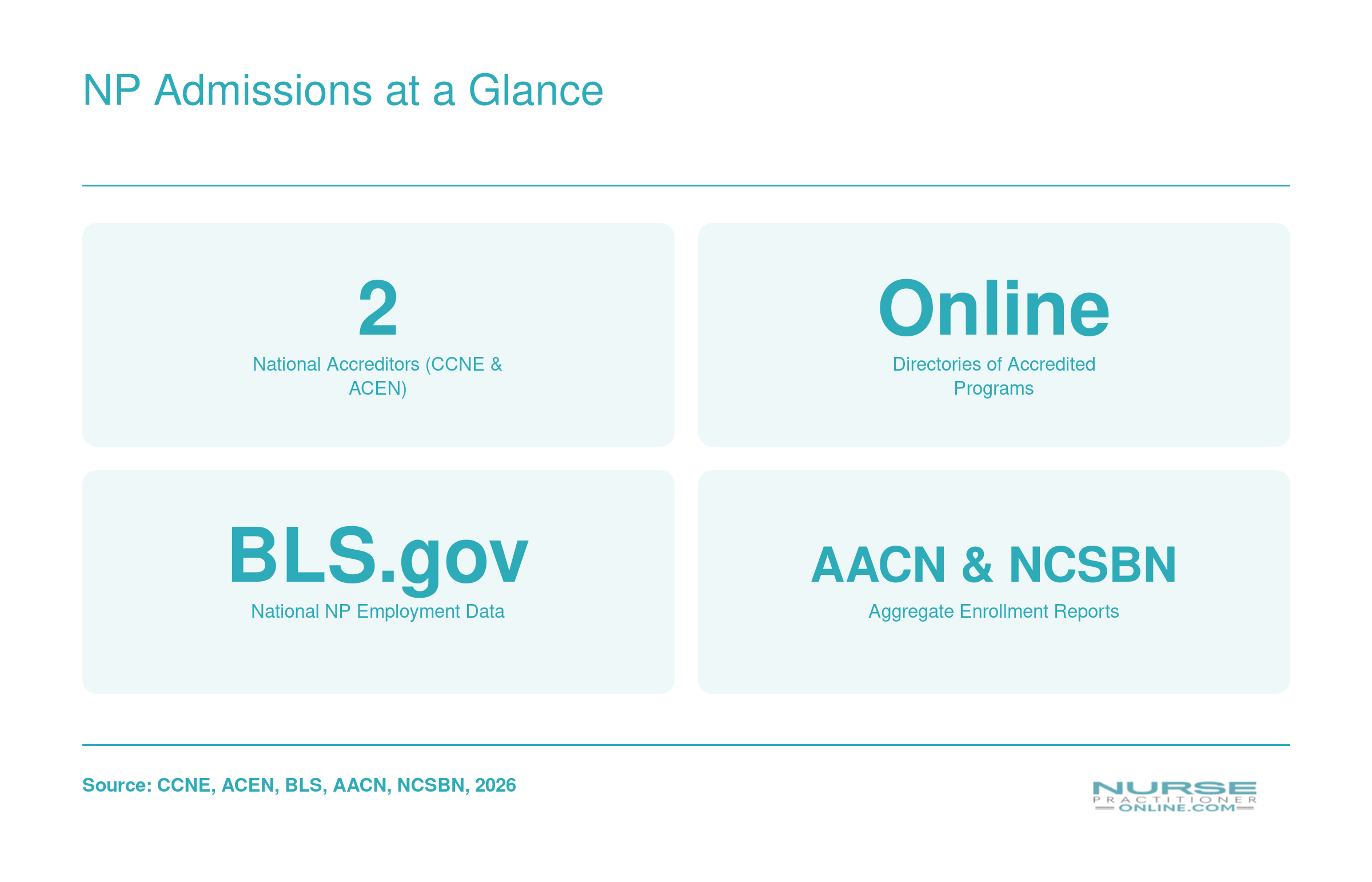
NP Admissions at a Glance
Getting a clear picture of NP admissions nationwide can be tricky because program-specific data like cohort sizes are rarely published in one place. Here is where to find the most reliable information as you plan your application.
Step-by-Step NP Application Process
Getting into NP school is a process you can control, but only if you start early and move through each stage with intention.
Step 1: Research Programs (9 to 12 Months Out)
Begin identifying programs at least nine to twelve months before your intended start date. Compare specialty focus, format, clinical placement support, and accreditation. Note whether each school uses NursingCAS, the centralized application platform that now serves hundreds of NP programs, or runs its own direct portal.1 University of Miami's FNP program and Emory University's graduate nursing programs, for example, both accept applications through NursingCAS.23 University of Cincinnati's online NP program and University of Maryland's graduate NP programs each use their own direct application portals.45 Knowing which system a school uses early prevents last-minute account setup surprises. For a broader view of the full journey, our guide on how to become a nurse practitioner maps out every major milestone from RN to NP.
Step 2: Gather Transcripts and Request Recommendations
Order official transcripts from every institution where you earned college credit. Processing times vary, and some registrars take four to six weeks, so do not wait. Simultaneously, identify two or three people who can write strong recommendation letters for nurse practitioner programs. Choose clinical supervisors or nursing faculty who have watched you function in advanced or complex clinical situations. A letter that speaks directly to your readiness for graduate-level, autonomous practice carries far more weight than one that simply vouches for your character.
Step 3: Write Your Personal Statement
Your personal statement is the single most controllable variable in your application. Use it to draw a straight line from your RN clinical experience to the specific NP specialty you are pursuing. A strong statement names the patient population you want to serve, references concrete clinical moments that sharpened that focus, and answers the fundamental question: why NP, and why now? Generic statements that could apply to any healthcare graduate program rarely move reviewers.
Step 4: Submit Applications on Time
Deadlines vary considerably across programs. For fall 2026 entry, the University of Maryland's deadline fell as early as February 15, while the University of Cincinnati set its cutoff at July 1.4 Frontier Nursing University closed applications on June 246, and Wilmington University set May 1 as its deadline.7 Programs using NursingCAS for fall 2026 entry generally clustered deadlines between March 1 and June 1.1 Spring 2027 programs, like Emory's Round 1, set deadlines as early as June 1, 2026.3 Rolling admissions programs accept applications year-round but typically fill cohorts quickly, so earlier submission still works in your favor.
Step 5: Interview and Accept
Some programs require a formal interview, either in person or via video. Treat it as a clinical conversation: know your specialty rationale, be ready to discuss your RN experience concretely, and prepare questions about preceptor support and clinical placement processes. Once admitted, respond to any offer by the stated deadline, pay your deposit, and confirm enrollment requirements such as background checks or updated immunization records before your first term begins.
Questions to Ask Yourself
NP Application Materials Checklist
Before you hit submit, make sure every item on this list is accounted for. Missing even one piece can delay your application by an entire admission cycle.
- Official Transcripts Showing a BSN from a Regionally Accredited InstitutionRequest sealed, official transcripts sent directly from your undergraduate institution. Admissions committees verify that your Bachelor of Science in Nursing comes from a regionally accredited school, so confirm your program's accreditation status before applying.
- Active, Unencumbered RN LicenseYou will need to provide proof of a current, unrestricted registered nurse license in your state. Programs typically require a copy of your license or verification through your state board of nursing.
- Minimum Cumulative GPA of 3.0 or HigherMost NP programs set a floor GPA around 3.0 on a 4.0 scale, though competitive programs may expect higher. If your GPA falls slightly below, strong clinical experience and a compelling personal statement can sometimes offset it.
- Professional Resume or CVHighlight your clinical RN experience, including specialty areas, leadership roles, certifications, and any quality-improvement or research involvement. Programs want to see that your bedside experience has prepared you for advanced-practice responsibilities.
- Personal Statement or Admissions EssayExpect to write roughly 500 to 1,000 words explaining why you want to become a nurse practitioner, your career goals, and how the specific program aligns with your professional path. Be authentic and specific rather than generic.
- Two to Three Letters of RecommendationSecure letters from clinical supervisors, nurse managers, or nursing faculty who can speak directly to your clinical competence, critical thinking, and readiness for graduate-level work. Give recommenders at least four to six weeks of lead time.
- Prerequisite Coursework CompletionVerify that you have completed required prerequisites, which commonly include statistics, advanced health assessment, and pathophysiology. Some programs allow you to complete these courses during your first semester, but many require them upfront.
- GRE Scores (If Required)Most NP programs have dropped the GRE requirement as of 2026, but a handful still ask for it. Check each program's admissions page carefully so you are not caught off guard by a testing deadline.
How to Choose the Right NP Program for You
Enrollment in MSN-NP programs grew by roughly 6.8% in 2025, while BSN-to-DNP pathways saw about 5.9% growth over the same period, according to data from the American Association of Colleges of Nursing.1 Both tracks are expanding because demand for nurse practitioners continues to climb, but the right fit depends on your career goals, timeline, and how you learn best.
MSN-NP vs. BSN-to-DNP: Key Differences
Both pathways require a BSN and must hold accreditation from CCNE or ACEN. Beyond that, they diverge in meaningful ways.
- Duration: MSN-NP programs typically take 24 to 36 months, while BSN-to-DNP tracks run 36 to 48 months.
- Clinical hours: MSN-NP students generally complete around 500 clinical hours. BSN-to-DNP students complete roughly 1,000 hours, reflecting the doctoral program's broader scope.
- Career focus: The MSN-NP is designed for nurses who want to move into clinical NP practice efficiently. The BSN-to-DNP pathway prepares you for clinical practice and positions you for executive leadership, faculty, or health-systems roles.
- Long-term positioning: If you think you may eventually pursue a DNP anyway, starting with a BSN-to-DNP pathway can save you from completing two separate programs.
Neither path is inherently better. If your priority is getting into clinical practice quickly, the MSN-NP is a practical choice. If you see yourself in academic or organizational leadership down the road, the BSN-to-DNP can get you there in one stretch. To help you decide, our breakdown of whether a DNP is worth it covers the pros, cons, and return on investment in detail.
Online, Hybrid, or On-Campus
Most working RNs gravitate toward online or hybrid formats, and for good reason: you can keep earning a paycheck while you study. Fully online programs let you complete didactic coursework on your own schedule, which is invaluable if you work rotating shifts. Hybrid programs add periodic on-campus intensives, sometimes one or two weekends per semester, that can deepen hands-on skills and faculty relationships.
The trade-off is real, though. Fully online learners need strong self-discipline and may feel less connected to classmates. Hybrid formats require travel and time away from work but often provide structured clinical-skills labs that purely online courses cannot replicate. Before committing, ask yourself honestly how you learn best and whether your employer offers schedule flexibility for campus visits.
Choosing a Specialty
Specialty selection shapes your entire career trajectory. Family Nurse Practitioner programs remain the most popular choice because of their breadth: FNPs can treat patients across the lifespan and work in virtually any primary-care setting. That versatility appeals to many nurses who want maximum job-market flexibility.
More specialized tracks, such as Psychiatric-Mental Health Nurse Practitioner or Adult-Gerontology Acute Care Nurse Practitioner, narrow your patient population but can open doors to high-demand niches. PMHNP graduates, for instance, are entering a field with significant workforce shortages in behavioral health. AGACNP-prepared nurses are sought after in hospitals and critical-care environments. If you are considering the acute-care route, our guide to adult gerontology nurse practitioner programs can help you compare specialty offerings and program formats.
When evaluating specialties, consider where you want to practice geographically, which patient populations energize you, and whether the program's clinical-placement network aligns with your specialty goals. A program that cannot reliably place students in relevant clinical sites will slow your progress regardless of how strong its coursework may be. Reviewing DNP prerequisites early can also prevent surprises if you later decide to pursue a doctoral degree.
Pulling It All Together
Choosing a program is not a single decision but a set of interconnected ones: degree level, format, specialty, and fit with your life. Start by listing your non-negotiables (timeline, budget, geographic constraints) and then compare programs against those criteria. Reach out to admissions offices, talk to current students, and review board-certification pass rates. The goal is to help you make this decision with confidence, not pressure, so take the time to get it right.
Clinical Hours and Preceptor Expectations
How many clinical hours does an NP program actually require, and will the school find your preceptor or will you? These are two of the most important questions to investigate before you commit to a program, and the answers vary more than most applicants expect.
Understanding Minimum Clinical Hour Requirements
Accrediting bodies set the floor, not the ceiling. The Commission on Collegiate Nursing Education (CCNE) and the Accreditation Commission for Education in Nursing (ACEN) publish current standards for MSN and DNP programs, and national certifying bodies like the American Nurses Credentialing Center (ANCC) and the American Association of Nurse Practitioners (AANP) outline their own minimums for exam eligibility. Many programs exceed these minimums, especially at the DNP level. If you are considering a doctoral path, reviewing DNP prerequisites early will help you understand how clinical hour expectations scale up. To get accurate, current numbers, go directly to the source: the CCNE and ACEN websites publish their standards openly, and individual program pages will list total required clinical hours for each track (FNP, PMHNP, AGACNP, etc.).
When you compare programs, look past the headline number. Ask how hours are distributed across specialty rotations, whether simulation hours count toward the total, and what happens if you need to repeat a rotation.
Preceptor Placement: Who Does the Work?
This is where programs differ dramatically. Some schools guarantee preceptor placement and have dedicated clinical coordinators who match students with sites. Others operate on a self-placement model, meaning you are responsible for finding qualified preceptors in your region, securing signed agreements, and ensuring the site meets program criteria. A hybrid model, where the school assists but expects student initiative, is increasingly common in online programs. For a closer look at how students in online programs arrange local clinical placements, that process is worth understanding before you apply.
Before you apply, call the admissions office and ask three direct questions:
- Does the program guarantee preceptor placement, or is it student-led?
- If student-led, what support does the clinical placement team provide?
- What is the typical timeline for securing rotations before they begin?
Professional associations like AANP and the National Organization of Nurse Practitioner Faculties (NONPF) publish guidance on preceptor standards and clinical education that can help you evaluate what a strong program looks like.
Checking Outcomes Before You Enroll
Certification exam pass rates are a useful proxy for clinical training quality. Most accredited programs publish first-time pass rates on their websites, and ANCC and AANP report aggregate data by certification type. Compare a program's pass rate against the national average for that certification, and ask the school to explain any gap. Strong clinical training shows up in those numbers.
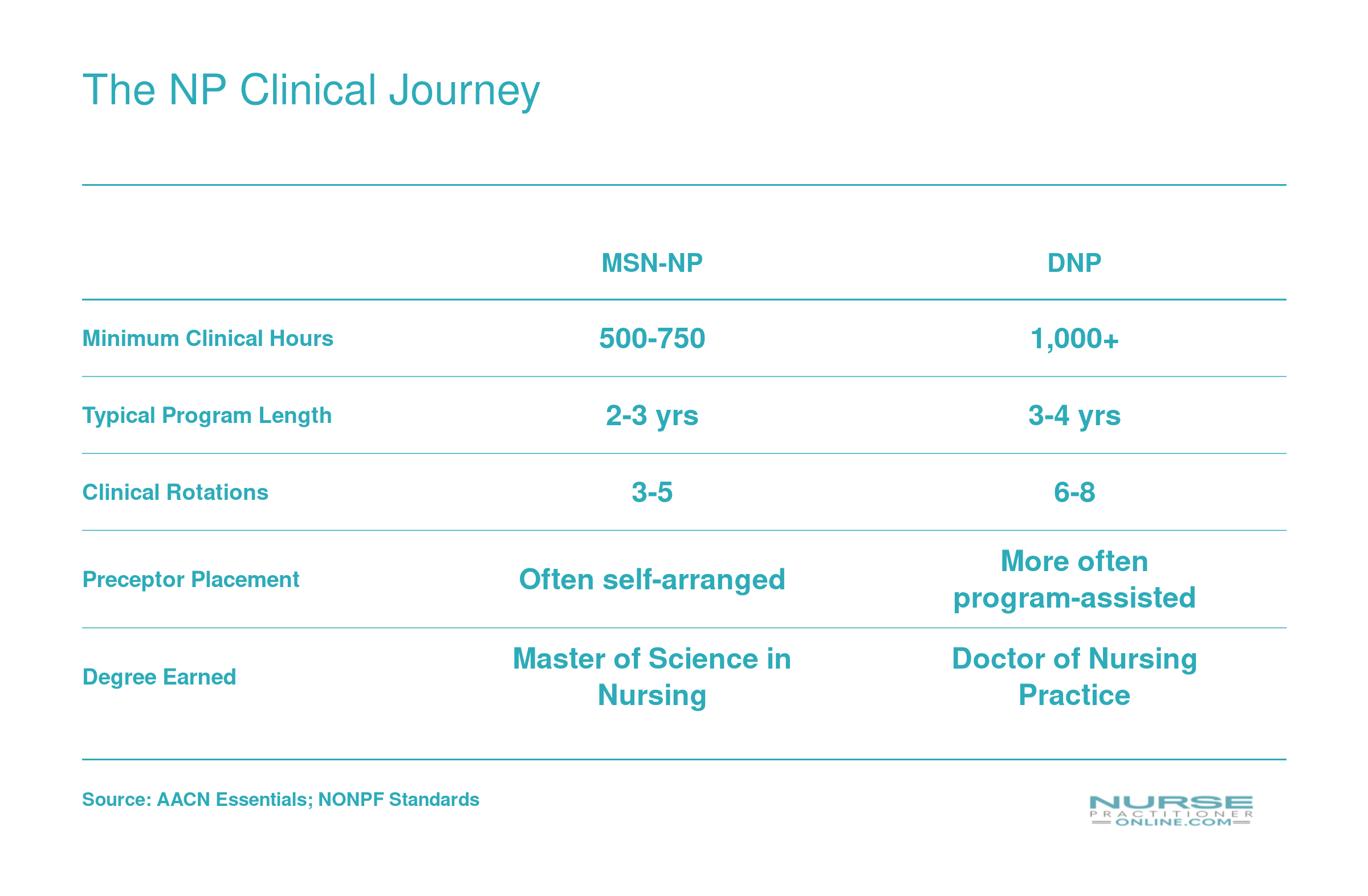
The NP Clinical Journey
Clinical requirements vary significantly between MSN-NP and DNP pathways. Understanding these differences helps you plan your timeline and secure preceptor placements early.
Paying for NP School: Costs, Financial Aid, and Scholarships
Paying for nurse practitioner school means understanding the full range of costs you might face, the federal and private funding sources available to offset them, and how your investment compares to the earning power you gain after graduation. The good news: with careful planning, the financial picture is often more manageable than it first appears.
How Much Does NP School Cost?
Tuition varies widely depending on the type of institution and degree level. As a general guideline:
- Public, in-state MSN-NP programs: Roughly $20,000 to $50,000 total.
- Private university MSN-NP programs: Often $50,000 to $80,000 or more.
- DNP programs (public or private): Can exceed $80,000 to $120,000, especially at private institutions.
These figures typically cover tuition and fees only. Budget for additional expenses like textbooks, clinical supplies, background checks, and travel to clinical sites. Online programs may reduce some costs (no campus housing, for example), but clinical rotations still require in-person time.
Federal Financial Aid
Start by completing the FAFSA. As a graduate student, you are eligible for federal Direct Unsubsidized Loans and, if needed, Grad PLUS Loans. A key principle: exhaust all federal loan options before turning to private lenders. Federal loans offer income-driven repayment plans, potential Public Service Loan Forgiveness, and deferment options that private lenders rarely match.
Scholarships and Loan Repayment Programs
Several programs are designed specifically for nursing students:
- HRSA Nurse Corps Scholarship Program: Covers 100% of tuition and fees plus a monthly living stipend.1 In return, recipients commit to at least two years of service at a Critical Shortage Facility after graduation. For 2026, the application deadline was April 9, with award notifications expected by September 30.3 Eligibility requires U.S. citizenship (or lawful permanent resident status), no delinquent federal debt, and no conflicting service obligations.3 Selection prioritizes applicants with the greatest financial need.4
- NHSC Loan Repayment Program: Helps NPs who have already graduated by repaying a significant portion of qualifying student loans in exchange for service in underserved communities.
- State nursing workforce grants: Many states fund their own scholarship or loan forgiveness programs for nurses pursuing advanced practice degrees. Check with your state board of nursing or higher education authority for current offerings.
Employer Tuition Reimbursement
If you are currently working as an RN, ask your employer about tuition assistance before you apply. Many hospitals and health systems offer $3,000 to $10,000 per year toward advanced nursing degrees, and some have full tuition partnerships with specific NP programs. Even partial reimbursement adds up across a two- or three-year program. Be sure to clarify any post-graduation service commitment your employer may require in exchange.
Connecting Cost to Return on Investment
According to the Bureau of Labor Statistics, median annual earnings for nurse practitioners are well above six figures, which places the profession among the highest-paying roles accessible with a master's degree. When you weigh even the upper end of NP tuition against that long-term earning potential, along with strong job demand and career flexibility, the financial case for pursuing an NP degree is compelling. That said, every individual's situation is different. Take time to model your own numbers: expected tuition, realistic financial aid, anticipated salary in your chosen specialty and region, and monthly loan payments under various repayment plans.
The bottom line is that NP school is a significant investment, but one that most graduates recoup within just a few years of practice. Exploring every funding avenue before you borrow makes the journey even smoother.
What Nurse Practitioners Earn After Graduation
Investing in NP school pays off. As discussed in the previous section, total program costs for an MSN or DNP can range from roughly $30,000 to over $100,000 depending on the school. With a national median salary of $129,210 for nurse practitioners, most graduates can expect to recoup their educational investment within a few years of practice. Keep in mind that the Bureau of Labor Statistics figures below reflect all NPs nationwide regardless of specialty. Your actual earnings may be higher or lower depending on your chosen specialty, practice setting, geographic location, and years of experience.
| Salary Percentile | Annual Earnings |
|---|---|
| 25th Percentile | $109,940 |
| Median (50th Percentile) | $129,210 |
| Mean (Average) | $132,000 |
| 75th Percentile | $149,570 |
Frequently Asked Questions About NP School Applications
Applying to nurse practitioner school raises a lot of practical questions, especially when you are juggling shifts and family responsibilities. Below are straightforward answers to the questions working nurses ask most often.
- How hard is it to get accepted into nurse practitioner school?
- Acceptance rates vary widely by program and specialty, but many NP programs admit roughly 50 to 70 percent of qualified applicants. Competitive programs at well-known universities may accept fewer. Strong clinical experience, a solid GPA, and well-crafted personal statements all improve your odds. The process is selective but very achievable for nurses who prepare thoughtfully and submit complete applications.
- What GPA do you need for nurse practitioner school?
- Most NP programs require a minimum cumulative GPA of 3.0 on a 4.0 scale, though some set the bar at 3.2 or higher for competitive cohorts. Science and nursing course GPAs often carry extra weight during review. If your GPA falls slightly below the cutoff, strong clinical experience, upward grade trends, and compelling recommendation letters can help offset a lower number.
- Do you need clinical experience to apply to NP programs?
- Nearly all NP programs require at least one to two years of direct patient care experience as a registered nurse. Some specialties, such as acute care or neonatal NP tracks, prefer candidates with relevant unit experience (ICU, NICU, or emergency settings). A few direct-entry programs accept non-nurses, but for BSN-prepared RNs, hands-on bedside experience is considered essential.
- Can you apply to NP school without a BSN?
- Some universities offer RN-to-MSN bridge programs that allow nurses with an associate degree to enter a nurse practitioner track without first completing a standalone BSN. You will typically complete BSN-level coursework as part of the bridge before advancing into graduate-level NP courses. Direct-entry MSN programs also exist for career changers who hold a bachelor's degree in another field.
- How long does the NP school application process take?
- From gathering documents to receiving an admissions decision, the process usually spans three to six months. Most programs have application deadlines six to nine months before the cohort start date. Requesting transcripts, securing recommendation letters, and scheduling any required interviews all add time, so starting early (at least nine to twelve months ahead) is a practical approach.
- Is FNP easier to get into than other NP specialties?
- Family nurse practitioner programs tend to have more available seats because they are the most commonly offered NP specialty. That larger capacity can make acceptance slightly less competitive compared to niche tracks like psychiatric mental health or neonatal NP programs. However, popular FNP programs at top-ranked schools can still be highly selective, so application quality matters regardless of specialty.
- Do NP programs require the GRE?
- A growing number of NP programs have dropped the GRE requirement in recent years. As of 2026, many master's and DNP programs no longer require standardized test scores, though some universities still list the GRE as optional or required. Check each program's current admissions page for the latest policy. Programs that waive the GRE often place greater emphasis on clinical experience and GPA instead.
Nine to twelve months: that is the runway strong NP applicants give themselves before their target start date. Use it. Build a timeline now that maps out program research, GRE decisions (if any), recommendation requests, personal statement drafts, and preceptor conversations. Admissions committees reward preparation more than a perfect GPA. A focused personal statement, solid clinical experience, and early finding NP preceptors consistently outweigh a tenth of a grade point.
From here, narrow your list. Explore FNP, psychiatric, acute care, and pediatric tracks to match a specialty to the patients you actually want to serve. If you are weighing the MSN route, comparing online MSN NP programs can help you sort options by format and specialty. Pick three to five programs, mark their deadlines on a calendar, and start the first task this week.