Most important takeaways…
- Only seven schools in New York offer pediatric nurse practitioner tracks, with most using a hybrid format.
- PNP students should expect 500 to 700 in-person clinical hours for an MSN and more for a DNP.
- Choosing between the CPNP-PC and CPNP-AC certifications locks you into distinct career paths in primary or acute care.
- Program-level earnings data for New York PNP graduates are not yet published, though statewide NP salaries remain strong.
Fewer than ten accredited schools in New York offer a pediatric nurse practitioner concentration, and only a subset deliver didactic coursework online. For working RNs trying to specialize in pediatric primary or acute care, that narrow field makes choosing the right program a high-stakes decision. Tuition, clinical placement support, and certification pass rates vary meaningfully across these programs.
New York requires a minimum of 600 supervised clinical hours for NP licensure, and every program, even those labeled fully online, builds those hours into its curriculum at in-person sites. Balancing 12-hour shifts with graduate-level coursework and clinical rotations is possible, but the format and scheduling flexibility of a program matters as much as its reputation. If you are also weighing programs outside the state, our national ranking of accredited online pediatric nurse practitioner programs can help you compare options side by side.
Best Online Pediatric Nurse Practitioner Programs in New York for 2026
New York is home to just seven schools offering pediatric nurse practitioner tracks, and only a handful deliver coursework in an online or hybrid format that works for nurses already juggling shifts and family life. The programs below were selected from those online-eligible PNP offerings and ordered using a composite quality score that weighs delivery flexibility alongside graduation rates, net price, and graduate outcomes. Program-level earnings data is not yet available for these pediatric NP tracks, but institution-wide median earnings are included to give you a general sense of each school's return on investment.
- Online or hybrid delivery format
- Institutional graduation rate
- Net price after financial aid
- Graduate earnings outcomes
- Program-specific highlights and features
- College Scorecard graduate earnings — collegescorecard.ed.gov
- Independent program research
- Internal program database
- NCES-IPEDS federal institutional data — nces.ed.gov

Stony Brook University
Stony Brook University is one of only two Long Island institutions with a pediatric NP track and one of the few fully online PNP options in the entire state. As a public SUNY school, it offers significantly lower tuition for New York residents, with a net price around $18,784 and a 75.6% graduation rate. Its statewide online reach makes it a strong choice for RNs across New York who want an affordable, fully distance path to pediatric primary care certification.
- Fully online master's program, no campus visits required
- Designed specifically for working RN professionals
- Covers advanced pediatric assessment and disease prevention
- Aligned with PNCB primary care certification exam
- BSN and active RN license required for admission
- Financial aid options available through SUNY system
- Curriculum spans infancy through adolescence care
Pediatric Primary Care Nurse Practitioner (MS) — Online

New York University
NYU Meyers stands out for the breadth of its pediatric NP offerings, with hybrid master's and post-master's certificate tracks in both primary care and acute care. It is one of the rare programs nationally that prepares students for dual CPNP-PC and CPNP-AC certification. With an 87.6% graduation rate, an 8:1 student-to-faculty ratio, and clinical placements arranged by expert pediatric faculty, NYU delivers a rigorous, clinically immersive experience. The higher net price (approximately $37,050) reflects a private institution, but graduates benefit from a strong reputation and New York City clinical networks.
- Hybrid format with synchronous online classes and campus immersions
- Eligible for both CPNP-PC and CPNP-AC national certification
- Clinical placements with expert PNPs arranged by faculty
- Simulation with standardized patients and interprofessional education
- Work experience and BSN required for admission
- Prepares for New York State licensure and prescriptive authority
- Hybrid MS or DNP degree options available
- Focus on pediatric primary care and evidence-based practice
- Interactive synchronous online instruction format
- Faculty-guided clinical decision-making skill development
- Graduates eligible for DEA number and prescription privileges
- Family-centered care and cultural diversity emphasis
- Post-master's certificate completable in one year
- 11 to 13 credits based on individualized gap analysis
- Hybrid model with two on-campus intensive sessions
- Prepares specifically for CPNP-AC certification exam
- Meets New York State licensure requirements directly
- Problem-based learning with individualized faculty attention
- Military benefits accepted, financial aid available
- Post-master's pathway for nurses with existing master's degree
- 18 to 39 credits determined by gap analysis
- One year pediatric RN experience required for entry
- PALS certification required before clinical rotations begin
- FAFSA financial aid encouraged for all applicants
- Requires active New York State RN license
Pediatrics Nurse Practitioner Primary Care/Acute Care (MS) — Hybrid
Pediatrics Nurse Practitioner Primary Care (MS) — Hybrid
Pediatric NP Acute Care Advanced Certificate — Hybrid
Pediatric NP Primary Care Advanced Certificate — Hybrid

University of Rochester
The University of Rochester serves as Western New York's primary hub for pediatric and neonatal NP education, offering hybrid master's tracks in both pediatric primary care and a combined pediatric/neonatal specialty. Students benefit from clinical rotations at Golisano Children's Hospital and the Gosnell NICU, giving them hands-on experience at a major tertiary center. With an 85.4% graduation rate and a 9:1 student-to-faculty ratio, Rochester provides an intimate, research-oriented learning environment at a net price of about $29,278.
- Hybrid format combining online coursework with clinical immersions
- Prepares for Pediatric Nursing Certification Board exam
- Covers well-child care, developmental screening, illness management
- Addresses behavioral health including ADHD and risk behaviors
- Career paths span primary care, schools, and hospitals
- Also available as an advanced certificate for post-master's students
- Combined pediatric and neonatal NP specialization
- Clinical rotations at Gosnell NICU and Golisano Children's Hospital
- Prepares for dual national certification eligibility
- Focus on care for low-risk and high-risk infants
- Hybrid format, BSN and relevant experience required
- Advanced training across neonatal and pediatric pathways
Pediatric Nurse Practitioner, Primary Care (MS) — Hybrid
Pediatric/Neonatal Nurse Practitioner (MS) — Hybrid

Molloy University
Molloy University offers a 42-credit hybrid master's program in Pediatric NP Primary Care, making it one of only two Long Island schools with this specialty. The program is notable for its INACSL Clinical Simulation endorsement, a distinction that signals high-quality simulation training, which is relatively uncommon among New York PNP programs. With a net price near $24,347, a 12:1 student-to-faculty ratio, and reported near-100% certification exam pass rates, Molloy delivers strong clinical preparation at a mid-range cost for a private institution.
- 42-credit hybrid program blending online and on-campus learning
- INACSL-endorsed clinical simulation training
- Near 100% certification exam pass rates reported
- Minimum 3.0 undergraduate GPA required for admission
- One year of clinical nursing experience required
- Multiple practicum courses for hands-on pediatric training
- Prepares for national primary care PNP certification
- DNP completion pathway available at the same institution
Pediatric Nurse Practitioner, Primary Care (MS) — Hybrid
Fully Online or Hybrid? What New York PNP Programs Actually Require
The real choice in front of you is not online versus in-person, but how much flexibility you can realistically negotiate against the unavoidable, in-person parts of becoming a pediatric nurse practitioner. Even programs marketed as online still require hands-on clinical hours, and some require periodic campus visits for skills validation or orientation. Understanding what each program actually demands of your calendar matters more than the label on the brochure.
What "Fully Online" Actually Means
When a New York PNP program calls itself fully online, that description applies only to the didactic coursework: the lectures, discussions, exams, and assignments you complete through a learning management system. Clinical hours are always in-person. Every PNP student in the country logs supervised patient care hours in pediatric primary or acute care settings, regardless of how the academic side is delivered. A 100% online label means you will not be sitting in a Long Island or Manhattan classroom for theory courses. It does not mean you can skip clinicals.
Stony Brook University's Pediatric Primary Care NP track, offered as both a Master of Science and an Advanced Certificate, is one of the clearer examples of a fully online didactic format in New York.12 Coursework is delivered online with no required campus visits.3 If you already hold an MSN and want to add a pediatric specialty, a post-master's certificate pediatric nurse practitioner pathway may also be worth exploring.
Synchronous vs. Asynchronous: The Schedule Question
This is where flexibility gets nuanced. Asynchronous coursework means you log in when your schedule allows, watch recorded lectures, and submit work by deadlines. Synchronous coursework means scheduled live class sessions, typically by video, that you must attend in real time.
Stony Brook's PNP programs require synchronous sessions, so even though there are no campus visits, you will need to block specific evening or daytime hours each week for live class.3 For nurses working rotating shifts, that distinction can be the difference between a program that fits and one that quietly falls apart by midterm.
Three Dimensions to Compare
- Campus visits: Ask whether the program requires any in-person intensives, orientation weekends, or skills check-offs, and how often.
- Class format: Confirm whether lectures are recorded for later viewing or require live attendance, and on which days and times.
- Clinical scheduling: Ask how clinical placements are arranged, whether you can complete hours near home, and how much control you have over the weekly schedule.
Questions to Ask Yourself
What Online PNP Programs in New York Actually Cost
Tuition for online pediatric nurse practitioner programs in New York varies widely depending on whether you attend a public or private institution. The table below breaks down graduate tuition, institution-wide average net price after aid, and median graduate debt at completion. Keep in mind that the net price figures shown are institution-wide averages for all students receiving financial aid. They are not guaranteed quotes for graduate nursing students specifically, so your actual cost may differ based on your program, enrollment status, and aid package.
| School | In-State Graduate Tuition | Out-of-State Graduate Tuition | Average Net Price (Institution-Wide) | Median Graduate Debt at Completion |
|---|---|---|---|---|
| Stony Brook University | $14,222 | $29,242 | $18,784 | $18,228 |
| Molloy University | $27,520 | $27,520 | $24,347 | $27,000 |
| University of Rochester | $39,310 | $39,310 | $29,278 | $21,000 |
| New York University | $42,726 | $42,726 | $37,050 | $20,500 |
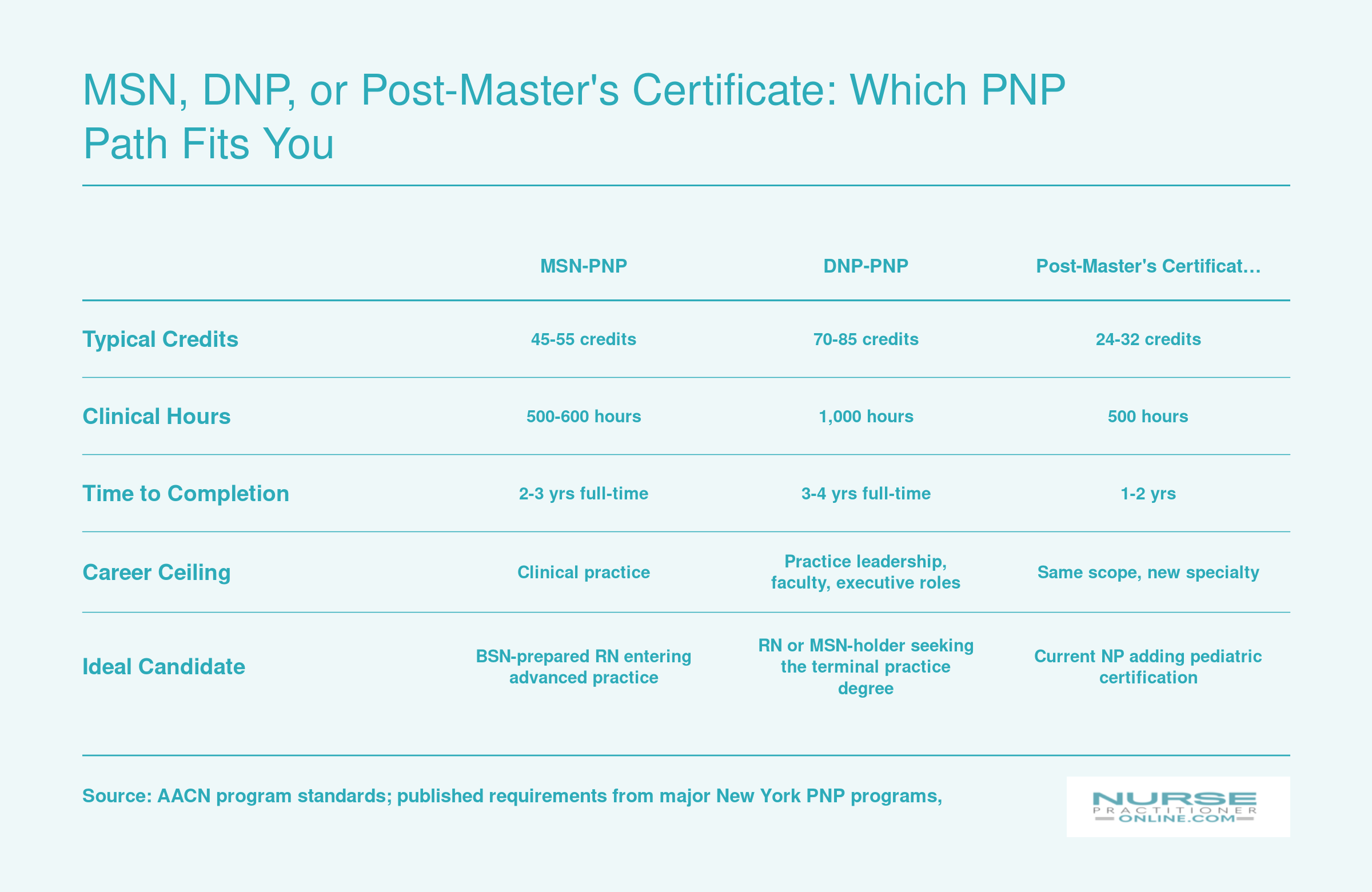
MSN, DNP, or Post-Master's Certificate: Which PNP Path Fits You
New York programs offer three distinct pathways into pediatric nurse practitioner practice. The MSN is the entry-level practice degree for RNs without a graduate credential. The DNP builds on that foundation with leadership, systems-level thinking, and a scholarly project. The post-master's certificate is designed for nurse practitioners who already hold an MSN or DNP and want to add a pediatric specialty. Here is how the three stack up across the details that matter most.
Primary Care vs. Acute Care PNP Tracks in New York
Which certification track should you choose, and what happens if you pick the wrong one?
This decision shapes your entire career trajectory. The Pediatric Nursing Certification Board offers two distinct credentials: CPNP-PC (primary care) and CPNP-AC (acute care).1 Each certification corresponds to a specific graduate program track, and they are not interchangeable. Completing a primary care track means you sit for the CPNP-PC exam and practice in primary care settings. You cannot legally practice in acute care environments with only a primary care certification.
Understanding the Two Certification Pathways
Both credentials come from PNCB, but they require different educational preparation. For CPNP-PC eligibility, you need an active RN license and a graduate degree from an accredited PNP primary care track.2 For CPNP-AC, you need the same RN license plus graduation from a program on PNCB's recognized acute care list.3 PNCB maintains specific lists of recognized programs for both acute care nurse practitioner programs and dual-track options.4
The acute care pathway typically recommends at least one year of acute or critical care RN experience before enrollment.3 Primary care programs less frequently require specialized nursing background, making them more accessible to nurses from varied clinical settings.
Where Each Track Leads You
CPNP-PC certified nurses focus on health promotion, disease prevention, well-child care, and managing common acute and chronic conditions. You will work in outpatient pediatric clinics, school health offices, community health centers, and private practices.
CPNP-AC certified nurses handle acute, critical, and complex illness in higher-acuity environments. Think pediatric intensive care units, neonatal intensive care units, emergency departments, and inpatient pediatric floors where children face serious or life-threatening conditions. If you want to learn more about this career path broadly, our guide to the pediatric nurse practitioner role covers it in detail.
Program Availability in New York
Primary care tracks dominate the online PNP programs landscape. National data from 2020 showed roughly 97 primary care programs compared to only 42 acute care programs across the country.5 This ratio reflects what you will find when searching for New York options.
NYU's Rory Meyers College of Nursing stands out by offering a dual PNP-PC/AC program, preparing graduates to sit for both certifications.6 If you want acute care specifically, you may need to look beyond fully online options or consider programs with hybrid components. Before committing to any program, verify it appears on PNCB's recognized list for your intended certification track.
How Online PNP Students Handle Clinical Placements in New York
Your coursework may happen on a laptop, but your clinical hours will always happen beside a real patient. That is the central tension of any online PNP program: the classroom flexes around your schedule, while the clinical component remains fixed, in person, and non-negotiable.
How Many Hours You Should Expect
Regardless of whether you enroll in an MSN, DNP, or post-master's certificate track, plan on completing somewhere between 500 and 700 or more direct patient care hours in a pediatric setting. National accreditation standards and New York State Education Department requirements set these minimums, and no program can waive them. The hours must be supervised by an approved preceptor, typically a board-certified pediatric NP or physician, and they must involve hands-on clinical work with pediatric patients.
Who Finds Your Clinical Site
This is where programs diverge, and it matters more than most applicants realize. Nationally, roughly 14 percent of NP programs require students to source their own clinical placements entirely.1 In New York, the picture is mixed. NYU Rory Meyers College of Nursing, for example, arranges clinical placements for students in the New York metro area through faculty connections.2 Students outside the metro region identify their own sites, though NYU then handles the affiliation agreement on the student's behalf. Other New York programs, including several of the seven CCNE-accredited PNP programs in the state (housed at institutions like Columbia, Stony Brook, University of Rochester, Upstate Medical, CUNY Lehman, and Molloy), follow their own models. Some provide dedicated clinical placement coordinators; others expect you to do much of the legwork yourself. Always ask before you enroll, because finding a pediatric preceptor on your own can add months to your timeline.
NYC Metro vs. Upstate: A Different Playing Field
The New York City metro area offers a dense network of children's hospitals, pediatric clinics, and specialty practices. That sounds ideal until you remember that thousands of NP students across multiple programs are competing for those same slots. Upstate and suburban regions may have fewer sites overall, but competition tends to be lighter, and preceptors in smaller practices sometimes offer broader clinical exposure. If you live outside a major metro hub, factor site availability into your program choice early.
Out-of-State Students and State Authorization
If you are considering a New York-based online PNP program but live in another state, do not assume your home state automatically qualifies for clinical placement. Programs participating in the State Authorization Reciprocity Agreement (SARA) can generally support distance learners across member states, but nursing programs sometimes carry additional state-specific requirements. Before committing tuition dollars, confirm directly with the admissions office that your home state is authorized for both coursework and clinical placement under the program's agreements. A quick email now can save a semester-long headache later.
Frequently Asked Questions About Online PNP Programs in New York
Choosing an online pediatric nurse practitioner program raises practical questions about format, licensing, and career outcomes. Below are answers to the questions working nurses ask most often, grounded in the latest available data from the Pediatric Nursing Certification Board and New York Education Law.
- Can you earn a pediatric nurse practitioner degree fully online in New York?
- Coursework for most New York PNP programs can be completed entirely online, but every program requires supervised clinical hours completed in person. These clinical rotations typically take place at pediatric care sites near your home or workplace. So while the didactic portion is fully online, the degree itself is a hybrid experience. Look for programs that help place students at clinical sites across New York.
- What are the PNCB certification pass rates for New York PNP programs?
- The Pediatric Nursing Certification Board does not publish a centralized table of pass rates broken out by individual New York programs. Nationally, the 2024 first-time pass rate was approximately 81% for the CPNP Primary Care exam (1,318 candidates) and about 70% for the CPNP Acute Care exam (691 candidates). Ask each school directly for its program-specific pass rate, because many track and share this data with prospective students.
- Can out-of-state students enroll in New York's online PNP programs?
- Most New York schools accept out-of-state online students, but enrollment depends on whether the university is authorized to offer distance education in your state. Check that the school participates in the State Authorization Reciprocity Agreement (SARA) or holds individual state approval. You will also need to confirm that your home state's board of nursing recognizes the degree for licensure and certification eligibility.
- How many clinical hours do online PNP programs require?
- MSN-level PNP programs in New York typically require 500 to 700 supervised clinical hours focused on pediatric populations. DNP programs generally require more, often exceeding 1,000 total hours. These hours must be completed at approved clinical sites under a qualified preceptor. Programs vary in whether they help arrange placements or expect students to secure their own sites, so clarify this before you enroll.
- Does New York grant full practice authority to pediatric nurse practitioners?
- As of 2025, New York operates under a reduced practice model that transitions to full practice authority after a nurse practitioner completes 3,600 qualifying practice hours. During that initial period, a collaborative agreement with a physician is required. Once you meet the 3,600-hour threshold, you can practice independently. No additional statutory changes affecting PNP scope of practice have been enacted through 2026.
- How long does it take to finish an online PNP program while working full-time?
- Most working nurses complete an MSN-level PNP program in three to four years on a part-time schedule. Full-time students can often finish in about two years. DNP programs typically add one to two years beyond that. Clinical placement scheduling is often the biggest factor in your timeline, since balancing patient care shifts with rotation requirements takes careful planning.
- What is the difference between a PNP and an FNP when treating children?
- A Pediatric Nurse Practitioner is trained exclusively in the care of infants, children, and adolescents, with deep expertise in developmental milestones, pediatric pharmacology, and childhood-specific conditions. A Family Nurse Practitioner is prepared to treat patients across the lifespan, including children, but with less specialized pediatric depth. If your career goal centers on dedicated pediatric care in settings like children's hospitals or pediatric primary care offices, a PNP credential signals that focused expertise to employers.
Explore other New York related topics
Related Articles
Salary and Career Outcomes for Pediatric NPs in New York
The Bureau of Labor Statistics does not break out pediatric nurse practitioners as a separate category, so the figures below reflect general nurse practitioner wages across New York metro areas. Even so, they give you a reliable baseline for what you can expect to earn after completing an online PNP program. New York's largest employment concentration sits in the NYC metro area, which accounts for nearly 19,850 NP positions. Upstate metros are smaller but still show strong demand, and NP job growth across the state continues to outpace most other healthcare occupations.
| Metro Area | Total NP Employment | 25th Percentile Salary | Median Salary | Mean Salary | 75th Percentile Salary |
|---|---|---|---|---|---|
| New York, Newark, Jersey City | 19,850 | $135,120 | $152,790 | $151,510 | $167,870 |
| Kiryas Joel, Poughkeepsie, Newburgh | 630 | $126,720 | $134,800 | $147,130 | $162,950 |
| Buffalo, Cheektowaga | 1,300 | $119,450 | $133,430 | $137,490 | $152,790 |
| Binghamton | 300 | $118,250 | $134,280 | $137,660 | $157,180 |
| Syracuse | 880 | $113,490 | $127,030 | $130,080 | $136,800 |
| Albany, Schenectady, Troy | 780 | $118,110 | $129,490 | $131,060 | $136,450 |
| Ithaca | 170 | $124,280 | $130,830 | $134,510 | $140,010 |
| Elmira | 130 | $120,620 | $133,960 | $135,130 | $142,690 |
| Rochester | 1,910 | $101,550 | $125,600 | $123,780 | $131,580 |
| Utica, Rome | 210 | $109,600 | $126,940 | $129,330 | $138,050 |
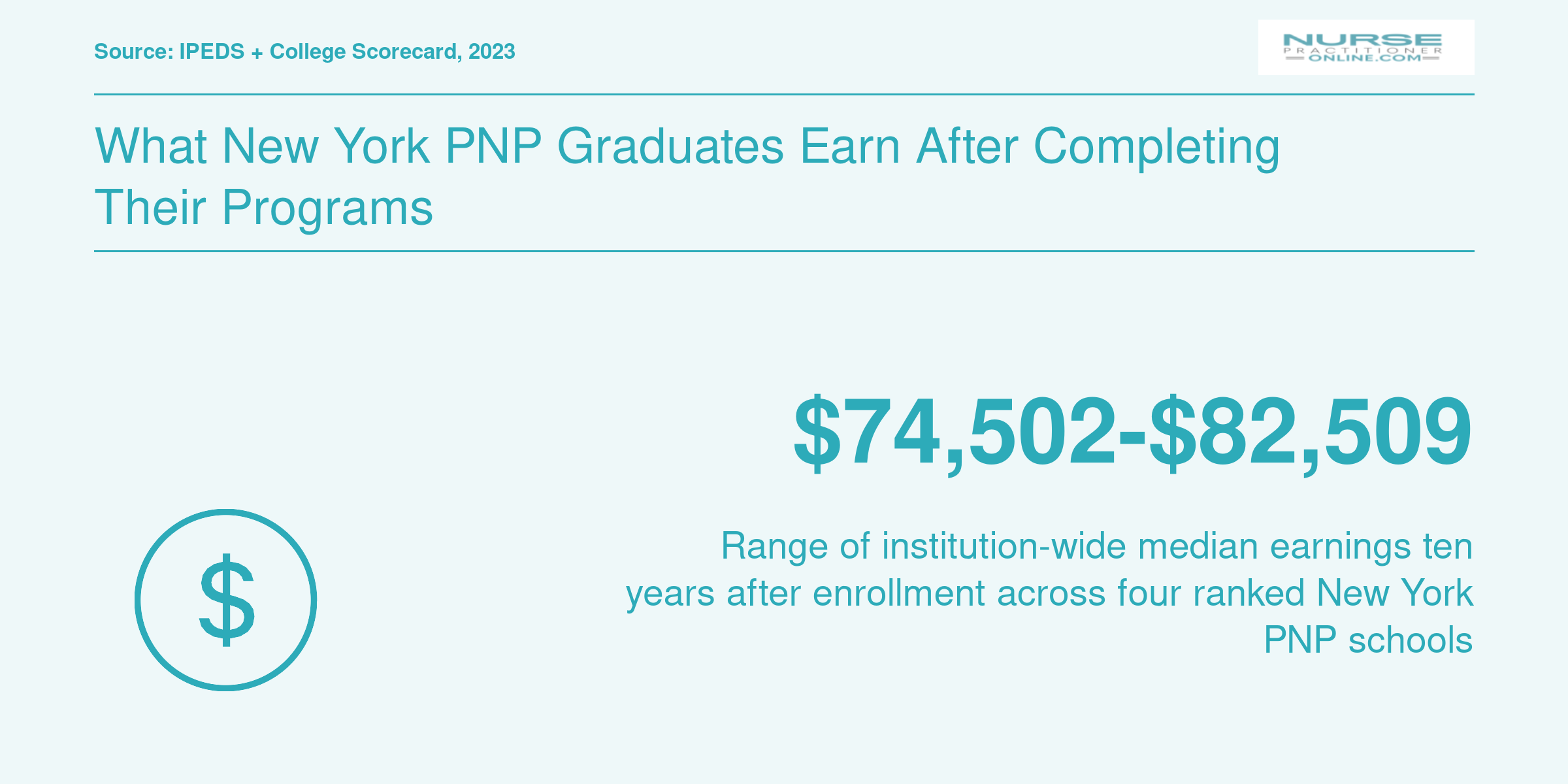
What New York PNP Graduates Earn After Completing Their Programs
Program-level earnings data for pediatric nurse practitioner graduates at New York schools are not yet published for any of the ranked programs. Without verified post-completion earnings figures, we can't build the side-by-side comparison we'd like to show here. However, institution-wide median earnings ten years after enrollment offer a useful reference point for the overall return on your investment.
New York by Specialty
- DNP NP Programs in New York
- FNP Programs in New York
- PMHNP Programs in New York
- New York
- Best Nurse Practitioner Options in Rochester, NY
- Best Nurse Practitioner Options in Syracuse, NY
- Best Nurse Practitioner Programs in Brooklyn, NY
- Best Nurse Practitioner Programs in Buffalo, NY
- Best Adult-Gerontology NP Programs in New York