

Most important takeaways…
- Most accredited post-master's WHNP certificate programs require 22 to 37 credits and 600 to 630 clinical hours.
- Annual tuition ranges dramatically, from roughly $8,500 to over $66,500 depending on the school and residency status.
- Graduates are eligible to sit for the NCC WHNP-BC certification exam immediately after completing the certificate.
- NP employment is projected to grow 40% from 2023 to 2033, fueling strong demand for women's health specialists.
Earning a second master's degree versus adding a specialty certificate through a post-master's program presents two very different cost and timeline paths for APRNs who want to practice in women's health. A full MSN typically spans two to three years and costs $30,000 to $70,000, while a targeted WHNP certificate runs 18 to 24 months and often costs half that amount. For family or adult-gerontology NP professionals already licensed and working, the certificate route eliminates redundant coursework while still meeting every clinical hour and certification requirement for WHNP practice.
The 11 online post-master's WHNP programs ranked below include verifiable tuition figures, clinical hour requirements, and institution-level outcome data where available. Each listing includes program format (fully online or hybrid), total credit hours, and direct links to official program pages.
The rest of this guide unpacks what these programs actually require: curriculum and clinical breakdowns, admissions checklists, a tuition comparison table sorted lowest to highest, and details on the national certification exam that follows program completion. Clinical placement models vary by school, and that single variable often determines whether a program works for nurses in rural states or those juggling full-time schedules.
Best Online Post-Master's WHNP Certificate Programs
Whether you're an FNP looking to add a women's health specialty or an experienced APRN ready to refocus your clinical career, a post-master's WHNP certificate can open new doors without requiring a full degree. The programs below represent a range of formats, price points, and clinical requirements. Some are fully online, while others use a hybrid model that combines distance coursework with on-campus intensives or in-person clinical rotations. Keep in mind that program-level earnings and debt data are not yet available for most of these certificates, so we've included institution-wide financial context where possible to help you weigh your options.
- Academic quality and accreditation
- Clinical hour depth and format
- Tuition and financial value
- Program flexibility for working nurses
- Graduate outcomes and reputation
- College Scorecard graduate earnings — collegescorecard.ed.gov
- Independent program research
- NCES-IPEDS federal institutional data — nces.ed.gov
- Internal program database

Vanderbilt University
Vanderbilt's School of Nursing pairs its women's health specialty with adult-gerontology primary care in a distinctive dual-track post-master's certificate. This Nashville-based hybrid program blends online coursework with in-person sessions and requires 1,190 clinical hours across five full-time semesters, with a part-time option available. The institution boasts a 93.5% graduation rate and an 8:1 student-to-faculty ratio, reflecting close mentorship and strong academic support.
- Hybrid format with online classes and in-person sessions
- 1,190 clinical practice hours required
- Dual WHNP/AGPCNP specialty track
- Five semesters full-time or part-time plan available
- Curriculum aligned with AACN Essentials
- Small class sizes with personalized faculty mentorship
- Prepares for both women's health and adult-gerontology certification exams
Women's Health/Gender-Related Nurse Practitioner Post-Master's Certificate — Hybrid

Duke University
Duke's post-graduate WHNP certificate builds on your existing master's degree through a hybrid model combining distance-based courses with clinical placements. The program emphasizes inclusive, equity-centered care for diverse populations and provides access to a global network of clinical partners. Duke's institution-wide graduation rate is 96.8%, and median graduate debt across the university sits at just $13,000, one of the lowest among schools on this list.
- Hybrid delivery with distance-based online courses
- Emphasis on inclusive care and health equity
- Access to global clinical partner network
- On-campus simulation experiences included
- Nationally ranked faculty with active research profiles
- Merit-based scholarships and federal loan options available
- Holistic admissions process with personalized mentorship
Women's Health Nurse Practitioner Post-Graduate Certificate — Hybrid

University of Utah
The University of Utah's post-APRN licensure certificate is tailored specifically for certified APRNs who already hold national certification in another population focus and want to add women's health. This hybrid program creates individualized study plans and is especially well-suited for NPs in the Mountain West. In-state tuition runs about $8,724, making it one of the most affordable options for Utah residents.
- Hybrid format with individualized study plans
- Designed exclusively for currently certified APRNs
- Requires active APRN licensure and a 3.0 GPA
- Prepares graduates for national WHNP certification
- CCNE-accredited program
- No federal financial aid available (non-degree program)
- In-state tuition approximately $8,724 per year
Post-APRN Licensure Certificate, Women's Health Concentration — Hybrid

Florida Agricultural and Mechanical University
As one of the few HBCUs offering an online post-master's WHNP certificate, FAMU brings a culturally responsive lens to women's health education. The fully online program spans 42 credit hours and covers advanced health assessment, pathophysiology, pharmacology, and clinical management. In-state tuition is approximately $9,876, and the curriculum's depth makes it closer in scope to a second specialty than a minimal add-on certificate.
- Fully online program delivery
- 42 total credit hours required
- Includes advanced health assessment and pharmacology
- Clinical management and women's health theory courses
- Credit transfer possible from prior master's coursework
- APRN synthesis seminar included
- In-state tuition approximately $9,876; out-of-state approximately $24,669
Post-Master's Certificate, APN, Women's Health Nurse Practitioner — On-Campus

Texas Woman's University
Texas Woman's University offers a compact 27-credit hybrid WHNP certificate built on the university's longstanding commitment to women's education and health. The program covers well-woman care, high-risk prenatal management, family planning, and menopause support. TWU's in-state tuition of roughly $8,520 makes this one of the most budget-friendly options, especially for Texas-based nurses who can easily access hybrid components.
- Hybrid program format with limited in-person requirements
- 27 semester credit hours total
- Covers well-woman care and high-risk prenatal management
- Includes family planning and menopause support
- Prerequisites in physical assessment, pharmacology, and pathophysiology
- Pharmacology prerequisite must be within six years
- In-state tuition approximately $8,520; out-of-state approximately $15,900
Post-Master's Certificate: Nurse Practitioner (Women's Health) — Hybrid

University of Missouri-Kansas City
UMKC's 18-credit WHNP certificate is a CCNE-accredited hybrid program designed to be completed in 18 months to two years at a pace of one to two courses per semester. The program requires Missouri licensure for entry and includes some campus visits in the Kansas City area. With an estimated total cost of about $16,610, it sits among the more affordable options, and graduates can transition seamlessly into UMKC's DNP program.
- Hybrid delivery with required campus visits in Kansas City
- 18 credit hours; estimated cost approximately $16,610
- Completion in 18 months to 2 years
- CCNE accredited with seamless DNP pathway
- Requires MSN or DNP, 3.2 GPA, and Missouri licensure
- Two years of clinical experience required for admission
- Covers primary care of women, health assessment, and pharmacology
Post-MSN Women's Health Nurse Practitioner Certificate — Hybrid

Fairleigh Dickinson University-Metropolitan Campus
FDU's fully online post-graduate certificate in women's health care requires a minimum of 23 credits and 750 clinical hours. Based in Teaneck, New Jersey, the program uses a blend of synchronous and asynchronous learning and can adjust clinical requirements through a gap analysis, potentially shortening time to completion for experienced NPs. Tuition is $19,068 regardless of state residency.
- Fully online with synchronous and asynchronous sessions
- Minimum 23 credits and 750 clinical hours
- Gap analysis may reduce clinical hour requirements
- Part-time pace with accelerated option available
- Prepares for ANCC or AANP certification exams
- Requires MSN or DNP and 2.8 GPA
- Flat tuition of $19,068 for all students regardless of state
Post-Graduate Certificate Program, Women's Health Care — Online

Kent State University
Kent State's 30-credit WHNP graduate certificate is delivered entirely online, making it accessible to working nurses throughout Ohio and beyond. Per-credit tuition is transparent and relatively affordable at roughly $613 for Ohio residents and $623 for non-residents. The program is CCNE-accredited and emphasizes reproductive health, prenatal care, and lifespan wellness for women, with flexible pacing for part-time study.
- 100% online delivery with CCNE accreditation
- 30 total credit hours
- Ohio resident tuition approximately $613 per credit
- Non-Ohio resident tuition approximately $623 per credit
- Requires master's in nursing and 3.0 GPA
- Active unrestricted RN license and three professional references needed
- Includes clinical practicum, advanced health assessment, and pharmacology
Women's Health Nurse Practitioner Graduate Certificate — Online

Husson University
Husson University's 12-month hybrid certificate is purpose-built for practicing family and adult NPs who want to expand into women's health. The program packs 688 internship hours into just 21 credits, giving it one of the highest clinical-to-credit ratios on this list. Based in Bangor, Maine, it serves as a strong New England option for NPs seeking a fast, hands-on path to WHNP certification.
- 12-month hybrid format combining online and in-person learning
- 21 credit hours with 688 clinical internship hours
- Designed for practicing FNPs and adult NPs
- Covers reproductive, gynecologic, and well-woman care
- Includes contraceptive counseling and prenatal services
- Prepares for national WHNP certification exams
- Tuition is $19,832 regardless of residency
Women's Health Nurse Practitioner Certificate — Hybrid

Carlow University
Carlow University's online WHNP post-master's certificate stands out for its reported 100% board pass rate and its integration of doctoral-level coursework within a certificate framework. Licensed NPs can finish in as few as three semesters, while others complete the 35-credit program in about seven semesters. At $946 per credit, total program cost comes to roughly $33,100, and the curriculum emphasizes care for underserved populations.
- Online delivery with CCNE accreditation
- 35 credits at $946 per credit (approximately $33,100 total)
- Licensed NPs can finish in 3 semesters; others in 7
- 525 to 600 clinical hours required
- Reported 100% board certification pass rate
- Incorporates doctoral-level coursework
- Focus on underserved and community health populations
Post-Master's Certificate in Women's Health Nurse Practitioner — Online

Drexel University
Drexel's post-master's WHNP certificate requires 37 credits and can be completed in about 1.5 years of part-time study, ideal for nurses who need to keep working. The program is delivered online with synchronous lectures and optional on-campus intensives in Philadelphia. Clinical preceptorships can be arranged near the student's home, and the quarter-based calendar offers more frequent start points than semester-based programs.
- Online delivery with synchronous lectures
- Optional on-campus intensives in Philadelphia
- 37 credits; approximately 1.5 years part-time
- Clinical preceptorships arranged near student's home
- Quarter-based academic calendar for flexible start dates
- CCNE accredited; prepares for NCC certification
- Requires MSN with 3.0 GPA and RN licensure
Women's Health/Gender-Related Nurse Practitioner Certificate — Online
Why Earn a Post-Master's Women's Health NP Certificate?
Healthcare systems across the country are scrambling to address widening gaps in women's health services, creating an urgent need for nurse practitioners who specialize in this population. For nurses who already hold an MSN or DNP and want to pivot into women's health, a post-master's certificate offers a streamlined path to this in-demand specialty.
What Is a Post-Master's WHNP Certificate?
A post-master's certificate is a focused credential designed for nurses who have already completed a graduate nursing degree. Rather than requiring you to repeat foundational coursework in leadership, research methods, or nursing theory, these programs concentrate exclusively on women's health content and clinical experiences. You build directly on the advanced practice foundation you already have.
The typical post-master's WHNP certificate includes 18 to 42 credit hours, depending on your prior coursework and the program's structure. Compare that to a full MSN in women's health, which often runs 45 to 60 credits and includes core graduate courses you may have already taken. If you earned your master's as a family nurse practitioner, adult-gerontology NP, or in another specialty, a certificate lets you add WHNP scope without duplicating effort.
Demand Drivers in Women's Health
Several factors are pushing demand for WHNPs higher:
- OB/GYN shortages: Rural and underserved communities face persistent gaps in obstetric and gynecologic care. Nurse practitioners with women's health training help fill these critical access points.
- Aging population: As women live longer, they need providers who understand menopause management, osteoporosis screening, and age-related reproductive health concerns.
- Expanded scope-of-practice laws: More states now grant full practice authority to nurse practitioners, allowing WHNPs to serve as primary women's health providers in settings where physician coverage is limited.
Projected physician deficits could reach as high as 124,000 providers nationally, according to workforce analyses. Nurse practitioners, increasingly recognized as primary care providers, are positioned to absorb much of that unmet demand.2
Salary Considerations
Nurse practitioners overall earn a median annual wage of approximately $132,050, with the occupation projected to grow 35 percent through 2034.3 While program-level earnings data for WHNP certificate graduates is not yet published, institutional data from schools in our rankings shows graduates from top programs often report median earnings of $91,000 to nearly $98,000 within a decade of completion. More detailed wage information appears later in this article.
For nurses already established in advanced practice, adding a WHNP certificate can open doors to specialized roles in women's health clinics, reproductive health centers, and maternal care settings where compensation often reflects the specialized skill set.
How We Ranked These WHNP Programs
Our ranking prioritizes the financial and outcome data that actually predicts whether a post-master's WHNP certificate pays off for you. We pulled tuition and net price figures from IPEDS, then layered in program-level earnings and median debt from the most recent College Scorecard release (data snapshot updated through early 2026), plus institutional graduation rates and verified online or hybrid delivery.
What We Weighed
- Cost: Published tuition and net price for graduate students at each host institution, with preference for programs that report transparent per-credit pricing.
- Outcomes: Program-level median earnings and median debt at graduation, drawn from College Scorecard where the school reports nursing-specific figures. Where program-level outcomes are not yet published, we relied on institutional graduate-nursing data and noted the gap.
- Completion: Institution graduation rate as a proxy for student support and program stability.
- Access: Confirmed online or hybrid format and an active post-master's certificate track (not just a full MSN or DNP).
What We Did Not Use as a Ranking Input
Clinical hour requirements and curriculum depth matter enormously, and we cover both in dedicated sections below. But we did not score programs on them directly. WHNP certificate programs cluster tightly around 600 to 784 clinical hours to meet NCC eligibility, and curriculum content is largely standardized by AACN Essentials and NONPF competencies. Ranking on those factors would mostly produce noise.
Every program on this list is delivered online or in a hybrid format and is filtered to the post-master's certificate level, so RNs already holding an MSN can step in without repeating coursework they have already completed. If you are still comparing specialty tracks, our guide to the best online nurse practitioner programs covers the full landscape.
Questions to Ask Yourself
Post-Master's WHNP Curriculum and Clinical Hours
Most accredited post-master's WHNP certificate programs require 600 to 630 clinical hours, completing coursework in 22 to 37 credits depending on the institution and any prior NP preparation you bring to the program.12 These certificates prepare experienced nurse practitioners to sit for the Women's Health Nurse Practitioner certification exam and expand their scope of practice into reproductive and gynecologic care.
Core Curriculum Themes
The curriculum in a post-master's WHNP certificate zeroes in on the knowledge and clinical skills specific to women's health across the lifespan. You'll study gynecologic health assessment and the management of common conditions such as pelvic pain, abnormal bleeding, and sexually transmitted infections. Prenatal and postpartum care modules cover low-risk obstetric management, fetal assessment, and postpartum complications. Reproductive endocrinology coursework addresses menstrual disorders, polycystic ovary syndrome, infertility evaluation, and hormone therapy. Menopause management and contraceptive counseling round out the core, equipping you to guide patients through family planning decisions and the transition to menopause.
Programs accredited by the Commission on Collegiate Nursing Education (CCNE) or the Accreditation Commission for Education in Nursing (ACEN) structure these topics across didactic and clinical courses, often pairing theory modules with concurrent practicum experiences so you can apply new concepts immediately in clinical settings.2 If you're an NP already certified in a different population focus, such as those holding a post master's certificate FNP, the credit load may be lighter because of overlapping coursework.
Online Didactic, In-Person Clinical
Every post-master's WHNP certificate advertised as "online" delivers didactic coursework through web-based platforms, but clinical rotations always occur in person at approved women's health sites. You'll complete your clinical hours in settings such as OB-GYN offices, family planning clinics, midwifery practices, and hospital-based women's health units. Expect to perform gynecologic exams, interpret lab and ultrasound findings, counsel patients on contraception and prenatal care, and manage routine and urgent conditions under the supervision of a physician or experienced nurse practitioner.
Understanding this hybrid reality is critical when evaluating programs. The flexibility you gain from online lectures does not extend to clinical days, which require local or regional travel and coordination with preceptors.
Clinical Placement Support: A Major Differentiator
How a program handles clinical placement can make or break your experience. Some schools provide robust placement support. The University of Colorado Anschutz Medical Campus, for example, arranges clinical sites for students in the Denver metro area, reducing the burden of finding and vetting preceptors on your own. Other programs, including Drexel University, require students to secure their own clinical placements, a process that can involve cold-calling practices, negotiating affiliation agreements, and managing liability paperwork.4
Self-placement offers geographic flexibility if you live far from campus, but it demands significant time and networking effort. Programs with placement support streamline the process but may limit where you can complete rotations. When comparing certificate programs, ask explicitly whether clinical coordination is included and what geographic constraints apply. This single factor often determines whether a program feels manageable alongside full-time work or becomes a source of ongoing stress.
WHNP Certificate at a Glance
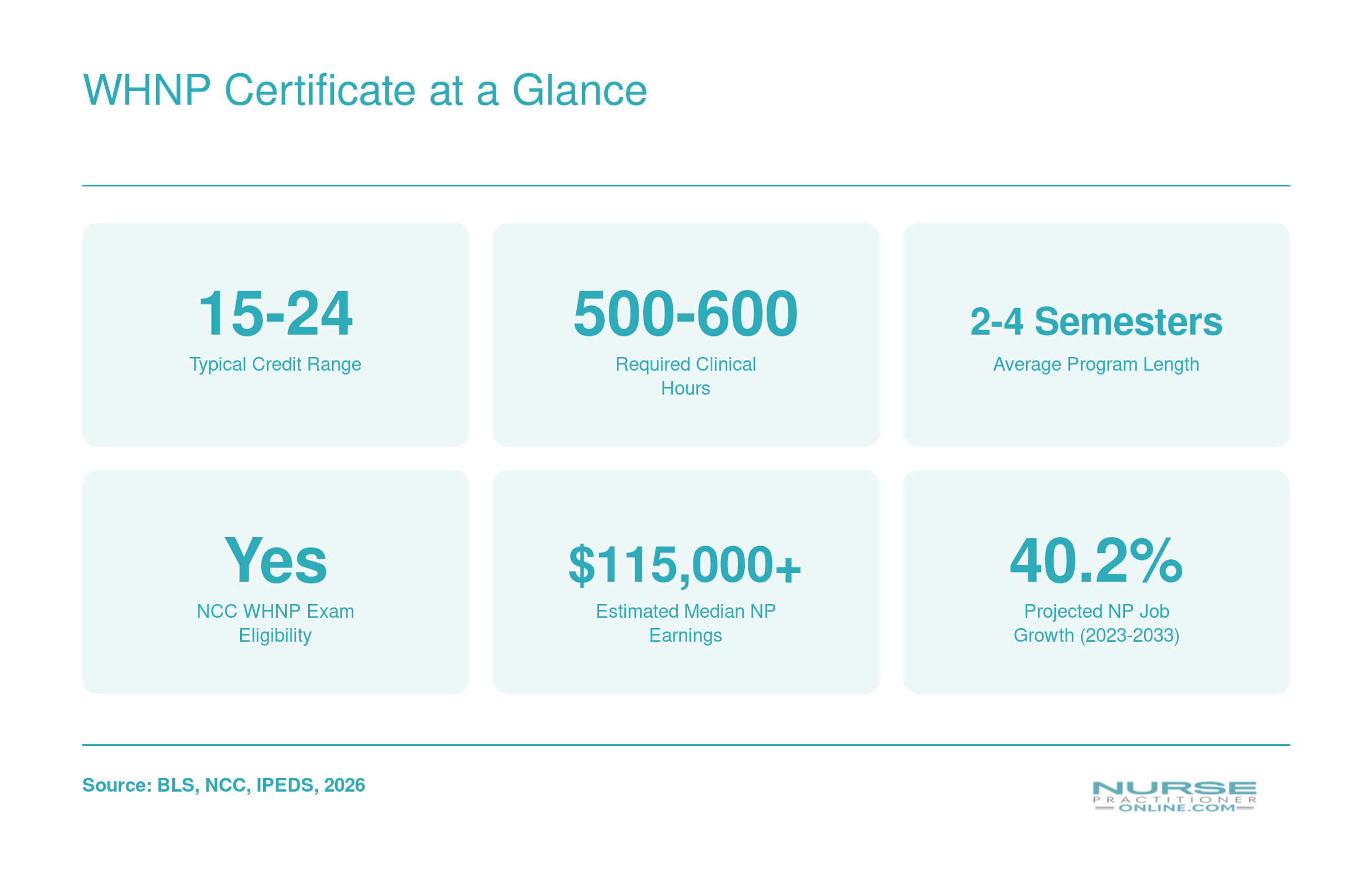
Before you start comparing individual programs, here are the key numbers that define most post-master's WHNP certificate programs in 2026. These benchmarks can help you set realistic expectations for time, cost, and career outcomes.
Admission Requirements for Post-Master's WHNP Programs
Admission standards share a common framework across post-master's WHNP certificate programs, but the details, especially around coursework recency, can vary significantly from school to school. Here's what you'll typically need to have in order before you apply.
- MSN or DNP from an accredited programYou must hold a master's or doctoral nursing degree from a program accredited by the CCNE or ACEN. This is non-negotiable across every program we reviewed.
- Active APRN certification in another population focusMost programs require current national certification as a nurse practitioner in a different specialty area, such as FNP or ANP. This confirms you've already completed foundational advanced-practice training.
- Active, unencumbered RN licenseYou'll need a current registered nursing license with no restrictions or disciplinary actions. Some programs also require licensure in the state where you'll complete clinical hours.
- The 3 Ps recency rule, and why you should check each schoolPrograms generally require recent coursework in pharmacology, pathophysiology, and physical or health assessment, but the acceptable timeframe ranges widely. Texas Woman's University, for example, requires pharmacology within six years. Cal State LA sets a five-year window for physical assessment courses, though currently certified and practicing NPs may qualify for an exception. Other programs, such as Georgetown, Georgia College, and the University of Rhode Island, take a competency-based, equivalency-review, or internal-review approach rather than applying a strict year cutoff. Herzing University uses a gap analysis to determine whether additional coursework is needed. Always confirm each school's specific policy before you apply.
- Minimum GPA requirementA cumulative GPA of 3.0 on a 4.0 scale in your graduate coursework is the most common threshold, as seen at Texas Woman's University and many peer programs. Some schools may set the bar slightly higher, so verify the requirement for every program on your list.
- Clinical experience or current practice documentationCertain programs ask for proof of recent clinical practice hours or employment verification as a nurse practitioner. This helps the admissions committee confirm you're actively using your advanced-practice skills, an important readiness indicator for specialty-focused clinical rotations.
Cost Comparison: WHNP Post-Master's Certificate Tuition
Tuition for post-master's WHNP certificate programs varies widely, from roughly $8,500 to over $66,500 per year depending on the institution and residency status. The table below lists all 11 programs sorted from lowest to highest in-state tuition. Keep in mind that the net price shown is an institution-wide average calculated across all students and aid packages, so it serves as a general benchmark rather than a personalized quote. Program-level earnings and debt data are not yet available for these certificates, so the median graduate debt figures reflect each university overall.
| School | State | In-State Tuition | Out-of-State Tuition | Avg. Net Price | Median Graduate Debt |
|---|---|---|---|---|---|
| Texas Woman's University | TX | $8,520 | $15,900 | $11,963 | $19,218 |
| University of Utah | UT | $8,724 | $27,983 | $16,200 | $19,000 |
| Florida A&M University | FL | $9,876 | $24,669 | $13,739 | $23,548 |
| Kent State University | OH | $12,483 | $23,352 | $20,787 | $24,500 |
| University of Missouri-Kansas City | MO | $13,726 | $32,298 | $13,310 | $18,750 |
| Fairleigh Dickinson University | NJ | $19,068 | $19,068 | $15,404 | $25,000 |
| Husson University | ME | $19,832 | $19,832 | $21,005 | $27,000 |
| Carlow University | PA | $24,816 | $24,816 | $20,786 | $25,500 |
| Drexel University | PA | $39,261 | $39,261 | $38,509 | $25,325 |
| Vanderbilt University | TN | $57,868 | $57,868 | $15,846 | $14,000 |
| Duke University | NC | $66,523 | $66,523 | $29,612 | $13,000 |
How to Choose the Right WHNP Certificate Program
The post-master's WHNP market has expanded fast over the past three years, which means the gap between programs that genuinely support working APRNs and those that simply collect tuition has widened. Picking the right one comes down to four questions you should ask before you submit a single application.
Confirm Accreditation First
If a program is not accredited by the Commission on Collegiate Nursing Education (CCNE) or the Accreditation Commission for Education in Nursing (ACEN), stop reading the brochure. National Certification Corporation (NCC) WHNP-BC exam eligibility hinges on graduating from an accredited program, and state boards of nursing will not grant you population-focus authority without it. Verify accreditation directly on the CCNE or ACEN site, not on the school's marketing page, and check that the accreditation specifically covers the post-master's certificate track rather than only the MSN or DNP. For a deeper look at what these designations mean, see our nursing accreditation guide on ACEN vs CCNE.
Look Past 'Online' to the Clinical Reality
Nearly every post-master's WHNP program delivers didactic coursework online. The real differentiator is clinical placement. Some programs hand you a preceptor coordinator who actively builds relationships with OB-GYN practices, FQHCs, and women's health clinics in your region. Others give you a placement handbook and wish you luck. Ask bluntly: does the program place students, assist with placement, or require self-placement? If you live in a saturated NP market, self-placement can add six months or more to your timeline.
Check Exam Prep Alignment
A quality program maps its curriculum to the NCC WHNP-BC content outline (gynecology, obstetrics, primary care, and professional issues). Ask whether faculty review pass rates with students, whether a board review course is built in, and whether they publish first-time pass rates. Programs that dodge that question usually have a reason.
Match the Pacing to Your Life
Finally, look at the practical fit:
- Pacing options: Confirm part-time and full-time tracks, and whether you can shift between them.
- Start dates: Multiple cohort starts per year give you flexibility if life intervenes.
- Working APRN accommodations: Asynchronous lectures, evening clinical intensives, and realistic credit loads matter when you are still working 36 hours a week.
- Time to completion: Most certificates run 12 to 24 months. Anything longer should come with a clear reason.
If you are still weighing whether to apply, our step-by-step guide on how to enroll in NP school online walks you through the logistics from transcript requests to financial aid.
WHNP Certification Exam and Career Outcomes
Earning a WHNP-BC credential validates your expertise and unlocks independent practice opportunities in many states. Once you complete an online post-master's WHNP certificate, you're fully eligible to sit for the National Certification Corporation (NCC) Women's Health Care Nurse Practitioner exam, with no extra degree required.1
NCC WHNP-BC Certification: Your Ticket to Practice
The NCC WHNP-BC certification is the gold standard for advanced practice in women's health. To qualify, you need an active RN/APRN license and a graduate degree from an accredited WHNP program, which includes a post-master's certificate as long as it meets NCC's educational standards.2 This pathway saves you from retaking an entire MSN or DNP just to add the specialty. Once you pass, you become board certified as a Women's Health Care Nurse Practitioner. NCC requires candidates to pass the exam within eight years of completing their program.3
Exam Format and What to Expect
The WHNP-BC exam is computer-based, with 175 total questions (150 scored and 25 unscored pretest items) and a 180-minute time limit.2 It covers four key domains: health promotion, gynecologic care, obstetrical care, and professional issues. Every question is multiple choice with a single best answer. The content aligns closely with what you'll learn in a post-master's WHNP curriculum, so your coursework directly prepares you for test day.
No Public Pass Rates, but Strong Outcomes
Unlike some nursing exams, NCC does not publish aggregate pass rates for the WHNP-BC exam.2 However, accredited programs often track and share their own graduates' success. For instance, Carlow University reports a 100% board certification pass rate for its certificate completers. This pattern reflects the rigorous clinical training and faculty support built into quality post-master's WHNP programs. If you apply yourself and choose a CCNE-accredited program, your odds of passing are high.
Earnings Potential and Return on Investment
While program-specific earnings data isn't yet available, we can look at the median earnings of former students a decade after enrolling at the institutions in our ranking. Top performers show impressive figures: graduates from Duke University report median earnings of $97,800, and Vanderbilt University alumni see $91,565. Even at more affordable public universities, returns are solid. University of Utah completers earn a median of $67,170. When you compare these earnings to typical post-master's certificate tuition (often between $10,000 and $40,000), the ROI speaks for itself. In many cases, you recoup your investment within the first year or two of working as a certified WHNP. If you're already an NP in another specialty and considering a similar add-on credential, online post-master's ACNP certificate programs follow a comparable pathway.
Job Market Outlook for WHNPs
The career outlook is equally compelling. According to the U.S. Bureau of Labor Statistics, employment for nurse practitioners overall is projected to grow 45% from 2023 to 2033, far outpacing most professions. Women's health NPs are especially sought after in outpatient clinics, OB-GYN practices, and community health centers. With a WHNP-BC certification, you position yourself for a role that's not only financially rewarding but also essential to closing gaps in women's healthcare.
The U.S. Bureau of Labor Statistics projects a 40% increase in nurse practitioner jobs from 2023 to 2033, a rate much faster than the average for all occupations. This strong growth includes women's health nurse practitioners, making WHNP certification a valuable asset in a growing field.
Frequently Asked Questions About Post-Master's WHNP Programs
Choosing a post-master's WHNP certificate program comes with plenty of practical questions. Below are answers to the ones working nurses ask most often, drawn from program details and requirements covered throughout this guide.
- How many clinical hours are required for a post-master's WHNP certificate?
- Most accredited post-master's WHNP certificate programs require between 500 and 700 supervised clinical hours focused on women's health across the lifespan. The exact number depends on the program and any hours your previous NP education may satisfy. These clinical placements typically cover prenatal, gynecologic, and primary care settings, and many programs allow you to complete them in your local community.
- What are the admission requirements for post-master's WHNP programs?
- Applicants generally need an MSN or doctoral degree from an accredited program, an active and unencumbered RN license, and current national certification as a nurse practitioner in another specialty. Most programs also require a minimum GPA (often 3.0 or higher), professional references, a goal statement, and documentation of prior graduate coursework. Some schools may ask for recent clinical practice hours as well.
- How long does it take to complete a post-master's WHNP certificate?
- Completion timelines typically range from two to four semesters, depending on whether you enroll full time or part time. Many programs are designed with working nurses in mind and can be finished in about 12 to 18 months of part-time study. The pace is often influenced by how quickly you can schedule and complete your required clinical hours alongside didactic coursework.
- What is the difference between a post-master's WHNP certificate and an MSN in women's health?
- A post-master's certificate is built for nurses who already hold an MSN or higher degree and want to add a WHNP specialty without repeating core graduate coursework. An MSN in women's health, by contrast, includes foundational nursing theory, research, and role courses alongside the WHNP specialty content. The certificate path is shorter, typically less expensive, and focused entirely on the women's health clinical and didactic requirements.
- Which post-master's WHNP programs are fully online?
- Several accredited programs offer the didactic portion of their WHNP certificate entirely online, making them accessible to nurses across the country. However, clinical hours must still be completed in person at approved sites. When evaluating programs listed on nursepractitioneronline.com, look for details on whether the school helps arrange clinical placements in your area or requires you to secure your own preceptors.
- Does a post-master's WHNP certificate qualify you for the NCC WHNP-BC exam?
- Yes, graduating from an accredited post-master's WHNP certificate program qualifies you to sit for the National Certification Corporation (NCC) Women's Health Nurse Practitioner Board Certified (WHNP-BC) examination. Accreditation by CCNE or ACEN is essential, as the NCC requires that candidates complete an approved program. Passing the WHNP-BC exam is the standard pathway to practicing as a credentialed women's health nurse practitioner.