Most important takeaways…
- New York now grants full practice authority to nurse practitioners, eliminating the previous collaboration agreement requirement.
- All five New York AGACNP programs featured here are at private universities and hold CCNE accreditation.
- AGACNP certification requires at least 500 direct clinical hours, and most New York programs mandate even more.
- Acute care NP salaries in New York range from roughly $115,000 upstate to over $133,000 in the NYC metro area.
Adult-gerontology acute care nurse practitioners are now integral to New York inpatient teams, from academic medical centers to community hospitals. Demand is rising as the state's aging population drives more complex hospital admissions.
Online and hybrid AGACNP programs (MSN, post-master's certificate, and DNP) let you advance without leaving the bedside entirely. But every program requires in-person clinical hours, and finding an NP preceptor at a qualifying hospital is often the biggest hurdle.
New York grants full practice authority to NPs, but only after you pass a national certification exam tied to your program's accreditation. Check CCNE or ACEN status first: it's the detail that determines whether your degree translates to a license.
Best Online AGACNP Programs in New York for 2026
The programs below were selected using a composite that weighs online and hybrid delivery availability alongside institutional graduation rates, net price, and graduate outcomes. This is not a pure prestige or cost ranking: it reflects what matters most to working nurses who need flexible access to high-quality AGACNP education in New York. Each school offers a distinct pathway, whether you are pursuing your first NP credential or adding an acute care specialty to an existing advanced practice license.
- Online or hybrid delivery availability
- Institutional graduation rate
- Net price after financial aid
- Graduate earnings outcomes
- Program credential and clinical depth
- Independent program research
- NCES-IPEDS federal institutional data — nces.ed.gov
- Internal program database
- College Scorecard graduate earnings — collegescorecard.ed.gov

University of Rochester
The University of Rochester School of Nursing pairs a strong research university infrastructure with a focused AGACNP Advanced Certificate designed for nurses who already hold a graduate degree. With the school's overall graduation rate at 85.4% and a 9:1 student-to-faculty ratio, students benefit from close faculty mentorship and a hybrid format that blends online coursework with hands-on clinical and procedure lab time in Rochester. The program channels experienced nurses into acute care specialty practice through individually advised degree plans.
- Hybrid format: online coursework with in-person clinical labs
- Clinical specialty courses totaling 672 supervised clinical hours
- NUR 414 Procedure Lab (1 credit) for hands-on skill building
- Faculty advisors help design personalized degree plans
- Advanced Health Assessment course included
- Prepares graduates for AGACNP board certification
Adult-Gerontology Acute Care NP Advanced Certificate — Hybrid

Daemen University
Daemen University in Amherst stands out as the only AGACNP provider of its kind in western New York, offering both an online MSN and a newer hybrid DNP track. At a net price of roughly $18,693, Daemen delivers the most affordable option on this list, making it especially appealing for budget-conscious nurses. The university launched its DNP cohort in spring 2025, giving students a post-BSN or post-MSN entry point to the highest clinical nursing degree.
- Fully online program format for maximum flexibility
- 38 total credits required, includes thesis component
- Advanced health assessment, pharmacology, and pathophysiology courses
- Practicum and preceptorship with lab experiences
- Research methods and nursing informatics coursework
- Evidence-based practice and interprofessional collaboration emphasis
- Leadership development and cultural competence training
- Only AGACNP DNP of its kind in western New York
- Hybrid delivery with post-BSN and post-MSN entry tracks
- Covers leadership, informatics, technology, and policy
- Prepares graduates for board certification as AGACNP
- Highest clinical degree in nursing
- Capstone scholarly project required
Master of Science in Adult-Gerontology Acute Care Nurse Practitioner — Online
Adult-Gerontology Acute Care Nurse Practitioner, DNP — Hybrid

Russell Sage College
Russell Sage College in Troy offers a Post-Master's Certificate built around a personalized gap analysis, meaning your curriculum is individually designed based on what your existing master's degree already covered. The hybrid program requires 27 credits and at least 590 clinical hours, keeping the pathway efficient while ensuring national certification eligibility. Coursework emphasizes complex geriatric care and palliative approaches alongside core NP foundations.
- Hybrid format combining online and on-site learning
- 27 credits with individualized gap analysis design
- Minimum 590 clinical hours for certification eligibility
- Advanced pathophysiology and pharmacology coursework
- Palliative care and complex geriatric case studies
- National AGACNP certification preparation
- Admission requirements mirror master's-level standards
Adult Gerontology Acute Care NP Post-Master's Certificate — Hybrid

St. John Fisher University
St. John Fisher University in Rochester offers a distinctive dual DNP that prepares graduates as both Certified Registered Nurse Anesthetists and AGACNPs. This rigorous, full-time hybrid program totals 103 credits and 2,600 clinical hours, with 600 hours dedicated specifically to the AGACNP role. The school's overall graduation rate of 74.2% and 11:1 student-to-faculty ratio reflect a supportive learning environment suited to the demands of a dual-certification pathway.
- Dual-degree: graduates earn both AGACNP and CRNA credentials
- 103 total credit hours with capstone scholarly project
- 2,600 clinical hours total, 600 dedicated to AGACNP role
- Full-time enrollment required
- Post-baccalaureate and post-master's entry options available
- Hybrid delivery with in-person clinical intensives
Doctor of Nursing Practice in Nurse Anesthesia and Adult Gerontology Acute Care Nurse Practitioner — Hybrid

Pace University
Pace University brings its AGACNP certificate to the heart of New York City, giving students clinical access to some of the nation's top acute care hospitals. The hybrid program requires 28 to 37 credits depending on a gap analysis of prior coursework, and it can be completed in 1.5 to 2 years part-time. Pace's STEM designation and recognition in U.S. News graduate nursing rankings add further credibility, while the no-GRE admissions policy lowers a common barrier for working nurses.
- Hybrid modality with New York City campus meetings
- 28 to 37 credits based on individualized gap analysis
- 1.5 to 2 years part-time completion timeline
- $1,585 per credit tuition rate
- No GRE required for admission
- One year of acute care RN experience required
- STEM-designated program
- Fall start date, prepares for AGACNP certification
Adult-Gerontology Acute Care Nurse Practitioner Certificate — Hybrid
AGACNP Tuition and Net Price: Comparing New York Programs Side by Side
All five AGACNP programs featured here are housed at private universities, which means there is no in-state vs. out-of-state tuition distinction. However, the listed graduate tuition rate and the approximate net price (after typical institutional aid) can differ significantly from school to school. Keep in mind that your actual cost will depend on your total credit load, the financial aid package you receive, employer tuition benefits, and whether you enroll in a master's, post-master's certificate, or DNP track. The net price figures shown below are institution-wide averages for aid-receiving students and should be treated as rough benchmarks, not personalized quotes.
| School | Sector | Graduate Tuition (Annual) | Approximate Net Price | Program Type |
|---|---|---|---|---|
| Daemen University | Private | $26,985 | $18,693 | MS (Online) |
| Russell Sage College | Private | $13,240 | $22,917 | Post-Master's Certificate (Hybrid) |
| St. John Fisher University | Private | $20,706 | $28,945 | DNP (Hybrid) |
| University of Rochester | Private | $39,310 | $29,278 | Advanced Certificate (Hybrid) |
| Pace University | Private | $30,770 | $30,892 | Post-Master's Certificate (Hybrid) |
What 'Online' Really Means for Acute Care NP Programs in New York
Can you really complete an AGACNP program online while working full-time as a bedside nurse in New York?
The short answer is: most of your coursework, yes. Your clinical hours, no. That distinction matters more than any program's marketing language, and it shapes nearly every practical decision you will make as a working RN trying to advance.
Didactics vs. Clinicals: Two Very Different Things
When a school calls its AGACNP program "online," it is describing how lectures, assignments, and faculty interaction are delivered. In a fully online didactic model, you log in on your own schedule, watch recorded lectures, participate in discussion boards, and complete coursework without setting foot on campus. That flexibility is real and significant for nurses juggling 12-hour shifts.
What online branding does not cover is the clinical component. Every AGACNP program, regardless of how it delivers coursework, requires supervised hands-on clinical hours in acute care settings. Expect somewhere in the range of 500 to 700 or more clinical hours, depending on the track. Those hours happen in hospitals and critical care units, not on a laptop.
Hybrid Models and Campus Requirements
Not every program takes the fully asynchronous route. Some use a hybrid structure that combines online coursework with periodic required campus visits. These visits typically involve simulation labs, skills checkoffs, or intensive weekend sessions. If you live hours from the program's home campus, that travel cost (in money and time off work) adds up quickly and deserves a spot in your decision calculus. For a deeper look at how these formats compare across the profession, our guide to online vs on-campus NP programs breaks down the key tradeoffs.
Among the programs covered in this article, you will find a mix of formats: fully online didactics with no required campus visits for coursework, hybrid models that bring students in for one or more on-site intensives per semester, and programs that lean more heavily toward in-person instruction throughout. Each format suits a different kind of schedule and a different geography.
What This Means for Your Week-to-Week Life
For working RNs, the practical implications break down like this:
- Asynchronous coursework: Lets you complete readings and lectures between shifts, at midnight if that is when your brain works.
- Synchronous sessions: Some programs require live video seminars on set days. Check whether those times conflict with your unit's scheduling norms.
- Simulation intensives: Skills labs often run in concentrated weekend or week-long formats. Factor in childcare, shift swaps, and lodging if the campus is not local.
- Clinical placement: Your acute care rotation site may be near you or may require negotiation with your program's clinical placement team.
The takeaway: ask every program you are considering exactly which components require your physical presence, on which days, and how often. Vague answers about being "mostly online" are a red flag worth pressing on.
Explore other New York related topics
Related Articles
Questions to Ask Yourself
Clinical Hours, Preceptor Placement, and Hospital Access by Program
How many clinical hours will I complete in a New York AGACNP program, and who finds my preceptors?
Clinical Hour Requirements: What the Certification Bodies Expect
Both the ANCC's AGACNP-BC exam and the AACN's ACNPC-AG certification require a minimum of 500 supervised clinical hours in adult-gerontology acute care. This is the baseline every program must meet, and many exceed it, especially for the DNP. While 500 hours is the floor, competitive applicants often accumulate 600 or more through program-required experiences. For a broader look at what clinical rotations involve, see our guide to nurse practitioner student clinical rotations.
Side-by-Side: Clinical Hours at Top New York AGACNP Programs
- Daemen University: 500 clinical hours (MSN track). The program aligns with certification minimums, making it efficient for students who already have strong acute care backgrounds.1
- Pace University: 760 clinical hours (MS track). The higher total reflects additional immersion in critical-care procedures and hospitalist rotations, providing a more extensive bedside experience.2
Clinical hour totals for University of Rochester, Russell Sage, St. John Fisher, NYU, and Stony Brook are not standardized across MSN, post-master's certificate, and DNP pathways. For each campus's latest figures, speak to the program coordinator. Hour totals may differ between the master's and doctoral tracks, with DNP programs often embedding extra practice hours. If you are comparing acute care nurse practitioner programs nationally, keep in mind that New York schools tend to cluster at or above national averages.
Preceptor Placement and Hospital Access: NYC vs. Upstate
Where you train matters as much as how many hours you log. In New York City, the concentration of major academic medical centers (NewYork-Presbyterian, NYU Langone, Mount Sinai, Montefiore) gives AGACNP students a deep bench of potential preceptors and clinical sites. Programs in the five boroughs and Long Island often maintain long-standing agreements with these networks, which can streamline placement and expose you to high-acuity settings.
Upstate and suburban campuses (Rochester, Albany, Buffalo) still offer robust rotations, but students sometimes need to be more proactive. Daemen, for example, works with Buffalo's Kaleida Health and Catholic Health systems, but the pool of acute care preceptors is narrower than in the NYC metro. In either geography, always clarify: does the school assign your preceptor or simply provide a coordinator? Policies range from guaranteed placement to "student arranges with faculty approval." This is one of the most common friction points, so ask directly before committing. Our step-by-step resource on how to find NP preceptors can help you navigate that process if your program expects you to secure your own site.
MSN vs. Post-Master's Certificate vs. DNP: Which AGACNP Track Fits You?
Choosing among an MSN, post-master's certificate, and DNP for adult-gerontology acute care NP preparation comes down to where you are in your nursing career and how quickly you want to reach the bedside in an acute care role. Each pathway leads to the same ANCC or AACN certification eligibility, but the investment of time, credits, and clinical hours shifts depending on your existing credentials and long-term goals.
MSN-AGACNP: The Traditional Entry Point
For BSN-prepared nurses with no prior NP certification, the Master of Science in Nursing is the most common route. In New York, these programs demand 36 to 50 credits and 600 to 800 clinical hours, typically delivered in hybrid formats that blend online coursework with on-campus intensives.1 Pace University's 49-credit MSN, for example, spans 36 months and includes 760 clinical hours.2 Molloy University's 45-credit program builds on a core of advanced practice and specialty courses, while Daemen University compresses the curriculum into 38 credits.1 Stony Brook and NYU also offer MSN tracks that position graduates for acute care roles in hospitals and specialty practices.34
Expect a time commitment of two to three years of full-time study. Most programs look for at least one year of bedside experience, though the exact requirement varies. This degree is the fastest way for a BSN nurse to enter the AGACNP workforce without an advanced degree.
Post-Master's Certificate: Add a Specialty Faster
If you already hold an MSN or DNP in another NP population (say, family or adult-gerontology primary care) a post-master's certificate lets you layer on AGACNP competencies in a fraction of the time. New York certificate programs run 18 to 30 credits with 500 to 700 clinical hours, based on a gap analysis of your prior coursework.1 You focus only on the acute care content, saving a year or more versus starting a full MSN. You can compare options nationally on our list of online post-master's AGACNP certificate programs. This track is ideal for practicing NPs who want to expand their scope into inpatient or critical care settings without repeating foundational coursework.
Because these programs are shorter, they often carry a lower total tuition burden. However, they assume you already meet all MSN core requirements, so they are not open to BSN-prepared nurses.
DNP-AGACNP: The Practice Doctorate
For nurses pursuing the highest clinical credential, the BSN-to-DNP AGACNP track combines advanced practice preparation with doctoral-level leadership, quality improvement, and evidence-based practice. These programs are the longest route, typically 70 to 90 credits, and usually take three to four years of full-time study.1 While the DNP is not yet required for entry to practice, it can position you for faculty roles, executive positions, or higher earning bands in some health systems. If you want to understand how the degrees stack up more broadly, our MSN vs DNP vs PhD in nursing guide breaks down salary, cost, and career outcomes. A DNP also satisfies the same certification requirements as the MSN or certificate, so you sit for the ANCC exam upon completion.
If you are weighing the DNP directly from your BSN, consider the total time and cost against your career timeline. Reviewing DNP prerequisites before you apply can help you identify any gaps early. For many working nurses, the MSN pathway offers a more immediate return, with the option to pursue a DNP later while employed.
Certification Alignment
Regardless of which track you choose, the ANCC Adult-Gerontology Acute Care Nurse Practitioner certification requires completion of an accredited graduate-level program in the role and population. An MSN, post-master's certificate, or DNP all meet this threshold. Your decision should therefore hinge on your current credentials, how soon you want to practice, and whether doctoral preparation aligns with your professional aspirations.
Admissions Requirements Across New York AGACNP Programs
Before you start gathering transcripts and drafting personal statements, understanding what each New York AGACNP program expects can save you time and help you target applications strategically. While core requirements overlap, the details vary enough that one program might be a perfect fit while another requires additional preparation.
Academic Standards and GPA Minimums
Most New York AGACNP programs set their GPA floor between 3.0 and 3.25 on a 4.0 scale. NYU and Stony Brook both require a minimum 3.0 cumulative GPA from your BSN or highest nursing degree, making them accessible options for nurses who performed solidly but not perfectly in their undergraduate work.12 Daemen sets a slightly higher bar at 3.25, which reflects its competitive cohort model.3 If your GPA falls just below a program's stated minimum, some schools will consider applicants with strong clinical backgrounds on a case-by-case basis, so reaching out to admissions before ruling yourself out is worth your time.
Acute Care RN Experience
This is where AGACNP programs diverge sharply from primary care tracks. Because you will be managing critically ill patients, programs want evidence that you can handle high-acuity settings. NYU requires at least one year of RN experience with adult and older adult populations, with critical care experience strongly preferred.1 Other programs typically expect one to two years in settings such as ICU, step-down units, emergency departments, or cardiac care. If your background is in med-surg or ambulatory care, you may need to transition to a higher-acuity unit before applying or seek programs that offer bridge experiences. Understanding the difference between acute care and primary care tracks is important, and our overview of AGNP vs FNP programs can help clarify the distinction.
GRE Policy: A Shifting Landscape
For working nurses juggling shifts and family responsibilities, the GRE can feel like an unnecessary hurdle. The good news: NYU does not require the GRE for AGACNP applicants, and this policy has become increasingly common across graduate nursing programs nationwide.1 Check each program's current requirements carefully, as policies can change year to year. Programs that have waived the GRE often place greater emphasis on clinical experience, letters of recommendation, and your personal statement. If you are considering a doctoral pathway down the line, reviewing DNP admission requirements now can help you plan ahead.
Prerequisite Certifications and Licensure
Every program requires an active, unencumbered New York RN license (or eligibility to obtain one before clinical rotations begin). Beyond licensure, expect to show current Basic Life Support certification. Some programs also require Advanced Cardiovascular Life Support certification prior to starting clinical coursework, while others allow you to complete it during the program. NYU notes that international applicants must submit TOEFL or IELTS scores, a standard requirement at most universities for non-native English speakers.1
Application Deadlines and Cohort Timing
Daemen is accepting applications for Fall 2026 entry, with cohorts typically starting once per year.3 NYU and other programs may offer both fall and spring start dates, giving you flexibility if you need additional time to complete prerequisites or gain clinical hours. Application deadlines often fall two to four months before the cohort start date, so if you are targeting Fall 2026, aim to have materials submitted by late spring. For Spring 2027 entry, expect deadlines in late fall 2026. Contact admissions offices directly for the most current dates, as these shift based on enrollment demand.
AGACNP Licensure, Scope of Practice, and Prescriptive Authority in New York
New York now recognizes full practice authority for nurse practitioners, a landmark shift that places the state among the full practice authority states granting NPs independent clinical autonomy. If you are finishing an AGACNP program in 2026, you are entering a practice environment that looks meaningfully different from what existed just a few years ago.
Steps to NP Licensure in New York
The path from graduation to active practice follows a clear sequence:
- Hold an active New York RN license: You must be licensed as a registered nurse in the state before applying for NP certification.
- Complete an accredited graduate program: Your AGACNP degree (MSN or DNP) must come from a program accredited by CCNE or ACEN.3
- Pass the ANCC AGACNP-BC certification exam: The American Nurses Credentialing Center administers this board exam, which validates your competency in adult-gerontology acute care. National certification is a non-negotiable requirement for New York licensure.3
- Apply through the New York State Education Department: Submit your NP certification application along with the $85 fee, transcripts, and proof of national certification.3
- Complete required education modules: New York mandates coursework in infection control and opioid-related continuing education before you can practice.4
- Register with the DEA: To prescribe controlled substances (Schedules II through V), you need a federal DEA registration in addition to your state authorization.
Prescriptive Authority and Collaborative Agreements
Under New York's current full practice framework, NPs hold independent prescriptive authority, meaning collaborative practice agreements with physicians are no longer required. You can prescribe Schedule II through V controlled substances on your own once you have completed a transition period of supervised practice. After that transition, you practice and prescribe independently within your certified specialty. For AGACNPs, that means managing complex, acutely ill adult and older adult patients in ICUs, emergency departments, and specialty units without a mandatory physician co-signature on prescriptions. If you want to understand the bigger picture of how the acute care nurse practitioner role fits into today's healthcare system, it is worth exploring the specialty in depth.
How New York Compares to Neighboring States
If you are considering cross-state practice, the regulatory landscape varies more than you might expect. A comprehensive look at nurse practitioner practice authority by state can help you compare requirements before making a move.
- Connecticut also grants full practice authority, so moving between New York and Connecticut is relatively seamless from a scope-of-practice standpoint.
- New Jersey has moved toward full practice authority as well, though specific transition requirements and timelines may differ from New York's.
- Pennsylvania still operates under a reduced practice model, requiring a collaborative agreement with a physician. If you relocate to Pennsylvania, expect to navigate additional oversight structures that New York no longer mandates.
Before applying for licensure in any neighboring state, verify that state's current requirements through its board of nursing. Certification as an AGACNP-BC transfers nationally, but scope of practice, prescriptive rules, and supervision requirements are set at the state level.
Practice Scope for AGACNPs Specifically
New York limits NP practice to your certified specialty area.3 As an AGACNP, your scope covers the acute care needs of adults and older adults. You would not, for example, independently manage pediatric patients or provide routine primary care outside the acute care setting. This distinction matters when choosing positions and negotiating job descriptions, so be sure your employment agreements align with the AGACNP certification boundaries.
What New York AGACNP Graduates Earn: Program-Level Outcomes and State Salary Data
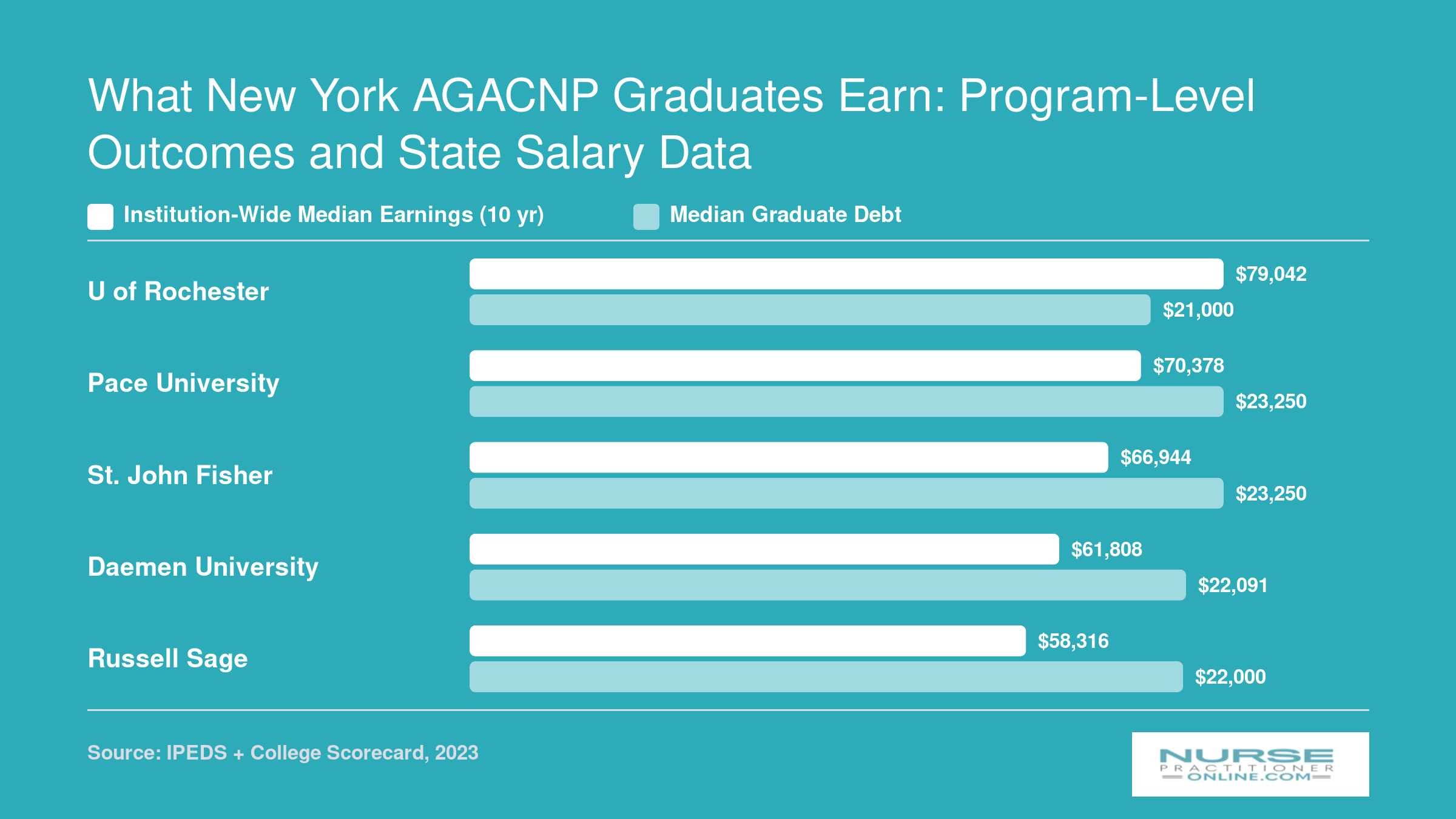
When evaluating AGACNP programs, it helps to compare two types of salary figures. Program-level graduate earnings, drawn from federal reporting on actual completers, offer a school-specific snapshot. However, program-level earnings data for these New York AGACNP programs are not yet available through federal sources. Instead, the institution-wide median earnings shown below reflect what all graduates of each school report earning ten years after enrollment, while BLS data tells us that nurse practitioners across New York earn a median of roughly $126,440 per year, providing broader occupational context. Median graduate debt at these schools ranges from about $21,000 to $23,250, suggesting a manageable investment relative to NP earning potential.
Acute Care NP Salary by Metro Area in New York
Nurse practitioner pay in New York varies significantly depending on where you practice. The NYC metro area offers the highest median salary and by far the largest concentration of NP jobs, while upstate metros like Rochester, Syracuse, and Albany typically pay $20,000 to $27,000 less per year. That said, lower cost of living in upstate regions can offset some of the wage gap. Below is a snapshot of NP compensation and employment across the state's major metro areas, based on the latest Bureau of Labor Statistics data.
| Metro Area | Total NP Employment | Mean Annual Salary | 25th Percentile | Median Salary | 75th Percentile |
|---|---|---|---|---|---|
| New York, Newark, Jersey City | 19,850 | $151,510 | $135,120 | $152,790 | $167,870 |
| Buffalo, Cheektowaga | 1,300 | $137,490 | $119,450 | $133,430 | $152,790 |
| Kiryas Joel, Poughkeepsie, Newburgh | 630 | $147,130 | $126,720 | $134,800 | $162,950 |
| Binghamton | 300 | $137,660 | $118,250 | $134,280 | $157,180 |
| Elmira | 130 | $135,130 | $120,620 | $133,960 | $142,690 |
| Ithaca | 170 | $134,510 | $124,280 | $130,830 | $140,010 |
| Albany, Schenectady, Troy | 780 | $131,060 | $118,110 | $129,490 | $136,450 |
| Syracuse | 880 | $130,080 | $113,490 | $127,030 | $136,800 |
| Utica, Rome | 210 | $129,330 | $109,600 | $126,940 | $138,050 |
| Rochester | 1,910 | $123,780 | $101,550 | $125,600 | $131,580 |
Common Questions About AGACNP Programs in New York
Choosing an AGACNP program raises a lot of practical questions, from clinical hour requirements to licensure steps. Below are answers to the questions New York nurses ask most often, drawn from current certification standards and program details covered earlier in this guide.
- What are the best AGACNP programs in New York?
- The strongest programs hold CCNE or ACEN accreditation, maintain high first-time certification pass rates, and offer clinical placement support in New York's major hospital systems. Specific rankings depend on your priorities, whether that is tuition, schedule flexibility, or DNP versus MSN track availability. See the full program ranking earlier in this article for a side-by-side comparison of accredited New York options.
- Can you complete an AGACNP program fully online in New York?
- Most New York AGACNP programs deliver didactic coursework online, but none have been confirmed to be 100% online with zero campus visits. Expect at least occasional on-site intensives for skills labs or simulation sessions, plus in-person clinical rotations. If minimizing campus time is a priority, check each program's immersion schedule before applying.
- How many clinical hours are required for AGACNP programs in New York?
- ANCC certification requires a minimum of 500 supervised clinical hours in an acute care setting. Many New York programs build in additional hours beyond that floor. Clinical rotations typically take place in ICUs, emergency departments, or specialty inpatient units. Programs vary in whether they secure preceptor placements for you or expect students to arrange their own sites.
- What are the licensure requirements for acute care nurse practitioners in New York?
- You must hold an active RN license, complete an accredited MSN, DNP, or post-graduate certificate program, and pass the ANCC AGACNP-BC certification exam. The exam includes 175 computer-based questions (150 scored, 25 pretest) completed within 210 minutes, with a minimum passing score of 350 points. New York also requires NP registration through the state education department before you can practice.
- How long does it take to complete an AGACNP program in New York?
- Program length depends on the track you choose. A full MSN typically takes two to three years of part-time study, while a post-master's certificate can be completed in roughly 12 to 18 months. DNP programs generally add one to two years beyond the MSN. Part-time and accelerated options are available at several New York schools, which is helpful for nurses who plan to keep working.
- What is the difference between AGACNP and AGNP?
- AGACNP programs prepare you to manage acutely and critically ill adult and older adult patients in hospital settings such as ICUs and emergency departments. AGNP (Adult-Gerontology Primary Care NP) programs focus on outpatient, preventive, and chronic disease management. The certifications are not interchangeable, so your intended practice setting should drive your choice. A more detailed breakdown appears in the callout section earlier in this article.
Accreditation Check: CCNE vs. ACEN Status for New York AGACNP Programs
Accreditation is not a formality. For AGACNP students, it is a hard prerequisite: the American Nurses Credentialing Center (ANCC) requires that you graduate from a nationally accredited program before you can sit for the AGACNP board certification exam. Enroll in an unaccredited program and you may complete every credit hour, finish every clinical rotation, and still be ineligible to certify. That makes checking accreditation status one of the first things you should do, not the last.
CCNE and ACEN: Two Paths to the Same Destination
Two accrediting bodies are recognized for nursing graduate programs in the United States. The Commission on Collegiate Nursing Education (CCNE) is affiliated with the American Association of Colleges of Nursing and primarily accredits baccalaureate and graduate-level programs at universities. The Accreditation Commission for Education in Nursing (ACEN) has a broader scope that spans diploma through doctoral programs and is especially common at nursing-focused institutions. For a deeper comparison, see our nursing accreditation guide covering ACEN vs CCNE.
Both bodies apply rigorous standards covering curriculum, faculty qualifications, student outcomes, and clinical training. For certification eligibility purposes, ANCC treats both as equally valid. If your program holds either CCNE or ACEN accreditation, you meet that baseline requirement.
Accreditation Status for Ranked New York Programs
All seven programs covered in this article hold CCNE accreditation for their graduate nursing offerings.1 None currently holds ACEN accreditation, which is not unusual for research universities in New York.2
- University of Rochester: CCNE-accredited. The School of Nursing most recently earned a full 10-year accreditation term, reflecting strong program outcomes.3
- Daemen University: CCNE-accredited.
- Russell Sage College: CCNE-accredited.
- St. John Fisher University: CCNE-accredited.
- Pace University: CCNE-accredited.
- New York University (NYU): CCNE-accredited.
- Stony Brook University: CCNE-accredited.
One note worth flagging: CCNE accredits programs at the MSN or DNP level rather than listing each specialty track by name. When you review an accreditation directory, look for the overall graduate nursing program at the institution, not a line item that reads "AGACNP." That is standard practice across the field and does not indicate a gap in coverage.
How to Verify Before You Apply
Accreditation status can change. Before submitting an application, confirm current status directly through the CCNE accredited programs search on the AACN website or the ACEN directory. Both are publicly searchable at no cost. If a program you are considering does not appear in either database, contact the nursing school's accreditation officer and ask for documentation. A reputable program will provide it without hesitation.