Most important takeaways…
- California AGNPs earn roughly $100,000 more per year than the national median for nurse practitioners.
- BRN-approved online AGNP programs range from affordable CSU options to private universities costing significantly more.
- Choosing between primary care and acute care tracks determines your certification exam and eligible practice settings.
- AB 890 allows qualifying California NPs to begin practicing independently after a supervised transition period.
California's over-65 population has grown by more than 20% in the past decade, creating a primary care shortage for aging adults. Adult-gerontology nurse practitioners fill that gap, and online programs have surged as working RNs seek to advance without leaving their jobs.
This ranking highlights online and hybrid AGNP programs for California students, factoring in cost, clinical hours, and licensing requirements. Programs are scored on a composite that weights online delivery alongside graduation rates and post-degree earnings, so flexibility and return on investment drive the list. If you are still comparing AGNP tracks nationally, our roundup of the best online nurse practitioner programs can help you see how California options stack up.
Even the best online program still demands in-person clinical hours in California settings, making local preceptor availability a make-or-break factor for many applicants.
Top Online Adult-Gerontology Nurse Practitioner Programs in California
We evaluated AGNP programs open to California students by weighting online accessibility against graduation outcomes, graduate debt levels, and post-completion earnings to surface the strongest options for working RNs. The programs below span public universities with resident tuition advantages, faith-integrated doctoral tracks, and fully online master's pathways, so you can find the format and price point that fits your career and life.
- Online and hybrid delivery options
- Institutional graduation outcomes
- Graduate debt and net price
- Post-completion earnings data
- Program accreditation and structure
- Independent program research
- Internal program database
- NCES-IPEDS federal institutional data — nces.ed.gov
- College Scorecard graduate earnings — collegescorecard.ed.gov

California State University-Long Beach
Cal State Long Beach delivers a DNP in Adult Gerontology Primary Care through its School of Nursing, blending synchronous and asynchronous online coursework with targeted campus sessions. As part of the California State University system, CSULB offers one of the lowest tuition structures for in-state students and opens the door to state-funded financial aid such as the Cal Grant and State University Grant. The institution-wide graduation rate sits near 69%, and median graduate debt across all programs is around $14,289, positioning it as a strong value for California residents.
- Hybrid format with 15-week online sessions
- 72 units completed over three years
- 1,000 clinical hours required for graduation
- Prepares graduates for national NP certification
- BSN and active RN license required for admission
- Minimum 3.0 GPA for entry
- BRN-approved Adult-Gerontology Acute Care NP track at this institution
Adult Gerontology Primary Care Nurse Practitioner (DNP) — Hybrid

Azusa Pacific University
Azusa Pacific University offers a BSN-to-DNP pathway for nurses who want to earn a doctoral degree without stopping at the MSN. The program uses a hybrid model with online didactics and in-person clinicals across multiple Southern California locations, giving students flexibility while keeping clinical training close to home. A 9-to-1 student-to-faculty ratio means more individualized mentorship, and the faith-integrated curriculum appeals to nurses seeking a mission-driven academic community.
- 67 to 73 total program units
- Cost per unit approximately $1,160
- Full-time and part-time enrollment options available
- Minimum 1,000 clinical hours in California settings
- Multiple Southern California campus and online sites
- Requires 8 months of RN work experience
- BRN-approved AGPCNP track confirmed
Adult Gerontology Primary Care Nurse Practitioner (BSN to DNP) — Hybrid

West Coast University-Orange County
West Coast University's Orange County campus offers a fully online MSN in Adult-Gerontology Primary Care that is purpose-built for working nurses juggling shifts and family life. Students choose between an accelerated 20-month pace or a 32-month working-professional track, both structured in manageable eight-week terms. Two brief on-site intensives provide hands-on skills practice. Estimated total program costs for California students range from roughly $45,305 to $47,970, and the CCNE-accredited curriculum covers emerging topics like telehealth and special populations.
- Fully online coursework with two on-site intensives
- Accelerated 20-month or 32-month pacing options
- 49 total credit hours
- CCNE-accredited program
- Prepares for ANCC or AANP certification exams
- BSN with 3.0 GPA and one year RN experience required
- Clinical placement support included
- Covers telehealth training and special populations
MSN Adult-Gerontology Primary Care Nurse Practitioner — Online

Loma Linda University
Loma Linda University's hybrid DNP in Primary Care Adult-Gerontology Nurse Practitioner is anchored in its health-sciences campus in Southern California and has been recognized among the top DNP programs in the state. Students come to campus just four days per quarter and complete the rest of their coursework online. Clinical rotations are arranged by faculty in Southern California, and the required DNP project can often be based at the student's own workplace. Roughly 70 to 75 percent of students receive financial aid, easing the impact of private-university tuition.
- Hybrid format: four campus days per quarter
- Full-time track spans approximately 3.75 years
- Part-time pathway available
- 1,000 clinical practice hours required
- DNP project may be completed at student's workplace
- CCNE-accredited program
- BRN-approved Adult-Gerontology Acute Care NP track at this institution
- Faith-integrated, whole-person care philosophy
Primary Care Adult-Gerontology Nurse Practitioner (DNP) — Hybrid

University of California-San Francisco
UCSF's AGPCNP program sits within one of the nation's leading academic health science centers and carries explicit eligibility for California BRN NP certification. The hybrid curriculum emphasizes health promotion and management of acute and chronic conditions in diverse, high-risk adult populations, with much of the clinical training taking place in San Francisco Bay Area safety-net and tertiary care settings. In-state tuition through the University of California system makes UCSF a competitive public option, though overall cost data at the program level is limited.
- Hybrid program with interprofessional clinical training
- Minimum 570 clinical residency hours
- Graduates eligible for California BRN NP certification
- Prepares for ANCC and AANP national board exams
- Focus on diverse and high-risk adult populations
- Bay Area clinical settings including safety-net facilities
- Patient-centered, evidence-based curriculum
Adult-Gerontology Primary Care Nurse Practitioner (DNP) — Hybrid

West Coast University-Center for Graduate Studies
West Coast University's Center for Graduate Studies in Los Angeles delivers the same fully online MSN AGPCNP curriculum as its Orange County counterpart, giving Southern California nurses a Los Angeles home campus for required on-site intensives and access to a large metro clinical network. Updated 2026 tuition estimates place total program costs between roughly $37,205 and $38,370 plus fees, and per-credit rates for APRN core courses rise slightly for cohorts starting Fall 2026. BRN approval for this campus should be independently verified, as the research confirms approval at other West Coast University locations but not specifically for this graduate center.
- Fully online coursework with two on-site intensives
- Accelerated 20-month or working-professional 32-month track
- 49 total credits in eight-week terms
- CCNE-accredited curriculum
- Prepares for ANCC or AANP certification
- Los Angeles campus for intensives and clinical access
- BSN, 3.0 GPA, and one year RN experience required
- Financial aid and scholarship options available
MSN Adult-Gerontology Primary Care Nurse Practitioner — Online
How We Evaluated California's Online AGNP Programs
Every ranking reflects choices, and readers deserve to know exactly which choices shaped this one.
What the Composite Score Captures
Programs were scored on a composite that gives meaningful weight to online delivery availability, since a program that cannot genuinely be completed online from California does not belong on a list aimed at working nurses. Layered on top of that foundation are graduation rates, median debt at graduation, post-completion earnings, and net price. Together, those five factors give you a picture of real-world outcomes, not just marketing promises.
Two data caveats matter here. Graduation rates reflect institution-wide figures, not outcomes specific to the AGNP program or even to graduate nursing students. Net price is a sector-conditional average, meaning it represents what students in a particular institutional category typically pay after aid. It is not a personalized quote. Your actual cost will depend on your financial situation, employer tuition benefits, and the aid package the school offers you.
How BRN Approval Fits In
California Board of Registered Nursing approval status was treated as a pass-or-fail eligibility filter, not a ranking factor. If a program did not meet that threshold, it was removed from consideration before scoring began. Approval status can change, however, so confirm directly with the California BRN that any program you are seriously considering remains current and in good standing. That single check takes ten minutes and protects your entire investment.
What This Ranking Does Not Measure
Transparency also means naming limitations. This evaluation does not score curriculum quality, individual faculty credentials, or the strength of a program's preceptor network. Those factors matter enormously in practice, and you will find guidance on assessing them elsewhere in this article. They were excluded here because no consistent, publicly available dataset captures them across programs. Ranking schools on data that cannot be verified evenly would create a false sense of precision.
If you are still exploring specialties, our broader look at adult gerontology nurse practitioner programs can help you compare AGNP tracks nationwide before narrowing your focus to California.
The goal of this methodology is straightforward: give you a defensible starting list built on outcomes you can trace, then equip you with the questions that move you beyond any ranking.
Questions to Ask Yourself
Primary Care vs. Acute Care: Picking the Right AGNP Concentration
California's Board of Registered Nursing treats Adult-Gerontology Primary Care (AG-PCNP) and Adult-Gerontology Acute Care (AG-ACNP) as distinct population foci, meaning your certification exam and graduate preparation directly determine where you can practice.1 Choosing the wrong track can limit your job options or require additional education later, so understanding the differences before you apply matters. For a broader overview of how these two tracks compare, see our guide to the adult-gerontology nurse practitioner scope of practice.
Scope of Practice and Daily Work
The AG-PCNP track prepares you for outpatient, longitudinal care: health maintenance visits, chronic disease management, preventive screenings, and care coordination. You will see patients over months or years, adjusting medications, ordering routine labs, and collaborating with specialists.
The AG-ACNP track focuses on episodic, high-acuity situations: stabilizing critically ill adults, performing diagnostic workups, and managing complex conditions in real time. Your clinical decisions often unfold within hours rather than across multiple appointments.
Where Each Track Works
- AG-PCNP settings: Family practice and internal medicine offices, community health centers, federally qualified health centers, skilled nursing facilities, assisted living, urgent care clinics, and occupational health programs.3
- AG-ACNP settings: Emergency departments, intensive care units, step-down and medical-surgical units, hospital-based cardiology or pulmonology teams, surgical services, and trauma centers.3
Some urgent care positions accept either certification, but most California employers match the role to the appropriate credential.
Certification Exams
AG-PCNP graduates sit for either the AANP Adult-Gerontology Primary Care exam or the ANCC Adult-Gerontology Primary Care exam. AG-ACNP graduates take the ANCC Adult-Gerontology Acute Care exam or the AACN Acute Care Nurse Practitioner exam. Your program's accreditation and curriculum must align with the certification you plan to pursue. If you later decide to add the other concentration, an AGNP post master's certificate online can bridge the gap without repeating an entire degree.
Making the Decision
Reflect on your current nursing experience and long-term goals. If you enjoy building relationships, managing hypertension and diabetes, and guiding patients through wellness visits, primary care likely fits. If you thrive on rapid assessment, unstable patients, and procedural interventions, acute care may be the better match. Neither track is inherently harder or more prestigious; the right choice depends on how you want to spend your clinical hours.
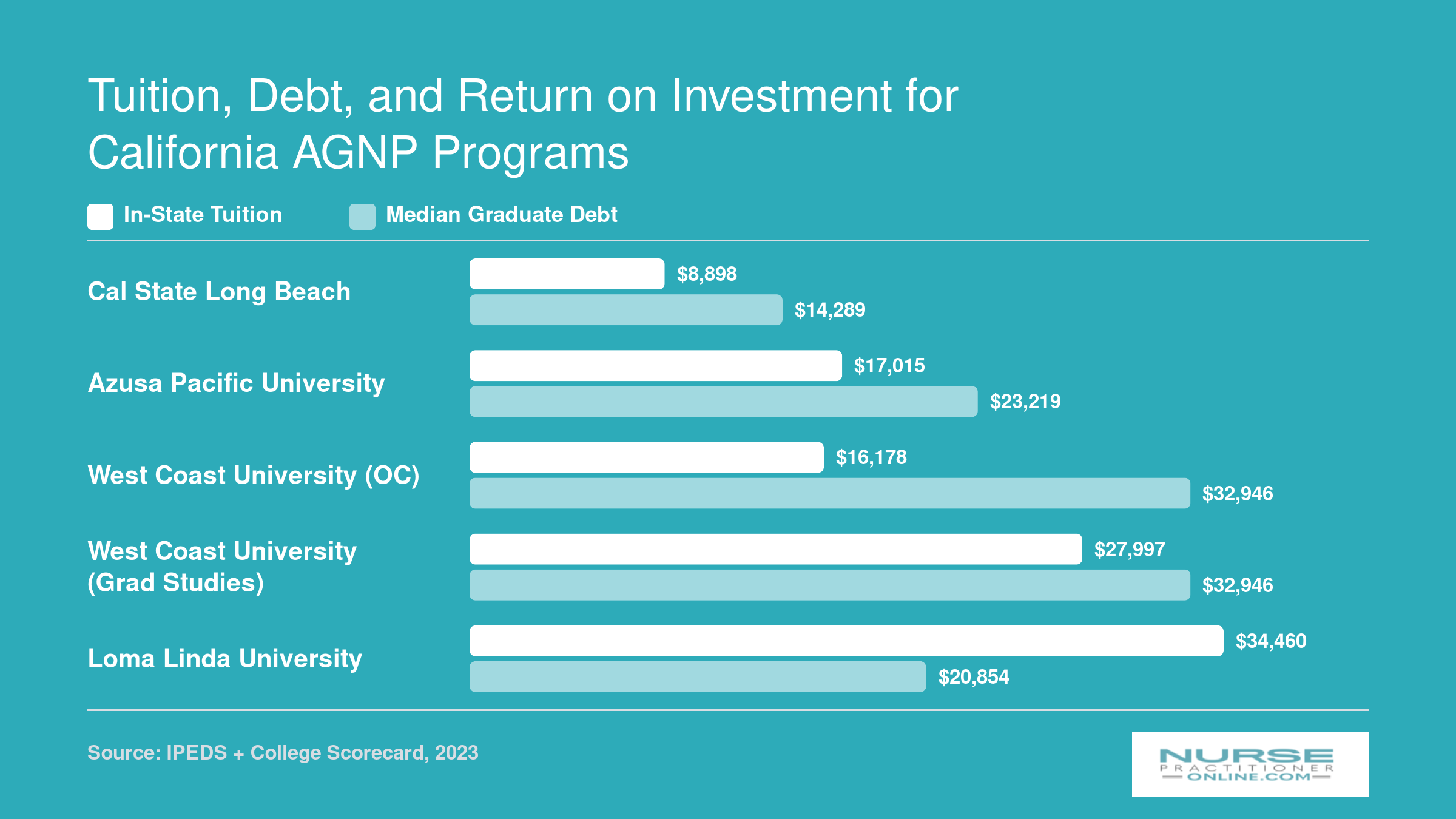
Tuition, Debt, and Return on Investment for California AGNP Programs
Tuition and debt vary widely across California's online AGNP programs, so understanding relative cost-to-value is essential before you commit. The chart below compares published in-state tuition and median graduate debt at each school. Keep in mind that net price figures reflect institution-wide averages and your individual aid package (grants, scholarships, employer tuition benefits) may shift costs significantly.
Explore other California related topics
Related Articles
Clinical Hours and Finding Preceptors in California
Securing enough clinical hours, and the right clinical sites, is the most underestimated hurdle in an online AGNP program, even more so in California. The state's unique geography and high demand for nursing education create both opportunity and competition, making the clinical placement process a make-or-break factor in your timeline and success.
How Many Clinical Hours Does California Require?
California's Board of Registered Nursing (BRN) sets a firm minimum of 500 direct patient care hours for nurse practitioner program approval under Title 16, CCR §1484, aligning with national NP education standards. However, many programs exceed this baseline to ensure graduates are practice-ready. For example, the Adult-Gerontology Primary Care NP track at UCSF requires 570 clinical hours.2 If you plan to become certified in more than one population focus (e.g., adding acute care to primary care), the BRN mandates additional clinical hours beyond the base requirement. Always verify the exact total with your program, as it directly impacts your scheduling and graduation timeline.
Who Finds Your Clinical Preceptor?
The preceptor placement landscape varies dramatically by program. Many large, national online AGNP programs typically expect students to self-source their own clinical sites and preceptors. This means you'll need to network, cold-call clinics, or leverage professional connections to secure a placement. In saturated metro areas like Los Angeles and the San Francisco Bay Area, competition for experienced preceptors is fierce because multiple nursing schools are vying for the same limited pool of clinicians.3 Rural regions often have fewer providers but also fewer students competing for them, though travel distances can be significant.
A handful of California-based programs offer dedicated placement services that match students with vetted preceptors, significantly reducing the legwork. Before you enroll, ask directly: "Does the program arrange clinical placements, or am I responsible?" If you are still enrolling in NP school online, understanding placement support should be near the top of your questions list. If self-sourcing, inquire about any support tools the school provides, such as a database of willing preceptors or placement coordinators who can assist in hard-to-find areas.
Full-Time vs. Part-Time Clinicals and Your Timeline
How you schedule clinical hours also shapes your total time to degree. Part-time students often spread clinical rotations across multiple semesters, completing them over 12 to 24 months while working full or part time. This flexibility is a lifeline for working nurses, but it extends the program length. Full-time clinical tracks concentrate hours into fewer semesters, sometimes requiring 24 to 32 hours per week in a clinical setting, which may force a reduction in work hours. The upside: you can graduate and start earning an NP salary sooner. Review each program's standard part-time and full-time curriculum plans to map out what fits your work and family commitments.
Ultimately, the clinical placement policy is a critical differentiator among adult gerontology primary care nurse practitioner online programs. Insist on clarity before committing: it's the single factor that most affects your ability to complete the degree on your terms.
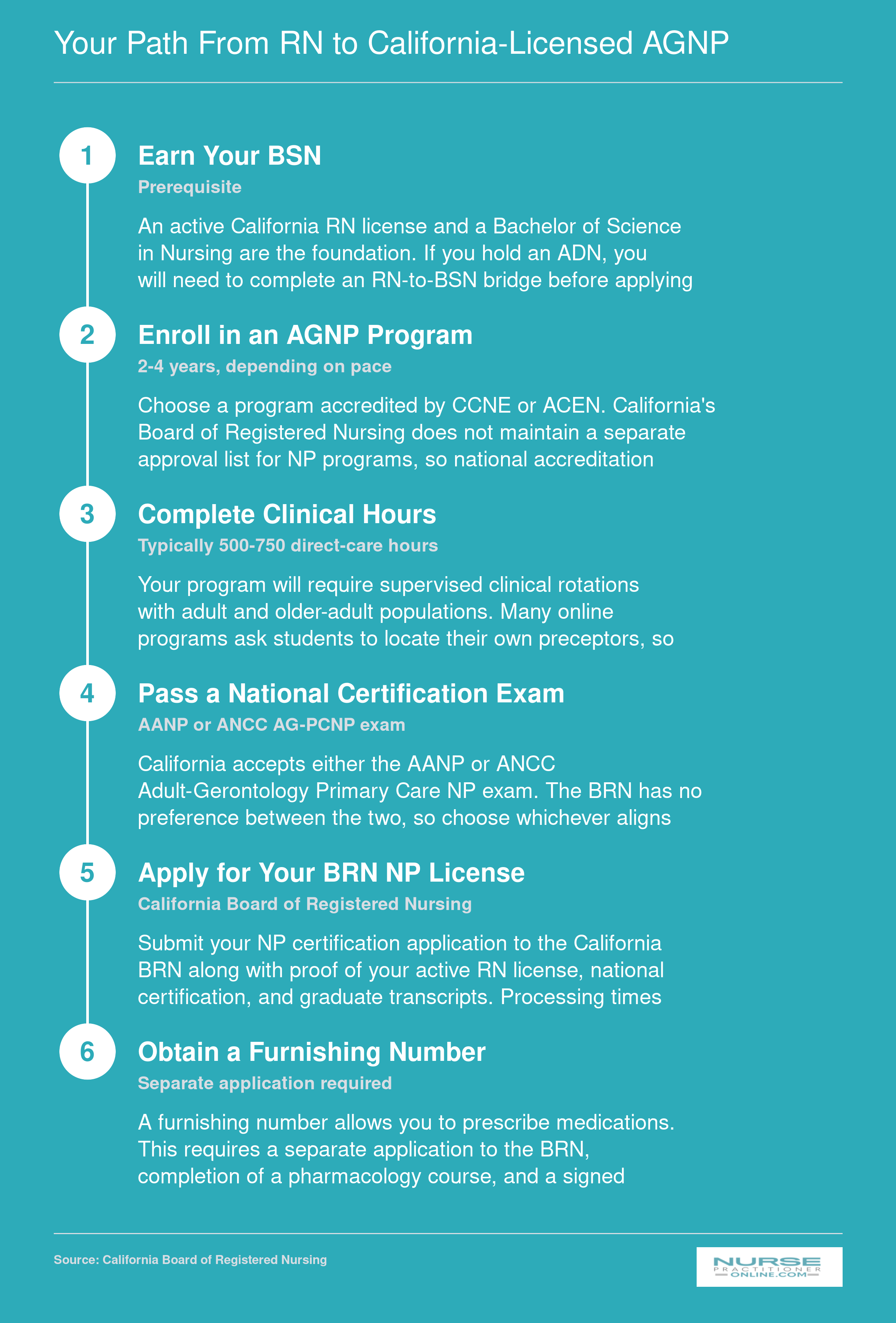
Your Path from RN to California-Licensed AGNP
The road from bedside RN to independent adult-gerontology nurse practitioner in California is well-defined, but each milestone must be completed in order. The timeline below maps every credential checkpoint so you can plan ahead. Keep in mind that under AB 890, California is phasing in broader practice authority for NPs. As of 2025-2026, AGNPs who complete a transition-to-practice program and log at least 4,600 supervised clinical hours may qualify for independent practice in primary care settings, a significant step toward full autonomy.
What California AGNPs Earn: Statewide and Metro Salary Data
California nurse practitioners consistently out-earn their counterparts nationwide, and the gap is wide enough to justify the higher tuition many California programs charge. The national median annual wage for NPs sits near $126,260, according to federal data, while California's statewide mean reaches roughly $158,130. Below is a metro-by-metro breakdown so you can estimate your earning potential based on where you plan to practice. Salary figures reflect all nurse practitioner specialties, including adult-gerontology; AGNP-specific data is not broken out separately by federal surveys. When you compare these figures to the tuition and debt numbers discussed earlier in this article, even the most expensive California programs can pay for themselves within a few years of full-time practice.
| Metro Area | Total NP Employment | Median Annual Wage | Mean Annual Wage | 25th Percentile | 75th Percentile |
|---|---|---|---|---|---|
| San Jose, Sunnyvale, Santa Clara | 1,280 | $225,730 | $223,530 | $201,090 | Not reported |
| San Francisco, Oakland, Fremont | 2,960 | $220,330 | $208,480 | $170,370 | $234,120 |
| Bakersfield, Delano | 360 | $165,460 | $168,180 | $147,990 | $182,140 |
| Modesto | 390 | $164,790 | $161,810 | $139,470 | $173,770 |
| Los Angeles, Long Beach, Anaheim | 6,400 | $164,510 | $165,030 | $140,230 | $184,670 |
| Sacramento, Roseville, Folsom | 1,200 | $164,520 | $168,790 | $141,660 | $210,340 |
| Riverside, San Bernardino, Ontario | 1,630 | $162,470 | $162,210 | $135,290 | $194,440 |
| San Diego, Chula Vista, Carlsbad | 2,790 | $162,030 | $159,590 | $130,880 | $181,030 |
| Fresno | 640 | $161,550 | $158,510 | $137,230 | $173,190 |
| Oxnard, Thousand Oaks, Ventura | 270 | $155,440 | $152,140 | $134,580 | $166,190 |
California AGNP Salary at a Glance
California nurse practitioners earn well above the national average.
California BRN Licensing Requirements for Online AGNP Graduates
California by Specialty
- ACNP Programs in California
- DNP NP Programs in California
- FNP Programs in California
- PMHNP Programs in California
- PNP Programs in California
- Best Nurse Practitioner Options in Long Beach, CA
- Best Nurse Practitioner Options in Pasadena, CA
- Best Nurse Practitioner Programs in Irvine, CA
- Best Nurse Practitioner Programs in Los Angeles
- Best Nurse Practitioner Programs in San Diego, CA
- Best Nurse Practitioner Programs in San Francisco
- Nurse Practitioner Programs in San Jose, CA
- Best NP Program Options in Anaheim, California