Most important takeaways…
- Kentucky's two in-state post-master's PNP certificate programs range from 11 to 43 credits and use hybrid formats.
- Tuition at the University of Kentucky starts at a flat rate of $1,002 per credit hour for certificate students.
- National certification through PNCB or ANCC is required before Kentucky will issue your APRN license.
- Kentucky Children's Hospital at UK HealthCare serves as the region's primary pediatric clinical placement site.
Can a nurse practitioner with an MSN in family practice become a pediatric NP without repeating a full degree? Yes, and in some cases the transition takes less than 12 months.
A post-master's certificate in pediatric nurse practitioner is a focused credential designed for APRNs who already hold an MSN or DNP in another specialty. Rather than re-earning a degree, you complete only the coursework and clinical hours required to sit for pediatric NP board certification. The FNP-to-PNP pathway is the most common example, though nurses transitioning from adult-gerontology or neonatal specialties pursue it too.
In Kentucky, this credential carries real weight: the state requires national PNP certification through PNCB or ANCC before the Board of Nursing will issue an APRN license in the pediatric population focus. That certification requirement is what makes program selection, clinical placement, and timeline planning so consequential.
Best Post-Master's PNP Certificate Programs for Kentucky Nurses
Kentucky is home to two strong post-master's certificate options for nurses ready to specialize in pediatric care, both accessible from the Lexington area. Each program uses a hybrid format that pairs online coursework with focused on-campus experiences, making it realistic for working APRNs to advance without stepping away from clinical practice. Keep in mind that institution-wide graduation rates reflect overall undergraduate outcomes, not graduate certificate completion specifically. Program-level earnings and debt data are not yet available for either certificate, so we have included broader institutional figures to help you think about return on investment. State authorization details for online learners are discussed in a later section.
- Program format and flexibility
- Credit hour requirements and pace
- Regional clinical relevance
- Tuition and affordability
- Institutional academic quality
- NCES-IPEDS federal institutional data — nces.ed.gov
- Internal program database
- Independent program research
- College Scorecard graduate earnings — collegescorecard.ed.gov

University of Kentucky
Located right in Lexington, the University of Kentucky's College of Nursing offers a condensed graduate certificate built specifically for licensed nurse practitioners pursuing a pediatric specialty change. The hybrid immersion model, with up to six on-campus days per semester, makes it especially convenient for APRNs already working in central Kentucky. UK's broader institutional profile includes a 71.4% graduation rate and median alumni earnings of $59,025 ten years after enrollment, both figures reflecting the university overall rather than this certificate alone.
- Hybrid immersion format: online classes plus campus days twice per semester
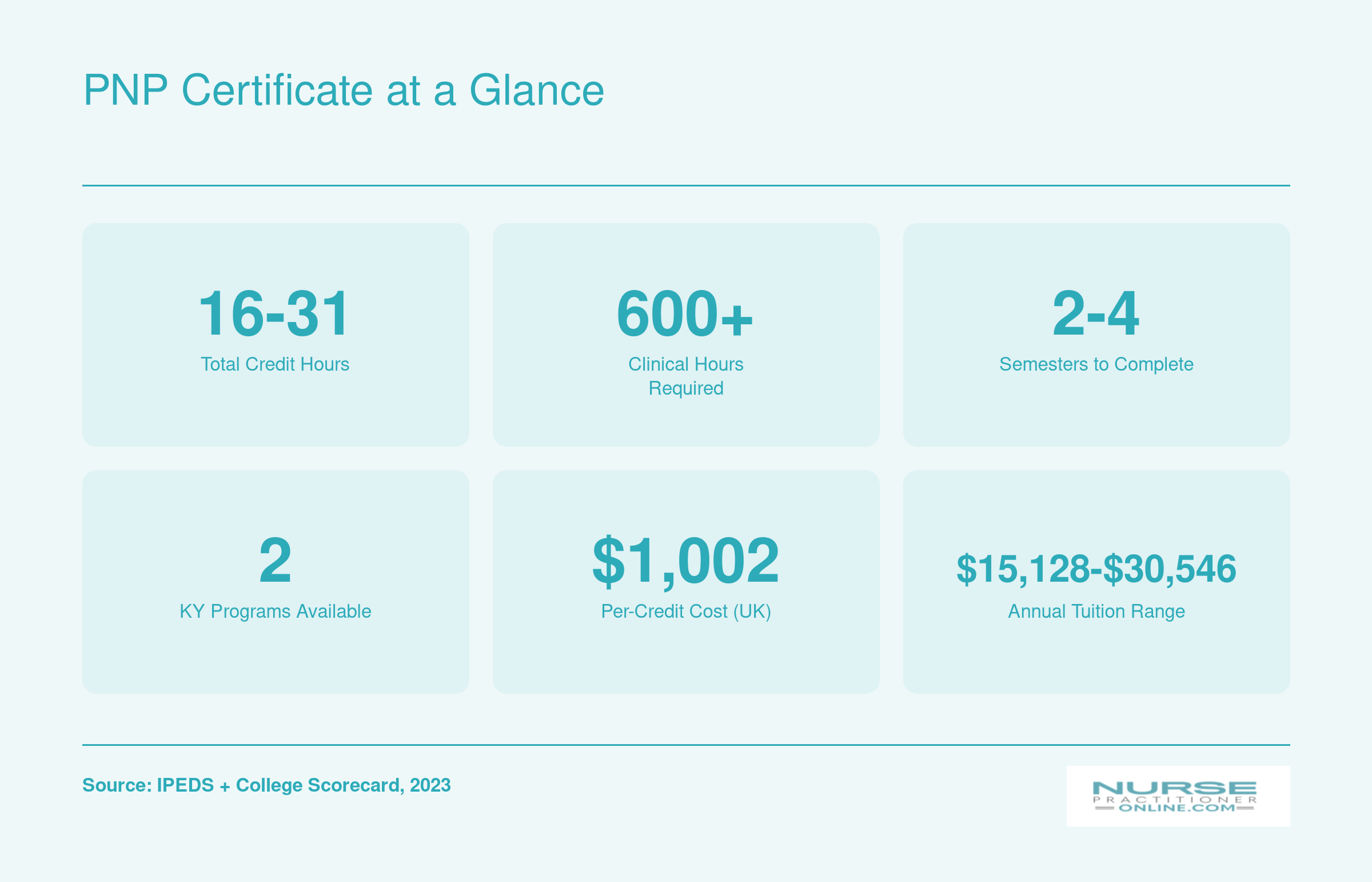
- 16 to 31 credit hours depending on prior coursework
- Flat tuition rate of $1,002 per credit regardless of residency
- Requires MSN, DNP, or PhD in nursing with a 3.0 GPA
- Application via NursingCAS with $80 fee, CV, and two recommendations
- Prepares graduates for PNCB or ANCC pediatric certification exams
- Current RN and APRN license required for admission
- Application window runs September 15 through January 15
Graduate Certificate in Professional Nursing, Pediatric Acute Care — Hybrid

University of Louisville
The University of Louisville's School of Nursing offers a post-graduate APRN certificate with a Pediatric Acute Care Nurse Practitioner concentration designed for completion in roughly three continuous semesters. This newer, CCNE-accredited program is built on Louisville's existing pediatric DNP infrastructure, giving certificate students access to well-established faculty and clinical partnerships at one of the state's leading pediatric medical centers. The university's overall graduation rate is 61.2%, with median alumni earnings of $53,899 at ten years; these figures represent institution-wide outcomes, not the certificate program specifically.
- Hybrid format with online coursework and in-person simulation days
- Designed for completion in approximately one year (three semesters)
- In-state tuition approximately $15,128 per year; out-of-state approximately $30,546
- Requires a master's degree in nursing and current RN license
- Prepares graduates for the PNCB acute care CPNP exam
- Focus on PICUs, pediatric EDs, cardiac ICUs, and specialty settings
- Multiple application deadlines throughout the year
- Student-to-faculty ratio of 14:1 at the institutional level
Post-Graduate Certificate in Nurse Practitioner (APRN), Pediatric Acute Care — Hybrid
How Long Does a Post-Master's PNP Certificate Take?
Most post-master's PNP certificate programs require somewhere between 11 and 43 credits, and that wide range is exactly why timeline questions deserve a careful answer rather than a quick one.
Credit Hours and What Drives the Range
The credit load depends on two things: the track you choose and how much your prior NP coursework overlaps with the pediatric curriculum. A primary care track (PNP-PC) typically carries more credits than an acute care track (PNP-AC) because the primary care scope covers a broader developmental range. Wright State University's PNP-PC certificate, for example, sits at 18 credits1, while Georgia State University's PNP-PC certificate requires 43 credits.2 On the acute care side, the University of Colorado Anschutz PNP-AC certificate is structured around just 11 credits3, and UMKC's PNP-AC certificate requires 21 credits.4 Those differences reflect curriculum design choices, not quality gaps, so look closely at what each program counts toward the total before drawing conclusions about workload.
Clinical Hours: The Real Timeline Driver
Credits tell only part of the story. Clinical hour requirements often determine how quickly you can actually finish. Wright State's PNP-PC program requires 560 supervised clinical hours1, Spring Arbor University's certificate requires 500 hours5, and the University of Colorado Anschutz PNP-AC program sets its clinical requirement at 360 hours.3 PNCB requires that your program hold CCNE or ACEN accreditation for your clinical hours to count toward certification exam eligibility, so confirm accreditation status before you apply.6
If you already hold FNP certification, some programs allow you to transfer a portion of your prior clinical hours toward the pediatric requirement. The amount accepted varies by program, so ask each school directly. Even a partial transfer can shave a semester off your timeline.
Full-Time vs. Part-Time Pace
For nurses who can shift to full-time study, completion in two to three semesters is realistic for lower-credit programs. Part-time students, who make up the majority of post-master's certificate enrollees, should plan for four to five semesters. Spring Arbor University and UMKC both publish 18-to-24-month timelines that reflect a working-nurse pace rather than a traditional student one.54
The FNP-to-PNP Bridge
If you currently hold FNP certification, the post-master's certificate route is almost always faster than re-entering a full MSN or DNP program. If you are weighing other specialty pivots, you may find it helpful to compare online post-master's FNP certificate programs as a reference point for credit and timeline expectations. Your advanced pharmacology, pathophysiology, and health assessment coursework frequently satisfies prerequisite requirements, leaving you with a focused set of pediatric-specific courses and clinical rotations. The result is a credential addition rather than a credential restart. Many FNP-to-PNP students complete the transition in roughly 18 months, though the exact length depends on whether you choose the primary care or acute care track and how your previous clinical experience maps onto the new program's requirements.
PNP Certificate at a Glance
Here is a snapshot of what Kentucky nurses can expect when pursuing a post-master's pediatric nurse practitioner certificate near Lexington. These figures are drawn from the two in-state programs currently accepting applications.
Post-Master's PNP Certificate vs. MSN or DNP: Which Path Is Right?
If you already hold an MSN or DNP in another NP specialty, the fastest and most cost-effective route to become a pediatric nurse practitioner is a post-master's certificate. This section breaks down the three primary pathways (post-master's certificate, MSN with PNP concentration, and DNP with PNP focus) so you can choose the one that aligns with your career stage, budget, and long-term goals.
Which Path Aligns with Your Background?
Your current nursing education level largely determines the most logical path. If you are an RN without a graduate degree, an MSN or DNP is necessary to become an NP. But for nurses who already have a master's or doctorate in another NP specialty (like family or adult-gerontology), the post-master's certificate is a streamlined add-on that builds on existing graduate coursework. It is not a lesser degree; it is an efficient way to pivot into pediatrics without repeating core advanced practice content. For a deeper look at the benefits, see why pursue a nurse practitioner post-master's certificate.
Time, Credits, and Clinical Hours: At a Glance
The commitment varies significantly across pathways. Here is a side-by-side comparison so you can see the tangible differences:
- Post-Master's Certificate: 25, 40 credits, typically 18, 24 months, 500, 700 clinical hours, total cost roughly $20,000, $40,000.123
- MSN-PNP: 35, 60 credits, 24, 36 months, 500, 700 clinical hours, $30,000, $70,000.1
- DNP-PNP: 65, 90 credits, 36, 48 months, 1,000 clinical hours, $40,000, $120,000.1
Keep in mind that if you hold a prior MSN, you may receive transfer credit for foundational courses, potentially shortening the post-master's certificate even further. Many online PNP certificate programs are designed to be completed in as few as five or six semesters while you continue working.
The Career Ceiling and Credential Earned
All three pathways lead to eligibility for pediatric nurse practitioner certification through the Pediatric Nursing Certification Board.3 Once certified and licensed, your scope of practice as a PNP is essentially the same regardless of which educational route you took. The DNP, however, is a terminal degree that can open doors to academic faculty positions, executive leadership roles, or advanced policy work. For most clinical settings in Kentucky, an MSN level is sufficient, and an add-on post-master's certificate will not hold you back in direct patient care.
Bottom Line: Choose Efficiency or Terminal Degree
If your goal is to transition into pediatric primary or acute care quickly and affordably, and you already have a graduate nursing degree, the post-master's certificate is the clear winner. It saves you a year or more of study and tens of thousands of dollars compared to a full DNP program while delivering the same clinical competencies. Reserve the DNP path for situations where you are certain you need a doctoral credential for teaching, research, or system-level leadership. If you are also weighing other specialty pivots, you can explore best online post master's NP certificate programs to compare options side by side. For the working nurse in or near Lexington, the post-master's PNP certificate offers the most direct route to a new specialty without sacrificing career momentum or financial stability.
Questions to Ask Yourself
Cost Comparison: Tuition and Fees for PNP Certificates
Tuition at Kentucky's Own Programs
For working nurses near Lexington, the two in-state public universities with post-master's PNP certificates are the University of Kentucky and the University of Louisville.
- UK's flat-rate advantage: The program charges a flat $1,002 per credit regardless of residency, with a total of 16 to 31 credits required. That puts total tuition between $16,032 and $31,062.
- UofL's two-tier structure: In-state tuition is approximately $15,128, while out-of-state students pay $30,546. Assuming a typical 15 to 30 credit load, this translates to roughly $504 to $1,008 per credit for Kentuckians and $1,018 to $2,036 for non-residents. (Exact per-credit rates can vary by semester; confirm with the school.)
What You'll Really Pay: Fees and Other Costs
Tuition is just the starting point. A realistic budget includes several additional expenses:
- Application fees: UK requires an $80 NursingCAS fee; UofL and other programs may charge $50 to $100.
- Background check and drug screening: Plan on $100 to $200, often repeated for clinical placements.
- Technology, lab, and student service fees: These can add a few hundred dollars per semester.
- Books and supplies: $500 to $1,000 or more for required texts and clinical resources.
- Certification exam: The national PNP board exam (ANCC or PNCB) costs roughly $350 to $400.
- Travel for clinicals: If you must commute or stay overnight for in-person requirements, budget for gas, parking, or lodging.
Kentucky Financial Aid and Loan Repayment
Several state-specific and federal programs can significantly reduce your out-of-pocket cost:
- Nursing Incentive Scholarship Fund (NISF): A $3,000 scholarship from the Kentucky Board of Nursing for the 2026-2027 year, requiring one year of service.1
- Nurse Corps Loan Repayment: The federal program repays 60% of qualifying loans after two years, plus an additional 25% for a third year.
- National Health Service Corps: Awards up to $75,000 for a two-year commitment in an underserved area.
- Public Service Loan Forgiveness (PSLF): After 120 qualifying payments (roughly 10 years) while working for a qualifying employer, remaining loan balances are forgiven.
- University and school scholarships: UK's College of Nursing and Frontier Nursing University list scholarships, including the Eastern Kentucky Nursing Student Award.34
- Employer tuition reimbursement: Many hospitals and health systems offer partial or full tuition coverage. Ask your HR department.
- KHEAA grants: State grants for graduate students are limited, but some may be available; check the Kentucky Higher Education Assistance Authority website.5
Online and Out-of-State Tuition Nuances
If you're looking beyond Kentucky, many respected online PNP certificate programs charge different rates based on residency, or none at all. UK's flat-rate model is becoming more common, but not universal. Some schools offer a single per-credit price for all online graduate nursing students, which can be competitive. Always confirm:
- Whether the program assesses "in-state" tuition based on your physical location during online study.
- If the published rate includes all fees, or if separate technology, clinical, or experiential learning fees apply.
- Whether you'll need to travel for occasional on-campus intensives (and factor in travel costs).
A certificate from a Kentucky public school already keeps costs lower for residents, but if you find a program with a flat out-of-state rate that matches or beats in-state pricing, it may be worth considering, especially if its clinical placement support or curriculum timelines are a better fit for your schedule.
Kentucky APRN Licensure Requirements for Pediatric NPs
Active Kentucky RN licensure forms the foundation for every pediatric nurse practitioner application submitted to the Kentucky Board of Nursing.1 Before you finish your post-master's certificate, understanding the state's APRN certification requirements helps you plan clinical hours, secure required documents, and avoid delays in launching your pediatric practice.
Application Documents and Process
Kentucky's APRN initial licensure application is submitted online through the KY Nurse Portal.1 You will need to gather several key items before you begin:
- Active RN license: You must hold a current Kentucky RN license or a multistate RN license recognized in Kentucky.
- Official transcripts: Request transcripts directly from your post-master's certificate program showing completion of graduate-level coursework in your pediatric population focus.
- National certification verification: Provide proof of passing an accepted certification exam. For pediatric NPs, the Pediatric Nursing Certification Board offers the CPNP-PC (primary care) and CPNP-AC (acute care) credentials. The ANCC pathway applies primarily to family NPs with pediatric focus rather than dedicated pediatric specialists.
- Criminal background check: Complete state and federal fingerprinting through IdentoGO before submitting your application.
- Identity documents: Standard identification verification is required as part of the online application.
Processing timelines vary, but most applicants find that having all documents submitted simultaneously helps move the review along more efficiently.
Collaborative Agreement Requirements
Kentucky has not implemented full practice authority statewide as of 2025 to 2026.2 New APRNs must enter a Collaborative Agreement for Prescriptive Authority (CAPA) with a licensed physician.3 This requirement applies in two forms:
- CAPA-NS: Required for non-controlled substance prescribing during your first four years of APRN practice.
- CAPA-CS: Required for prescribing controlled substances in schedules II through V, with no automatic sunset. This agreement remains in effect as long as you prescribe controlled medications, regardless of years in practice.
After completing four years of practice under a CAPA-NS agreement, you may prescribe non-controlled substances independently. However, prescribing controlled substances still requires an active CAPA-CS and DEA registration.2
How Your Post-Master's Certificate Satisfies Requirements
The Kentucky Board of Nursing requires that your graduate education align with the population focus you intend to practice. A post-master's certificate in pediatric primary care or pediatric acute care specifically prepares you to sit for PNCB certification exams, which the board recognizes for pediatric APRN licensure.1 Your certificate must come from a program accredited by a nursing education accreditation body, such as CCNE or ACEN, to meet state standards. If you are still exploring the pediatric nurse practitioner career path, reviewing scope and salary details can help you confirm this specialty is the right fit.
Pediatric Scope of Practice Details
Pediatric NPs in Kentucky practice within a defined age range, from birth through late adolescence and early adulthood.2 Your certification determines your patient population, and you should not independently manage adult patients outside this pediatric age range unless additional education and certification support a broader scope.
Prescriptive authority for pediatric NPs follows the same CAPA framework as other APRNs. With an active CAPA-CS and DEA registration, you may prescribe controlled substances in schedules II through V for your pediatric patients.
Continuing Education and Maintenance
Maintaining current national certification through PNCB generally satisfies Kentucky's annual continuing education requirements.4 However, the state does require three additional hours of continuing education specific to cannabis for APRNs with prescriptive authority.4 Staying current with these requirements ensures your license remains active and your practice uninterrupted.
Securing Pediatric Clinical Placements in Lexington, Kentucky
Kentucky Children's Hospital at UK HealthCare stands as the region's primary pediatric teaching site, offering inpatient acute care, PICU, NICU, and subspecialty clinics that provide robust training opportunities for pediatric NP students.1 However, securing a rotation there requires a formal affiliation agreement between your program and the hospital, meaning you cannot simply contact a preceptor directly and arrange your own placement.2
Major Clinical Sites in the Lexington Area
Central Kentucky offers several pediatric facilities that accept NP students, though each has its own placement requirements:
- Kentucky Children's Hospital: Offers the most comprehensive pediatric experience, including acute care and specialty outpatient clinics. Requires centralized placement through your program's clinical coordinator.2
- Baptist Health Lexington Pediatrics: Provides newborn nursery, general pediatric inpatient, and outpatient clinic rotations. Your school must submit a formal placement request through their student placement office.2
- Shriners Children's Lexington: Specializes in pediatric orthopedics, neuromuscular conditions, and rehabilitation. Rotations are limited and competitive, requiring an existing affiliation between Shriners and your institution.3
- Lexington-Fayette County Health Department: Offers pediatric immunization clinics and child health services. This safety-net site tends to be more accessible for outside students when an affiliation agreement exists.1
Federally qualified health centers throughout central Kentucky also support pediatric primary care rotations, providing well-child visits, EPSDT screenings, and chronic condition management for Medicaid-insured and uninsured children.1
Student Responsibilities for Finding Preceptors
Most post-master's certificate pediatric nurse practitioner programs expect you to identify and secure your own clinical preceptors. Unlike traditional MSN or DNP programs at brick-and-mortar schools, online certificate programs rarely have established placement networks in every state. This means you will need to start networking three to six months before your clinical courses begin.
The UK College of Nursing maintains an internal preceptor database, but it is not openly accessible to students enrolled in outside programs.1 Access requires your school to hold an active affiliation agreement with UK, with placements coordinated between your program's clinical office and UK's placement coordinators.2
Practical Tips for Securing Your Rotation
Begin by contacting your program's clinical coordinator to understand which Kentucky sites already have affiliation agreements in place. Building on existing relationships saves weeks of paperwork. If your program lacks local connections, consider reaching out to rural pediatric clinics in eastern Kentucky, where competition for preceptors is often less intense than in Lexington proper.
One critical consideration: your program must be authorized to operate in Kentucky for clinical hours completed in-state to count toward your certificate. Before investing time in placement arrangements, verify that your online program holds appropriate state authorization. Without it, you may complete clinical hours that your program cannot accept toward graduation or that the Kentucky Board of Nursing will not recognize for APRN licensure.
Tips for Choosing the Right PNP Certificate Program
Finding the right post-master's PNP certificate program takes more than comparing tuition rates and course lists. The real complexity lies in state authorization rules, which vary by institution and can determine whether you can legally enroll and complete clinical hours in Kentucky.
Verify State Authorization Before You Apply
Kentucky participates in NC-SARA (the National Council for State Authorization Reciprocity Agreements), which means many out-of-state online programs can accept Kentucky residents for distance coursework.1 The Kentucky Council on Postsecondary Education serves as the state's SARA portal agency, so you can check nc-sara.org to confirm whether a school you are considering holds SARA membership.
Here is the critical catch: SARA covers distance education authorization, but nursing programs operate under a separate, more restrictive layer of approval.2 A school can be SARA-approved and still be unable to enroll Kentucky nurses in a clinical graduate program. Always verify nursing-specific authorization, not just general SARA participation.
For example, Spring Arbor University lists Kentucky as a state where it is authorized to offer its nursing programs, while several other states (including Alabama, Arizona, Louisiana, and New York) are excluded from that same approval.2 That kind of detail matters, and it is easy to miss if you only glance at a school's homepage.
Go Straight to the Source
Every school worth considering will have a "State Authorization" or "Licensure Disclosure" page buried somewhere in its website, often under the registrar or compliance section. Pull that page up for each program you are researching and look specifically for Kentucky. The University of Kentucky and Eastern Kentucky University, both SARA participants, make clear that where you live affects how you can complete distance education activities.34 Use that same standard when evaluating any out-of-state option. Beyond authorization, nursing program accreditation is another essential checkpoint before committing to any program.
If you cannot locate a clear disclosure page, that is itself a signal worth noting. Contact the admissions office directly and ask two specific questions: Is the program authorized to enroll Kentucky residents in its nursing certificate track? And will the school help coordinate or support clinical placements in the Lexington area?
Lean on Professional Resources
You do not have to navigate authorization rules alone. The American Association of Nurse Practitioners (AANP) and the Kentucky Board of Nursing are both practical starting points when you want an outside check on whether a program meets state requirements. These organizations can clarify what your certificate will need to demonstrate before you sit for the PNCB or ANCC board exam and apply for Kentucky APRN licensure.
Taking these verification steps upfront protects your time, your tuition dollars, and your clinical hours from being spent on a program that cannot legally serve you where you live.
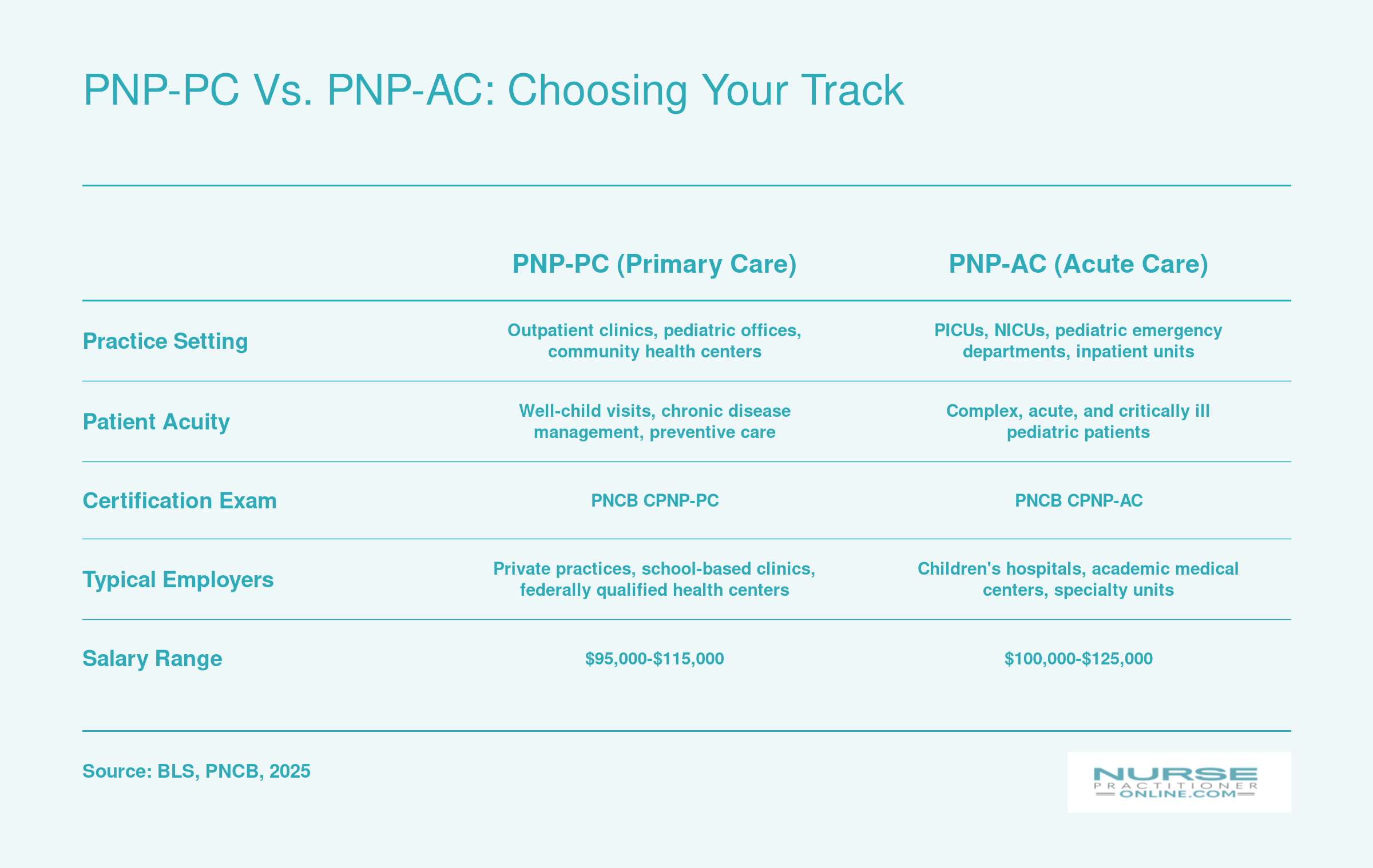
PNP-PC vs. PNP-AC: Choosing Your Track
If you already hold a master's degree and want to specialize in pediatrics, you will need to decide between a primary care (PNP-PC) and an acute care (PNP-AC) focus. Each track prepares you for a distinct certification exam, practice setting, and patient population. Here is a quick side-by-side view of the key differences.
Frequently Asked Questions About PNP Certificates in Kentucky
Choosing to pursue a post-master's certificate in pediatric nurse practitioner is a significant career move, and it is natural to have questions before you apply. Below are answers to the most common questions Kentucky nurses ask about PNP certificate programs, clinical requirements, costs, and certification eligibility.
- What is a post-master's certificate in pediatric nurse practitioner?
- A post-master's certificate in pediatric nurse practitioner is a focused credential designed for nurses who already hold a master's or doctoral degree in nursing. Rather than repeating an entire graduate program, you complete only the pediatric-specific coursework and clinical hours needed to sit for national certification through the Pediatric Nursing Certification Board (PNCB). It is one of the fastest pathways to add a PNP specialty to your practice.
- How long does it take to become a nurse practitioner in Kentucky?
- If you are starting from an RN license, becoming a nurse practitioner in Kentucky typically takes two to four years of graduate education. However, if you already hold an MSN or DNP and are adding a pediatric specialty through a post-master's certificate, most programs can be completed in as few as two to four semesters, depending on your prior coursework and whether you study full time or part time.
- Can I complete a PNP post-master's certificate online in Kentucky?
- Yes. Several nationally accredited programs offer PNP post-master's certificates in an online or hybrid format that Kentucky nurses can access. Didactic coursework is typically delivered online, while clinical practicum hours are completed in person at approved pediatric sites near you. Lexington and the broader central Kentucky region offer a solid network of pediatric clinical partners, which can simplify placement logistics.
- How many clinical hours are required for a PNP certificate?
- Clinical hour requirements vary by program but generally range from approximately 500 to 600 supervised hours in pediatric settings. The exact number depends on the certifying body's standards and whether you are pursuing primary care (PNP-PC) or acute care (PNP-AC). Some programs may grant credit for overlapping clinical competencies from your prior master's education, potentially reducing the total hours required.
- How much does a post-master's PNP certificate cost?
- Tuition for a post-master's PNP certificate typically ranges from roughly $10,000 to $30,000 or more, depending on the institution, credit hour requirements, and residency status. Programs requiring fewer bridge courses will generally cost less. Keep in mind that Kentucky pediatric nurse practitioners earn a median annual wage of around $101,000 in primary care roles, making the investment a strong long-term value for most nurses.
- What is the difference between a PNP-PC and PNP-AC certificate?
- PNP-PC (Primary Care) prepares you to manage well-child visits, chronic conditions, and routine illnesses in outpatient or community settings. PNP-AC (Acute Care) focuses on caring for children with complex, rapidly changing, or critical health conditions, often in hospital or specialty clinic environments. Each track leads to a separate PNCB certification exam, so it is important to choose the track that aligns with your desired practice setting.
- Can I convert my FNP certification to a PNP through a post-master's certificate?
- Yes. If you hold a current FNP certification, a post-master's PNP certificate lets you add pediatric specialization without earning another full degree. You will complete pediatric-focused coursework and clinical hours, then become eligible to sit for the PNCB's Certified Pediatric Nurse Practitioner exam. This FNP to PNP certificate pathway is one of the most popular routes for family nurse practitioners who want to deepen their pediatric expertise.