

Most important takeaways…
- Eastern Kentucky University offers a fully online PMHNP MSN track designed for working nurses near Richmond.
- Kentucky has 213 Mental Health Professional Shortage Areas covering roughly 60% of the state's population.
- Net price after aid varies significantly across the five PMHNP programs closest to Richmond, KY.
- Nurse practitioner salaries in Kentucky range widely based on experience, specialty, and practice setting.
Kentucky's 213 Mental Health Professional Shortage Areas cover nearly 2.8 million residents, and Richmond sits in a dense corridor for nursing education. As the demand for psychiatric care intensifies, PMHNP programs are meeting that need through fully online and hybrid formats that allow working RNs to stay employed while advancing. Comparing tuition, clinical placement support, and earning potential reveals sharp differences between programs. The path from MSN completion to full licensure is tightly structured, and the state's shortage ensures psychiatric NPs step into immediate demand, but only after clearing the certification and credentialing hurdles that define the role.
Best PMHNP MSN Programs Near Richmond, KY
Kentucky offers several strong options for nurses pursuing a Psychiatric-Mental Health Nurse Practitioner MSN, and many of them are accessible to students living in or near Richmond. The programs below range from fully online formats to hybrid models with minimal campus visits, making it possible to keep working while you earn your degree. Note that graduation rates listed are institution-wide figures, not specific to any individual nursing program.
- Program format and flexibility
- Tuition and net price
- Clinical hour requirements
- Institutional graduation rate
- Relevance to Richmond-area students
- Independent program research
- NCES-IPEDS federal institutional data — nces.ed.gov
- College Scorecard graduate earnings — collegescorecard.ed.gov
- Internal program database

Eastern Kentucky University
Eastern Kentucky University is the most geographically convenient choice for Richmond-area nurses, with its School of Nursing based right in town. The fully online PMHNP program runs on accelerated seven-week terms with spring, summer, and fall start dates, so you can begin when it fits your schedule. EKU also offers a Rural Psychiatric Mental Health NP concentration for students drawn to underserved community practice. Applications are accepted from October through March 15, and an enrollment counselor is available locally for one-on-one guidance.
- 49 credit hours at $733 per credit hour
- 100% online with no campus visits required
- Accelerated 7-week course terms
- 98.6% certification exam pass rate reported
- CCNE accredited program
- Spring, summer, and fall start dates
- Up to 12 transfer credits accepted
- Rural PMHNP concentration available
MSN Psychiatric Mental Health Nurse Practitioner, Rural Concentration — Online

Northern Kentucky University
Northern Kentucky University delivers its 47-credit PMHNP program entirely online, which makes it an excellent fit for Richmond-area nurses who want a Kentucky-based degree without commuting to Highland Heights. The program can be completed in as few as 22 months, and NKU publishes a total tuition estimate of roughly $29,177. Students complete 750 clinical hours and graduate prepared for ANCC board certification, with the university reporting a strong pass rate.
- 47 credit hours, completable in about 22 months
- 100% online delivery format
- 750 clinical hours required
- $600 per credit hour published rate
- Prepares for ANCC certification (88.94% pass rate reported)
- Seven-week course terms with multiple yearly starts
- Coursework addresses the opioid crisis
- 1,000 hours of prior RN clinical experience required
MSN Psychiatric Mental Health Nurse Practitioner — Online

University of Louisville
The University of Louisville combines online coursework with hands-on clinical training in a hybrid PMHNP program that spans a minimum of two years of full-time study. Students complete 672 patient care hours across settings that include children, adolescents, adults, and special populations. UofL's School of Nursing sits within a research university with an affiliated hospital system, giving students exposure to a large clinical network. The institution holds the highest graduation rate among the public universities on this list at approximately 61%.
- Hybrid format with online coursework and clinical rotations
- 672 patient care hours required
- Six MSN concentration options available
- Minimum two-year full-time completion timeline
- 3.0 GPA and BSN from accredited program required
- Apply through NursingCAS
- Holistic admissions review process
- Prepares for APRN certification upon graduation
MSN Psychiatric Mental Health Nurse Practitioner — Hybrid

Western Kentucky University
Western Kentucky University offers a 43-credit-hour PMHNP concentration within its MSN program, making it one of the shorter curricula on this list. The program is delivered online, and applicants should bring at least one year of psychiatric nursing experience, which distinguishes WKU's admissions expectations from several peers. Coursework covers advanced assessment, psychopharmacology, and lifespan-focused clinical internships.
- 43 credit hours, among the shortest on this list
- Online program delivery
- One year of psychiatric nursing experience required
- Advanced psychopharmacology coursework included
- Lifespan-focused clinical internships
- 3.0 GPA and three professional references required
- Competitive admissions with possible interview
MSN, Psychiatric Mental Health Nurse Practitioner Concentration — Online

Bellarmine University
Bellarmine University is a private institution in Louisville offering a 47-credit hybrid PMHNP program that can be completed part-time in about two years. Only one on-campus visit is required, and students arrange clinical practicums in their own communities, a meaningful benefit for Richmond-area nurses who want to stay close to home for hands-on training. Bellarmine's institution-wide graduation rate of roughly 64% is the highest among the schools featured here. Graduate tuition is $14,760 regardless of residency.
- 47 credit hours, two-year part-time completion
- Hybrid format with only one on-campus visit
- Clinical practicum arranged in your local community
- $14,760 graduate tuition (same for all students)
- CCNE accredited, eligible for ANCC or AANP certification
- Fall semester start only
- No GRE required
- Emphasis on evidence-based practice and interprofessional collaboration
MSN Psychiatric Mental Health Nurse Practitioner — Hybrid

Spalding University
Spalding University, another private Louisville institution, delivers its PMHNP track in a hybrid format with a strong focus on service learning and ethical decision-making. Applications are due in April for a summer cohort start, and students can study full-time or part-time within a five-year completion window. The program's 9-to-1 student-to-faculty ratio is the lowest on this list, suggesting a more personalized learning experience. Graduate tuition is $12,530 regardless of where you live.
- Hybrid format with service learning component
- $12,530 graduate tuition (same for all students)
- Full-time or part-time study options
- 9-to-1 student-to-faculty ratio
- CCNE accredited program
- No GRE required for admission
- Up to 12 transfer credit hours accepted
- Five-year maximum completion window
MSN Psychiatric Mental Health Nurse Practitioner — Hybrid

Frontier Nursing University
Frontier Nursing University in Versailles uses a distance education model built around two brief campus stays and clinical practicums completed in the student's own community. This structure is particularly appealing for Richmond-area nurses who want to train locally without relocating. Frontier offers the PMHNP track at both the MSN and post-graduate certificate levels, with a DNP pathway for those planning longer-term advancement. Limited institutional data is publicly available because Frontier is a graduate-only institution.
- Hybrid with only two brief on-campus stays
- Clinical practicums completed in your home community
- MSN and post-graduate certificate options available
- DNP pathway available for continued education
- Full-time and part-time study tracks offered
- RN licensure and bachelor's degree required
- Graduate tuition of $20,460 (same for all students)
MSN Psychiatric Mental Health Nurse Practitioner — Hybrid
How We Ranked These PMHNP Programs
Choosing a program means balancing what you'll pay today against what you'll earn tomorrow, and no single number tells the full story. Our rankings weigh four dimensions: net price after aid, institution-wide graduation rate, program-level earnings outcomes where available, and median graduate debt. Together, these factors help you see which programs deliver a strong return on investment without requiring you to take on excessive financial risk. We apply the same methodology across our online msn pmhnp programs rankings nationwide.
What the Numbers Mean
Net price reflects the average annual cost after federal, state, and institutional grants, drawn from IPEDS data for the entire institution. It's a helpful benchmark, but your individual price may differ based on your residency, financial aid eligibility, and enrollment status. Similarly, graduation rates come from institution-wide IPEDS reports, not the PMHNP program alone. A strong overall graduation rate often signals robust student support services, advising, and infrastructure that benefit graduate students too.
Program-Level Earnings and Debt
When the U.S. Department of Education's College Scorecard publishes program-level data for a given school and credential, we incorporate median earnings one year and multiple years after graduation, along with median debt at completion. These metrics let you compare real-world outcomes, not just catalog promises. Where program-level data are thin or not yet released, we rely on institution-level averages and note the gap. If you're weighing a doctoral path instead, our dnp pmhnp programs guide uses the same framework.
Accreditation as a Baseline
Every program on this list holds accreditation from the Commission on Collegiate Nursing Education (CCNE) or the Accreditation Commission for Education in Nursing (ACEN). That's table stakes for state board approval and national certification eligibility, so we treat it as a threshold requirement rather than a scoring bonus. If a program isn't accredited, it doesn't appear here.
Questions to Ask Yourself
EKU PMHNP Program: A Closer Look
Choosing between an on-campus experience and an online program can feel like charting two very different career paths. Eastern Kentucky University's PMHNP track leans fully online, giving working nurses the room to keep their jobs while advancing clinically.1
Curriculum and Credit Hours
The program requires a total of 47 credit hours, blending core MSN courses with specialized psychiatric mental health content.2 Courses follow a structured block format: 8-week terms for core coursework and 16-week terms for specialty courses, letting you focus deeply on each subject area.1 While the exact number of clinical hours is not listed publicly, the curriculum is structured to meet all national certification requirements, which typically demand at least 500 supervised patient-care hours in psychiatric settings. The online format also means no campus visits; coursework, assignments, and collaboration happen entirely through EKU's learning management system.
- Core courses: 30 credits of advanced nursing foundations covering pathophysiology, pharmacology, health assessment, research, and leadership.2
- PMHNP concentration: 17 credits covering psychiatric diagnostic reasoning, psychopharmacology, individual and group therapy, and clinical management across the lifespan.2
- Clinical rotations: Sequenced across multiple terms, with placements in diverse mental health settings to build assessment, diagnosis, and medication management competencies.
Time to Completion
With three start dates each year (fall, spring, and summer), you can move through the program at a pace that fits your life.1 The program is designed to be completed in approximately 30 months for students maintaining a steady course load.1 Part-time study stretches to three or even four years, with no penalty for slowing down when work or family obligations tighten. Clinical experiences are threaded into the second half of the program, after a solid foundation of didactic work, so you're well-prepared before stepping into a preceptor's site.
Tuition and Fees
EKU charges a flat per-credit rate for its online PMHNP program, regardless of where you live. The published rate is $733 per credit hour, which brings total tuition to approximately $34,451 for the full 47-credit program. This is often lower than many in-person graduate nursing programs, especially when you factor in the absence of commuting or relocation costs. The university also advertises access to low-cost textbook options, further reducing out-of-pocket expenses. Typical student fees (technology, library, and registration) may add a few hundred dollars each term, but specific fee schedules should be confirmed with the bursar's office. If you already hold an MSN and want to add psychiatric specialization, you might also explore post-master's PMHNP certificate programs as a shorter, more affordable path.
- Per-credit rate: $733 (in-state and out-of-state online students pay the same)
- Estimated total tuition: ~$34,451
- Additional costs: Low-cost textbooks, modest per-term fees
Clinical Placement Support
Like many online nurse practitioner programs, EKU expects students to take the lead in identifying clinical preceptors and sites. Faculty and staff provide guidance, resources, and sample agreements, but the responsibility for securing a preceptor rests with you. That said, the program's robust student satisfaction scores and strong alumni network often help new students locate high-quality placements in their local communities. Plan to start your search early and lean on EKU's advising team if you run into obstacles.
Certification Pass Rates
One of the strongest indicators of program quality is how well graduates perform on the national certification exam. EKU reports a 98.6% pass rate for its PMHNP students, a figure well above the national average. This track record suggests the curriculum aligns tightly with the ANCC exam blueprint, so you'll feel prepared when test day arrives.
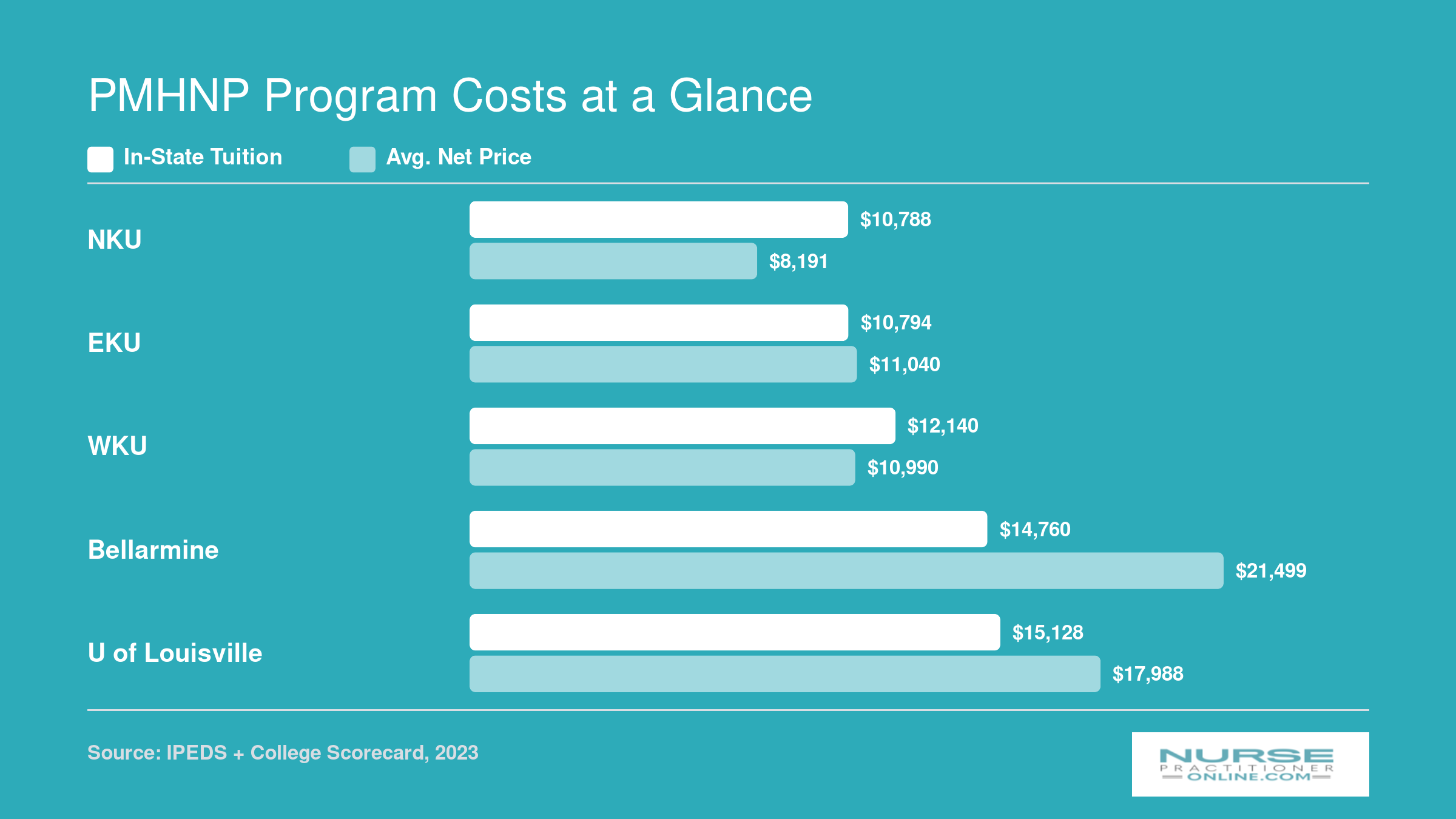
PMHNP Program Costs at a Glance
Tuition varies significantly across Kentucky PMHNP programs. The chart below compares annual in-state tuition alongside the average net price (what students typically pay after grants and scholarships) at the five programs nearest Richmond, KY. Net price can be a more realistic picture of your out-of-pocket costs.
Tuition, Financial Aid, and Total Cost of Attendance
How much will a PMHNP MSN program near Richmond, KY actually cost you from start to finish?
Sticker prices listed per credit hour only tell part of the story. To plan realistically, you need to multiply those rates by the total credits required, then factor in fees, books, and clinical-related expenses. Below is a closer look at estimated tuition totals, institutional debt figures, and the financial aid options that can shrink your out-of-pocket investment.
Estimated Total Tuition Across Kentucky Programs
Eastern Kentucky University's PMHNP program runs 49 credit hours at a published rate of $733 per credit, putting estimated tuition around $35,917 for in-state students. Northern Kentucky University advertises a total tuition of roughly $29,177 for its 47-credit online program (about $600 per credit). At the University of Louisville, in-state graduate tuition is listed near $15,128 per year, and total program cost depends on how many semesters you need. Western Kentucky University's 43-credit program and Bellarmine University's 47-credit hybrid track fall in similar ranges when you calculate their per-credit rates across the full curriculum.
Keep in mind that these estimates cover tuition alone. Budget separately for university fees, clinical supplies, background checks, malpractice insurance, and any required on-campus visits for hybrid programs.
Median Graduate Debt in Context
Institution-wide median graduate debt gives you a ballpark sense of what borrowers at each school carry after completing their degrees. Among the Kentucky schools offering PMHNP programs, median debt ranges from about $20,500 at the University of Louisville to roughly $25,250 at Spalding University. EKU falls near the middle at approximately $22,500, while NKU sits close to $23,000.
These figures reflect all graduate students at each institution, not just PMHNP students specifically, so your individual borrowing may look different depending on your enrollment pace, prior savings, and aid package. Still, when you weigh these debt levels against median PMHNP salaries in Kentucky (which commonly exceed $100,000), the return on investment is strong for most graduates.
Financial Aid Levers for PMHNP Students
Beyond standard federal loans and university scholarships, PMHNP students have access to targeted funding worth exploring:
- HRSA BHWET Grants: These institutional grants support accredited psychiatric nursing programs and can translate into student stipends, enhanced clinical placements, and training support.1 The current grant cycle focuses on care for children, adolescents, and transitional-age youth.2 Your program applies on your behalf, so ask your admissions advisor whether the school participates.
- NURSE Corps Loan Repayment Program: After you earn your PMHNP license and begin working in a Health Professional Shortage Area or approved shortage facility, you may qualify for up to $50,000 in loan repayment in exchange for a two-year service commitment.3 Psychiatric nurse practitioners are specifically listed as an eligible discipline.
- Kentucky-specific options: The state periodically offers nursing workforce scholarships and loan forgiveness tied to practicing in underserved regions. Check with the Kentucky Board of Nursing and your school's financial aid office for current offerings.
For a broader look at repayment assistance after graduation, our guide to student loan forgiveness options for nurse practitioners covers several additional federal and state programs.
A Note on Net Price Averages
You may see institution-wide average net price figures published for these universities. Those numbers reflect the typical cost after grants and scholarships across all students and all degree levels at the school. Your actual cost as a graduate nursing student will depend on your enrollment status, the aid you receive, and whether you qualify for in-state tuition. Treat published averages as a starting reference, not a guarantee, and request a personalized cost estimate from each program's financial aid office before committing.
Clinical Placement Support and Requirements for PMHNP Students
For PMHNP students near Richmond, the practical question is rarely whether you can handle the coursework. It is whether you can secure 500-plus hours of supervised psychiatric practice while working, parenting, and commuting. Clinical placement is where promising programs and overwhelmed students most often part ways.
How Many Hours You Need and Why
The American Nurses Credentialing Center requires at least 500 direct patient care hours to sit for the PMHNP-BC exam.1 Most Kentucky programs align with that floor or build in a cushion above it. Northern Kentucky University's post-MSN PMHNP certificate requires 500 hours.2 The University of Louisville's post-graduate APRN track lists 504 hours, while its non-APRN track requires 672 clinical hours plus 84 professional role hours for students entering without prior NP preparation.3 Nationally, PMHNP programs typically land in the 500 to 700 hour range across CCNE, ACEN, and CNEA accredited tracks.4
Where You Will Actually Rotate
Expect a mix of settings: inpatient psychiatric units, community mental health centers, outpatient behavioral health clinics, private practices, and VA facilities.5 A well-rounded PMHNP rotation usually spans acute stabilization, longitudinal outpatient care, and at least one rotation involving substance use or child and adolescent populations.
The Preceptor Question, Answered Honestly
This is the part many programs gloss over. NKU's online NP programs operate on a student-initiated placement model, meaning you are responsible for identifying and securing your own preceptors, with the program approving the site.2 That works if you already have a network of psychiatric providers. It is a real obstacle if you do not.
Richmond-area students do have geographic advantages worth leveraging. Eastern State Hospital in Lexington offers inpatient psychiatric exposure, UK HealthCare provides academic medical center rotations, and Appalachian regional clinics often welcome PMHNP students because the behavioral health workforce shortage is acute. Before you enroll anywhere, ask the program coordinator point blank: who finds my preceptors, and what happens if I cannot. If you are still comparing options nationally, our ranking of the best online PMHNP programs can help you weigh clinical placement support across schools.
Did you know? According to HRSA data analyzed by KFF, Kentucky had 213 Mental Health Professional Shortage Areas covering nearly 2.8 million residents as of late 2025. That’s roughly 60% of the state’s population, highlighting the urgent demand for psychiatric-mental health nurse practitioners.
PMHNP Salary and Job Outlook in Kentucky
Psychiatric-mental health nurse practitioners in Kentucky step into one of the most financially rewarding and urgently needed roles in the state's healthcare system. Here is what the numbers look like and why demand keeps climbing.
What Nurse Practitioners Earn in Kentucky
The national median annual wage for nurse practitioners was $121,610 as of the most recent Bureau of Labor Statistics data.1 In Kentucky, the mean annual wage for NPs generally falls in the $110,000 to $115,000 range, which is somewhat below the national midpoint but goes further in a state where the cost of living is well below the U.S. average.3
To understand the full earning spectrum nationally, consider these percentile benchmarks:1
- 10th percentile: approximately $87,340
- 25th percentile: approximately $103,250
- 75th percentile: approximately $135,470
- 90th percentile: approximately $165,240
Entry-level NPs can expect to land in the lower quartiles, but experienced providers, especially those in high-demand specialties, move up quickly. Average total compensation nationally, including benefits and bonuses, has been reported at roughly $144,500.2
The PMHNP Salary Premium
PMHNPs often earn more than their primary care nurse practitioner counterparts. Industry compensation surveys suggest that psychiatric-mental health specialization commands a premium of roughly 5 to 20 percent over general NP salaries, depending on setting, geography, and experience level.2 In Kentucky, where behavioral health providers are scarce, employers frequently sweeten offers with signing bonuses, loan repayment assistance, and flexible scheduling to attract psych-trained NPs.
Why Demand Is So Strong in Kentucky
Several forces converge to keep PMHNP job prospects robust across the Commonwealth:
- Opioid crisis: Kentucky has among the highest opioid overdose rates in the nation, driving sustained demand for providers who can manage substance use disorders alongside co-occurring mental health conditions.
- Rural mental health deserts: Dozens of Kentucky counties have few or zero practicing psychiatrists, making PMHNPs the primary prescribers for psychiatric medications in many communities.
- Medicaid expansion: Expanded coverage brought hundreds of thousands of Kentuckians into the behavioral health system, increasing caseloads and creating new positions in community mental health centers, telehealth organizations, and hospital-based programs.
Connecting Salary to Program Cost
When you weigh the cost of an MSN-level PMHNP program against expected first-year earnings, the return on investment is generally strong. Many programs in and around Kentucky carry total tuition in the range of $30,000 to $60,000. With a starting salary that often exceeds $100,000 in the state, graduates can reasonably expect to recoup their educational investment within a few years, especially if they take advantage of federal or state loan repayment programs for providers serving underserved populations. Program-specific debt figures vary by institution, so check each school's published net price and financial aid resources before committing.
The bottom line: Kentucky's behavioral health landscape needs PMHNPs now, and the compensation reflects that urgency. For working nurses considering this specialty, the financial outlook is encouraging, and the professional impact is hard to overstate.
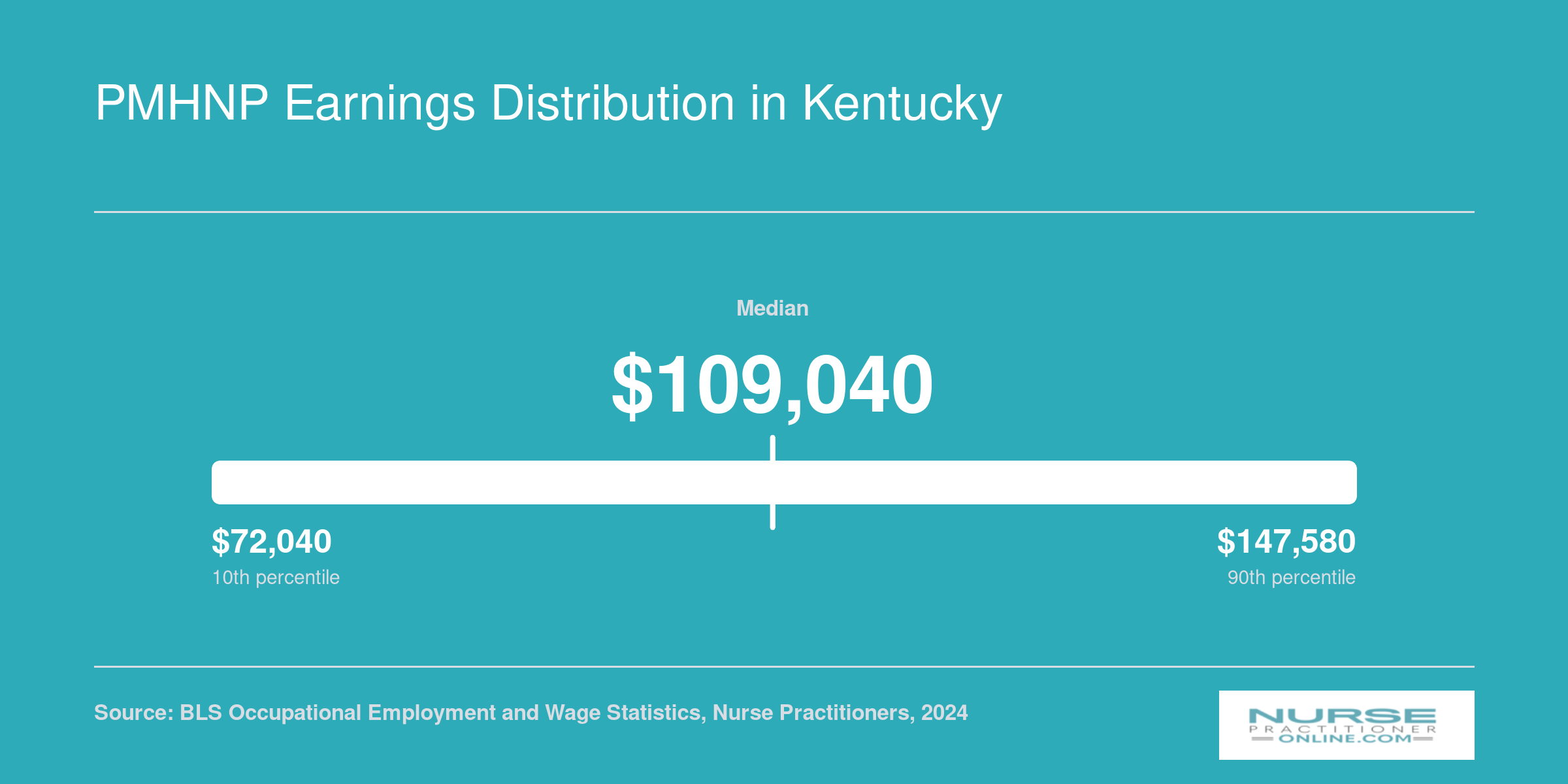
PMHNP Earnings Distribution in Kentucky
Nurse practitioner salaries in Kentucky span a wide range depending on experience, specialty, and practice setting. The figures below show how NP earnings are distributed across the state, from early-career to highly experienced practitioners.
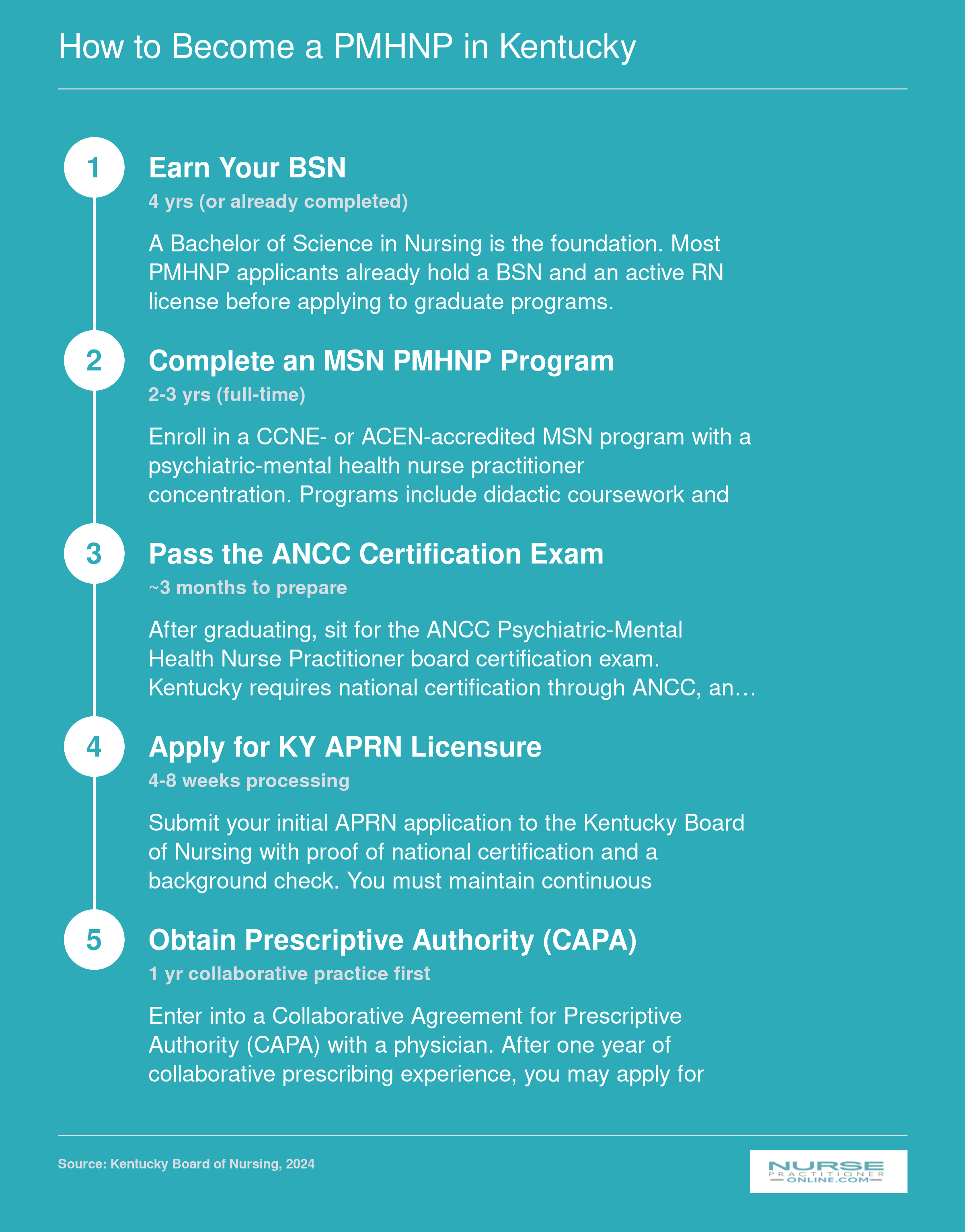
How to Become a PMHNP in Kentucky
The path from bedside nurse to psychiatric-mental health nurse practitioner follows a clear sequence of education, certification, and state licensing. Here is the typical timeline for nurses in Kentucky.
Kentucky PMHNP Licensure: Step-by-Step
Once you've earned your MSN with a PMHNP specialty, there are several concrete steps to begin practicing in Kentucky. Here's your checklist to go from graduate to licensed provider.
- Hold an active Kentucky RN licenseBefore you can apply for APRN licensure, you must have an unencumbered registered nurse license in Kentucky. If you hold a compact license from another state, verify your eligibility with the Kentucky Board of Nursing.
- Pass the ANCC Psychiatric-Mental Health NP certification examNational certification is required for APRN licensure in Kentucky. The American Nurses Credentialing Center (ANCC) administers the PMHNP board certification exam. Plan to register and sit for this exam as soon as possible after graduation.
- Submit your KY Board of Nursing APRN applicationApply for initial APRN licensure through the Kentucky Board of Nursing. You'll need to submit official transcripts from your MSN program, proof of national certification, and complete a background check. The application fee is $165, and processing typically takes about 14 business days.
- Establish a Collaborative Agreement for Prescriptive Authority (CAPA)Kentucky requires PMHNPs to have a collaborative agreement with a physician in order to prescribe. Your CAPA outlines the scope of your prescriptive authority. Note that you'll need at least one year of prescribing experience under a CAPA before you can independently prescribe controlled substances.
- Register with the DEAOnce your CAPA is in place and you have prescriptive authority, apply for a Drug Enforcement Administration (DEA) registration number. This allows you to prescribe controlled substances within the parameters of your collaborative agreement.
- Obtain your National Provider Identifier (NPI)Apply for an NPI number through the National Plan and Provider Enumeration System. You'll need this unique identifier for billing, credentialing with insurance panels, and electronic health record systems.
- Stay current with continuing education requirementsTo maintain your Kentucky APRN license, you must complete required continuing education each renewal cycle. This includes at least 5 hours of pharmacology CE annually, 3 hours in pain management, and 3 hours in medicinal cannabis education. Mark your calendar and track your credits to avoid any lapse in licensure.
Frequently Asked Questions About PMHNP Programs in Kentucky
Choosing a PMHNP program is a big decision, especially when you are balancing work and family life. Below are answers to the questions we hear most often from RNs exploring psychiatric mental health nurse practitioner MSN programs near Richmond, KY.
- How long does it take to complete an MSN PMHNP program near Richmond, KY?
- Most MSN PMHNP programs in the Richmond, KY area take about two to three years of full-time study. Part-time tracks designed for working nurses may extend that to three or four years. Eastern Kentucky University's program, for example, is structured so students can progress through coursework and clinical rotations at a manageable pace while continuing to work as registered nurses.
- What are the clinical hour requirements for PMHNP programs in Kentucky?
- PMHNP programs in Kentucky typically require a minimum of 500 to 600 supervised clinical hours, in line with national certification standards set by ANCC and AANP. Some programs exceed that threshold. These hours must be completed in psychiatric and mental health settings under the supervision of a qualified preceptor, and students usually begin clinical rotations during the second year of the program.
- How much does EKU's PMHNP program cost?
- Tuition for EKU's PMHNP program varies depending on residency status and whether you attend full-time or part-time. For the most current per-credit-hour rates and total estimated cost of attendance, check EKU's graduate nursing tuition page directly, as rates are updated annually. Additional costs include textbooks, certification exam fees, background checks, and clinical site expenses.
- Does EKU help PMHNP students find clinical placements?
- EKU provides guidance and support for securing clinical placements, though students are generally expected to take an active role in identifying potential preceptors and sites. The university maintains relationships with healthcare facilities across Kentucky, which can help streamline the process. Starting your search early and networking with local psychiatric providers is strongly recommended, especially in rural areas where placement options may be more limited.
- Can I complete a PMHNP program online while working full-time as an RN?
- Yes, many PMHNP programs near Richmond, KY offer online or hybrid formats designed for working nurses. Didactic coursework is often delivered asynchronously, so you can study on your own schedule. However, clinical rotations must be completed in person. Most students find that reducing to part-time nursing work during clinical semesters helps them manage the workload without burning out.
- What is the difference between a PMHNP and a general psychiatric NP in Kentucky?
- In Kentucky, the term psychiatric NP and PMHNP refer to the same role. The official designation is Psychiatric Mental Health Nurse Practitioner, and it requires completion of an accredited PMHNP program followed by national certification through the ANCC. There is no separate general psychiatric NP credential. PMHNPs are trained to diagnose and treat mental health conditions across the lifespan, including prescribing medications.
- Do PMHNP programs in Kentucky require GRE scores for admission?
- Many PMHNP programs in Kentucky, including EKU's, do not require GRE scores for admission. Programs typically prioritize your nursing GPA, active RN licensure, clinical experience, and a strong personal statement. That said, admission requirements can change from year to year, so it is always wise to confirm current criteria directly with the program before you apply.