
Most important takeaways…
- California NP license processing can take 4 to 8 months, including furnishing number and DEA registration.
- Delays often stem from LiveScan fingerprint issues, incomplete forms, or missing transcripts.
- Working as an RN on a temporary permit bridges the income gap during the wait.
- California offers top NP salaries nationally, with metro areas exceeding the national median.
Six months. That’s how long some nurse practitioners wait for a California license, long after job offers have come and gone. The California Board of Registered Nursing (BRN) processes thousands of applications each year, but the gap between official timelines and real-world experience has made it one of the slowest licensing boards in the country. For NPs weighing an out-of-state offer against the Golden State’s top-tier salaries, the delay can feel like a career standstill. The tension is acute: California’s NP market pays among the highest in the nation, but getting through the door tests even the most patient clinicians.
Current California NP License Processing Times: What the BRN Says Vs. Reality
How long does it actually take to get a California NP license in 2026?
The California Board of Registered Nursing (BRN) processes thousands of NP applications each year, and the posted timelines rarely capture the full picture. If you are planning your career move or starting a new job, understanding the gap between official processing windows and real-world experiences can save you weeks of frustration.
What the BRN Website Tells You
The BRN publishes estimated processing timeframes for different application types. For new NP graduates, the agency generally lists a review window that starts from the date all required documents are received. Endorsement applicants coming from other states often see a slightly different posted range. The key detail many nurses overlook: these estimates usually reflect only the time an application sits in the primary queue, not the total calendar time from submission to license in hand. You can find the most current figures by visiting the BRN website directly and navigating to the licensing division page. The online system also lets you check your application status, which is the only way to know exactly where you stand.
What Real Applicants Are Reporting
In practice, many applicants encounter longer waits than the BRN projections suggest. Professional forums such as Reddit's r/nursepractitioner and threads on AllNurses are filled with firsthand accounts from NPs who tracked every step of the process. Some report smooth approvals in a matter of weeks, while others describe stretches of radio silence that extend several months. Common themes include delays when fingerprint results are pending, when school transcripts are not transmitted electronically, or when the application has minor errors. If you want a realistic sense of current wait times, reading these recent posts is more illuminating than relying on the official numbers alone. Also consider reaching out to your NP program's career services office; advisors often have a pulse on what recent alumni experienced.
Why Timelines Fluctuate
Processing times are sensitive to several unpredictable factors. Staffing levels at the BRN, seasonal surges in application volume, and background check hiccups all play a role. During peak graduation periods, typically spring and early summer, the queue can grow significantly. Endorsement applications from nurses in compact states or those with out-of-state credentials sometimes require additional manual review, adding weeks. And while the BRN has modernized parts of its process, no automated system is immune to glitches or incomplete data transmissions.
How to Plan Ahead
Rather than banking on a best-case scenario, build a buffer into your timeline. Most advisors suggest allowing at least two to six months from the moment you submit your application until you hold a valid California NP license. This range accounts for the official review period, fingerprint processing, and potential requests for additional information. If you plan to apply for a furnishing number, anticipate an additional separate review window that could add more weeks. Start gathering transcripts, verification forms, and background check materials as early as possible, and submit them in the exact format the BRN specifies. The more complete your initial packet, the fewer reasons for your file to be set aside for clarification. While waiting can be stressful, a realistic schedule will help you align your job search and start date with greater confidence.
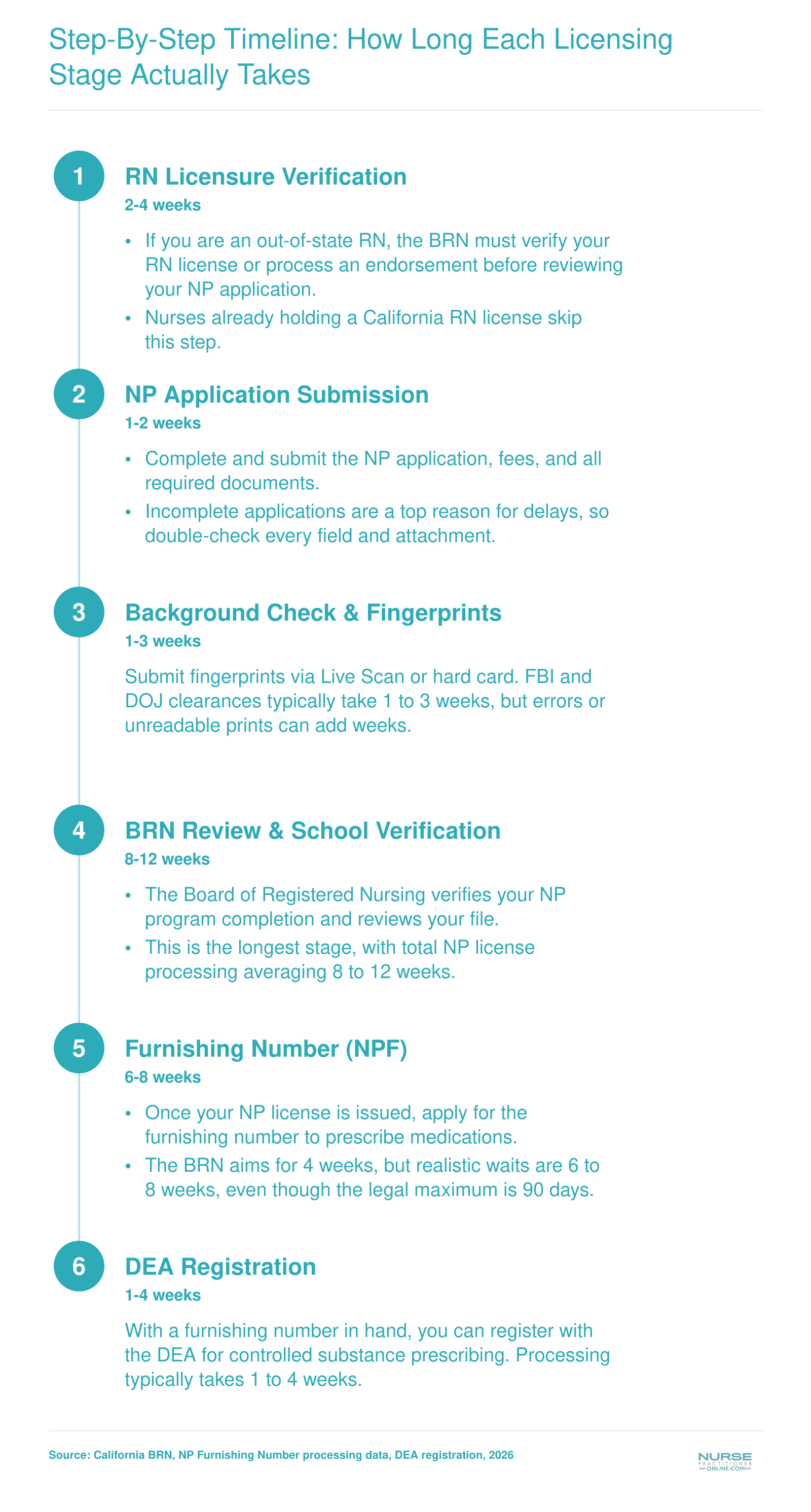
Step-By-Step Timeline: How Long Each Licensing Stage Actually Takes
Getting full prescriptive authority in California can take 4 to 8 months from start to finish. The BRN processes the core NP license, but many applicants forget to plan for the additional weeks required for a furnishing number and DEA registration afterward.
New Graduate Vs. Endorsement Vs. Adding a Specialty: How Timelines Differ
Across all three application pathways, new graduate, endorsement, and adding a specialty, California BRN records and recent applicant reports show that processing times commonly land between 10 and 12 weeks in 2025-2026. However, where those weeks get eaten up can vary dramatically depending on your starting point.
New Graduate NP: The Graduation Surge
The typical 10-12 week window is an average, but new grads hitting the pipeline between May and August often wait longer. That semester-end flood of applications strains BRN resources, and the biggest bottleneck is not the Board itself, it is the documentation from your NP program. Missing or erroneous school submissions, from incomplete clinical hour logs to improperly formatted transcripts, trigger weeks of back-and-forth corrections.
- Coordinating with your school: Confirm that your program submits materials as a complete cohort package whenever possible, and double-check your individual record for accuracy before it leaves the registrar’s office.
- Surge planning: If you graduate in spring, budget for a timeline closer to 14-16 weeks rather than the published average.
Endorsement from Another State: Verification Hurdles
Endorsement applicants face the same 10-12 week baseline, but two extra layers often stretch the wait. First, the BRN must verify your out-of-state NP license, which requires the other state’s board to respond promptly, a variable you cannot control. Second, many endorsement candidates need to secure a California RN license before the NP application can move forward; if you haven’t started that parallel process, the timeline lengthens accordingly. Fingerprint logistics add friction too, especially for out-of-state applicants who must submit hard cards or travel for Live Scan.
- Start verification early: Request license verification from your current state the moment you begin your California application.
- Tackle fingerprints proactively: Use the out-of-state fingerprint packet (FD-258) and mail it well ahead of other documents to avoid a bottleneck.
Adding a Specialty: A Less-Defined Path
If you’re a California-licensed NP adding a new population focus, the BRN does not publish a distinct timeline, but real-world reports point to a similar 10-12 week window when applications are complete. The danger here is assuming the process will be quicker because you already hold a license. Incomplete applications, missing certification verification, outdated clinical practice forms, or absent fee schedules, are the primary reason these submissions stall. Unlike new grads or endorsement candidates, there is no defined cohort or interstate coordination, so your file can sit ignored if a single item is missing.
- Submit everything at once: Gather every required document before hitting submit; piecemeal filings invite delay.
- Check for specialty-specific requirements: Some population foci demand additional advanced pharmacology evidence or separate board certifications, verify what your new specialty requires beyond your current credential.
Regardless of your path, understanding these distinct pressure points helps you plan a realistic waiting period and avoid the most common holds. A little front-end coordination can shave weeks off the back end.
Related Articles
Top Reasons California NP Applications Get Delayed
Most California NP license delays trace back to a handful of fixable mistakes that applicants unknowingly make. The Board of Registered Nursing (BRN) processes thousands of new and endorsement applications each year, and even small oversights can push a straightforward application into a holding pattern for weeks or months. Here is where things most often go wrong, and what to watch for before you submit.
Incomplete Applications: Missing Transcripts or Outdated Forms
The most common reason an application stalls is simply that it is not finished. BRN analysts cannot begin a review until every required piece lands in the file. The top missing items include official transcripts sent directly from the degree-granting school (student-uploaded copies are not accepted), outdated paper forms pulled from third-party websites instead of the current BRN site, and payment discrepancies. Always verify you are using the latest version of each form, and double-check that your name on every document matches exactly, including middle initials and suffix (Jr., II, etc.).
Fingerprint Processing Backlogs and DOJ Delays
California requires both Department of Justice (DOJ) and Federal Bureau of Investigation (FBI) fingerprint clearance. While Live Scan results often return quickly for applicants with no criminal history, the process can still take weeks during busy periods. A criminal history disclosure, even for a minor or expunged offense, automatically routes the application into a separate enforcement review track. This adds several months while BRN investigators pull court documents and evaluate the case, regardless of the offense's age or severity.
School Verification Lags and Degree Confirmation
Degree verification is one of the slowest stages. Many nurse practitioner programs are backlogged with final transcript and certification requests, especially in the May-June graduation window. If your school does not promptly submit a Certification of Completion or the official transcript with the NP degree posted, the BRN will not proceed. Proactively request these documents early and follow up with both the school and the BRN to confirm receipt.
Fixable Data Errors: NPI Numbers, Name Mismatches, and Missing Agreements
- NPI Number: An incorrect, inactive, or missing National Provider Identifier (NPI) on the application can trigger a deficiency notice. Verify your NPI status at the NPPES registry before submitting.
- Name Discrepancies: If your name on transcripts, nursing license, or identification differs in any way (hyphenation, maiden vs. married name, missing middle name), the application may be placed on hold. Provide a copy of marriage certificates or legal name change documents proactively.
- Supervisory Agreements: For applicants transitioning from pre-2023 license types that required collaborative or supervisory agreements, missing or outdated copies of those agreements can stall the process. Include them if they were part of your previous credentialing.
BreEZe System Glitches and Document Loss
The BRN's BreEZe online portal occasionally drops uploaded attachments without warning. Applicants who log back in may find required fields or documents missing. To avoid this, take screenshots of every successful upload confirmation page. If you receive a deficiency notice for a document you already submitted, re-upload immediately and note the confirmation date in your communication with BRN.
Peak Season Timing
Applications submitted between May and September routinely take longer. This coincides with the influx of new graduates and out-of-state applicants moving during the summer. If your timeline is flexible, aim for an off-peak submission whenever possible.
Questions to Ask Yourself
How to Speed up Your California NP License Application
Pre-Submission Checklist: Gather Everything Before You Apply
A handful of proactive steps on the front end can shave months off your timeline.
- LiveScan fingerprints: Complete your LiveScan at least two to three weeks before you submit your application. The California DOJ and FBI typically return results in 7-10 business days, but any mismatch or resubmission delays can stall your entire file. Having them done early means the BRN has clearance in hand when your application lands.
- Official transcripts: Request sealed transcripts from your NP program as soon as you have your conferred degree date. Many schools take 2-4 weeks to process transcript orders, and electronic delivery through services like Parchment or National Student Clearinghouse is faster than mailed paper copies.
- Current BRN forms: Download the application package directly from the California BRN website each time you apply. Forms update periodically, and using an outdated version gets the application returned. Confirm you are using the most recent revision date printed on the form footer.
Call the BRN Early, Very Early
Phone access to licensing staff is notoriously limited, but you can improve your odds with the right timing.
- Dedicated NP line: The BRN maintains an Advanced Practice line separate from the general RN line. Ask for that number when you first connect, the general queue rarely transfers directly.
- Call at 8:00 AM exactly: Hold times spike after 9:00 AM, and by 10:00 AM the line often reaches capacity and refuses additional callers. Start dialing a few minutes before 8:00 so you are first in queue.
- Have your information ready: Pull up your BreEZe tracking number, application ID, and any reference numbers before you call. Agents can pull your file faster when you provide identifiers immediately.
Submit the Furnishing Number Application Concurrently
If you need furnishing authority, and most NPs in California do, do not wait for your NP license to process first.
Furnishing number applications can be submitted the same day as your initial NP application. When both files move through review simultaneously, you avoid the sequential delay of waiting for one approval before the second evaluation starts. Use the same BreEZe account, reference your pending NP application number, and upload all supporting documents at once. For endorsement applicants, include verification of your prescribing education from your original program and any out-of-state prescribing evidence to prevent back-and-forth requests.
Use BreEZe to Track and Know When to Escalate
Passive waiting is the biggest time sink. Active monitoring with well-timed escalations moves your application forward.
- Check BreEZe weekly: After the initial processing window, log in to BreEZe weekly to spot status changes. A stuck “pending” status for more than six weeks often means a deficiency notice was missed or a document was lost.
- Escalate at 90 days: If your application shows zero activity for 90 days (not including fingerprint or transcript holds you can prove were sent), it is time to contact your state assembly member or senator’s constituent services office. Most legislative offices have a staffer who handles professional licensing delays. Provide your full name, BreEZe ID, application date, and a brief timeline. The legislator’s inquiry flag often generates a priority review from BRN management.
When to Consider Professional Help
Hiring a licensing expediter or attorney is available as a last resort, but it rarely helps a clean application move significantly faster. Reserve this route for complex situations: multiple compact or foreign license verifications, a disciplinary history requiring legal analysis, or a prolonged deficiency without explanation. For straightforward applications, the steps above yield the same acceleration at no extra cost.
Temporary Permits and Interim Practice Options While You Wait
Waiting for your NP license to process can feel like watching your career stall. But you have a concrete alternative: you don't have to put your nursing skills, or your income, on hold while the California Board of Registered Nursing (BRN) works through its backlog. By leveraging your existing RN license (or obtaining an interim RN permit), you can bridge the gap productively.
Why California Doesn't Issue Temporary NP Permits
The BRN does not provide temporary practice permits for nurse practitioners. This is a common point of confusion because many healthcare employers casually refer to “NP interim permits,” but what they really mean is an RN Interim Permit or a Temporary RN License. These are strictly RN-level credentials that allow you to work as a registered nurse, not as a nurse practitioner. If you hold an active California RN license already, no additional permit is needed, you can continue practicing as an RN while your NP application processes.
Working as an RN Under an Interim Permit
For nurses who don't yet have a California RN license, the BRN offers two fast-track options. An RN Interim Permit is issued within 24 to 48 hours of a completed application and lets you work under supervision as an RN. It remains valid until your full RN license is approved, denied, or for six months, whichever comes first. A Temporary RN License, which costs $100, provides a full six months of RN practice authority but cannot be renewed. Both are practical bridges if you're waiting for NP licensure and need to generate income immediately.
Telehealth and Out-of-State Options
If you hold an active NP license in another compact or single-state jurisdiction, you can work remotely via telehealth for patients located in that state. Many per diem RN roles also offer scheduling flexibility that leaves room for your NP transition once licensure arrives. This layered approach, RN work combined with out-of-state telehealth, keeps your clinical skills sharp and your finances steady.
What to Expect When Your NP License Finally Arrives
Once the BRN approves your NP application, your scope of practice may be broader than you realize. Under AB 890, newly licensed NPs are categorized as either 103 NPs (requiring a transition-to-practice period under standardized procedures) or 104 NPs, who may practice independently without physician supervision. Applications for the 104 NP designation became available in 2026. Additionally, as of July 1, 2026, AB 583 allows California NPs to complete and attest death certificates, further expanding your professional authority. While none of these privileges apply during the interim period, they underscore the value of waiting out the process.
How California NP Processing Times Compare to Other States
Deciding whether to wait out California’s prolonged licensing process or seek credentials elsewhere is a classic time-versus-opportunity tradeoff. If you can afford to wait, you gain access to one of the highest-paying NP markets in the country. If you need income sooner, securing a license in a faster state might keep your career momentum going while your California application crawls through the system.
Texas: Moderate Timelines but No Temporary Permits
- New graduate processing: 6 to 10 weeks
- Endorsement processing: 4 to 8 weeks
- Temporary permit available: No
- NLC status: Not applicable to APRNs; no multistate practice privilege for NPs
- Key hurdles: Fingerprint requirements, a jurisprudence exam, and seasonal graduation volume can stretch timelines. There is no expedited processing option.
New York: Steady But Slower Than Average
- New graduate processing: 8 to 12 weeks
- Endorsement processing: Similar timeframe for endorsements, as New York does not distinguish heavily in public data
- Temporary permit available: No
- NLC status: Again, NLC does not cover advanced practice; NPs must hold a standalone New York license
- Key hurdles: The NP Modernization Act (set to sunset July 1, 2026) and an updated child-abuse continuing education requirement have added administrative load. High application volume contributes to delays.
Florida: Quick for New Grads, Slower for Endorsements
- New graduate processing: 6 to 10 weeks
- Endorsement processing: 6 to 12 weeks, sometimes longer due to background checks
- Temporary permit available: No
- NLC status: Like Texas and New York, Florida does not participate in a multistate APRN compact
- Key hurdles: A level 2 background check mandated by HB 975 creates bottlenecks. General APRN application volume can push endorsement times to the upper end of the range.
What This Means for Your California Plans
When you stack these numbers against California’s typical 4-to-6-month processing timeline, the gap is stark. None of the large states compared here offer temporary permits that let you practice while your full license is pending, so moving to a faster state solely for a quick start may not bypass the wait entirely. However, if you’re relocating or can work remotely in a non-clinical role, securing a license in Texas, New York, or Florida while your California application is pending could keep your earnings flowing. Just remember: none of these states share compact privileges for NPs, so each license stands alone.
California NP Salary and Workforce Outlook
The wait for a California NP license can be frustrating, but the state offers some of the highest salaries in the nation. Many metro areas boast median wages well above the national median, and California will need thousands of additional primary care clinicians by 2030, ensuring strong demand for new practitioners.
| Metro Area | Employment | Median Annual Wage |
|---|---|---|
| Los Angeles-Long Beach-Anaheim, CA | 6,400 | $164,510 |
| San Francisco-Oakland-Fremont, CA | 2,960 | $220,330 |
| San Diego-Chula Vista-Carlsbad, CA | 2,790 | $162,030 |
| Riverside-San Bernardino-Ontario, CA | 1,630 | $162,470 |
| San Jose-Sunnyvale-Santa Clara, CA | 1,280 | $225,730 |
| Sacramento-Roseville-Folsom, CA | 1,200 | $164,520 |
| Fresno, CA | 640 | $161,550 |
| Modesto, CA | 390 | $164,790 |
| Bakersfield-Delano, CA | 360 | $165,460 |
| Visalia, CA | 270 | $156,740 |
| Oxnard-Thousand Oaks-Ventura, CA | 270 | $155,440 |
| Stockton-Lodi, CA | 230 | $161,010 |
| Santa Maria-Santa Barbara, CA | 210 | $171,150 |
| Santa Rosa-Petaluma, CA | 200 | $164,630 |
| Vallejo, CA | 190 | $169,990 |
Frequently Asked Questions About California NP Licensing Delays
Navigating California's NP licensing process can be frustrating, with delays often stretching months beyond official estimates. Below we answer the most common questions about processing times, temporary permits, and how to avoid common pitfalls. These insights are drawn from the BRN's current guidelines and real-world applicant experiences.
- How long does it take to get an NP license in California?
- The California Board of Registered Nursing (BRN) reports processing times of 12 to 16 weeks for NP applications, but many applicants experience delays of 20 weeks or longer. Endorsement applications and those requiring fingerprint background checks can add additional weeks. The actual timeline often depends on application completeness and BRN caseload.
- What is the current BRN processing time for NP applications?
- As of 2026, the BRN states that routine NP applications take approximately 12 to 16 weeks. However, anecdotal reports indicate that incomplete applications, fingerprint rejections, and high volume can push processing to 6 months or more. Checking the BRN's online application status portal regularly is recommended.
- Can you practice as an NP in California with a temporary permit?
- Yes, California offers a temporary NP certificate for eligible applicants who hold a valid RN license and have met NP education requirements. The temporary permit allows practice under supervision while the full NP license is processed. It is valid for 6 months, but processing of the temporary permit itself can take 4 to 6 weeks.
- Is there a shortage of nurse practitioners in California?
- Yes, California faces a significant NP shortage, especially in primary care and rural communities. The demand is fueled by an aging population and recent scope-of-practice expansions, yet licensing delays slow the entry of new NPs into the workforce. This mismatch worsens healthcare access in underserved areas across the state.
- How long does it take to get a California NP furnishing number after licensure?
- After obtaining an NP license, applying for a furnishing number to prescribe medications requires a separate application to the BRN. Processing typically takes 4 to 8 weeks, but it can be delayed if supporting documents, such as pharmacology coursework verification, are missing or incomplete.
- What should I do if my California NP application has been pending for more than 90 days?
- If your application has exceeded 90 days, contact the BRN directly via phone or email. Have your application number ready. You can also request an expedited review if you have a job offer pending. Document all communications and follow up persistently, as responses may take weeks.
- Does a misdemeanor affect California NP license processing time?
- Yes, any criminal history, including misdemeanors, can significantly delay processing. The BRN requires detailed disclosures and may refer the application for further investigation. Applicants should submit court documents and a personal statement explaining the circumstances to avoid prolonged hold-ups.