

Most important takeaways…
- Alabama's three public universities offering AGACNP pathways all feature online coursework with in-person clinical components.
- The AACN ACNPC-AG certification exam posted a 91% national pass rate in 2023 before dipping roughly five points in 2024.
- In-state AGACNP tuition across Alabama runs significantly below the national average for graduate nursing programs.
- Nurse practitioners in Alabama earn competitive regional salaries, with AGACNPs in high-acuity settings often exceeding general NP benchmarks.
MSN-entry versus DNP-completion: that is often the first fork in the road for Alabama nurses pursuing acute care advanced practice. Hospital systems in Birmingham, Huntsville, and Mobile have expanded their advanced practice staffing aggressively over the past several years, driven by physician shortages in critical care, cardiology, and pulmonology units at facilities like UAB Medicine and Huntsville Hospital.
Alabama has a concentrated but well-structured set of AGACNP options, spanning MSN, DNP, and post-master's certificate pathways, all delivered online or in hybrid formats that let you keep working while you advance. The 2025 APRN Consensus Model update matters here: it formally retired the legacy standalone ACNP credential, meaning new graduates must now sit for either the AACN ACNPC-AG or the ANCC AGACNP-BC, both of which require program completion in the adult-gerontology acute care framework.
For Alabama nurses, the practical tension is rarely about program quality alone. It comes down to credit load versus time-to-completion, in-state tuition advantages, and whether a given program arranges clinical placements or requires you to secure your own preceptors in an already competitive market. If you are still deciding between an acute care track and a primary care path, our comparison of AGNP vs. FNP differences can help clarify where each credential leads.
Top Online AGACNP Programs in Alabama for 2026
Alabama offers three public universities with AGACNP pathways that blend online coursework with hands-on clinical training, making it possible to advance your career without stepping away from the bedside full-time. The ranking below uses a quality composite that weighs online and hybrid delivery accessibility alongside institutional metrics such as graduation rate, net price, and student support indicators. These are not ranked solely by cost or earnings; instead, the composite highlights programs that combine strong academic foundations with the flexible delivery working nurses need most.
- Online delivery accessibility
- Institutional graduation rate
- Net price and affordability
- Clinical network strength
- Student support indicators
- Internal program database
- NCES-IPEDS federal institutional data — nces.ed.gov
- College Scorecard graduate earnings — collegescorecard.ed.gov
- Independent program research

University of Alabama at Birmingham
UAB is Alabama's flagship academic health center and the state's most comprehensive AGACNP provider, offering MSN, DNP, and post-graduate certificate pathways, all in a distance-accessible hybrid format with periodic on-campus intensives. Its network of more than 5,000 clinical affiliates across Alabama gives students extensive placement options in ICU, cardiology, and hospitalist settings. UAB's strong regional employer recognition and CCNE accreditation make it the go-to choice for nurses who want to stay in-state while training at a nationally ranked institution.
- Hybrid format with distance-accessible coursework
- 45 credit hours completed in 6 to 7 semesters
- Tuition of $723 per credit hour
- Part-time schedule designed for working nurses
- Optional RNFA subspecialty concentration available
- Prepares for ANCC AGACNP-BC or AACN ACNPC-AG certification
- 3.0 GPA and three recommendation letters required
- CCNE-accredited doctoral program
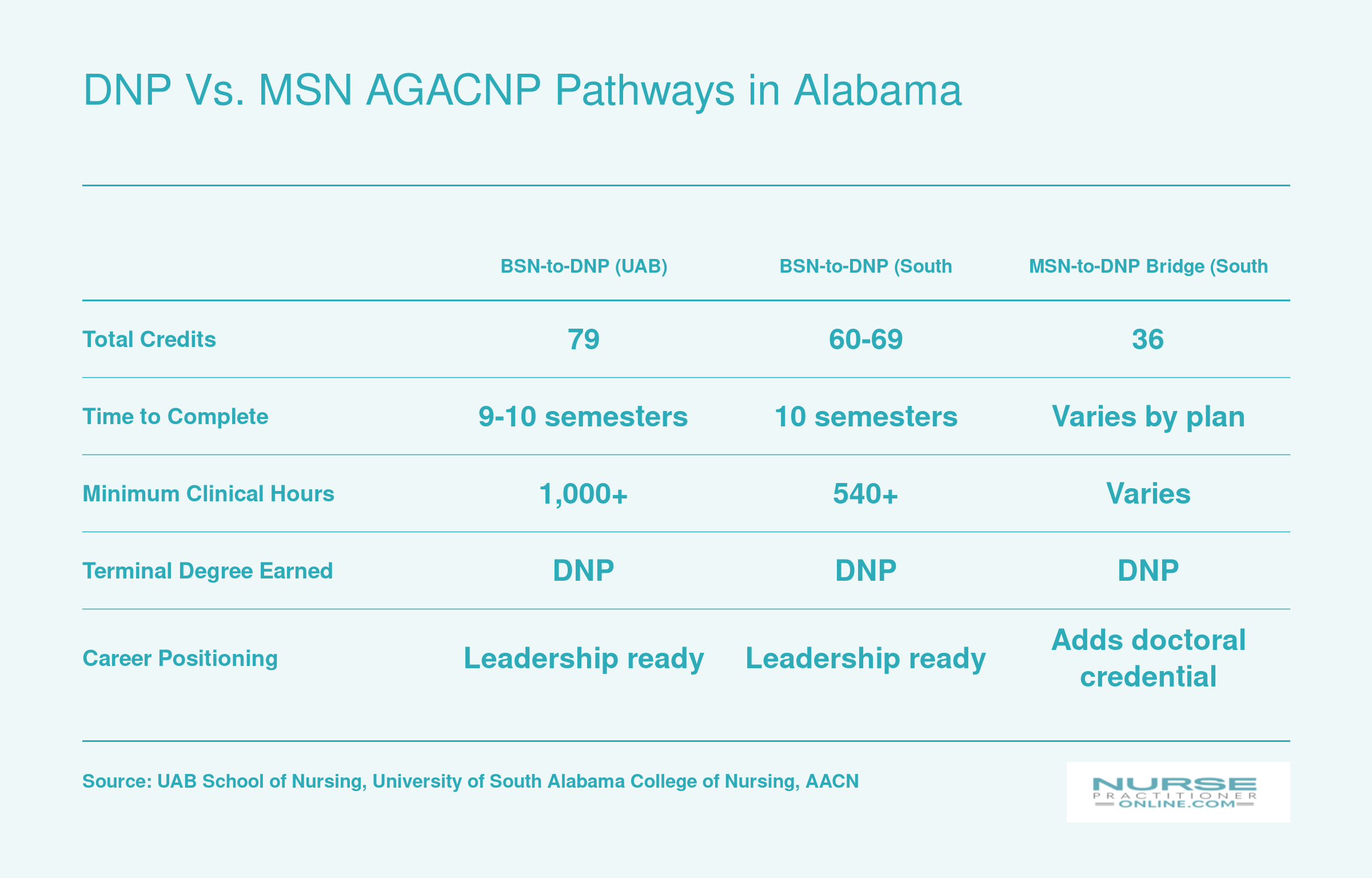
- 79 total credit hours over 9 to 10 semesters
- Distance-accessible format with on-campus intensives
- Capstone scholarly project required
- $723 per credit hour for all students
- Application deadline October 8, 2026 for next cohort
- Financial aid and scholarships available
- Designed for MSN-prepared nurses with existing APRN certification
- Minimum 27 credit hours across four semesters
- Hybrid delivery with distance-accessible coursework
- Summer-only entry point
- GAP analysis evaluates prior coursework for credit
- Requires current unencumbered nursing license
MSN Adult-Gerontology Acute Care Nurse Practitioner — Hybrid
DNP Adult-Gerontology Acute Care Nurse Practitioner — Hybrid
Post-Graduate APRN Certificate in AGACNP — Hybrid

University of South Alabama
The University of South Alabama delivers its AGACNP track as a fully online DNP with a mandatory clinical skills intensive, letting students complete residency hours in their home region. USA's long track record in distance nursing education and its Gulf Coast clinical network make it especially practical for nurses across southern Alabama, the Florida Panhandle, and Mississippi. Its 69-credit-hour curriculum prepares graduates for AACN ACNPC-AG certification and acute care roles in ICUs, emergency departments, and transitional care.
- Fully online delivery with limited on-campus requirements
- 69 total credit hours
- Clinical residency can be completed in home region
- Mandatory clinical skills intensive included
- Capstone scholarly project required
- Accepts BSN-to-DNP and MSN-to-DNP applicants
- Two years of acute care experience required, including one year in ICU
- Prepares for AACN ACNPC-AG certification
DNP Adult-Gerontology Acute Care Nurse Practitioner — On-Campus

Jacksonville State University
Jacksonville State University offers a hybrid DNP with an AGACNP track that appeals to nurses in northeast Alabama and the Birmingham-to-Atlanta corridor who value smaller cohorts and closer faculty mentorship. The program requires 700 clinical hours combining simulation and direct patient care, with on-campus components held at JSU's main campus. Graduates are prepared to sit for both ANCC AGACNP-BC and AACN ACNPC-AG certification exams.
- Hybrid format blending online coursework with on-campus labs
- 700 clinical hours including simulation and direct care
- Capstone scholarly project required
- Prepares for both ANCC and AACN certification exams
- Financial aid available for qualifying students
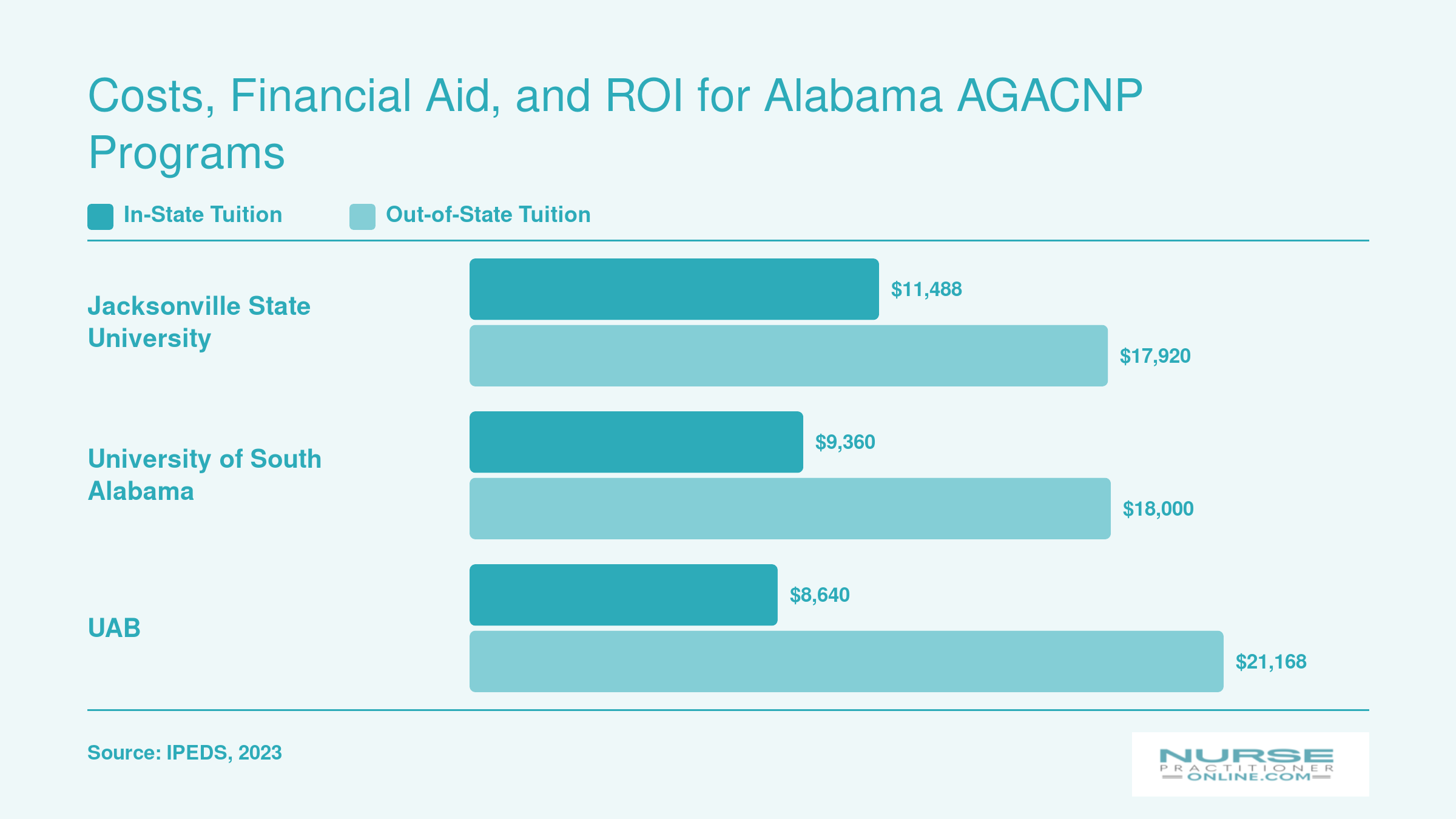
- In-state tuition of $11,488 per year (institution-wide rate)
- Clinicals typically arranged within Alabama or nearby region
DNP Adult-Gerontology Acute Care Nurse Practitioner — Hybrid
What Is an AGACNP, and How Does It Differ from an FNP?
The credentialing landscape for acute care nurse practitioners shifted significantly in 2025, when the updated APRN Consensus Model formally retired the legacy standalone ACNP and PCNP credentials in favor of a unified adult-gerontology framework.1 If you are weighing specialty options, understanding exactly what an AGACNP does, and how that role diverges from an FNP, will shape every decision that follows.
The AGACNP Scope of Practice
The Adult-Gerontology Acute Care Nurse Practitioner specializes in patients from adolescence through older adulthood who are experiencing complex, rapidly changing, or life-threatening conditions. The practice setting is almost always inpatient: intensive care units, emergency departments, cardiac stepdown units, trauma services, and specialty surgical floors. AGACNPs manage ventilator weaning, hemodynamic instability, post-operative complications, and the cascading needs of critically ill older adults. The work demands clinical reasoning that holds up under time pressure and diagnostic uncertainty, often within interprofessional teams moving fast.
How the AGACNP Differs from an FNP
The Family Nurse Practitioner role is built around primary and ambulatory care across the lifespan, including pediatrics. An FNP's clinical sites tend to be outpatient clinics, community health centers, and private practices focused on prevention, chronic disease management, and episodic illness. The AGACNP and FNP share advanced practice status, but their certifications, clinical training requirements, and typical job settings do not overlap much in practice. Choosing between them is less about preference and more about where you want to spend your career: acute care vs primary care. For a deeper comparison, see our guide to AGNP vs. FNP differences in scope and salary.
Certification Credentials
Graduates of AGACNP programs pursue one of two national certifications. The American Association of Critical-Care Nurses offers the AACN ACNPC-AG credential. The American Nurses Credentialing Center offers the ANCC AGACNP-BC. Both are widely accepted by Alabama employers, and either satisfies the national certification requirement for state licensure as a Certified Registered Nurse Practitioner (CRNP) in Alabama.2
Alabama's Practice Environment
Alabama currently requires AGACNPs to practice under a collaborative agreement with a physician.3 The collaborating physician must have at least three years of experience (or one year if board certified in a relevant specialty), and the agreement carries a $200 registration fee.3 After 4,000 hours of practice under collaboration, on-site requirements drop to 10 percent of the AGACNP's schedule.3 Continuing education tied to collaboration rules took effect for NPs in January 2024 and for physicians in January 2025.4 In March 2026, Alabama repealed older rules governing clinical hours for APRN approval, with updated rules still pending.1 Legislative conversations around full practice authority continue, but as of mid-2026, a supervising agreement remains mandatory.4 This is a real operational consideration when evaluating job offers and planning your post-graduation setup.
Questions to Ask Yourself
How Alabama AGACNP Programs Compare: Credits, Clinicals, and Format
Choosing the right AGACNP program means weighing credit loads, clinical hour requirements, delivery format, and clinical placement access. Alabama's three main AGACNP programs each take a slightly different approach, so the best fit depends on whether you're pursuing an MSN, DNP, or post-master's certificate, and how much flexibility you need as a working nurse. Here's how they stack up side by side.
| Feature | UAB (Birmingham) | University of South Alabama (Mobile) | Jacksonville State University |
|---|---|---|---|
| Degree Pathways Offered | MSN (45 credits), Post-Graduate APRN Certificate (minimum 27 credits) | DNP (69 credits), Post-Graduate Certificate available | DNP (hybrid format) |
| Delivery Format | Online coursework with required on-campus intensives | Online with mandatory clinical skills intensives | Hybrid with on-campus requirements |
| Clinical Hours | Included in MSN and certificate curricula (hours set by program) | Included in DNP curriculum (residency in home region) | 700 clinical hours required |
| Clinical Partnerships | UAB Medicine (Birmingham) | USA Health (Mobile) | Regional health system placements |
| Capstone or Project | Varies by pathway | Capstone required | Capstone required |
| Certification Exam Eligibility | AACN ACNPC-AG and ANCC AGACNP-BC | AACN ACNPC-AG | AACN ACNPC-AG and ANCC AGACNP-BC |
| In-State Tuition (institutional, annual) | Approximately $8,640 | Approximately $9,360 | Approximately $11,488 |
| Out-of-State Tuition (institutional, annual) | Approximately $21,168 | Approximately $18,000 | Approximately $17,920 |
| Student-to-Faculty Ratio | 18:1 | 19:1 | 19:1 |
| Entry Term | Summer entry only (certificate track) | Check program for current cycle | Check program for current cycle |
| Prerequisite Notes | Current APRN certification and MSN required for certificate; GRE may be required | Work experience and prerequisite courses required | Prerequisite courses required |
AGACNP Certification Pass Rates and Outcomes in Alabama
Nationally, the AACN's ACNPC-AG exam posted a 91% pass rate in 2023, though that figure dipped by roughly five percentage points in 2024.1 The ANCC's AGACNP-BC exam has held in the 80 to 83% range over the same period.2 Those benchmarks matter because they give you a realistic target when evaluating how well any program prepares graduates for the credential finish line.
What Alabama Programs Publish (and What They Don't)
Here is the honest picture: program-level certification pass rates for Alabama's AGACNP programs are not consistently published, and that gap makes direct school-to-school comparison difficult. UAB, for instance, makes NCLEX pass-rate data publicly available, but AGACNP-specific certification outcomes are not reported separately for that program.3 The University of South Alabama, Jacksonville State University, and the University of Alabama in Huntsville similarly do not appear to publish program-level ACNPC-AG or AGACNP-BC pass rates in an easily accessible format.
This is not unusual in the AGACNP space. Programs that graduate smaller cohorts each year often cannot release statistically meaningful pass-rate figures without risking student privacy, and some simply have not yet built the reporting infrastructure that larger programs have. If you are evaluating a school and pass rates are important to you, it is worth calling the program director directly and asking what percentage of graduates sit for and pass the ACNPC-AG or AGACNP-BC within six months of graduation. A program that tracks this number internally and shares it confidently is usually one that takes outcomes seriously.
Employment Outcomes: A Similar Story
Program-level employment outcomes for Alabama's AGACNP programs are not yet available through federal reporting channels. That means figures like the share of graduates employed within a year, or the proportion earning above a self-sufficiency threshold, cannot be reported here with confidence for any of the schools in this guide. Statewide labor data does indicate strong demand for acute care NPs across Alabama's hospital systems, particularly in Birmingham, Mobile, and the Tennessee Valley corridor, but that is a market signal rather than a program-specific outcome.
How to Fill the Gap as a Prospective Student
Until more programs report granular outcomes data, here are practical steps to assess a program's real-world results:
- Ask the program directly: Request first-time certification pass rates for the most recent two to three graduating cohorts.
- Check AACN and ANCC program lists: Both certifying bodies publish lists of approved programs, which is a baseline quality signal.
- Talk to recent graduates: LinkedIn and professional nursing associations often surface alumni who are willing to share their experience.
- Look at clinical placement quality: Hospitals where students complete practicums often hire graduates, so strong affiliations with Level I trauma centers and academic medical centers are an indirect outcomes indicator.
If you are still deciding between the ACNPC-AG and AGACNP-BC credential pathways, understanding the ANCC vs AANP certification differences can help you choose the exam that best fits your career goals. The absence of published pass-rate data is a gap in transparency, not necessarily a red flag about program quality, but it does mean you need to ask harder questions before enrolling.
Explore other Alabama related topics
Related Articles
AGACNP Salaries in Alabama: Statewide and by Metro Area
Understanding salary benchmarks can help you weigh the financial return of earning your AGACNP credential. The table below compares statewide earnings for nurse practitioners in Alabama against related healthcare roles. While federal labor data groups all NP specialties together, AGACNPs who practice in acute and critical care settings often command salaries at the higher end of the NP pay range due to the complexity of their patient populations. With a median NP salary of $106,930 in Alabama and a mean of $109,650, the earnings premium over a registered nurse role (median $71,040) is substantial, representing roughly a 50% increase in pay.
| Occupation | Total Employment in Alabama | 25th Percentile Salary | Median Salary | 75th Percentile Salary | Mean Salary |
|---|---|---|---|---|---|
| Nurse Practitioners | 4,730 | $98,940 | $106,930 | $121,170 | $109,650 |
| Registered Nurses | 53,340 | $62,160 | $71,040 | $82,170 | $74,970 |
| Medical and Health Services Managers | 9,320 | $77,160 | $92,950 | $108,200 | $101,790 |
| Nursing Instructors and Teachers, Postsecondary | 1,370 | $63,340 | $77,270 | $97,090 | $82,490 |
AGACNP Pay by Metro Area in Alabama
The following table shows nurse practitioner compensation across Alabama's major metro areas, based on the most recent federal wage data. Keep in mind that these figures cover all NP specialties combined. AGACNPs working 12-hour shifts in high-acuity inpatient settings (ICU, trauma, hospital medicine) often command premiums above these medians, especially at academic medical centers like UAB Medicine, Huntsville Hospital, and USA Health. Birmingham leads in both total NP employment and top-end pay, reflecting the concentration of acute care roles at UAB and surrounding hospitals.
| Metro Area | NPs Employed | 25th Percentile | Median Salary | 75th Percentile | Mean Salary |
|---|---|---|---|---|---|
| Birmingham | 1,280 | $100,320 | $107,550 | $127,090 | $112,930 |
| Huntsville | 720 | $102,960 | $107,950 | $112,520 | $110,150 |
| Tuscaloosa | 260 | $101,980 | $109,610 | $123,630 | $111,180 |
| Decatur | 140 | $99,960 | $108,220 | $119,360 | $112,560 |
| Daphne, Fairhope, Foley | 130 | $98,540 | $107,830 | $124,940 | $110,770 |
| Auburn, Opelika | 120 | $97,370 | $107,780 | $119,790 | $106,840 |
| Montgomery | 240 | $100,150 | $105,780 | $121,740 | $111,120 |
| Dothan | 220 | $91,220 | $103,860 | $108,510 | $103,750 |
| Mobile | 320 | $92,760 | $102,070 | $111,860 | $102,810 |
| Florence, Muscle Shoals | 180 | $93,990 | $100,200 | $110,770 | $99,710 |
Costs, Financial Aid, and ROI for Alabama AGACNP Programs
Tuition is one of the biggest factors when choosing an AGACNP program, and Alabama's three options span a wide range depending on residency status. The good news: even the highest sticker price stays well below the national average for graduate nursing programs. Program-level earnings data is not yet available for these AGACNP tracks, but institution-wide median graduate debt ranges from roughly $22,000 to $25,000, which many graduates can recoup within the first year of acute care NP practice. To offset costs further, look into the HRSA NURSE Corps Scholarship and Loan Repayment Program (Alabama students are eligible), the Alabama Board of Nursing Graduate Nursing Scholarship (requires a two-year service commitment), the Alabama Nurses Foundation's $2,500 graduate scholarship, and employer tuition reimbursement at systems like East Alabama Health (up to $10,000 per year). UAB Medicine and other major health systems in the state also commonly offer tuition assistance for employees pursuing advanced practice degrees.
Admission Requirements and How to Apply to Alabama AGACNP Programs
Alabama AGACNP programs share a common baseline for admissions, though individual schools add their own wrinkles. Here is a practical checklist of what you will need to prepare before you apply.
- Minimum GPA of 3.0 on a 4.0 scaleBoth UAB and the University of South Alabama set a 3.0 cumulative GPA floor for their MSN and DNP AGACNP tracks. If your GPA falls slightly below, check with each program, some will consider applicants holistically when clinical experience is strong.
- Unencumbered, active RN licenseYou will need a current, unrestricted RN license in Alabama or a valid multistate compact license. Programs verify licensure status before clinical placements begin, so resolve any encumbrances well ahead of your application.
- Acute care clinical experienceMost Alabama AGACNP programs prefer, and many require, at least one to two years of bedside RN experience in an ICU, emergency department, or other acute care setting. This hands-on background is essential because AGACNP coursework builds directly on high-acuity clinical reasoning.
- GRE policiesUAB has waived the GRE for both its MSN and BSN-to-DNP AGACNP tracks. Be sure to verify current GRE requirements at each school you are considering, as policies can shift from year to year.
- Prerequisite coursework in statisticsUAB requires a completed descriptive statistics course before matriculation, and statistics is a common prerequisite across Alabama AGACNP programs. If you have not taken one, many universities offer affordable online options you can finish in a single semester.
- Standard application materialsPlan to submit official transcripts from every college or university attended, a professional goal statement explaining your interest in the AGACNP role, a current resume or CV highlighting acute care experience, and two to three professional references, ideally from supervisors or faculty who can speak to your clinical abilities.
- BSN from an accredited institutionPrograms typically require a Bachelor of Science in Nursing from a regionally accredited school with nursing accreditation through CCNE or ACEN. Post-master's applicants should confirm that their existing MSN also meets accreditation standards.
- Application deadlines and timelinesUAB's MSN AGACNP deadline for a Summer 2027 start is October 8, 2026, while its BSN-to-DNP track followed a similar October cycle for its Summer 2026 cohort. Alabama programs generally admit once per year for a summer start, so mark your calendar early and allow time to secure references and transcripts.
DNP vs. MSN AGACNP Pathways in Alabama
The American Association of Colleges of Nursing (AACN) first recommended the DNP as the entry-level practice doctorate back in 2004, originally targeting 2015 for full adoption. While that deadline passed without a hard mandate, the momentum toward the DNP continues to reshape program offerings. In Alabama, both UAB and the University of South Alabama now offer BSN-to-DNP AGACNP tracks, and neither school currently offers a standalone MSN AGACNP option for new students. If you already hold an MSN with AGACNP certification, South Alabama offers an MSN-to-DNP bridge of roughly 36 credits. Choosing a DNP path now positions you ahead of potential future requirements while also opening doors to leadership and faculty roles.
FAQ: AGACNP Programs in Alabama
Choosing the right Adult-Gerontology Acute Care Nurse Practitioner program is a big decision, and we know you have questions. Below are the most common questions working nurses ask about AGACNP programs in Alabama, with concise answers to help you move forward with confidence.
- What is the difference between AGACNP and FNP programs?
- AGACNP programs prepare you to manage acutely and critically ill patients, typically adolescents through older adults, in hospital and ICU settings. FNP programs focus on primary care across the lifespan in outpatient clinics. The clinical rotations, certification exams, and scope of practice differ significantly. If your goal is hospital-based acute care, the AGACNP track is the right fit.
- How many AGACNP programs are in Alabama?
- Alabama has a small number of AGACNP programs, offered at select universities such as the University of Alabama at Birmingham and Samford University. Options include MSN, DNP, and post-master's certificate tracks. Because seats are limited, early application is strongly recommended.
- Can you complete an AGACNP program online in Alabama?
- Yes. Several Alabama schools offer AGACNP coursework in a primarily online format, with required clinical hours arranged locally or at approved sites. This hybrid approach lets working nurses continue bedside practice while advancing their education. Expect periodic on-campus intensives for simulation labs and skills validation.
- What are the certification pass rates for Alabama AGACNP programs?
- Certification pass rates vary by school, but top Alabama programs report first-time pass rates above 85% on the ANCC AGACNP-BC and AACN ACNPC-AG exams. Check each program's published outcomes for the most current data. Strong pass rates signal effective curriculum alignment with national certification standards.
- How much does an AGACNP program cost in Alabama?
- Total tuition for an AGACNP program in Alabama typically ranges from roughly $30,000 to $70,000 or more, depending on whether you pursue an MSN or DNP and whether you qualify for in-state rates. Additional costs include fees, books, clinical supplies, and certification exam fees. Many schools offer financial aid, scholarships, and employer tuition reimbursement options.
- What do acute care nurse practitioners earn in Alabama?
- Nurse practitioners in Alabama earn a median annual salary that generally falls between $100,000 and $120,000, according to recent federal wage data. AGACNP-prepared NPs working in hospital critical care or specialty units may earn toward the higher end, particularly in metro areas like Birmingham and Huntsville. Exact figures depend on experience, employer, and setting.
- Do Alabama AGACNP programs require ICU experience?
- Most Alabama AGACNP programs require at least one year of acute care or critical care nursing experience, and many prefer two or more years. ICU, emergency department, and progressive care unit experience are commonly accepted. Some programs may consider step-down or telemetry experience on a case-by-case basis. Check each school's prerequisites before applying.