Most important takeaways…
- California AGACNP program tuition ranges from roughly $15,500 to $47,800 depending on degree level and school type.
- Most programs require at least one year of acute care RN experience, a BSN, and a competitive GPA for admission.
- California does not participate in NC-SARA, so out-of-state online AGACNP students must verify their school holds separate California BRN approval.
- Bay Area metros offer the highest NP salaries statewide, though cost of living offsets much of the wage premium.
Which California schools offer AGACNP programs, and what does it actually take to get in?
California hospitals are facing a sustained ICU staffing shortage at the same time that adults 65 and older represent the fastest-growing segment of inpatient census. That combination is pushing health systems to expand their AGACNP (Adult-Gerontology Acute Care NP) workforce, a role credentialed through the AACN ACNPC-AG or ANCC AGACNP-BC exam. Five California programs made this ranking, spanning MSN, DNP, and post-master's certificate pathways at schools from Riverside and Anaheim to Loma Linda and San Francisco.
The practical tension most nurses face is not finding a program but choosing among formats, costs, and clinical access requirements that vary widely. Tuition ranges from roughly $15,500 to over $47,000, ICU experience is typically required before admission, and California's non-SARA status limits which out-of-state online programs can legally enroll you. The 2025 APRN Consensus Model, now adopted by the California BRN, adds another layer: your education, certification, and licensure must align precisely to the AGACNP role.
Top AGACNP Programs in California: 2026 Rankings
The following California AGACNP programs are ranked using a quality composite that weighs online or hybrid delivery eligibility alongside institutional outcomes such as graduation rates, graduate earnings, and median debt. Because program-level earnings data is not yet available for most AGACNP tracks, institution-wide graduate outcomes serve as a proxy. Each listing notes the degree level, format, and tuition so you can compare at a glance.
- Online delivery eligibility
- Institutional graduation rate
- Graduate earnings outcomes
- Median graduate debt levels
- Overall institutional strength
- Independent program research
- Internal program database
- College Scorecard graduate earnings — collegescorecard.ed.gov
- NCES-IPEDS federal institutional data — nces.ed.gov

California Baptist University
California Baptist University in Riverside offers a 33-unit hybrid Post-Master's Certificate in AGACNP built for nurses who already hold an MSN and want acute care specialization without committing to a full doctoral program. Schools offering this program have a graduation rate of roughly 62%, and graduates across the university report median debt of about $26,063. CBU's faith-based mission integrates Christian principles into clinical ethics and spiritual care, making it one of California's few explicitly mission-driven AGACNP pathways.
- Hybrid format: online coursework plus clinical practicum
- 33 total credit units required
- Prepares graduates for national AGACNP certification
- Curriculum covers geriatric pharmacology and cardiac rhythm analysis
- Emphasizes cultural sensitivity and ethical standards
- Comprehensive examination and professional portfolio required
Adult Gerontology Acute Care Nurse Practitioner Post-Master's Certificate — Hybrid

West Coast University-Orange County
West Coast University's Orange County campus delivers both an MSN and a Post-Master's Certificate in AGACNP entirely online, with just two required on-site intensives held in Southern California. The MSN track is 50 credits and available in a 20-month accelerated or 32-month working-professional pace, while the certificate can be completed in as few as 16 months. The university is CCNE-accredited, reports a strong clinical-placement support network across Southern California hospital systems, and schools offering these programs have a graduation rate of about 60%.
- Online delivery with two on-site intensives
- 50 total credits: 12 MSN core, 38 APRN track
- Accelerated (20 months) or working professional (32 months) pace
- CCNE-accredited program with 8-week terms
- Requires BSN with 3.0 GPA and one year ICU experience
- Clinical placement support across SoCal systems
- Tuition range approximately $37,990 to $47,780
- 29 total credits, completable in about 16 months
- Online format with two on-site intensives
- CCNE-accredited with clinical placement assistance
- Prepares for national AGACNP certification exams
- 8-week academic terms with multiple start dates
- Financial aid and military tuition rates available
MSN Adult-Gerontology Acute Care Nurse Practitioner — Online
Post-Master's Certificate in Adult-Gerontology Acute Care NP — Online

Loma Linda University
Loma Linda University offers a DNP with an Acute Care Adult-Gerontology Nurse Practitioner concentration, one of relatively few doctoral-level AGACNP pathways in California. The 56-unit hybrid curriculum spans about four years and requires a minimum of 1,000 clinical hours across acute care settings. Loma Linda's exceptionally low 3:1 student-to-faculty ratio supports close mentorship, and its faith-based, whole-person care philosophy shapes every clinical rotation. Graduates are eligible for AGACNP certification through both the ANCC (AGACNP-BC) and AACN (ACNPC-AG).
- Hybrid delivery with on-campus exam requirements
- 56 total credit hours over approximately four years
- Minimum 1,000 clinical hours (600 practice plus 510 practicum)
- 3:1 student-to-faculty ratio for close mentorship
- Prepares for ANCC and AACN national certification
- Emphasizes systems thinking and translational research
- CCNE-accredited with whole-person care philosophy
DNP, Acute Care Adult-Gerontology Nurse Practitioner — Hybrid

West Coast University-Center for Graduate Studies
West Coast University's Center for Graduate Studies in Los Angeles mirrors its Orange County sibling with an online MSN and a Post-Master's Certificate in AGACNP, but roots its on-site intensives and clinical placement network in the greater Los Angeles metro area. The MSN requires 50 credits with the same accelerated or working-professional pacing, while the certificate track spans 16 to 20 months. Clinical placement support covers LA-area hospitals including emergency departments, ICUs, and trauma units.
- Online delivery with LA-based on-site intensives
- 50 total credits with 8-week academic terms
- Accelerated (20 months) or working professional (32 months) pace
- Total tuition approximately $37,990 to $39,180
- Requires BSN, 3.0 GPA, RN license, and one year ICU experience
- Includes telehealth training and career services
- CCNE-accredited with clinical placement support
- Online format, completable in 16 to 20 months
- 500 clinical hours required
- Clinical placement assistance across Los Angeles metro
- Prepares for national AGACNP certification
- Financial aid and military education resources available
- Full-time and part-time options available
MSN Adult-Gerontology Acute Care Nurse Practitioner — Online
Post-Master's Certificate in Adult-Gerontology Acute Care NP — On-Campus

University of California-San Francisco
UCSF's AGACNP specialty is the only program of its kind in Northern California, offered as a hybrid DNP pathway through one of the nation's top-ranked nursing schools. Students train across major academic and safety-net hospitals in diverse settings including internal medicine, transplant, cardiology, neurosurgery, oncology, trauma, ICU, and emergency departments. Admissions are notably selective, requiring at least two years of inpatient RN clinical experience. Note that the fall 2026 application cycle is now closed; the fall 2027 application opens in September 2026. In-state tuition runs approximately $14,738 per year, while out-of-state students pay around $29,840.
- Hybrid delivery, the only AGACNP program in Northern California
- Trains across internal medicine, cardiology, trauma, and ICU
- Requires minimum two years inpatient RN experience
- In-state tuition approximately $14,738 per year
- Out-of-state tuition approximately $29,840 per year
- Prepares for certification via ANCC (AGACNP-BC) and AACN (ACNPC-AG)
- Emphasizes interprofessional teamwork in high-acuity settings
DNP, Adult-Gerontology Acute Care Nurse Practitioner — Hybrid
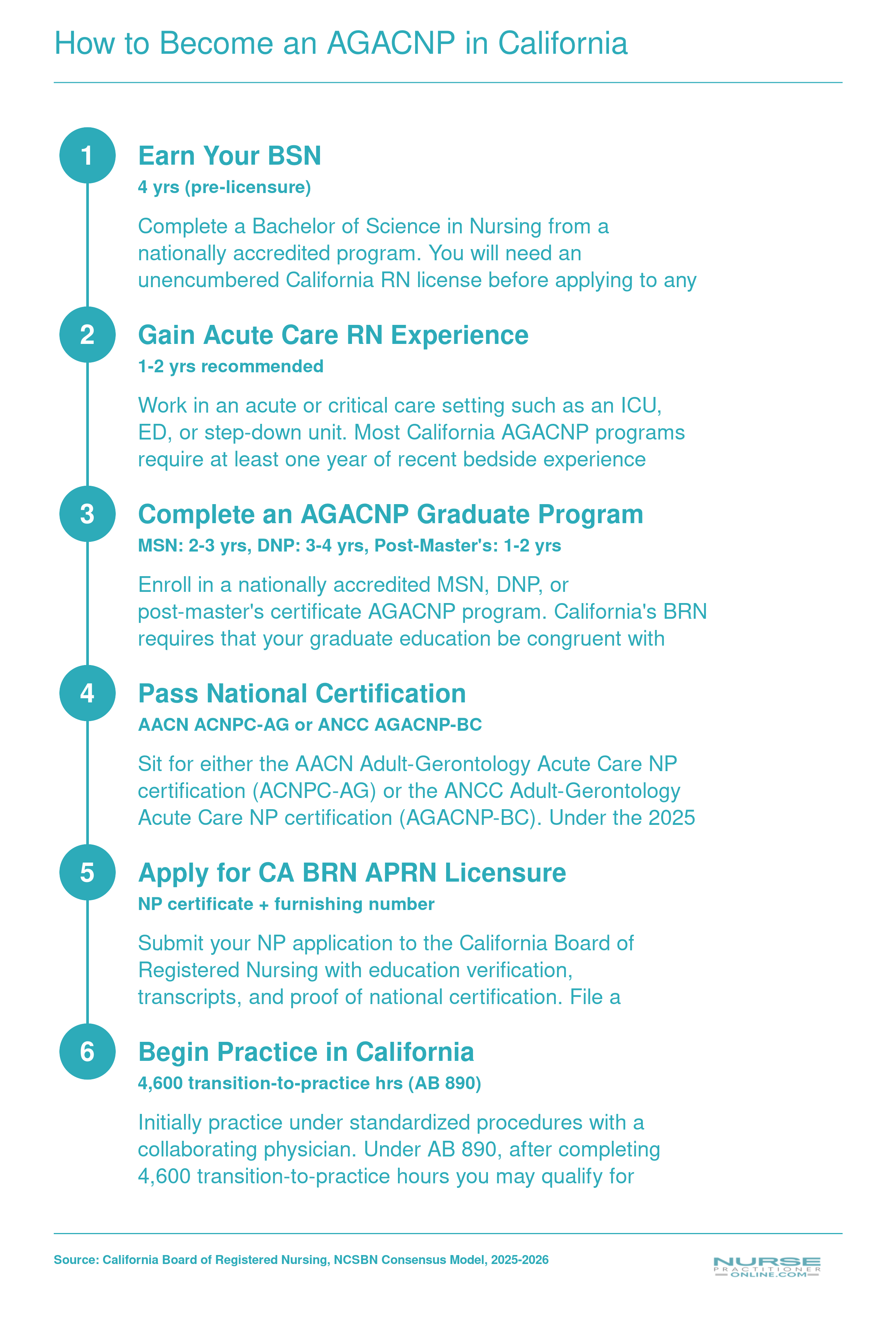
How to Become an AGACNP in California
Becoming an Adult-Gerontology Acute Care Nurse Practitioner in California follows a clear credentialing ladder. Since the California BRN formally adopted the 2025 APRN Consensus Model, your education, national certification, and licensure must all align in role and population focus. Legacy ACNP and PCNP credentials have been retired for new graduates, so you will need AGACNP-specific certification to practice.
AGACNP Admission Requirements at California Schools
Admission to an AGACNP program in California is competitive, but understanding the core requirements makes the process far less intimidating. While each school sets its own criteria, common threads run through most applications: a solid academic record, hands-on acute care nursing experience, and a clear vision for your advanced practice career. Here is what you need to line up before you hit submit.
GPA and Academic Prerequisites
California AGACNP programs typically look for a minimum cumulative GPA of 3.0, though some may set the bar closer to 3.2 for the most competitive tracks.1 Your bachelor's degree in nursing must come from a regionally accredited institution, and official transcripts are non-negotiable. Beyond grades, programs often require specific prerequisite coursework. The two most common are an upper-division statistics course and a graduate-level advanced pathophysiology class. If you completed these more than five years ago, some schools may ask you to retake them to ensure your knowledge is current. If you are weighing a DNP track, reviewing DNP admission requirements ahead of time can help you identify overlapping prerequisites. Plan to check each program's details, as prerequisite policies vary.
RN Experience Requirements
Because the AGACNP role focuses on complex, acutely ill patients, schools place heavy emphasis on bedside experience. Most California programs require one to two years of recent, full-time RN experience in an acute or critical care setting.2 Acceptable units usually include adult or pediatric ICUs, emergency departments, step-down units, and high-acuity medical-surgical floors. UCSF, for example, asks for a minimum of two years, while Samuel Merritt University requires at least one year.3 This experience ensures you arrive with a strong clinical foundation and can handle the fast-paced, high-stakes nature of acute care advanced practice.
GRE and Testing Policies
The GRE is rapidly disappearing from AGACNP admissions in California. All programs in our rankings, including UCLA, UCSF, and Samuel Merritt, have moved to a test-optional or no-GRE-required policy.1 This trend reflects a growing recognition that clinical experience and academic performance predict success better than standardized exams. You should still confirm the current testing policy for each school you are targeting, but you can generally focus your energy on strengthening other parts of your application.
Application Deadlines and Timeline
Timing matters. Most California AGACNP programs admit for a fall start, with application deadlines clustered between December and March of the preceding year. For instance, UCLA's deadline for the fall cohort was December 1 of the prior year.4 You will want to begin gathering materials (transcripts, letters of recommendation, personal statements) at least six months before your chosen deadline. Some schools offer spring or summer entry, but these are less common, so plan for a fall cycle unless you have verified otherwise.
Post-Master's Certificate Options
If you are already a certified NP in another population focus and want to add adult-gerontology acute care privileges, a post-master's AGACNP certificate can be a streamlined path. Several California schools offer this option, including Samuel Merritt University, CSU Los Angeles, and West Coast University.2 These programs build on your existing graduate education and typically require fewer credits than a full MSN or DNP. Keep in mind that not every school provides this route: UCLA, UCSF, and USC currently do not offer post-master's AGACNP certificates, so you will need to look beyond those if a certificate is your goal.4
A Note on Variability
Admission requirements can shift, and details like prerequisite expiration policies, minimum experience hours, or available start terms often change between cycles. Always reach out to the program coordinator or review the most current graduate handbook for the schools you are considering. An informal conversation with an admissions advisor can also clarify whether your specific clinical background meets their acute care experience criteria. Taking these extra steps helps you submit the strongest possible application without avoidable delays.
Questions to Ask Yourself
Online vs. Hybrid AGACNP Program Formats in California
Not all AGACNP programs in California deliver coursework the same way, and picking the right format can make or break your ability to balance work, family, and school. Here is a side-by-side look at the three delivery models you will encounter when researching California AGACNP programs in 2026. Understanding these differences is especially important because few resources clearly distinguish formats for this specialty.
| Comparison Attribute | Fully Online (with On-Site Intensives) | Hybrid with Regular Campus Days | Traditional Campus-Based |
|---|---|---|---|
| Didactic Delivery | 100% online lectures, discussions, and coursework completed on your own schedule through a learning management system | Most didactic content delivered online, supplemented by scheduled in-person sessions each term or quarter | All or nearly all coursework delivered face to face in a classroom setting on a fixed weekly schedule |
| Campus Visits Required | Minimal: typically two mandatory on-site intensive weekends over the entire program (e.g., West Coast University's MSN AGACNP) | Moderate: expect multiple on-campus meetings per quarter plus periodic skills labs (e.g., Loma Linda University requires at least four on-campus sessions per quarter; UCSF schedules required campus days each term) | Ongoing: students attend campus on a regular weekly basis throughout the program (e.g., UCLA's in-person AGACNP track) |
| Clinical Placement Model | Students generally arrange their own precepted clinical sites, though some programs offer clinical placement support (West Coast University provides placement assistance) | Clinical sites may be coordinated through the school's hospital and health system partnerships, with students supplementing as needed | Clinical rotations are typically embedded in the university's affiliated medical centers and teaching hospitals |
| Flexibility for Working RNs | Highest flexibility: asynchronous coursework and 8-week terms let you maintain a full-time or part-time nursing schedule; accelerated (roughly 20 months) and working-professional (roughly 32 months) pacing options available | Moderate flexibility: online didactics reduce commute time, but recurring in-person days require schedule adjustments; programs often span 3 to 4 years at a part-time pace | Lowest flexibility: fixed class times and frequent campus presence make it difficult to work full-time bedside shifts; best suited for nurses who can reduce clinical hours or take a leave |
| California Program Examples | West Coast University MSN AGACNP (online, CCNE accredited, 50 credits); Rockhurst University's online AGACNP is also available to California residents as an out-of-state option | Loma Linda University DNP AGACNP (hybrid/hyperflex, 56 credits, 4-year plan); UCSF AGACNP DNP (hybrid, the only AGACNP program in Northern California) | UCLA AGACNP (in-person delivery with ongoing campus attendance); note that Samuel Merritt and Azusa Pacific do not currently offer an AGACNP track |
Securing AGACNP Clinical Placements in California
Clinical placements represent one of the most challenging aspects of completing an AGACNP program in California. Unlike primary care tracks where outpatient clinics offer more flexibility, acute care rotations require access to hospital ICUs, emergency departments, and specialty units where preceptor availability is limited and competition among students is fierce.
Understanding Clinical Hour Requirements
Most AGACNP programs require between 500 and 750 direct patient care hours in acute and critical care settings. These hours must be completed under the supervision of a board-certified acute care nurse practitioner or physician working in eligible environments such as medical or surgical ICUs, cardiac care units, trauma centers, or step-down units. Some programs divide these hours across specialty rotations, while others allow students to concentrate on a particular area of interest. For a broader look at what to expect from the clinical experience, our guide to nurse practitioner student clinical rotations breaks down the process in detail.
The quality of your clinical experiences shapes your readiness for independent practice, so securing strong placements matters as much as meeting the minimum hour requirements.
Program Support Models Vary Significantly
California AGACNP programs typically expect students to find their own preceptors rather than arranging placements on their behalf.1 This self-placement model puts the burden squarely on students to network, cold-call hospitals, and navigate affiliation agreement processes between their school and clinical sites.
Before enrolling, ask each program directly whether they assist with preceptor placement or provide dedicated clinical coordinators. Programs with established hospital partnerships or academic medical center affiliations generally offer smoother placement experiences, though even these may require students to participate actively in the search process.
Regional Competition Shapes Your Options
Preceptor availability in California varies dramatically by region.2 Major metropolitan areas, including Los Angeles, the San Francisco Bay Area, San Diego, Orange County, and Sacramento, are highly competitive markets where multiple nursing schools vie for the same limited pool of acute care preceptors. Students in these regions often spend months securing placements and may need to commute significant distances to reach available sites.
Less saturated areas offer more opportunity. The Central Valley, Inland Empire, and Northern California counties tend to have fewer NP students competing for preceptors, making placement searches somewhat easier for students willing to complete rotations outside major urban centers.2
Resources for Self-Placing Students
If your program requires you to find your own preceptors, several resources can help. The California Association for Nurse Practitioners provides connections and resources for students seeking clinical mentors. CANP also partners with placement services including PreceptorLink, AMOpportunities, and NPHub, which maintain databases of available preceptors and can facilitate introductions.1
Start your preceptor search early, ideally six to nine months before your clinical courses begin. Reach out to NPs and physicians you have worked with professionally, contact hospital education departments directly, and attend local NP organization meetings where you can network with potential mentors.
A Note About Out-of-State Online Programs
Students enrolled in online AGACNP programs based outside California may face additional placement challenges. These programs often have weaker clinical networks within the state, leaving students largely on their own to establish site agreements and find willing preceptors. Before enrolling in an out-of-state program, confirm what clinical support they realistically provide for California residents and whether they have existing affiliation agreements with hospitals in your area.
AGACNP Program Costs and ROI in California
Tuition for California AGACNP programs ranges from roughly $15,500 to $47,800 depending on program length, degree level, and institutional type. Understanding these costs alongside earning potential helps you build a realistic financial plan before committing to an advanced practice program.
Tuition Across California AGACNP Programs
Private institutions dominate the California AGACNP landscape, and their tuition structures vary considerably. California Baptist University's post-master's AGACNP certificate runs approximately $15,562 for the 33-unit program, making it one of the more affordable pathways for nurses who already hold an MSN. West Coast University's MSN AGACNP track costs between $37,990 and $47,780 for the full 50-credit program, with an accelerated 20-month option or a 32-month pace for working professionals.
Public university programs, when available, typically offer lower tuition for California residents, though out-of-state online students should expect rates comparable to private institutions. Always verify current tuition directly with each program, as rates shift annually. If you are comparing costs nationally, our guide to the most affordable nurse practitioner programs can help you benchmark California tuition against the broader market.
Understanding Net Price and Financial Aid
Institution-wide net price figures provide a starting point for estimating costs after financial aid. California Baptist University reports an average net price of $26,285 across all programs, while West Coast University averages $32,879. Keep in mind these figures reflect undergraduate and graduate averages institution-wide, not AGACNP-specific calculations. Contact each program's financial aid office for a personalized estimate that accounts for scholarships, employer tuition assistance, and federal loans available to graduate nursing students.
Hidden Costs to Budget For
Beyond tuition, several expenses add up quickly:
- Clinical placement fees: Some programs charge administrative fees for arranging preceptor sites.
- Malpractice insurance: Required for clinical rotations, typically $100 to $300 annually.
- Certification exams: AACN ACNPC-AG and ANCC AGACNP-BC exams each cost approximately $395.
- California BRN licensure: Application fees for NP furnishing numbers and controlled substance registration add several hundred dollars.
- Background checks and drug screens: Often required before clinical rotations begin.
Building Your ROI Picture
Median graduate debt at California Baptist University sits around $26,063, while West Coast University graduates carry approximately $32,946. Program-level earnings data for these AGACNP tracks are not yet available, but California AGACNPs working in acute care settings typically earn between $140,000 and $175,000 annually, with higher salaries in major metro areas and specialized ICU roles.
At median debt levels under $35,000 and starting salaries well above $140,000, most graduates can expect to recoup their educational investment within one to two years of full-time practice. Employer loan repayment programs, common at large health systems, can accelerate this timeline further. Nurses considering the DNP pathway may also want to explore DNP AGACNP programs to compare longer-term cost and credential benefits. When evaluating programs, weigh total cost against clinical support quality, certification pass rates, and time-to-completion to find the pathway that delivers the strongest return for your career goals.
AGACNP Salary in California
The table below presents statewide wage data for nurse practitioners in California, drawn from occupational employment statistics. These figures reflect the broader NP profession rather than program-specific graduate earnings shown in the school rankings above. Because the Bureau of Labor Statistics does not break out AGACNP salaries as a separate category, these numbers cover all nurse practitioner specialties combined. With over 20,900 NPs employed across the state, California remains one of the highest-paying markets in the country for the profession.
| Occupation | Total Employment in California | 25th Percentile Salary | Median Salary | 75th Percentile Salary |
|---|---|---|---|---|
| Nurse Practitioners | 20,980 | $140,260 | $166,610 | $205,400 |
| Registered Nurses | 326,720 | $119,710 | $140,330 | $172,200 |
| Medical and Health Services Managers | 68,800 | $90,790 | $136,500 | $203,400 |
AGACNP Salary by Metro Area in California
Nurse practitioner salaries in California vary significantly depending on where you practice. The table below breaks down median and mean annual wages across the state's major metro areas. Keep in mind that the highest-paying metros, particularly the Bay Area, also come with steep costs of living. These same high-demand, high-pay metros tend to be the most competitive when it comes to securing AGACNP clinical placements, so it is worth weighing salary potential against the preceptor availability you will encounter during your program.
| Metro Area | Total NP Employment | Median Annual Salary | Mean Annual Salary | 25th Percentile | 75th Percentile |
|---|---|---|---|---|---|
| San Jose, Sunnyvale, Santa Clara | 1,280 | $225,730 | $223,530 | $201,090 | Not reported |
| San Francisco, Oakland, Fremont | 2,960 | $220,330 | $208,480 | $170,370 | $234,120 |
| Sacramento, Roseville, Folsom | 1,200 | $164,520 | $168,790 | $141,660 | $210,340 |
| Bakersfield, Delano | 360 | $165,460 | $168,180 | $147,990 | $182,140 |
| Los Angeles, Long Beach, Anaheim | 6,400 | $164,510 | $165,030 | $140,230 | $184,670 |
| Modesto | 390 | $164,790 | $161,810 | $139,470 | $173,770 |
| Riverside, San Bernardino, Ontario | 1,630 | $162,470 | $162,210 | $135,290 | $194,440 |
| San Diego, Chula Vista, Carlsbad | 2,790 | $162,030 | $159,590 | $130,880 | $181,030 |
| Fresno | 640 | $161,550 | $158,510 | $137,230 | $173,190 |
| Oxnard, Thousand Oaks, Ventura | 270 | $155,440 | $152,140 | $134,580 | $166,190 |
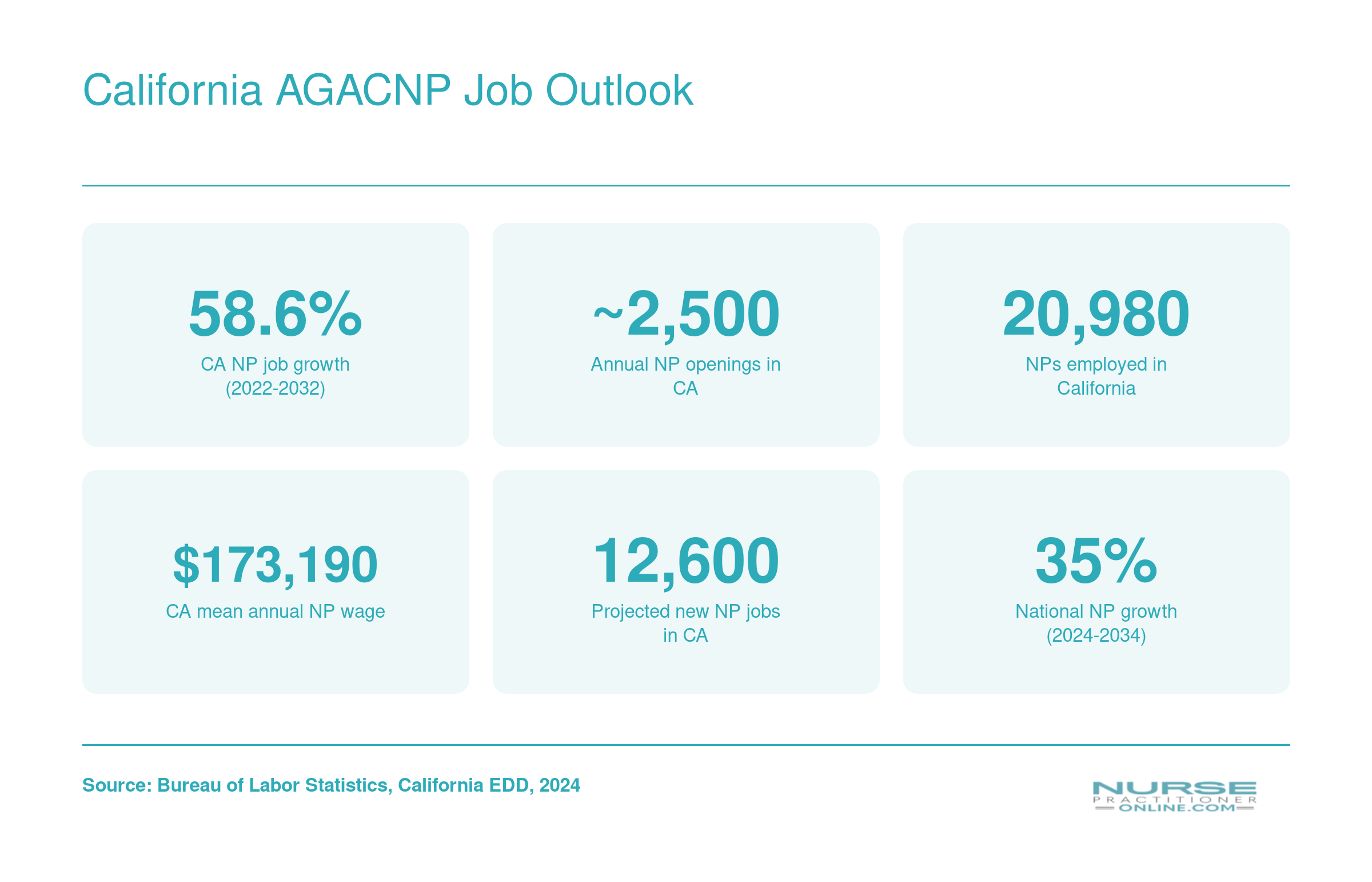
California AGACNP Job Outlook
California's demand for nurse practitioners continues to surge, driven by an aging population, persistent ICU staffing shortages, and evolving CMS supervision rules that expand NP practice authority in acute care settings. The outlook for AGACNPs is especially strong in hospital-based and critical care roles across the state.
Out-of-State Online AGACNP Programs That Accept California Residents
California's decision to remain outside the NC-SARA agreement creates a genuine complication for nurses who want to pursue an online AGACNP program from a school headquartered in another state.
Why California's Non-SARA Status Matters
Most states have joined NC-SARA, a national framework that simplifies how online programs enroll students across state lines. California has not joined, and as of 2025 that has not changed.1 What this means in practice: even if a school participates in NC-SARA, that agreement does not automatically authorize them to place students in California clinical sites.2 Clinical placement authorization is a separate question entirely, and one you need to ask directly before you apply. If you are weighing options outside California, our guide to online NP programs for out-of-state students walks through the verification steps in detail.
The California Board of Registered Nursing also requires that any graduate program you attend be nationally accredited and that you graduate eligible to sit for national certification, such as the AACN ACNPC-AG or the ANCC AGACNP-BC.3 Those baseline requirements apply regardless of where the school is located.
Well-Known Programs Worth Investigating
Several nationally recognized programs are worth contacting if you prefer an out-of-state option. Each of the following participates in NC-SARA for distance education purposes, though you must separately confirm California-specific authorization for clinical placements:4
- University of South Alabama: Offers an AGACNP track and has a history of enrolling students from multiple states.
- Georgetown University: A well-regarded program with strong acute care focus; confirm California clinical placement status directly with their enrollment team.
- Rush University: Known for its clinical rigor; check whether California residents can arrange preceptors locally or must travel.
- Vanderbilt University: Frequently cited for NP program quality; contact their state authorization office for California specifics.
- Duke University: Another strong option with broad program offerings; verify current California authorization before applying.
What to Do Before You Enroll
Verification is not optional here. Contact the program's state authorization office and ask two questions directly: Are you authorized to enroll California residents? And can I complete my clinical hours at a California site? Do not assume NC-SARA participation answers either question, because it does not.
You can search the NC-SARA institution directory to confirm a school's participation status, but treat that as a starting point rather than a final answer for California students.4
A Word on Cost
Out-of-state tuition applies to most of these programs even when the format is fully online. That can push total program costs noticeably higher than what California-based public university programs charge. Before committing to an out-of-state option, run a side-by-side comparison with programs at UC San Francisco or Cal State campuses. The clinical flexibility and name recognition of a national program may be worth the premium for some nurses, but the numbers deserve a close look either way.
Frequently Asked Questions About California AGACNP Programs
Below are answers to the most common questions prospective students ask about Adult-Gerontology Acute Care Nurse Practitioner programs in California. Where possible, each answer draws on data covered earlier in this guide.
- How much does an AGACNP make in California?
- California AGACNPs earn some of the highest salaries in the country. According to recent Bureau of Labor Statistics data, the mean annual wage for nurse practitioners in California is roughly $158,000, with top earners in metro areas such as San Francisco and Los Angeles exceeding $180,000. Acute care specialization in hospital and ICU settings can push compensation even higher, especially with overtime or shift differentials.
- Can you complete an AGACNP program fully online in California?
- Coursework for most AGACNP programs can be completed online, but clinical hours must be done in person. Several California schools and select out-of-state programs offer hybrid formats that let you study from home and complete direct patient care rotations at approved acute care sites near you. Fully online didactics with local clinicals is the most common arrangement for working nurses.
- How long does it take to become an AGACNP in California?
- Timeline depends on degree level and enrollment status. An MSN-level AGACNP program typically takes two to three years of full-time study. A BSN-to-DNP track runs three to four years full time. Post-master's certificate programs for nurses who already hold an MSN usually take 12 to 18 months. Part-time options extend these timelines accordingly.
- Do California AGACNP programs help find clinical preceptors?
- Policies vary by school. Some California programs, particularly those affiliated with large health systems like UCLA or UCSF, coordinate clinical placements for students. Others require you to secure your own preceptors at acute care facilities. Before enrolling, ask each program directly about its placement support, existing hospital partnerships, and any additional fees tied to clinical coordination.
- What is the difference between AGACNP and AGNP?
- AGACNP stands for Adult-Gerontology Acute Care Nurse Practitioner, focused on managing complex, acute, and critical conditions in hospital or inpatient settings. AGNP (Adult-Gerontology Primary Care NP) centers on outpatient, preventive, and chronic disease management. The populations overlap (adolescents through older adults), but the practice settings and certification exams are distinct. Choose AGACNP if you want to work in ICUs, emergency departments, or specialty surgical units.
- How many AGACNP programs are there in California?
- As of 2026, California offers a relatively small number of AGACNP tracks compared to primary care NP options. Roughly six to eight accredited programs at institutions such as UCLA, UCSF, Samuel Merritt University, and others currently admit students at the MSN, DNP, or post-master's certificate level. Availability can shift year to year, so check each school's latest admissions page for current offerings.
- Does California require a furnishing number for AGACNPs to prescribe?
- Yes. California uses the term "furnishing" rather than prescribing for nurse practitioners. To furnish medications, including controlled substances, AGACNPs must obtain a furnishing number from the California Board of Registered Nursing (BRN). This requires completion of a pharmacology course, a standardized procedures agreement with a collaborating physician (for Schedule II drugs), and a valid DEA number for controlled substance authority.
Explore other California related topics
California by Specialty
- AGNP Programs in California
- DNP NP Programs in California
- FNP Programs in California
- PMHNP Programs in California
- PNP Programs in California
- Best Nurse Practitioner Options in Long Beach, CA
- Best Nurse Practitioner Options in Pasadena, CA
- Best Nurse Practitioner Programs in Irvine, CA
- Best Nurse Practitioner Programs in Los Angeles
- Best Nurse Practitioner Programs in San Diego, CA
- Best Nurse Practitioner Programs in San Francisco
- Nurse Practitioner Programs in San Jose, CA
- Best NP Program Options in Anaheim, California