Most important takeaways…
- Rutgers, Seton Hall, and Rowan are the three New Jersey schools currently offering AGACNP pathways at MSN or DNP levels.
- New Jersey's median NP salary reaches $149,620, with hospital and critical care roles often paying above that figure.
- Both MSN and DNP AGACNP tracks lead to the same acute care certification, but DNP programs require significantly more credits.
- The 2025 Consensus Model retired the legacy ACNP credential, making the AGACNP the current standard for acute care practice.
New Jersey's acute care facilities face a growing need for AGACNP-certified providers to manage complex patients from adolescence through older adulthood. The state's NP workforce earns a median $149,620, with hospital-based AGACNPs often exceeding $160,000. MSN, DNP, and post-master's certificate pathways now operate in online or hybrid formats that fit the schedules of practicing RNs. Program costs can swing by tens of thousands of dollars, and the level of clinical placement assistance varies sharply, factors that directly affect return on investment for graduates entering a market where demand for acute care specialization continues to rise.
Top AGACNP Programs in New Jersey: 2026 Rankings
These rankings reflect New Jersey programs offering online or hybrid AGACNP coursework, scored on a composite of graduate tuition, institutional outcomes, and online delivery eligibility. No single factor like cost or speed determines placement. Instead, the composite balances affordability, academic quality, and flexibility so you can compare programs that genuinely fit a working nurse's schedule. Each school below offers a distinct path to AGACNP certification, whether you are starting from a BSN, already hold an MSN, or want to pursue a DNP.
- Graduate tuition and net price
- Institutional graduation and retention rates
- Online or hybrid delivery availability
- Student-to-faculty ratio
- Overall return on investment indicators
- Independent program research
- Internal program database
- NCES-IPEDS federal institutional data — nces.ed.gov
- College Scorecard graduate earnings — collegescorecard.ed.gov

Rutgers University
Rutgers University's School of Nursing in New Brunswick delivers a Post-Master's Certificate in AGACNP through a hybrid format that pairs online didactic work with hands-on clinical rotations at multiple New Jersey campuses. The institution hosting this program has a graduation rate of roughly 84%, one of the highest among NJ schools on this list. With a 16:1 student-to-faculty ratio and strong ties to the state's largest health system, the program positions experienced nurses for specialty certification in acute and critical care.
- Hybrid format: online coursework with in-person clinicals
- Designed for nurses who already hold an MSN or doctoral degree
- Prepares graduates for AGACNP specialty certification exams
- Multiple New Jersey campus locations for clinical experiences
- Focus on evidence-based acute care decision-making
- Advanced training in managing complex adult and geriatric conditions
Post-Master's Certificate in Adult-Gerontology Acute Care Nurse Practitioner — Hybrid

Rutgers University-Newark
Rutgers University, Newark offers a Post-Baccalaureate DNP with an AGACNP concentration, spanning 73 credit hours in a hybrid delivery model. BSN-prepared nurses can choose between four-year or five-year study plans, and rolling admissions with a fall start keep the timeline flexible. The program emphasizes diagnostic and therapeutic interventions for critically ill adult populations, preparing graduates for national board certification through the AACN or ANCC.
- 73 total credit hours in a hybrid online and campus format
- Four-year or five-year completion plans available
- Rolling admissions with priority deadline March 1
- Fall start each academic year, final deadline July 1
- Graduates eligible for national AGACNP board certification
- Curriculum covers acute, critical, and chronic complex illness care
- Emphasis on diagnostic ordering, interpretation, and therapeutic management
Post-Baccalaureate DNP in Adult-Gerontology Acute Care Nurse Practitioner — Hybrid

Rowan University
Rowan University in Glassboro stands out for offering both an MSN and an Advanced Graduate Certificate in AGACNP, each built around 100% online coursework. At $869 per credit, Rowan is among the most affordable options in the state, and multiple start dates (fall, spring, summer) give working nurses genuine scheduling flexibility. The institution hosting these programs has a graduation rate of about 67%, and in-state graduate tuition sits well below most NJ competitors.
- 36 to 53 graduate credits depending on prior coursework
- 100% online coursework with hybrid clinical components
- $869 per credit tuition rate
- Completion in 36 to 60 months at a part-time pace
- Asynchronous courses designed for working professionals
- Includes advanced pharmacology, health assessment, and research
- Prepares graduates for AGACNP certification exams
- 22 graduate credits required for completion
- 100% online didactic coursework
- Approximately 24 months to complete
- Requires an existing MSN degree and active NJ RN license
- Minimum 3.0 GPA for admission
- Fall, spring, and summer start dates available
Master of Science in Nursing: Adult-Gerontology Acute Care Nurse Practitioner — Hybrid
Certificate of Advanced Graduate Study in Adult-Gerontology Acute Care Nurse Practitioner — Hybrid

Saint Peter's University
Saint Peter's University in Jersey City offers a fully online MSN with an Adult-Gerontology NP concentration, requiring 39 credit hours and completable in as few as two years. The Jesuit institution emphasizes small class sizes and personalized faculty mentorship, with a 12:1 student-to-faculty ratio that is the lowest on this list. The program includes 600 clinical practice hours and is CCNE accredited, and Saint Peter's specifically highlights New Jersey's strong NP job market when recruiting prospective students.
- Fully online program format for maximum flexibility
- 39 credit hours with completion in approximately two years
- 600 required clinical practice hours
- CCNE accredited with small cohort sizes
- 12:1 student-to-faculty ratio supports individualized mentorship
- State-of-the-art simulation labs supplement clinical training
- Designed to prepare graduates for AGACNP certification and doctoral study
Master of Science in Nursing, Adult-Gerontology Nurse Practitioner — Online

Seton Hall University
Seton Hall University in South Orange provides both an online MSN in AGACNP and a Post-Master's Certificate, making it a versatile choice for nurses at different stages of their careers. The MSN track requires 48 credits and 675 clinical hours, and the program reports a 95% certification exam pass rate. A gap analysis determines how many of the 18 to 39 Post-Master's credits each certificate student needs. The institution hosting these programs has a graduation rate of about 70%, and it is CCNE accredited.
- 48-credit fully online MSN program
- 675 total clinical hours across multiple specialty settings
- 95% certification exam pass rate reported by the program
- One year of acute care nursing experience required for admission
- CCNE accredited and prepares for ANCC and AACN certification exams
- Flexible online coursework built for working nurses
- 18 to 39 credits based on individualized gap analysis
- Fully online didactic coursework
- Includes both didactic and clinical course components
- CCNE accredited program
- Designed for nurses who already hold a master's degree
- Prepares graduates for AGACNP specialty certification
Master of Science in Nursing, Adult-Gerontology Acute Care Nurse Practitioner — Online
Post-Master's Certificate in Adult-Gerontology Acute Care Nurse Practitioner — Online
NJ AGACNP Programs at a Glance: Credits, Tuition, and Format
The table below compares every AGACNP pathway currently offered in New Jersey, including DNP, MSN, and post-master's certificate options. Credit totals and estimated completion timelines come from each school's published program pages for the 2025-2026 catalog year, while tuition figures reflect institutional rates reported to federal databases. Because graduate nursing tuition is often charged per credit hour and may differ from the university-wide rates shown here, contact each program directly for a personalized cost estimate.
| School | City | Degree Level | Total Credits | Format | Full-Time Timeline | Part-Time Timeline | In-State Tuition (University-Wide) | Out-of-State Tuition (University-Wide) |
|---|---|---|---|---|---|---|---|---|
| Rutgers University | Newark | DNP | 73 | Hybrid | 4 years | 5 years | $23,221 | $37,669 |
| Rutgers University | New Brunswick | Post-Master's Certificate | Varies by gap analysis | Hybrid | Contact program | Contact program | $23,241 | $37,689 |
| Seton Hall University | South Orange | MSN | 48 | Online | 24 to 30 months | 36 to 48 months | $37,470 | $37,470 |
| Seton Hall University | South Orange | Post-Master's Certificate | 18 to 39 (gap analysis) | Online | Contact program | Contact program | $37,470 | $37,470 |
| Rowan University | Glassboro | Post-Master's Certificate (CAGS) | 22 | Hybrid | 24 months | Contact program | $18,607 | $18,607 |
| Saint Peter's University | Jersey City | MSN | 39 | Online | 2 years | Contact program | $16,035 | $16,035 |
Clinical Practicum Hours and Site Placement for NJ AGACNP Students
Accumulating enough high-quality clinical hours in acute care settings can make or break your AGACNP preparation, yet New Jersey programs vary widely in how much support they provide for securing those placements. Understanding each program's clinical framework and site-placement process will help you gauge whether you'll be searching for preceptors on your own or leaning on an established hospital network.
Minimum Clinical Hours Required by NJ AGACNP Programs
Most New Jersey AGACNP programs require between 500 and 750 supervised clinical hours at the MSN or certificate level, and substantially more if you're completing a DNP pathway. Rutgers structures its post-baccalaureate DNP AGACNP to include 752 direct clinical hours embedded within a larger 1,000-hour experiential requirement that also encompasses simulation, practice immersion, and DNP project work. The Rutgers post-master's certificate, which assumes you already hold an MSN, retains the same 752-hour clinical threshold to meet national certification standards.2 Both the AACN ACNPC-AG and ANCC AGACNP-BC certifications mandate a minimum number of supervised hours in acute care environments, so every Commission on Collegiate Nursing Education-accredited program in New Jersey must design its curriculum to meet or exceed those thresholds.
Acute Care Settings: Where You'll Train
AGACNP clinical hours unfold in environments very different from primary care clinics. Expect rotations in intensive care units, cardiac care and cardiothoracic step-down units, trauma services, emergency departments, and progressive care floors. You'll work with adolescent, adult, and older adult patients experiencing acute exacerbations of chronic illness, post-surgical complications, sepsis, respiratory failure, and other high-acuity conditions. Unlike family or adult-gerontology primary care nurse practitioner student clinical rotations, AGACNP learners gain competency in invasive procedures, ventilator management, vasoactive drips, and rapid clinical decision-making under time pressure. Programs typically require rotations across multiple specialties to ensure breadth of experience before graduation.
How NJ Schools Handle Clinical Site Placement
Rutgers leverages its Rutgers Health network, which includes Robert Wood Johnson University Hospital, University Hospital in Newark, and affiliated community hospitals across central and northern New Jersey.3 While the school's published curriculum materials do not explicitly describe a clinical placement assistance office, Rutgers Health's extensive hospital partnerships offer students access to a wide array of acute care sites. Students should confirm during admissions whether the program assigns preceptors directly or expects learners to identify and secure their own placements in consultation with faculty. Programs that maintain dedicated clinical coordination staff and formalized affiliation agreements tend to reduce placement stress, especially in competitive urban markets where multiple schools draw on the same pool of advanced practice preceptors.
Questions to Ask Yourself
MSN vs DNP AGACNP Pathways: Which Degree Fits Your Career Goals?
Master's-level entry versus doctoral preparation represents the central fork in the road for nurses pursuing AGACNP certification in New Jersey. Both pathways lead to the same acute care credentials, but they differ substantially in time investment, career positioning, and long-term professional scope.
What New Jersey Currently Requires
As of 2026, the New Jersey Board of Nursing licenses AGACNPs who hold either an MSN or a DNP from an accredited nursing program. There is no state mandate requiring the doctorate for initial licensure or practice authority. Working nurses can earn their AGACNP certification through a master's track, pass the AACN ACNPC-AG or ANCC AGACNP-BC exam, and begin practicing in critical care settings across the state without pursuing additional education.
That said, the regulatory landscape continues to evolve. The AACN has long endorsed the DNP as the preferred entry-to-practice degree for advanced practice nurses. While this recommendation has not translated into a New Jersey licensing requirement, many health systems and academic medical centers now favor DNP-prepared candidates for leadership roles. Staying current on any rule changes means checking the NJ Board of Nursing's Advanced Practice Nurse pages periodically or following updates from organizations like AANP and NONPF.
Comparing the Two Tracks
- MSN pathway: Typically 40 to 50 credits and two to three years of part-time study. This route gets you into practice faster and costs less overall. It works well if your primary goal is bedside acute care or ICU-based clinical work.
- DNP pathway: Usually 70 to 80 credits and three to four years, including a scholarly project. The added coursework covers health policy, systems leadership, quality improvement, and evidence translation. DNP preparation positions you for roles in hospital administration, faculty appointments, or executive-level clinical practice.
Making the Decision
If you plan to spend your career delivering direct patient care in New Jersey's acute settings, the MSN provides everything you need for licensure and certification. If you anticipate moving into education, policy, or organizational leadership, reviewing DNP prerequisites early can help you plan a BSN-to-DNP pathway that saves time over completing two separate degrees. You can also explore AGACNP online programs at the national level to compare curricula and clinical-hour structures with what New Jersey schools offer, then align your choice with your five- and ten-year career vision.
Frequently Asked Questions About AGACNP Programs in NJ
Choosing the right AGACNP program in New Jersey means sorting through details on timelines, costs, clinical requirements, and credentials. Below are answers to the questions working nurses ask most often when exploring adult-gerontology acute care nurse practitioner education in the Garden State.
- How much do AGACNPs make in New Jersey?
- New Jersey AGACNPs typically earn competitive salaries that reflect the state's high cost of living and strong demand for acute care providers. While program-level earnings data specific to NJ AGACNP graduates are not yet widely published, national nurse practitioner salary surveys consistently place acute care NPs among the highest-paid NP specialties. Compensation varies by employer, metro area, and years of experience, so researching local hospital systems is a smart move.
- How long does it take to complete an AGACNP program in New Jersey?
- Most MSN AGACNP programs in New Jersey take about two to three years of full-time study, though part-time options can extend that to three or four years. DNP AGACNP tracks generally require three to four years, depending on whether you enter with a BSN or already hold an MSN. Post-master's certificate pathways are typically shorter, often around 18 to 24 months, making them a practical choice for nurses who already have an advanced degree.
- What are the clinical hour requirements for AGACNP programs in NJ?
- AGACNP programs in New Jersey generally require a minimum of 500 direct patient care clinical hours at the MSN level, consistent with national accreditation standards. DNP programs often exceed that threshold, sometimes requiring 1,000 or more total practice hours across the curriculum. These hours must be completed in acute care settings such as ICUs, emergency departments, or specialty inpatient units, so confirm each school's placement support before enrolling.
- What is the difference between AGACNP and AGPCNP?
- AGACNP (Adult-Gerontology Acute Care Nurse Practitioner) focuses on managing complex, unstable, and critically ill patients in hospital-based settings. AGPCNP (Adult-Gerontology Primary Care Nurse Practitioner) centers on wellness, chronic disease management, and outpatient care. The two roles serve different patient populations and practice environments, so the certification exams, clinical training sites, and scope of practice are distinct. Choosing between them depends on whether you see your future in inpatient or outpatient care.
- Which NJ schools offer online AGACNP programs?
- Seton Hall University is one of the most recognized NJ schools offering an online MSN Adult-Gerontology Acute Care NP program, with coursework delivered largely online and clinical hours arranged in local acute care facilities. Rutgers University and Rowan University also offer AGACNP pathways, though format details vary by cohort. Always verify each school's current delivery model, because clinical rotations will still require in-person attendance regardless of online coursework.
- Is a DNP required to practice as an AGACNP in New Jersey?
- No. New Jersey does not currently require a DNP to practice as an AGACNP. An MSN with the appropriate national certification (ANCC AGACNP-BC or AACN ACNPC-AG) meets the state's licensure requirements. That said, some employers and health systems prefer or incentivize doctoral preparation, and the profession has been moving toward the DNP as a recommended entry-level degree. Earning the DNP can open doors to leadership and faculty roles.
- What happened to the legacy ACNP and PCNP certifications after the 2025 consensus model update?
- The 2025 APRN Consensus Model update retired the legacy ACNP and PCNP credentials for new graduates. Nurses seeking acute care NP certification now sit for the AGACNP-BC exam through ANCC or the ACNPC-AG exam through AACN. Practitioners who already hold a legacy credential may continue practicing under existing licensure rules, but new applicants must pursue the updated certification pathways that align with the adult-gerontology population focus.
- What AGACNP certification exam pass rates do NJ schools report?
- Seton Hall University publicly reports strong pass rates: 96% on the ANCC AGACNP-BC exam and 100% on the AACN ACNPC-AG exam. For context, the national ANCC AGACNP-BC pass rate was approximately 80% in 2025, and the AACN ACNPC-AG national pass rate was roughly 75% in 2024. Not all NJ schools publish program-specific pass rate data, so contacting admissions offices directly is the best way to obtain the latest figures for schools like Rutgers, Rowan, or Saint Peter's.
Admission Requirements and What Makes NJ AGACNP Applicants Competitive
New Jersey AGACNP programs share a core set of admission requirements, but each school adds its own wrinkles. Below is a consolidated checklist drawn from Rutgers, Seton Hall, and Rowan, along with notes on what separates competitive applicants from those who merely meet the minimums.
- Cumulative GPAMost NJ programs expect a minimum 3.0 on a 4.0 scale, with some setting the bar at 3.2 for the nursing major. Competitive applicants typically present a 3.4 or higher, especially in upper-level clinical and science coursework.
- Active, Unencumbered RN LicenseYou will need a current New Jersey RN license (or eligibility for one) with no disciplinary actions. This is non-negotiable across every program in the state.
- Acute Care RN ExperienceSeton Hall requires a minimum of one year of acute care bedside experience. Other programs generally expect similar experience in settings such as ICU, ED, progressive care, or step-down units. Two or more years of direct acute care nursing strengthens any application significantly.
- Prerequisite CourseworkExpect to have completed undergraduate or graduate-level courses in health assessment foundations, statistics, and pathophysiology. Requirements vary by school and degree level, Rowan's post-master's certificate, for example, assumes you already hold an MSN or higher graduate nursing degree with these courses completed. New Jersey also requires at least three graduate credits (or 45 integrated hours) of pharmacology for APN certification, so plan accordingly.
- Application MaterialsStandard components include a polished personal statement explaining your interest in the AGACNP role, two to three professional references (ideally from supervisors or faculty who can speak to your clinical skills), and a detailed resume or CV highlighting acute care clinical experience, unit types, and patient populations served.
- Certifications and InterviewsWhile not universally required, holding a specialty certification such as CCRN is looked upon favorably and may give you an edge in competitive admission cycles. Some programs also conduct interviews or require a supplemental essay, so check each school's admissions page for the latest cycle details.
- Competitive vs. Minimum ProfilesMeeting minimum requirements gets your file reviewed; it does not guarantee a seat. The strongest applicants pair a solid GPA with multiple years in high-acuity settings, a clear and specific personal statement tied to acute care goals, and strong references who can vouch for clinical judgment. Leadership roles, quality-improvement projects, or published work add further distinction.
- Application Deadlines to WatchTimelines differ across NJ schools. Rutgers lists a March 1 priority deadline and a July 1 final deadline for fall admission. Seton Hall accepts applications through August 1 for fall and December 15 for spring starts. Applying early is always advisable, seats and clinical placements can fill well before final deadlines.
AGACNP Salary and Job Outlook in New Jersey
New Jersey is one of the highest-paying states for nurse practitioners, with a median annual salary of $149,620 according to the latest Bureau of Labor Statistics data. For AGACNPs working in hospital and critical care settings, compensation frequently lands in the upper salary percentiles thanks to specialty premiums, shift differentials, and the complexity of acute care patient populations. It is also worth noting that New Jersey's practice landscape shifted significantly in March 2026, when Governor Sherrill signed S2996/A4052 into law. This legislation grants conditional full practice authority to experienced APNs in primary and behavioral healthcare who have completed at least 5,000 supervised clinical hours. While AGACNPs practicing in acute care settings still operate under a joint protocol with a collaborating physician, the broader expansion of APN independence signals a positive trajectory for NP autonomy and earning potential across the state.
| Role | Total Employment in NJ | 25th Percentile Salary | Median Salary | 75th Percentile Salary | Mean Salary |
|---|---|---|---|---|---|
| Nurse Practitioners | 9,590 | $126,030 | $149,620 | $162,250 | $140,470 |
| Registered Nurses | 95,150 | $96,110 | $102,730 | $123,130 | $106,990 |
| Medical and Health Services Managers | 16,070 | $106,280 | $132,250 | $174,330 | $169,520 |
AGACNP Pay Across New Jersey Metro Areas
Salaries for nurse practitioners vary across New Jersey's metro areas, shaped by factors like cost of living, hospital density, and local demand for acute care specialists. If you are weighing clinical placement sites or planning where to launch your AGACNP career after graduation, these figures offer a practical starting point. The data below reflects all nurse practitioners in each metro area; AGACNP salaries in hospital and ICU settings may trend higher within these ranges.
| Metro Area | Total NP Employment | 25th Percentile Salary | Median Salary | Mean Salary | 75th Percentile Salary |
|---|---|---|---|---|---|
| Trenton-Princeton, NJ | 450 | $124,110 | $142,200 | $143,980 | $159,210 |
| Atlantic City-Hammonton, NJ | 360 | $126,380 | $137,870 | $138,460 | $154,800 |
| Vineland, NJ | 100 | $129,100 | $135,640 | $140,450 | $161,780 |
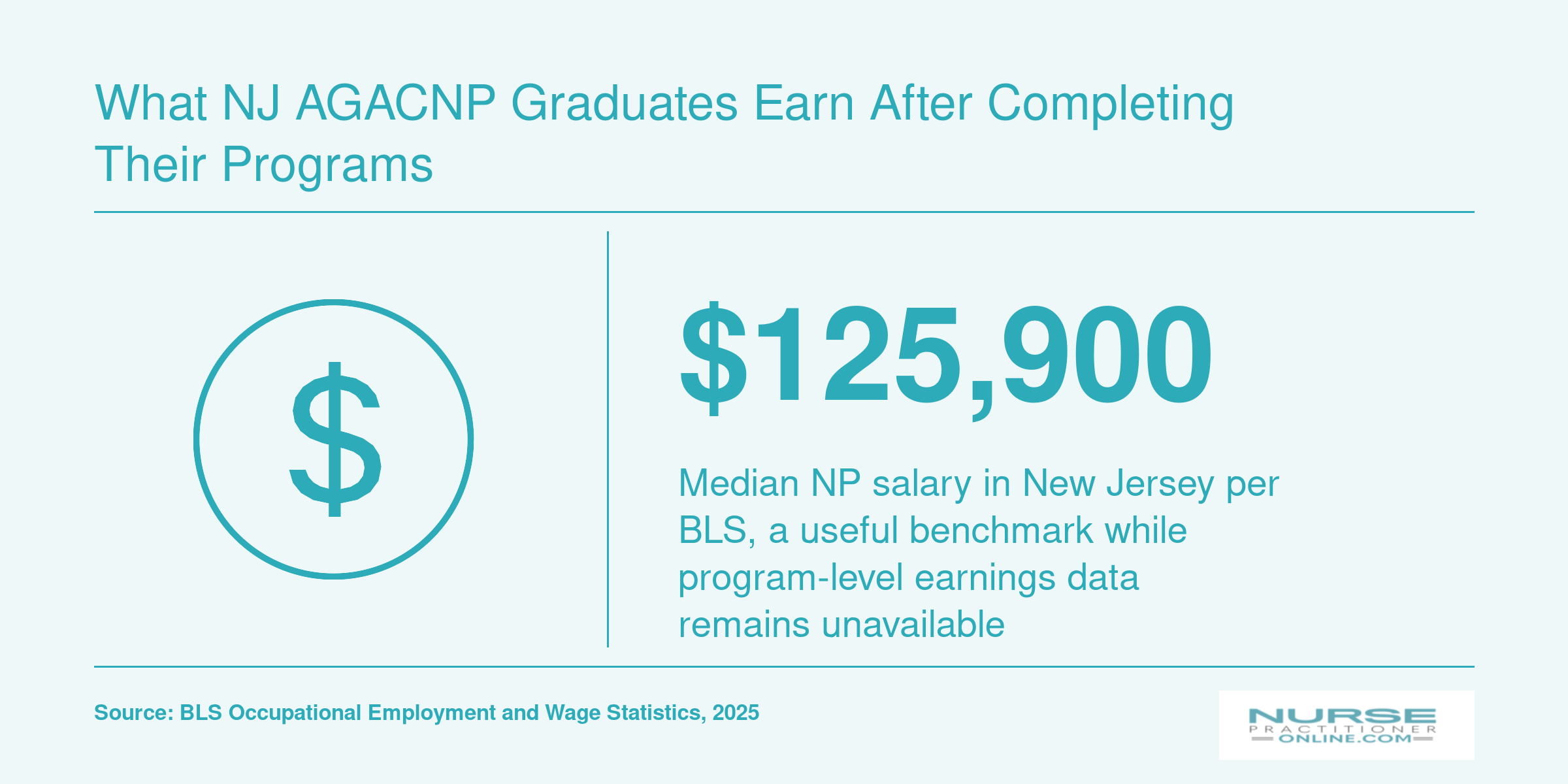
What NJ AGACNP Graduates Earn After Completing Their Programs
Program-level median earnings for New Jersey AGACNP graduates are not yet reported in the federal data we use to build these rankings. Because AGACNP is a specialized post-licensure track, federal reporting lags behind broader nursing categories. Once program-level graduate earnings are published, we will update this section with a full visual comparison across NJ schools.
Choosing the Right AGACNP Program: A Decision Framework for Working Nurses
Selecting between a part-time online program and a full-time campus-based track is just the beginning. Finding the right AGACNP program in New Jersey requires balancing accreditation standards, clinical logistics, and the realities of managing work, family, and study. Working nurses who rush the decision often discover mid-program that schedule conflicts or weak clinical placement support derail their momentum.
Accreditation: Verify AGACNP-Specific Recognition
General program accreditation (ACEN vs CCNE for the overall school of nursing) is baseline. What matters more is whether the AGACNP track itself meets national consensus model standards and prepares you for AACN ACNPC-AG or ANCC AGACNP-BC certification. Not every NP program carries specialty-specific approval, so confirm with the registrar that the AGACNP curriculum is recognized for acute-care certification. Programs that blend tracks or offer generic NP preparation may leave you ineligible for the AGACNP certification exams you need.
Schedule Flexibility and Cohort Structure
Most New Jersey AGACNP students maintain at least part-time clinical work. Ask whether the program runs asynchronous coursework or requires synchronous weekend intensives. Smaller cohorts (12 to 20 students) often mean closer faculty mentorship and easier scheduling of clinical rotations, while larger cohorts may offer more peer networking but less individual attention. Faculty ratios below 1:15 typically signal stronger support during practicum placements. If you are weighing the format question broadly, our comparison of online vs on-campus NP programs breaks down the practical tradeoffs.
Certification Pass Rates and Exam Preparation
Certification pass rates give you a window into program quality. As the FAQ section details, New Jersey programs with first-time pass rates above 90 percent typically embed exam review courses, AGACNP-specific case simulations, and mock certification testing into the final semester. Programs that publish transparent pass-rate data year over year show accountability; those that do not often hide weak outcomes.
Clinical Placement Logistics
AGACNP programs require 500 to 700 supervised acute-care clinical hours across ICU, step-down, emergency, and specialty inpatient units. Confirm whether the school secures sites or expects you to self-place. Self-placement saves tuition but adds administrative burden. Asking about preceptor networks in northern versus southern New Jersey helps you gauge geographic feasibility. Nurses who are also considering programs across the Hudson River may want to compare the best AGACNP programs in New York for additional clinical site options.
Take the Next Step
Contact program coordinators at two or three New Jersey schools this week. Ask about the next cohort start date, clinical site availability in your region, and how many students successfully completed clinical hours on schedule last year. Those answers will tell you whether a program fits your real life or just looks good on paper.