
Most important takeaways…
- Dallas-area DNP-FNP programs require a minimum of 1,000 supervised clinical hours, roughly double the master's NP threshold.
- Public Texas universities offer annual DNP tuition under $11,000, while private programs can cost several times more.
- Most Texas DNP-FNP admissions no longer require GRE scores, favoring clinical experience and interviews instead.
- The AANP and ANCC FNP certification exams posted first-time pass rates near 81% and 82% nationally for 2025.
The Dallas-Fort Worth metro added more than 170,000 residents between 2023 and 2025, intensifying a primary-care provider shortage that Health Resources and Services Administration projections already flagged as among the most acute in the Sun Belt. Doctorally prepared family nurse practitioners are a direct answer to that gap, and the credential carries measurable wage and scope advantages over a master's-level FNP in Texas's supervised-practice environment.
Online DNP-FNP programs now make it possible for bedside nurses across the Metroplex to pursue that terminal degree without pausing a career or uprooting a family. The real challenge is sorting programs that differ widely in cost, clinical-placement support, and certification outcomes, all while balancing shift schedules and personal obligations. For nurses weighing a BSN-to-DNP track against a post-master's route, the financial and timeline differences are substantial enough to reshape the entire return on investment.
2026 Best Online DNP-FNP Programs Near Dallas, TX
We evaluated online-eligible DNP-FNP programs accessible to Dallas-area nurses using a composite that weights online-delivery readiness alongside graduate outcomes, institutional graduation rates, and net price. The ten programs below span public health science centers, private research universities, and Fort Worth institutions just minutes from the Metroplex. Whether you're looking for the lowest tuition in the state, a dual-certification track, or an embedded nurse coaching curriculum, this list has an option that fits your schedule and career goals.
- Online delivery readiness
- Graduate earnings outcomes
- Institutional graduation rates
- Net price and affordability
- Program clinical depth
- College Scorecard graduate earnings — collegescorecard.ed.gov
- Independent program research
- Internal program database
- NCES-IPEDS federal institutional data — nces.ed.gov

The University of Texas Health Science Center at Houston
UTHealth Houston's Cizik School of Nursing consistently ranks among the best FNP programs in the country, landing at No. 12 nationally according to U.S. News. The BSN-to-DNP pathway blends online coursework with on-campus labs and simulations, and students benefit from clinical placements inside the Texas Medical Center, the world's largest medical complex. A 96% first-time certification pass rate and 25 HRSA-funded traineeships each year underscore the program's clinical rigor and financial support.
- CCNE accredited hybrid format with online coursework
- 79 credit hours completed over 10 semesters
- 1,140 clinical hours, many in the Texas Medical Center
- 96% first-time licensure pass rate
- Spring and fall start dates with full or part-time options
- 25 HRSA-funded traineeships awarded annually
- Academic success coach assigned from enrollment to graduation
- Optional Emergency Nurse Practitioner certificate add-on
BSN to DNP Family Nurse Practitioner — Hybrid

The University of Texas Medical Branch at Galveston
UTMB's School of Nursing offers one of the most flexible DNP-FNP tracks in the state, requiring only one campus visit per semester while delivering the rest of the curriculum online. Small class sizes and nationally recognized faculty create an intimate learning environment rarely found at a major research institution. UTMB also stands apart as the only Texas program offering a dual FNP and Adult Gerontology Acute Care NP track for nurses who want to practice across both primary and acute care settings.
- CCNE accredited, 75 credit hours over 12 semesters
- Part-time format with one campus visit per semester
- 1,020 clinical hours with a scholarly capstone project
- Prepares for ANCC or AANP certification
- Small cohort sizes with personalized faculty advising
- Up to 12 transfer credit hours accepted
- Only dual FNP-AGACNP track offered in Texas
- 87 credit hours over 13 semesters
- 1,380 clinical hours spanning primary and acute settings
- Prepares for ANCC, AANP, and AACN certification
- No entrance exam required for admission
- ICU or acute care experience highly preferred
BSN to DNP Family Nurse Practitioner — On-Campus
BSN to DNP Dual FNP and Adult Gerontology Acute Care NP — On-Campus

Texas Tech University Health Sciences Center
Texas Tech University Health Sciences Center delivers a direct BSN-to-DNP pathway from its Lubbock campus, combining online coursework with face-to-face sessions and supervised clinicals. The curriculum aligns with both AACN Essentials and NONPF criteria, and the program's in-state tuition is among the lowest on this list. Admission requires a minimum of two years of RN experience and includes a faculty interview, reflecting a selective, mentor-driven approach.
- Hybrid format with online and on-campus components
- In-state tuition roughly $7,153 per year
- Meets AACN Essentials and NONPF standards
- Requires two years of RN clinical experience
- One start date per year, summer admission only
- Faculty interview and critical analysis essay required
- Prepares graduates for national FNP certification
BSN to DNP Family Nurse Practitioner — Hybrid

University of Houston
The University of Houston's post-master's DNP with an FNP concentration is designed specifically for nurses who already hold an MSN and want doctoral-level leadership skills. The hybrid format requires just two face-to-face days per term on the Houston campus, making it workable for DFW commuters. Students complete a minimum of 1,000 total clinical hours (585 beyond the MSN) and produce both a DNP project and a professional portfolio.
- CCNE accredited, 8 semesters part-time
- Hybrid: two face-to-face days per term on campus
- 585 additional clinical hours beyond the MSN
- Minimum 1,000 total clinical hours required
- DNP project and professional portfolio required
- Focus on evidence-based practice and quality improvement
- In-state tuition approximately $10,051 per year
Post-Master's DNP Family Nurse Practitioner — On-Campus

The University of Texas Health Science Center at San Antonio
UT Health San Antonio offers a BSN-to-DNP with four concentration tracks, including Family Nurse Practitioner, giving students some of the lowest annual tuition of any program on this list. The CCNE-accredited curriculum emphasizes evidence-based primary care across the lifespan, and the hybrid format mixes online learning with campus components in San Antonio. A 3.0 GPA, one year of clinical RN experience, and three references are required for admission through NursingCAS.
- CCNE accredited with four available concentrations
- In-state tuition approximately $4,648 per year
- Hybrid format with online and on-campus elements
- Requires 3.0 GPA and one year of RN experience
- NursingCAS application with embedded online interview
- Application deadline of April 1 each year
- Prepares for advanced practice licensure in Texas
BSN to DNP Family Nurse Practitioner — On-Campus

Baylor University
Baylor University's Louise Herrington School of Nursing offers a 75-credit online BSN-to-DNP program with a dedicated FNP track built for practicing RNs. The curriculum focuses on delivering culturally sensitive primary care to underserved populations across all age groups. As a private university, Baylor's tuition is higher than the public options on this list, but the institution's 80% graduation rate and strong faith-based mission appeal to nurses seeking a values-centered education.
- 75-credit online program with virtual immersions
- Emphasis on underserved and diverse patient populations
- Comprehensive clinical experiences included
- Graduates eligible for national FNP certification
- Institution-wide graduation rate of 80%
- Median graduate debt of $23,000
- Tuition of $43,578 per year (same for all students)
BSN to DNP Family Nurse Practitioner — Online

Texas Christian University
Located just 30 miles from downtown Dallas, TCU's Harris College of Nursing offers a BSN-to-DNP FNP concentration in a hybrid format that pairs online courses with two on-campus intensive sessions. The program prepares graduates to address the national primary-care provider shortage through health promotion, disease prevention, and interprofessional collaboration. TCU's institution-wide graduation rate of 85.5% is the highest among the programs featured here.
- Hybrid format: online courses plus campus intensives
- Emphasis on health promotion and preventive care
- Interactive online learning platform
- Prepares graduates for clinical leadership positions
- Institution-wide graduation rate of 85.5%
- Median graduate debt of $21,500
- Tuition of $38,658 per year (same for all students)
- Financial aid available for qualifying students
BSN to DNP Family Nurse Practitioner — Hybrid

University of the Incarnate Word
The University of the Incarnate Word offers a three-year, full-time BSN-to-DNP with an FNP concentration rooted in the institution's Mission-driven approach to holistic, patient-centered care. The hybrid format holds on-ground classes one day every other week, with the rest delivered online in both synchronous and asynchronous modes. Close faculty mentorship and a cohort-based structure provide a supportive environment for working nurses in the San Antonio area and beyond.
- Three-year full-time hybrid program
- On-campus classes one day biweekly
- Synchronous and asynchronous online options
- Focus on cultural competence and collaboration
- Close working relationship with dedicated faculty
- Prepares for NP certification exam
- Two concentration options available
BSN to DNP Family Nurse Practitioner — On-Campus

Texas Tech University Health Sciences Center-El Paso
TTUHSC El Paso extends the Texas Tech nursing system into the border region with a BSN-to-DNP FNP track that blends online coursework, on-campus sessions, and supervised clinicals. The program aligns with AACN and NONPF standards and admits only for summer terms, making planning straightforward for working nurses. In-state tuition of about $5,544 per year and a median graduate debt of $12,500 make it one of the most affordable doctoral nursing options in Texas.
- Hybrid format with online and on-campus components
- In-state tuition approximately $5,544 per year
- Median graduate debt of $12,500
- Meets AACN and NONPF national standards
- Requires two years of RN experience and a 3.0 GPA
- Summer-only admission with one start per year
- Prepares graduates for national FNP certification
BSN to DNP Family Nurse Practitioner — Hybrid

Texas Wesleyan University
Texas Wesleyan University, based in Fort Worth just minutes from Dallas, stands out with an embedded nurse coaching curriculum that qualifies graduates for national nurse coach certification alongside their FNP credential. The 86-credit, three-year program also teaches the business side of practice management, from insurance credentialing to running a clinic. With CCNE accreditation, 1,035 clinical hours, and a military-friendly reputation, it is a strong choice for DFW nurses who want to combine clinical practice with entrepreneurial skills.
- CCNE accredited, 86 credit hours over three years
- 1,035 clinical hours with hands-on experiences
- Embedded nurse coaching curriculum and certification
- Business of healthcare taught, including credentialing
- Small class sizes with dedicated faculty mentors
- Online coursework with on-campus skills sessions
- Holistic, patient-centered care philosophy
- Military-friendly program positioning
DNP Family Nurse Practitioner — On-Campus
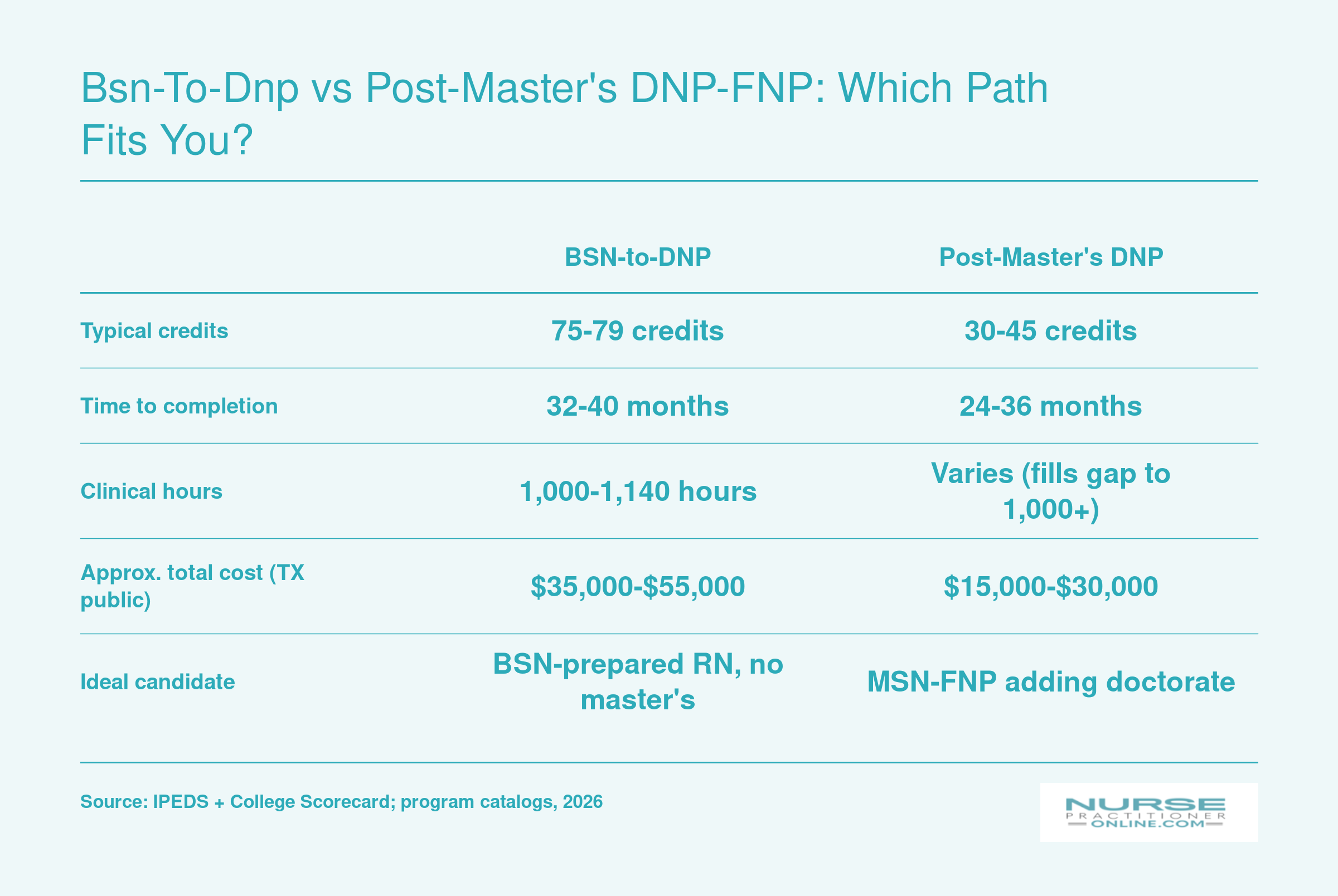
BSN-to-DNP vs Post-Master's DNP-FNP: Which Path Fits You?
Choosing between these two entry routes comes down to where you are in your career right now. The BSN-to-DNP path is designed for nurses who hold a bachelor's degree and want to earn their FNP certification and doctorate in one integrated program. The post-master's DNP is built for current MSN-prepared family nurse practitioners who want to add the doctoral credential without repeating advanced-practice coursework. Program-level earnings data by entry route are not yet available for most Texas schools, so we recommend comparing total investment and time commitment as your primary decision factors.
How Much Does a DNP-FNP Cost in Texas?
Tuition for DNP-FNP programs in Texas varies dramatically depending on whether you attend a public or private university. Public institutions like Texas Tech University and the University of Houston offer in-state annual tuition under $11,000, while private universities can run three to four times that amount. Keep in mind that the average net price figures in the table below reflect institution-wide averages across all students and degree levels, not DNP-specific totals, so treat them as a rough affordability benchmark rather than a precise out-of-pocket quote. To offset costs, most DNP students tap a combination of federal Graduate PLUS or unsubsidized Direct loans, employer tuition reimbursement programs (common among major DFW hospital systems), and competitive scholarships such as the HRSA Nurse Corps Scholarship, which covers tuition and fees in exchange for a service commitment in an underserved community.
| University | Type | Annual Tuition (In-State) | Annual Tuition (Out-of-State) | Approx. Avg. Net Price (All Students) |
|---|---|---|---|---|
| Texas Tech University | Public | $9,518 | $17,918 | $19,070 |
| University of Houston | Public | $10,051 | $19,231 | $14,276 |
| Texas Wesleyan University | Private | $19,499 | $19,499 | $24,066 |
| University of the Incarnate Word | Private | $22,650 | $22,650 | $22,775 |
| Texas Christian University | Private | $38,658 | $38,658 | $36,660 |
| Baylor University | Private | $43,578 | $43,578 | $41,104 |
DNP-FNP Salary and ROI in the Dallas-Fort Worth Metro
Spending three to four years in a doctoral program is a serious investment, and the honest tension every Dallas-area nurse faces is whether the earnings bump justifies the tuition, the hours, and the deferred income. The numbers tell an encouraging story, but they come with some important nuance worth understanding before you enroll.
What NPs Actually Earn in the DFW Metro
According to Bureau of Labor Statistics data, nurse practitioners in the Dallas-Fort Worth-Arlington metro earn a median annual wage in the range of roughly $111,000 to $115,000.1 That figure sits below the Texas statewide mean of approximately $124,660 and below the national median of $121,610, which may surprise nurses who expect a major-metro premium. A few factors explain the gap: the DFW market has a relatively high concentration of NPs compared to rural Texas, and managed-care contracting in large hospital systems can compress starting wages. That said, the metro's sheer volume of health system employers, urgent care networks, and independent practices gives you significant leverage to negotiate, and high performers clearly move well past the median.
For context, the national 10th-percentile NP wage sits at about $87,340, while the 90th-percentile wage reaches roughly $165,240. The spread is wide, which reflects how much specialty, setting, and experience shape your actual paycheck.
Program-Level Earnings Data: A Gap Worth Noting
Ideally, this section would layer in graduate earnings reported directly by the Texas DNP-FNP programs ranked on our site, showing you what graduates of each school earned one, two, and five years after completing their degrees. Unfortunately, program-level earnings outcomes are not yet available for any of the ranked programs in our dataset. Federal disclosure timelines and the graduate health-professional exemption mean many nursing doctoral programs simply do not appear in published graduate earnings reports yet. As that data becomes available, it will be incorporated here. In the meantime, BLS occupational wages for the DFW metro remain the most reliable proxy for what you can expect to earn after certification.
DNP vs. MSN: Does the Doctorate Pay More?
This is one of the most common questions Dallas nurses ask, and the honest answer is that the evidence is mixed. Some surveys and employer salary studies suggest DNP-prepared NPs command a modest premium of roughly $5,000 to $10,000 annually over MSN-prepared peers, particularly in leadership roles, academic positions, and health system settings where the credential carries formal weight. In direct patient-care FNP roles, however, many Texas employers currently use a single NP pay scale regardless of whether the candidate holds a DNP or an MSN. The salary advantage of the DNP tends to be most pronounced when you move into administrative, policy, or faculty tracks, or when a future requirement for doctoral-level entry to practice takes effect.
A Simple ROI Framework
While program-level graduate earnings are not yet published for these specific schools, you can build a rough payback estimate using available data. Texas public DNP-FNP programs in our rankings carry median graduate debt figures ranging from around $12,000 to $15,000, reflecting the affordability of in-state public tuition. Private programs show median debt closer to $21,000 to $27,000.
Set against a DFW metro median NP wage in the $111,000 to $115,000 range, the math looks favorable for graduates carrying modest debt loads:
- Public program graduates: At $12,000 to $15,000 in median debt and a six-figure salary from year one, most graduates reach payback within the first few months of practice, even accounting for living costs and loan interest.
- Private program graduates: At $21,000 to $27,000 in median debt, payback still arrives well within the first year of full-time NP employment for most borrowers.
The bigger financial variable is actually the opportunity cost of the program years rather than the tuition itself. Nurses who step back to part-time status during their DNP are forgoing RN income, and that gap can dwarf the out-of-pocket tuition figure. Programs that allow you to stay employed full-time while completing coursework online tend to deliver the strongest net ROI, which is one reason flexible scheduling and asynchronous delivery matter as much as sticker price when you are comparing programs.
DFW nurse practitioners earn competitive salaries
Clinical Hours, Preceptor Support & On-Campus Requirements
All DNP-FNP programs require extensive supervised clinical practice, with most mandating a minimum of 1,000 cumulative practice hours before degree conferral. How those hours accumulate depends on your entry point: BSN-to-DNP students build the entire 1,000 hours during the doctoral program, while post-master's DNP students enter with 500 to 720 hours already banked from their master's FNP training and complete the remaining 300 to 500 during the DNP residency and project phases. Understanding which bucket you fall into helps you map out how many clinical semesters lie ahead and whether you can juggle placement logistics alongside your current nursing schedule.
Who Finds Your Preceptor?
The answer varies significantly among Texas online DNP-FNP programs. Texas Woman's University, for example, provides clinical placement support for all graduate-level clinical rotations and asks students to complete a placement intake form early in the admissions cycle.1 This proactive approach can relieve much of the anxiety that comes with securing preceptors in a competitive metro. Baylor University, by contrast, operates on a shared-responsibility model: the school maintains a network of clinical partners but expects students to participate actively in identifying and vetting potential sites.2 Other programs ask students to self-source all preceptors, a model that works well if you already practice in a large health system with established NP mentors but can present challenges if you live in a rural county with fewer advanced-practice clinicians.
Urban Advantage, Rural Hustle
Dallas-Fort Worth students typically enjoy an abundance of clinical sites: hospitals, urgent-care clinics, family-medicine offices, and federally qualified health centers dot the metro, making it easier to line up diverse patient populations and specialties. Students in rural Texas face stiffer competition for the same preceptors, especially when multiple online programs draw from the same geographic pool. Starting your search early and being flexible with drive times can open doors that would otherwise stay closed.
On-Campus Immersions That Aren't Really Optional
Even programs marketed as fully online often build in mandatory on-campus intensives. Texas Wesleyan University, for instance, requires students to attend periodic residency weekends for skills validation, simulation sessions, and DNP project consultations.3 These immersions typically cluster at program milestones (orientation, mid-point clinical assessments, and final defense), so plan for travel, lodging, and time away from your bedside shifts. Clarify immersion expectations during your initial admissions conversation; a weekend in Dallas may be easy for you, while a student in El Paso faces a longer trip.
Questions to Ask Yourself
What You Need to Get In: DNP-FNP Admission Benchmarks
Texas DNP-FNP admissions have shifted noticeably over the last few cycles: the GRE has all but disappeared as a requirement, and programs now lean harder on clinical experience, writing samples, and interviews to sort applicants. That trade-off (less standardized testing for more holistic review) means your nursing record and how you tell your story matter more than ever. If you want a broader look at what doctoral nursing programs expect, our guide to DNP prerequisites breaks it down across the country.
The Baseline You Need to Clear
Most Texas DNP-FNP programs publish a similar floor for applicants. Expect to need:
- Accredited nursing degree: A BSN for BSN-to-DNP tracks (Texas Woman's University requires a BSN for its FNP pathway)1 or an MSN for post-master's DNP tracks.
- Minimum GPA: Typically 3.0 on a 4.0 scale. Texas Woman's University, Texas State, and Texas Tech all hold the line at 3.0, while UT Arlington sets a higher 3.5 bar with probationary admission available for applicants in the 3.0 to 3.49 range.2
- Active, unencumbered RN license: Texas licensure (or a multistate compact license valid in Texas) is standard.
- Clinical experience: Usually 1 to 2 years of bedside RN work. Texas State and the BSN-to-DNP tracks commonly cite at least one year,34 and Texas Tech requires documented work experience for its BSN-to-DNP FNP pathway.
- Prerequisite statistics: Nearly every program in this list requires an undergraduate or graduate statistics course, often with a grade of B or better.2
- Application package: A statement of purpose, three letters of recommendation, and a current resume. Some programs add a writing sample, the Casper situational judgment assessment (Texas Woman's University),1 or a faculty interview (Texas Tech).
GRE Status and Selectivity
The GRE is essentially off the table. Texas Woman's University, UT Arlington, Texas State, and the BSN-to-DNP FNP programs reviewed here either waive it or do not require it.1234 Institution-wide admit rates (for example, UT Arlington and University of Houston accept the majority of undergraduate applicants) can make a school look open, but those numbers reflect the whole university, not the graduate nursing school. DNP-FNP cohorts are intentionally small, often 20 to 40 students per intake, because clinical placement capacity is the real bottleneck. Meeting the published minimums gets your file read; strong references, a clear practice focus, and a well-rehearsed interview are what move you onto the admit list.
Accreditation, Licensure & Texas Scope-of-Practice Essentials
For 2025, the national first-time pass rate for the AANP FNP exam was 81%1, while the ANCC FNP exam reported an 82% pass rate2, a narrow margin that underscores the importance of selecting a program with strong certification preparation. In Texas, where nurse practitioners practice under collaborative agreements, passing these exams is just one step in a regulated pathway toward nurse practitioner licensing.
CCNE vs. ACEN Accreditation
When evaluating online DNP-FNP programs, verify that the nursing school holds either CCNE (Commission on Collegiate Nursing Education) or ACEN (Accreditation Commission for Education in Nursing) accreditation. Both are recognized by the U.S. Department of Education and satisfy eligibility requirements for ANCC and AANP certification exams. CCNE typically accredits baccalaureate and higher degree programs, while ACEN may accredit all levels, including diploma and associate programs. For employers and state boards, either accreditation is acceptable, but confirm the specific programmatic accreditation directly through the school's website or the accreditor's public directory.
Certification Exam Pass Rates in Texas
National pass rates offer a benchmark, but individual program performance varies. The ANCC Family Nurse Practitioner (FNP-BC) exam and the AANP FNP certification exam both test clinical knowledge and decision-making. Most Texas DNP-FNP programs publish their annual pass rates on their school websites or in CCNE/ACEN self-study reports. When comparing programs, request the most recent three-year aggregate first-time pass rate. A rate consistently above the national average signals strong curriculum alignment with exam blueprints and effective faculty support.
Texas Practice Authority: What It Means for Your Career
As of 2026, Texas remains a restricted practice state.2 This means DNP-prepared FNPs must maintain a written collaborative agreement with a supervising physician to diagnose, treat, and prescribe medications. Unlike full-practice-authority states where NPs operate independently, Texas regulations tie your scope to a delegating physician. You can compare how other states handle this by reviewing nurse practitioner practice authority by state. The agreement must outline the services the NP will provide and protocols for consultation and referral. While the Texas Legislature has considered bills to expand NP autonomy, no full practice authority has been enacted as of this year.2
Prescriptive Authority and DEA Registration
Prescriptive authority in Texas also requires a collaborative agreement that explicitly lists the categories of drugs the NP may prescribe.2 Controlled substances are restricted: schedules III through V are allowed, but schedule II medications, including most opioid pain medications and stimulants used for ADHD, are limited to specific settings and require additional oversight.2 A DEA registration is mandatory for prescribing controlled substances. These layered requirements directly impact daily practice, as you must ensure each prescription falls within the agreed scope and that the supervising physician is reasonably available for consultation.
Related Articles
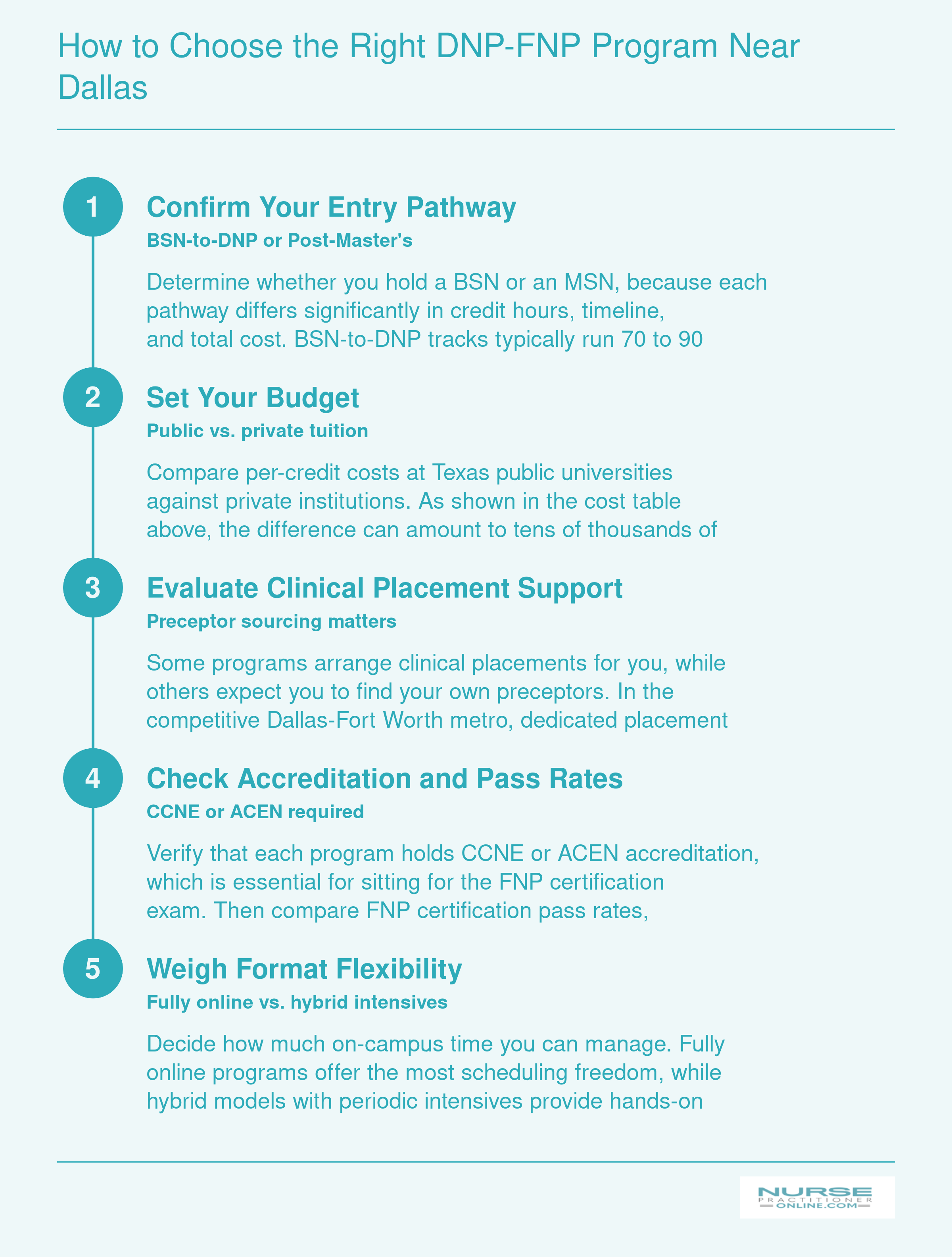
How to Choose the Right DNP-FNP Program Near Dallas
Choosing the right DNP-FNP program means weighing several factors at once: cost, clinical support, accreditation, and how the format fits your life as a working nurse. The five steps below pull together the tuition comparisons, certification outcomes, and format details covered earlier in this article so you can move from research to a confident decision.
Frequently Asked Questions About Online DNP-FNP Programs in Texas
Below are some of the most common questions working nurses ask when exploring online DNP-FNP programs near Dallas. Each answer draws on program, salary, and clinical data covered earlier in this article.
- How much does a DNP-FNP program cost in Texas?
- Total tuition varies widely depending on whether you attend a public or private university and which entry pathway you choose. BSN-to-DNP programs at Texas public schools generally range from roughly $30,000 to $55,000, while private institutions can exceed $80,000. Post-master's DNP tracks are typically shorter and less expensive. Be sure to factor in fees, books, and any on-campus immersion travel costs when comparing programs.
- How many clinical hours are required for a DNP-FNP in Texas?
- Most CCNE- or ACEN-accredited DNP-FNP programs require a minimum of 1,000 supervised clinical hours, which includes both the advanced practice nursing hours and the DNP project practicum. BSN-to-DNP students complete all 1,000 hours during the program, while post-master's students may transfer previously earned clinical hours, reducing their remaining requirement. Schools near Dallas typically help students locate preceptors across the DFW metro area.
- What is the salary for a DNP-prepared family nurse practitioner in Dallas?
- According to federal wage data, nurse practitioners in the Dallas, Fort Worth, and Arlington metro area earn a median annual salary that ranks well above the national NP median. DNP-prepared FNPs often command salaries at the higher end of that range, particularly in specialty clinics, hospital systems, and underserved primary care settings. Exact figures fluctuate with experience, employer, and practice setting.
- Which Texas DNP-FNP programs are fully online?
- Several Texas universities offer DNP-FNP programs with fully online coursework, including options from Texas Woman's University, the University of Texas at Arlington, and Texas A&M University. Keep in mind that while didactic classes are delivered online, every program requires in-person clinical rotations and some include brief on-campus intensives or immersion weekends. Confirm each school's specific on-site requirements before applying.
- What is the difference between a BSN-to-DNP and a post-master's DNP-FNP program?
- A BSN-to-DNP pathway is designed for nurses who hold a Bachelor of Science in Nursing and want to earn their doctoral degree without first completing a separate master's program. It typically takes three to four years. A post-master's DNP track is built for nurses who already hold an MSN or an active APRN certification and usually takes one to two years, focusing on the DNP essentials and a scholarly project rather than foundational APRN coursework.
Texas remains one of the states where nurse practitioners must hold a collaborative agreement with a physician to prescribe medication, a restriction that directly impacts career autonomy and income potential.