Most important takeaways…
- Washington NPs earned a mean annual wage of $152,180 as of 2023, well above the national average.
- Washington grants AGACNPs full practice authority with no physician supervision or collaborative agreement required.
- Only two accredited AGACNP programs currently serve Washington students, both offered in a hybrid format.
- Scholarships, employer tuition benefits, and state loan repayment programs can be combined to reduce out-of-pocket costs.
Which Washington hospitals are hiring AGACNPs, and where can you train for the role?
Washington's Level I trauma centers, including Harborview Medical Center in Seattle and Providence Sacred Heart in Spokane, operate high-volume ICUs and emergency departments that increasingly rely on AGACNPs to manage complex, high-acuity patients around the clock. The specialty is distinct: AGACNPs hold a population-focused credential, either the AACN ACNPC-AG or the ANCC AGACNP-BC, and practice exclusively in acute and critical care settings rather than primary care. If you are still weighing acute care against other tracks, our overview of acute care nurse practitioner programs can help clarify how the AGACNP concentration fits the broader landscape.
The practical tension for most Washington nurses is that in-state AGACNP programs are limited. Most students enroll in CCNE-accredited online programs headquartered elsewhere, then complete clinical hours at Washington facilities. The 2025 APRN Consensus Model also retired legacy credentials, making program selection more consequential than it was even a few years ago.
Top Online AGACNP Programs Open to Washington Students
Washington offers a limited but strong selection of AGACNP programs that blend online coursework with hands-on acute care clinical training. Both programs below use a hybrid format, pairing flexible online or on-campus didactics with clinical rotations you can arrange across the state, from Seattle's major hospital networks to rural critical-access facilities. Because Washington has specific rules governing out-of-state online programs that require in-state clinical placements, always verify your chosen school's state authorization status before enrolling. Graduates of these CCNE-accredited programs are prepared to sit for the ANCC AGACNP-BC or the AACN ACNPC-AG certification exam.
- Institution-wide graduation rate
- Net price and affordability
- Program outcome indicators
- Accreditation and certification eligibility
- Clinical placement flexibility
- NCES-IPEDS federal institutional data — nces.ed.gov
- Internal program database
- Independent program research
- College Scorecard graduate earnings — collegescorecard.ed.gov

University of Washington-Tacoma Campus
The University of Washington system delivers its AGACNP training through a post-graduate certificate housed in the UW School of Nursing and available to the Tacoma campus community. With an institution-wide graduation rate of about 63% and a notably low net price for in-state students, UW Tacoma offers an affordable entry point for Washington APRNs looking to add acute care credentials. The program emphasizes clinical experiences across both urban and rural settings, aligning with Washington's workforce needs in underserved areas.
- Hybrid format: 12 to 15 month completion timeline
- Designed exclusively for currently licensed APRNs
- Faculty-guided gap analysis tailors your individual curriculum
- Clinical rotations span urban and rural Washington sites
- Prepares graduates for ANCC AGACNP-BC or AACN ACNPC-AG exams
- CCNE-accredited program with space-available admission
- Tuition follows state-based or fee-based funding models
Adult-Gerontology Acute Care Nurse Practitioner Post-Graduate Certificate — Hybrid

Seattle University
Seattle University's College of Nursing, recently recognized as the top-ranked nursing school in Washington, offers an AGACNP post-master's certificate built around monthly on-campus intensives on its First Hill campus and clinical hours completed in your home community. The program spans 41 credits over six consecutive quarters (roughly 18 months), and the 10:1 student-to-faculty ratio means you get close mentorship in high-acuity clinical reasoning. Seattle U's emphasis on health equity and state-level policy leadership makes it a strong fit for nurses who want to shape acute care practice across Washington.
- Hybrid format: 18-month program across six quarters
- 41 credits with monthly on-campus sessions in Seattle
- Clinical hours arranged in your local community
- No application fee lowers the barrier to entry
- Requires existing MSN or DNP plus FNP or AGNP certification
- Prepares for both ANCC AGACNP-BC and AACN ACNPC-AG exams
- CCNE-accredited with emphasis on urban and rural practice
- Prefers at least one year of acute care nursing experience
Nurse Practitioner, Adult-Gerontology Acute Care Post-Master's Certificate — Hybrid
How We Ranked These Washington AGACNP Programs
Only programs holding CCNE or ACEN accreditation and preparing graduates to sit for the AACN ACNPC-AG or ANCC AGACNP-BC certification exams were eligible for this ranking. That accreditation gate matters: Washington's Nursing Care Quality Assurance Commission requires graduation from an accredited advanced practice program for ARNP licensure, and the national certification bodies require it for exam eligibility. Unaccredited or non-AGACNP-track programs (primary care, family, psychiatric) were excluded from the start.
What We Weighted
Among eligible schools, we built a composite score that favors programs Washington nurses can actually complete while working. The factors:
- Online or hybrid delivery: Programs offering distance-based coursework, with intensives or clinicals arranged locally, ranked higher than fully campus-bound options.
- Tuition at the relevant degree level: MSN and DNP tuition were compared within their own tiers rather than against each other.
- Institution-wide graduation rate: A proxy for how well the school supports students through to completion.
- Net price: Average cost after grants and scholarships, not sticker price.
- Program-level outcomes: Median earnings and median debt for graduate nursing programs, where reported in the U.S. Department of Education's College Scorecard.
What the Ranking Does Not Measure
A few things matter enormously to your experience but cannot be compared apples-to-apples across schools, so we left them out: the quality of clinical preceptor sites, faculty-to-student ratios in seminar courses, and subjective student satisfaction. Those are worth investigating once you have a shortlist. If you are still deciding between specialties, browsing best online nurse practitioner programs can help you compare AGACNP tracks alongside other NP concentrations. Talk to current students, ask about preceptor placement support, and request the program's first-time certification pass rate directly from the admissions office.
What AGACNP Programs in Washington Cost
Tuition for AGACNP programs available to Washington students varies widely depending on the school, degree level, and residency status. Most online programs based outside Washington charge out-of-state rates unless the school participates in WICHE's Western Regional Graduate Program (WRGP) or offers a flat-rate distance tuition. The figures below reflect institution-wide annual tuition rates reported to federal databases, not program-specific totals. To estimate your full program cost, multiply the per-credit tuition by the total credits required. The net price column represents an institution-wide average for all students receiving aid and may not reflect what graduate nursing students actually pay.
| School | Location | Program Type | Total Credits | Annual Tuition (In-State) | Annual Tuition (Out-of-State) | Avg. Net Price (Institution-Wide) |
|---|---|---|---|---|---|---|
| University of Washington (Tacoma) | Tacoma, WA | Post-Graduate Certificate (Hybrid) | Varies by gap analysis | $18,987 | $33,006 | $10,163 |
| Seattle University | Seattle, WA | Post-Master's Certificate (Hybrid) | 41 credits | $24,216 | $24,216 (flat rate) | $34,662 |
| UTHealth Houston | Houston, TX | BSN-to-DNP (Online) | 79 credits | Contact school | Contact school | Contact school |
| UTHealth Houston | Houston, TX | Post-Graduate Entry (Online) | 29 to 30 credits | Contact school | Contact school | Contact school |
| George Washington University | Washington, DC | MSN (Online) | 48 credits | Contact school | Contact school | Contact school |
| University of South Carolina | Columbia, SC | Online AGACNP | 48 credits | Contact school | Contact school | Contact school |
Questions to Ask Yourself
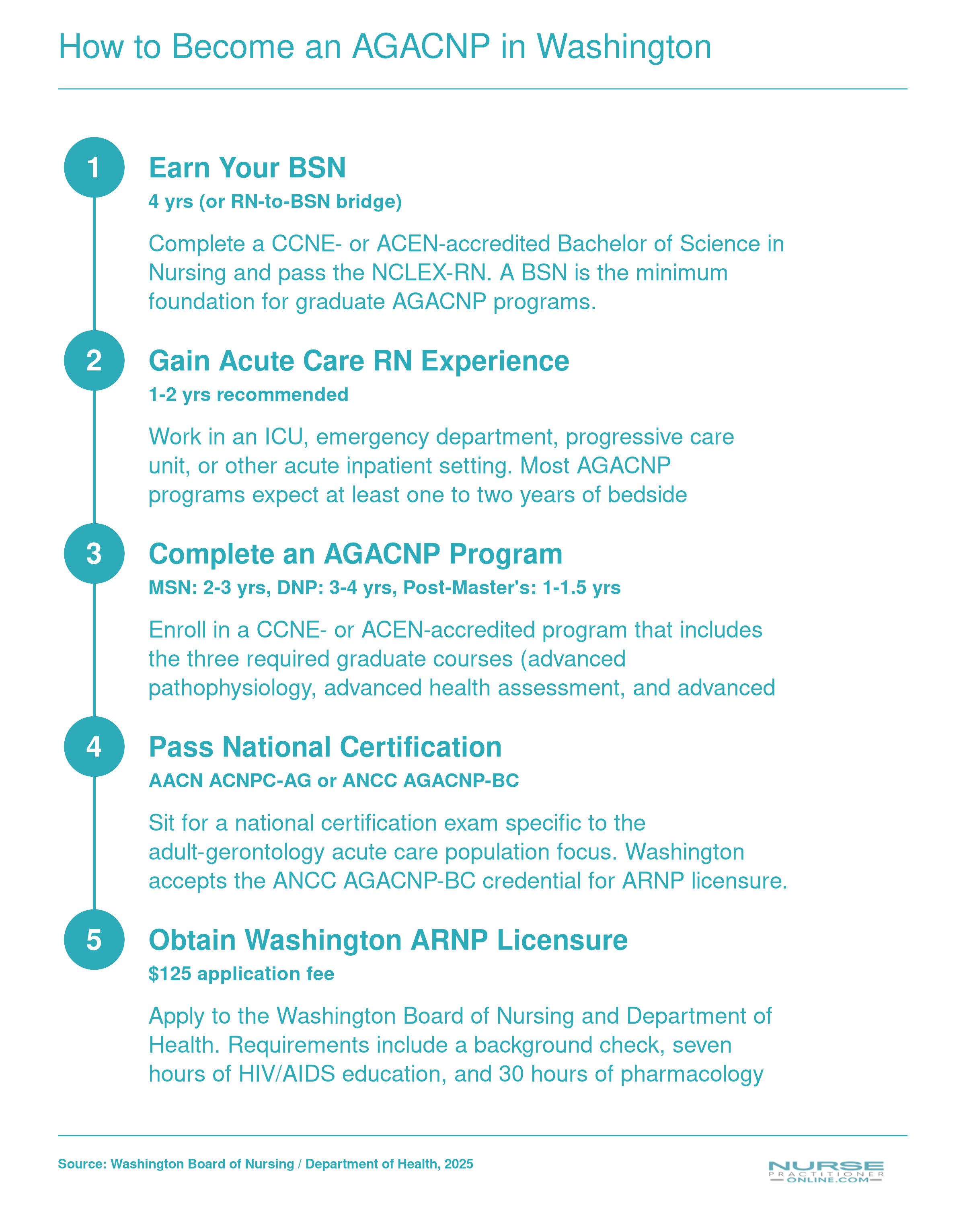
How to Become an AGACNP in Washington
The path from bedside RN to Adult-Gerontology Acute Care Nurse Practitioner in Washington follows a clear sequence. Under the 2025 APRN Consensus Model, legacy ACNP and PCNP credentials have been retired, and Washington now aligns with the updated population foci, so you will pursue an AGACNP-specific program and certification from the start.
Washington ARNP Licensure and Prescriptive Authority for AGACNPs
Arranging Acute Care Clinical Rotations in Washington
Securing a clinical preceptor in an acute care setting takes significantly more effort than arranging a primary care rotation. Intensive care units, emergency departments, and step-down units have limited capacity to train students, and most hospitals enforce strict credentialing requirements that add weeks or months to the onboarding process. For adult-gerontology acute care nurse practitioner (AGACNP) students, these hurdles can delay graduation if not addressed early.
Why AGACNP Clinical Rotations Are Harder to Secure
Acute care sites are high-stakes environments where patient turnover is rapid and student supervision demands close attention from experienced preceptors. Unlike primary care clinics, which can often absorb multiple learners, an ICU may only host one or two students per semester. Hospitals also require proof of immunizations, background checks, drug screenings, and facility-specific orientation before a student steps onto the floor. Some institutions will not consider a student unless the nursing program has an existing affiliation agreement, a formal contract that outlines liability, supervision, and educational expectations. Without that agreement in place, even a willing preceptor cannot take you on.
Washington's Authorization Requirements for Out-of-State Students
Washington participates in NC-SARA, the national reciprocity agreement that simplifies distance education across state lines.1 However, nursing clinical placements are treated separately under Washington regulations. If you enroll in an online NP program as an out-of-state student, the program must hold authorization from the Washington Student Achievement Council (WSAC) for clinical placements to be lawful.1 The Washington State Board of Nursing (WABON) also requires that any program preparing students for state licensure meet its approval standards.3 This means that even if an out-of-state program is fully accredited, you cannot assume it has the necessary Washington-specific approvals. Verify with the program directly that it has secured clinical placement authorization for Washington and can document a current affiliation agreement with your intended facility. Beginning in 2026, NC-SARA requires programs to report their clinical placement locations, including acute care rotations, adding a layer of transparency but not eliminating the need for individual authorization.2
Starting Your Preceptor Search Early
Plan to begin your preceptor search at least six to nine months before your first acute care rotation. Start by reviewing WABON's preceptor guidelines, which outline qualifications and supervisory ratios. Many large hospital systems in Washington, such as those affiliated with the University of Washington or regional health networks, have established clinical education offices that coordinate student placements. Contact these offices directly to understand their application timelines and required paperwork. Building a relationship with a potential preceptor early, through professional networks, alumni groups, or local nurse practitioner associations, can give you an edge. Our guide on how to find NP preceptors walks through this process step by step. Remember that preceptors are often volunteering their time, and a thoughtful, organized approach demonstrates professionalism.
Program Placement Support vs. Self-Placement
A critical factor when choosing an AGACNP program is whether it provides clinical placement services. Some online programs employ dedicated placement coordinators who contact hospitals, negotiate affiliation agreements, and match you with a qualified preceptor. Others require you to find your own preceptor, which can be daunting if you are new to acute care or lack local connections. The difference is substantial: self-placement can add months to your timeline and may even prevent you from completing the program if no site agrees to take you. Before you enroll, ask the program what placement assistance looks like for Washington students, whether they have existing contracts with facilities in your region, and what costs, if any, are associated with placement support. You can also learn more about how online nursing programs arrange local clinical placements. A program with strong Washington partnerships can mean the difference between a smooth clinical experience and a stressful, uncertain journey.
Scholarships and Funding for Washington AGACNP Students
How do working nurses in Washington actually pay for an AGACNP degree without draining savings? Most piece together two or three sources: a state or federal loan repayment commitment, an employer tuition benefit, and a competitive scholarship or two. Here is where to look.
Washington State Programs
The Washington Health Professional Loan Repayment Program is the heavyweight option for AGACNPs willing to commit. It repays $75,000 to $100,000 of qualifying educational debt in exchange for full-time service at an approved site in a designated shortage area.1 Nurse practitioners qualify, and acute care NPs working at safety-net hospitals or rural critical access facilities are competitive applicants.
The Washington State Opportunity Scholarship Graduate program is built specifically for graduate nursing students. The 2025 cycle awarded up to $25,000 over three years ($6,250 per term), plus a $500 per-term travel stipend for clinicals and a $3,600 preceptor stipend.2 Applications typically close in mid-May.
The Washington State Nurses Foundation expanded its giving sharply, awarding 24 scholarships totaling roughly $89,000 in 2025, up from 14 awards and $45,000 two years earlier.34 Awards are modest individually but stack well with other funding.
WICHE WRGP
Washington participates in the Western Regional Graduate Program, which lets state residents pay in-state or reduced tuition at select AGACNP programs in member states such as Oregon, Idaho, Utah, and Colorado. Check the WICHE WRGP program list before assuming an out-of-state DNP is unaffordable.
Employer Tuition Benefits
Most large Washington health systems pay part of your tuition while you work:5
- Providence: $3,000 to $5,250 per year for clinical staff in eligible roles
- Virginia Mason Franciscan Health: up to $5,250 annually, the IRS tax-free maximum
- MultiCare and UW Medicine: comparable annual benefits with service or GPA conditions
Confirm current terms with HR, as eligibility windows and payback clauses change.
Federal and Military Options
The HRSA Nurse Corps Loan Repayment Program pays 60% of unpaid nursing debt for two years of service at a critical shortage facility, rising to 85% with a third year.1 The Nurse Corps Scholarship Program covers tuition, fees, and a monthly stipend in exchange for post-graduation service.6 Active-duty, Reserve, Guard, and VA-employed nurses should also review the Health Professions Scholarship Program and VA Employee Incentive Scholarship Program. For a broader look at repayment options across specialties, see our guide to nurse practitioner loan forgiveness programs.
AGACNP Salary and Job Outlook in Washington
Washington state is one of the highest-paying markets for nurse practitioners in the country. According to the Bureau of Labor Statistics (SOC 29-1171), the mean annual wage for NPs in Washington was $152,180 as of 2023, well above the national mean of $124,680. Keep in mind that BLS data does not separate acute care NPs from primary care NPs, so these figures reflect all nurse practitioner specialties combined. For AGACNP-specific salary insights, consider reaching out to the Washington State Nurses Association or reviewing graduate outcome reports published by programs such as the University of Washington or Gonzaga University. The national job outlook for nurse practitioners is exceptionally strong, with the BLS projecting 40% employment growth from 2022 to 2032. State-level projections from the Washington State Employment Security Department echo this trend, though they also do not break out growth by NP specialty.
| Wage Metric | Washington | National |
|---|---|---|
| Mean Annual Wage | $152,180 (2023) | $124,680 (2022) |
| Mean Hourly Wage | $73.16 (2023) | $59.94 (2022) |
| Median Annual Wage | Not separately reported | $121,610 (2022) |
| 10th Percentile Annual Wage | Not separately reported | $87,340 (2022) |
| 25th Percentile Annual Wage | Not separately reported | $103,250 (2022) |
| 75th Percentile Annual Wage | Not separately reported | $135,470 (2022) |
| 90th Percentile Annual Wage | Not separately reported | $165,240 (2022) |
| Total Employment (2022) | Not separately reported | 258,230 |
| Projected Job Growth (2022 to 2032) | Not separately reported | 40% |
AGACNP Salaries by Metro Area in Washington
Nurse practitioner compensation varies across Washington's metro areas, and understanding those differences can help you plan where to practice after earning your AGACNP credential. The figures below reflect all nurse practitioners in each metro area. AGACNPs working in hospital based acute and critical care settings may earn at the higher end of these ranges, especially in facilities with Level I trauma centers or specialized ICUs. Keep in mind that the Seattle metro typically commands the highest wages, but it also carries the state's highest cost of living, so weigh take home pay against housing, transportation, and other expenses.
| Metro Area | Total NPs Employed | 25th Percentile | Median Salary | 75th Percentile | Mean Salary |
|---|---|---|---|---|---|
| Seattle, Tacoma, Bellevue | 2,850 | $125,890 | $142,940 | $164,730 | $144,870 |
| Spokane, Spokane Valley | 460 | $116,500 | $131,080 | $153,790 | $135,880 |
| Kennewick, Richland | 150 | $129,430 | $142,150 | $160,960 | $146,830 |
| Olympia, Lacey, Tumwater | 140 | $126,630 | $135,870 | $157,780 | $141,770 |
| Yakima | 130 | $124,920 | $128,370 | $152,090 | $134,820 |
| Bremerton, Silverdale, Port Orchard | 120 | $122,760 | $144,240 | $158,460 | $142,440 |
| Wenatchee, East Wenatchee | 100 | $133,650 | $137,360 | $160,790 | $145,890 |
| Bellingham | 90 | $120,690 | $149,560 | $160,640 | $147,760 |
| Longview, Kelso | 60 | $133,560 | $135,900 | $158,410 | $144,710 |
| Mount Vernon, Anacortes | 60 | $126,250 | $138,010 | $161,410 | $146,420 |
Frequently Asked Questions About AGACNP Programs in Washington
Choosing an AGACNP program is a big decision, especially when you are juggling shifts and family life. Below are answers to the questions Washington nurses ask most often about Adult-Gerontology Acute Care NP education, licensure, and career outlook.
- What AGACNP programs are available in Washington state?
- Washington has a limited number of brick-and-mortar AGACNP programs, so many students enroll in nationally accredited online programs based outside the state. Schools such as the University of South Alabama, Georgetown University, and several others admit Washington residents into MSN, DNP, and post-master's certificate tracks. Always confirm that a program holds CCNE or ACEN accreditation and is approved for clinical placements in Washington before you apply.
- Can I complete an AGACNP program entirely online from Washington?
- Most didactic coursework can be completed 100% online. However, every AGACNP program requires hands-on clinical hours in acute care settings such as ICUs, emergency departments, and progressive care units. You will need to arrange those rotations at approved Washington hospitals or health systems. Some programs help with clinical placement, while others expect you to secure your own preceptors, so ask about support before enrolling.
- How much does an AGACNP program cost for Washington residents?
- Total tuition varies widely. Public university MSN programs may run between roughly $30,000 and $50,000, while private or DNP programs can exceed $80,000. Online programs based out of state sometimes offer a flat per-credit rate regardless of residency. Factor in fees, textbooks, certification exam costs, and any travel required for clinical intensives when you build your budget.
- What is the difference between AGACNP and AGPCNP?
- AGACNP (Adult-Gerontology Acute Care NP) prepares you to manage complex, rapidly changing conditions in hospital and critical care environments for patients from adolescence through older adulthood. AGPCNP (Adult-Gerontology Primary Care NP) focuses on outpatient, preventive, and chronic disease management. The two tracks have different clinical hour requirements, different certification exams, and different scopes of practice, so choose the one that matches your career goals.
- How do I get ARNP licensure in Washington after finishing an AGACNP program?
- After graduating from an accredited AGACNP program, you must pass a national certification exam, either the AACN ACNPC-AG or the ANCC AGACNP-BC. Then apply for Advanced Registered Nurse Practitioner (ARNP) licensure through the Washington State Department of Health Nursing Commission. Washington is a full practice authority state, so once licensed you can diagnose, treat, and prescribe (including controlled substances with a DEA number) independently.
- What is the salary for an acute care nurse practitioner in Washington?
- Washington consistently ranks among the top-paying states for nurse practitioners. According to the most recent Bureau of Labor Statistics data, NPs in Washington earn a mean annual salary well above the national average, with acute care specialists in metro areas like Seattle often commanding even higher compensation. Exact figures fluctuate by employer, specialty focus, and years of experience, so check current local postings for the latest ranges.
- Are there AGACNP DNP programs or post-master's certificate options available to Washington students?
- Yes. Several online programs offer both a DNP with an AGACNP concentration and a post-master's AGACNP certificate for nurses who already hold an MSN. The DNP pathway typically takes three to four years part time, while a post-master's certificate can often be finished in roughly 12 to 18 months. Both options require acute care clinical hours that you can complete at Washington facilities.