Most important takeaways…
- PMHNP programs require a minimum of 500 direct clinical hours, and most accredited programs mandate closer to 600.
- FNP-to-PMHNP post-master's certificate programs typically take 12 to 18 months, making them the fastest realistic path.
- Net price at the lowest-cost online PMHNP programs can fall well below published tuition after grants and scholarships.
- Median first-year PMHNP earnings significantly outpace program debt, producing a strong return on investment from day one.
Federal data shows roughly 160 million Americans live in mental health professional shortage areas, and psychiatric-mental health nurse practitioners are stepping into the breach. That demand is driving enrollment in online PMHNP programs, which exist at both the MSN and post-master's certificate levels and let working nurses add therapy and prescribing credentials without pausing their careers. But sorting through the growing number of options means weighing cost, clinical placement support, accreditation, and whether a program actually leads to board certification. Below, we break down the best online nurse practitioner programs offering PMHNP tracks, compare costs, and walk you through what the curriculum and clinical requirements really look like. Telehealth expansion is pushing psychiatric nurse practitioners into a market where need consistently outpaces supply, so choosing a program that builds real competence matters more than ever.
Top Online Psychiatric-Mental Health NP Programs for 2026
We evaluated online PMHNP programs using a quality composite that weighs institutional outcomes, affordability, and online delivery, and here are the programs that rose to the top. Each school on this list offers a hybrid or fully online pathway to psychiatric-mental health nurse practitioner preparation, whether you are pursuing a graduate certificate, an MSN, or a DNP. Note that graduation rates listed below reflect institution-wide figures, and program-level earnings data are not yet available for these specific PMHNP tracks.
- Online delivery availability
- Institutional graduation outcomes
- Affordability and net price
- Graduate debt levels
- Retention and student support
- NCES-IPEDS federal institutional data — nces.ed.gov
- College Scorecard graduate earnings — collegescorecard.ed.gov
- Internal program database
- Independent program research

University of California-Davis
UC Davis anchors a first-of-its-kind multicampus PMHNP certificate program shared with UCLA, UC Irvine, and UCSF, giving students access to faculty and clinical sites across the entire University of California system. The 12-month hybrid format blends virtual coursework with immersion sessions and clinical placements throughout California, with an explicit mission to expand behavioral health access in underserved and rural parts of the state. With an institution-wide graduation rate of about 86% and a median graduate debt of $13,000, it pairs strong outcomes with a California-focused workforce pipeline that includes telepsychiatry training.
- 12-month hybrid graduate certificate, 48 units total
- Virtual classes plus three immersion sessions per year
- Clinical placements arranged across California communities
- Prepares graduates for ANCC PMHNP board certification
- Open to licensed NPs, CNSs, CNMs, and CRNAs
- Case-based, interprofessional curriculum design
- Telepsychiatry training integrated into coursework
- Full-time enrollment required, 16 to 24 clinical hours weekly
UC Psychiatric Mental Health Nurse Practitioner Certificate — Hybrid

University of Florida
The University of Florida offers a BSN-to-DNP track in psychiatric-mental health nursing that prepares advanced practice nurses for lifespan mental health care, including psychotropic prescribing and individual, family, and group therapy. Clinical placements draw on UF Health, VA facilities, and community behavioral health centers across Florida, with growing emphasis on integrated primary care settings and telehealth simulation. The institution posts a 91% graduation rate and a relatively low net price of about $6,541, making it one of the more affordable public options on this list.
- BSN-to-DNP track with full-time and part-time options
- Training in psychotropic medication prescribing
- Individual, family, and group therapy preparation
- Clinical sites span urban, rural, and VA settings in Florida
- Graduates eligible for ANCC board certification
- Emphasis on integrated behavioral health and primary care
- Exposure to opioid-use disorder treatment models
Psychiatric-Mental Health Nurse Practitioner (BSN to DNP) — Hybrid

University of California-Los Angeles
UCLA contributes its Southern California clinical network to the UC multicampus PMHNP certificate, offering placements through UCLA Health, Los Angeles County mental health agencies, and community clinics. Students benefit from proximity to UCLA's Semel Institute for Neuroscience and Human Behavior, which enriches coursework with neurobiology of mental illness and severe mental illness management. The institution carries a 93% graduation rate and a median graduate debt of $14,000, with a net price around $12,548 for in-state students.
- 12-month hybrid certificate through UC multicampus model
- Clinical placements in Los Angeles and surrounding counties
- Access to UCLA Semel Institute neuroscience resources
- 48-unit curriculum with Wednesday virtual case conferences
- Prepares for ANCC PMHNP-BC certification
- Emphasis on neurobiology and severe mental illness
- Three immersion sessions across summer, fall, and winter
- For licensed APRNs only; full-time enrollment required
UC Psychiatric Mental Health Nurse Practitioner Certificate — Hybrid

Yale University
Yale's School of Nursing brings its three-year hybrid MSN in psychiatric-mental health nursing to working RNs across select states, with asynchronous online coursework punctuated by three on-campus immersions. What sets the program apart is a deep emphasis on psychotherapy competency, including individual, group, and family modalities, alongside equity-focused content on care for marginalized populations. The institution posts the highest graduation rate on this list at nearly 96%, with a median graduate debt of about $12,975. The published tuition of $49,500 per year is higher than the public schools here, but the net price after aid drops to roughly $23,777.
- Three-year hybrid MSN with asynchronous online courses
- Three mandatory on-campus immersion sessions
- Strong psychotherapy training: individual, group, and family
- Anti-racism and social justice content in mental health care
- Telepsychiatry and remote crisis assessment simulation
- Clinical placements arranged near students' home communities
- NursingCAS application required; Fall 2026 cycle open
Psychiatric-Mental Health Nurse Practitioner (MSN) — Online

University of North Carolina at Chapel Hill
UNC Chapel Hill delivers a distance-based MSN with a PMHNP specialty designed to serve North Carolina's rural and underserved communities, with clinical partnerships spanning community mental health centers, FQHCs, and state facilities. The curriculum places notable depth on child, adolescent, and family psychiatric care, reflecting state-level shortages in pediatric mental health providers, and weaves in telehealth and digital mental health tools. In-state tuition sits at about $12,751, the institution holds a 91% graduation rate, and median graduate debt comes in at $14,000.
- Fully online, distance-based MSN format
- Lifespan focus with depth in child and adolescent care
- Clinical placements in NC community and rural settings
- Psychopharmacology and prescriptive authority preparation
- Telehealth and digital mental health tools in coursework
- Graduates eligible for board certification exams
- Integrated behavioral health and primary care emphasis
Psychiatric-Mental Health Nurse Practitioner (MSN) — Online

Texas A & M University-College Station
Texas A&M offers an online post-graduate certificate in PMHNP for nurses who already hold a graduate nursing degree and an active Texas RN license. The 26-credit program covers adult, child-adolescent, and older adult psychiatric care with asynchronous didactic delivery and supervised clinical hours across Texas. In-state tuition of roughly $11,748 makes it one of the most budget-friendly certificate options, though median institutional graduate debt runs about $17,804. The institution-wide graduation rate is approximately 84%.
- 26-credit online asynchronous certificate program
- Requires active Texas RN license and graduate nursing degree
- Covers adult, child-adolescent, and older adult care
- Psychopharmacology and family psychiatric health content
- Clinical hours in Texas with telehealth training
- Application via NursingCAS with priority January deadline
- Prepares graduates for PMHNP certification exam
Post-Graduate Certificate in Psychiatric Mental Health Nurse Practitioner — Online

University of Minnesota-Twin Cities
The University of Minnesota's DNP in Psychiatric/Mental Health Nurse Practitioner combines online learning with one-week on-campus sessions each semester, offering three-year and four-year completion plans. The curriculum spans 80 credits and 1,000 clinical hours, with placements in Minneapolis-St. Paul, rural Minnesota, tribal communities, and VA systems. Tuition runs about $22,017 in-state, and the program is CCNE accredited. The institution-wide graduation rate is roughly 85%, with median graduate debt around $19,500.
- 80-credit post-baccalaureate DNP with CCNE accreditation
- Three-year or four-year completion plans available
- 1,000 supervised clinical hours required
- Hybrid format with weekly on-campus intensive sessions
- Training in collaborative care and integrated behavioral health
- Focus on diverse and immigrant populations in Upper Midwest
- Prepares for ANCC PMHNP certification
- $1,100 per credit tuition rate noted by the program
Psychiatric/Mental Health Nurse Practitioner (DNP) — Hybrid

University of California-Irvine
UC Irvine contributes Orange County and Southern California clinical networks to the UC multicampus PMHNP certificate, giving students placements through county behavioral health agencies and community clinics in a rapidly growing region. Like the other UC partner sites, the 12-month hybrid program leads to a 48-unit graduate certificate and ANCC board certification eligibility. The institution carries an 87% graduation rate and a net price of roughly $14,251, with median graduate debt of $15,000.
- 12-month hybrid program through UC multicampus initiative
- Clinical placements in Orange County and Southern California
- 48-unit graduate academic certificate format
- Prepares for ANCC PMHNP board certification
- Wednesday virtual case conferences and immersion sessions
- For licensed NPs, CNSs, CNMs, and CRNAs
- Regional clinical training model with local placement focus
- Addresses California mental health provider shortage
UC Psychiatric Mental Health Nurse Practitioner Certificate — Hybrid
Common Questions About Online PMHNP Programs
Choosing an online PMHNP program raises plenty of practical questions, from clinical logistics to certification details. Below are answers to the questions working nurses ask most often, grounded in current program data and credentialing standards.
- Are online psych NP programs available, and are they fully online?
- Yes. Many accredited universities offer PMHNP programs with fully online coursework. Didactic classes, including psychopharmacology and advanced psychiatric assessment, are delivered through virtual platforms. However, clinical rotations must be completed in person at approved sites, typically in your local area. Some programs also require brief on-campus orientations or simulation labs, so review each school's format before applying.
- How long does it take to complete an online PMHNP program?
- Most MSN-entry PMHNP programs take about 24 months of full-time study, though part-time tracks may stretch to three or four years. If you already hold an MSN or DNP in another specialty, a post-master's certificate program can be completed in roughly 12 months. Timelines vary by credit load, clinical scheduling, and whether you enroll year-round or take breaks between semesters.
- What are the clinical hour requirements for PMHNP programs?
- Accredited PMHNP programs require a minimum of 500 supervised clinical hours focused on psychiatric and mental health care. Many programs set their requirement between 500 and 700 hours or more to ensure graduates are well prepared for independent practice. These hours must be completed under a qualified preceptor in settings such as outpatient behavioral health clinics, psychiatric hospitals, or community mental health centers.
- Can you go from FNP to PMHNP online?
- Absolutely. Several accredited schools offer online FNP-to-PMHNP post-master's certificate programs designed for family nurse practitioners who want to add a psychiatric specialty. Because you already hold an advanced practice degree, these bridge programs focus on psychiatric coursework and clinical hours, and they can often be finished in about 12 months. You will still need to pass the ANCC PMHNP-BC certification exam afterward.
- How do you become a psychiatric-mental health nurse practitioner?
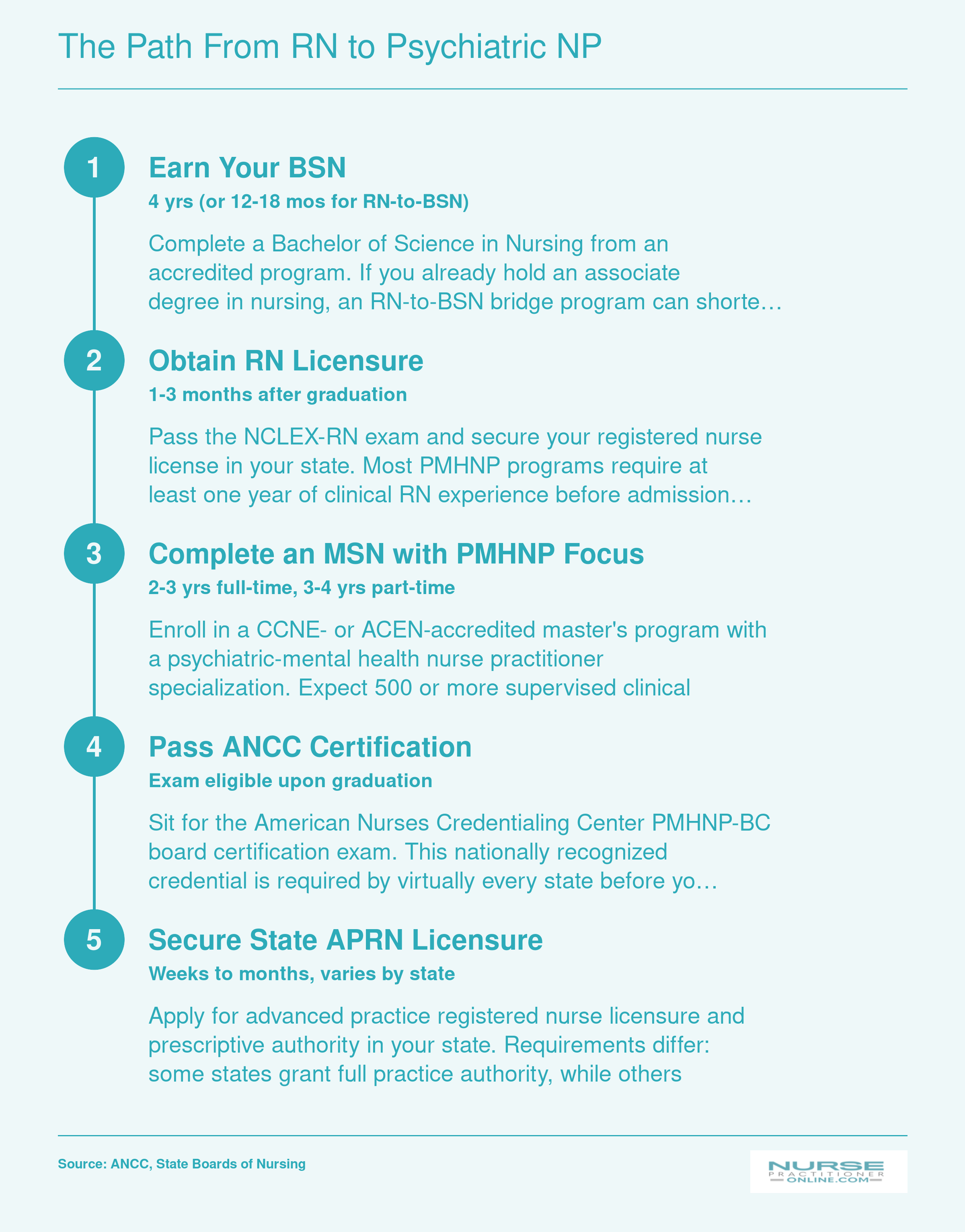
- Start by earning your BSN and obtaining an active RN license. Next, complete a graduate-level PMHNP program (MSN or DNP) accredited by a recognized nursing body. Fulfill at least 500 clinical hours in psychiatric settings. After graduation, pass the ANCC Psychiatric-Mental Health Nurse Practitioner certification exam (PMHNP-BC) and apply for state APRN licensure. Most states also require ongoing continuing education to maintain your credential.
- Do online PMHNP programs require on-campus residencies or intensives?
- It depends on the school. Some programs are entirely online aside from clinical rotations, while others require one or more brief on-campus immersion weekends or simulation intensives each year. These sessions typically last two to four days and focus on hands-on skills like psychiatric interviewing techniques and standardized patient encounters. Always confirm the campus visit schedule before enrolling, especially if travel is a concern.
- What is the ANCC PMHNP certification exam pass rate?
- The most recently published national pass rate for the ANCC PMHNP-BC exam is approximately 82 percent. Individual program pass rates can be higher or lower, and many schools publish their own graduates' results. A strong program will typically report pass rates at or above the national average. Reviewing a school's certification exam outcomes is one of the most useful ways to gauge how well its curriculum prepares students for practice.
- Are online PMHNP degrees respected by employers and credentialing boards?
- Yes, provided the program holds proper accreditation from a body such as the CCNE or ACEN. Credentialing boards and employers evaluate whether your degree comes from an accredited institution, not whether classes were delivered online or in person. Graduates of accredited online programs sit for the same ANCC PMHNP-BC exam and hold the same certification as their on-campus peers, so the credential carries equal professional weight.
Lowest-Cost Online PMHNP Programs Worth Considering
When comparing PMHNP program costs, net price is a more useful figure than sticker tuition. Net price reflects the average amount students actually pay after grants and scholarships are factored in, giving you a clearer picture of your real out-of-pocket expense. Keep in mind that these net price figures are institution-wide averages reported to the federal government, not program-specific quotes. Your actual cost will depend on your financial aid package, residency status, and enrollment details.
| School | Location | In-State Tuition | Out-of-State Tuition | Avg. Net Price | Program Type | Degree Level |
|---|---|---|---|---|---|---|
| Texas A & M International University | Laredo, TX | $6,650 | $15,490 | $3,637 | Online | Post-Master's Certificate |
| California State University, Stanislaus | Turlock, CA | $9,766 | $19,846 | $6,067 | Hybrid | Post-Graduate Certificate |
| University of Florida | Gainesville, FL | $12,737 | $30,130 | $6,541 | Hybrid | Doctorate (BSN to DNP) |
Questions to Ask Yourself
Explore By State
How to Evaluate an Online PMHNP Program
Beyond glossy marketing pages and convenient online formats, a PMHNP program is only worth your tuition if it produces graduates who can sit for board certification, find jobs, and practice safely. Here is a practical framework for cutting through the noise.
Start With Accreditation
Accreditation is your first filter, not your last. Two bodies accredit graduate nursing programs in the U.S.: the Commission on Collegiate Nursing Education (CCNE) and the Accreditation Commission for Education in Nursing (ACEN). CCNE is more common at the graduate level, particularly among universities offering MSN and DNP tracks, while ACEN accredits a smaller but growing share of advanced practice programs. For a deeper comparison, see our nursing accreditation guide on ACEN vs CCNE.
Check the official accreditor lists directly:
- CCNE: ccneaccreditation.org maintains a searchable directory of accredited programs.
- ACEN: acenursing.org lists accredited nursing programs by degree level and specialty.
Both accreditations are generally accepted by the American Nurses Credentialing Center (ANCC) for PMHNP-BC certification eligibility, but "generally" is not the same as "always." Confirm two things before you enroll: that your state board of nursing recognizes the program for APRN licensure in the state where you plan to practice, and that ANCC (ancc.org) accepts the program's accreditation for your certification pathway. Our nurse practitioner licensing and certification guide walks through this process in detail. A five-minute email to each organization can save you a year of regret.
Compare Outcomes, Not Just Promises
Once a program clears the accreditation bar, dig into outcomes. The numbers that actually predict your experience are:
- Certification pass rates: Most reputable programs publish first-time PMHNP-BC pass rates on their outcomes or consumer information page. Aim for 90% or higher.
- Clinical placement support: Ask whether the program secures preceptors for you or expects you to self-source. This single answer can make or break an online program.
- Time to completion and attrition: A 24-month program that 40% of students fail to finish on schedule is not really a 24-month program.
- Graduate employment: Cross-reference national demand data from the Bureau of Labor Statistics (bls.gov/ooh/healthcare/nurse-anesthetists-nurse-midwives-and-nurse-practitioners) with the program's own placement reporting.
If a school will not share these figures, treat that silence as an answer.
PMHNP Admissions: What Programs Typically Require
Admissions requirements are fairly consistent across online PMHNP programs, so you can start gathering materials well before application deadlines open. Here's what most programs ask for.
- Active, unencumbered RN licenseEvery program requires a current RN license in good standing. If you plan to complete clinicals in a different state, check whether that state requires additional licensure.
- BSN from an accredited institutionMSN-entry PMHNP programs require a BSN earned from a program accredited by CCNE or ACEN. A few schools, like Spring Arbor University, offer an RN-to-MSN pathway for nurses with an associate degree, though additional coursework applies.
- Minimum GPA of 3.0A cumulative GPA of 3.0 on a 4.0 scale is the standard across programs such as Simmons University, Loma Linda University, and UC Davis. Some schools will consider applicants with a GPA as low as 2.75 on a conditional basis, so it's worth asking if you fall just below the cutoff.
- Clinical nursing experienceMost programs prefer at least one to two years of RN experience. Psychiatric or behavioral health nursing is a plus, but many programs accept experience from other acute-care or community settings as well.
- No GRE requiredThe GRE has been widely waived for online PMHNP programs. Among the schools we reviewed, including Simmons, Loma Linda, UC Davis, and Spring Arbor, none require it in 2026.
- Letters of recommendation, goal statement, and CVExpect to submit two to three professional or academic references, a personal statement outlining your interest in psychiatric-mental health practice, and an up-to-date resume or CV that highlights relevant clinical work.
- Prerequisite courseworkSome programs require completed prerequisites before enrollment. Common ones include statistics (required at Simmons, for example) and the "three Ps" of advanced practice, advanced pathophysiology, advanced pharmacology, and advanced health assessment. If you haven't taken these, many schools let you complete them during the first semester.
What You'll Study: PMHNP Curriculum and Clinical Breakdown
PMHNP coursework trains you to assess, diagnose, and treat mental health conditions across the lifespan, and the clinical hours behind that training are non-negotiable for certification. Before you commit to any program, verify the current numbers directly with the certifying body, because requirements and policies (especially around telehealth) shift more often than program brochures get updated.
The Coursework You Should Expect
Nearly every accredited online PMHNP program builds on the same graduate nursing core: advanced pathophysiology, advanced pharmacology, and advanced health assessment. The three Ps, as faculty call them, are prerequisites for any specialty practicum. From there, PMHNP-specific courses typically cover psychopathology across the lifespan, neurobiology of mental illness, psychopharmacology, individual and group psychotherapy modalities, and child and adolescent psychiatric care. Many programs also fold in coursework on substance use disorders, trauma-informed care, and integrated behavioral health.
Clinical Hours: What Certification Actually Requires
The American Nurses Credentialing Center (ANCC) sets the minimum direct patient care hours required to sit for the PMHNP-BC exam. Most accredited programs build in 500 to 750+ supervised clinical hours, often exceeding the minimum to ensure graduates are practice-ready and meet state licensure thresholds, which can be higher than the certification floor. For a broader look at what the exam process involves, our guide to understanding nurse practitioner certification exams walks through the major options and requirements.
Telehealth hours are a moving target. ANCC has updated its stance more than once in recent years on how much synchronous virtual care can count toward direct patient hours. Do not rely on a program's website or a forum post: go to nursecredentialing.org and read the current PMHNP eligibility criteria yourself before you enroll.
For curriculum design and clinical training standards, the National Organization of Nurse Practitioner Faculties (NONPF) publishes guidelines that most accredited programs follow. Their site is the best reference for what a rigorous PMHNP education should include.
Preceptors and Placement
Clinical placement is where online programs vary the most. Some schools have dedicated placement coordinators who secure your preceptor and site. Others require you to identify your own preceptor and have the program approve them. If you fall into the latter group, our article on how online NP students arrange clinicals in their local area offers practical strategies. Ask the admissions office directly:
- Who is responsible for finding preceptors?
- What happens if a placement falls through mid-semester?
- Are placements available in your state?
For broader role context and labor market data, BLS.gov, the American Nurses Association, and the American Psychiatric Nurses Association are reliable starting points, though specific hour requirements always come from your program and ANCC.
The Path from RN to Psychiatric NP
Becoming a psychiatric-mental health nurse practitioner is a clearly defined credentialing journey. Each step builds on the last, and most working nurses complete the process over several years while continuing to practice. Here is what the typical sequence looks like.
Accelerated and Fast-Track PMHNP Programs: What's Realistic
A true 12-month PMHNP program at the master's level is essentially a myth. Search results and program ads may dangle the promise of completing your psychiatric nurse practitioner degree in under a year, but when you examine the actual requirements, that timeline almost never holds up for working nurses pursuing an MSN.
What 'Accelerated' Actually Means
Most programs marketed as accelerated or fast-track run 18 to 24 months, not 12. The difference lies in year-round enrollment rather than traditional semester breaks. Cleveland State University's online MSN PMHNP requires 48 credits and 780 clinical hours, completed over 24 months.1 Felician University's online PMHNP covers 39 credits with 750 clinical hours, also structured for 24-month completion.2 These are considered brisk timelines by graduate nursing standards, but they are not the one-year sprints that hopeful applicants sometimes expect.
The rare programs that do advertise completion under 18 months are typically post-master's certificate tracks, not full MSN programs. Spring Arbor University, for instance, offers a post-master's PMHNP certificate with a timeline of 18 to 24 months for nurses who already hold an MSN in another specialty.3 If you completed your FNP years ago and want to add psychiatric credentialing, this pathway makes sense. If you are starting from an RN or BSN, a certificate program is not an option. For a broader look at condensed NP timelines, our guide to fastest nurse practitioner programs puts these numbers in context.
Who Actually Qualifies for Faster Tracks
Accelerated timelines are realistic for one group: nurses who already have a master's degree and need only the PMHNP-specific coursework. Post-master's certificate students skip foundational graduate courses and move directly into psychiatric content. For everyone else, the math simply does not work. National certification requires a minimum of 500 clinical hours, and most CCNE-accredited programs require 600 to 780. There is no shortcut through patient encounters. If you are still mapping out the full journey from RN to NP, our overview on how to become a nurse practitioner walks through every milestone.
The Hidden Cost of Compression
Squeeze a 24-month program into less time and you may find yourself scrambling for preceptors willing to accommodate an intense schedule. Clinical sites often have limited capacity, and compressing hours into fewer months can mean longer days, fewer placement options, and increased risk of burnout. If you are working full-time while enrolled, an 18-month track can quickly feel like running two marathons at once. Faster is not always better when the finish line is a demanding career in psychiatric care.
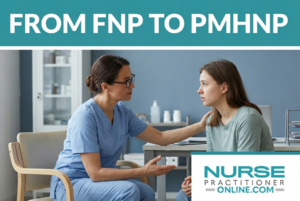
FNP-to-PMHNP Bridge Programs: Adding a Psychiatric Specialty Online
If you already hold an FNP certification and master's degree, you can add psychiatric-mental health credentials through a post-master's certificate (PMC) program without repeating the full master's curriculum. These programs allow you to expand your scope into psychiatric prescribing and mental health treatment, often in response to the nationwide shortage of psychiatric providers or simply because you've discovered a clinical interest in behavioral health.
Why FNPs Pursue Post-Master's PMHNP Certificates
Many family nurse practitioners transition into psych for a few clear reasons:
- Scope expansion: PMHNP certification grants independent authority to diagnose mental health conditions, prescribe psychotropics, and provide psychotherapy in most states. (Check nurse practitioner practice authority by state to see where PMHNPs can practice independently.)
- Career pivot: If primary care feels less sustainable or engaging, behavioral health offers a different pace and patient population.
- Market demand: Mental health provider shortages create strong hiring demand and often higher compensation.
Because you already hold one NP credential, PMC programs streamline the path by focusing exclusively on psychiatric coursework and clinical training.
Typical Credit and Clinical Requirements
Most FNP-to-PMHNP post-master's certificates require 15 to 32 credits and 500 to 750 supervised clinical hours in psychiatric settings. Even if you have thousands of hours as an FNP, you'll need to complete the psych-specific clinical requirement because the skills, patient presentations, and treatment frameworks differ significantly from primary care.
Programs typically run 12 to 24 months and can be completed part-time while working.
Online Programs Currently Enrolling
Several schools offer fully online FNP-to-PMHNP certificates:
- Felician University: 21 credits, 750 clinical hours, approximately $16,653 total tuition, 24-month timeline.1
- West Coast University: 32 credits, approximately $33,520 total tuition, 16-month accelerated format.2
- Spring Arbor University: 500 clinical hours required, 18 to 24 months online, specific tuition not publicly posted.3
- Western Governors University: 18-month competency-based program, flat-rate tuition model.4
Other programs worth exploring include University of Michigan-Flint5, Augusta University (web-based)6, and University of Colorado Colorado Springs (online format).7
Clinical Placement and Preceptor Considerations
Most programs require you to arrange your own psychiatric preceptors, which can be challenging depending on your geographic location and existing professional network. Start building relationships with PMHNPs, psychiatrists, or mental health clinics early in the application process to ensure you can meet the clinical hour requirement on schedule. If you're also weighing other post-master's specialty options, our overview of online post-master's ACNP certificate programs walks through a similar process for acute care credentials.
PMHNP Earnings and Career ROI
Nurse practitioners across all specialties earned a median annual wage of roughly $121,610 as of the most recent BLS occupational data, with the bottom 10% bringing in about $87,340 and the top 10% exceeding $165,240.1 Those numbers cover the full NP workforce, and PMHNPs frequently land in the upper half of that range, especially given the acute shortage of psychiatric providers nationwide.
What the National Numbers Tell You
The Bureau of Labor Statistics projects 35% job growth for nurse practitioners, nurse anesthetists, and nurse midwives through 2034, with an estimated 32,700 openings per year.2 That kind of demand translates directly into negotiating power. Mean annual wages for NPs have already climbed to approximately $142,270, and psychiatric specialization tends to command a premium because so few providers are qualified to prescribe psychotropic medications and deliver psychotherapy.3
PMHNPs who practice in full practice authority states, where no collaborative agreement with a physician is required, often earn above the NP median. The same is true for those who open their own private practices, where reimbursement flows directly to the provider rather than through a hospital system's salary structure. While precise PMHNP-specific salary figures are not tracked separately by the BLS, professional surveys consistently place psychiatric NPs among the higher-earning NP specialties.
Why Debt-to-Earnings Ratio Matters More Than Raw Salary
A six-figure salary looks appealing on paper, but the real question is how quickly your degree pays for itself relative to what you borrowed. Program-level earnings data for PMHNP graduates are not yet published at the detail level needed for direct program-to-program salary comparisons. However, we can look at the relationship between median graduate debt at each institution and longer-term alumni earnings to approximate return on investment.
Among the programs featured in our rankings, estimated ROI ratios (institutional median earnings divided by median graduate debt) range from roughly 5:1 to nearly 8.5:1. Schools like Johns Hopkins, Yale, and the University of Pennsylvania show particularly strong ratios, largely because their graduates carry moderate debt loads relative to long-term earning potential. Public universities such as the University of Virginia and the UC system programs also perform well, thanks to lower tuition baselines. If cost is a top priority, our guide to the most affordable nurse practitioner programs can help you compare options side by side.
Concrete Takeaways for Your Decision
- High demand equals high leverage. With 35% projected growth and tens of thousands of annual openings, PMHNPs are entering one of the most favorable job markets in healthcare. That demand supports strong starting salaries and gives you room to negotiate.
- Practice setting shapes your ceiling. PMHNPs in private practice or in full-practice-authority states regularly exceed the national NP median. If long-term earning potential matters to you, consider where and how you plan to practice after graduation.
- Focus on debt-to-earnings, not sticker price alone. A program that costs $100,000 but positions you for rapid loan repayment may deliver better ROI than a cheaper program with weaker career outcomes. Look at how much graduates borrow relative to what they earn within a few years of finishing.
- Program-level salary data is still emerging. Detailed post-graduation earnings for specific PMHNP programs are not yet widely available, so use institutional-level outcomes and published ROI indicators as a starting framework, not a final answer.
The bottom line: psychiatric mental health is one of the strongest financial investments within nursing. The combination of workforce shortages, expanding scope-of-practice laws, and growing public awareness of mental health needs makes PMHNP one of the few specialties where both job security and earning potential continue to trend upward.
More Online PMHNP Programs to Explore
If you didn't find the right fit among our top picks, don't worry, there are many more excellent online PMHNP programs across the country. Below is a wider directory of additional programs beyond the top 10, covering a range of formats, tuition levels, and degree levels.
Other
California State University-Stanislaus Turlock, CA · Hybrid
- Post Graduate Psychiatric APRN Certificate
Florida State University Tallahassee, FL · Hybrid
- DNP- Psychiatric Mental Health Nurse Practitioner
Florida International University Miami, FL · Hybrid
- Psychiatric-Mental Health Nurse Practitioner
- Post-BSN to DNP (Psychiatric-Mental Health Nurse Practitioner)
- Post-Graduate Nurse Practitioner Certificate (Psychiatric-Mental Health Nurse Practitioner)
University of Virginia Charlottesville, VA · Hybrid
- Psychiatric Mental Health Nurse Practitioner
- Psychiatric-Mental Health Nurse Practitioner
Vanderbilt University Nashville, TN · Hybrid
- Post-Master's Certificate in Psychiatric-Mental Health Nurse Practitioner (Lifespan)
- Psychiatric-Mental Health Nurse Practitioner (Lifespan)
California State University-Long Beach Long Beach, CA · Hybrid
- Doctor of Nursing Practice (Psychiatric-Mental Health Across the Life Span)
Texas A & M International University Laredo, TX · Online
- Psychiatric Mental Health Nurse Practitioner Post-Master's Certificate
University of Wisconsin-Madison Madison, WI · Hybrid
- Nursing Practice: Psychiatric Mental Health Nurse Practitioner, DNP
- Post-Graduate Psychiatric Nursing Capstone Certificate
California State University-San Marcos San Marcos, CA · Hybrid
- BSN to Doctor of Nursing Practice (Psychiatric Mental Health Nurse Practitioner)
- Master of Science in Nursing (Psychiatric-Mental Health Nurse Practitioner)
Johns Hopkins University Baltimore, MD · Hybrid
- DNP: Psychiatric Mental Health Nurse Practitioner
- Psychiatric Mental Health Nurse Practitioner, Post-Master's Certificate
Purdue University West Lafayette, IN · Hybrid
- Post BSN to DNP with Psych Mental Health Specialization
- Psychiatric/Mental Health Nurse Practitioner Certificate Program
- Psychiatric/Mental Health Nurse Practitioner
Ohio State University Columbus, OH · Hybrid
- Doctor of Nursing Practice (Psychiatric Mental Health Nurse Practitioner)
- Psychiatric Mental Health Nurse Practitioner
University of North Florida Jacksonville, FL · Online
- Psychiatric Mental Health Nurse Practitioner Certificate
- Psychiatric Mental Health Nurse Practitioner
Stony Brook University Stony Brook, NY · Hybrid
- Psychiatric-Mental Health Nurse Practitioner DNP
Georgetown University Washington, DC · Hybrid
- Psychiatric-Mental Health Nurse Practitioner Post-Graduate Certificate
Explore Programs
Explore Programs
- Best Accelerated Nurse Practitioner
- Best Affordable Nurse Practitioner Programs of
- Best Online Acute Care Nurse Practitioner (ACNP)
- Best Online Adult-Gerontology NP Programs (AGPCNP & AGACNP)
- Best Online DNP Nurse Practitioner
- Best Online Emergency Nurse Practitioner (ENP)
- Best Online FNP
- Best Online MSN Nurse Practitioner
- Best Online Neonatal Nurse Practitioner (NNP)
- Best Online PNP
- Best Online Post-Master's NP Certificate
- Best Online WHNP