
Most important takeaways…
- WHNP programs require 500 to 600 clinical hours for MSN tracks and 1,000 or more for the DNP.
- Nurse practitioner employment is projected to grow 40.1% from 2024 to 2034 per the Bureau of Labor Statistics.
- MSN pathways cost less and finish faster, while DNP programs open doors to leadership and academic roles.
- Online WHNP students typically must find their own preceptors, making early clinical site planning essential.
The WHNP credential sits in an unusual spot in 2026: maternal health workforce shortages have widened in over half of U.S. counties, yet the number of accredited women's health NP programs remains under 30 nationally, making seat availability tighter than in family nurse practitioner program or adult-gerontology tracks.
That scarcity is part of why online delivery has reshaped the specialty. Working RNs can now pursue an MSN, a BSN-to-DNP, or a post-master's certificate in women's health largely from home, completing 500 to 1,000+ clinical hours through local preceptors while keeping their hospital shifts.
The practical tension is real: WHNP graduates earn competitive NP salaries, but tuition spreads from roughly $25,000 to north of $90,000, and preceptor placement still falls largely on the student.
Best Online Women's Health Nurse Practitioner Programs for 2026
These online WHNP programs are ordered by overall quality, not solely by cost or speed. Our composite weighs institutional strength, graduate outcomes, and online accessibility so you can compare programs on the factors that matter most to working nurses. Where program-level earnings data is available we include it as an outcome signal, though institution-wide figures should not be read as specific to a single specialty track.
- Institutional academic quality metrics
- Graduate earnings and debt outcomes
- Online and hybrid delivery access
- Student-to-faculty ratio
- Financial value and net price
- Internal program database
- College Scorecard graduate earnings — collegescorecard.ed.gov
- NCES-IPEDS federal institutional data — nces.ed.gov
- Independent program research

SUNY Downstate Health Sciences University
SUNY Downstate is a health sciences university in Brooklyn with a tight 9:1 student-to-faculty ratio and a mission centered on health equity in urban communities. Its DNP with a WHNP concentration accepts both BSN- and MSN-prepared nurses through a hybrid format that pairs online coursework with on-campus intensives and clinical placements. Ten-year median earnings for graduates across the institution reach approximately $109,600, and median graduate debt sits at just $12,500.
- BSN-to-DNP track (76 credits) or advanced standing (46 credits)
- Complete in 10 or 13 semesters depending on entry point
- Hybrid format with online coursework and campus intensives
- Focus on underserved and diverse urban populations
- Prepares graduates for highest level of nursing practice
- Small cohorts with personalized faculty mentorship
- Aligned with the quadruple aim of healthcare
Doctor of Nursing Practice, Women's Health Nurse Practitioner — Hybrid

Vanderbilt University
Vanderbilt's School of Nursing offers a distinctive dual WHNP and Adult-Gerontology Primary Care NP track, available at both the MSN and post-master's certificate level. The hybrid format combines online classes with in-person sessions and requires 1,190 clinical practice hours. With an 8:1 student-to-faculty ratio and a median graduate debt of $14,000, Vanderbilt balances prestige with robust financial aid.
- Dual WHNP and AGPCNP certification upon graduation
- 1,190 clinical practice hours required
- Five semesters full-time or part-time plan available
- Hybrid online and in-person delivery format
- Curriculum aligned with AACN Essentials
- Small class sizes with experienced faculty mentors
- Requires existing master's degree in nursing from ACEN or CCNE school
- Builds dual WHNP/AGPCNP specialty on prior credentials
- Hybrid format with distance-based online courses
- Prepares for both NCC and ANCC certification exams
- Clinical placement assistance and geographic flexibility
- Personalized mentorship from nationally ranked faculty
MSN, Women's Health Gender-Related NP / Adult-Gerontology Primary Care NP — Hybrid
Post-Master's Certificate, Women's Health Gender-Related NP — Hybrid

University of Minnesota-Twin Cities
The University of Minnesota's DNP in Women's Health/Gender-Related Nursing stands out for its institution-arranged clinical placements at over 200 partner sites and its hybrid-by-design model with on-campus intensives each semester. The program reports a 100% NCC board exam pass rate and 100% employment rate for the Class of 2025. A small cohort structure and nationally recognized faculty make this a strong choice for nurses who value structured mentorship.
- 3-year and 4-year program plans available
- 1,000 clinical hours at institution-arranged partner sites
- 100% licensure pass rate and 100% job placement rate
- Hybrid format with on-campus intensives each semester
- Cohort-based structure with close faculty mentorship
- Prepares for NCC Board Certification Exam
- Whole-person health and interprofessional collaboration framework
DNP, Women's Health/Gender-Related Nurse Practitioner — Hybrid

University of Illinois Chicago
UIC's WHNP DNP program prepares nurses as primary care providers for women across the lifespan, covering well-woman care, reproductive health, and prenatal/postpartum management. A key advantage: the university arranges all clinical placements so students learn from practicing WHNPs in specialty areas like urogynecology and infertility. Available at three Illinois campuses, UIC also offers a post-DNP certificate option. In-state tuition starts at roughly $17,550.
- Clinical sites arranged by program staff across three campuses
- Covers well-woman, reproductive, and gynecological care
- Post-master's DNP and post-DNP certificate pathways available
- Hybrid format with flexible scheduling
- Prepares graduates for National Certification Corporation exam
- Learn directly from practicing WHNPs in specialty settings
- Strong emphasis on health promotion and disease prevention
DNP, Women's Health Nurse Practitioner — Hybrid

Duke University
Duke's School of Nursing offers WHNP preparation at both the MSN and post-graduate certificate level through a hybrid model blending distance-based coursework with clinical placements and on-campus simulation. With a 5:1 student-to-faculty ratio and median graduate debt of $13,000, Duke pairs a nationally ranked faculty with personal mentorship. The curriculum focuses on inclusive, culturally competent care for diverse populations.
- Hybrid format with distance-based curriculum
- Clinical placement support and global clinical partners
- Personalized mentorship from nationally ranked faculty
- Focus on inclusive care and health equity
- Holistic admissions approach with financial aid options
- Advanced clinical training in reproductive and sexual health
- Requires existing master's degree from accredited nursing program
- Hybrid learning with distance courses and on-campus simulation
- Specialized focus on reproductive health and inclusive care
- Builds on prior advanced practice expertise
- Clinical placement assistance with global partner network
- Merit-based scholarships and federal loan opportunities
MSN, Women's Health Nurse Practitioner — Hybrid
Post-Graduate Certificate, Women's Health Nurse Practitioner — Hybrid

University of Cincinnati
The University of Cincinnati's online MSN in Women's Health Nurse Practitioner is one of the few fully online WHNP programs at the master's level. With three start dates per year and flexible scheduling, it is designed for working RNs. Faculty are certified in women's health or nurse-midwifery, and the program includes on-campus immersions alongside precepted clinical practice. In-state tuition begins at about $14,900.
- 100% online coursework with on-campus immersions
- Three start dates per year for maximum flexibility
- Faculty certified in women's health or nurse-midwifery
- Covers wellness promotion, prenatal, and gynecological care
- Prepares for primary care roles from puberty through lifespan
- At least one year of U.S. RN experience preferred
- CCNE-accredited program at a top research university
MSN, Women's Health Nurse Practitioner — Online

Stony Brook University
Stony Brook University's DNP in Women's Health Nurse Practitioner emphasizes evidence synthesis, interprofessional leadership, and health information technology. Delivered in a hybrid format for working professionals, the program focuses on the unique health needs of women while building skills in quality management and population health. In-state tuition is approximately $14,200, and median graduate debt across the institution is around $18,200.
- Hybrid format combining online coursework and clinical practice
- Focus on analyzing scientific data for population health
- Integrates nursing science with evidence-based outcomes
- Interprofessional leadership and collaboration emphasis
- IT-driven quality management training
- Prepares for advanced clinical, leadership, and advocacy roles
DNP, Women's Health Nurse Practitioner — Hybrid

Georgetown University
Georgetown offers both an online MSN and an online DNP with WHNP specialization. The MSN is a 44-credit, 23-month program requiring 784 clinical hours and two clinical intensives, with a reported 100% NCC certification rate. Clinical settings span FQHCs, military and veterans facilities, birth centers, and telehealth. The DNP adds leadership, ethics, and policy coursework across 69 credits and 1,150 clinical hours.
- 44 credits completed in approximately 23 months
- 784 clinical hours with two on-site clinical intensives
- 100% NCC certification rate reported
- Live distance-based classes with interactive 3D anatomy tools
- Clinical sites include FQHCs, military, and telehealth settings
- Faculty are active clinicians in women's health
- Online DNP with WHNP specialization (69 credits)
- 1,150 clinical hours with full-time or part-time plans
- Leadership, ethics, and health policy training
- Prepares for NCC certification
- No birth attendance requirement
- CCNE-accredited with focus on health equity
MSN, Women's Health Nurse Practitioner — Online
DNP, Women's Health Nurse Practitioner — Online

Emory University
Emory's MSN in Women's Health/Gender-Related NP is a 46-credit program with a flexible online curriculum complemented by limited on-campus intensives. The program is notable for its focus on addressing health disparities, with specialized training in forensic nursing and care for LGBTQ populations. Graduates complete 630 clinical hours and are eligible for national certification. Full-time students can finish in four semesters.
- 46 credit hours with 630 clinical practice hours
- Fully online with limited on-campus intensives
- Specialized forensic nursing training included
- Inclusive care focus for LGBTQ and diverse populations
- Part-time and full-time options (four semesters full-time)
- Prepares for national certification
- Practice settings include academic health centers and private clinics
MSN, Women's Health/Gender-Related Nurse Practitioner — Hybrid

Florida Agricultural and Mechanical University
Florida A&M University, a historically Black university, offers both an online MSN and an online post-master's certificate in WHNP. The certificate program totals 42 credit hours and allows transfer credits from previous master's work. FAMU's in-state tuition is among the lowest on this list at roughly $9,876, making it particularly accessible. The curriculum covers advanced health assessment, pharmacology, pathophysiology, and clinical management in women's health.
- Online MSN with women's health focus
- Emphasizes evidence-based practice and health policy
- Addresses socio-cultural factors in women's health
- Prepares for primary care WHNP roles
- BSN required for admission
- Curriculum includes research methods and clinical management
- 42 credit hours with transfer credit options
- Online delivery for maximum flexibility
- Courses in advanced health assessment and pharmacology
- Includes clinical management and practicum components
- Individualized curriculum maps for each student
- Requires master's degree in nursing for admission
MSN, Women's Health Nurse Practitioner — Online
Post-Master's Certificate, Women's Health Nurse Practitioner — Online

University of Alabama at Birmingham
UAB offers WHNP preparation at both the MSN and BSN-to-DNP level through a hybrid format pairing online synchronous classes with annual on-campus intensives. The MSN spans 45 credit hours over six semesters, while the DNP requires 79 credits completed in nine to ten semesters. In-state tuition starts at approximately $8,640, with graduate tuition at $723 per credit hour for 2025 to 2026.
- 45 credit hours over six semesters
- Hybrid format with online classes and on-campus intensives
- 10 credit hours of supervised clinical practica
- $723 per credit hour (2025 to 2026)
- Evidence-based practice and culturally sensitive care emphasis
- BSN, 3.0 GPA, and unencumbered license required
- 79 total credit hours with capstone project
- Complete in nine or ten successive semesters
- CCNE-accredited with part-time option available
- Annual on-campus intensive required
- Two start dates per year (summer and fall)
- Financial aid and scholarships available
- BSN-to-DNP pathway for direct entry
MSN, Women's Health Care Nurse Practitioner — Hybrid
DNP, Women's Health Care Nurse Practitioner — Hybrid

University at Buffalo
The University at Buffalo's post-master's DNP in Women's Health Nurse Practitioner is built for certified NPs who want to advance their clinical leadership. At 36 credits delivered 100% online, it is one of the shorter DNP pathways on this list. The curriculum focuses on informatics, health policy, program evaluation, and a capstone project addressing real-world practice gaps. Completion takes 2.5 to 5 years part-time.
- 36 credits delivered 100% online
- Designed for already-certified nurse practitioners
- Complete in 2.5 to 5 years part-time
- Capstone project targeting real-world practice gaps
- Covers informatics, health policy, and program evaluation
- Registered with New York State Education Department
- Focus on systems-level improvement and clinical leadership
Post-Master's DNP, Women's Health Nurse Practitioner — Hybrid

Texas Woman's University
Texas Woman's University offers both an MSN and a post-master's certificate in WHNP through a hybrid format. The MSN requires 780 clinical hours and can be completed in two years full-time, while the certificate requires 27 semester credit hours. TWU's in-state tuition of approximately $8,520 makes it one of the most affordable WHNP options. Note that clinical hours must be completed in Texas, and applicants need an active Texas RN license.
- Hybrid format with online courses and campus visits
- 780 clinical hours completed in Texas
- Full-time completion in two years or part-time option
- CCNE-accredited with NCC certification eligibility
- BSN, 3.0 GPA, and active Texas RN license required
- Preceptor placement assistance provided
- 27 semester credit hours with clinical practice courses
- Hybrid delivery for working nurses
- Covers well-woman, prenatal, family planning, and menopause care
- Requires master's in nursing with prerequisite courses
- Pharmacology prerequisite must be within six years
- Prepares for WHNP advanced practice roles
MSN, Women's Health Nurse Practitioner — On-Campus
Post-Master's Certificate, Women's Health Nurse Practitioner — Hybrid

University of Utah
The University of Utah offers multiple WHNP pathways: a BSN-to-DNP track (73 credits, 8 semesters), a dual Women's Health/Nurse-Midwifery DNP (86 credits), and a post-APRN licensure certificate for certified APRNs wanting to add a WHNP specialty. All are hybrid with synchronous and asynchronous options, and the DNP program reports a 100% licensure pass rate. Resident DNP tuition is estimated at $62,200 for the full program.
- 73 credits over 8 semesters with fall start
- 780 clinical hours and capstone project required
- 100% licensure pass rate reported
- Hybrid synchronous and asynchronous learning
- Resident tuition approximately $62,200 total
- Prepares for NCC Women's Health Care NP Certification
- 86 credits over 9 semesters with dual certification prep
- 1,200 clinical hours across WHNP and midwifery
- ACME-accredited midwifery component
- Approximately $71,700 total program tuition
- Prepares for both NCC and AMCB certification exams
- Hybrid online and on-campus format
- For certified APRNs adding a WHNP specialty
- Individualized study plans based on prior credentials
- Hybrid format leading to national WHNP certification
- CCNE-accredited, non-degree-seeking program
- No federal financial aid (certificate program)
- Requires 3.0 GPA and active APRN licensure
DNP, Women's Health Nurse Practitioner — Hybrid
Dual Women's Health / Nurse-Midwifery DNP — Hybrid
Post-APRN Licensure Certificate, Women's Health — Hybrid

Georgia College & State University
Georgia College & State University offers a CCNE-accredited online MSN and a BSN-to-DNP with a WHNP concentration. The MSN features a fully online format with minimal campus visits and 675 clinical hours completed within Georgia. Cohort-based learning begins each summer, and in-state tuition is approximately $8,376. The BSN-to-DNP is a three-year full-time pathway with on-campus labs and simulations once per semester.
- Fully online with minimal campus visits
- 675 clinical hours completed in Georgia
- CCNE-accredited with cohort-based summer start
- BSN and Georgia RN license required
- Preceptor assistance provided by program
- Seven-year completion limit with part-time options
- Three-year full-time program (9 semesters)
- Online format with on-campus labs once per semester
- Synchronous and asynchronous course delivery
- Cohort-based structure with summer start
- 2.8 GPA minimum with work experience required
- Capstone project and Georgia RN license required
MSN, Women's Health Nurse Practitioner Concentration — Online
BSN-to-DNP, Women's Health Nurse Practitioner — Online

East Tennessee State University
East Tennessee State University offers an online DNP with a Women's Health Care NP concentration through a joint program with Tennessee Tech. The asynchronous online format includes synchronous intensives twice a year, making it manageable for nurses with demanding schedules. At $672 per credit, the program balances quality and affordability. It holds a U.S. News Top 100 DNP ranking and provides clinical placement assistance.
- CCNE-accredited joint program with Tennessee Tech
- $672 per credit hour
- 9-semester program with full-time and part-time options
- Asynchronous online with intensives twice per year
- Clinical placement assistance provided
- No entrance exam required for admission
- Eligible for Women's Health Care NP national certification
- U.S. News Top 100 DNP program ranking
DNP, Women's Health Care Nurse Practitioner — On-Campus

Tennessee Tech
Tennessee Tech partners with ETSU to deliver a DNP with a Women's Health Care NP concentration. Two entry tracks are available: a 79-credit BSN-to-DNP path and a 32-credit MSN-to-DNP path. The hybrid program features small cohorts and evidence-based practice throughout, culminating in a capstone project. Graduates are eligible for national WHCNP certification.
- Joint program with ETSU featuring two entry tracks
- BSN-to-DNP path requires 79 credits
- MSN-to-DNP path requires 32 credits
- Small cohorts with evidence-based practice focus
- Capstone project required for graduation
- Prepares for national WHCNP certification
- Career paths in primary care, OB, GYN, and women's health clinics
DNP, Women's Health Care Nurse Practitioner — On-Campus

Thomas Jefferson University
Thomas Jefferson University in Philadelphia offers an MSN with a Women's Health/Gender-Related NP focus. The 45-credit hybrid program blends online learning with on-campus sessions at two campuses and can be completed in two to five years. Graduates meet NCC eligibility for the Women's Health Care NP Examination. The curriculum emphasizes interprofessional collaboration, evidence-based practice, and culturally responsive care.
- 45 credits completed over 2 to 5 years
- Hybrid format with sessions at Center City and Dixon campuses
- Prepares for NCC Women's Health Care NP Examination
- Interprofessional collaboration and evidence-based practice emphasis
- Culturally responsive care training included
- BSN and relevant professional experience required
MSN, Women's Health / Gender-Related Nurse Practitioner — Hybrid

University of Missouri-Kansas City
UMKC offers WHNP preparation at three levels: an MSN (46 credits), a DNP (74 credits), and a post-MSN graduate certificate (18 credits, approximately $16,610). All use a hybrid model with required campus visits and clinical rotations arranged near the student's location. The university extends in-state tuition rates in authorized states, which can significantly lower costs for out-of-state students.
- 46 credit hours over 2 to 3 years
- Hybrid delivery with campus visits required
- CCNE-accredited with national certification preparation
- 3.2 GPA and current RN licensure required
- Courses include advanced physiology and health policy
- Clinical practicum near student's location
- 74 credit hours, estimated $68,283 total tuition
- Complete in 4 to 5 years
- In-state tuition available in authorized states
- Clinical rotations arranged near student's location
- Prepares for national WHNP certification
- 3.2 GPA minimum with work experience required
- 18 credit hours, approximately $16,610 total
- Completes in 18 months to 2 years
- Hybrid format with 1 to 2 courses per semester
- Requires MSN or DNP plus 2 years clinical experience
- Seamless transition into DNP program if desired
- Missouri licensure and personal interview required
MSN, Women's Health Nurse Practitioner — Hybrid
DNP, Women's Health Nurse Practitioner — Hybrid
Post-MSN Certificate, Women's Health Nurse Practitioner — Hybrid

University of South Alabama
The University of South Alabama offers both an MSN and a DNP in Women's Health Nurse Practitioner through hybrid and online formats. The MSN covers 45 credit hours including primary care, gynecology, and obstetrics, while the DNP ranges from 60 to 69 credits for MSN-to-DNP students. Both tracks require a Clinical Skills Intensive and in-region clinical residency. Graduates are eligible for APRN licensure and national certification.
- 45 credit hours for BSN-to-MSN students
- Hybrid format with Clinical Skills Intensive required
- Covers primary care, gynecology, and obstetrics
- Nursing experience in women's health preferred
- APRN licensure and national certification eligibility
- Five-year completion limit with flexible scheduling
- 69 total credit hours (MSN-to-DNP path: 60 to 69 credits)
- Online format with Clinical Skills Intensive
- Capstone project required for graduation
- Clinical residency completed in student's home region
- Post-graduate certificate option available in two years
- Seven-year completion timeframe
- Eligible for national APRN certification
MSN, Women's Health Nurse Practitioner — Hybrid
DNP, Women's Health Nurse Practitioner — Hybrid

Fairleigh Dickinson University
Fairleigh Dickinson University offers an MSN with a Women's Health Care NP concentration through a hybrid program totaling 43 credits and 750 clinical hours. Rolling admissions with fall, spring, and summer starts make it easy to begin when you are ready. Synchronous online classes are paired with in-person clinical experiences, and the program prepares graduates for certification exams in women's health.
- 43 credits with 750 clinical hours
- Hybrid format with synchronous online classes
- Rolling admissions with three start terms per year
- 2.8 GPA and active RN licensure required
- Courses in advanced pharmacology and health assessment
- Prepares for women's health certification exams
- Post-graduate certificate pathway also available
MSN, Nurse Practitioner (Women's Health Care Concentration) — Hybrid
Our Ranking Approach: What the Data Actually Measures
Reputation surveys versus hard outcome data: that distinction shapes how different publications rank graduate nursing programs, and it matters more than most prospective students realize.
We built this list around measurable, publicly available outcomes rather than peer perception or editorial opinion. We apply a similar methodology across our best online nurse practitioner programs, though the specifics here are tailored to WHNP tracks. Below is what goes into the process and why each factor earns its weight.
What the Composite Score Includes
Every program on this list was scored using a quality composite that balances several factors:
- Online delivery eligibility: Only programs offering a genuinely online WHNP track were considered. Hybrid models that require regular on-campus sessions beyond clinical rotations were excluded.
- Graduation rate: A higher institutional graduation rate signals stronger student support systems, advising, and program design.
- Net price: Lower out-of-pocket cost, after institutional aid, gives working nurses a more realistic picture of financial burden.
- Graduate earnings: Post-graduation salary data helps gauge whether a program's alumni are landing competitive positions.
- Debt levels: Federal loan debt at completion rounds out the financial picture, balancing cost against what graduates actually borrow.
A Note on Institutional vs. Program-Level Data
Graduation rates and net prices come from institution-wide averages reported through federal data sources. They are useful directional signals, especially when comparing schools side by side, but they are not program-specific guarantees. A university with a 90 percent overall graduation rate may have different completion patterns within its graduate nursing college. Treat these numbers as context, not prophecy.
Accreditation and Certification Readiness
Every ranked program holds CCNE or ACEN accreditation (or an equivalent recognized nursing accreditation) and prepares graduates to sit for the NCC Women's Health Nurse Practitioner certification exam. That said, the ranking itself does not use certification pass rates as a direct scoring input. Pass-rate data is often self-reported by schools on varying timelines, making apples-to-apples comparison unreliable. We include pass-rate information where available in individual program profiles so you can evaluate it on your own terms.
How This Differs from Other Rankings
Many competitor lists rely heavily on reputation surveys sent to deans or faculty, or they publish rankings with no stated methodology at all. That approach can reward name recognition over student outcomes. Our composite prioritizes what you can verify independently: cost, completion, earnings, and debt. If a school lands on this list, it earned its spot through numbers, not prestige alone.
WHNP Program Comparison: Tuition, Earnings, and Debt at a Glance
Costs for online WHNP programs vary widely depending on school type, residency status, and degree level. The table below compares annual tuition rates, median graduate debt, and institutional median earnings for each program featured in our ranking. Keep in mind that these earnings figures reflect all graduates of each university, not WHNP graduates specifically, since program-level earnings data is not yet available for these programs.
| School | State | Degree Level | In-State Tuition | Out-of-State Tuition | Median Graduate Debt | Institutional Median Earnings (10 yr) | Student-to-Faculty Ratio |
|---|---|---|---|---|---|---|---|
| University of Illinois Chicago | IL | DNP | $17,550 | $27,748 | $16,704 | $68,740 | 17:1 |
| Texas Woman's University | TX | Graduate Certificate | $8,520 | $15,900 | $19,218 | $56,544 | 16:1 |
| University of Missouri, Kansas City | MO | Graduate Certificate | $13,726 | $32,298 | $18,750 | $59,637 | 13:1 |
| Florida A&M University | FL | Graduate Certificate | $9,876 | $24,669 | $23,548 | $44,349 | 14:1 |
| Tennessee Tech | TN | DNP | $12,386 | $15,746 | $15,650 | $48,501 | 16:1 |
| University of Missouri, St. Louis | MO | DNP | $15,480 | $36,792 | $20,000 | $53,037 | 13:1 |
| Fairleigh Dickinson University | NJ | Graduate Certificate | $19,068 | $19,068 | $25,000 | $57,273 | 14:1 |
| Vanderbilt University | TN | Graduate Certificate | $57,868 | $57,868 | $14,000 | $91,565 | 8:1 |
| East Tennessee State University | TN | DNP | $11,366 | $26,486 | $19,442 | $44,859 | 15:1 |
| University of Utah | UT | Graduate Certificate | $8,724 | $27,983 | $19,000 | $67,170 | 19:1 |
| University of Minnesota, Twin Cities | MN | DNP | $22,017 | $33,249 | $19,500 | $69,020 | 17:1 |
| University of South Alabama | AL | MSN | $9,360 | $18,000 | $24,929 | $49,379 | 19:1 |
| University of Alabama at Birmingham | AL | MSN | $8,640 | $21,168 | $22,300 | $54,501 | 18:1 |
| Stony Brook University | NY | DNP | $14,222 | $29,242 | $18,228 | $74,502 | 19:1 |
| Georgia College & State University | GA | MSN | $8,376 | $27,530 | $22,250 | $58,140 | 17:1 |
MSN vs. DNP for Women's Health: Choosing the Right Degree Level
Should you pursue an MSN or a DNP to practice as a women's health nurse practitioner? That question shapes how long you will be in school, how much you will spend, and where your career can go afterward.
The MSN-Level WHNP Track
Most MSN programs in women's health run between 42 and 52 credit hours and take two to three years to complete for part-time students, which is the pace most working nurses choose. Clinical hour requirements typically land around 500 to 600 hours, though you will want to verify the exact number on each school's admissions or curriculum page because it varies. Graduates sit for the National Certification Corporation (NCC) WHNP-BC exam and enter practice ready to work in OB-GYN offices, midwifery-collaborative practices, family planning clinics, and hospital-based women's services.
Salary at the MSN level is competitive. The Bureau of Labor Statistics reports a national median wage for nurse practitioners overall that holds steady in a strong range, though BLS does not break salary down by specialty or degree level in a way that cleanly separates MSN from DNP earners. In practice, the salary gap between the two degree levels in clinical NP roles tends to be narrow, with institutional prestige and geographic market influencing pay more than the letters after your name.
The DNP-Level WHNP Track
A DNP adds a significant layer of coursework focused on health systems, quality improvement, evidence-based practice translation, and organizational leadership. Most DNP programs require 70 to 90 total credit hours if you are coming in with a bachelor's degree, or roughly 30 additional hours if you already hold an MSN. Program length for a post-BSN DNP typically stretches to three and a half to four years part-time. Clinical hour requirements are higher, often reaching 1,000 hours in total.
The DNP makes the most sense if you are aiming toward leadership roles, academic positions, health policy work, or practice settings that prefer or formally require terminal-degree clinicians. The American Association of Nurse Practitioners (AANP) publishes resources and white papers on degree-level positioning that are worth reviewing before you commit.
The Post-Master's Certificate Pathway
If you already hold an MSN in another specialty, such as family practice or adult gerontology nurse practitioner programs, a post-master's WHNP certificate can be the fastest route to adding women's health to your scope. These programs generally run 18 to 30 credit hours and require 500 to 700 clinical hours, though specifics vary by school. You keep your existing graduate credential and simply build the specialty competencies on top of it. Searching for "post-master's WHNP certificate" on program sites and verifying ACEN vs CCNE accreditation are the two non-negotiable steps before you enroll.
Whichever path you consider, the NCC website is the authoritative source for current WHNP-BC certification eligibility requirements. Confirm those requirements line up with any program you are seriously evaluating.
Related Articles
WHNP Admissions: What Programs Expect Before You Apply
Most online WHNP programs share a core set of requirements, though details vary by school and degree pathway. Gather these items early so you can apply with confidence.
- BSN from an accredited institutionA Bachelor of Science in Nursing is the standard prerequisite for MSN-level WHNP programs. Post-master's certificate applicants will need an MSN instead, while some RN-to-MSN bridge pathways accept associate-degree nurses with additional coursework.
- Active, unencumbered RN licenseEvery program requires a current registered nurse license. If you hold a compact license, check whether your program's state recognizes it for clinical placement purposes.
- Minimum 3.0 GPAA cumulative undergraduate GPA of 3.0 on a 4.0 scale is the most common threshold. Some schools will consider applicants slightly below this mark if they demonstrate strong clinical experience or complete prerequisite courses with higher grades.
- At least one year of clinical nursing experienceMost programs expect a minimum of one year of direct patient-care experience as an RN. OB/GYN or women's health experience can strengthen your application, though it is not always mandatory.
- Prerequisite coursework, including statisticsAn undergraduate statistics course is widely required. Some programs also expect completed coursework in health assessment and pathophysiology before enrollment, while others build those into the curriculum.
- Two letters of recommendationPlan to submit at least two professional or academic references. A letter from a supervising nurse manager or a faculty member who can speak to your clinical abilities carries the most weight.
- Personal statement and résuméA goal-oriented personal statement explaining your interest in women's health and a current résumé highlighting your nursing background are standard application components.
- Official transcripts from all institutions attendedPrograms require sealed or electronically verified transcripts. If you earned your BSN outside the U.S., you may also need a credential evaluation and proof of English proficiency through a TOEFL or IELTS score.
- GRE scores (often waived)Many online WHNP programs now offer GRE waivers, particularly for applicants who meet the minimum GPA or have significant clinical experience. Confirm each school's current policy before investing in the exam.
Coursework, Clinical Hours, and Securing a Preceptor Online
The coursework in an online WHNP program can feel worlds away from the real challenge: securing a preceptor and clinical site near your home, without the on-the-ground support of a campus. Online students enjoy flexibility in lectures, but clinical rotations demand in-person hours, and the logistics of finding a willing preceptor often fall directly on the student.
Core Coursework: From Advanced Assessment to Lifespan Care
WHNP programs build on a nurse's foundation with specialized content. Expect courses like: - Advanced Health Assessment for Women: Honing differential diagnosis skills tailored to female physiology and reproductive health concerns. - Reproductive Endocrinology: Understanding hormonal cycles, fertility, and menopause management. - Gynecologic Care Across the Lifespan: From adolescent well-woman visits to postmenopausal health screening. - Prenatal and Postpartum Management: Comprehensive care during pregnancy, childbirth, and the postpartum period, including low-risk obstetric management. - Primary Care for Women: Managing chronic conditions like diabetes, hypertension, and mental health within the context of women's unique needs.
These courses typically form the online didactic backbone, delivered asynchronously or in real-time virtual sessions. But the hands-on application happens during clinical rotations.
Clinical Hour Requirements: MSN vs. DNP
Clinical hour requirements vary by degree level: - MSN programs: Generally 500 to 700 hours of supervised direct patient care. - DNP programs: Often exceed 1,000 hours, reflecting the additional practice leadership competencies.
Whether you choose an MSN or DNP, those hours must occur at approved women's health sites, including outpatient clinics, public health departments, private OB/GYN practices, or hospital-based women's units. In an online program, you typically coordinate these near your community, with university oversight.
The Preceptor Placement Gap: Who Finds the Site?
This is where online WHNP programs diverge sharply. The most common model is hybrid: the school offers some leads or a network, but the student bears primary responsibility for securing a preceptor and site.1 For instance, Wilkes University uses a hybrid model, expecting students to network locally.2 In contrast, a minority of programs are school-placed: Texas Woman's University provides sites and preceptors through a dedicated placement team.3 Frontier Nursing University takes a middle path, giving students a community mapping tool and a school-supported network to identify local options, while still asking students to initiate contacts.4 For a deeper look at how this process works across NP specialties, see our guide on how online NP students arrange clinicals in their local area.
The preceptor shortage is real and persistent. Nationally, nursing schools reported turning away over 80,000 qualified applicants in 2019, with two-thirds of programs citing preceptor shortages as the primary bottleneck.2 For WHNP students, finding a women's health preceptor can be even tougher since the specialty is relatively small.
How to Evaluate Placement Support Before You Enroll
Ask pointed questions during admissions: - Does the program assign a dedicated clinical coordinator? - Is there a preceptor-matching service? Some schools contract with third-party services that charge a fee, and this can be a fallback if personal networks run dry.1 - What is the timeline? A program that pressures you to find a preceptor within weeks of starting may leave you scrambling. - What happens if a preceptor backs out? Understand the contingency plan.
One positive trend is the emergence of school-clinic partnerships. A few programs have formalized relationships with regional health systems, making the match more predictable. Texas Woman's University's placement team, for example, actively coordinates with sites, reducing the burden on students.3 Frontier's mapping tool and alumni network also streamline the search without completely replacing student effort.4
When evaluating online WHNP programs, prioritize those that recognize clinical placement as a shared responsibility, not just a student headache. The difference in support can determine whether you complete your hours on time or watch your graduation date slip further away.
Questions to Ask Yourself
How to Become a Women's Health Nurse Practitioner
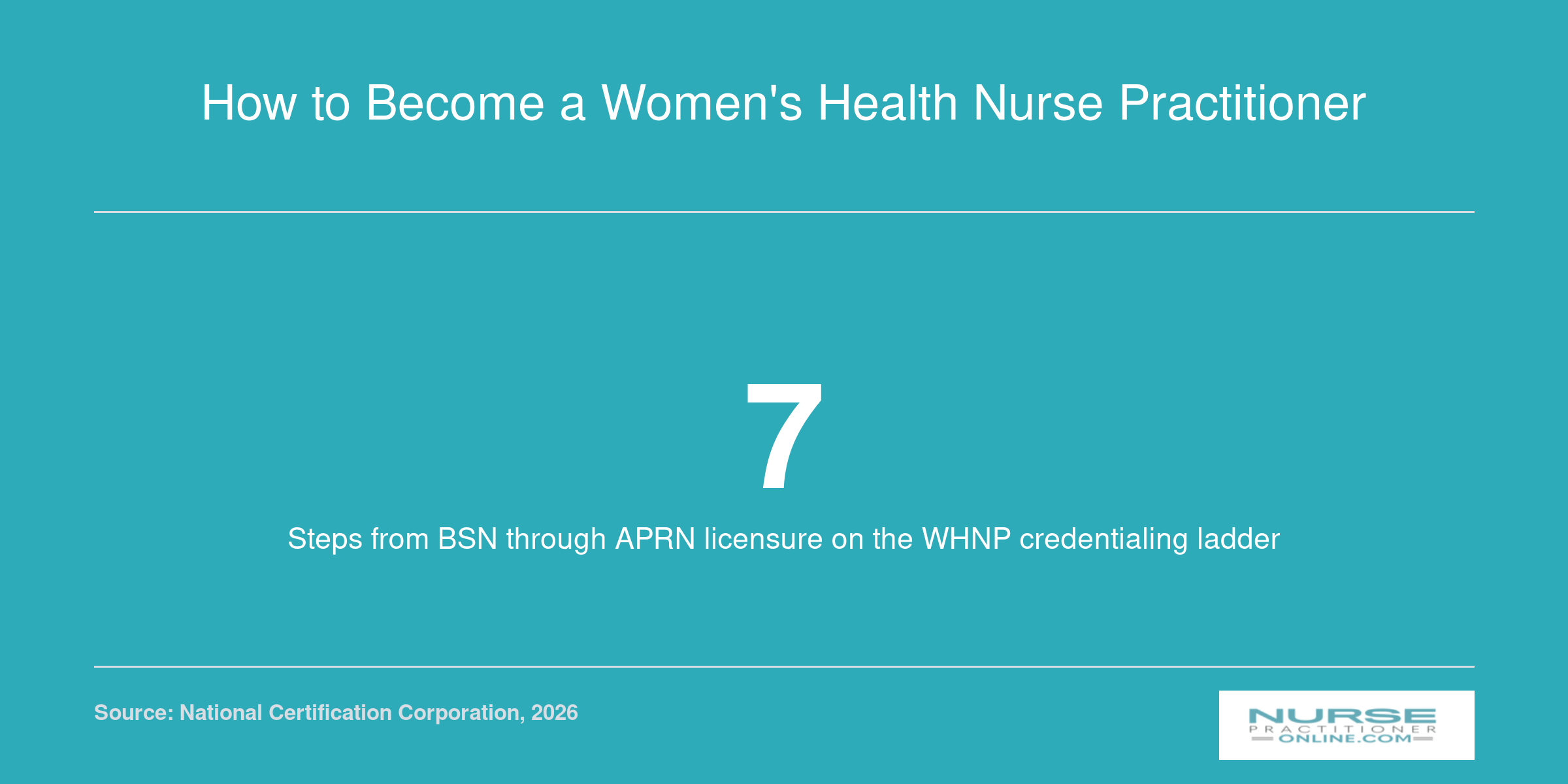
The path to becoming a WHNP follows a clear credentialing ladder, and each step builds on the last. Start with a BSN (about four years), earn your RN license, then gain one to two years of clinical experience, ideally in women's health or a related area. Next, complete an accredited MSN (two to three years) or DNP (three to four years) WHNP program. After graduating, you will sit for the NCC WHNP-BC exam, the only national certification for women's health nurse practitioners. The exam includes up to 175 questions over three hours, scored on a criterion-referenced scale where a 72 out of 100 is passing. You can take it at a test center or via live remote proctoring. Once certified, apply for state APRN licensure and begin practice. Recertification is required every three years.
WHNP Salary, Job Growth, and What Graduates Actually Earn
Salaries for nurse practitioners are among the highest in clinical nursing, but when you're eyeing a specialized role like women's health, you need more than just national averages. The data we have pulls back the curtain on what graduates of specific WHNP programs actually make, and how that stacks up against what they borrowed to get there.
National NP Salary Picture
The Bureau of Labor Statistics reports a 2024 median annual wage of $129,210 for nurse practitioners (SOC 29-1171). The lowest 10% earned about $87,340, while the top 10% cleared roughly $165,240.2 That gap reflects experience, setting, and geography: California leads with a mean annual wage of $161,540, followed by Nevada ($148,670), Washington ($145,400), New Jersey ($145,030), and Oregon ($144,950). Job growth projections are striking, with a 35% expansion forecast from 2024 to 2034.4 These numbers encompass all NP specialties, though, and the BLS does not break out women's health nurse practitioners as a separate line. WHNP-specific earnings can differ from the broader NP average, so comparing specialties like family nurse practitioner programs or best online PMHNP programs can help you gauge where women's health sits relative to other tracks.
What WHNP Graduates Actually Earn
Our program-level data gives a clearer view. For graduates of the ranked WHNP programs, median earnings 10 years after completion range widely, from $68,740 at one public university to $109,601 at another. The median debt at program completion sits between $12,500 and $19,500 across these programs. While one-year post-completion earnings are not yet available for these schools, the 10-year figures provide a useful long-run benchmark. Keep in mind that these numbers reflect all graduates of the program, not just those who stay in women's health practice.
Understanding the ROI of a WHNP Degree
A powerful way to evaluate a program is to compare what you borrow against what you stand to earn. The ratio of median earnings to median debt, what we call return on investment, shows how many dollars of income a graduate sees for every dollar of student debt. Among these programs, ROI ratios run from about 3.5 to 8.8. For example, a program with a $12,500 median debt and $109,601 in median earnings yields an ROI above 8.5. A program where graduates leave with $19,500 in debt and earn $69,020 produces an ROI closer to 3.5. That spread underscores why cost and earnings projections matter just as much as a school's reputation.
How WHNP-Specific Financial Aid Can Improve Your Return
Even with a strong ROI outlook, lowering debt up front changes the math. Several organizations offer scholarships aimed at women's health NP students: the Association of Women's Health, Obstetric and Neonatal Nurses (AWHONN), the March of Dimes, and Nurse Practitioners in Women's Health (NPWH) all have dedicated awards. On top of that, WHNPs who commit to working in designated shortage areas can apply for the Health Resources and Services Administration (HRSA) Nurse Corps Loan Repayment Program, which can wipe out a significant portion of student loans. When combined with a program that already has a low debt-to-earnings gap, these levers can make the degree feel more like a launchpad than a ledger entry.
Did you know? The Bureau of Labor Statistics projects nurse practitioner jobs will grow by 40.1% between 2024 and 2034, making it one of the fastest-growing fields, compared to just 3.1% for all occupations.
Frequently Asked Questions About Online WHNP Programs
Choosing a women's health nurse practitioner program raises a lot of practical questions, from scope of practice to timeline and cost. Below are the answers working nurses ask most often when weighing online WHNP programs in 2026.
- What is the difference between a WHNP and an FNP?
- A WHNP focuses exclusively on women's health and gender-related care, typically practicing in OB/GYN offices and women's health centers. An FNP treats individuals across the entire lifespan in family practice, urgent care, and community health settings. Certification also differs: WHNPs are certified through the National Certification Corporation, while FNPs earn credentials through the AANPCB or ANCC. The two roles overlap in some primary care skills, but the WHNP's training is more specialized in reproductive and gynecologic health.
- Are there fully online WHNP programs, or do all require in-person clinical hours?
- No accredited WHNP program is 100% online. All programs use a hybrid format: didactic coursework is delivered online, but clinical rotations must be completed in person at approved sites. This is because hands-on patient care experience in women's health settings is essential for certification eligibility and safe practice. The good news is that most programs allow you to arrange clinical placements near your home, so you can continue working while completing requirements.
- How long does it take to complete an online WHNP program?
- Timeline depends on degree level and enrollment pace. An MSN-level WHNP program typically takes 24 to 36 months full time, or 36 to 48 months part time. A DNP WHNP program generally runs 36 to 48 months because it adds a doctoral project and additional coursework. Many programs designed for working nurses offer part-time schedules that let you spread coursework across more semesters without sacrificing clinical quality.
- What clinical requirements do WHNP programs have?
- WHNP students must complete supervised clinical hours in women's health settings such as OB/GYN practices, reproductive health clinics, or midwifery offices. Most MSN programs require roughly 500 to 700 direct patient care hours, while DNP programs often exceed 1,000 total practice hours including the doctoral project. Students in online programs are usually responsible for identifying a qualified preceptor, though some schools offer placement assistance or maintain preceptor networks.
- How much does a women's health nurse practitioner earn compared to other NP specialties?
- Based on 2022 compensation data, WHNPs earn salaries comparable to family nurse practitioners, who reported a median annual wage of approximately $98,700. Psychiatric-mental health nurse practitioners (PMHNPs) topped NP specialties at a median of roughly $115,000. Earnings for WHNPs can vary based on location, practice setting, and experience. Demand for women's health services continues to support steady opportunities, particularly in underserved areas where access to specialized reproductive care is limited.
More Online WHNP Programs to Explore
In addition to our top-ranked programs, these accredited online WHNP offerings provide flexible pathways for nurses seeking advanced training in women's health. Each program is reviewed for curriculum, format, and accessibility.
Other
Fairleigh Dickinson University-Metropolitan Campus Teaneck, NJ · Online
- Post-graduate Certificate Program (Women’s Health Care)
University of Missouri-St Louis Saint Louis, MO · Hybrid
- Nursing DNP, Women's Health Nurse Practitioner Emphasis
Husson University Bangor, ME · Hybrid
- Women's Health Nurse Practitioner Certificate
Kent State University Kent, OH · Online
- Women's Health Nurse Practitioner Graduate Certificate
- Women's Health Nurse Practitioner
Explore Programs
Explore Programs
- Best Accelerated Nurse Practitioner
- Best Affordable Nurse Practitioner Programs of
- Best Online Acute Care Nurse Practitioner (ACNP)
- Best Online Adult-Gerontology NP Programs (AGPCNP & AGACNP)
- Best Online DNP Nurse Practitioner
- Best Online Emergency Nurse Practitioner (ENP)
- Best Online FNP
- Best Online MSN Nurse Practitioner
- Best Online Neonatal Nurse Practitioner (NNP)
- Best Online PMHNP
- Best Online PNP
- Best Online Post-Master's NP Certificate