Most important takeaways…
- PMHNPs earned an average of $145,000 in 2026 as the mental health provider shortage continued to deepen.
- BSN-to-DNP tracks typically require 70 to 90 credits, while MSN-to-DNP tracks range from 30 to 43 credits.
- Comparing total program cost against median post-completion earnings reveals wide ROI differences across schools.
- Accreditation status, clinical placement support, and certification exam pass rates should drive your final program choice.
The American Association of Colleges of Nursing has long positioned the DNP as the terminal degree for advanced practice nurses, and by 2026, a growing number of health systems and state boards are treating it that way. Psychiatric-mental health nurse practitioners now enter a field where the DNP has shifted from optional credential to emerging standard, particularly for nurses seeking leadership roles, faculty positions, or clinical autonomy in underserved markets.
Choosing between a BSN-to-DNP track and an MSN-to-DNP pathway depends on where you start, how much time you have, and what you can afford. Total program costs range from under $30,000 at some public institutions to well over $80,000 at private universities, and clinical hour requirements vary widely. Some programs require 1,000 post-master's clinical hours; others fold PMHNP certification and doctoral work into a single 80-credit BSN-to-DNP sequence.
Median earnings for experienced PMHNPs now exceed $145,000 annually, but student debt loads at some schools approach half that figure. The return on investment depends less on program prestige than on total borrowing, state licensure requirements, and whether your employer offers tuition assistance or loan repayment. If you are still weighing whether the investment makes sense, our deep dive into getting your DNP and whether it is worth it can help frame the decision.
Best Online DNP PMHNP Programs
The programs below represent some of the strongest options in 2026 for nurses looking to specialize in psychiatric-mental health care through an online or hybrid pathway. You will find a mix of DNP, MSN, and graduate certificate programs, each with its own entry requirements and clinical model. Whether you are a BSN-prepared nurse ready to jump into doctoral study or an experienced APRN adding a psychiatric specialty, this list highlights what each school does best so you can find the right fit for your goals and schedule.
- Graduate earnings and debt outcomes
- Institutional graduation and retention
- Program format and clinical model
- Tuition affordability and value
- Workforce relevance and specialization
- Internal program database
- Independent program research
- College Scorecard graduate earnings — collegescorecard.ed.gov
- NCES-IPEDS federal institutional data — nces.ed.gov

Florida State University
Florida State University offers a hybrid DNP with a dedicated Psychiatric-Mental Health Nurse Practitioner track, making it one of the few programs on this list that leads directly to a doctoral degree in the PMHNP specialty. The curriculum pairs online didactic coursework with clinical placements that span diverse settings, including underserved communities across Florida's Panhandle and rural north. FSU's College of Nursing is actively involved in state-level efforts to grow the behavioral health workforce, giving students strong connections to Florida employers.
- Hybrid format: online classes plus limited campus visits
- Full-time and part-time plans available for working nurses
- $444 per credit hour
- Prepares graduates for ANCC PMHNP-BC certification
- Clinical placements in hospitals, community centers, and private practices
- Capstone project required for graduation
- Fall start with application deadline in early May
- Focus on lifespan mental health, including underserved populations
DNP Psychiatric-Mental Health Nurse Practitioner — Hybrid

Florida International University
Florida International University stands out for offering three distinct PMHNP pathways under one roof: a Post-BSN to DNP, an MSN, and a post-graduate certificate. That breadth means nurses at virtually any career stage can find an entry point. Located in Miami, FIU places a strong emphasis on culturally and linguistically diverse mental health care, reflecting South Florida's multilingual population. Clinical placements are arranged across the university's established partner network in Miami-Dade, Broward, and nearby counties.
- Hybrid format combining online coursework and in-person clinicals
- Concentration in psychiatric-mental health across the lifespan
- Prepares for national PMHNP certification and APRN licensure
- Designed for BSN-prepared RNs entering doctoral study
- Emphasis on leadership in Florida's mental health systems
- Flexible scheduling for working professionals
- 45-credit hybrid program over six semesters
- Fall-only admission with a March 1 application deadline
- Clinical sites include psychiatric hospitals, crisis centers, and correctional settings
- Optional dual Nurse Educator track available
- Prepares for national certification and state APRN licensure
- Applied via NursingCAS
- 35-credit hybrid certificate for MSN-prepared nurses
- Builds advanced psychiatric assessment and prescribing skills
- Clinicals arranged within FIU's Florida partner network
- Prepares graduates for national PMHNP certification
- Fall admission cycle
- Psychopharmacology coursework included
Post-BSN to DNP, Psychiatric-Mental Health Nurse Practitioner — Hybrid
MSN Psychiatric-Mental Health Nurse Practitioner — Hybrid
Post-Graduate Nurse Practitioner Certificate, Psychiatric-Mental Health — Hybrid

University of Florida
The University of Florida's BSN-to-DNP Psychiatric-Mental Health Nurse Practitioner track is a hybrid program that takes BSN-prepared nurses all the way through to a practice doctorate. UF emphasizes clinical training in north-central Florida and other medically underserved areas, aligning with UF Health's mission to expand behavioral health access across the state. Both full-time and part-time plans are available, which is a meaningful perk for nurses who need to keep working while they study.
- Hybrid format with online didactic and in-person clinical hours
- Full-time and part-time scheduling options
- Advanced health assessment and psychotropic prescribing curriculum
- Clinical placements in rural, community, and urban Florida settings
- Graduates eligible for ANCC PMHNP-BC certification
- Emphasis on leadership and mental health advocacy
- All clinical training completed within Florida
BSN-to-DNP Psychiatric-Mental Health Nurse Practitioner — Hybrid

Yale University
Yale's School of Nursing offers a hybrid MSN in Psychiatric-Mental Health Nurse Practitioner that is designed for working registered nurses across the country. The three-year program blends asynchronous online coursework with three on-campus immersions, and it is especially well regarded for its dual emphasis on psychotherapy and psychopharmacology. With a 5:1 student-to-faculty ratio university-wide, Yale provides an unusually close-knit academic environment. The school-wide graduation rate is 95.7%, among the highest of any university in the nation, though this figure reflects the institution as a whole rather than the nursing program specifically.
- Three-year hybrid program for working RNs nationwide
- Asynchronous online coursework with three campus immersions
- Dual focus on psychotherapy and psychopharmacology
- Training in crisis intervention and collaborative care planning
- Tuition is $49,500 per year (same for all students)
- Median graduate debt of $12,975 across all programs at Yale
- Accepts applications via NursingCAS for Fall 2026
- Access to Yale New Haven Health clinical environments
MSN Psychiatric-Mental Health Nurse Practitioner — Online

University of North Carolina at Chapel Hill
UNC Chapel Hill's distance-based MSN with a PMHNP specialty is built for nurses who plan to practice in North Carolina. The program leans heavily on clinical partnerships with UNC Health and the NC Area Health Education Centers (AHEC) network, giving students access to placements in rural and underserved communities across the state. Coursework intentionally weaves in NC-specific behavioral health challenges, including the opioid crisis and rural access gaps, making it a strong choice for nurses committed to serving Tar Heel communities.
- Fully online distance-based format
- Lifespan psychiatric care curriculum
- Clinical placements arranged through AHEC and UNC Health partners
- Emphasis on psychopharmacology and individual, group, and family therapy
- Prepares for ANCC board certification
- NC-specific behavioral health policy integrated into coursework
- Evidence-based practice framework throughout the program
MSN Psychiatric-Mental Health Nurse Practitioner — Online

University of California-Davis
UC Davis serves as the administrative home for the UC Psychiatric Mental Health Nurse Practitioner Certificate, a first-of-its-kind multicampus collaboration among UC Davis, UCLA, UC Irvine, and UCSF. This 12-month, 48-unit hybrid program is designed to upskill California APRNs already practicing in primary care, FQHCs, and safety-net settings. Clinical placements are arranged within each student's home region to minimize disruption, and the entire program is built around addressing California's behavioral health workforce shortage.
- 12-month hybrid format with online classes and three immersions
- 48-unit graduate certificate for licensed APRNs
- Full-time enrollment required (four consecutive quarters)
- Clinical training 16 to 24 hours per week in home region
- Prepares for ANCC PMHNP-BC certification
- Admissions centralized through UC Davis
- Case-based, interprofessional curriculum
- Open to NPs, CNSs, CNMs, and CRNAs with California licensure
UC Psychiatric Mental Health Nurse Practitioner Certificate — Hybrid

University of California-Los Angeles
UCLA participates in the same UC system PMHNP certificate described above, with curriculum and admissions centralized through UC Davis. What UCLA adds is proximity to the dense, diverse mental health population of Los Angeles County and clinical partnerships with UCLA Health and surrounding safety-net systems. For APRNs living in Southern California, the LA-area clinical placements and interprofessional connections with UCLA's psychiatry and social work programs can be a significant advantage.
- Same 48-unit, 12-month hybrid certificate as UC Davis program
- Clinical placements arranged through UCLA Health and LA-area partners
- Virtual classes on Wednesdays with immersion sessions
- Designed for Southern California-based APRNs
- Interprofessional collaboration with UCLA psychiatry faculty
- Prepares for ANCC PMHNP-BC certification
- Full-time enrollment over four consecutive quarters
UC Psychiatric Mental Health Nurse Practitioner Certificate — Hybrid

University of California-Irvine
UC Irvine rounds out the UC system's multicampus PMHNP certificate, anchoring clinical placements in Orange County and surrounding Southern California communities. The program is especially relevant for APRNs working in integrated primary care and behavioral health practices in the region. Like its UC partner campuses, UCI emphasizes maintaining employment during training through a regional clinical model that limits commute time.
- Part of UC multicampus 48-unit, 12-month hybrid certificate
- Clinical sites in Orange County and Southern California
- Regional training model to support continued employment
- Virtual Wednesday case conferences plus immersion sessions
- First multicampus PMHNP upskilling program in California
- Prepares for ANCC PMHNP-BC certification
- Open to NPs, CNSs, CNMs, and CRNAs with active California license
UC Psychiatric Mental Health Nurse Practitioner Certificate — Hybrid

Texas A & M University-College Station
Texas A&M University offers an online Post-Graduate Certificate in Psychiatric Mental Health Nurse Practitioner, a 26-credit program aimed at graduate-prepared nurses who hold an active Texas RN license. Clinical placements are expected within Texas, and the College of Nursing emphasizes service to rural and underserved Texas communities. Coursework covers adult, child-adolescent, and older adult psychiatric care, with a curriculum aligned to Texas Board of Nursing APRN regulations for a straightforward path to state licensure.
- Fully online asynchronous coursework
- 26 credits with mandatory clinical hours in Texas
- Requires active, unencumbered Texas RN license and a graduate nursing degree
- Covers adult, child-adolescent, and older adult mental health
- Prepares for PMHNP national certification
- Application via NursingCAS with priority deadline in January
- Fall start in August each year
- Psychopharmacology and ethical, culturally diverse care emphasized
Post-Graduate Certificate in Psychiatric Mental Health Nurse Practitioner — Online

California State University-Stanislaus
CSU Stanislaus offers one of the most affordable PMHNP upskilling options in California through its Post-Graduate Psychiatric APRN Certificate. This hybrid program is tailored for MSN-prepared nurses with a California RN license, with clinical training arranged through partnerships with Central Valley health systems and county behavioral health departments. In-state tuition runs about $9,766 per year, making it a cost-effective path to psychiatric specialization for California-based APRNs.
- Hybrid format with online and campus-based components
- Requires MSN degree and current California RN license
- One year of prior nursing experience required
- Curriculum includes psychotherapy, neuroscience, and psychopharmacology
- Clinical placements in Central Valley and underserved California areas
- Prepares for advanced practice roles in psychiatric-mental health
- Minimum 3.0 GPA required for continued enrollment
Post-Graduate Psychiatric APRN Certificate — Hybrid
BSN-to-DNP vs. MSN-to-DNP PMHNP: Which Track Is Right for You?
BSN-prepared nurses and MSN-prepared nurses arrive at the DNP from very different starting lines, and the program you choose should reflect where you are now, not where you wish you were. Both tracks end in the same terminal degree and the same board eligibility, but the time, cost, and day-to-day experience along the way look quite different.
The BSN-to-DNP Track
This is the longer road, designed for registered nurses who hold a bachelor's in nursing but have not yet completed graduate work. Expect roughly 60 to 90 credit hours and three to six years of study depending on whether you enroll full-time or part-time.1 Programs like Indiana University (66 credits) and the University of Oklahoma Health Sciences Center (76 credits) sit squarely in that range.23 The curriculum folds in the foundational nurse practitioner coursework you would normally take at the master's level (advanced pathophysiology, pharmacology, and health assessment) before layering in PMHNP specialty content and the doctoral capstone.
Admission typically requires an active RN license, a BSN from an accredited program, a minimum 3.0 GPA, and at least one year of clinical nursing experience.4 Psychiatric or behavioral health background is a plus but rarely mandatory.
The MSN-to-DNP Track
If you already hold an MSN, this is the efficient path. Programs generally run 30 to 50 credit hours and finish in 24 to 36 months.1 Coursework focuses on doctoral-level content: systems leadership, health policy, evidence-based practice, informatics, and the DNP project. You will not repeat the NP foundations you already completed.
One important practical point: if you are already certified as a PMHNP (or another NP specialty) and hold state authorization, you can continue practicing as a nurse practitioner while enrolled in an MSN-to-DNP program.5 Many students keep working full-time and use their clinical setting as the backdrop for their DNP project. Admission requirements mirror the BSN track on GPA (3.0 minimum) and require an MSN from an accredited institution, an active RN license, and typically a year of relevant nursing experience.5 If you are still mapping out the overall path to practice, our guide on how to become a nurse practitioner breaks down every step from licensure to specialization.
Which Fits You?
Choose BSN-to-DNP if you want a single, seamless program that takes you from bedside RN to doctorally prepared PMHNP. Choose MSN-to-DNP if you already have your master's, want to keep practicing, and are ready to add the doctoral credential in the shortest reasonable timeframe. Nurses who want to compare timelines across specialties may also find our roundup of the best online nurse practitioner programs helpful for context.
Questions to Ask Yourself
How We Ranked These DNP PMHNP Programs
Ranking nurse practitioner programs always involves a tradeoff between what looks impressive on paper and what actually predicts a strong return for the working nurse paying tuition. We leaned toward the second. Instead of editorial impressions or reputation surveys, we built the list around measurable outcomes pulled from federal data, then filtered for programs that fit the practical realities of an employed RN going back to school.
The Criteria We Weighted
Each program was scored against a consistent set of factors, with no single metric dominating:
- Net price: The average cost students actually pay after grants and scholarships, drawn from the institution's reported figures rather than sticker tuition. If affordability is a top concern, our guide to the most affordable nurse practitioner programs offers additional context.
- Median graduate earnings: Post-completion earnings data for graduates of the institution, used as a directional signal of degree value.
- Median student debt: What graduates typically owe, balanced against earnings to approximate return on investment.
- Institutional graduation rate: A proxy for student support and completion culture at the university.
- Program format: Whether the DNP PMHNP track is genuinely online or hybrid, with clinical placement support that works for distance learners.
What These Numbers Do and Do Not Tell You
A few honest caveats matter here. Graduation rates are reported at the institution level, not the program level, so they describe the university broadly rather than the DNP cohort specifically. Net price is a sector-conditional average across undergraduates at the school, which means your actual graduate tuition bill will differ, sometimes significantly. Earnings figures reflect all graduates of an institution, not PMHNPs alone.
Accreditation and Format Were Non-Negotiable
Every program on the ranked list comes from a regionally accredited institution with CCNE or ACEN nursing accreditation, and each offers the DNP PMHNP in an online or hybrid format suitable for working nurses. Programs that required full-time campus residency or lacked current accreditation were excluded before scoring began. If you are still weighing whether to pursue this path, our step-by-step guide on how to enroll in NP school online walks through the application process.
DNP PMHNP Cost Comparison: Tuition, Debt, and ROI
The table below compares tuition, median graduate debt at completion, median earnings ten years after enrollment, and a simple ROI ratio (median earnings divided by median debt) for schools offering PMHNP pathways. A higher ROI ratio suggests stronger earning power relative to the debt you carry at graduation. Keep in mind that these figures reflect institution-wide graduate data rather than PMHNP-specific outcomes, since program-level earnings are not yet available for most of these schools. Also note that the listed tuition is the published graduate-level rate; your actual net price can vary significantly depending on your financial aid package, employer tuition assistance, military benefits, and state residency status.
| School | In-State Tuition | Out-of-State Tuition | Median Graduate Debt | Median Earnings (10 Yr) | ROI Ratio |
|---|---|---|---|---|---|
| Johns Hopkins University | $64,730 | $64,730 | $10,250 | $87,555 | 8.5 |
| Yale University | $49,500 | $49,500 | $12,975 | $100,533 | 7.7 |
| Vanderbilt University | $57,868 | $57,868 | $14,000 | $91,565 | 6.5 |
| University of California, Davis | $15,141 | $30,243 | $13,000 | $80,838 | 6.2 |
| University of California, Los Angeles | $14,476 | $29,578 | $14,000 | $82,511 | 5.9 |
| University of California, Irvine | $14,827 | $29,929 | $15,000 | $80,735 | 5.4 |
| University of North Carolina at Chapel Hill | $12,751 | $31,408 | $14,000 | $72,200 | 5.2 |
| University of Virginia | $23,526 | $37,628 | $17,500 | $86,863 | 5.0 |
| University of Florida | $12,737 | $30,130 | $15,000 | $71,588 | 4.8 |
| California State University, Stanislaus | $9,766 | $19,846 | $13,540 | $63,188 | 4.7 |
Related Articles
DNP PMHNP Curriculum and Clinical Hour Requirements
BSN-to-DNP and MSN-to-DNP tracks both lead to the same destination, but they take very different routes to get there. Understanding what each path requires in terms of coursework, clinical hours, and time on campus helps you match a program to your actual life.
How Clinical Hours Work
All DNP PMHNP programs must meet the national benchmark of at least 1,000 supervised clinical hours.1 Where things get interesting is how those hours are counted and structured depending on your starting point.
If you are coming in with a BSN, you will complete all your clinical hours within the program itself. Most BSN-to-DNP tracks require between 1,000 and 1,200 hours total, typically split between direct patient care hours (roughly 700 to 800 hours) and hours dedicated to your DNP scholarly project (roughly 200 to 300 hours).1 As a concrete example, UT Health San Antonio's BSN-to-DNP program totals 1,080 hours, with 810 hours of direct clinical work and 270 hours for the DNP project.2 The University of Colorado Anschutz program requires 1,100 total hours.3
If you already hold an MSN with NP preparation, your program may apply your prior clinical hours toward the overall requirement. Simmons University, for instance, accepts up to 500 hours of prior NP clinical experience, with the full graduate program requirement set at 1,000 hours.4 MSN-to-DNP programs generally expect between 1,000 and 1,500 hours total across both degrees.4
Core Curriculum Components
Regardless of track, DNP PMHNP programs cover a consistent set of clinical and leadership competencies.1 Expect courses in:
- Advanced psychopharmacology: the pharmacological foundation for managing psychiatric conditions across the lifespan
- Psychiatric assessment: comprehensive mental health evaluation skills, including differential diagnosis
- Advanced pathophysiology and health assessment: required across all DNP programs
- Evidence-based practice and informatics: translating research into clinical decision-making
- Healthcare policy and leadership: preparing you to influence systems, not just patients
- DNP scholarly project: a practice-focused capstone that distinguishes the DNP from an MSN
BSN-to-DNP programs require more total credits, typically 60 to 90, to cover this full scope.1
Can You Do It Fully Online?
Mostly, yes. Didactic coursework is delivered entirely online in virtually every program listed here. The caveat is clinical rotations, which by definition require in-person patient contact, and some programs also require brief on-campus intensives. Nova Southeastern University, for example, schedules one to three on-campus sessions per year5, and Simmons holds intensives running two to four days.4 If traveling to campus is a hardship, confirm the intensive schedule before you apply.
Preceptor and Clinical Placement Support
This is one of the most overlooked differences between programs, and it matters enormously as a working nurse. Some programs actively arrange clinical placements for you. The University of Colorado Anschutz, for instance, coordinates placements within the Denver metro area.3 Other programs expect students to identify and secure their own preceptors, which can be time-consuming and stressful, particularly in areas with mental health provider shortages. For practical tips on navigating this process, read our guide on how online NP students arrange clinicals in their local area.
Before committing to any program, ask directly whether the school arranges preceptors, whether placement support is available in your region, and what happens if you cannot secure a site on your own.
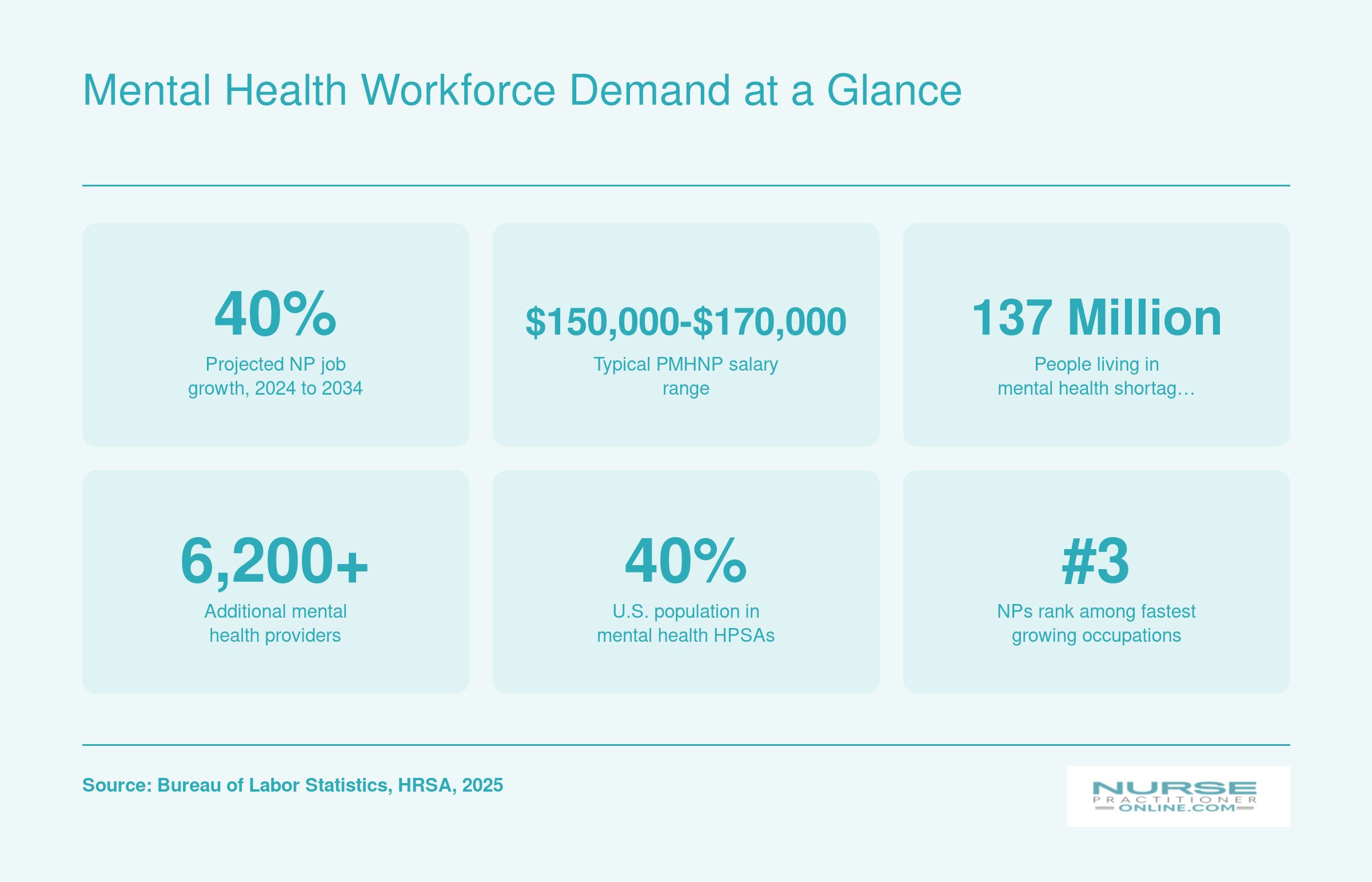
Mental Health Workforce Demand at a Glance
The mental health workforce gap continues to widen, and PMHNPs are uniquely positioned to help close it. These figures paint a compelling picture for nurses considering a DNP in psychiatric-mental health: demand is surging, salaries are strong, and millions of Americans still lack access to a psychiatric provider. For prospective DNP PMHNP students, these trends signal both job security and the chance to make a meaningful difference.
Is a DNP PMHNP Worth It? Salary, Career Outcomes, and Demand
The national average annual salary for psychiatric-mental health nurse practitioners reached $145,000 in 2026, up from $134,000 the previous year, reflecting both strong demand and the profession's critical role in addressing the nation's mental health crisis.1 For nurses weighing whether to invest in a DNP PMHNP credential, the financial and career returns merit close examination alongside the broader workforce context.
Salary Outcomes: What PMHNPs Actually Earn
New PMHNPs entering the workforce in 2026 typically earn between $115,000 and $135,000 annually in most markets, with high-demand regions offering starting salaries in the $130,000 to $150,000 range.2 The overall salary spectrum for psychiatric nurse practitioners spans $100,000 to $210,000, with experienced clinicians averaging $140,000 to $160,000 and top earners commanding $170,000 to $190,000.2 Geographic variation is significant: Ohio PMHNPs averaged $186,667 in 2026, Minnesota practitioners earned $180,296, and California clinicians saw average salaries of $172,928.1 Many states cluster in the $140,000 to $160,000 range, offering competitive compensation regardless of location.
Program-level earnings data from select institutions show strong early-career outcomes. Stony Brook University's DNP PMHNP graduates reported median earnings of approximately $75,000 one year post-completion, while Binghamton University graduates earned around $80,600. These figures represent early-career snapshots and typically rise substantially within the first few years of practice as new graduates gain clinical experience and autonomy.
The DNP Salary Premium: Does the Terminal Degree Pay More?
DNP-prepared PMHNPs often earn $10,000 to $20,000 more annually than their MSN-prepared counterparts, with the premium at the upper end of that range in competitive markets and leadership roles.3 This differential reflects several factors: DNP graduates frequently qualify for senior clinical positions, administrative roles, and faculty appointments that prioritize or require the terminal degree. The salary advantage compounds over a career, particularly for clinicians who pursue leadership tracks, policy work, or academic roles.
That said, the DNP premium is not universal. In purely clinical roles, especially early in practice, MSN and DNP PMHNPs often command similar compensation. Nurses still deciding between degree levels can explore a detailed comparison of the DNP or MSN degree pathway. The real financial advantage of the DNP emerges over time and in roles where the credential opens doors that would otherwise remain closed.
Beyond Salary: Career Advantages of the DNP
The DNP credential positions PMHNPs for opportunities that extend well beyond direct patient care. Most nursing faculty positions at universities now require or strongly prefer a DNP or PhD, making the terminal degree essential for nurses who want to teach future practitioners. Leadership roles in health systems, policy positions in government or advocacy organizations, and executive-level positions in mental health organizations increasingly favor DNP-prepared candidates.
As nursing education standards evolve, the DNP may become the standard entry credential for advanced practice. While no firm timeline exists, the profession's trajectory suggests that earning a DNP now positions nurses ahead of potential future requirements and ensures long-term credential relevance. For more context on this evolving landscape, see our analysis of where things stand after the 2025 DNP deadline has passed.
Mental Health Workforce Demand: A Growing Crisis
The demand for psychiatric providers has never been more acute. The Health Resources and Services Administration designates thousands of geographic areas and populations as mental health professional shortage areas, with rural communities and underserved urban neighborhoods facing particularly severe gaps. PMHNPs fill a critical role in these settings, often serving as the only accessible mental health prescribers in their communities.
This shortage shows no signs of abating. Mental health needs have escalated in recent years, driven by increasing recognition of psychiatric conditions, reduced stigma, expanded insurance coverage for mental health services, and the lingering effects of public health crises. PMHNPs enjoy exceptional job security, geographic mobility, and the ability to negotiate favorable practice terms in a market where qualified psychiatric providers remain scarce.
The Return on Investment
When considering the DNP investment, weigh tuition costs against both immediate salary potential and long-term career trajectory. A DNP PMHNP program typically costs $30,000 to $70,000 depending on the institution, with some private universities exceeding that range and public institutions often falling below it. Given median earnings of $145,000 and the career flexibility the credential provides, most graduates recover their educational investment within a few years of practice, especially when factoring in the salary premium and expanded job opportunities the DNP unlocks.
The credential's value extends beyond pure earnings. PMHNPs report high job satisfaction, meaningful work, and the ability to shape patient outcomes in profound ways. For nurses committed to psychiatric care and interested in leadership, education, or policy alongside clinical practice, the DNP represents not just a financial decision but a strategic career investment with returns measured in both income and professional impact.
How to Choose the Right Online DNP PMHNP Program
Choosing the wrong program costs you time, money, and in some cases, your ability to sit for the national certification exam. Here is a five-factor framework that cuts through the noise so you can make a confident decision.
Accreditation Comes First
Before anything else, confirm that the program holds nursing program accreditation from CCNE, ACEN, or NLN CNEA. These are the three bodies the American Nurses Credentialing Center recognizes when determining whether a candidate is eligible to sit for the PMHNP-BC exam.1 A program can be regionally accredited as a university and still leave you ineligible for certification if the nursing component lacks the right credential. Check the program's accreditation page, then verify directly with the accrediting body's website.
Clinical Placement Support
This is the issue that generates the most student frustration in online psychiatric NP education, and it rarely gets enough attention during the admissions process. Some programs arrange preceptors and clinical sites on your behalf. Others require you to find your own. Neither model is automatically better, but you need to know which one you are signing up for before you enroll. Ask the admissions team directly: does the program have a dedicated clinical placement coordinator, and what happens if a placement falls through? Get the answer in writing if you can.
The ANCC requires a minimum of 500 supervised clinical hours, and your curriculum must include training in at least two psychotherapeutic modalities alongside core graduate science courses such as advanced physiology/pathophysiology, advanced health assessment, and advanced pharmacology.1 Programs vary in how they structure and support that clinical experience.
State Authorization and Licensure Portability
Not every online program is authorized to enroll students in every state. This matters for two reasons. First, some states require that the institution hold specific authorization before you can complete clinical hours there. Second, licensure portability after graduation depends partly on whether your program met your state's standards from the start. For a broader look at credentials across specialties, our nurse practitioner licensing guide walks through the process state by state. Before you apply, contact the program and ask whether it is authorized to operate in your state.
Schedule Flexibility and Total Cost
Look at how courses are delivered. Fully asynchronous programs give you the most scheduling freedom, which matters if you are working full-time while completing your degree. Synchronous requirements, especially live sessions scheduled during business hours, can create real conflicts for working nurses. Part-time tracks extend your timeline but reduce per-semester financial pressure.
On cost, look beyond per-credit tuition. Factor in fees, technology costs, clinical travel, and whether the program requires any on-campus residencies. The national PMHNP-BC pass rate sits at around 82 percent1, so graduation outcomes and certification preparation quality are worth weighing alongside sticker price when you calculate the full return on your investment.
Frequently Asked Questions About DNP PMHNP Programs
Choosing a DNP PMHNP program is a big decision, and it helps to have clear answers before you commit. Below are the questions we hear most often from nurses considering this path, along with straightforward, fact-based responses to help you move forward with confidence.
- How long does a DNP PMHNP program take to complete?
- It depends on the entry track. BSN-to-DNP programs typically run three to four and a half years. For example, the University of Oklahoma offers a 36-month BSN-to-DNP option, while Duke University and Texas Tech each list 48 months, and the University of Colorado Anschutz comes in around 54 months. MSN-to-DNP programs are shorter, usually one to two years, since you have already completed graduate-level coursework.
- Can you complete a DNP PMHNP program fully online?
- Most DNP PMHNP programs deliver didactic coursework entirely online, which makes them a strong fit for working nurses. However, you will still need to complete clinical practicum hours in person at approved sites. Some programs also require a small number of on-campus intensives or immersion sessions each year. Always confirm the specific format before applying.
- What are the admission requirements for DNP PMHNP programs?
- Standard requirements across programs include a BSN (for BSN-to-DNP tracks) or MSN (for post-master's tracks), an unencumbered RN license, and a minimum GPA of 3.0. Applications are typically submitted through NursingCAS or a university's own portal. Many programs also ask for professional references, a personal statement, and a current resume highlighting clinical experience.
- How many clinical hours are required for a DNP PMHNP?
- Most accredited DNP PMHNP programs require at least 1,000 direct clinical hours in total, though some require more. BSN-to-DNP students complete the full count during their program, while MSN-to-DNP students may receive credit for hours earned during their master's degree. Check each program's breakdown, because policies on transferring prior clinical hours vary.
- What is the difference between BSN-to-DNP and MSN-to-DNP PMHNP programs?
- A BSN-to-DNP program is designed for nurses who hold a bachelor's degree and want to earn their doctorate without stopping at a master's. These programs are longer, typically three to four and a half years, and include foundational advanced practice coursework. An MSN-to-DNP program is built for nurses who already hold a master's degree. It focuses on doctoral-level content such as evidence-based practice, systems leadership, and a scholarly project, and usually takes one to two years.
- Do DNP PMHNP programs help you find clinical preceptors?
- Policies vary widely. Some programs actively arrange clinical placements and pair you with approved preceptors, while others expect students to secure their own sites. This is especially important for online students who may live far from the university. Before you apply, ask the program directly about preceptor support, because finding qualified psychiatric mental health preceptors can be competitive in certain regions.
- Is a DNP required to practice as a PMHNP?
- No. As of 2026, an MSN is still the minimum degree needed to sit for PMHNP national certification and practice in all 50 states. The AACN has recommended the DNP as the preferred entry-level degree for advanced practice, but this has not become a regulatory requirement. Earning a DNP can strengthen your clinical expertise, open leadership roles, and position you well if requirements change in the future.
More Online DNP PMHNP Programs to Consider
While the programs above represent our top picks, there are many other excellent online DNP PMHNP programs across the country. Explore the following schools to find the right fit for your career goals.
Other
University of Minnesota-Twin Cities Minneapolis, MN · Hybrid
- Psychiatric/Mental Health Nurse Practitioner
California State University-Long Beach Long Beach, CA · Hybrid
- Doctor of Nursing Practice (Psychiatric-Mental Health Across the Life Span)
University of Wisconsin-Madison Madison, WI · Hybrid
- Post-Graduate Psychiatric Nursing Capstone Certificate
- Nursing Practice: Psychiatric Mental Health Nurse Practitioner, DNP
Purdue University West Lafayette, IN · Hybrid
- Psychiatric/Mental Health Nurse Practitioner
- Post BSN to DNP with Psych Mental Health Specialization
- Psychiatric/Mental Health Nurse Practitioner Certificate Program
Ohio State University Columbus, OH · Hybrid
- Doctor of Nursing Practice (Psychiatric Mental Health Nurse Practitioner)
- Psychiatric Mental Health Nurse Practitioner
University of North Florida Jacksonville, FL · Online
- Psychiatric Mental Health Nurse Practitioner Certificate
- Psychiatric Mental Health Nurse Practitioner
California State University-San Marcos San Marcos, CA · Hybrid
- BSN to Doctor of Nursing Practice (Psychiatric Mental Health Nurse Practitioner)
- Master of Science in Nursing (Psychiatric-Mental Health Nurse Practitioner)
Florida Atlantic University Boca Raton, FL · Hybrid
- BSN to DNP (Psychiatric Mental Health Primary Care Nurse Practitioner)
- BSN to DNP (Psychiatric Mental Health Nurse Practitioner)
- Post Graduate Certificate Psychiatric Mental Health Nurse Practitioner Program
Stony Brook University Stony Brook, NY · Hybrid
- Psychiatric-Mental Health Nurse Practitioner DNP
Johns Hopkins University Baltimore, MD · Hybrid
- DNP: Psychiatric Mental Health Nurse Practitioner
- Psychiatric Mental Health Nurse Practitioner, Post-Master's Certificate
Binghamton University Vestal, NY · Hybrid
- DNP in Family Psychiatric Mental Health Nurse Practitioner