
Most important takeaways…
- George Mason, Radford, and Old Dominion offer some of the lowest net-price NP options in Virginia.
- BSN-to-DNP fast tracks in Virginia can be completed in as few as three years of full-time study.
- Most Virginia NP programs use a hybrid format, requiring students to secure their own clinical preceptors.
- An MSN takes roughly two to three years while a DNP adds one to two additional years and a scholarly project.
Virginia is home to 15 ranked nurse practitioner programs spanning public research universities, private colleges, and career-focused institutions. In-state graduate tuition starts below $8,400 at UVA Wise and climbs past $26,000 at Shenandoah, while program lengths range from 22-month accelerated tracks to three-year part-time plans built for nurses who cannot step away from clinical shifts.
That spread in cost and pace is the core tension. A lower price tag may mean fewer preceptor placement resources; a faster timeline may demand 30-plus clinical hours per week on top of coursework. Virginia grants NPs reduced practice authority, so the degree you choose and the certification exam you pass shape not just your title but your day-to-day autonomy in the state. Below, you will find ranked programs, cost comparisons, accelerated pathway breakdowns, and guidance on choosing between an MSN and a DNP.
Virginia's Leading Online Nurse Practitioner Programs, 2026 Rankings
We evaluated Virginia's online and hybrid NP programs using a composite that weights online-delivery availability alongside graduation rates, graduate debt levels, and post-completion earnings. The result is a ranked list designed to help working nurses find programs that balance academic quality, flexibility, and long-term career value. Note that some Virginia schools are shifting NP preparation entirely to the DNP pathway, so we flag those changes where they affect your planning.
- Online and hybrid delivery options
- Institution-wide graduation rates
- Graduate debt levels
- Post-completion earnings data
- Program breadth and flexibility
- Independent program research
- NCES-IPEDS federal institutional data — nces.ed.gov
- College Scorecard graduate earnings — collegescorecard.ed.gov
- Internal program database

University of Virginia
UVA's School of Nursing offers one of the strongest NP portfolios in the state, spanning FNP, PMHNP, AGACNP, and Pediatric NP tracks at both the MSN and DNP levels. A major 2026 update: the school is no longer accepting MSN NP applications for fall 2026 and is directing all new NP applicants to its DNP pathway. Hybrid delivery brings students to campus roughly once a month, with clinical placements supported through UVA Health. The school's overall graduation rate is 95.6%, and median graduate debt sits at $17,500, among the lowest in the state.
- Hybrid format with Thursday/Friday on-campus classes
- Two years full-time or three years part-time
- Total tuition roughly $25,756 (VA residents)
- No GRE required; 3.0 GPA and one year RN experience
- Prepares for ANCC or AANP certification exams
- Guaranteed admission for UVA Nursing alumni
- $914 per credit; in-person class about once per month
- 750 clinical hours with faculty-guided placement support
- Full-time and part-time schedules available
- Capstone project replaces traditional dissertation
- Prepares for ANCC or AANP FNP certification
- Access to interdisciplinary resources across UVA
- Monthly in-person sessions balanced with online coursework
- 500+ clinical hours, primarily in Virginia
- Two-year full-time or three-year part-time completion
- Focus on underserved and rural populations
- No GRE required; BSN and RN license needed
- Prepares for ANCC PMHNP certification
- Hybrid delivery; two years full-time completion
- 500 clinical hours at UVA Medical Center and partners
- Tuition approximately $21,942 (VA residents)
- Evidence-based practice and leadership emphasis
- No GRE required; one year RN experience
- Eligible for AACN or ANCC certification
- $914 per credit; three-year hybrid program
- 750 clinical hours with placements at UVA Health
- Eligible for ANCC or PNCB PNP certification
- Capstone required; interdisciplinary learning available
- Full-time and part-time tracks offered
- In-person class once per month
Family Nurse Practitioner (FNP) MSN — Hybrid
Family Nurse Practitioner (FNP) DNP — Hybrid
Psychiatric Mental Health Nurse Practitioner MSN — Hybrid
Adult Gerontology Acute Care Nurse Practitioner MSN — Hybrid
Pediatric Nurse Practitioner DNP (Primary Care) — Hybrid

George Mason University
George Mason, located in the Northern Virginia corridor, offers NP preparation through both an online MSN FNP and a hybrid BSN-to-DNP with multiple concentrations, including PMHNP and Adult Gerontology Primary Care. The MSN FNP is a fully online 49-credit program priced at roughly $850 per credit, making it accessible for out-of-state learners as well. The school's overall graduation rate is 67.8%, and median graduate debt is $19,500.
- Fully online 49-credit program; CCNE accredited
- Approximately $850 per credit plus $35 distance fee
- 500+ clinical hours with rolling admissions
- Two to three years to complete part-time
- Prepares for ANCC or AANP FNP certification
- One year nursing experience and BSN required
- 23 graduate credits; hybrid delivery format
- Prepares for national PMHNP certification
- Part-time study available for working nurses
- Eligible for prescriptive authority upon completion
- Available to students in 49 states via NC-SARA
- Current RN license and 3.0 GPA required
- 72 total credit hours; CCNE accredited
- BSN-to-DNP and MSN-to-DNP entry pathways
- 1,000 clinical hours with capstone project
- Four concentration options including PMHNP
- Transfer up to 30 credits from prior graduate work
- Full-time and part-time schedules offered
Family Nurse Practitioner (FNP) MSN — Online
Psychiatric Mental Health Nurse Practitioner Graduate Certificate — Hybrid
Nursing DNP (Multiple NP Concentrations) — Hybrid

University of Virginia's College at Wise
UVA Wise serves the rural southwestern corner of Virginia with a hybrid FNP master's program designed for nurses who want to keep working. The three-year, part-time track includes over 600 clinical hours through semester-long preceptorships, with placements primarily in Virginia. At $8,352 in published tuition (identical for in-state and out-of-state students), it is one of the most affordable options on this list. The school's overall graduation rate is 47.1%, and median graduate debt is $16,750.
- Three-year part-time hybrid format
- Over 600 clinical hours via preceptorships
- Identical tuition for in-state and out-of-state students
- Designed so students can continue working
- Focus on holistic, community-centered primary care
- Clinical placements primarily within Virginia
Family Nurse Practitioner (FNP) MSN — Hybrid

James Madison University
James Madison University stands out for its unique cross-institution PMHNP pathway, where students complete the first year at JMU and the second at Shenandoah University, graduating with both an MSN from JMU and a Post Graduate Certificate from Shenandoah. JMU also offers BSN-to-DNP tracks in FNP and Adult Gerontology Primary Care with small cohort sizes and dedicated clinical placement support. The school's overall graduation rate is 79.7%, and median graduate debt is $20,093.
- Joint program: Year 1 at JMU, Year 2 at Shenandoah University
- Graduates earn MSN from JMU plus post-grad certificate
- 22 credits at JMU, 29 credits at Shenandoah
- Part-time or full-time first-year options
- Hybrid format with interviews in January
- Applications due January 6
- 77 total credit hours; hybrid learning format
- Three-year full-time plan with small cohorts
- 1,000 clinical hours including 650 practicum hours
- Prepares for ANCC or AANP FNP certification
- Dedicated clinical placement support
- 3.2 GPA minimum; January start date
- Three-year full-time hybrid program
- Small cohort sizes with dedicated faculty support
- Aligned with AACN competencies
- Clinical placement assistance provided
- Prepares for APRN certification and licensure
- Capstone project required
Psychiatric Mental Health Nurse Practitioner MSN — Hybrid
Family Nurse Practitioner (FNP) BSN-to-DNP — Hybrid
Adult Gerontology Primary Care NP BSN-to-DNP — On-Campus

Liberty University
Liberty University delivers its NP programs almost entirely online, with one required residential intensive on the Lynchburg campus. NP tracks span FNP and PMHNP at the DNP level, plus a post-graduate PMHNP certificate. The university uses the same per-credit rate for all students regardless of state, and it accepts up to 50% transfer credits. Three start dates per year give working nurses added scheduling control. The school's overall graduation rate is 65.3%, and median graduate debt is $24,500.
- 78 total credit hours; fully online with one intensive
- BSN or MSN entry options available
- $850 per credit; military tuition at $375 per credit
- No standardized testing required for admission
- Weekly online meetings with faculty
- Practicum placement assistance and state-licensure compliant
- 59 credit hours (post-master's) or 73 credits (BSN-to-DNP)
- CCNE accredited; three start dates per year
- Telehealth allowed for up to 50% of practicum hours
- Transfer up to 50% of credits from prior programs
- Prepares for ANCC PMHNP certification exam
- Financial aid, scholarships, and military benefits accepted
- 18 credit hours; fully online with no set login times
- $850 per credit; 8-week course structure
- Requires MSN or DNP plus active APRN license
- Practicum experience and comprehensive exam included
- Credits may apply toward a doctoral degree
- CCNE and SACSCOC accredited
Family Nurse Practitioner (FNP) DNP — Online
Psychiatric Mental Health Nurse Practitioner DNP — Online
Psychiatric Mental Health Nurse Practitioner Post-Graduate Certificate — Online

Regent University
Regent University in Virginia Beach offers FNP and PMHNP pathways at the MSN, DNP, and post-master's certificate levels, all delivered online with a brief two-day on-campus residency. At $590 per credit, Regent's per-credit cost is among the lowest for private institutions on this list. The program is CCNE accredited and includes a White Coat ceremony before students begin their practicum. The school's overall graduation rate is 56.9%, and median graduate debt is $24,534.
- 47 credit hours; $590 per credit; CCNE accredited
- Online with one on-campus residency in Virginia Beach
- BSN, 3.0 GPA, and one year clinical experience required
- Faculty interview as part of the admissions process
- Prepares for APRN certification and licensure
- Next cohort starts August 2026
- 74 total credit hours; $590 per credit
- Online with on-campus residency and White Coat ceremony
- Clinical partnerships with EVMS
- Military benefits and veteran discounts accepted
- Financial aid available; 3.0 GPA minimum
- Work experience and prerequisite courses required
- 26 credit hours; $580 per credit; $15,080 total tuition
- Fully online delivery with two-day campus residency
- Current RN and APRN licenses required
- Faculty interview and resume submission needed
- Designed for nurses adding an FNP credential
- Pursuing CCNE accreditation
- 74 total credit hours; $590 per credit; CCNE accredited
- Full-time and part-time options with three annual starts
- Two-day on-campus residency required
- Prepares for national PMHNP certification
- One year RN experience required; 3.0 GPA minimum
- Military benefits accepted; fully online delivery
Family Nurse Practitioner (FNP) MSN — Hybrid
Family Nurse Practitioner (FNP) DNP — Hybrid
Family Nurse Practitioner Post-Master's Certificate — On-Campus
Psychiatric Mental Health Nurse Practitioner DNP — Online

Virginia Commonwealth University
VCU's NP programs are built around its Magnet-designated Medical Center in Richmond, giving students access to team-based clinical training with school-matched preceptors. DNP tracks include FNP, PMHNP, and Adult Gerontology Acute Care, all offered in a 3.5-year, part-time hybrid format. VCU reports a 91% FNP and 100% PMHNP first-time certification pass rate. Note: the FNP concentration is currently closed for fall 2026 due to capacity limits. The school's overall graduation rate is 63.2%, and median graduate debt is $21,500.
- 10-semester, 3.5-year part-time hybrid program
- 91% first-time FNP certification pass rate
- School-matched preceptors; no self-placement required
- Graduate teaching assistantships can cover tuition
- BSN graduates of VCU get guaranteed admission
- Currently closed for fall 2026 (capacity limited)
- 3.5-year part-time hybrid format
- 100% first-time PMHNP certification pass rate
- Clinical placement support at VCU Medical Center
- No dissertation; practice-focused DNP project
- Graduate teaching assistantships available
- Fall start; application deadline November 1, 2026
- 10-semester part-time hybrid program
- 100% first-time certification pass rate
- Train at Magnet-designated VCU Medical Center
- Preceptors matched by program faculty
- Financial aid, scholarships, and assistantships offered
- Practice-focused capstone replaces dissertation
- Two-year part-time hybrid delivery
- 91% certification exam pass rate reported
- One on-campus day per week with online coursework
- Clinical placement support provided
- For RNs with an existing master's degree
- Financial aid and scholarships available
Family Nurse Practitioner (FNP) DNP — Hybrid
Psychiatric Mental Health Nurse Practitioner DNP — Hybrid
Adult Gerontology Acute Care Nurse Practitioner DNP — Hybrid
Family Nurse Practitioner Post-Master's Certificate — Hybrid

Old Dominion University
Old Dominion University's Ellmer School of Nursing delivers NP preparation through hybrid MSN tracks in FNP, PMHNP, and Pediatric NP, plus a post-master's DNP for psychiatric mental health. The FNP program is approved by the Virginia Joint Boards of Nursing and Medicine and reports a 96% certification pass rate and 95% employment rate. Clinical sessions take place at ODU's Virginia Beach campus. The school's overall graduation rate is 46.3%, and median graduate debt is $24,000.
- Hybrid format with on-campus clinical sessions in Virginia Beach
- 96% certification pass rate and 95% employment rate (2024)
- Approved by the Virginia Joint Boards of Nursing and Medicine
- Up to 12 transfer credits accepted (B or higher)
- Student Clinical Services Coordinator assists with placements
- 3.0 GPA, three recommendations, one year RN experience
- 40 total credits; two-year full-time hybrid program
- 22 credits core MSN plus 18 credits PMHNP concentration
- Lifespan approach to psychiatric and mental health care
- Comprehensive portfolio evaluation at completion
- Progression to post-master's DNP available
- Prerequisites in statistics and health assessment required
- 100% licensure pass rate and 100% degree completion rate
- 560 clinical hours with placement assistance
- Hybrid format using Canvas with on-campus simulation
- No GRE required for applicants with 3.5+ GPA
- Primary care pediatric focus across the lifespan
- 91% job placement rate reported
- $486 per credit; seven-semester program
- Current RN license and master's in nursing required
- Advanced diagnostics and emerging care technologies
- Scholarships and assistantships available
- Application deadline September 1
- Three letters of recommendation required
Family Nurse Practitioner (FNP) MSN — Hybrid
Psychiatric Mental Health Nurse Practitioner MSN — Hybrid
Pediatric Nurse Practitioner MSN — Hybrid
Post-Master's PMHNP DNP — On-Campus

Radford University
Radford University, in Virginia's New River Valley, offers NP preparation through DNP tracks in FNP and PMHNP plus a standalone PMHNP graduate certificate that can be completed in as little as one year full-time. The programs use an online and hybrid delivery mix, and the FNP DNP emphasizes holistic, family-centered primary care across the lifespan. The school's overall graduation rate is 48.7%, and median graduate debt is $24,000.
- Hybrid format with main campus location in Radford
- Prepares for AANP or ANCC FNP certification exams
- Focus on holistic, family-centered primary care
- Admission available every semester
- Priority admission offered for qualified applicants
- Primary healthcare across the lifespan
- Online format with focus on psychopharmacological interventions
- Addresses acute and chronic mental illness across the lifespan
- Emphasis on mental health promotion and prevention
- Prepares for PMHNP certification exam
- Psychotherapeutic and medication management training
- Available as a BSN-to-DNP concentration
- 23 credit hours; 540 clinical hours required
- Full-time completion in one year; part-time in 18 to 24 months
- Online delivery format; no GRE required
- Requires master's or doctoral nursing degree and NP certification
- 3.5 graduate GPA, professional references, personal interview
- Prepares for ANCC PMHNP certification exam
Family Nurse Practitioner (FNP) DNP — Online
Psychiatric Mental Health Nurse Practitioner DNP — Hybrid
Psychiatric Mental Health Nurse Practitioner Graduate Certificate — Hybrid
What Virginia NP Graduates Earn, and What Programs Cost
Program-level earnings and tuition data for Virginia NP programs are not yet available in the current College Scorecard release. When updated figures are published, this section will feature a side-by-side comparison of median first-year post-completion earnings and graduate tuition at leading Virginia NP schools, giving you a quick return-on-investment snapshot.
The NP Landscape in Virginia: Demand, Scope of Practice, and Salary
How many nurse practitioner programs are available in Virginia, and is the job market strong enough to justify the investment? Both questions have encouraging answers, but the details matter before you commit to a program.
Workforce Demand and Salaries Across Virginia
Virginia consistently ranks among the stronger mid-Atlantic states for NP employment. The Bureau of Labor Statistics places the statewide median annual wage for nurse practitioners well above the national average, with notable variation across the state's three major metro regions. The Northern Virginia and Washington D.C. corridor tends to produce the highest compensation figures, reflecting both the cost of living and the concentration of federal health systems and large hospital networks. The Richmond metro sits in the middle range, buoyed by a growing academic medical hub anchored by VCU Health and HCA facilities. Hampton Roads, while historically more military-health-care-focused, has seen steady NP demand grow as civilian health systems expand.
For working nurses weighing whether to pursue an NP credential, those regional salary differences are worth mapping against where you actually plan to practice, not just statewide averages.
Scope of Practice: What Virginia Currently Allows
Virginia operates under a reduced practice model as of 2026. That means newly licensed NPs must complete a two-year transition period under a collaborative agreement with a physician before they can practice with greater autonomy. After that period, autonomous practice becomes available. NPs in Virginia hold prescriptive authority across Schedules II through VI, which covers the broad range of medications most primary care and specialty NPs prescribe daily. For a broader look at how Virginia compares, our nurse practitioner scope of practice guide breaks down rules across all 50 states.
No full practice authority legislation was enacted during the 2025 to 2026 legislative session, despite ongoing advocacy from nursing organizations.4 Bills have been introduced and tracked by groups like the Virginia Nurses Association, but the collaborative requirement for new graduates remains in place for now. That is worth factoring in if your career plan involves opening an independent practice quickly after graduation.
The MSN-to-DNP Shift and Program Count
Virginia is home to more than a dozen NP programs spanning public universities, private institutions, and online-focused schools, giving applicants a genuine range of format, cost, and specialty options. One notable trend shaping that landscape: the University of Virginia has moved away from offering a master's-level NP pathway, joining a national shift toward the Doctor of Nursing Practice as the terminal entry credential. Other Virginia schools are watching that transition closely, and the MSN versus DNP question is becoming less theoretical and more urgent for nurses who are planning a two-to-four year timeline. If you are still leaning toward the master's route, our ranking of the best online MSN nurse practitioner programs can help you compare what is available nationally. That distinction gets its own section later in this guide.
Related Articles
Lowest-Tuition NP Programs in Virginia: A Cost Comparison
Sticker price rarely tells the full story. The net price column below reflects an institution-wide average after grants and scholarships have been applied, so it gives you a more realistic sense of out-of-pocket costs than published tuition alone. Keep in mind that net price is not a program-specific quote; your actual cost will depend on your financial aid package, residency status, and enrollment pace. To bring costs down further, look into the HRSA Nurse Corps Scholarship Program, which covers full tuition, required fees, and a monthly stipend of $1,490 for full-time NP students who commit to two years of service in a high-need area (applications for 2026 closed April 9). Virginia also participates in state loan repayment initiatives for nurses serving in underserved communities, and many health systems across the commonwealth offer employer tuition assistance that can offset thousands of dollars per year. Combining even two of these resources can dramatically shrink your total graduate debt.
| School | NP Program Offered | In-State Tuition | Out-of-State Tuition | Avg. Net Price (Institution-Wide) | Median Graduate Debt |
|---|---|---|---|---|---|
| University of Virginia's College at Wise | MSN, Family Nurse Practitioner (Hybrid) | $8,352 | $8,352 | $9,210 | $16,750 |
| Mary Baldwin University | MSN, Family Nurse Practitioner (Hybrid) | $18,865 | $18,865 | $12,756 | $26,586 |
| Radford University | PMHNP Graduate Certificate (Hybrid) | $13,762 | $23,525 | $14,578 | $24,000 |
Questions to Ask Yourself
Accelerated and Fast-Track NP Programs in Virginia
Speed versus depth: that is the central tradeoff when evaluating accelerated NP pathways. A faster program gets you into practice sooner, but the right pace depends on your current credentials, your clinical availability, and how much intensity your life can absorb right now.
What "Accelerated" Actually Means for NP Programs
The term accelerated gets applied loosely in graduate nursing, so it helps to know what you are comparing. Nationally, intensive BSN-to-DNP programs can run as short as 18 to 30 months, though programs at that pace are uncommon and are rarely built around full family nurse practitioner preparation.1 Post-MSN DNP completion tracks, on the other hand, can often be finished in 12 to 18 months, but these typically focus on leadership or health systems work rather than NP clinical training.1 If you already hold an MSN with an NP specialty, a DNP completion program is the fastest available path. If you are starting from a BSN, you should expect a longer runway regardless of how a program markets itself. For a deeper look at how timelines vary by entry point, our guide on how long a DNP program takes breaks down each pathway in detail.
Virginia-Specific Timelines
At the University of Virginia, the BSN-to-DNP nurse practitioner program runs between 36 and 60 months depending on whether you enroll part-time or full-time. The program is delivered in a hybrid format, and part-time enrollment is available, which matters enormously for working nurses who cannot step away from their jobs. Virginia Commonwealth University also offers a BSN-to-DNP post-baccalaureate pathway, with fall start terms.3 For both programs, and for others at institutions like Liberty University, George Mason, Old Dominion, Radford, Marymount, and Shenandoah, the specific timelines depend on your enrollment pace, the specialty track you choose, and how clinical hours are scheduled across semesters. If you are specifically considering a doctorate, our roundup of online DNP NP programs in Virginia compares costs, formats, and completion timelines side by side.
How to Find the Most Current Information
Program structures change more often than most prospective students expect. The most reliable approach is to go directly to each school's graduate nursing program page and look specifically for sections labeled "fast-track," "accelerated," or "nurse practitioner pathways." From there, contact the admissions office by phone or email and ask three targeted questions: What is the minimum time to completion for a full-time student? Is part-time enrollment available, and what does that add to the timeline? Is year-round enrollment an option?
For broader context on NP career outlook and educational standards, the American Association of Nurse Practitioners and the American Association of Colleges of Nursing both publish updated guidance on program formats and professional requirements. You can also review our list of accelerated nurse practitioner programs nationwide for comparison. Cross-referencing those resources with what a specific Virginia school tells you directly will give you the clearest, most current picture of your options.
Online vs. Hybrid NP Programs in Virginia: Format, Clinicals, and Preceptor Support
Format alone doesn't tell you what you need to know about a Virginia NP program. Two schools can both call themselves "online," yet one ships you a confirmed preceptor and the other hands you a directory and wishes you luck. That distinction shapes your stress level, your timeline, and sometimes whether you finish at all.
Three Delivery Formats You'll Encounter
Virginia programs generally fall into three buckets. Fully asynchronous online programs let you watch lectures on your own schedule and complete clinicals near home. Synchronous online programs (Shenandoah's MSN-FNP is the clearest example) hold live virtual class sessions on set evenings, with a short on-campus immersion in the fall.1 Hybrid programs, including the University of Virginia DNP-FNP and Old Dominion's FNP MSN, blend distance coursework with periodic in-person sessions on campus.2
None of these formats reduce the clinical hours you owe. FNP tracks in Virginia typically require 500 to 720 supervised clinical hours, completed locally with approved preceptors regardless of how lectures are delivered. If you're wondering how that process works in practice, our guide on how online NP students arrange local clinical placements walks you through the logistics.
Who Finds Your Preceptor?
This is the question prospective students ask too late. Policies vary sharply:
- Shenandoah University (MSN-FNP): The school finalizes preceptor selection and clinical placement. You provide leads and preferences; faculty handle confirmation.1
- University of Virginia (DNP-FNP): Faculty offer guidance and help you identify placements, with structured support through the process.
- Old Dominion University (FNP MSN): Student-initiated placement with school approval. You source the preceptor; the school vets and approves.2
- Radford University (BSN-DNP FNP): Student responsibility with faculty oversight. The legwork is yours.4
If you live in a rural area or work in a saturated market like Northern Virginia, the difference between "we place you" and "you find your own" can add months to your timeline.
Out-of-State Enrollment and Licensure Portability
Most Virginia online NP programs accept students from other states, but state authorization rules limit which ones.4 Shenandoah explicitly accepts out-of-state students and asks that your RN license cover both Virginia (or the multistate compact) and the state where you complete clinicals.1 Old Dominion accepts out-of-state students subject to authorization limits, so confirm your state is approved before applying.2 For a deeper look at navigating these rules, see our resource on online NP programs for out-of-state students. Always verify that the program meets the NP licensure requirements in the state where you intend to practice after graduation.
MSN vs. DNP for Nurse Practitioners in Virginia: Cost, Time, and Career Impact
One of the biggest decisions you'll face as a Virginia nurse weighing NP programs is whether to pursue a Master of Science in Nursing (MSN) or a Doctor of Nursing Practice (DNP). Both degrees qualify you to sit for national certification and practice as an NP in Virginia, but they differ meaningfully in cost, time commitment, and long-term career positioning. The University of Virginia stopped accepting MSN-NP applications for Fall 2026, shifting nurse practitioner preparation entirely to its DNP track. While schools like Old Dominion University, Regent University, UVA Wise, and Mary Baldwin University still offer MSN-level NP pathways, the trend toward DNP-only entry is gaining momentum nationally. No state or federal regulation currently mandates a DNP to practice as a nurse practitioner in Virginia, so an MSN remains a fully valid entry point. Program-level earnings data for MSN and DNP NP completers at Virginia schools are not yet available, which makes direct salary comparisons program by program difficult. However, DNP holders often qualify for leadership, faculty, and health-system roles that command higher pay over a career.
| Factor | MSN (Nurse Practitioner) | DNP (Nurse Practitioner) |
|---|---|---|
| Typical Credit Hours | 42 to 50 credits (e.g., Regent University requires 47 credits; Mary Baldwin University requires 47 credits) | 70 to 90+ credits for BSN-to-DNP pathways; post-master's DNP tracks are shorter (30 to 40 credits) |
| Time to Complete | 2 to 3 years (full-time to part-time). UVA Wise, for example, offers a 3-year part-time MSN-FNP. | 3 to 4 years for BSN-to-DNP (full-time). Post-master's DNP completion may take 1.5 to 2 years part-time. |
| Clinical Hour Requirements | Approximately 500 to 700 supervised clinical hours. Old Dominion and Mary Baldwin both require around 600 hours. | Approximately 1,000+ total practice hours, including a scholarly DNP project with a clinical component. |
| Estimated Total Tuition (Virginia Resident, In-State Public) | Roughly $25,000 to $35,000 at public schools. UVA listed approximately $25,756 total for Virginia residents in its MSN-FNP track. | Roughly $40,000 to $65,000+ at public schools due to additional credit hours and longer enrollment. |
| Virginia Schools Still Offering This Pathway | Old Dominion University, UVA Wise, Mary Baldwin University, Regent University, and others | University of Virginia (DNP only for NP entry as of 2026), George Mason University, Radford University (BSN-to-DNP), and VCU |
| Required for NP Licensure in Virginia? | Yes. Virginia's Board of Nursing accepts an MSN with NP preparation for APRN licensure. | Not currently required. No Virginia or national mandate exists requiring a DNP for NP practice as of 2026. |
| Career and Salary Implications | Fully qualifies you for clinical NP roles. Lower upfront cost and faster entry into practice can mean earlier earning potential. | Opens doors to academic faculty positions, executive leadership, and health-system quality roles. May offer a salary premium in organizational and educational settings over time. |
| Key Consideration | If your goal is clinical practice and you want to start earning NP wages sooner, the MSN is a practical, cost-effective choice. | If you anticipate wanting leadership roles, teaching opportunities, or future-proofing against potential regulatory changes, the DNP positions you well. |
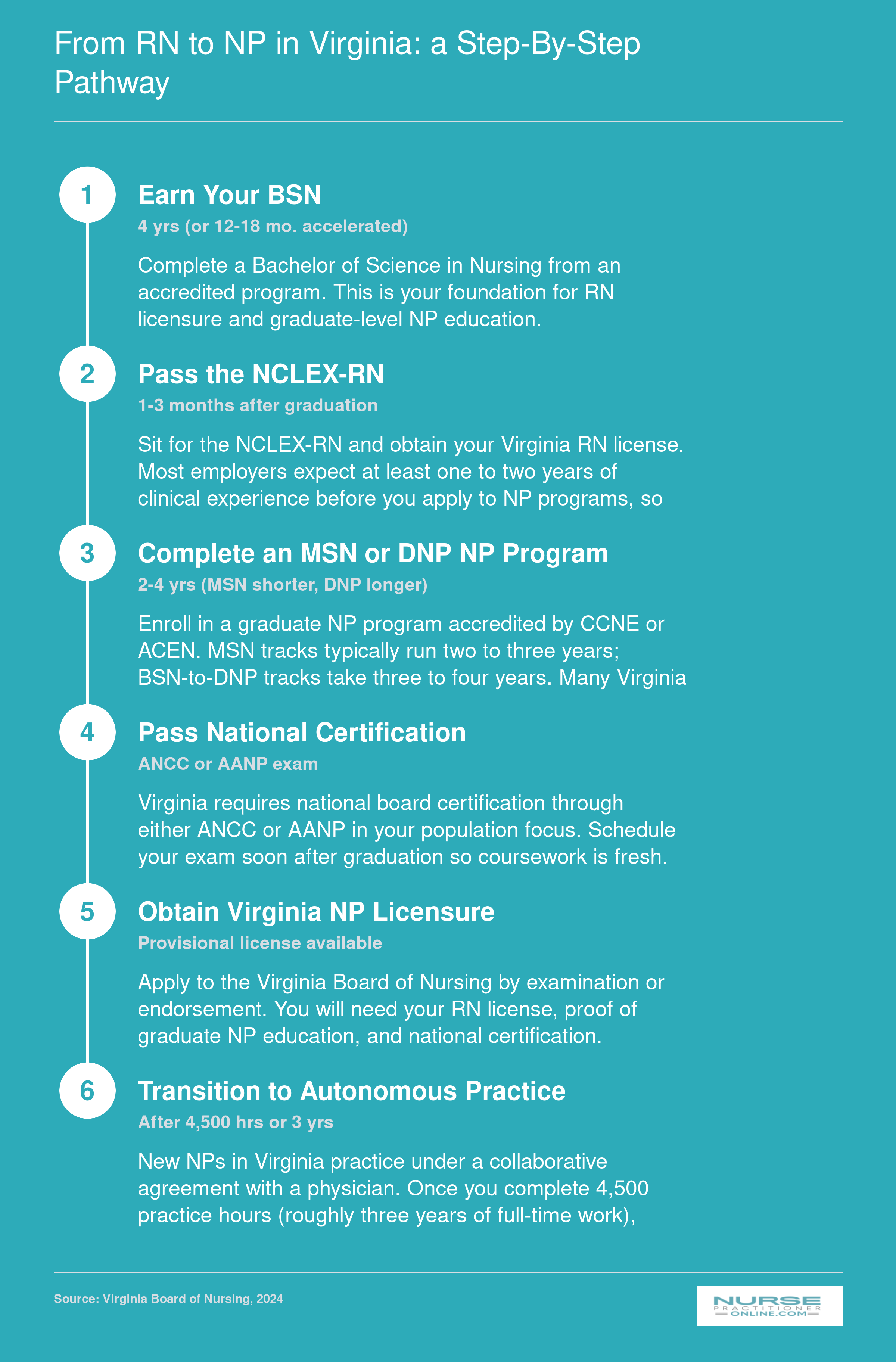
From RN to NP in Virginia: A Step-by-Step Pathway
Wondering how long it actually takes to go from bedside nurse to practicing nurse practitioner in Virginia? Here is the credentialing ladder, with realistic timelines at each stage. Most nurses complete the journey in five to eight years after earning a BSN, depending on whether they pursue an MSN or DNP and how quickly they log the required practice hours for autonomous authority.
Virginia NP Program Questions, Answered
These are the questions working nurses ask most often when exploring nurse practitioner programs in Virginia. Each answer draws on current program details and state requirements to help you plan with confidence.
- How long does it take to go from BSN to nurse practitioner in Virginia?
- Most BSN to MSN nurse practitioner programs in Virginia take about two to three years of full-time study. Part-time tracks, which are popular with working nurses, typically run three to four years. Accelerated BSN to DNP pathways can be completed in as few as three years at schools like George Mason University or the University of Virginia, though many students finish in four years when balancing clinical work.
- What are the cheapest NP programs in Virginia, and how can I lower my cost further?
- Radford University and Old Dominion University consistently rank among the most affordable NP programs in the state, with in-state graduate tuition well below the national average. To reduce costs further, look into employer tuition reimbursement, federal NURSE Corps scholarships, and HRSA loan repayment programs for graduates who practice in underserved areas. Virginia state financial aid and graduate assistantships can also make a meaningful difference.
- Can I earn my nurse practitioner degree entirely online through a Virginia school?
- Several Virginia schools offer NP programs with fully online coursework, including Old Dominion University, Radford University, and George Mason University. However, no program is 100 percent remote because accreditation standards require hands-on clinical hours. You will complete clinical rotations in person, often at a site near your home. Many programs provide preceptor placement support to help you secure local clinical sites.
- How many clinical hours do Virginia NP programs require?
- Virginia NP programs typically require a minimum of 500 direct patient care clinical hours for MSN tracks, consistent with national certification board standards from ANCC and AANP. DNP programs often require 1,000 or more total practice hours, which may include a scholarly project component. Some schools, such as the University of Virginia, build additional clinical time into their curricula beyond the minimum threshold.
- What is the difference between MSN and DNP for nurse practitioners in Virginia?
- The MSN is a master's level degree that prepares you to sit for NP certification and begin practice, usually in two to three years. The DNP is a doctoral degree that adds training in leadership, evidence-based practice, and systems improvement, typically requiring one to two additional years beyond the MSN. Both qualify you to practice as an NP in Virginia. A DNP may open doors to faculty roles, executive positions, and slightly higher earning potential over time.
More Virginia NP Programs Worth Exploring
In addition to the top-ranked programs, several other Virginia schools offer quality NP education. Here are more options worth exploring, each with unique features and formats.
Northern Virginia
Marymount University Arlington, VA · Online
- Master of Science in Nursing – Psychiatric Mental Health Nurse Practitioner
- Doctor of Nursing Practice – Family Nurse Practitioner Program
- Doctor of Nursing Practice – Family Nurse Practitioner
- Online BSN to DNP PMHNP
Richmond Area
South University-Richmond Glen Allen, VA · Online
- RN to Master of Science in Nursing in Adult-Gerontology Primary Care Nurse Practitioner
Hampton Roads
ECPI University Virginia Beach, VA · Online
- MSN – Family Nurse Practitioner
South University-Virginia Beach Virginia Beach, VA · Online
- Master of Science in Nursing with a Specialization in Adult-Gerontology Primary Care Nurse Practitioner
Shenandoah Valley
Mary Baldwin University Staunton, VA · Hybrid
- Master of Science in Nursing - Family Nurse Practitioner Track (MSN)
- Post-MSN Family Nurse Practitioner Certification
- Doctor of Nursing Practice - Family Nurse Practitioner Track (DNP)
- Doctor of Nursing Practice – Family Nurse Practitioner
Shenandoah University Winchester, VA · Online
- Master of Science in Nursing: Family Nurse Practitioner
- Family Nurse Practitioner Post-Graduate Certificate
- Psychiatric Mental-Health Nurse Practitioner Post-Graduate Certificate
- MSN Psychiatric Mental-Health Practitioner (PMHNP)
- Post-Baccalaureate Doctor of Nursing Practice (Psychiatric Mental Health Nurse Practitioner)
Southwest Virginia
Bluefield University Bluefield, VA · Hybrid
- Master of Science in Nursing (MSN) (Family Nurse Practitioner)
- Master of Science in Nursing (MSN) (Psychiatric Mental Health Nurse Practitioner)
- Master of Science in Nursing (MSN) (Leadership/Education)
- Nursing (MSN) – Psychiatric Mental Health Nurse Practitioner
- RN to BSN-MSN (Family Nurse Practitioner)