
Most important takeaways…
- Allen College, Clarke University, and Graceland University rank among Iowa's lowest net-price NP program options for 2026.
- Post-master's FNP certificate tracks in Iowa can be completed in as few as 12 to 18 months.
- Iowa NP salaries range from roughly $126,580 to $131,820 depending on metro area, well above the national median.
Iowa is one of roughly two dozen states granting nurse practitioners full practice authority, meaning ARNPs here can evaluate patients, order tests, and prescribe medications independently under the Iowa Board of Nursing. That regulatory backdrop matters because it shapes both program design and post-graduation earning power, with NPs in Des Moines, Iowa City, and Cedar Rapids reporting median salaries above $126,000.
A Crowded but Navigable Field
Iowa nurses choosing among MSN, post-master's certificate, and BSN-to-DNP routes face real tradeoffs: tuition spreads of more than $30,000 between in-state public and private options, clinical placement requirements that can complicate fully online study, and timelines ranging from 12 months for post-MSN certificates to four years for part-time DNP tracks. Format and pace usually drive the decision more than rankings do.
Iowa's NP Education Landscape: Demand, Scope of Practice, and Program Options
Iowa stands out as one of the strongest states in the country for nurse practitioner autonomy, and that regulatory environment shapes everything about how you will train, practice, and build a career here.
Full Practice Authority: What It Means for Iowa NPs
Iowa is a full practice authority state with no transition-to-practice period required.1 Once you earn your Advanced Registered Nurse Practitioner (ARNP) license through the Iowa Board of Nursing, you can evaluate patients, diagnose conditions, order and interpret diagnostic tests, initiate and manage treatments, and prescribe medications, all without a collaborative agreement with a physician.2 Your scope of practice is governed by your education, population focus, and national certification standards rather than by a supervising physician's preferences.1 Compared to restricted or reduced-practice states, where NPs may need years of physician oversight before practicing independently, Iowa's model lets you hit the ground running from day one of licensure. For a broader look at how regulations differ across the country, see our guide to nurse practitioner scope of practice by state.
Rural Workforce Shortages Fueling NP Demand
Iowa has a large number of federally designated Health Professional Shortage Areas, particularly across its rural counties. Many communities depend on NPs as their primary source of care, and the combination of an aging population, physician retirements, and limited access to specialty services means demand for NPs continues to climb. If you are wondering how to become a nurse practitioner in Iowa, understand that the state is actively working to expand its ARNP workforce, and full practice authority is one of the policy levers designed to make that happen.3
Program Types and Delivery Formats
Iowa's universities offer several pathways into NP practice, and most have embraced online or hybrid delivery to accommodate working nurses:
- MSN-FNP: The most common route for BSN-prepared nurses, typically two to three years of study.
- Post-master's certificate: Designed for nurses who already hold an MSN and want to add a new population focus or specialty.
- BSN-to-DNP: A direct doctoral pathway that bundles clinical training and scholarly work into a single program, usually three to four years.
The family nurse practitioner program track remains the most popular choice among Iowa candidates, though other specialties are growing. Clinical placements are arranged in person, often close to where you live and work, while didactic coursework is delivered online. This flexibility is especially valuable if you are balancing shifts, family responsibilities, or a commute from a rural area.
Why Accreditation Matters
Before you enroll in any program, verify that it holds accreditation from either the Commission on Collegiate Nursing Education (CCNE) or the Accreditation Commission for Education in Nursing (ACEN). Graduating from an accredited program is a prerequisite for sitting for national certification exams such as the ANCC or AANP boards, and the Iowa Board of Nursing requires that certification for ARNP licensure. You can learn more about the exam process in our nurse practitioner licensing guide. A detailed walkthrough of Iowa's specific licensure steps appears later in this article.
Top-Ranked Online NP Programs in Iowa for 2026
We evaluated Iowa's online-accessible NP programs using a composite of net price, institutional graduation rates, and post-graduation outcomes to surface the strongest options for distance learners. Each school below offers at least one NP pathway that can be completed primarily online or through a hybrid format with limited campus visits, making them practical choices for working nurses across the state.
- Net price after financial aid
- Institution-wide graduation rate
- Post-graduation earning outcomes
- Program breadth and flexibility
- Clinical placement support
- NCES-IPEDS federal institutional data — nces.ed.gov
- College Scorecard graduate earnings — collegescorecard.ed.gov
- Internal program database
- Independent program research

University of Iowa
The University of Iowa is the state's flagship research institution and one of the first schools in the nation to offer doctoral-level NP preparation. Its College of Nursing holds CCNE accreditation and delivers an unusually broad menu of NP specializations, from FNP and PMHNP to pediatric and adult-gerontology tracks at both the DNP and post-graduate certificate levels. The FNP DNP is ranked No. 9 nationally in the 2026 U.S. News Best Graduate Schools list, and the program reports a 100% certification exam pass rate and 100% job placement. With a 74.6% institution-wide graduation rate and median graduate debt of $22,500, Iowa balances prestige with reasonable cost for in-state students.
- CCNE accredited, primary care focus across the lifespan
- One of the first DNP programs approved in the U.S.
- Hybrid format with didactic and clinical experiences
- Prepares graduates as healthcare system leaders
- Small cohort of 24 students for personalized mentoring
- In-state tuition approximately $13,425 per year
- Three-year or four-year BSN-to-DNP completion options
- 100% certification exam pass rate reported
- 14-month post-graduate certificate pathway available
- Hybrid online coursework with clinical experiences
- CCNE accredited since 2009
- Eligible for ANCC certification exam upon completion
- Only PNP Acute Care program in the state of Iowa
- Cohorts limited to 10 students with assigned faculty advisor
- Online courses paired with supervised clinical rotations
- DNP project required for graduation
- 720-plus clinical hours in pediatric acute settings
- Hybrid delivery designed for working nurses
- Prepares for ANCC or AANP certification exam
- CCNE accredited doctoral-level program
- Focus on primary care for adult and aging populations
- One of the first approved AG-PCNP programs nationally
- Hybrid format balances online learning and clinical hours
- Strong regional clinical site network across Iowa
- 26 semester hours for post-master's APRN students
- Hybrid format with gap analysis to tailor coursework
- Covers pediatric, adult, and geriatric primary care
- Includes pharmacology and diagnostic procedures
- Three clinical practicum rotations included
- February 1 application deadline
- 21 credit hours for post-master's nurses adding a specialty
- Hybrid program completed in approximately two years
- Curriculum includes pharmacology and diagnostics
- Multiple clinical practicum levels built into the plan
- Gap analysis determines individualized coursework
- College of Nursing administers admissions and advising
DNP in Family Nurse Practitioner — Hybrid
DNP in Psychiatric Mental Health Nurse Practitioner — Hybrid
DNP in Pediatric Nurse Practitioner (Acute Care) — Hybrid
DNP in Adult-Gerontology Primary Care Nurse Practitioner — Hybrid
Post-Graduate Certificate in Family Nurse Practitioner — Hybrid
Post-Graduate Certificate in Pediatric Nurse Practitioner (Acute Care) — Hybrid

Mount Mercy University
Mount Mercy University pairs a 90-year nursing legacy with a modern, working-nurse-friendly DNP structure in Cedar Rapids. Its FNP-DNP track requires 57 credits and can be finished in as few as 24 months, one of the faster doctoral timelines in Iowa. Classes meet just one evening per week in 5- and 10-week blocks, and the program arranges clinical experiences through its Clinical Simulation Laboratory and Eastern Iowa health system partnerships. A 100% FNP certification pass rate and a 10% employer partner tuition discount add tangible value for nurses already employed in the region.
- 57 total credit hours at $950 per credit
- Completable in 12 to 24 months depending on entry path
- 100% FNP licensure pass rate reported
- One class at a time in 5- and 10-week blocks
- 10% tuition discount through employer partner agreements
- Clinical experiences coordinated by program staff
- On-campus classes required only one evening per week
- Military benefits and employer reimbursement accepted
DNP in Family Nurse Practitioner — On-Campus

Clarke University
Clarke University in Dubuque offers both FNP and PMHNP concentrations at the DNP level through a hybrid model that requires only monthly campus visits, making it accessible to nurses across eastern Iowa and the tri-state region. Cohorts are capped at roughly 20 students, and the curriculum emphasizes 1,000 clinical hours of lifespan-focused training. Full-time students can finish in three years, while a part-time track extends to five years, giving nurses meaningful flexibility around their schedules.
- 81 total credit hours with full-time or part-time pacing
- Hybrid format with monthly on-campus meetings
- 1,000 clinical hours in family-focused settings
- Cohorts limited to 20 students for close faculty guidance
- Prepares for national FNP certification
- Training spans pediatrics through geriatrics
- 81 total program credits with PMHNP concentration
- Only 8 campus visits required over the full program
- 1,000 clinical training hours in behavioral health settings
- Three-year full-time or five-year part-time options
- Simulation lab experiences supplement clinical rotations
- Post-graduate certificate option also available
DNP in Family Nurse Practitioner — On-Campus
DNP in Psychiatric Mental Health Nurse Practitioner — Hybrid

Briar Cliff University
Briar Cliff University in Sioux City stands out for its fully online NP delivery and relatively affordable per-credit tuition among Iowa's private institutions. The school offers MSN and post-graduate certificate pathways in PMHNP and Adult-Gerontology Primary Care, with clinical preceptors arranged near each student's home, a significant advantage for nurses in rural western Iowa and the Siouxland tri-state area. Admissions are accepted year-round, with no GRE requirement, lowering barriers for experienced RNs ready to advance.
- 54.5 credit hours delivered online with part-time pacing
- 750 clinical hours required across the lifespan
- No GRE required for admission
- CCNE accredited and eligible for ANCC exam
- Three-year typical completion timeline
- Minimal on-site requirements beyond lab days
- Online format for nurses who already hold an MSN
- 54.5 credits and 750 clinical hours over two years
- $525 per credit with financial aid available
- Clinical placements arranged near the student's home
- CCNE accredited with year-round application windows
- Requires 2,000 hours of prior RN experience
- 53.5 credits with 750 clinical hours over two years
- Online delivery with limited on-campus lab days
- $525 per credit tuition rate
- Individualized study plans via gap analysis
- Prepares for ANCC or AANP certification
- MSN degree and active RN license required for entry
MSN in Psychiatric Mental Health Nurse Practitioner — Online
Post-Graduate ARNP Certificate in Psychiatric Mental Health — Online
Post-Graduate ARNP Certificate in Adult-Gerontology Primary Care — Online

Morningside University
Morningside University rounds out Iowa's NP landscape with an online FNP MSN that features competitive per-credit pricing, rolling admissions, and no entrance exam requirement. The 50-credit program includes 750 clinical hours that can be completed in the student's local community plus two brief on-site residencies in Sioux City. Morningside also offers post-master's certificates in Adult-Gerontology Acute Care and Primary Care, along with a newer DNP pathway for nurses seeking doctoral preparation.
- 50 credit hours at $675 per credit, online delivery
- Completable in approximately 2 years (4 to 6 semesters)
- 750 clinical hours arranged in the student's community
- Two brief on-site residencies in Sioux City
- No GRE required, rolling admissions year-round
- Prepares for ANCC or AANP national certification
- Eligible for federal loans and loan forgiveness programs
- Full-time and part-time tracks available
- BSN or MSN entry paths into doctoral preparation
- Online coursework with individualized faculty instruction
- Rolling enrollment for flexible start dates
- Focus on evidence-based practice and leadership
- Prepares for advanced family primary care roles
- Iowa Board of Nursing approved program
- 35 credit hours at $675 per credit, online format
- 750 clinical practicum hours over four semesters
- Two on-site residencies required
- Gap analysis customizes coursework to prior learning
- Prepares for ANCC or AACN certification exam
- Post-master's credential for practicing APRNs
- 49 credit hours at $675 per credit, online delivery
- Completable in 4 to 6 semesters with rolling admissions
- 750 clinical hours with capstone project required
- Prepares for ANCC or AANP certification
- Two on-site residencies in Sioux City
- Financial aid and loan forgiveness programs available
MSN in Family Nurse Practitioner — On-Campus
DNP in Family Nurse Practitioner — On-Campus
Post-Graduate Certificate in Adult-Gerontology Acute Care NP — Online
MSN in Adult-Gerontology Primary Care Nurse Practitioner — Online
Questions to Ask Yourself
Lowest-Cost NP Programs in Iowa: Tuition and Financial Aid Pathways
Keeping graduate education affordable is a top priority for working nurses, and Iowa offers several competitively priced NP programs alongside generous loan repayment incentives. The table below ranks three of Iowa's most affordable NP program institutions by average net price, then highlights state and federal financial aid pathways that can dramatically reduce your out-of-pocket costs. Note that the net price figures shown are institution-wide averages based on federal data; your actual graduate tuition will vary depending on program type, credit load, and residency status. For example, Mount Mercy University lists its DNP credits at $950 each, while Briar Cliff University's post-graduate ARNP certificate runs about $525 per credit. Beyond sticker price, major Iowa health systems such as UnityPoint Health and MercyOne offer tuition reimbursement benefits that can offset thousands of dollars per year for employees pursuing advanced practice degrees, so be sure to check with your employer's HR department before you enroll.
| Institution | City | Average Net Price | Published Graduate Tuition (Per Year) | Program Format | Notable Detail |
|---|---|---|---|---|---|
| Mount Mercy University | Cedar Rapids | $20,168 | $12,148 | Hybrid | DNP/FNP track at $950 per credit; 100% licensure pass rate reported |
| University of Iowa | Iowa City | $22,531 | $13,425 (in-state) / $32,372 (out-of-state) | Hybrid | R1 research university; 16:1 student-to-faculty ratio |
| Briar Cliff University | Sioux City | $23,907 | $9,738 | Online | PMHNP certificate at $525 per credit; 10:1 student-to-faculty ratio |
| NHSC Loan Repayment Program (Federal) | Statewide at approved sites | Up to $75,000 | N/A | N/A | Requires 2-year service commitment at an NHSC-approved site in Iowa |
| Health Care Professional Incentive Program (State) | Statewide | Up to $105,000 | N/A | N/A | 5-year service commitment; administered through the Iowa Department of Education |
| Rural Iowa RN and PA Loan Repayment Program (State) | Rural communities | Up to $20,000 | N/A | N/A | 5-year commitment to practice in a designated rural Iowa area |
| Iowa RN and Nurse Educator Loan Forgiveness (State) | Statewide | 20% of outstanding loans | N/A | N/A | Available to registered nurses; forgives a percentage of qualifying loan balances |
Accelerated and Fastest NP Pathways in Iowa
Can you complete an NP program in Iowa in less than two years? For working nurses with an MSN already in hand, the answer is yes. Post-master's FNP certificate tracks typically run 12 to 18 months and represent the fastest route to ARNP licensure. For those starting from a BSN, full-time MSN programs offer completion in approximately two years, while BSN-to-DNP pathways require three to four years of full-time study. If you're mapping out your timeline, our guide on how long a DNP program takes breaks down each pathway in detail. Each pathway trades off speed, credential level, and flexibility in different ways.
Common Accelerated Pathways in Iowa
Iowa schools offer three main accelerated formats. Post-master's FNP certificates are the shortest option, designed for nurses who already hold a master's degree in another nursing specialty and need only the clinical FNP coursework and supervised hours. Graceland University's MSN Nurse Practitioner program, for example, is structured as a 47-credit, 24-month full-time track, one of the more compact master's-level pathways in the state. BSN-to-DNP programs combine the master's and doctoral levels into a single sequence, typically requiring 36 to 60 months depending on enrollment intensity. The University of Iowa offers a DNP-FNP track that spans 36 to 48 months, with on-campus requirements. Clarke University's DNP-FNP program is structured as 81 credits over three to five years, delivered in a hybrid format that blends online coursework with periodic on-campus intensives.
Full-Time vs. Part-Time Enrollment for Working Nurses
Many Iowa programs offer both full-time and part-time enrollment options, with part-time tracks extending to three or four years. Graceland's MSN program explicitly supports both pacing models, recognizing that most students remain employed during their studies. Full-time enrollment typically means 9 to 12 credits per semester, while part-time tracks drop to 3 to 6 credits. The part-time path doubles the calendar time but halves the weekly course load, a trade-off that makes continuing full-time work more realistic.
Clinical Hour Requirements Remain Constant
Accelerated does not mean abbreviated. Every NP program in Iowa, regardless of pacing, must prepare graduates to meet national certification board requirements, a minimum of 500 direct patient care clinical hours for FNP certification through the AANP or ANCC. Most Iowa programs exceed this baseline, with totals ranging from 600 to 700 hours spread across multiple semesters. Accelerated tracks compress the didactic schedule but preserve the supervised clinical practicum in its entirety.
Working Full-Time During an NP Program
Can you work full-time while enrolled? It depends on the semester and your role flexibility. Many Iowa nurses successfully maintain full-time employment during didactic coursework, especially in part-time or online formats. For nurses weighing this decision from the start, our from RN to NP planning guide covers key milestones along the way. Clinical semesters are more demanding: expect to dedicate 16 to 24 hours per week to supervised patient care, often during standard clinic hours. Nurses in per-diem or weekend roles report better success balancing clinical rotations with paid work. Full-time night-shift positions can accommodate daytime clinicals, but fatigue becomes a real concern over a 12- to 16-week practicum.
Online vs. Hybrid: Comparing Iowa's NP Program Formats
If you're searching for online family nurse practitioner programs in Iowa, it helps to understand what 'online' actually means at the graduate nursing level. Every NP program, regardless of format, requires hands-on clinical hours for certification eligibility. The real difference lies in how didactic coursework is delivered and whether you'll need to travel to campus for intensives or weekly classes. Here's how Iowa's NP programs break down across key dimensions.
| Dimension | Fully Online Programs | Hybrid Programs |
|---|---|---|
| Iowa schools in this format | Briar Cliff University (Sioux City), Morningside University (Sioux City) | University of Iowa (Iowa City), Mount Mercy University (Cedar Rapids), Clarke University (Dubuque) |
| Didactic coursework delivery | Lectures, discussions, and exams completed entirely online; asynchronous modules let you study around your shifts | Most coursework is online, but scheduled on-campus sessions are required (weekly meetings at Mount Mercy; monthly visits at Clarke; periodic campus days at the University of Iowa) |
| Campus visit requirements | Minimal to none for didactic work. Morningside requires two brief on-site residencies over the full program. Briar Cliff lists minimal on-site requirements. | Regular campus presence expected. Clarke requires monthly campus visits; Mount Mercy holds on-campus classes once a week. |
| Clinical placement logistics | Students typically arrange clinical sites near their home community, with program coordinator support. Morningside requires 750 practicum hours; Briar Cliff requires 750 hours minimum. | Clinical placements coordinated with program assistance. Clarke requires 1,000 clinical hours; Mount Mercy arranges experiences through a clinical coordinator. |
| Flexibility for working nurses | Highest flexibility. Coursework fits around full-time nursing schedules. Morningside offers rolling admissions and both full-time and part-time plans. | Moderate flexibility. You'll need to block time for campus days, which can be challenging if you live far from Dubuque, Cedar Rapids, or Iowa City. |
| Typical time to completion | About 2 years at both Morningside (4 to 6 semesters) and Briar Cliff (2 years part-time) | Ranges from about 2 years (Mount Mercy's 12 to 24 month DNP) to 3 years full-time at Clarke (up to 5 years part-time); University of Iowa's certificate spans roughly 2 years |
| Student to faculty ratio | 10:1 at Briar Cliff; 12:1 at Morningside | 16:1 at the University of Iowa; 14:1 at Mount Mercy; 9:1 at Clarke |
| Best fit | Nurses in rural Iowa or bordering states who cannot commute regularly to a campus | Nurses who value periodic face-to-face instruction and live within driving distance of an Iowa campus |
Related Articles
Iowa NP Certification Pass Rates and Common Questions
Choosing the right nurse practitioner program means looking beyond curriculum and cost. Certification pass rates, admissions requirements, and program format all play a role in your success. Below are answers to some of the most common questions Iowa nurses ask when exploring NP programs.
- What are the national FNP certification pass rates, and how do Iowa programs compare?
- In 2025, the national first-time pass rate for the AANP FNP certification exam was 81%, while the ANCC FNP certification exam had a first-time pass rate of 82%. Individual Iowa programs may perform above or below these benchmarks, but many schools do not publish program-level pass rates on their websites. To find school-specific data, visit the AANP (American Association of Nurse Practitioners) and ANCC (American Nurses Credentialing Center) websites, which sometimes publish aggregate pass rate data organized by school and year.
- How can I find program-specific certification pass rates for Iowa NP schools?
- Start by checking each school's nursing program or graduate admissions website, where some institutions post their most recent first-time pass rates. If the data is not listed publicly, contact the program directors or admissions offices directly at schools such as Allen College, University of Iowa, Clarke University, Graceland University, and Briar Cliff University to request their most recent results. You can also cross-reference any school-reported figures with state board of nursing reports and accreditation documents published by the Commission on Collegiate Nursing Education (CCNE) for verified data.
- Do Iowa NP programs require GRE scores for admission?
- GRE requirements vary by institution and may change from year to year. Check each school's graduate admissions or nursing program website under the 'Admissions' or 'Program Requirements' section for the FNP track. Some Iowa NP programs have moved away from requiring the GRE in recent years, while others may still list it as a requirement or accept alternative evidence of academic readiness. When in doubt, reach out to the admissions office directly.
- How long does it take to become a nurse practitioner in Iowa?
- The timeline depends on your starting credentials. If you already hold a BSN, most MSN programs take two to three years of full-time study. BSN-to-DNP pathways typically run three to four years. Accelerated options may shorten the timeline, and part-time schedules extend it. Clinical hour requirements also affect your completion date, so review program-specific plans of study carefully before enrolling.
- Can you work full-time while completing an NP program in Iowa?
- Many Iowa NP programs, especially those offered in an online or hybrid format, are designed with working nurses in mind. Courses may be delivered asynchronously, and clinical rotations can sometimes be arranged near your home or workplace. That said, clinical intensives and certain semesters may require a reduced work schedule. Talk with current students or program advisors at your target school for a realistic picture of the time commitment involved.
- Can you earn your nurse practitioner degree entirely online in Iowa?
- Several Iowa schools offer NP coursework in a fully online format, though virtually all programs require in-person clinical rotations. Some programs also include occasional on-campus immersion days or simulation lab sessions. If flexibility is your top priority, look for programs that allow you to arrange clinical placements in your local area and deliver the majority of didactic content asynchronously. You can explore a curated list of online NP program options on nursepractitioneronline.com.
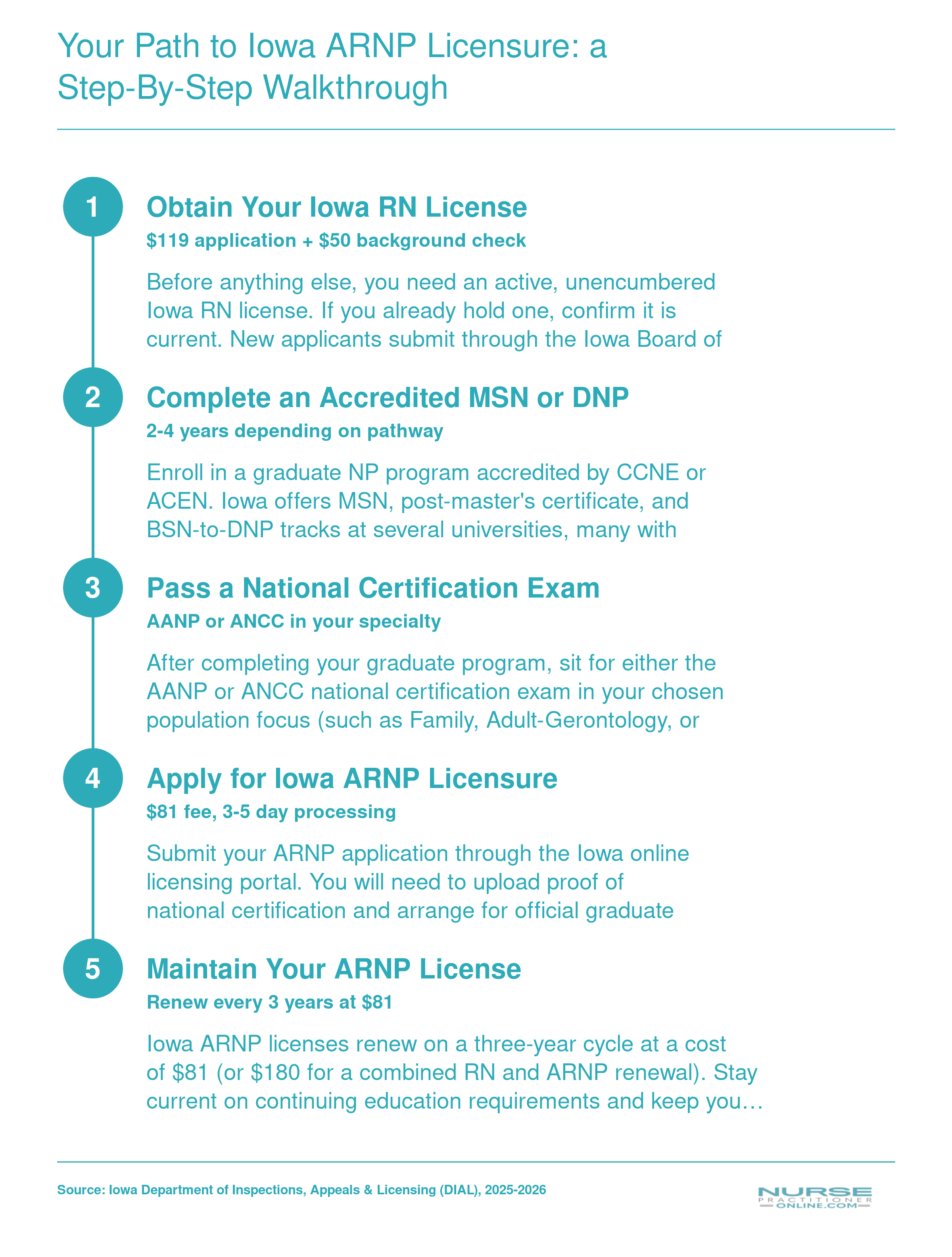
Your Path to Iowa ARNP Licensure: A Step-by-Step Walkthrough
Getting from bedside nurse to licensed Advanced Registered Nurse Practitioner in Iowa follows a clear, sequential path. Each step builds on the last, and knowing the requirements, fees, and timelines in advance helps you plan without surprises. Here is the full sequence from active RN through ARNP practice authority.
What Nurse Practitioners Earn in Iowa: Salary by Metro Area
Iowa nurse practitioners enjoy strong earning potential across the state, with median salaries ranging from roughly $126,580 to $131,820 depending on the metro area. To put these numbers in perspective, consider that the most affordable NP programs in Iowa can cost under $30,000 in total tuition. At a median salary around $129,000, many graduates can recoup their entire program investment within a single year of practice. The table below compares NP salaries with RN salaries in each metro, so you can see exactly how much additional earning power an advanced practice credential delivers.
| Metro Area | NP Employment | NP Median Salary | NP 75th Percentile | RN Median Salary | Salary Gain (NP vs. RN) |
|---|---|---|---|---|---|
| Des Moines / West Des Moines | 590 | $131,820 | $142,480 | $78,970 | $52,850 |
| Iowa City | 290 | $130,140 | $137,090 | $82,920 | $47,220 |
| Sioux City | 150 | $129,340 | $169,060 | $69,180 | $60,160 |
| Cedar Rapids | 190 | $128,660 | $135,870 | $76,560 | $52,100 |
| Waterloo / Cedar Falls | 210 | $127,410 | $139,460 | $69,680 | $57,730 |
| Davenport / Moline / Rock Island | 350 | $126,590 | $133,920 | $76,590 | $50,000 |
| Dubuque | 100 | $130,010 | $141,080 | $70,740 | $59,270 |
| Ames | 60 | $126,580 | $137,900 | $72,920 | $53,660 |
Iowa NP Salary at a Glance
Nurse practitioners in Iowa earn a strong median salary that reflects the state's growing demand for advanced-practice providers.
Iowa NP Job Growth and Employment Outlook
Launching an NP career in a state with full practice authority versus starting in a restricted-practice state can shape your professional trajectory for years. Iowa offers the former, and the employment numbers reflect it.
Demand That Outpaces the National Trend
Nationally, the Bureau of Labor Statistics projects 45 percent job growth for nurse practitioners through 2032, translating to roughly 118,600 new positions. Iowa's projected growth rate is even stronger at nearly 53 percent over the same period, with an estimated 1,270 new NP jobs and about 260 annual openings statewide.2 Those figures make sense when you consider the state's demographics: an aging rural population, persistent primary care shortages in many counties, and a growing reliance on NPs to fill gaps that physician recruitment alone cannot close. Iowa consistently ranks among the states with most need for nurse practitioners.
Full Practice Authority as a Career Advantage
Iowa's regulatory environment is a meaningful differentiator. As a full practice state for nurse practitioners, Iowa allows ARNPs to evaluate patients, diagnose conditions, order and interpret diagnostic tests, and prescribe medications, including controlled substances, without a collaborative agreement with a physician. This autonomy opens doors that remain partially shut in restricted-practice states, particularly in rural and underserved communities where an NP may be the sole primary care provider for miles. For nurses weighing where to invest in graduate education, that regulatory freedom directly translates into broader job options and greater clinical independence from day one.
Where Iowa NPs Work
Employment settings across the state are diverse:
- Federally qualified health centers: These clinics serve medically underserved populations in both rural and urban Iowa, and they actively recruit NPs to meet federal staffing benchmarks.
- Critical access hospitals: With dozens of critical access designations across the state, small rural hospitals depend on NPs for emergency, primary, and inpatient care.
- Large health systems: Organizations like UnityPoint Health, MercyOne, and University of Iowa Health Care employ hundreds of NPs across nurse practitioner specialties, from family practice to acute care.
With a mean annual wage of roughly $133,020 reported for Iowa NPs, compensation is competitive and continues to trend upward alongside demand.2
A Strong Launchpad for Your NP Career
Iowa's combination of aggressive job growth, full practice authority, a wide range of practice settings, and affordable graduate programs creates an unusually favorable environment for nurses ready to advance. Whether you plan to serve a small farming community through a federally qualified health center or join a large urban health system, the state's workforce needs align squarely with the career you are building. Few states offer this balance of opportunity, autonomy, and accessible education all in one package.